Simon Says

Music preserves your youth. When my wife was studying music therapy, one of the pieces of information she received is that those whose brains have begun to shut down the speaking faculties can still sing. People respond best, in such states, to the music of their youth. Anyone who lives long enough will decry the noise that the younger generation calls music. I’m thinking about this not just because of my recent visit to Bethel Woods, but also because of a New York Times story that Paul Simon is planning to leave the musical stage. Simon and Garfunkel was among the music of my youth. Accessible music with profound lyrics and, for the most part, a muted sadness. I grew up a long way from New York City, but listing to this music I felt like I was wandering the streets of the Village, soaking in a reality I would otherwise never experience.

It strikes me as no surprise that among the earliest manufactured artifacts discovered are musical instruments. While I seem to have missed nature’s boon in offering musical gifts, I nevertheless inherited the appreciator’s side. I don’t often listen to background music. I listen to music to listen. It carries its own meaning, akin to what we tend to think of as a religious experience. No doubt, for many, Woodstock felt like such an encounter. Music that could take you away from the troubles of a war-torn, prejudicial, jaded society. Even if only for a few moments. “I am a Rock,” was, for much of my youth, a kind of personal anthem.

IMG_2836

During a commencement address in not too distant months past, Simon told the graduates that ours was becoming a society at war with art. Music is money. College isn’t about becoming who you are; it’s career training. We don’t allow our young any time to explore any more. Few are willing to admit that capitalism, unrestrained, is just as bad as communism. Music used to be about the soul. The artists I know tell me it’s now about the cash. The man calls the shots. So as I stood on the hill overlooking the former Max Yasgur’s farm a few days ago, the lack of sound was poignant. There used to be, it seemed, different ways of existing in the world. Today the tempo is set and the music composed by those who prefer marching tunes that lead straight to the bank. Standing on that windswept hill I’m sure I can hear the sound of silence.

Insane Deities

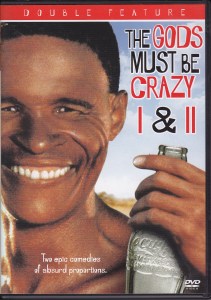
GodsMustBeCrazyIt was 1987. I was in Israel for a good part of the summer excavating at Tel Dor. Between degrees and trying what to do with my life, like many people, I sought out a holy place. One evening while I was there, the locals (I can’t recall if it was the dig coordinators or the local community) sponsored a public showing of The Gods Must Be Crazy. The movie was fairly recent then, and it was the first and only time I’ve seen a movie captioned in Hebrew. I had a seminary friend who often showed me movies at his place, but this was one I had somehow missed, even though it came out when I was in high school. I’ve seen the movie several times since then, but not in the past seven years or so (this blog is a pretty good record of my movie viewing as well as book reading). This weekend we dusted it off and popped it into the DVD player and I noticed a few things for the first time.

Spoiler alert: not for the movie, but for reality. The portrayal of the bushmen in the movie is pure verisimilitude. While living much more in harmony with nature than modern, industrial late capitalists, they are not a completely peaceful people with no violence. We can overlook the “noble savage” viewpoint for the sake of entertainment, but anyone who researches human cultures closely finds that the perfect society doesn’t actually exist. Still, what I noticed in the movie diegesis was the bushmen had no need of theodicy. Theirs was a world where the gods gave them only good. The Coke bottle becomes their “tree of knowledge,” to put a Judeo-Christian spin on it, and they even use it for curing snake skins. The movie doesn’t work, of course, without this fictional view, but in reality all believing people require a theodicy.

Our particular disc of this movie has a less-than-dynamic special feature of someone who never identifies himself following up on the movie. This rambling, twenty-minute featurette shows “current” (for it must be a decade old by now itself) developments among the bushmen. Two hundred miles from the nearest electrical grid, schools are being equipped with solar panels so that the children can learn about computers. A laptop in the middle of the Kalahari. As I reflected on the loss of innocence theme, this struck me as surely as an angry serpent. The world in which we live allows for only one way of existing. It is a world of money where even the self-sufficient must be wired into the matrix. If ever there was a need for theodicy, this was surely it.


Philosophies of Reading

I like my Starter. For those of you unaccustomed to New Jersey Transit buses and their ways, a Starter is a person who makes sure the buses scheduled to arrive at her or his gate do so on time. It’s not a job for the faint-hearted. If a bus is late, or AWOL, the Starter takes the heat from angry would-be passengers. Since they’re present “on the ground,” angry people lash out with their frustration. My regular Starter recognizes me. I’m usually early in my line, so I appear about the same place most days. My routine is, well, routine. I get to the Port Authority Bus Terminal, pull out my book, and read. Starters can’t really get involved in anything like a book because their job requires constant interruptions. Even when no buses are coming in because of an accident in the Lincoln Tunnel, they still have to answer questions and hold up the occasional crucifix. My Starter came to me the other day, as I was reading, and asked me what I thought of an incident four days earlier. To put this in context, the incident happened on Friday. I was there for it, in my usual spot, and this was Tuesday. Clearly it still bothered the Starter that someone had come out and yelled at him for not getting us a bus on time.

I sympathized. Starters can’t materialize objects. If they could, they wouldn’t be Starters. Yet, I realized as I turned back to my book, that I had lost some reading time. I don’t mind helping out my Starter, but it occurred to me that there are a couple of different philosophies behind reading while waiting for, and on, the bus. Many people, I suspect, read to pass the time. I don’t know what they’re reading, since much of it is on a flat device, but knowing that research reading is nearly impossible on the bus, I suspect they are just reading to make the weary time go quicker. Others, I know, read for content. For me, reading is very seldom passing time. I read because reading is what I want to do.

Commuting behavior isn’t conducive to my life choices. No longer do people sit quietly on the bus, respecting that inherent violence of awaking before 4 a.m. to try to get to the city before traffic inevitably makes you late. Devices make their unmuted bodily noises and glare in your face. The guy next to you pulls out his wide-screen laptop, while tapping away on his phone. Or pulls our her iPad to watch a movie with fast-paced images splashing in your face. The book is demanding company. Your time, your attention, your concentration are required to get the most out of it. I don’t mind supporting my Starter. I feel for the ennui of my fellow commuters. I also crave time alone with my books.

IMG_0899


All Things Newton

Andover Newton Theological School is the oldest stand-alone graduate school of theology in the United States. Was, I should say. Declining enrollment—supply and demand dictates fewer clergy are required—and the rising costs of a job description that has no obvious retirement age have led many seminaries to merge or close. It seems that Andover Newton is about to merge with Yale Divinity School, much like Berkeley Divinity School, bringing together a mix of Congregationalists, Episcopalians, and Nones to huddle together across the quad until people want to believe again. Those of us who grew up being taught that belief was normal, and widely accepted, have experienced a sense of bad investment lately. We poured resources into keeping our product current only to find the use by date predated the use of use by dates.

Think of it as evolution. From the earliest days of civilization, priests were integral to, well, civil society. Evidence more and more points to religious belief being the actual glue that held larger communities together in permanent settlements. In other words, that’s how we’ve lived for five thousand years. How were we to know that the rules were about to change? You could always count on a need for clergy. The world’s first service industry. Ah, but it’s the latter word of that noun phrase that’s the problem. When religion becomes a commodity it’s subject to supply and demand. Supply has exceeded demand for some years now and the factories are shutting down. Anyone want a used Bible, cheap?

The Episcopal Church, with its outsize influence for such a small body, used to have eleven seminaries in this country. The United Methodist Church, larger by nearly an order of magnitude, had thirteen. Once and future clergy such as yours truly were produced in classes of dozens. We didn’t diversify our portfolios enough. So now, Andover Newton—the very school where I learned Hebrew—is downsizing faculty by a rather drastic percentage. I’m not so worried about deans and administrators since they easily buy into the business model of education. I do wonder about the effect on society of having so many unemployed theologians around. One thing we don’t have to worry about is organized groups of them roving the streets; theologians are fiercely individualistic. As they transition into the corporate world—the only world that now exists—they’ll find themselves wondering how to live among the soulless multitudes. There’s only one orthodoxy here—lucre be thy name. And, oh, you might consider asking about entry-level positions.

IMG_1550


The Lure of the Dark Side

I have to confess that the easy self-publishing of ebooks is a real temptation sometimes. Perhaps it’s one of those inexplicable side-effects of earning a Ph.D., but sometimes you have the impression you have something to say and traditional publishers just don’t agree. In my work life I see many clever ideas that, well, let’s be frank, just won’t sell. Publishers do have to keep an eye on whether a book can earn back the money put into it, and sometimes a good idea leads to no cash payout. So when you can easily sign up online—you don’t even have to talk to anyone—and post your unedited words right on Amazon and call it a book, well, anyone can be an author. So I was looking up books with the terms “Bible” and “America” on Amazon when I came up with Donald Trump in the Bible Code. I found the self-designed cover frightening, and the sentiments expressed in the description grounds for terror. Then I noticed it was only 15 pages long. I’ve written student evaluations that were longer than that.

Trump

At three bucks, that’s—wait while I get my calculator—twenty cents a page. Now anyone who’s been able to read the original Bible Code and not cover a snicker or two will possibly find such a jeremiad palatable. After all, it’s a book! Somebody published it. Well, actually, all you need for self-publishing is an internet connection and at least one finger to type and click. Or a toe. You too can become an expert! No education required. Publishing fiction in such a format is one thing, but when people can’t tell a prestige publisher from a vanity press when it comes to factual material, we’re all in trouble.

There’s an old saying: “those who can’t do, teach.” I think I first came across this wisdom in a Peanuts cartoon, with all the gravitas that such implies. Editors, it seems, are not required for publishing. In fact, some of us who live by the word seem destined to die by the word. Even with connections I have trouble getting my ideas published. More than once I’ve lingered on Amazon’s CreateSpace page with my finger hovering over the mouse. Publication is one click away and some people make six digits a year publishing only on Amazon. Since I produce about 145,000 words a year on this blog alone (apart from my other writing), the urge is very strong at times. Then I look at that cover and I stay my finger as it hovers. I’ll wait a little longer. At least until November.


New World Witches

MarWitchOne of the most coveted phenomena in the publishing world is the bad review. Controversy sells a book like nothing else. It wasn’t because of the controversy, however, that I read Alex Mar’s Witches of America. Looking back, I wasn’t even sure of what to expect. Witches can mean many things and there is little one can do, beyond reading the blurbs and summaries (and who has time for that?) to know beforehand what a book’s really about. I like books about witches, so I just read it. I soon found myself engrossed in a spiritual memoir. Perhaps even more than books on witches, I’m drawn to women’s experience of religion. Many such accounts have haunted me over the years, but Mar’s story was different than most I’ve read. Women often write of escaping intolerant, priapic religions of a conservative stripe. Mar may be the first account I’ve read of a spiritual seeking becoming part of modern paganism.

The negative reviews largely focus on what they perceive as a false bill of goods. A woman passing herself off as an authentic seeker just to write a book that violates confidences. As a writer, and as someone who knows authors, I was a little taken aback at this. Those who know writers know they’re disruptive personalities. They look at things differently than most other people do. More than that, their experiences are subjective and must be explained in that vein. Some reviewers claim Mar was just wanting to write a book. Writers know that books write the authors. Spiritual experience is notoriously difficult to capture in words. I’ve read plenty of books about modern witchcraft, including the balanced, academic titles everyone commends. Mar was able, however, to explain the lure far better by taking a personal approach.

There are inherent dangers to sharing your innermost experiences. Other people are involved and honest perceptions will sometimes hurt. A writer finds it difficult to hold back. Spiritual experiences are something complex, multilayered, and scandalous. Often I was told, as an undergraduate at a conservative Christian college, that mystical experiences were to be avoided. They are powerful, frightening, and addictive. I can’t say if Mar violated any confidences, but it seems to me that the portraits she paints of witches are complimentary, and generally feel heartfelt. Then again, Christianity has been analyzed seven ways to Sunday, so it may feel like violation if a religion is still largely secretive. Were it not for the negative reviews, I would’ve never guessed that I’d read anything more shocking than the spiritual memoir that offers other ways of looking at what we think we already know. Oh, and did I mention the book was about witches?


Virgil’s Vigil

IMG_2798I can never keep Virgil and Beatrice straight. I blame Dante. Allegories can be so tiring. So, sitting under a tree in Princeton, enjoying a root beer float prepared at The Bent Spoon, I ponder the empty bottle before me. Virgil’s root beer. So good, it states, that I’ll swear it was made in Heaven. It is good, I must say, but didn’t Virgil lead Dante through the other place? You see, I’ve just spent a pleasant morning at Grounds for Sculpture, the outdoor museum set up by Seward Johnson, a sculptor that some accuse of kitsch. Others come by the busload to see what it’s all about. Johnson’s cast sculptures of people are so lifelike that it isn’t unusual to find yourself staring at an actual person sitting on a bench, wondering if they’re real or not. I spend a lot of time pondering reality, and this place makes that question explicit.

Descartes said “I think therefore I am,” but what if I am really the thought of another? How would I ever know? As I wonder around among the sculptures, a different face of reality shows itself. Many of Johnson’s pieces are sculptures based on paintings. To get behind the surface you have to imagine what the unshown side must’ve looked like. That which the original artist left out. Any art is a matter of perspective. Unseen realities—isn’t there something Dantesque about all this? Is Virgil the guide through Heaven, or is that Beatrice?

These statues, in quotidian poses, are so real. If they’re cast from actual persons, maybe they are. After all, this camera I carry is capable of capturing souls. And if you don’t make it through the first time around, there’s always Purgatory as a safety net. This bottle in my hand causes me confusion. Is my tipple divine or diabolical? How much difference is there between them, really? Princeton is a place that needs no one, after all, except those who have already made a success out of life. A place with expensive root beer on offer. A vice for which I’m willing to pay. Maybe life is a divine comedy after all.


Grasping for Meaning

DSCN6301

How often we’re told—and writers on biblical topics are especially guilty of this—the meaning of a story. Despite what materialists say, we are meaning-seeking creatures. We want to know why. When we read a story we want to know what it means. I occasionally dabble in the pool of fiction. Many times I read the emerging story and wonder what it means. Sometimes the meaning changes over time. Sometimes it means many things at once. Recently I read someone explicating the meaning of the story of Noah. The meaning? No, a meaning. That little article makes all the difference. Definite or indefinite, we need constantly to remind ourselves that stories bear meanings. Plural. They mean nothing otherwise.

Those of us who spend a lot of time with sacred texts see that it suggests something specific to us. Those who manage to gain followers start their own religions. The problem comes when one meaning is fixed to a text. I often saw this growing up as a Fundamentalist. I also saw it frequently at Nashotah House. This verse means this. Nothing other. Any interpretation outside this particular one is heresy. Heresy is, of course, punishable by death. Lest you think this is just the idle musing of an underemployed biblical scholar I must remind you that wars have been fought over such things. People have died. All for someone’s mistaking an indefinite article for a definite. There are those who say certain canons of the Mass must not exclude the definite article or otherwise all you’re getting is a very cheap and meager lunch out of the deal. For this you put on your best clothes?

We read stories for entertainment, but if they mean nothing they are quickly forgotten. Dreamtime stories, as David Abram reminds us, may lack plot but they have place. They take us to a place where we aren’t physically present. Or if we are physically present, we need to be taken there in mind as well as body. They give life meaning. Ironically, as a culture, fewer and fewer people find meaning in their work. Living for the weekend, they find their sense of fulfillment by what they do when not on the clock. And some of that time has traditionally been demanded by those who offer worship experiences. After all, weekends were their idea in the first place. There may be some meaning in that. If there is it is only one meaning among many. And even while attending, it is best to keep an eye or ear open for something other than the meaning which the ordained may insist is the only true one.


Literate Madmen

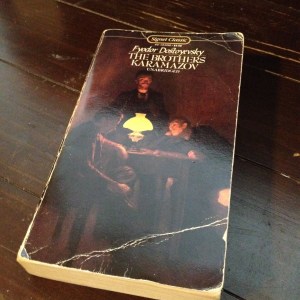
My experience of paternal parents growing up never led me to think Father’s Day was a holiday particularly worth celebrating. (Don’t panic—today’s not Father’s Day!) I do have an ironical sense of humor about the commemoration, though. So the other day when I clicked through one of Amazon’s many daily ads to my email account, I noticed it was for Father’s Day gifts. The first item listed was Fyodor Dostoyevsky’s The Brothers Karamazov. Probably based on my browsing history, I thought. But no, I’ve been looking at non-fiction lately and I bought my well-worn copy of Dostoyevsky before Amazon was a gigabyte in Jeff Bezos’ eye, back when I was in seminary. Then it dawned on me: this is perhaps the most famous patricide novel ever written. Had the Amazon advertisers really thought about what they were recommending? “Here, Dad. It’s a book about sons killing their father.” If marketing is driving America, it may be time to pull over at a rest stop for a coffee break. Or at least read the book first.

IMG_2796

I don’t pay attention to when Father’s Day is. It comes somewhere in that complex of spring holidays that include Passover, Easter, Mother’s Day, and Memorial Day. When my father was alive I sent him a card. It was a card to a stranger, but as Episcopalians know, it’s the done thing. I loved him, but I didn’t know him. Not that I’ve been a parent that deserves a holiday dedicated to my skill either. I confess my fair share of parental failures. They play and replay in my head, in the way the Protestant brain can never quite clear itself of guilt. We, as people, I believe, generally try our best to be good parents. It can be difficult, though. Nothing really prepares you for it.

One of my brothers once told me that, after having a girlfriend with kids from a previous marriage, he better understood how our stepfather viewed us as inherited children. Although I always want to claim the victim role in that scenario (I was only ten, what could I do?, etc.) his insight has stayed with me. It can’t be easy to inherit someone else’s progeny. It’s tricky raising your own child—that new person you want never to experience your own disappointments in life. Even cynics can be sentimental. But then again, I’ve been plowing through The Brothers Karamazov again since January, frequently laying it aside for weeks at a time. It’s not the kind of book I’d give a father on the edge. It’s okay, I think I’m good to drive again. I just won’t pay any attention to the ads I see beside the road.


Religious Melancholy

DamnedNationI’d never come across the term “religious melancholics” before, but somehow it seemed to suit me. Perhaps that goes without saying as I’m reading Damned Nation, by Kathryn Gin Lum. While sitting on a bus. We’re sitting in traffic and the guy sitting next to me has obviously just finished a cigarette before climbing aboard. Having grown up as the victim of second-hand smoke for my first two decades in life, I’m thinking about Hell as well as reading about it. You see, Gin Lum’s descriptive subtitle is Hell in America from the Revolution to Reconstruction. The fact that Hell’s alive and well, despite some evangelicals’ attempts at annihilating it, suggests that it’s best to keep informed on the topic. This book’s mostly historical, however, reporting how Americans interpreted Hell in the eighteenth and nineteenth centuries.

As with most histories, I find the earliest material the most interesting. Gin Lum tends to focus, naturally, on preachers at this period since they are the ones most likely to talk about eternity. The thing that struck me the most was the number of people she describes who, after contemplating (a primarily Calvinist vision of) Hell, attempted suicide. I tend to think of suicide as a contemporary problem, but obviously it has been a steady human practice since our species first learned that you don’t have to wait for someone else to help you slough off this mortal coil. It is troubling, however, that it was a “doctrine” barely found in the Bible that led people—most of whom later became preachers—to try to kill themselves. It also seemed a touch odd that evangelicals in those earlier days of our nation didn’t find it troubling that those leading the flock had almost sent themselves to perdition. These early days of literal Hell believing were most interesting indeed.

The phrase “religious melancholics” comes from the resistance. There were those—generally skeptics, doctors, psychologists, and the like—who felt that the preaching of hellfire and brimstone took a toll on the healthy psyche, particularly of the young. As one of those who grew up attending revivals where Hell was a featured guest, I know that my life has been a prolonged attempt to avoid said eternal lake of fire. Even when I rationally learned that there is no three-tiered universe in which it still fit, and that the idea was cobbled together from a variety of religions into the ultimate scary place, Hell still manages to haunt me. Does it keep me moral? I don’t suppose that to be the case, since I have tended to believe people are basically good. Don’t bother trying to convince me logically that Hell doesn’t physically exist. I know that already. It’s the mental one that I’m trying to avoid. And that can be a full-time job for a religious melancholic brought up on a diet of overcooked theology.


Busyness as Usual

“Time,” Morpheus said, “is always against us.” Such is life in the Matrix. Wake before daylight. Climb on a bus. Stare at a screen for a solid eight hours. Climb on a bus. Sleep before dark. Repeat. It’s a schedule only a machine could appreciate. Since I was a seminary student, I’ve considered time an ethical issue. Take waiting in line, for example. This is difficult to convert to a good use of resources. In circumstances where the queue is anticipated, such as waiting for a bus, one might bring along a book. The unexpected line, however, is wasted time. Paying Agent Smith his due. This all comes to mind because of a recent news blurb about Søren Kierkegaard. The story in Quartz, cites the Kierkegaard quote: “Of all ridiculous things the most ridiculous seems to me to be busy—to be a man who is brisk about his food and his work… What, I wonder, do these busy folks get done?”

Kierkegaard

I’m a lapsed Kierkegaard reader. The sad fact is that philosophy takes time. You can’t sit down and whiz through it. You need to stop frequently and ponder. This was the life of the academic that I once knew. Before the Hindenburg. Before capitalism became my raison d’être. You see, you can never give too much time to work. There’s always email. The internet has wired us to that which once wired money. “We are the Borg.” There’s no time for a Danish and a concluding unscientific postscript any more. We willingly comply because the rent is due. What, o Søren am I getting done?

We rush around, it seems to me, because when labor-saving devices were invented they only led to more labor. Our European colleagues look with wonder at our febrile, frenetic pace. They wonder where it has gotten us. Has the final trump indeed sounded? Has the stock market become divine? Has money become the only Ding an sich? Kierkegaard wears a thick layer of dust on my shelf. Once I spent an entire day trying to digest a single paragraph of his writing. Now I brush him off like crumbs from my danish and I don’t have time to finish my coffee since the till is calling. I will get back to you, Søren, truly I will. It’s just that I have this never-ending task to accomplish first. After that we’ll sit down and have a leisurely talk.


Big Boxification

When was the last time I purchased an actual book at Barnes and Noble? In a vain hope that they might have something intellectual and edgy, I stop in once in a while. If I were a faster learner I might have known that I’d leave disappointed. You see, it’s been rainy a lot around here and rainy Saturdays are perfect for book stores. But where are the good books? I’m not just picking on B&N. I stopped in Bed, Bath, and Beyond (they don’t really use the Oxford comma, but then, who had time for commas?). This is not a frequent occurrence since we rent and it’s hard to gentrify bohemian decor, but we needed a practical household item. After wandering enough aisles that I thought it was time to hire a jungle guide, I found that the choices were actually rather limited. If I don’t like what they tell me to like, well, I’m out of luck. The local stores were driven out of business, you see, and you have to like what we have to offer because we are the BIG GUYS.

It’s not just housewares. It’s everywares. We’re a big box society. Costco and Sam’s Club and SUVs to haul it all home. Once, back when paper was still a thing, I had to find some file folders. I tend to like color coding—my non-Harvard-educated mind just rolls that way. So I went to the local stationary store and found a virtual reading rainbow of options. A year or so later, strangely, more papers had accumulated. I went back and the store was out of business. A Staples had opened nearby. Everyone was going there. They offered a superfluous loyalty card—where else would you go? They had four colors of folders. Just four. In industrial cardboard boxes that mean business. I mean BUSINESS. You want choices? There’s a clinic down the road. Unless you’re female, of course.

Photo credit: Ben Schumin, Wikimedia Commons

Photo credit: Ben Schumin, Wikimedia Commons

I’m not a genius, but I can recognize repeating patterns. Big box settles outside your town then limits your choices. I consume, therefore I am. To buy, or not to buy? I am not a number, I am a—what? What am I if I’m not a consumer? A communist, I guess. And everyone knows the Bible says communism is evil. And if you need a Bible you can purchase one from Sam’s Club. To be part of the resistance, you need to buy from Amazon. What a radical I’ve become! At least at Amazon they still have books.


Beg to Differ

Screen Shot 2016-05-09 at 4.15.19 AM

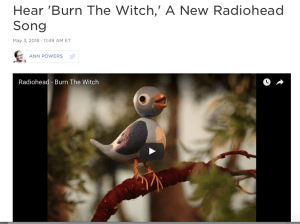
“What do you burn apart from witches?” “More witches!” Earning a doctorate is kind of like learning how to get lost. It certainly doesn’t make you either cool or employable, but it allows you a few years to accumulate enough debt to keep you out of trouble for awhile. One of the things I learned along the way is that you should always follow the crowd. I look at the schools that only hire Harvard grads and there can be no doubt. I look at all the Trump supporters and I know there can be no question. Yes, the ayes have it. So, I never learned to tell which bands were truly worth listening to until I learned to follow the critics. I never studied music. Like most people, I know what I like but I can’t say why. I only discovered Radiohead in the last few months. Some of my critics claim my complaint of lack of time is only an excuse, but I don’t listen to music unless I can really listen to music. It can’t be pure filler. Put on Beethoven’s seventh and you’ll see what I mean.

In any case, my wife alerted me to the new Radiohead song “Burn the Witch.” And you can’t listen to a new song without watching it as well. This time it’s worth it. The claymation video accompanying the song (conveniently found here on NPR) is a reprisal of “The Wicker Man,” one of the truly intellectual movies in the horror genre. Of course, that’s something I picked up from the crowd. We’re told by the most powerful and charismatic bigots of our age that life is all about acquiring stuff. Were I to argue with that, well, I guess I’d be the witch to be burnt. Before listening to/watching the Radiohead song, do yourself a favor and watch “The Wicker Man” (the original, please, accept no substitutes). Go on, everybody’s doing it.

The most dangerous thing in the world is an independent thinker. No, I didn’t learn that at Harvard. On my first walking tour through Edinburgh with one of my doctoral advisors he pointed out the part of town where they used to kill witches. He was truly an original thinker (still is) and taught me to be one too. Problem is, I should’ve been following the crowd all along. You want people to pay attention to you? Go to Harvard! Want people to vote for you? Clearly show you’ve got what it takes (money). Give a man a little cash and anything will do for brains, to paraphrase one of the smartest movies of all time. The only way forward is to do what everyone else is doing. And pick up some kindling along the way—you’re going to need it.


Do the Twist

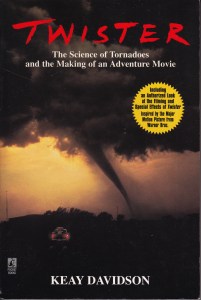
TwisterA used book sale is like a box of chocolates, if I may abscond with a simile that fits many scenarios. After all, you are there to buy books that others have discarded. Some of them show their age rather blatantly. Keay Davidson’s Twister: The Science of Tornadoes and the Making of an Adventure Movie is one such title. Those who know me well know of my fascination with weather—I wrote a little book on the subject based on that obsession. Although the weather informed and formed me long before I was ever near a tornado, these particular terrors were so exquisite that I couldn’t help but look. Although I grew up in Pennsylvania—not exactly tornado alley—one night when I was away from home a tornado swept by less than ten miles from where my family was. It toppled trees down one side of a hill and up another. It was eerie and uncanny and in many ways shook me out of the feeling that I never had to worry about them. Then when I went to Ann Arbor for a weekend with my fiancee the sky turned bronze. Rain was whipping past horizontally. Later we learned that a tornado had passed maybe four miles from where we were. Living in Illinois and Wisconsin, we experienced many tornado warnings. I never saw a tornado, but somehow thought I should.

It goes without saying that if I see a book on tornadoes that is reputable and cheap, I can’t pass it up. Davidson is a journalist whose work appears (as of the two decades ago when the book came out) in National Geographic. Some of you may not have been living in tornado alley twenty years ago, and therefore may not have felt the excitement that Twister, the movie, promised. By the time it came out I had already been thinking about Weathering the Psalms, at some level. I was a bit disappointed in the film itself, but it does mention that an F5 tornado is “the finger of God.” Davidson’s book picks up on this as well. At several points witnesses, and even scientists, lapse into divine language to describe tornadoes. One person even says that a tornado is an image of God, or that the storm is God. That’s a very natural way for people to think. The power of a Midwest storm has to be experienced to be believed.

The divine represents the highest echelon of language. The tornado fits because it is the most powerful wind on the planet. Concentrated, raging, and fickle. One can’t help but think: I was raised Protestant, what if the Catholics are right? Substitute any religion in either half of the equation. The weather simply does not do what we want it to do. It reminds us that humans can’t comprehend our own atmosphere that we so blithely pollute. The book may look dated—who remembers Twister anymore?—but it is a forceful reminder. When you need a metaphor for the most intense experience the weather will always be waiting.


Used Knowledge

One of the unadulterated pleasures of life—or maybe adulterated is the better adjective—is the used book sale. The year I missed the Hunterdon County Friends of the Library sale felt like a year without a summer. There are other book sales around, but this one’s my favorite. Books are my heroin. You see, I became an academic because it was too difficult to make a living as a writer. Besides, I never formally studied writing and what are you without credentials? Just a poser making some claim of talent. Like most academics I learned to write in staid, measured prose, never exaggerating or showing any emotion. Research for that kind of writing requires a university library since who can afford those kinds of books and you need a JSTOR account to keep on top of all the journals. You read and read on the same topic for months at a time until you have something new to say. Thus knowledge, they tell us, progresses by baby-steps, into a safe and conservative future.

Nietzsche, meet Evangelicals

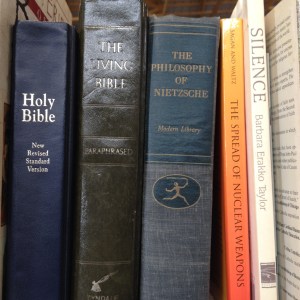
Nietzsche, meet Evangelicals

The reading that I do is of a different species. I’ve had academics ask me “why don’t you do research on the bus?” Have you ever tried to do research on a bus? Some stranger sleeping next to you with his/her body relaxing and melting into your side of the seat, their arm falling off their rotund belly onto you before being retracted to start the cycle all over again? And staid, measured prose before the sun comes up hardly makes the trip any faster. Of course editing pays much, much less than the professorate. So I buy cheap books. Nothing like a buck a book to bring out the reasonable side of any economically minded obscure private intellectual. You never know what you’ll find at a book sale. Some of my best reading experiences on public transit have been at the behest of orphaned books others turned out into the streets. Books I would never have read otherwise. Books that I feel would understand me.

The once and future academic in my brain tries to reconcile this with what I paid thousands and thousands of dollars to learn how to do (research). Isn’t this in some way pushing knowledge forward? After all, maybe a dozen people will read this post and that’s kind of like publishing, isn’t it? Don’t mind me, I’m just book drunk. It’s the used books talking. While my academic friends prepare themselves for a summer off, some going to vacation houses they justly deserve, I’ll be filling my commute with adulterated books. And hopefully by the time I reach the bottom of this stack another sale will come along so that I don’t have to go through withdrawal. Methadone for books hasn’t been invented yet, and besides, I take no substitutes.