Life’s Soundtrack

Calvin once said to Hobbes, “I thought my life would seem more interesting with a musical score and a laugh track.” In many ways, our lives do have soundtracks. From my youngest days dramatic music has moved me and Jim Steinman always seemed to know just which buttons to push and strings to pull to bring it off. Growing up in humble circumstances, however, I missed the whole video craze that accompanied MTV, back when MTV still showed music. Friends would tell me about the great videos I was missing, and I let my imagination run wild. Recently, however, a friend pointed out the video of Bonnie Tyler singing the Steinman hit, “Total Eclipse of the Heart” on YouTube. This particular video brings together so much of my adult life that it seems like Steinman spent a few years inside my head. Well, maybe not that much. The song came out just as my first love was breaking up with me, back in college. I attended Grove City College, a campus that, despite its pristine Christian image, can be very gothic at night. The first chords of that song are always like a stake through my heart. Few experiences in life are as dramatic as unrequited love. Just queue up that song and I’m a college junior again.
The video, however, is set in an old-style boy’s boarding school. The setting is not far off from the antiquated campus of Nashotah House seminary, gothic both by day and by night. The imagery of the video employs English trappings of cassocks and surplices and candles along with clandestine romps in the night. Seminaries, in my experience, leave many secrets in their shadows. My heartbreak as an undergraduate cannot compare with some of the drama I witnessed both as a student and a professor in seminary. The pious are often among the most passionate of people, but they must learn to be actors before their congregations. Such inherent conflict is fertile ground for intense drama. The video plays this out with the headmistress (Tyler) fantasizing about her young male charges in a highly ritualized, yet anarchic setting. Too close to the truth.

The sacred and the profane lie close together and may be teased apart only with difficulty. The experience of buying an LP when I was a teenager was an investment for not just the sound, but also the album art, the aroma of the vinyl and ink when the plastic wrap first came off, the feel of the heavy paper sleeve housing the disc. It could transport me to another place. Today the iPod reduces the sounds down to background noise, not a soundtrack. The drama we create for our lives is efficient and convenient, but in the end, plastic. Perhaps it is Calvin’s laugh track. No matter. Even if it is on YouTube, with its electronic sound, that video will take me back decades in time, and will be one of the repeated songs on the soundtrack of my life.

Had my Phill

One of the pleasures of the editorial occupation is traveling to campuses to meet potential authors. Having no excuse not to go to Philadelphia, I jumped on a train this morning to spend the day on the campuses of the University of Pennsylvania and Temple University. I’d been to both campuses before, but they are a study in contrasts. Penn is Ivy League, of course, and the students appear confident and self-assured. Temple is a large, public university situated in a neighborhood that doesn’t exactly inspire the same confidence. The students appear happy enough, but of a rather different ethnic blend. I pondered these differences while waiting for a taxi. I hadn’t realized that PHL Taxi stands for “Prefer Hanging Loose”—after three calls and no vehicle, I had to call another company. To try to save Routledge a few pennies, I had opted for the Days Inn in north Philadelphia. A friend told me over lunch that this part of the city is probably not the safest.

In the taxi we drove through neighborhoods that politicians like to pretend do not exist. The sheer degradation of the buildings, sidewalks, and people was sad. The most common type of building, next to houses (many semi-demolished), is churches. Many of the churches bear their names in Spanish; most have heavy metal chain doors emblazoned with crosses. It seems that maybe Van Helsing would go to church in a place like this. The kind of place where a dead body does not astonish, and the people on the street corners look remarkably cheerful, given the circumstances. The Days Inn is in a more open and commercial area, and I don’t think anyone has actually been murdered in this particular room. On Temple’s campus I saw many signs for Occupy Philly.

Those who think everything is just fine with the ultra-wealthy in their heaven while we expect human beings to live like this are worse than naïve. Those who are privileged look on Occupy Philly with a sense of academic curiosity. Those who live next to poverty, hard up against it, see Occupy Philly as a mandate. We can’t keep pretending that everything is okay. If God has a plan for America, why have so many people been left out? People with more churches per block than any affluent neighborhood desires or supports? The movement may be ill-focused and leaderless, but the need is very real. Tomorrow I go back to Temple, back to where the struggle is often life and death and the need is very human. But for this evening, “Now I lay me down to sleep…” I’m sure you know how the rest of it goes.


Pay No Attention

I’m not sure whether to feel insulted or flattered: apparently WordPress has deemed this blog worthy of enough hits to place an advertisement on it. The ad feels like a wart. Probably because religion is deemed an “embarrassing” topic, WordPress has not given much promotion to my persistent efforts; I’ve only reached the coveted features page only once. Yet I may be targeted for an ad. Those who actually read my posts will know that I find commercialization banal and trivializing. Doesn’t mean it doesn’t happen. Sometimes it can even be good. I guess in this context, I’d like to find out why my little blog was singled out for such attention.

Maybe I’m over-thinking this. (Do I hear a gasp of astonishment from my readers?) I believe a blog should be a place of ideas and discussion. Of course, I believe the same thing about religions: they should be open to discussion about what they’re trying to do. They should also give truthful responses to those who inquire. Otherwise it is just false advertising. Perhaps I’m only annoyed since yesterday’s post (where the ad first appeared) was heart-felt and serious, while the ads I saw were light-hearted and funny. It is the price you pay for not owning your own server, I guess. I’ve trespassed into the realm of giving my words to a commercial vendor (not for any profit, I should add), and can I begrudge them their attempt to make a buck by my efforts? Only a writer knows how much of her or himself they put into their words.

I’ve just come into the great throne-room and I wish to say to my readers, “Pay no attention to the ads behind the posts.” I do not put them there. I gain nothing from it but a space where I might express my thoughts without having to pay fees for my own domain name. “Get a publisher,” the cynical might say. What publisher would pay for the observations of a highly trained specialist who commands no attention in the academic world? I guess I should be grateful that WordPress even allows me to scribble on their pages. What do I hope to get out of it? Open minds and free thought, and perhaps a small dose of sanity when approaching religion. I’m not selling anything, so please ignore the ads. Now, after this break for “station identification” I guess I can get back to my idealized world where no money is required for ideas changing heads.


Lamp of the Gods

Long venerated as a god, the moon has fallen to such a declination that it scarcely attracts the notice of most people anymore. While some governments are busy making plans to reach the moon—notably those with the largest populations—the rest of the developed world looks to the nighttime sky and lets out a yawn. The poignant little book called Moon: A Brief History, by Bernd Brunner, offers a moving tribute that is part science, part history, and part whimsy. Very few heavenly bodies have undergone the dramatic plummet in interest as our familiar old moon. It remains the proximate cause for werewolves and the occasional harvest-season horror movie, but since the Cold War has ended and we no longer need to prove ourselves to anybody, attention has shifted toward more distant and abstract targets. Maybe Mars, or one of Jupiter’s moons holds the fascination we so long for. The moon, apart from a brief flare of interest when water was discovered there, has died a slow death in the human imagination.

In ancient times, the moon was often considered superior to the sun. Sure, it’s not as warm—downright cold at times—but its light is more gentle, more forgiving. The traveler’s companion, the moon illuminated the way before headlights were invented. The god of the moon (its gender was slippery in parts of the ancient Near East) sometimes topped the pantheon. Even today in Islam, the memory of the high god’s crescent moon can be found atop mosques throughout the world.

What happened to the moon? Famously Carl Sagan, himself an astronomer, wrote about The Demon-Haunted World. In this book he decried the human tendency to look for supernatural causation; the universe is entirely natural. Many have used his reasoning as a nail in the coffin of God. Clearly he was right in many cases, but, as Brunner shows, science can rob even a deity of its shine. Writes Brunner: “Its significance and roles have always varied across cultures and eras—from heavenly god to symbolic guardian or judge, to the scene or stage of spectacular visions and visits, to being ‘just’ and object of scientific investigation.” Once we’ve been to bed with the moon and look at it scientifically, its luster is lost. “Maybe we should try sometimes to un-think our scientific knowledge of the moon,” Brunner opines.

I was one of those thousands planted before the television on 21 June 1969 to watch the first men on the moon. Amid the turmoil of earth, it was a sublime, even a religious moment. In the end a dozen men walked on the moon before it was forgotten. Like the dozen disciples, they alone have been near the truly sublime. With Brunner I too would suggest that we not be too quick to forget our constant companion.


The Body Apocalyptic

We are all products of our upbringing. Our early assumptions, although sometimes challenged and overcome, are generally with us for life. So it was that my progression of education led me to a small, conservative college to major in religion. Compared to what I learned at Grove City, the historical criticism firmly in place at Boston University sounded downright sinful. Nevertheless, it made sense, so I followed reason. At Edinburgh we were way beyond historical criticism in that wonderful, European way. Somehow in the midst of all the excitement, I missed Post-Modernism. “Po-Mo” has, like most recent movements, been quickly added to the pile of the passé, but I find it refreshing. I just finished reading Tina Pippin’s Apocalyptic Bodies (Routledge, 1999). This may have been one of the first truly Post-Modern biblical critiques I have read, and it was fascinating. Pippin is taking on especially the book of Revelation. If more people had read her book there would have been less panic back around May 21.

I find feminine readings of the Bible enlightening. As a member of the gender largely responsible for a book filled with sex and violence, it is often difficult to see how the other half of the human race might read that same text. Having grown up with a literal understanding of Revelation, I never questioned whether it was a good or a bad thing. The end of the world must be God’s will, therefore, by definition, good. One of the beauties of a Post-Modern interpretation is that everything is thrown open to question. Pippin does just that. Noting the ennui associated with eternity, she asks a question that always lurked in my mind—isn’t too much of anything eventually a problem? Eternity itself becomes problematic. Where do we go from here?

Perhaps the most striking comment Pippin makes is in the context of her chapter on the monsters of the apocalypse, “Apocalyptic Horror.” She compares Revelation to horror movies and demonstrates how all the elements are there in the Bible. She notes, “There are many monsters in the Apocalypse, but the real bad ass monster sits on the heavenly throne.” Pippin explains that God, in Revelation, joys in killing off humankind. As many of us have come to learn, people are generally good; at least most people have done nothing to deserve the heinous punishments gleefully doled out in Revelation. That, of course, raises the sticky question of ethics as applied to the divine. Here the book of Job comes to mind where our hapless hero declares that even though he is innocent, God still can count him guilty. It is the human situation. And Job was a good guy. Pippin’s little book challenged many of the assumptions with which I’d grown. Anyone who can read such a book and not worry about being a good parent is more Po-Mo than me.


A Peculiar Resurrection

Although it is not my regular practice to splash melodrama across my blog, my recent experience with losing the Internet for four days prompts me to consider resurrection. After consulting with three technical agents and giving my laptop a kind of electronic enema, I am now once more able to access that mysterious nirvana called the world-wide web (and even the www2, whatever that is). This experience has taught me something about the human craving for resurrection. I began this blog in July of 2009. Since then I’ve added new entries almost daily. Even in places as remote as the northwoods of Idaho, if my laptop receives a signal, I can post my unorthodox thoughts for the world to read (at least the very small cross-section of the world that stumbles upon my pages). Being forced to go without Internet connectivity in New York City, of all places!, was itself a surreal experience. I literally wept in frustration. No one could help. This morning the Verizon tech assistant had me connect via an Ethernet cable and with his omnipotent hand remotely guiding my cursor, brought these dry bones back to life. Praise the landline!

The writers of the Hebrew Bible did not believe in resurrection. The book of Daniel, written just before the death of Antiochus IV Epiphanes (“the manifestation” as he humbly called himself) in 164 BCE, is the earliest hint that Jewish thinkers were beginning to consider the resurrection concept. The Egyptians had, many centuries earlier, played with the idea. They eventually developed it into a national pastime—building pyramids to ensure the king got to live again—but other ancient people were more pragmatic. Death was the end, so live this life to the fullest. As far as we can tell, Jesus taught his followers about the possibility of life beyond life. Some take that to mean a literal reconstituting of life after death while others understand it metaphorically. Both ideas can be, broadly speaking, labeled “Christian.” Some Jewish thinkers accept resurrection, others do not. Other religions, as mentioned earlier this week, go for the cyclical approach of reincarnation.

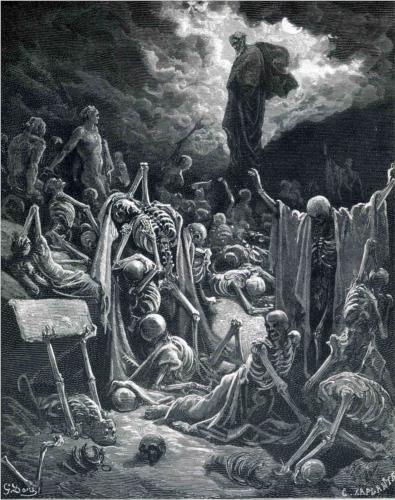
Ezekiel, according to chapter 37 of his surreal book, saw a valley of dry bones. These people were, as the Munchkin coroner croons, “really most sincerely dead.” Ezekiel did not believe in resurrection. If he had the miracle would have been lost on him. Reviving the dead was considered the most extreme, impossible feat in his entire (if limited) universe. The people of Judah, defeated by Babylonia, carried into exile, their temple—God in their midst—destroyed, believed it was all over. There was nothing to bring home into such a desolate landscape. Some suggest Ezekiel was schizophrenic or perhaps addicted to psychedelic mushrooms. In reality, I believe, he owned a MacBook that could not connect to the Internet. Once that divine signal from on high penetrated the arid air of exilic lassitude, he rebooted and without the aid of any drugs, saw God in all his/her glory. (Ezekiel refuses to give God a gender, but that is a topic for another post.)


Confessions of a Luddite

I am not now, nor have I ever been, a techie. I learned my computer skills on a Mac, and I have been an adoring follower of Apple ever since. Every time I see Windows at work, I sneer at how they try to emulate the real thing: the Mac operating environment. Only clunkier. It is like watching hand-drawn cartoons in high-definition. Regular readers of this blog expect a daily post, but my valiant laptop, alas, had what is akin to a religious experience and I’m losing it. I’ve done my blog posts from that laptop for nearly two years. I sometimes work on them during the long commute to New York City. When my Mac Book encountered the plethora of signals from a Manhattan office building, it froze up. At home it no longer recognizes my base-station router. With my limited technical knowledge I’ve tried every trick on the Internet that doesn’t involve some Geek God going off into jargon that a humble reader of ancient languages can’t understand. I am grieving.

Yesterday, thinking about my plight, I saw the parallels with religious experience. My laptop in my eighth-floor office is like Moses climbing Mount Sinai, but less robust than the 80-year-old prophet. Having encountered a higher being—signals from the heavens, hundreds of them—it has bowed in acquiescence. It has received an epiphany that I missed while going about my daily editing duties. When it returned home, it was not able to recognize the one signal that has been its lord and master since it was first booted up. Nothing from restarting the router to reinstalling the entire factory-set system to clearing and restricting the access to the one true network has helped. My computer, to borrow a phrase from Atwood, has gone into a fallow state. That is a kind way of saying it is a mere paperweight or doorstop.

According to the standard interpretation, that is similar to an encounter with the divine. It leaves you marked, transformed. Sometimes incapacitated. Or perhaps the correct analogy is that of idolatry. My computer has gone on after foreign gods and no longer recognizes the one who gave it birth. I have suffered through two sleepless nights because of it. I even visited the local Apple store where they suggest I clear the AirPort history. Like I know what that means. Perhaps I have the analogy all wrong. Maybe my computer is the deity and I am the acolyte. It is mysterious and powerful and I am left in tears after an encounter with it. But really, it feels like a friend has died. I haven’t been able to post my quirky observations. I have to borrow a friend’s computer. Am I a prophet or just another Luddite awaiting my own theophany?


Unanswered Questions

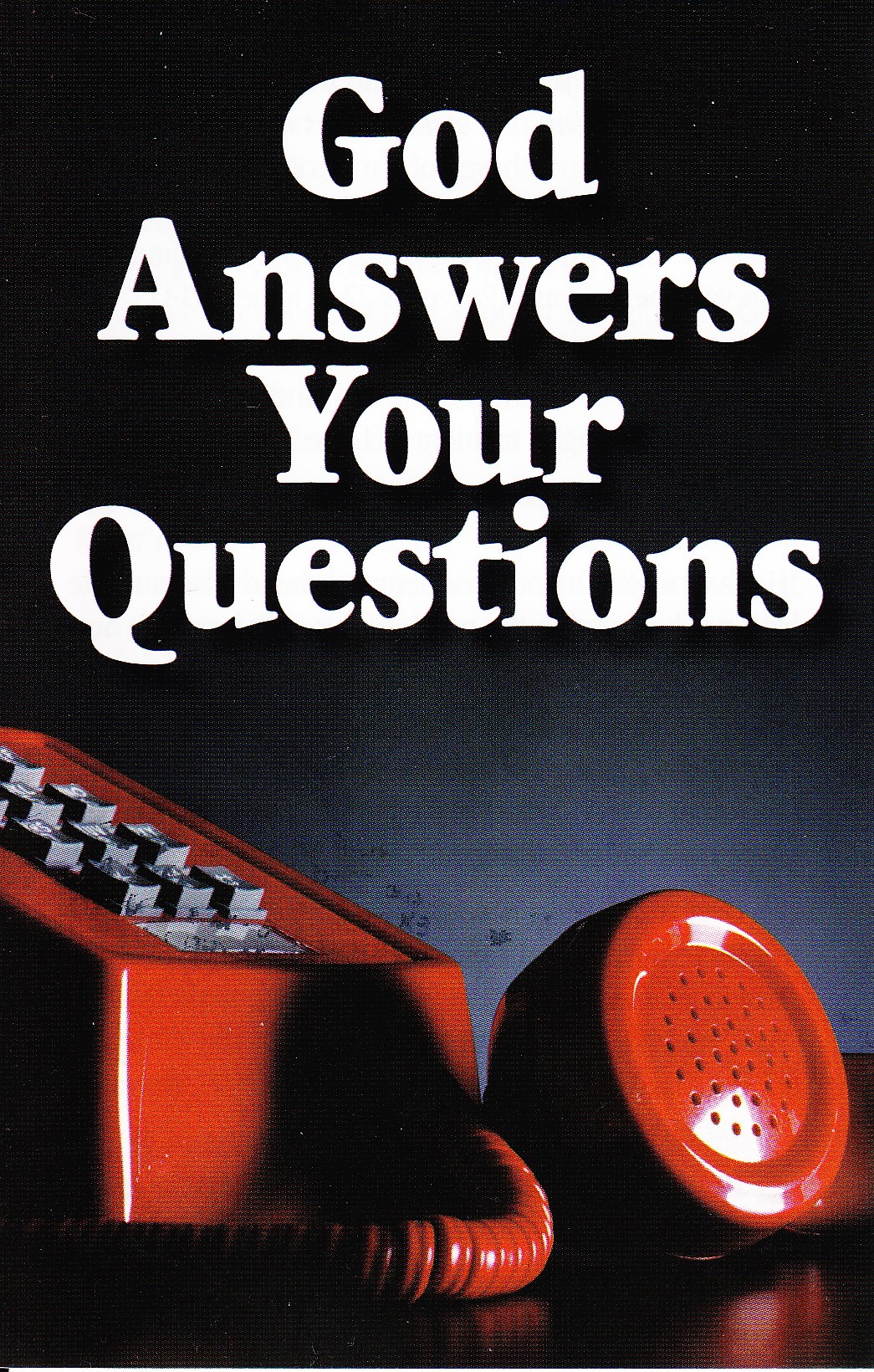
Attempting to write a blog post everyday on the single subject of religion can be a challenge when you don’t share the freedom of the Internet with most faculty. Once in a while a topic just drops in your lap like a gift from God. It helps that New York City is such a religious place. Despite the many critics who claim New York is godless and completely secular, it my experience there are a goodly number of the godly in it. It is not uncommon to see street preachers on a sunny day (apparently God has less need of saving on rainy days). On my way home from work today I was presented with a tract in which “God Answers Your Questions.” It was a little odd that the acolyte with the tracts knew what my questions were, but since the leaflet quotes extensively from the Bible it must be true. From this pamphlet I learned what my hidden question were.

The first question, rather flatteringly, states, “I am young yet, and likely to live for a long time.” Once I’ve been buttered up, the other shoe drops: “Why should I think of eternal things now?” Rather than the Bazooka Joe Bible verse, I thought I might field that one myself. I grew up thinking about eternal things on a nearly daily basis. By the time I was in high school I was somewhat creepy about it. In a college course on the psychology of death and dying, we were asked how often we thought of death. My honest answer was, “every day.” Now, a person with that kind of background may be overthinking this a bit. Death is a relatively simple matter: you need do nothing to achieve it eventually. I had been taught that if you worked to make sure you were honest and true, it would be rewarded. I was fired from my first job for being true to what I’d learned with intellectual honesty. I thought about death a lot.

Death, given its finality, is a universal religious concern. Some religions offer an afterlife—generally it is not an option—while others do not. The life well-lived is its own reward. Others suggest what seems to me a more insidious option: reincarnation. Those religions that take this approach are generally honest up front, stating outright that life is suffering. Reincarnation is goal-directed: break the cycle and achieve Nirvana. And there is no reason to flatter people with the long life yet ahead of them. The evangelist ignored my white whiskers and gave me an anonymous tip for salvation. Perhaps all I really needed was a sip of cold water. Having spent the better part of one life thinking about its end, reincarnation could be a cruel reprisal indeed. I don’t need to worry, however, because I’ve got the answers—along with the questions—right here in my pocket.


Remembrance Day

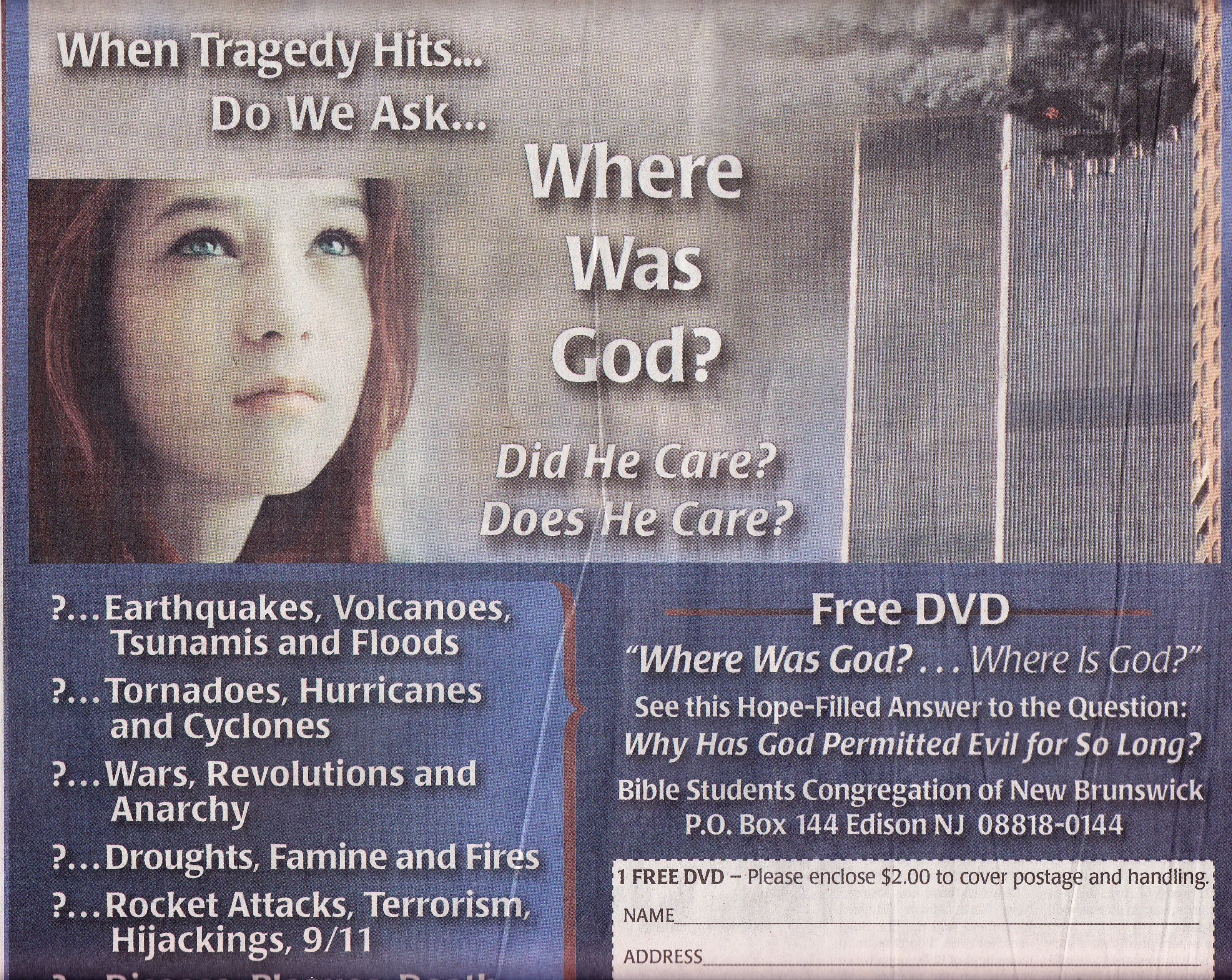
September 11, 2001 is on America’s collective consciousness. A decade ago thousands lost their lives in a religiously motivated and misguided attack on what some see as a wicked culture. Those who hate America have never come to know it. What a sad commentary it is that religious belief lends its strength of conviction to those whom it has convinced that evil is righteousness and that terror is divine. It is somber to experience this tenth anniversary so close to New York City. When I ride in to work now every day I see the new World Trade Center rising, literally, from the ashes. It is a monument to what America tries to embody.

Twin towers, 13 years old.

Our nation is not perfect. None is. Too easily we accept the casual relegation of various minority groups to poverty. Too easily we allow the obscenely wealthy to escape all sense of social obligation. Too easily we focus on our selves rather than our community. No, we cannot claim to be perfect. Nevertheless, we strive for an ideal that will not die.

Some have boldly claimed twentieth century notables as “the greatest generation.” I believe that praise, although deserved in a sense, to be misplaced. The greatest generation was that rag-tag group of colonial citizens who’d fled from cesspools of oppression to find freedom in a new world. They were not perfect. They oppressed and displaced Native Americans who still suffer under repressive policies that ensure the great embarrassment of their treatment will remain out of sight. The greatest generation I envision is those who, at the risk of their own lives, decreed that the world should, must contain a haven for those who cannot live without a free conscience. A place where religion, or even the very words you say or write, cannot be dictated by the government. A place where people could go on to become the putative “greatest generation”s of the future.

When I first heard about the attacks on 9/11 I was at Nashotah House. Those first moments of confusion were terrifying—our daughter had just started school and was not close enough to hold. My wife and I watched the television in sheer unbelief, tears on our faces, our lives being forever wrenched and twisted in new directions. In was a day that sobered up an entire country.

(Please read the remainder at Full Essays.)


Do Unto Others

Having just finished my first week as Religion Editor at Routledge, I have learned many things. The lengthy commute into New York City is filled with many lessons along the way and working for a publisher of some distinction is a privilege. My working life began with the work of a common laborer at 14. Conditions weren’t bad although the work was hard—we have laws to protect minors against exploitation. Funnily, after people reach a certain age exploitation is freely allowed, as long as someone benefits from it (not the one doing the labor). Being from a working class family, I gravitated towards dirty jobs. My college career was supported by many long hours in the dishroom, washing the cups and plates sent back by kids whose parents could foot their bill. I didn’t complain—physical work has always been relaxing to me. Mind work is much harder.

The majority of my adult life has been whiled away under the Damoclesian stare of religious institutions or individuals. Christians don’t make good bosses. My years at Nashotah House felt like some combination of Alcatraz and Bedlam. Under the authority of the religious I was taught to quake and fear. After over a dozen years of this, released into an empty academic void, I found a job with a Christian publisher who once again lived to dominate. I try hard to believe it is not inherent in religion itself, but often those who wish to bend others to their whim have some sacred sanction. For a brief respite I had a wonderful experience at the University of Wisconsin Oshkosh. My boss was secular and very caring. The same applied at Rutgers University. When Gorgias Press tired of my efforts, the secular academy came to my rescue.

Routledge once again reinforces that paradigm. For the first time in my professional life I feel that I am truly valued. As a rule, adjuncts are like Kleenex—there when you need them, but disposable after used. The university people were kind but could offer little. Now I am accepted among the secular and the little knowledge I’ve gained over the decades is appreciated. The scars, however, still show. The fear of long years of subservience are not easily dismissed. It is my hope that some day they may become effaced enough that the terrors wielded by the religious might be only nightmares recalled vaguely in the full light of day. If such deliverance comes it will have been because of my non-religious bosses. Such a parable should teach us about what religion has become in this “Christian country.”

No mean city.


Feeding the Multitudes (on a Budget)

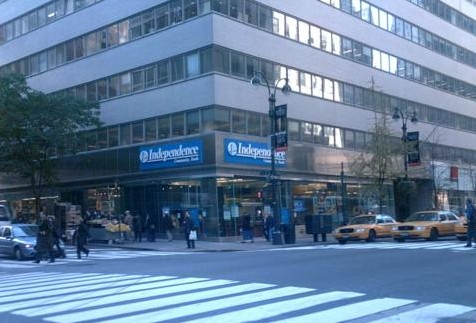
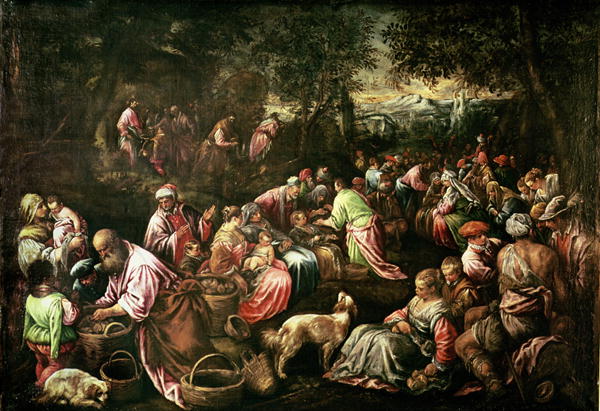
Commuting to New York City by bus can be an epiphany. When an hour-and-a-half scheduled ride stretches into two-and-a-half (I spent three-quarters as much time commuting as I did actually at work yesterday) you have plenty of time to look at the scenery. In New Jersey this translates into several towns and cities of differing socio-economic viability. The bus is a great leveler of people: corporate, business types sitting next to those who can’t afford a car or bicycle. As we trundled through Plainfield yesterday I spied a restaurant called Two Fishes & Five Loaves taglined Soul Food for all occasions. The name, of course, is borrowed from the story of the miraculous multiplication of food from the Gospels. This story fits particularly well in this setting.

According to the Gospel writers—this is the only miracle to appear in all four of the Gospels—a crowd following Jesus in a lonely place grew hungry. Instead of sending the crowds away, Jesus took the five loaves of bread and two fish they had with them and fed the crowd of 5,000 with that little morsel. When I was a student it was customary to interpret this story as one of a human-dimension miracle. The crowd, seeing Jesus sharing the food he had, each offered to share with their neighbors. Once the idea caught on, those without food had enough and those who’d brought extra had the right amount. They even had leftovers. This naturalized version of the story illustrates the message of Jesus quite nicely, although those who prefer supernatural intervention naturally reject it.

Plainfield is a town with stunning wealth and abject poverty. This situation is not unique to this location; indeed, it is a hallmark of capitalism. Those who have do not willingly give it up for the sake of those less fortunate. The free market is not really free. Today most readers like to see the story of the feeding of the five thousand as divine intervention. That matches our bail out mentality. When our circumstances make us too selfish, God comes to the rescue with conjured seafood and crumpets—or Tea Partiers—and the rest of us look on hungrily. By the end of the day, enduring that long bus ride home, I too was hoping for a miracle. Instead, as we crawled by Two Fishes & Five Loaves, loaded with people of every status, I was living in a Gospel story.


Secret Life of Language

I recently met with a friend to catch up on several years of silence. Increasingly I’m discovering the wisdom of those I’m privileged to know—perhaps it is the shedding of a purely academic way of learning. We all share in this very human voyage of discovery. This particular friend presented me with an idea that I just can’t dismiss: what if language is a living entity, existing in its own world but intersecting with ours? In a symbiotic relationship, we use words and they help us to survive and advance. This friend is a writer, and like all of us who attempt the art, knows the joys and frustrations of dealing with words that can elude but also fall subtly into place forming a poem or story of sublime beauty. We haven’t fully tamed language, but it defines us. Even my feeble attempt to replicate his fascinating idea is fraught with difficulty, for language won’t be relegated to the page, whether of paper or of electrons.

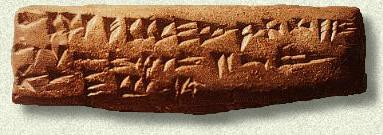
Language evolves along with us, helping us to express concepts that defy explanation. I recently read of the disappearance of three of our alphabetic letters in English. Alphabets, beginning with the earliest complete exemplar in Ugaritic, contain roughly thirty members that may be combined to replicate, in facsimile, the sounds we make. Different cultures use differing sounds; letters that represent those sounds require symbolic representation. Not all alphabets are created equally. One of English’s missing letters is “ampersand.” I always wondered why when I learned the alphabet the song ended with “W, X, Y and Z”—why the “and”? “Ampersand” was part of the alphabet in the early 1800s. Students sang “X, Y, Z, and per se and.” “And per se (‘by itself’) and” eventually ran together into “ampersand.” Over time it fell out of our rank of letters. As the runic Anglo-Saxon that gave us English was absorbed into Latin characters, the Teutonic “thorn,” or th sound, went extinct in our alphabet as well. As any student of German knows, “th” has distinct pronunciations in Germanic languages. It has its own letter of the alphabet in both Arabic and Greek. Since the Latin “y” resembled “thorn” the letter was replaced by ye olde “y.” The archaic letter “wynn” looks like a flattened “p” but was pronounced as “w.” As Latin superseded runic forms “wynn” was written as a doubled “u,” literally “double-u,” which, in Latin was scripted with a “v” shape. This gives us the anomalous W written with what looks like two “v”s.

The alphabet, second to writing itself, is perhaps the most important invention that humans have devised. The alphabet made writing much easier to learn and with writing ideas could be preserved for centuries and could be sent vast distances without changing. Writing allows us to stand on the shoulders of giants. As the school year is beginning again and kids everywhere feel the strain of losing the freedom of summer, I think back to the purpose of education—teaching our young to read, write, and calculate. Language has been guiding us all along. It may evolve, shed a letter or two, frequently grow by taking on entire new words, but it still cradles us as we struggle to find the perfect expression. We should take a little time to get to know our own language better, for without it we are merely biological entities.

An Ugaritic abecedary


A Sense of Place

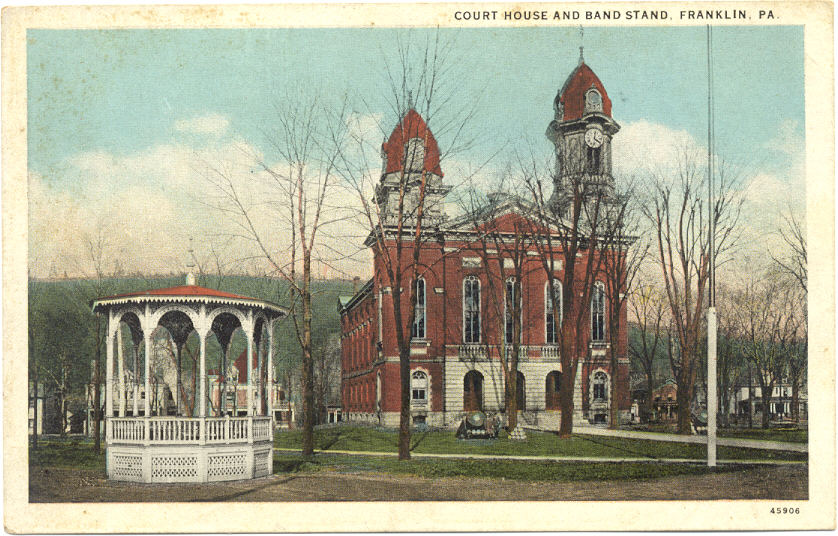
Franklin, Pennsylvania. The place I was born seems to participate in what is sometimes labeled “sacred geography.” No one really knows why people imbue certain places with a sense of particular significance, but we all do. Whether it is world-famous tourist sites or our humble hometowns, there are places for us that possess an emotional resonance that other places lack. By the time I was an adult I was eager to get away from my hometown, to stretch myself and see if there was more to this world than these ancient green hills were willing to disclose. But still I return. When something brings my town into prominence, it somehow still impacts me. In the second season of the X-Files Mulder and Scully came to Franklin. Of course, the episode was not filmed here, just set here. But that was enough. My small hometown had been validated. It is part of my personal sacred geography.

I recently learned about WestPA Magazine. While it still has a way to go before becoming mainstream, it needles into that sense of belonging that refuses to let me go. Reading about the grandeur that once settled over this town feels like reading my own biography at times. Last night, for example, I learned that one of the first steps of female equality—a small step, but we all must begin to walk somewhere—took place here. One of the inheritors of the oil wealth that originally put this region on the map was Charles Joseph Sibley Miller. He hosted two presidents on his yacht, partnered with John Astor and William Vanderbilt on a business venture, and had his car personally delivered by Louis Cheverolet. Although largely overlooked by history, Miller purchased a hot air balloon in which he took his wife, Mary Prentice Miller, for a ride, making her the first known woman aeronaut in history. One small lift for a woman, one giant lift for womankind.

There seems to be no scientific basis for sacred geography. It is simply something that we sense. I left my home region, the birthplace of the oil industry, a site of some importance in the Revolutionary War, to pursue a more tenuous, if abstract career track. And still I come back and find myself amazed. I suspect our sense of sacred geography evolved along with our penchant for territorialism, our desire for private property, and our need to find sanctuary of some kind. I can stake no claims for the accomplishments of those who settled this region, but for me it will always be a touch-point for sacred geography. When I make my occasional returns, it feels as though I might still belong.


Glass Act

One of the main cultural Meccas of central New York state is the world-renowned Corning Museum of Glass. I recall visiting the museum three decades ago, as a child. Since then the museum has continued to expand and diversify its programs and displays. The Corning Museum of Glass is perhaps the greatest collection of art glass in the world. The history of glass is laid out chronologically, and along about the Middle Ages, religious glasswork comes into fashion. Some of the pieces were manufactured as intentionally religious artifacts. Others acquire a religious significance through less orthodox means.

Traditional religious glass

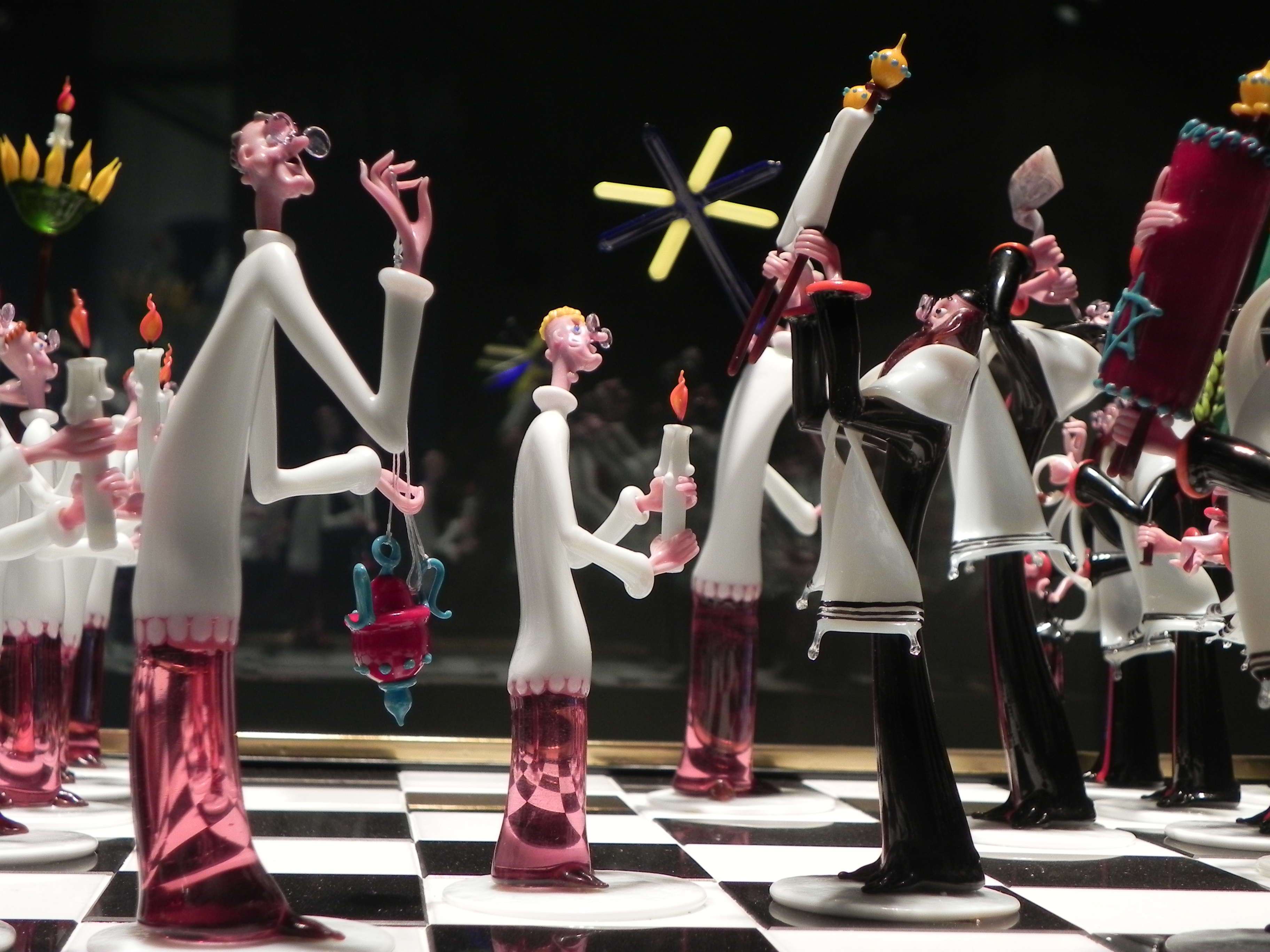
Near the end of the display is a piece by Gianni Toso, done around 1981. Entitled “Chess Set,” the glass sculpture features Roman Catholic pieces facing off against Jewish rabbinic pieces. The sculpture is intended to be comic as the expressions and the postures of the figures clearly indicate. Each piece bears some symbol of their faith: thuribles, lulavs, crosiers and Torah scrolls face off against one another, each side wearing unmistakable looks of superiority on their faces. Countless hours obviously went into the fabrication of such an intricate piece, and as with most art, it contains a serious message.

Toso's Chess Set

The figures here may be Jewish and Christian, but they could really be any religious traditions. The concept of putting them into a chess match is an inspired commentary on the constant struggle for superiority among religious traditions. In a world of differing religious outlooks, and where such outlooks are taken with deadly seriousness, no one is willing to relinquish religious superiority. The aggressors are difficult to discern since, as in life, any true believer must be a kind of missionary.

Toso's face-off

The medium of an artwork also makes a statement about its subject. Glass is a difficult medium to manipulate. Since it often must be very hot, the artist is familiar with the burns that accompany such intense heat. Glass produces a superior shine as an artistic medium, but it is also very fragile. Like the conflict presented on this chessboard, the religions behind it bear the limitations of the medium: they shine at times, yet they can also cause severe burns. And above all, they are fragile.


Failing Geology

Rocks of ages

Watkins Glen, New York, sports a natural wonder that has occasionally drawn me to the Finger Lakes region to refresh my memory of the view. The eponymous glen has been carved out of the relatively soft shale by a tireless stream that falls to the level of nearby Seneca Lake. The relentless persistence of this water has left a canyon of striated layers over a period of 12,000 years. Even today tourists from around the world flock to the site, captivated by its natural beauty. To assist walking the gorge, 832 steps have been added alongside a mile and a half of the stream, taking the visitor past, and occasionally behind numerous small waterfalls. When we visited yesterday, what struck me—beyond the sheer number of out-of-shape Americans complaining of the number of stairs (this was well before the hundredth riser), a number that continually thinned the further we climbed—was the special compensation that biblical literalists claim to accommodate their view. The typical response is that all geologic wonders are a result of Noah’s flood, despite the different erosional rates and dates of the sites. Watkins Glen is a fairly new piece of earth architecture.

Some years back while driving out to the western United States, my family camped in Makoshika State Park in Montana. This particular park, apart from its wild, arid, and rocky scenery, also boasts many dinosaurs. You can sidle right up to the exposed, fossilized backbone of a hadrosaurus, and triceratops skulls can be found in situ. Preparing to hike one of the trails, we stopped at the ranger station for a map. As usual, interpretive displays explained what we were about to see. As we entered, an older couple spoke with the ranger. One of them said, “How can that be, since the earth is only 6,000 years old?” Special compensation is required to refuse the evidence that lies all around us. The Fundamentalist movement seldom takes into account that this distorted and bizarre worldview is almost uniquely American. Religion drives their scientific outlook, even as they are relying on the factuality of actual science to prolong their lives with medical advances or to allow them to read this blog (although the latter is not likely).

The same flood had to carve out the buttes of Makoshika and expose its Cretaceous fossils of 65 million years ago at the same time as eroding the first 6,000 years of Watkins Glen, leaving the remaining 6,000 to be worn away during our world’s lifespan so that we might declare the great works of God. It is a worldview that demands a constant center stage for a feeble explanation based on the worship of a misunderstood book. And yet they come to see the beauty. No matter how many persuasive words might be penned, the possibility of changing this outlook will elude us. Reinforced by television personalities and politicians, this utter breakdown of reason is one of our national characteristics. As a nation we suffered through eight years of “leadership” by a president who did not believe in science, and we are still paying off his tab. In another 6,000 years or so we may succeed. By then, however, I expect, if I’ve learned anything from the movies, we will have reversed roles with the great apes.