Tomorrow Ever After

Last night as we said goodnight to Irene, my family decided to watch The Day After Tomorrow. Beyond The Perfect Storm and Twister we didn’t have any other weather-related disaster movies on hand. I became convinced long ago that weather was somehow key in the conception of divinity. Working at a seminary that required attendance at chapel twice daily where we would lugubriously and laboriously recite every verse of every Psalm according to the unforgiving schedule of the Book of Common Prayer, I began to notice the weather. Among the more common images used in the “hymnal of the second temple,” weather was seen as an essential aspect of divinity. Religions with celestial orientations frequently view the sky with a sacred aura. I began to compile all the Psalm references to the weather and eventually brought them together into a book, still unpublished. What became clear at the end of this exercise was that ancient people had no way to interpret the weather other than as a divine phenomenon. Listening to all the hype about Irene, it still seems to be the case.

In The Day After Tomorrow, our ill-fated teenagers are trapped in the New York Public Library as a super-chilled tropospheric wind freezes New York City. They build a fire and when you’re in a library, naturally, you burn books. I kept looking at all the furniture they spared as they consigned the books to the flame. A minor character called Jeremy is shown clutching a Bible. A girl named Elsa asks if he thinks God will save him. Replying that he is an atheist, Jeremy says that this is a Gutenberg Bible, “This Bible is the first book ever printed. It represents the dawn of the Age of Reason. As far as I’m concerned, the written word is mankind’s greatest achievement. You can laugh, but if Western Civilization is finished I’m gonna save at least one little piece of it.” This little dialogue represents the full circle of the celestial god. Jeremy doesn’t believe in this god, and the Bible requires human protection. Instead of being the instrument of war and political badgering and tea parties, it is seen as a symbol of enlightenment. It represents the first steps toward reason.

As Hurricane Irene still gusts outside my window, dropping rain as if New Jersey were a desert receiving its first drink in a century, the Tea Party is busy crafting ways of getting the Bible back in the White House. Their Bible is the antithesis to the Age of Reason. It is the symbol of superstition and prejudice and authoritarianism. It is the means of political power. The god of the Tea Party is a white-bearded man living in the sky, sending his fury against the liberal cities of the East Coast in a mighty wind. He is the punishing god of the Psalms. As the helicopter lifts off over a frozen Manhattan, the teenagers saved by a flawed father who walked from Philadelphia to New York to find his son, the camera pans across Jeremy as he hugs the Bible to his chest. I was in Boston for Hurricane Gloria back in 1985. Watching the waves crash on the beach at Winthrop I felt the power of fierce nature at the beginning of my own journey to, I hope, enlightenment. When it was over, however, there was not yet a Tea Party threatening an even worse, unnatural disaster to follow.

Irene, the early days
Girl Meets God…

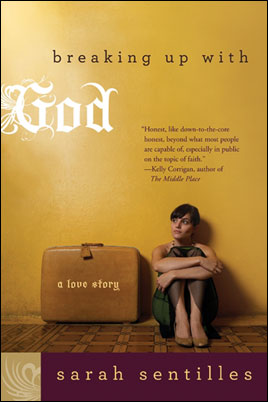
Once in a very great while I find a book that I simply can’t put down. It is a rare windfall when that book feels like it was written especially for me. I was instantly engrossed in Sarah Sentilles’ Breaking Up With God. Like Susan Campbell’s Dating Jesus, this book reinforced the fact that women experience a side of God’s character generally closed to men—the idea that God might be a lover. In our distorted, still patriarchal culture we have yet to grow beyond the idea that God is male. This simple, persistent teaching ensures that a gender-divide will always remain in effect when it comes to monotheistic religions. What truly spoke to me from Sentilles’ book, however, was not the theology, but the heart. Although the gender view from which I approach concepts of divinity must necessarily be different, here I found someone with a journey in many ways similar to mine. The honesty with which the author lays open her experience is beautiful and terrifying.

One of the recurring questions on this blog is whence the concept of God arose. Anthropologists, psychologists, and theologians come up with varying answers but the fact is the real impact is felt in very human minds. We have, perhaps unwittingly, devised a punishing image of the creator of the universe. A God who causes, allows, or at least condones arbitrary human suffering. A God who permits atrocities daily to be committed in his name (for this is a masculine god). A God who has left a burning ruin in his wake. Those of us who’ve attended seminary, as Sentilles makes vividly clear, are taught perceptions of the divine that can never be translated into the pulpit. Those of us who go on to graduate school are permitted a rare glimpse behind the veil to see something that it frightens us to contemplate, let alone write or speak about. It is a burden best worn like a hairshirt—beneath other clothes so that people don’t know it’s there. Many of us are then cast into the career outer darkness with nothing but our highly educated, disturbing thoughts for comfort.

Sarah Sentilles has given the world a gift with her revealing, sensible, and very human story. Having grown up with the image of God as a father, it was a shock when a seminary professor once revealed to me that God could never really fill that role. Nor, he added, could the church. While it cannot be the same as breaking up with God, the realization that what you were taught as a child was merely a metaphor forces a grand reevaluation of perceptions. My professor was, of course, correct. Carrying around a faulty image of God will lead only to intractable complications further down the road. Although Sentilles started down the path some years later than I did, it seems we have wound up in the same neighborhood. Her book deserves to be read widely, thought over carefully, and pondered for a time. We need to consider: what hath man wrought?


God’s Country Club

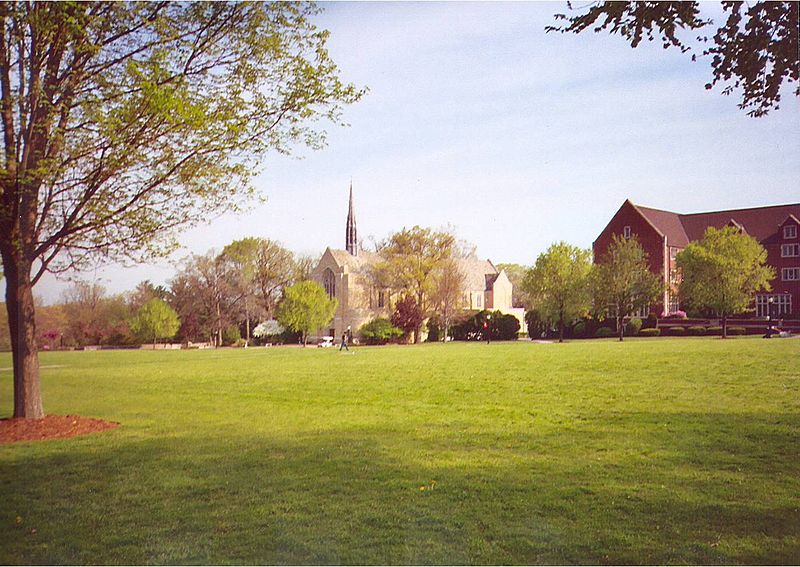
Last week CNN’s religion Belief Blog reported on the five most and least religious colleges in the United States, according to Princeton Review (not affiliated with Princeton University). Having attended one of the five most religious colleges on the list (Grove City College, but whether it is number one or five is difficult to determine), I took an interest in the overarching question: how do you determine if a college is religious? The author of the survey indicated that it was through student interviews concerning whether they perceived other students as religious or not. And that’s where the bone of contention pokes through—who determines what is religious behavior? Are students able to determine who is religious or who acts religious? Does religious mean Christian in this context, or religious in any tradition?

Grove City College, God's Country Club

My years at Grove City left little doubt that the school itself was proudly religious. An evangelical bastion against many forms of critical thought, plenty of indoctrination took place in those hallowed halls. A few religion professors (I was even then over-zealous to learn as much as I could about this field), while personally faithful, asked serious questions that many self-righteous classmates blithely ignored. From glancing through alumni magazines, they seem to be the successful ones. Those who asked the hard questions seriously were ostracized; now they are lost in obscurity. Is this true religion? The Princeton Review is concerned with providing potential students with accurate data about their collegiate choices, but I wonder if the religiosity proffered is anything more than denominational branding.

Three of the four other most religious schools might bear this out: Brigham Young, Thomas Aquinas College, and Wheaton College. Hillsdale College, the final member of the most religious fraternity, is the exception. A liberal arts school, formerly Baptist but currently independent, it fits somewhat uneasily next to the Mormon, Catholic, and Reformed natures of the other four schools. While I can’t speak for the other colleges, at Grove City there was definitely a coercive peer pressure to behave like everybody else—to be religious, i.e., evangelical Christian. With required attendance at chapel and required courses in religion, the ethos was heavily impressed. Were other students truly religious? That depends on the measure that is used. Many have gone on to be entrepreneurs declaring free market economics in the name of the kingdom of heaven. If that is a measure of true religiosity, all hope is lost indeed.


Last Rites

Last night at 9:40 p.m., my last class at Rutgers University ended. I began a teaching career in higher education back in 1992 when I was still younger than most of my students (that was in a seminary). Despite the difficulties of that setting, I had lowly dreams of a reasonable teaching post in a small college where good teaching was emphasized and serious research was allowed. It was never to be. Now, facing an exciting career move, it feels like a giddy run suddenly played out. The finish line crossed halfway through the race. Higher education simply never made room for the likes of me. Students have frequently commented on how they like my courses and find me a congenial instructor and wonder why no full-time positions ever emerged. My answer has always been that Religious Studies is the one field where religious discrimination is legal and regularly practiced. Denominational schools are permitted to hire on the basis of faith—I have been declined more than one position because I was not the right brand of religion. State schools are afraid of the field.

State universities, where I ultimately ended up, are very cagey about Religious Studies. I’ve known otherwise highly educated individuals who suppose that such departments are glorified Sunday Schools or Catechisms. They always seem surprised, when a religiously motivated person decides to become a mass murderer on the basis of conviction, that universities don’t know more about religions. It is, however, a dying field. Religion in America has been hijacked by the NeoCon camp. Over the years I’ve had mainstream Christian students explain to me why they are not really “Christian” since they assume that the title goes with conservative political and social values. To my humble eyes, it appears the battle may have been already lost. State schools fear interference with the establishment clause while NeoCons plow ahead to mandate a state church. It is the religious makeover of America.

I will miss teaching, but it has been a punishing career. My years at Nashotah House were filled with abusive situations and unrealistic expectations. Since then I have never had a full-time teaching post. In some cases I have spent more time driving to campus than I spent in the classroom. It is time to launch on a new career direction—even my previous editing experience was under the shadow of a conservative religious outlook. I have told many students over the years that teaching careers are not what they used to be. I have many horror stories to back me up. That doesn’t mean that a tear or two didn’t fall as I left my last classroom after nearly twenty years in the biz. It has been an education to me, and I hope a few students among the hundreds I’ve taught out there feel that it has been the same for them.

Nevermore.


For the Love of Books

As is so often the case, publication and religion go hand-in-glove. George Routledge was a man with a vision. As a literary man of nineteenth century England, he moved from bookseller to publisher, establishing the well-known London house of Routledge (aka Warne & Routledge, George Routledge & Sons) in 1843. Although his initial successes were literary, among his first publications were the reprinted Bible commentaries of Albert Barnes. By 1854 a branch of Routledge was established in New York where it continues to operate. Acquired by Taylor & Francis in 1998, Routledge still pursues and produces notable academic books in many fields of the humanities and social sciences. The company is a testimony of the strength of vision of a man with a love of books.

I began this blog as a recently unemployed editor at Gorgias Press and part-time lecturer at Rutgers University. Both were jobs involving books and religion, but I am now moving to Routledge as a religion editor. Once again, I will be full-time in the world of books. Regular readers of this blog will know of my sense of loss at the closing of Borders this year. Although I claim no special insight into the way businesses work, the loss of comfortable space surrounded by books is something I felt very deeply. There seems to be a kind of redemption in taking on a position that will once again set me in the role of seeking to produce more books. It is as if the fabric of several loose strands of my life that had unraveled under the trials of the world of higher education have once again rejoined.

While whiling away the happy hours at the 4-H fair last week, I enjoyed strolling through the arts tent. There I noticed that someone in our county has started a creative writing club. This was a hopeful sign; the previous year I had made inquiry into starting such a club myself. When the world seems to have evolved beyond books, those of us who need them must invest the love of writing in our young. Although 4-H is not a religious organization, writing nevertheless has a sacred appeal. Those who feel drawn to the craft know the incredible grip that written expression can exert on a person—seeing your name on the cover of a book is a form of eternal life, metaphorically speaking. As editor I will not be the name on the cover, but I will be the one helping others to attain that immortality. It may not bring Borders back from the dead, but even the very idea of resurrection comes to us in the form of a book. Even so, Routledge is the agent of resurrection in my meandering career.


Faith on Trial

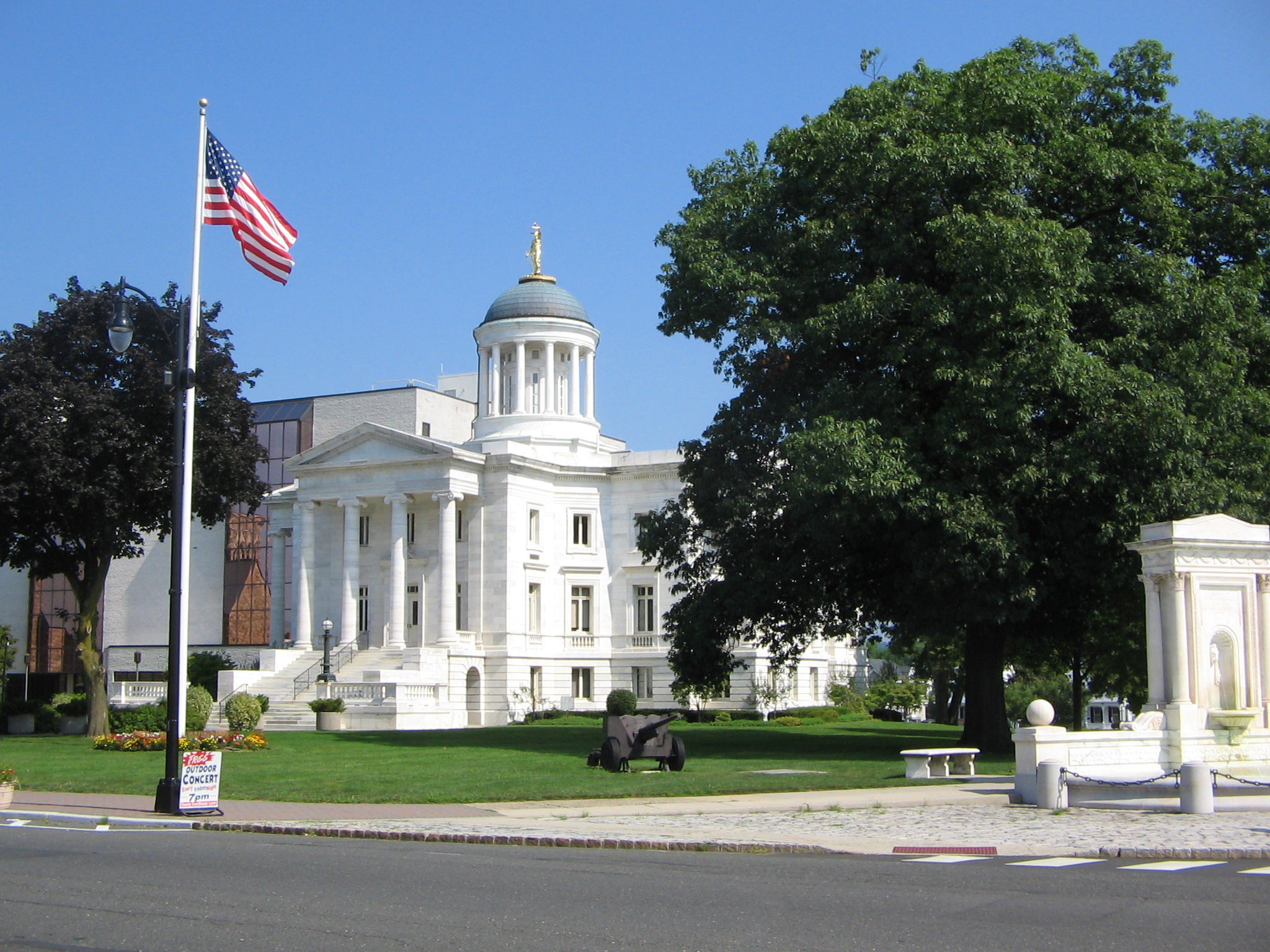
Great white throne of judgment?

I just had a brush with the law. I was recently called up for jury duty for what looked like a very interesting case, but I was dismissed before it got started. When I left the courthouse, I felt as if I was being watched. I was trembling. The reason, I suppose, began with a simple ticket. As a teen I was reluctant to drive. Those who’ve had the annoyance of riding with me know that I rigidly adhere to speed limits and traffic laws. At a momentary lapse some years ago, I was cited for speeding in a rural setting and my sense of justice was shaken. I may have been going too fast, but it is not a habit nor a common occurrence. This happened within a year of being dismissed from a long-term job because the politics of the institution at which I’d faithfully worked for over a dozen years had changed. My faith in the system had been badly shaken. The ticket, issued on a road with very little traffic and for an offense that endangered nobody, only exacerbated the sense of something awry on a cosmic level.

This story has a point. Being raised in a religion with a punishing God who spent most of his time seeking out secret sins and infractions had molded me into what I supposed was a model citizen. I read the Bible daily, attended church every week, avoided all the common sins that others seemed to enjoy with no repercussions. Nevertheless, the God I knew was angry. That anger was directed toward me. Like Michael Pedersen Kierkegaard, I was surprised when things seemed to work out so that I had a secure job in the midst of a recession. Although my thought had evolved considerably, the angry God was still stalking me; I have no doubt that he will be until my dying day. What we teach our children about religion will stay with them for a lifetime. When that job ended, sending me in a career spiral that has now lasted five years, I could feel those punitive eyes staring me down. Now if I see a police car in my rearview mirror, my pulse rate quickens and I break out in a sweat. Like God, they are seeking any little infraction to exploit.

Ironically, the jury assembly room in our county seat is in an old church. As I sat, waiting for my number to be called, I looked at the stained glass windows of Jesus, angels and saints. My first thought was how such a sight might be experienced by someone from a different faith background: what does our public space say about justice? Would a Hindu or Muslim find this welcoming, contemplating the seriousness of the juror’s role? It is a beautiful and comfortable waiting area nevertheless. As I found myself in the rarefied atmosphere of a courtroom with a judge, attorney, and many other jurors, I again felt the eyes of judgment upon me. I’d just exited a building formerly inhabited by an angry God–losing a building surely can’t put someone in a good mood, can it? Had I not been dismissed, I would have watched the drama of justice unfold. And it would have been myself that was sitting at the table of the defendant in a world where no one can ever live up to the standards set by a wrathful God.


Monsters Are Due on Elm Street

November 1984. George Orwell’s dark vision had not fully emerged, but the veneer had worn off of the fairy-tale world promoted by the evangelical, free-market professors at Grove City College. As a blue-collar kid in a blue-blood institution, I was out of place. The campus was buzzing, however, about a new movie—A Nightmare on Elm Street—for which I finally plucked up the courage to ask a cute coed for a date. I’d never seen a slasher movie before, having sampled mostly traditional monster-flick fare as a child. I felt a sense of accomplishment since some of my college friends had to leave the theater for fear. On the big screen, with no previous knowledge of the plot, the film worked for me on many levels. Last night I decided to watch it again.

My first reaction was a sense of surprise at how much of the movie I still recalled with pristine clarity. For having been nearly thirty years ago, such clarity is a rare phenomenon for many details of life, often reserved for memories of early girlfriends. A second reaction was noticing how religion featured in the film. The girls skipping rope chant, “One, two, Freddy’s coming for you / Three, four, better lock your door / Five, six, grab your crucifix.” Indeed, the crucifix features in several scenes as an ineffectual weapon against Freddie Krueger. The days of defying vampires are over when your own subconscious turns on you. In one of the early chase sequences, Freddie, raising his infamous glove, says, “This is God!” Religion and its overarching concerns with death and suffering come together with horror in that one moment. The traditional power structures of religion have lost their power to defend the troubled teenagers. The only one well adjusted is, ironically, Johnny Depp’s Glen. Even he falls victim to the revenge sought by Krueger.

Surprisingly, the scene I had most trouble recalling was the end. I recollected the bright, hazy sunshine, but couldn’t remember how Wes Craven released his audience from the drama. Of course, there is no end. Freddie came back in countless sequels, none of which I ever watched. Although I wouldn’t know it at the time, Robert Englund based the screen presence of Freddie on Klaus Kinski’s Nosferatu in Werner Herzog’s classic remake of that silent gem. Freddie is the vampire that defies religious cures. Movie villains are among the most adept practitioners of resurrection on the silver screen. The occasional E.T., Neo, or Spock will come back from the dead, but those who repeatedly return are the denizens of our nightmares. As Orwell’s vision continues to unfold in subtle ways, 1984 looks like an age of innocence before the ineffectual god worshipped by the establishment became self-image, writ large, on Elm Street.


Out of the Depths

You’d think that a lifetime of theological study would be excellent training for repairing a toilet. If, however, you live in an old rental unit that has been ritually neglected for decades and that has a plumbing system designed by the Marquis de Sade’s evil twin, you’d soon think otherwise. All I tried to do was replace the flapper—something I learned how to do before leaving home. When the overflow tube snapped off, corroded all the way through at the bottom, I figured I’d just replace the unit. The bolts holding the toilet tank, however, were installed before Noah even built the ark and therefore wouldn’t budge. The leverage room for a wrench, is, of course, negligible. So it was, temperature about 100 degrees, no air-conditioning, no working toilet (bad combination) on a weekend, that I came to face the human condition once again.

As biological creatures, humans have constructed themselves a grand, spiritual universe that kindly overlooks the basics of daily living. Religion, in origin, seems to have had a survival value. Psychologists have suggested that the sense of hope that religions often project might have led to a stronger desire to thrive. Others have suggested religion is part of the curse of consciousness—aware of our own mortality, we attempt to overcome it like any other obstacle. Religion gives us the leg-up over pure biological existence. Unlike other creatures, many western religions assert, we survive our own deaths to face a (hopefully) better world beyond.

In the meantime, however, we are faced with a messy biological existence. Some of our compatriots in this venture stumble along the way and cannot meet the expectations like those who know how to work the system. Religions have traditionally dictated a moral imperative for those who are in positions of power to assist those who are weak. Of late, however, that has somehow shifted—at least in popular Christianity—to the overarching objective of looking out for one’s self. As a species we are all, rich and poor alike, constrained by the same biological necessities. It would speak well of our religious constructs should they reflect the same. As the temperature climbs once again, and I must face my plumbing nemesis, I realize that the metaphor may go deeper than I originally surmised.

The theologian's best friend


A World Without Borders

When Borders announced it is closing its remaining stores earlier this week, part of me died. My first Borders experience was with the original Ann Arbor store after moving to Michigan to be with my (then) fiancée. Since then my wife and I have spent many happy weekend hours browsing at Borders. The sensory, indeed, nearly hedonistic pleasure of being among books in a casual, friendly environment where ideas seemed to roam as freely as the bison on the plains before the Louisiana Purchase, is, sadly, about to end. Barnes and Noble never attained that balance nor has it ever aspired to it. I once met Jeff Bazos, the founder of Amazon, and he is a very nice guy. But when I buy books from his store, I never leave my living room. One of the intellectual’s guilty pleasures has been eradicated.

I grew up in a town with no bookstore beyond the local Christian supply shop. When a mall was built nearby and a Waldenbooks came in, I thought I was in heaven. Even the town where I attended college had no bookstores beyond the campus supplier. Borders represented the intelligent side of book buying, without appealing to the lowest common denominator. I can hear the nails being driven in from the pillow in my coffin. Our society is a post-literate one. As a person who has had many an unrepentant love affair with words, it feels like civilization itself has received a mortal blow. As I tell my students: the mark of true civilization is writing. Ever since the Sumerians invented it, it has been a means of release from reinventing the wheel with each generation. Our hearts, however, have gone after technology and gadgets and left bookstores in the dust.

Please allow me my eulogy here—I realize that reading will continue, but its context has morphed almost beyond recognition. I have watched while every employment for which I am suitable has silently gone extinct: higher education, libraries, museums, publishers—the pillars of culture itself. Gone is the day when a kid receiving his summer paycheck would beg his mother to drive the forty miles to the nearest bookstore where he would come out with not a cent in his pockets but his arms full of books. We can read about such idiotic behavior online. A border has been crossed, but some of us will linger on the other side hoping that the civilization we knew might somehow survive.

I had no idea this would become a collector's item


Cherry Pie

It is one of those days when it is too hot to move. The heat is the kind that gives you a headache, and the Internet beckons. Thus I came across Cherry Hill Seminary. Having been a seminary professor in a previous life, I’m always interested in the craft. This particular seminary, however, is unlike any other. Advertising itself as “the first and only graduate-level education for Pagan ministry in the world,” Cherry Hill offers pastoral education for those who identify themselves as Pagan. I find the concept fascinating. In an age where the standard offerings of the religious marketplace are experiencing their own kind of recession, the alternatives seem to be flourishing.

Just last night I was explaining to my class how the difference between the religious and the pagan is simply a matter of perspective. Used pejoratively “pagan” means any non-Christian, generally. “Infidels,” “heathens,” or “godless fill-in-the-blanks”—religions crave the handy moniker to make those who are different into “the other.” It is easier to detest a person with a label. Cherry Hill Seminary, however, offers a respectful view towards religious education. The school, which offers its program online, has the goal of educational accreditation. From some of the seminaries I’ve experienced, the bar should not be too high. My only concern is that the uniqueness of this program might fade into the background against some of the weirdness that ATS accredits among the mainstream schools.

Starting at least as early as the Bible, religions have looked upon each other as dogs straying into a bigger dog’s yard. Each one wishes to be the strongest one, the most respected and applauded. Why should paganism be excluded? Requiring a bachelor’s degree for admission, Cherry Hill offers courses in Text, Tradition & Interpretation; Nature, Deity & Inspiration; Pagan Pastoral Counseling; Public Ministry & Expression; and Pagan Advocacy & Leadership. Some of these offerings sound more informative than various seminary classes I suffered through. And on days when it’s hot like this, fantasies come easily. It is not too hard to imagine, especially based on my own experience, being treated more humanely by a pagan than by one who claims my own religious heritage.

When the cherry tree blossoms...


Sanctuary

Sanctuaries are often difficult to get to, but are often even more difficult to leave. Various religions make use of the concept—a sanctuary is a safe place, somewhere away from the normal world. Perhaps this is one of the reasons humans devised religion to begin with; the world feels heartless and threatening much of the time, and a place where the unseen parent will keep us safe is a desideratum anxiously quested. The problem with sanctuaries is that too much safety inhibits growth. As history repeatedly demonstrates, sequestered religions grow stagnant and antiquated—frequently hindering more than helping.

The concept of a sanctuary is of a piece with the amorphous idea of sacred space. The idea that some places are different, special, or spiritually vibrant is one that admits of no testing or verification. Nevertheless pilgrims will seek out such places in order to recover a sense of balance or peace. Even scientists know the feeling, although it is frequently consigned to the psychologist’s couch. Finding that spot that gives momentary tranquility is big business, as any travel agent knows. While we may invest our sanctuaries with divine trappings, the practice is, at its roots, very human.

The world was not created for us. Congealing from a rapidly spinning mass of superheated rock and dust, it took a few billion years before life might even manage to float atop the cosmic embers. As part of this fascinating development called life, we have learned its hard lessons. Nature is beautiful and dangerous. We are its masters and its slaves. Some of us take great pains to escape to it and when it is time to leave we are ripped from it like a crying babe from its mother’s arms. Sanctuary is a human concept with divine implications.

A sanctuary


Metaphor

Author Neal Stephenson, inspired by fellow author George B. Dyson, built a baidarka a few years back. The baidarka, an Aleutian version of the sea kayak, was such a necessity of life among the Aleut that it was treated as a living being. Whenever I find myself at the same latitude and longitude as the baidarka Neal built, I like to take it out for a relatively safe lake voyage. I’m not much of a swimmer, and taking boats out on the big water always chills me before the water actually touches my skin, but this is a kind of ritual that I feel compelled to observe. It is a participation in the mythic world of the Aleut. As spiritual beings, kayaks were a necessary part of life for island dwellers. In their own way, I suppose, they are saviors.

Author and partner in the baidarka

Traveling by water, I find, is a spiritual experience that eschews scientific quantification. It is a feeling, not a measurable commodity. To quote the great sage Rat in Kenneth Grahame’s The Wind in the Willows, “There is nothing—absolutely nothing—half so much worth doing as simply messing about in boats.” We are born of water, mostly made of water, and ineluctably drawn to the water. Rachel Carson suggested in her classic, The Sea Around Us (always one of my favorite books), that having evolved from the sea we are forever yearning to get back to the sea. Water is life as much as blood is.

broken water

When water breaks by being forced into an unyielding shore or by being thrown over a cliff to become a waterfall, flinging refreshing spray into the air, its great energy is released. Although its flow may be interrupted it will break apart granite and basalt, literally moving mountains and carving coastlines. Water that is placid in the morning may be raging by the end of the day. Water is life, and if life is anything more than a metaphor no one has yet convinced me of it.


Hope Soap

I have the distinct good fortune of an occasional sanctuary. I married into a family that owned a share in a remote cabin on a pristine mountain lake. When I can afford it, I make the long journey during the summer and wonder why anyone would ever want to live anywhere else. When I began coming here in the 1980s, the preferred method of bathing was in the cold waters of a meltwater-fed lake. Although I’m extremely sensitive to cold, I’d nevertheless take the plunge and I’d always take my Dr. Bronner’s Magic Soap with me to lessen the environmental impact. My wife and I bought our Dr. Bronner’s at a local health-food store and were pleased not only with its eco-friendliness, but also with the many religious/philosophical sayings printed on the bottle in tiny script. After using Dr. Bronner’s yesterday, I decided to learn a little more of the religion on the bottle.

Dr. Bronner's in its natural environment

Emmanuel Heilbronner emigrated to the United States shortly before the Second World War. His parents were murdered in the Holocaust, but Heilbronner, shortening his name to Bronner, developed a religion that promoted love and peace, making him a popular figure in the hippie movement. He called his philosophy All-One-God-Faith or the Moral ABC and he had tenets of his religion printed on each bottle of his product. The factory he founded remains unmechanized and produces over a million bottles a year. The soap is not animal tested. Ironically, the bottle I used yesterday was purchased back when Dr. Bronner was still alive: visits to the lake are tragically brief and the soap is concentrated and lasts a long time.

Dr. Bronner’s religion is a blend of his father’s Judaism with Christianity and a sprinkling of Islam. Bronner was a promoter of the benefits of monotheism, and his eccentricity may partially be accounted for by the fact that he was treated with shock therapy in an asylum while developing his philosophy at the University of Chicago. Society has a way of trying to silence those who speak with conviction—especially if the conviction doesn’t lock step with those who secretly admire McCarthy. It is fitting, in tribute to this free thinker, to give the final word to Dr. Bronner: “1st: A Human being must teach ‘Love His Enemy’ to help unite all mankind free or that being is not yet Human! Jesus #1. Based on African astronomer Israel’s: ‘Listen Children Eternal Father Eternally One:!’ Exceptions? None!”


Patriot Games

Earlier this week I had the occasion to find myself in Newark’s Liberty Airport. I had mentally prepared myself for a government-sponsored groping (I find full-body scanners immoral and, no matter what the Patriot Act says, illegal) but I managed to make it through with just emptying my pockets and walking around in my stocking feet. Once I arrived at the gate area, I was once again struck by the duplicitous use of religion in America. Posted above each gate was a small banner reading “God Bless America” surrounding a stylized flag. I thought of the Hindus, Buddhists, and atheists flying out of that terminal (and in Newark I am certain there were all three species, in spades). Since 9/11 the staffs of the large New York City airports are justifiably cautious, but the blending of nationalism with divine will always makes me nervous. Especially since the weightier implications are so readily ignored.

In the biblical world the ideal was that travelers would be treated fairly. Someone away from home is already at a disadvantage. In ancient times the traveler deserved special consideration, not to be swindled or met with unfairness. Looking around at the prices merchants charge for those who’ve gone beyond the gate and have no choice, it struck me how when religion and economy collide, economy always continues on unscathed. The weary traveler, according to the Bible, especially deserves fair treatment. Charging extra to someone already at a disadvantage violates just about every biblical standard that echoes through those unread pages. God bless America? Only if it fills the coffers.

The sentiment expressed in “God bless America” is vastly at odds with the way we behave. Taking advantage of others is the bane of prophets and messiahs alike. Taking care of the poor, the disadvantaged, the traveler—this is the biblical ideal. Instead it is easier to band-aid over our sins with posters asking God’s blessing on our insincerity. Many people fear Islamic fundamentalists without taking into account the more subtle damage done by our own homegrown variety, giddily holding hands with an unfettered free market. Cheating the traveler may not be as wicked as blowing up an airplane, but both these tangled vines, in the biblical view, spring from the same root.


The Big Man

“When the change was made uptown/And the Big Man joined the band…”

Clarence Clemons (from WikiCommons)

Among the earliest markers of religion in human culture is the advent of music. While still disputed, bone “flutes” from about 40,000 years ago seem to indicate that early humans knew the value of music. Driving around now that the weather has warmed up, it is clear that people still find music so important that they like to share it from their open car windows at a volume I find uncomfortable even across the street. Like religion, music is an intensely personal aspect of life. Although I mention bands I like occasionally in this public forum, I never parse my music tastes too much because they are a little too revealing. With Clarence Clemons’ death yesterday, however, it is appropriate to pause and give my respects.

Those who know me sometimes wonder at the fascination I have with Bruce Springsteen; I am not an idol-worshipper and not all of Springsteen’s work appeals to me equally, but he represents an appreciation of the ordinary person. What first drew me to his music was the fact that he understood blue-collar mentality and angst generated by an unfair society. In an interview on his Born to Run special edition, Springsteen notes the seminal change that Clarence Clemons made in the E-Street Band, as reflected in the opening quote from “Tenth Avenue Freeze-Out” above. The playing of Clemons’ saxophone was so distinctive that even my very untrained ear could often pick it out on other artists’ albums even before reading the credits.

The E Street Band, of course, changed over time and lost a first-generation member with Danny Federici’s death three years ago. Although Bruce Springsteen is alive and well, and still active in causes to help those who are victims of an uncaring system, the E Street Band will never be the same without Clarence Clemons. The old camp song says that music never dies, and that is a hope we can hold out for the impact of remarkable performers as well. When I walk into a classroom with kids who have no idea who the Beatles were and who’ve never heard of Alice Cooper, Deep Purple, or Pink Floyd, I feel my age. But it is okay as long as I can still listen to the music once I get home (I never play the stereo while driving—I prefer to concentrate on the music a little too much). It is like a religious experience. I am sure the cosmos is a more harmonious place for having hosted Clarence Clemons, even if just for a little while.