Seaport Mystic

While at Mystic Seaport yesterday epiphanies of America’s religious life lined up to be encountered. The museum owns the Charles W. Morgan, the last surviving American whaler from the nineteenth century. The connection between whaling and religion is, as I’ve posted about before, Herman Melville’s Moby Dick. Whaling was a barbaric, inhumane business – particularly for the whale – but it had all the justification that BP or Exxon still utilize in the destruction of our oceans: the product is in demand and pockets are very nicely lined indeed. Moby Dick is, however, the story of an inaccessible, at times angry god, who leads to death as easily as enlightenment. The Morgan is dry-docked undergoing extensive restoration, yet is still open to the public. Stooped over in the blubber room, imagining the horrors of the place, Melville was my only comfort that something akin to nobility might have come from whaling.

The Seaport also offers an exhibition called “Voyages” – a look at the way the sea has played and continues to play a role in the life of an America that most people associate with a large swath of dry land. The first display tells the story of a family of Cuban immigrants rescued from a tiny fishing boat while trying to get to the United States. A nearby display features Neustra Senora de la Caridad del Cobre. This mythological character is a goddess emerging from the conflation of the Virgin Mary and the African goddess (through the mediation of Santeria) Oshun. The story of the Cuban family associates the origin of this goddess’s concern with seafarers through the chance find of a statue of the Virgin floating at sea near Cuba in 1606. Our Lady of Charity, the Catholic version, is the patron saint of Cuba, and the syncretism of these goddesses has led to a new mythological character on view in Mystic.
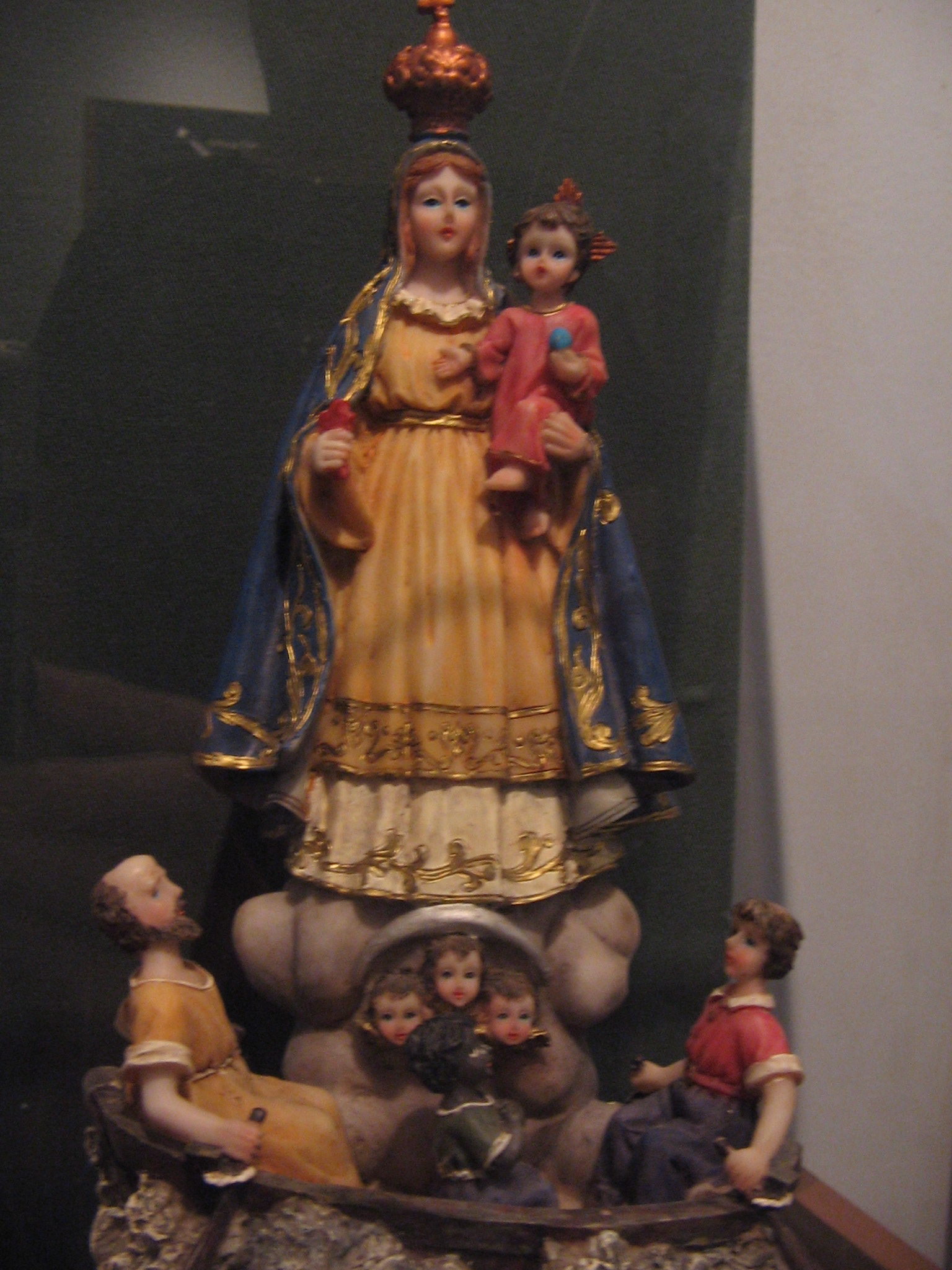
Neustra Senora de la Caridad del Cobre

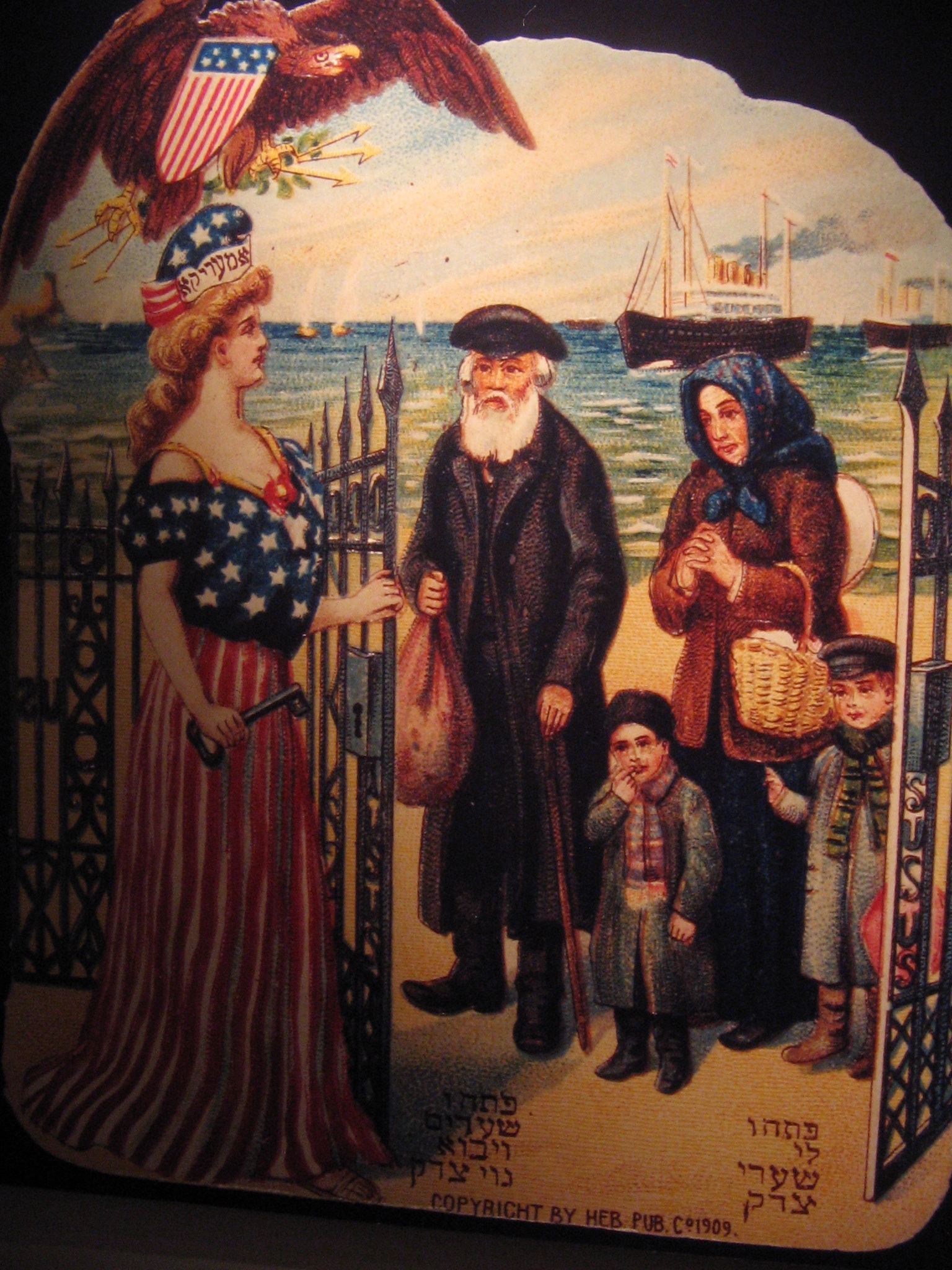
Further along in the same building, in the story of immigration, is the painting shown below. A Jewish family is shown disembarking before a Lady Liberty with “America” written on her crown in Hebrew. The inscription on the sand asks whether the new world has room for the righteous. It is a poignant reminder that acceptance in the United States religious world is often a difficult one. Even today non-Christian religions are viewed with suspicion by many in America. The sea has brought us all together, however, since historically immigration has meant crossing the great waters somehow. One of the gifts of the sea that we are still struggling to grasp is what it means truly to offer freedom of religion to those from far distant outlooks in a world that daily requires less of the gods.
Mystery of Mystic

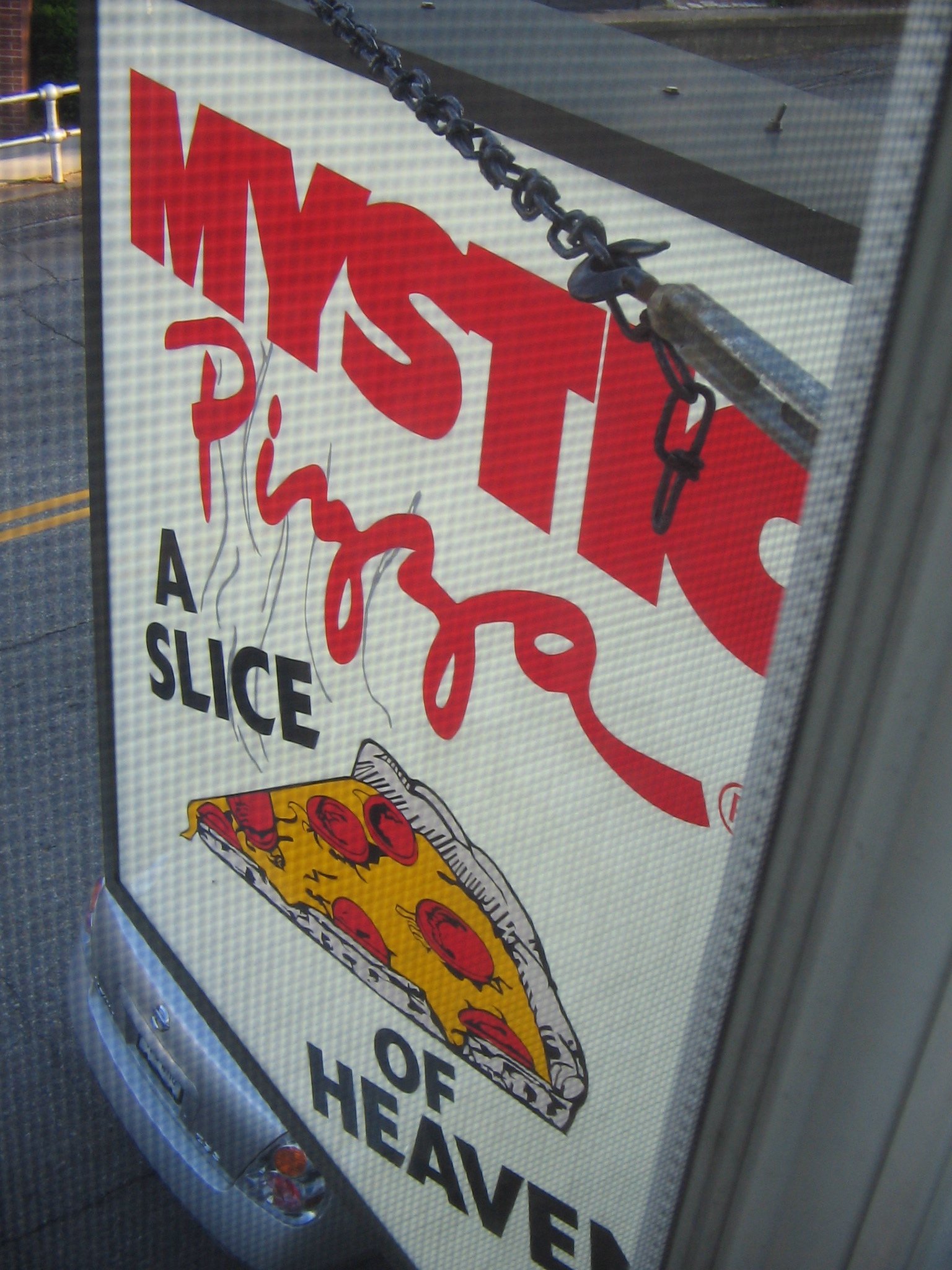
Ever since my school days at Boston University, even before a movie made the town famous, I wanted to visit Mystic, Connecticut. Perhaps it was the draw of the name that evoked foggy harbors and suggested the possibility of some kind of enlightenment. Perhaps it was because Mystic is near the gray waters of the north Atlantic that so captivate me. Perhaps because I am innately attracted by the sense of place. Whatever the reason, since we needed a break from my perpetual quasi-unemployment and my wife’s demanding hours, we have come to Mystic at last. Since traffic was exceptionally heavy, we haven’t had a chance to explore much beyond Mystic Pizza, now an iconic stop for all visitors.

She wasn't there

Curious about the name with its quasi-religious overtones, I tried to find in the town’s literature some hint of its origin. Nobody knows for sure. Like many “American” toponyms, however, Mystic likely derives from native American roots. The suggestion has been made that it means “great river whose water is driven in waves” (missi tuk). To the colonial ear ever alert for religious significance, this may have become “Mystic.” The true origin of the name may never be known.

Religious enthusiasm among early European colonists and their scions further west often inspired quasi-spiritual toponyms. Devil’s Tower and Devil’s Lake (Wyoming and Wisconsin, respectively) had no associations with the dark lord, but rather were locations of spiritual significance for the native populations. Grasping for a way to express this, the best evangelical Christianity could come up with was “Devil.” At least Mystic sounds much less diabolical. As we explore this town I will, by dint of natural disposition, keep an eye open for the religious implications. If I, perchance, uncover the true origin of the name, my readers will be the first to know.


Life Without Dragons

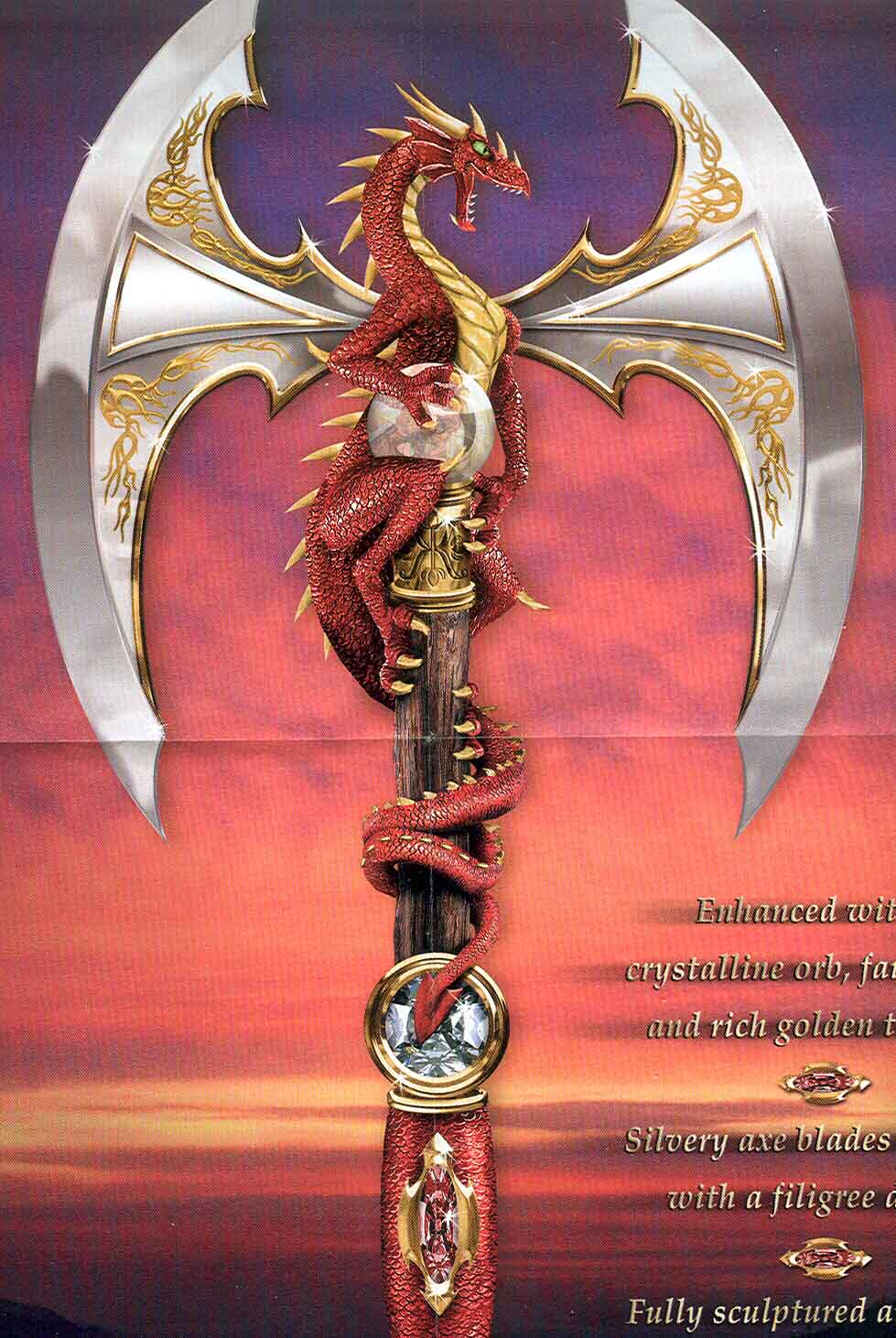
Every now and again, the great cosmic spheres align in their eternal turning and something just right clicks into place on our little planet. Such a juxtaposition must have recently occurred, for just when my worry about dragons had been reaching a crescendo, I received an offer for “dragon bane,” a beautifully crafted double-axe in the Minoan tradition, for only $39.99. The double-axe, or labrys, actually predates the Minoans, probably originating in ancient Sumer. The dragon predates even that.

Labrys dragon style

I’ve posted on the origin of dragons before, but of all mythological creatures dragons are perhaps the most tenacious. In various guises they reappear when we thought that they were gone. They are among the most ancient of feared creatures. Representing the untamed, indeed untamable areas of life, the dragon is the perfect symbol of chaos. Dragons are the disorder against which gods always struggle. Metaphorical dragons are always more troublesome than physical ones.

Although the idea of being a sword-swinging hero out to vanquish the forces of evil is an appealing one, I know that I won’t be purchasing this collectable. I have too much respect for dragons to see them slain by gods or mortals. What would life be without our dragons?


Vegetarian Meat Loaf

I’ve never been a hero worshipper. Perhaps the delusion set in when I realized several years ago that nobody really has all the answers. The “experts” (I’m even sometimes shackled with that designation at times) are limited by the same mental capacity as all Homo sapiens. Our elected officials do their best to find solutions, but at the end of the day oil still gushes into the Gulf, priests still violate children, and unemployment continues to wreck lives. No, hero worship is counter-productive and leads only to disappointment. Not that there aren’t people I admire – there are many – but they have their shortcomings too.

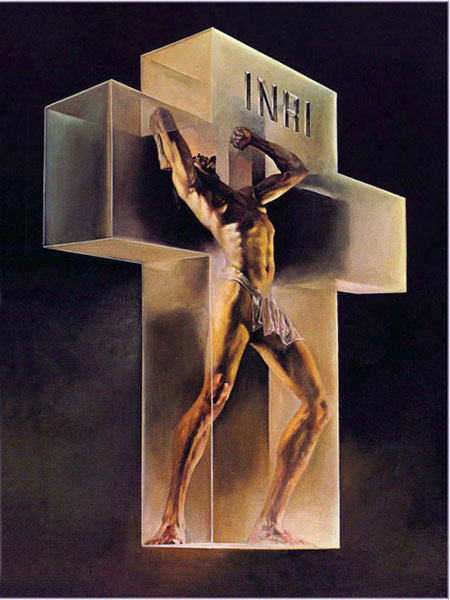
One of my admired people that often surprises those who know me is Meat Loaf. I really don’t qualify as a head-banger, but my tastes in music vary widely. With Meat Loaf the attraction is the sincerity evident in his voice. He may not write his own material, but the man feels the songs he belts out. So it was that I made a rare music purchase when Hang Cool Teddy Bear was released earlier this month. On glancing through the liner notes I was pleasantly surprised to find Boris Vallejo’s Crucifixion among the art.

Boris Vallejo's Crucifixion

Anyone familiar with the fantasy-style artwork in most Meat Loaf albums will not be surprised at finding Vallejo’s work, but this particular piece, reminiscent of Salvador Dali’s “religious” paintings, presents a depth of feeling to the crucifixion that most theologians diminish in their desire for profundity. The Jesus in this piece is sealed within the cross, raging for release. Most devotional paintings show a placid Jesus accepting, with existentialist-type calm, his long-foretold fate. I find Vallejo’s work compelling for the same reason I enjoy Meat Loaf’s performances – there is real emotion here.

Religion has little to offer the world in the way of rationality. Theologians have generally accepted the fact that religion runs counter to reason and therefore its value lies elsewhere. What is left when reason is gone is emotion. When reason tells me there are no heroes left, emotion sometimes convinces me otherwise.


Voices from the Third Estate

Discussions over the past week in that great wasteland we call state government have included talk of actually having millionaires taxed to shoulder a little of the state’s fiscal burden. Naturally there has been a strong backlash in this nation of deeply embedded plutocracy. Those who have their millions certainly feel little social responsibility, since the prosperity Gospel (or its analogs) comforts them with whispers that wealth is a sign of blessing. One of the most evil ironies of all is that many such folk have the chutzpah to cite the Bible as their backer. God loves the beautiful people.

Such virulent misreading of religion shrugs off millions of gallons of crude oil gushing into the Gulf. Petroleum companies breed some of the wealthiest individuals around, and if we wipe out the marine life of the southern coast, well, that’s a small price to pay for individual privilege. Somewhere along the line an unholy matrimony between religion and greed produced the great plague that will lead to the fall of western civilization. This may be seen clearly among the apes.

Frans de Waal, an author whom I’ve quoted before, notes that in ape society when an individual (or individuals) takes advantage of the system, the group eventually brings an end to his (or rarely her) reign. Primate society can only tolerate abuses that damage a community for so long before a collapse is immanent. Consider Rome, “the eternal empire.” Every day politicians posture in the media about how they have the best interests of society at heart. As members of the privileged classes, they have lost sight of what it feels like to live in the constant umbra of the supercilious wealthy while millions have no jobs, no health care, no future. Millionaires owe nothing to the society that allowed them to become rich, for the Bible tells them so. Nature, however, begs to differ.


Religious Democracy

An op-ed piece in yesterday’s paper raised some important issues concerning religion and the unfortunate fall of Mark Souder. The article, by E. J. Dionne, pointed out that Souder once said, “To ask me to check my Christian beliefs at the public door is to ask me to expel the Holy Spirit from my life when I serve as a congressman, and that I will not do.” This pointed affirmation of faith is precisely the dilemma of a democratic system that allows for freedom of religion. All religions (those that are serious attempts to deal with the supernatural, in any case) are defined by the conviction that their practices, their beliefs, their ethics, are correct. When a religious individual is elected, or even converted after election, in a democratic system their religion is given power. With their faith they vote on issues that cut across religious boundaries, binding those who do not agree to their personal faith stance by law.

Europe in the Middle Ages is perhaps the most obvious example of what might happen when one religious body (in that case, the Roman Catholic Church) gains excessive political power. Problem is, these days folks don’t agree on which is the right religion. America was not founded as a Christian nation, let alone an evangelical Neo-Con one. It has become, perhaps because of this fact, one of the most actively religious nations in the developed world. As befits a consumer mentality, religions are offered in a marketplace. Within Christianity alone there are aisles and aisles of churches from which to choose. When a public servant is elected and her or his religion dictates their votes, have we not just lost freedom of religion?

Teaching for many years in a seminary is a sure way of becoming aware of the limited training that religious leaders generally receive (if any). The short time they spend being educated does not equip them to think through all the implications of their convictions. They attain the pulpit and the congressional leaders who happen to be in their congregations receive an inchoate theology confused by their three years earning a “Master of Divinity” degree. Not all are equal to the task. Those religious leaders with promise, often because of internal church politics, end up in smaller venues, their voices effectively silenced. Those with the most strident voices reach larger congregations, often without the humility of admitting that the more you learn about theology they less you know. Their congregants, armed with faulty perceptions of their own religion, burst into their congressional chambers full of conviction based on problematic conceptions. It is a very serious dilemma.

Perhaps what is needed is an oath of office for politicians rather like the Hippocratic Oath for physicians. Perhaps they should swear to put their own religious outlooks in check while considering social issues on which their constituents vary widely. Perhaps their integrity in truly representing the population they govern would lessen the impact of their inevitable personal foibles. And naturally, this oath would not be superstitiously sworn with a hand on the Bible.


Robots and Religion

One of the constant duties I have as a “Robot Dad” (Soccer Mom just doesn’t apply here) is seeking funding for my daughter’s high school FIRST Robotics team. Always a supportive layman in the scientific venture to understand our world, I have encouraged this interest although I am pretty hopeless when it comes to understanding how it all works. So last night I found myself at a fund-raising, public-awareness event at the local minor league stadium. The Somerset Patriots stadium is just down the road, but I’d never been to a game before. I really don’t feel comfortable participating in crowd dynamics; I’d rather sit back and analyze than participate. And I have no real interest in sports. I wondered how I was going to survive being in such a foreign environment for several hours. Then my wife pointed out a, as it were, godsend.

Last night was “Faith Night” at the Somerset County Ballpark. The event was sponsored by Somerset Christian College, “the ONLY licensed and accredited Christ-centered, evangelical, undergraduate college in New Jersey.” Located in the appropriately denominated Zarephath, New Jersey, the small, extremely doctrinal college bought the privilege of a pre-game sermonette. Not too often does a public sporting event begin with references to “our Lord Jesus Christ;” I looked around for him but then remembered he’d been hit by a car just under two weeks ago. One of the administrators addressed the crowd and, trying to capture the elated, anticipatory feel of the moment, compared his college to a baseball game. I was busy handing out fliers and missed the early stages of his rhetoric, but when I heard him say, “third base is love,” my mind shifted to a more familiar baseball analogy I’d learned in high school. I imagined the prospective students’ interest when he went on to declare, “home base is Heaven!”

As two Christian motorcycle clubs solemnly rode their hogs around the field and local Catholic schools hawked their own fliers in competition, the sound system belted out any pop songs that had the word “faith” in them, no matter what the context. It was a circus-like atmosphere. I was surrounded by techies deeply immersed in science and human learning. We, in turn, were surrounded by an aggressive Christianity eager to claim as much territory as possible. Above it all wafted scents of searing flesh and deep-fried snacks. It seemed to me that a microcosm of American life was indeed evident at the stadium last night. Perhaps there is nothing as American as baseball after all.

Lead us not...


Suddenly the Bible

Universities are generally reluctant to hire Bible faculty (except in the case of “Christian” colleges where Bible faculty must be a particular brand of “scholar” who has already decided the case before the evidence is presented). The stock reason given to department heads and deans is that religion just doesn’t make money. Universities thrive on the income from science grants and wealthy business and finance donors who want buildings named after them. Religion, it is claimed, doesn’t bring in money. The real problem is that universities don’t know how to market religion.

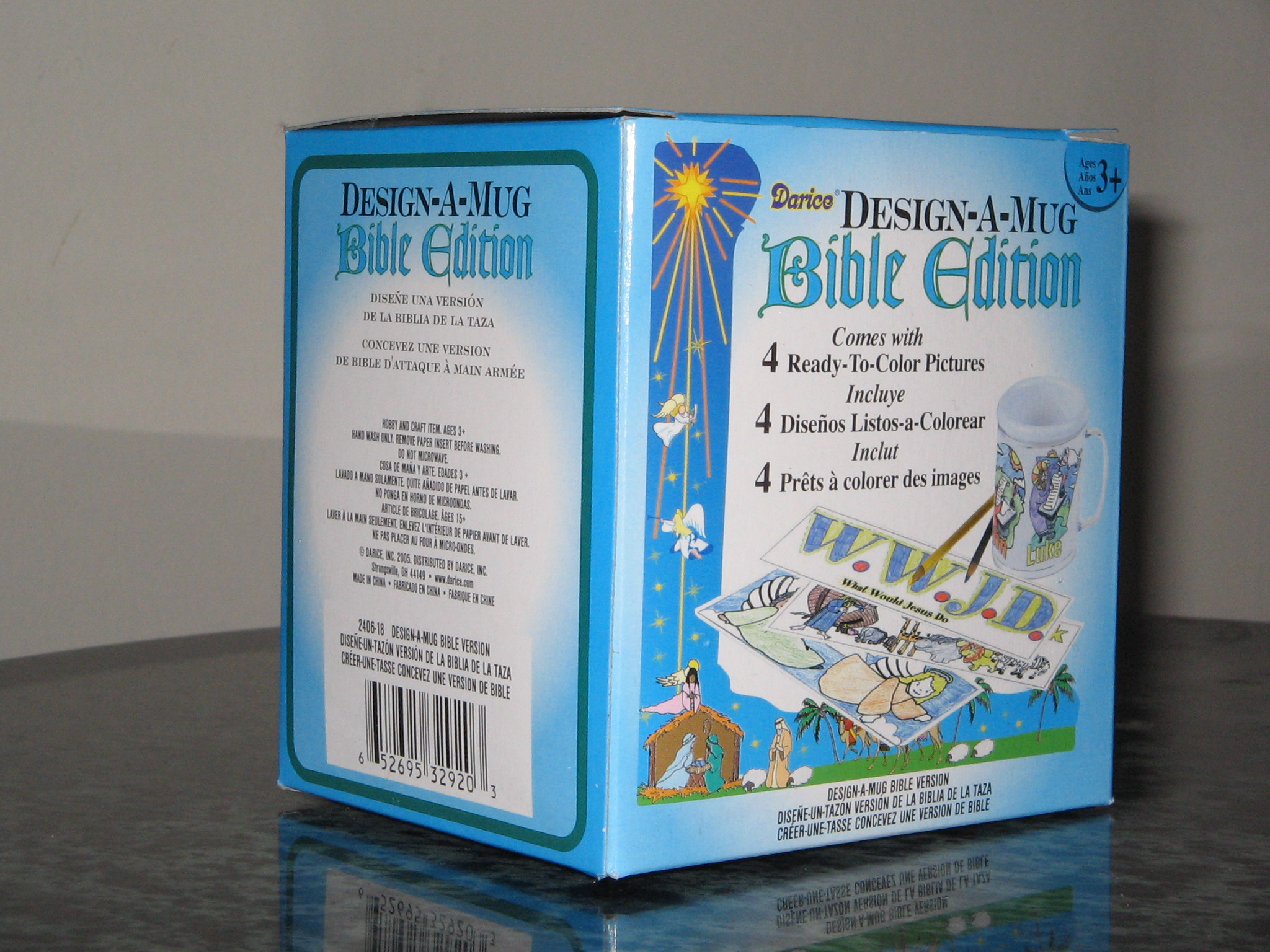
The other day I visited the local craft store to pick up supplies for a project my wife is working on. While in line I spotted this novelty item:

God in a box?

The shelf was full of them. When I returned later in the week, the supply was severely diminished. Someone had reasoned, correctly, that by putting a cheap length of paper-roll with “biblical” designs printed on it in a kit for making a throw-away mug, it would sell. Obviously universities and colleges couldn’t stoop to such a level, could they? Isn’t it far more respectable to draw your finest students into a mega-stadium to watch guys in tights throw around a fake pig-bladder and emerge drunk enough to vomit up all the costly snack foods they purchased? This is, after all, where the leaders of tomorrow are formed!

While looking up a troublesome word I can’t spell in an online dictionary, I was intrigued by this promotional inset (click to see). All I had done was type in a word on the Merriam-Webster site (it was not a biblical word), and when the answer popped up, so did this self promotional add for “Kiss of Death, Feet of Clay: Words From the Bible.” I don’t pretend to know how online advertising works, but it was clear that Merriam-Webster wanted the cyber-visitor to linger on their site, and the Bible was an effective way to achieve this.

The Bible is all around us. It would be difficult to nominate any other icon that would better illustrate American social self-consciousness. So immediately the sophisticated academic shuns it. Those of us who’ve put our lives into trying to understand the Bible phenomenon are deemed useless as money-makers while our counterparts in marketing and sales laugh biblically all the way to the bank.


Awaiting the Evolution

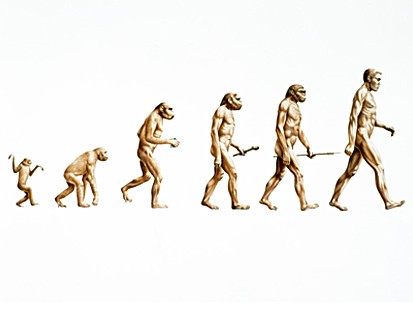
My daughter’s taking the mandatory New Jersey high school biology tests this week. Probably designed to ensure that basic health risks are factored and understood, it is one of the few bulwarks of the correct teaching of evolution in the United States. As anyone who follows my college Michael Zimmerman’s blog in the Huffington Post realizes, Creationism is a constant menace to our country. Although many simplistically assume that the threat is gone, it is, alas, sleeping but not dead. Perhaps quiescent under the administration of a moderate president, the Creationists have not gone away. I fear an imminent backlash along with popular apocalyptic hype for the year 2012. The Creationists are out there, just beyond the perimeter fence. I can feel it.

Having grown up under the umbra cast by the Creationists, I know their resiliency well. In a high school current events class, I participated in a Creationist-Evolution debate that classmates still remember some three decades later. It would be a situation laughable if it weren’t such a serious threat. While society has continued to evolve since Scopes, most Americans are still convinced that there is something insidiously evil about evolution, as if the devil generated the first simple cells and set the entire process running. In a society where Creationists daily benefit from the advances of science – as any search for evolution on the internet will demonstrate – they hold their feet firmly on the brakes nevertheless, awaiting a snow-white stallion at the parting of the literal clouds overhead.

I am not alone in foreseeing this whiplash that’s about to come. Many analysts who know the radical Evangelical camp share my fits of nerves and jitters. The educated elite suppose they’ve been eliminated, but those of us who know the world of the uneducated faithful tremble with a fear not inspired by the Maya. Sarah Palin is one of the most popular people in this country right now, and the Creationists, I assure you, are already staring at their watches and counting each passing tick.

Neo-Cons marching straight to the polls


Giving Lilith Her Due

Lilith Fair has announced its 2010 tour dates and excited fans are already purchasing tickets. Lilith Fair is a collection of women artists who share a stage to showcase the female contribution to contemporary music and donate a considerable share to charity. The event name, of course, is taken from the mythological character of Lilith. Popularized as a rare example of “Hebrew myth,” Lilith is a character who likely derives from ancient Mesopotamia, although her origins are obscure. Best known as “Adam’s first wife,” her somewhat sexy story in Judaic tradition evolved into Lilith being the original woman. Unlike Eve she was created simultaneously with Adam. Things were fine until she wanted to be on top during intercourse – males were not made to be dominated, according to patriarchal old Adam, and Lilith ships out to shack up with Satan. She is demonized (literally and figuratively) and becomes the “night hag” that snatches babies and claims the first right of intercourse with every male (an etiology for nocturnal emissions). She becomes the mother of demons.

This story shows all the traits of a late development, but the idea of a strong female figure in Eden is an appealing one. Lilith has come to represent the empowered female, and the modern trend towards accepting her as an icon of feminine independence is apt. Long ago I was intrigued by the female side of the story. Perhaps because I was raised primarily in a single-parent family for my formative years, I have always wondered about the disparity in our “advanced” culture that still considers the male as the “default” model with the female as kind of an adjunct after-thought. This fascination led me to the study of goddesses in the first place, culminating in a doctorate on Asherah. In the Bible men have Adam, Noah, Moses, David, and countless other role-models – even God himself according to standard interpretation. Why not admit the goddess?

It is telling that when Lilith becomes too powerful she is presented as evil. Anthropological explanations have little to offer by way of adequate explanations for such a development. Not to blame biology (or to lay claim to an excuse), but Frans de Waal’s Inner Ape demonstrates that males are hopelessly paranoid about showing weakness. Female primates tend to express their power by group cohesiveness while males try to blunder their way to the top with brute individualism. Adam had nothing to fear from Lilith. To those who perform in Lilith Fair, I only have to say, “Rock on!”


Expect a Miracle

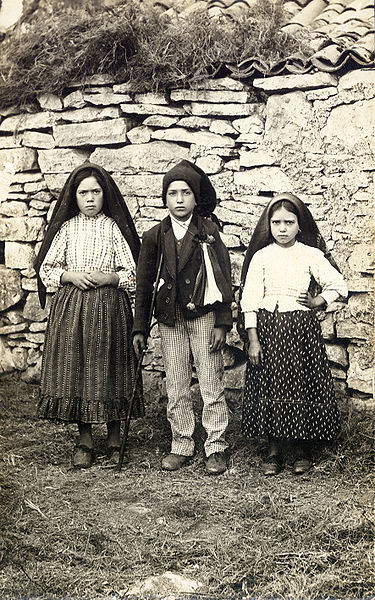
The Pope has been in Portugal. No visit to Portugal would be complete without a stop at the shrine of Fatima. Named for one of the most fascinating characters in Muslim history, Mohammed’s strong daughter Fatima, this small, centrally located town had no claims to fame until 1917. Suddenly three children declared that the Virgin Mary had appeared to them while tending their sheep. The story is about as eerie as the canonical photograph of the unsmiling youngsters. Their sincere proclamations were met with acceptance by many war-weary Europeans and predictions began to emerge from these visions. On October 13 that year some 70,000 pilgrims alleged that the sun itself danced, twirled, and took on new colors. Astronomers reported no solar anomalies at the time.

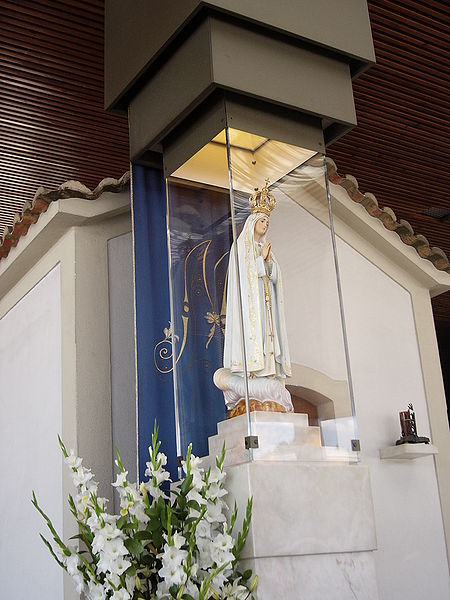
The events at Fatima have fascinated both religious and secular explorers of the supernatural. The religiously devout claim nothing shy of a miracle while those seeking more dramatic non-theistic explanations claim that aliens were behind the show. Whether or not a physical event transpired, something out of the ordinary occurred in Fatima that day. Now a permanent shrine graces the location. If the apparition appears again, she will be comfortably housed in doors, out of the elements. She might even see one of the bullets fired at Pope John Paul II during the famous assassination attempt. Many believe the Pope’s survival was itself a miracle.

Gnu version of Virgin under Glass

Now Pope Benedict XVI has visited the shrine where heaven once touched earth. Afterwards he climbed into the Popemobile, the motorized bullet-proof reliquary that allows papal viewing by the faithful while protecting Rome’s most valued asset. The message is clear: it is wonderful to believe in miracles, but it is prudent never to trust in them. Two of the three children (Jacinta and Francisco) died before they reached twelve, felled by the famed Spanish Influenza. The miracle that could have preserved their young lives never occurred. Lucia alone survived to 97. Expect a miracle? The odds are hard to predict on that one.


And With Perfect Teeth

This week drug stores across the country will begin offering a testing product that will help assess genetic predispositions to various diseases and weaknesses. Potential parents might learn what debilitating illnesses could plague their children. Who wouldn’t want to eliminate needless suffering and create a world involving less pain and wasting away? Who wouldn’t want to know in advance? Ethicists are up in arms for such knowledge is surely a dangerous thing, just like an overcrowded lifeboat.

Ancient peoples had their own way of dealing with such dilemmas – blame the gods. Disease was not the result of genetic predisposition or even microbes. Illness, plague, pestilence and degeneration were the punishing weapons in the arsenal of ill-tempered deities who didn’t really understand what it was to be mortal. In Ugarit the archer-god Resheph was the divinity who brought pestilence. Shooting from afar with his fiery arrows he could topple cities and nations. Yet few prayers to him are recorded. Better to appeal to a higher power, an outranking deity who might overturn random suffering.

With the loss of many gods comes the loss of the right of appeal. Should the one God be the one who sends disease, to whom can prayers be offered? For many prayers to Jesus or even to Mary are made to circumvent the sad lot poured out upon a destitute humanity by an implacable father. People now recognize genetics and microbes, but still talk to the spirit world about woes and fears. Starting on Friday, however, there will be a product locally available that might provide relief in advance. Who’s willing to take on the gods and give Pathway Genomics a try?


The Death of an Art

In most ways, I enjoy progress. Having electronic communication has spared the lives of many innocent trees, information may be had quicker, and ideas can be freed from the sometimes narrow constraints of staid publishers. (On the other hand, it has given internet users way TMI, some of it not worth the double-click.) There is, however, no comparison to holding a book in your hands. I grew up with cheap paperbacks with their brittle, brown-edged pages and their cadre of book-mites, but many happy memories have accrued to those hours of reading. I never much cared if the books were pristine, as long as they were legible. As intensive reading became a major part of my career aspirations, I started to notice the quality and longevity issues of books. Hardbacks were more durable, but less portable. Some were artworks in themselves.

I was disappointed, therefore, when I recently ordered an Oxford University Press book and I discovered that it had been done Print on Demand. Having worked nearly three years for Gorgias Press, pretty much a strictly Print on Demand publisher, I immediately recognized the hallmarks of this quick and easy way of keeping books in print – inferior print quality and image replication were dead giveaways. The truly disappointing part of the scenario was that this particular book has an intensive discussion of artifacts shown in their grainy, low resolution PoD reproductions. I realize that even large publishers save immense warehousing costs by supplying on-demand titles after an initial print run sells out, but when it compromises the quality, in part the raison d’être of a book with illustrations, some troubling issues are raised.

It seemed when I was young that no matter which copy of a book – barring obviously defective tomes – I picked up, the contents were virtually identical. The industry standard, offset printing provided many identical copies of good quality relatively cheaply. With Print on Demand, books can be outsourced to different vendors and interiors can vary considerably. I saw this all the time while checking proofs at Gorgias Press. PoD also means that little changes can be made between “print runs” resulting in different copies of the same book having variable text. The compulsive footnoter in my veins starts clutching his little chest. When books move from a print run that can only be altered by a new edition to a PDF that can be adjusted between each individual copy, I begin to wonder about the stability of the written word. I’m still enjoying my OUP book, despite the uneven printing and the grainy pictures. But deep inside I fear that rewriting history has become much, much easier.


What’s in a Name?

Two of my readers sent me an article yesterday about Lord Jesus Christ, the Massachusetts man who was hit by a car. Lord Jesus survived the brush with death this time. Clearly the angle on this story is the human interest aspect instead of the courtroom precedent or the political scope of its ramifications. In our minds, if we’re honest, we’ll admit that we’ve already come up with a profile for a man named “Lord Jesus Christ.” We’ve already judged him and determined his motives in legally taking such a name. This is a book to be judged by its cover.

From a purely semantic point of view, the victim’s name would probably have more impact with the definite article: The Lord Jesus Christ. As it is, the name differs only in degree from the thousands of Chrises out there, of either gender, or the many Hispanic men named Jesus, or those Anglos with the surname Lord. Not to mention all those Joshuas. Our names are the labels that others immediately use to prejudge us, although mostly our names come from our parents, or sometimes spouses. We are known through life by tags branded on us by parents who have no idea who we will become. As the non-adopted step-son of a second father I changed my name and I know the baggage that goes with such a change. The burden became so great that I reverted to my birth-name after college. I felt like I had been living a lie for much of my youth. What’s in a name?

Our injured man with the newsworthy name has not yet become the savior of the world. Some religious folk are offended by his appellation, yet most of us would be flattered by someone naming their child after us. Why not aim high when it comes to names? If we are to be judged by our verbal moniker, why not select one that states our point of view? With religiously motivated terrorism on the ascendant, however, it gives me pause to think about Lord Jesus Christ being run down. A man was injured here, while crossing the street. It could have been anyone. If it hadn’t been for his epithet, the story would not be national news. More than anything else, this may reveal the significance of the name.

A message from on high?


Ch-ch-changes

Podcast 20 is here! For those who are wondering, it was a long semester with daily class prep, so I did not have the opportunity to record any podcasts. The topic of this discussion is how religions naturally must change over time. Even though religions are by nature conservative, if they last long enough they will face advances in human culture and experience. This creates a dilemma that is not often addressed. It’s evolution on a religious scale.