The Call of the Apocalypse

In discussing various polemics against religion, such as those by Christopher Hitchens and Bill Maher, I have frequently stated that they have a point, but they have ignored the good that religion hath wrought. It is like an Anti-Julius Caesar – the good is oft interred with the bones. Then the news goes and validates their polemic. The arrests yesterday of the leadership of the Christian militia calling themselves the Hutaree (I’m sorry, but it sounds like a happy Boy Scout gathering) highlights once more the danger that religion poses to an already unstable society. I’d not heard of the Hutaree before, and chances are I would never have heard of them had they not plotted an apocalyptic war against the United States’ government that landed them on the front page.

Few people are willing to admit just how dangerous apocalyptic thought is, or how deeply rooted it is in American politics. Tracing the roots of this form of belief is not difficult – apocalyptic first appears in the Bible when revelation through prophecy met and mated with Zoroastrianism’s dualism. The offspring of this union was the belief that a new, and better (!), age was about to dawn. God would usher in an era of peace, but it had to be precipitated by an era of war. Presidents drawn from the Religious Right have held this belief. Some have even eagerly begun wars in hopes that this ancient Afghanistanian religion would lead to the Christian apocalypse. At least the Hutaree were up-front about it: they believed that armed conflict with the government would flush out the Antichrist and usher in the end.

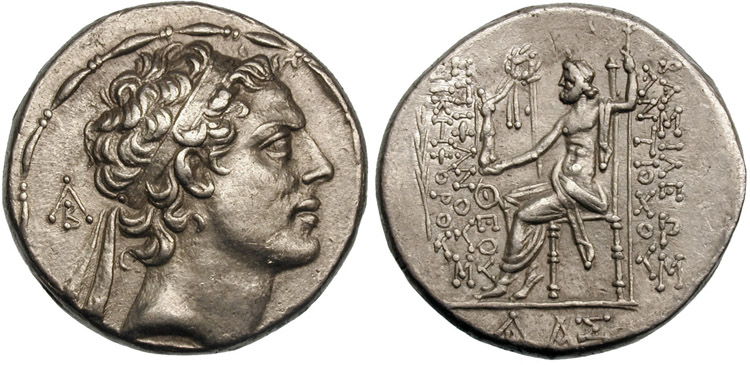
Last night in my Prophets class student questions indicated just how much interest there is in apocalyptic. We live in an era when information is all-too-easy to find, and yet many otherwise intelligent people believe that a hidden knowledge about the future is available in the Bible. It is not. For those who have ears to hear, Daniel was written about Antiochus IV Epiphanes. Revelation was written about a Roman emperor (perhaps Nero or Domitian) who threatened nascent Christianity. The apocalyptic battle was already underway. The future they longed for was peace. Modern apocalypticists see all of this as future prediction and believe that they must start the war. All of this makes me feel strangely vindicated. The FBI and other government officials are starting to demonstrate an awareness that to prevent religious extremism you must understand it. Now if only universities would catch on and realize that the study of religion is vital to national security I might end up with a full-time teaching post after all.
The original Antichrist

Civil Rights and Science Fiction

I remember reading L. Ron Hubbard’s science fiction before the Church of Scientology was widely known. Not surprisingly, the religious movement began in New Jersey – a state where anything seems possible (except finding a job or having a stable government). Over the weekend, however, a New Jersey Star-Ledger story noted that some former members of the Church of Scientology are trying to sue their religion for violation of labor laws and unreasonable pay. Lawyers predict such a case cannot win in court, and I personally wonder how such cases of enforced labor differ from other brands of organized religion that require that extra push from their members. Doesn’t the church reserve the right to demand, voluntarily of course, that citizens forfeit their legal rights?

When I was young and naïve (instead of being old and naïve, as I am now), I took my first teaching job at Nashotah House. I was not yet thirty. It was, of course, a conflicted situation: a bunch of men living in the Wisconsin woods trying to maintain a monastic presence nestled between the sinful cities of Madison and Milwaukee. (And a few women, always the minority of the student body collective.) One of only two non-clergy on the faculty, I was surprised when, in response to what was an unreasonable administrative demand I was told, “When you signed your contract, you gave up your civil rights!” I’m not a lawyer, but I learned an important legal lesson – never mess with the saintly sorts that make up the church administration. Religion is big business. And religious bodies can afford big lawyers.

I feel sorry for the plaintiffs in this legal dispute, but they are in a wide and vast company. Organized religions are human constructs, and human constructs will always favor climbers. Climbers who reach the top will always build fortresses to protect their personal interests. In the church they’ll call it ecclesiastical authority and trace it right back to Jesus handing Peter some metaphorical keys. No, the church is not above the felonies and misdemeanors that secular courts just can’t judge. Potential members should read the contract, including the fine print. And don’t be taken in by the bits that sound like science fiction.

Inventor of new worlds


Heavenly Visitors

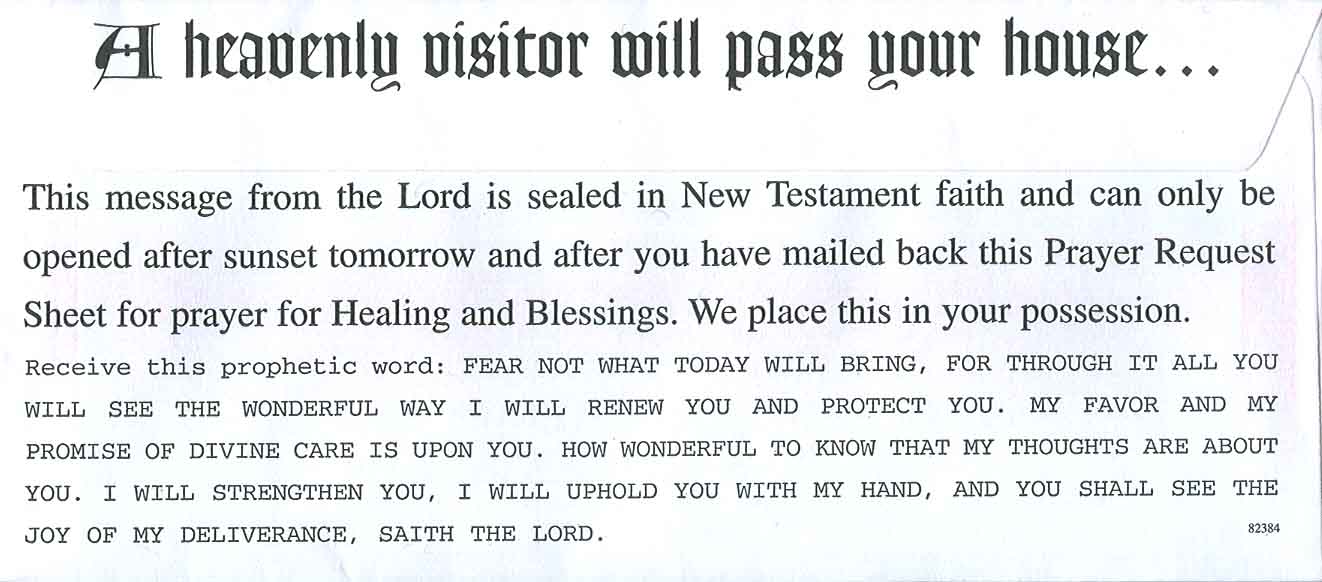
With Passover hard upon us, I was a little disturbed to receive a letter on Friday that read, “A heavenly visitor will pass your house…” Having been raised on the sturdy fare of Exodus, I knew that heavenly visitors more often take the form of marauding angels than of jocular Santa Clauses. It seemed an ominous warning. Of course, it came from the Saint Matthew’s Churches that sent me such good wishes of divine promises of prosperity some months back, so I had to assume it was a purely coincidental biblical reference. The folks at Saint Matthew’s Churches are, after all, Bible believers.

Perhaps because of that fateful letter, I dreamed, in good Genesis style, a dream two nights ago. I dreamed that I found a dollar coin on the ground at a family outing. A few feet away lay another. And another. Wherever we went in that Morpheus-bewitched town there were silver dollars unclaimed on the ground. My trousers were being dragged down with the weight of the lucre in my pockets. I couldn’t believe my good fortune! Then I awoke, still employed only part-time, still worrying every minute about whether we can meet all the bills. Perhaps the dream was a message? Should the Saint Matthew’s’ folks be right, prosperity was headed my way. Saturday’s powerball jackpot was in the double-digit millions. I very rarely play the lottery, but since state education in New Jersey needs all the help it can get, I offered up a dollar to see if Saint Matthew’s’ prosperity was at hand.

No. Not even one number came close. Perhaps there is a secret clause in the prosperity gospel contract. Perhaps those who prosper must hold certain conservative views on social issues. The views, say, my mother holds. Yet she lives in a trailer on a severely circumscribed income. That doesn’t seem to be it either. Last night I awaited another dream. Instead, the next-door neighbors were holding a loud party until 3 a.m. Perhaps celebrating Palm Sunday? Or perhaps that was the heavenly visitor passing over for Passover a couple of days early? Either way, I didn’t sleep well last night knowing that something was just outside my window.


Jesus Lets Himself Go

Leonardo da Vinci's Last Supper


Carpentry is hard work, as Jesus must have known. The occasions when I head to the basement and chew through wood with an electric saw and nail boards together through pre-drilled pilot holes always leave me feeling like I’ve burned a few calories. Not to mention walking everywhere. No Hondas, Volkswagens, or Smart Cars in those days. A guy could sure build up an appetite. My wife pointed me to Newsweek’s blog this week, where a story about the portion sizes portrayed in paintings of the last supper over the past millennium is posted. The conclusion drawn: the food servings have continued to escalate in size as food production and acquisition have become easier.

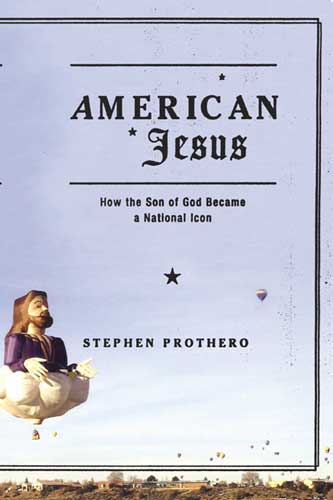
This is not so surprising, given that what people value is what they portray in art. As I’ve mentioned before, Stephen Prothero, in his book American Jesus, demonstrates that portraits of Jesus reflect the self-perception of the society in which they are produced. Few attempt to make a life-like representation, largely because no one knows what Jesus might have looked like.

Jesus as an ordinary guy

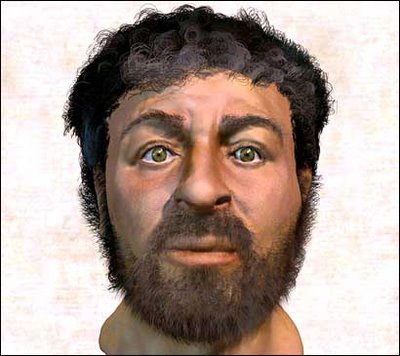
A few years back, Richard Neave, a retired medical artist from the University of Manchester reconstructed, based on forensic research, what he believes Jesus likely looked like. The portrait is not handsome, and to be fair, not based on the actual skull of Jesus which has been missing for a couple of millennia. I used to ask my students in Intro to Christianity what difference it would make if Jesus was not good-looking. They tended to react strongly – particularly those of Christian disposition – there was an inherent blasphemy in suggesting that Jesus might not have been drop-dead handsome.

Now, if we gently push his chair back into that fateful table one more time, we might wonder how an overweight Jesus might appeal to those who struggle with weight issues. More of him to go around, as the saying goes. I’ve viewed much religious art in my time, but I’ve never seen a love-handled Jesus, let alone a chunky savior. And perhaps that is the biggest miracle of all, given that he eats more each passing year.


Mournful Metaphor

Sometimes the concept is great but the results disappoint. Those who have followed this blog know that a unifying concept over the past half-year has been the often hidden relationship between religion and monsters. Certainly this fascination has its roots in my refusal to admit that I’ve grown up, but with the popular media pushing the undead into our collective consciousness on a daily basis I feel a happy vindication. I posted last week about Seth Grahame-Smith’s new book, Abraham Lincoln: Vampire Hunter. Well, now that I’ve finished the book I would say that the jarring concept of our most honored president leading a secret life was fun to wrestle with, but the book failed to win me.

Lincoln’s great contribution to our nation is still echoing through a society slow to admit the equality of all. Perhaps that fact alone would render any book trying to throw some comic relief on a deadly serious issue mute before it even begins to spin its yarn. That, and I didn’t like the portrayal of the vampires. I’m no undead purist, and I’m aware that vampires have changed form and character over the centuries, but having masses of them in one place felt like being the proverbial cat-shepherd. Giving them political ambitions, with a nod to Francis Ford Coppola’s Bram Stoker’s Dracula, was too much. The issue of slavery, clearly the metaphor being utilized by Grahame-Smith, is hard to smile about. Lincoln’s personal suffering is difficult to lighten with his career as a vampire hunter. The story just didn’t work.

I’ve had enough bumps in my own life to eschew easy categorization. Even my current career must be listed in the TBD category. Nevertheless, I wasn’t sure if what I was reading was a serious attempt at a novel or a humorous exploration of a funny idea. I found the book catalogued in humor, but its narrative seems to have the earnestness of a determined novelist. When the story ended I felt as if I’d read a dime-store novel I’d purchased at Comedy Central. And with the headlines the way they are these days, I’d been hoping for a good laugh. Instead it seems that I have been bitten by a vampire wearing shades.

Two heroes, no smiles


Grounds for Sculpture

Few people would deny that religion and art share a common heritage. Some of the earliest human art was religiously motivated (I would contend that cave paintings and Paleolithic figurines were religious objects), and much of the contemporary art scene derives its inspiration from religious motifs and constructs. Not all art is religious, however, and not all religions are friendly toward art. Nevertheless, there is a tangible connection.

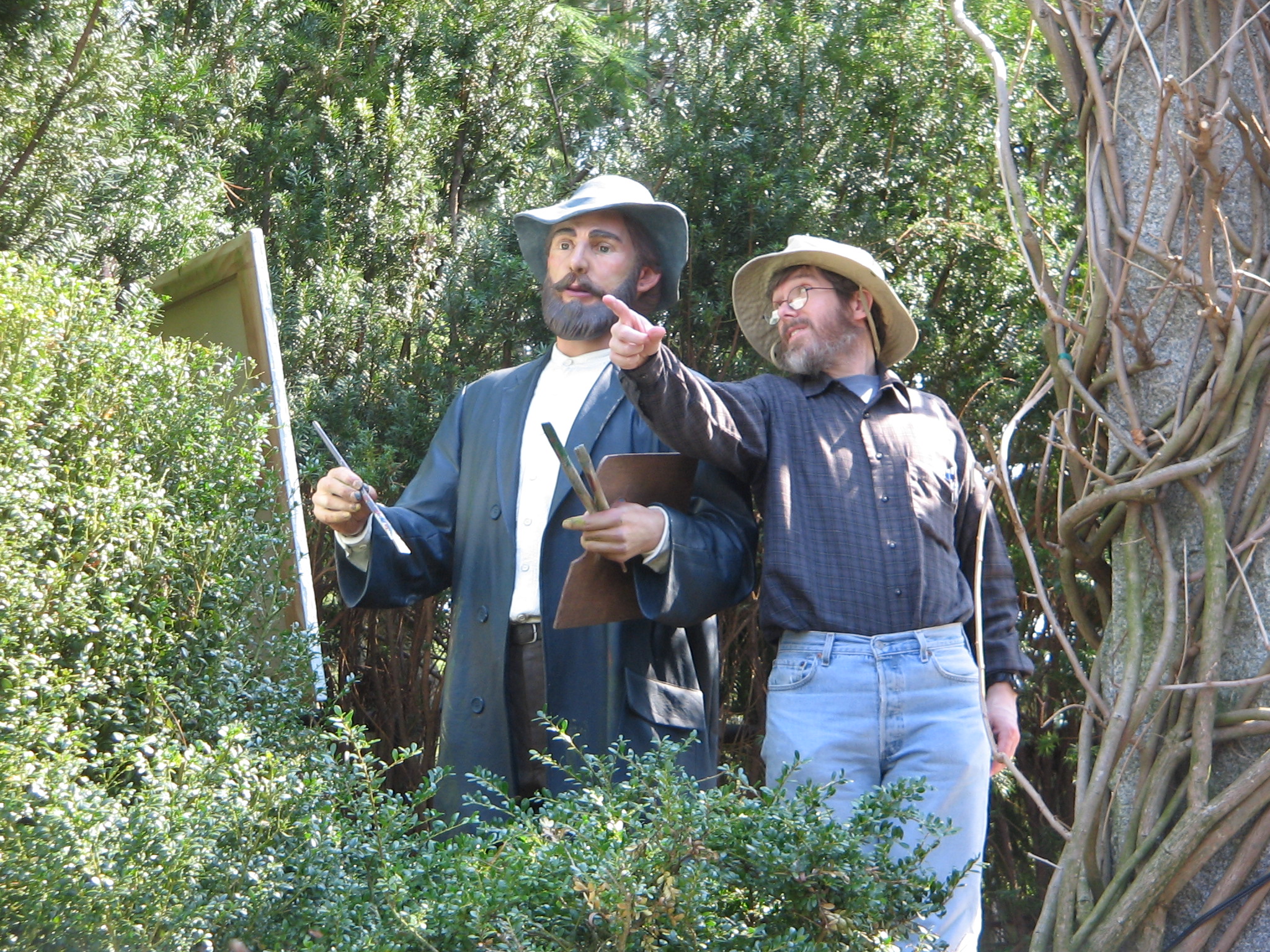
This weekend was uncharacteristically warm and sunny for a New Jersey March. This led us to take our visiting family to Grounds for Sculpture, one of New Jersey’s often overlooked treasures. Built on the remains of the old State Fair grounds in Hamilton, this park houses an impressive array of outdoor sculpture that is contemplative, innovative, puckishly funny, and even a little weird. It reflects the human experience. My family and I have been there multiple times, appreciating the sculpture from new angles, discovering new pieces, and seeing it all through the eyes of others.

Taste in art is highly personal and individualistic. Just like religious sensibilities. Both art and religion seek to make the human soul accessible to others through profound expression. Several of the sculptures in this unique garden bear biblical titles or suggestions, but they may be enjoyed as secular pieces of expression as well. Here is where art is superior to religion: it does not insist on any single way of expressing the truth. Sometimes, it seems, art may actually attain what religion only aspires toward.

Monet listens attentively to a dilettante


Be Careful Little Hands

“Time is always against us,” Morpheus informs Neo in The Matrix. Of course, this is a paradigm for life spinning out of control, an allegory of having been taken over by forces against which there is no defense. It surprises no one that as time continues its inexorable march there will be generations that see the same phenomenon in very different ways. In last week’s Time, Nancy Gibbs’ essay addresses the differences between the millennial generation and those of us who are, well, not to put too fine a point on it, older. Her observation on their religious sensitivities is worth noting: “millennials” are just as religious but less conventional, with 1 in 4 having no religious affiliation. They nevertheless remain a deeply spiritual bunch.

Neurologists continue to study the “hardwired” aspect of religious belief, finding that human brains possess a genuine need to believe in something. Why not god? It is, after all, our cultural matrix. As I read this I reflected on ancient religion. Often students ask me what ancients believed. We don’t really know. Religion as a belief system only arises when monotheism emerges: if only one religion is correct, then it is possible to believe in the wrong one. There is no empirical way to test religious claims (yet) and so modern people equate religions with belief systems.

Ancient folk were much more practical. Religion was a matter of praxis, not belief. If you did what your local gods demanded, you’d get along for another day. Modern people peer deeply into the divine realm and make long-term plans based on the assurance of correct belief. Neither method, however, ultimately works. The millennial generation may be on the right track back to that old time religion. According to Gibbs what they’ve lost is faith “in the institutions that claim to speak for [God].” The idea of an all-powerful guy out there purposefully keeping us guessing while refusing to demonstrate the truth plainly for all to see is strangely outmoded. Religion becomes a matter of correct practice, as the old children’s song goes, “Be careful little hands, what you do – for the father up above is looking down in love, be careful little hands, what you do.” Millennials may rightfully wonder who this “father” is, but there is no question that there is someone out there watching what they do. Or else our own neurons conspire against us. The more we learn about the nature of religion, the less we know.


Asherah in Australia

It has been one of those weeks dominated by a lady from my past. Asherah. Just when I thought I could forget her and get on with my life, she has reappeared with a fury. The problem is, I haven’t kept up with where she’s gone over the past few years and we all know what kinds of problems society has out there. Turns out she’s in Australia. At least according to a comment left on one of my old posts about Asherah. The author of the comment provided a tip that led me to abovetopsecret.com, a conspiracy theory website. One of the threads is from Brian Leonard Golightly Marshall, a man who claims to be the messiah – apparently he’s returned with his spouse Asherah, in her form of Mary Magdalene. Also, he states, Prince Charles is the anti-christ.

The internet has provided a forum not only for the serious exchange of ideas that help shape the future, but also a soapbox more massive than any other. In general I don’t believe conspiracy theories – just this week my daughter came home from school with news about Disney’s alleged subliminal smut, leading me to recall the hysterical claims made about the New World Order. The more things change, the more predictable they become.

So, is Asherah down under, waiting for a new apotheosis, or has the collective imagination of the internet just taken over? I’m not the one to judge. Nevertheless, while doing a little web research on Asherah I discovered that Asherah greeting cards are now available. They’ll have to wait until I find a job, however. Maybe once that happens I’ll also be able to afford a trip to Australia to see the goddess I’ve researched for so many years.


Under G-d

In one of the great showcases of civil religion, the Pledge of Allegiance is again in the news for its brash statement, “under God.” Lawsuits have been introduced in California to try to label the statement as unconstitutional – state supported religion, a declaration that the United States is a theistic country. Even as a child, a religious child, no less, I was vaguely disturbed by the Pledge. I am a sentimentally patriotic American, and I begrudge no one that natural feeling of pride in their heritage. We all come from somewhere, and we like to think the best of ourselves, and therefore our forebears. I’ve tried to trace my ancestry and find that with a sole exception on a great, great-grandparent’s exodus from Germany that my roots are hopelessly lost in long generations of northern European expatriates that have been on these shores for well over a century and a half. Some even more. And yet, to pledge allegiance to a flag? As a student of religion, I understand the value of symbols, but I always felt that a hand over the heart while addressing a banner was a little like idolatry.

Well, I’ve grown up since then. I spent three years abroad, and returned with a renewed appreciation of how much this country has to offer. I’m still a little puzzled by the “under God” bit, however. Sure, America’s founders were generally deists (not Christian by any recognizable stretch of the definition), and since God is assumed, why not add him to the books? But God was only added to the pledge in 1954. In the heat of McCarthyism it seemed important to fly our “anti-communist,” theistic colors high for all to see. And yet, we never define who “God” is.

The God of the Bible has a name. Every semester I find students that have difficulty grasping the idea that “God” is not the name of a deity – it is only a generic title. It could be anybody divine. Shiva, Zeus, or even Baal. In the written work of many of my students from the Jewish tradition, the reverence accorded to the deity’s personal name has been transferred to this innocuous title. In essays and papers I frequently find reference to “G-d,” as if the Torah commands never to make reference to deity at all. So, out of reverence to the same divinity we have some citizens leaving out the lonely vowel of a one-syllable deity while others loudly proclaim that he (never “she”) must be kept in the little bit of civil religion we impress on our public school children. We don’t agree, as a nation, on who “God” is. Reading the rantings of the Religious Right with their tea parties and Conservapedias, I’m sure that this is not the G-d of the Bible. What does it mean to be a nation under a deity we don’t recognize?


Emasculating Science Education

American lags behind. Tough words to read, n’est-ce pas? America lags behind in science education. Even nations as “conservative” as Tajikistan teach evolution in their classrooms without question while the United States just can’t seem to accept the facts. The fault, with no question whatsoever, lies with a very narrow Christian interpretation of the irreconcilably contradictory creation stories that open the book of Genesis. This fact has once again come to an ugly head in New Jersey, among the bluest of states. Our, gulp, Republican governor has recently nominated Bret Schundler, a supporter of school’s rights to teach intelligent design, as state commissioner of education. I shudder.

As I teach classroom after classroom of Rutgers students, there is neither biblical nor scientific basis for Creationism. Creationism is a neo-Christian chimera forged together by political pundits who believe that if evolution is stopped in its factual tracks, America will revert automatically to the pre-hippie days of the 1950s where authoritarian dads with conservative haircuts barked out the family marching orders and saw everyone to gospel-hymn-singing churches each and every Sunday. It is a myth, they assert, that is worth believing.

The problem is that facts don’t evaporate simply because nabobs don’t like them. At the FIRST Robotics competition I attended this weekend, facts were presented. The facts are that America has fallen far behind in science education. Decades of fighting the pointless battle of Creationism at the highest political level in this country have weakened us. Those who study the Bible seriously do not question evolution. Those who study science at all cannot seriously question it. Those who do dig trenches of doubt in the minds of generations of Americans with an already inadequate understanding of science and suggest that maybe there is reason to find an atheistic plot behind evolution. There is no plot, only facts. And if New Jersey is about to join the Kansases, Arkansases, and Texases that see big cars, big oil, and big daddies as the solution to our social ills, it may be time to move to New Hampshire.


Horror and Head-colds

Religion is such a pervasive vehicle for movies, whether disguised or blatant, that pointing out such connections might seem too easy. Finding these connections in horror movies is child’s play since religion constantly probes our deepest fears. Trying to get over a lingering head-cold and suffering from lack of sleep, I pulled out Ken Russell’s 1988 film, Lair of the White Worm. The film itself is not unlike a Nyquil dream, disjointed with sudden shifts of setting and context. The immediate connections with The Cult of the Cobra and Stuart Gordon’s Dagon – based on H. P. Lovecraft – were unexpected bonuses.

Through all of the B- special effects pulses a strong religion subtext. The crucifixion vision juxtaposed with Roman soldiers raping nuns was a dead giveaway. The supporting female characters bearing the names of Eve and Mary could not be more obvious. And the snake wrapped around a tree – is this Sunday School 101? Lacking the sophistication of Robin Hardy’s Wicker Man, Lair of the White Worm nevertheless does strike some similar religious chords. When archaeologist Angus Flint discovers a Roman temple dedicated to Dionin under a convent in England’s north-country, a mosaic of the great white dragon wrapped around a cross tells the viewers all they need to know.

Like Marduk, Baal, Yahweh, Zeus, and St. George, Lord James D’Ampton becomes the dragon-slayer. Chaoskampf (god slays dragon motif) is perhaps the most ancient form of religion, alongside the world-wide flood and dying gods returning to life. These archetypical images populate many films to the point of saturation and Lair of the White Worm is a treasure trove of them. The plot successfully invents an ancient deity, Dionin, whose name and cult have clear connections with that of Dionysus, himself a dying and rising god. This religion is in conflict with Christianity, and the film is opaque enough not to reveal the winner. I need to ponder this some more. In the meantime, I think I need another dose of Nyquil.

Take it with a dose of Nyquil


WWJWF?

On the way to work yesterday, my wife spotted an old billboard ad that read, “My birthday wish: Protect life from conception until natural death. Jesus.” Now, I realize that this is a belated birthday response (or perhaps premature – scholars of the Christian Scriptures tell me Jesus was likely born in April), but I felt compelled to exegete this wish. In the biblical world, which, by definition, includes Jesus, there was no such thing as conception as we know it. Ancient folk did not know about sperm and ova, and so “conception” was simply the act of carrying a child. When it began they did not know. The Bible is pretty clear that breath indicates life, so life begins at the moment of the first breath. Everyone in the first century knew that.

As a good Jewish believer, Jesus also knew that the Bible dictates scores of reasons that life would not end naturally. Many acts considered normal and healthy today were singled out in the Torah as offenses against the almighty, and many were worthy of the death penalty. If natural death is the divine will, well, father and son ought to have a heart-to-heart talk. I will go on the record as opposed to capital punishment. Heck, I’ll go on the record as a pacifist and a vegetarian too. I do so, however, fully aware that the Bible has a different view.

My concern with billboards like this is that they co-opt a figure who cannot correct the human errors of misreading emotion for righteousness. Anyone with money can make up a birthday wish for Jesus and, with a willing vendor, splay it out for all passing motorists to see. I respect the sanctity of life, but I don’t force my wishes into Jesus’ mouth. We have the Bible, we have brains. For those who want to know what Jesus really wished for, it is a simple a matter as reading a book.


Trojan Gods

Every great once in a while Hollywood produces a major motion picture that demands the attention of scholars. Well, at least those of us who like to stay current about the way our subject is being displayed to the wider public. When Troy was released in 2004, I was still firmly engaged in teaching biblical studies and the Trojan War, although located somewhere at the fringes of the Ancient Near East, was not a particular concern. Now that I’m also teaching a mythology course that covers the Iliad, I figured I’d better watch the movie. For research purposes only, of course. Although I hadn’t seen the film before, I knew of the critics’ complaints that the gods, conspicuous in Homer, had been left out. I was expecting to be disappointed, but I found the movie to be more intelligent and subtle than I supposed it might be. The absence of the gods, distressing as it may be to purists, gave the movie an angst that is generally reserved for more cerebral subjects.

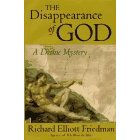
The question of where the gods might be in all the slaughter and destruction of war reminded me of a book that had profound influence on me several years ago. Richard Elliott Friedman’s The Disappearance of God: A Divine Mystery (Little, Brown, 1995) traces the gradual withdrawal of God from the scene in the course of the writing of the Hebrew Bible. The god who appears so active in the early chapters of Genesis distances himself further and further until the latest writings, according to Friedman’s dating, show few traces of the divine at all. God subtly, quietly, goes away.

Portrayed as defying the power of the gods in the film, Achilles desecrates the temple of Apollo and seals his fate. Nevertheless, although he is shot by an archer, the death of the hero seems more like an arbitrary act than the design of divine majesty. The Greeks, after all, did win the war. Atheism, however, did not exist in any real terms in the twelfth century before the Common Era. Then again, Achilles probably did not exist in any real terms either. Although Troy will never be among my list of most profound films, its commentary on the quiet skies of ancient Ilium serves as a useful metaphor, even for today.


The Gospel According to Caulfield

When one is asked to cite her or his favorite theologian, J. D. Salinger isn’t likely to be in the running. He might not even make the top ten. My personal introduction to Salinger, however, took place in a theological context. While in a Cambridge (Massachusetts) bookshop with a grad school buddy, I pointed out Mircea Eliade’s classic The Sacred and the Profane, insisting that my friend read it. Never to be outdone, Dave pointed at Salinger’s Franny and Zooey and said if I bought and read it he would do the same with Eliade. The Catcher in the Rye had not been part of my high school curriculum, so I was curious what all the fuss was about. I took him up on his dare. I’m not sure Dave ever read Eliade, but I read Salinger. My first impression was, “I don’t get it.”

Now my daughter’s school does require The Catcher in the Rye, and I’ve always tried (not always successfully) to keep up with her required reading. It gives us something to talk about – I’ve read several great books I’d otherwise have missed by this exercise. So I picked up the Catcher and plowed through. Salinger, I’m sure, requires no introduction. What is noteworthy, however, is that Holden Caulfield, while avowing himself an atheist, does make subtle but pointed comments about religion. (One of the occupational hazards of being a religionist is a constantly humming radar looking for any god-talk that might otherwise blend into the haze.) Holden, in chapter 14, points out the idiotic behavior of the disciples while Jesus was alive. He admits to thinking Jesus is okay, but his favorite character is the demon-possessed man who lives among the tombs. “I like him ten times as much as the Disciples, that poor bastard,” he says.

Who is as honest as Holden?

There is true religion in this statement. The “lunatic” running about in the tombs, rejected by society and even as far from God as you can get (demon possessed), is an image of humanity. Living a life of desperate alienation, the man in the tombs appeals to angst-ridden teenagers and displaced adults alike. He is likeable because he is like us. Holden scores bonus points on that observation!

With Salinger’s recent death, a renewed interest has sprung up about his novels – books that have changed the literary landscape. I read Catcher with more inherent appreciation than I did Franny and Zooey, but I’ve grown up a little since then. As an adult I can better appreciate the honest appraisals of Holden Caulfield.


Saint John, Elton, That Is

“I think Jesus was a compassionate, super-intelligent gay man who understood human problems. On the cross, he forgave the people who crucified him. Jesus wanted us to be loving and forgiving. I don’t know what makes people so cruel. Try being a gay woman in the Middle East — you’re as good as dead.” According to Parade.com, this was Elton John’s take on Christianity. I find the comments endearing in a naïve sort of way. They further demonstrate how people construct their gods in their own images. Compassionate? No question. Super-intelligent? Well, maybe. He certainly was creative, witty, and above average in intellectual celerity. Gay? Not likely. Not for doctrinal reasons, but simply for cultural ones. “Gay” as a lifestyle simply did not exist in the first century. The Bible maintains a steely silence on any aspect of Jesus’ sexual life, so we can never know. Perhaps it’s a case of “don’t ask, don’t tell”? Understood human problems? Bingo! Yahtzee! That is, I believe, what Jesus was all about. In my humble opinion, Elton hit that one dead on.

The crafting of Jesus into our own form is a major aspect of Stephen Prothero’s American Jesus. A fascinating romp through a bizarre collection of made-over Jesuses, Prothero’s book should be required reading for anyone interested in civil religion or Thucydides. Even a religion prof from my alma mater, however, didn’t fully convince me that anybody really understands who Jesus was. Such is the way with all truly great individuals.

Unlike some commentators who are clearly upset by Elton John’s summation of Christianity’s founder, I am a bit more circumspect about it. No one has cornered the market on Jesus. As hard as various Christianities have tried, Jesus still emerges in divergent forms to diverse individuals and populations. From Superstar to “super-intelligent gay man,” there is no doubt that Jesus left an eternal imprint on the human population of this planet and that those who believe in him will always portray him in their own image.