Sleepy and Hollow

Call it nostalgia.  (“It’s nostalgia!”)  What with major expenses rolling in like the longer nights—a major plumbing job followed by the roofers back again to fix another leak—I try to accept my joys in inexpensive doses.  I’ve written before about how “The Legend of Sleepy Hollow” caught my childhood imagination.  My brothers and I, growing up in quite humble circumstances, were collectors.  Not having much money, the collecting tended to be of free stuff, much of which drove our mother crazy.  Bottle caps, believe it or not, could be had for free from the openers on vending machines that dispensed genuine glass bottles.  We had bags full and the aroma was wonderful.  We had baseball cards—which were cheap and would now be worth something had they been kept—by the boxful.  And we collected stamps because they came free in the mail.

Yes, even bills used to have stamps.  The Legend of Sleepy Hollow stamp was released for Halloween in 1974.  I don’t recall how I heard about it, because there was no internet in those days.  I knew, however, that I fervently hoped one would come so that I could add it to my collection.  It never did.  In fact, I never actually saw the stamp itself.  When we moved house my childhood philatelic ambitions met an abrupt end as those endless childhood collections (which included metal slugs dropped from trucks rumbling out of the local steel mill and fossils found by the river under the bridge where those slugs pinged) were simply thrown out.  I would never see the coveted stamp, and now we use email.

It took many years—decades now—to occur to me that the stamp might be available online.  I guess I had pictures of the price tag of that upside-down airplane stamp in mind as I navigated to a vendor who was asking less than a dollar for a mint copy of a ten-cent Sleepy Hollow stamp.  Gritting my teeth between plumbing and roofing bills, I finally clicked “check out.”  With postage ironically costing more than the contents, still I felt giddy.  This was a piece of childhood on a simple slip of sticky paper.  I am not a stamp collector.  I will likely never be.  I do have vivid memories of bags full of aromatic bottle caps, and shoeboxes groaning with baseball cards, and cheap albums with common stamps.  They’re long gone.  But on my desk I now have a small piece of memory from many years ago, and  I have to wonder if I’m the pedagogue or his headless haunter.


Mouse Trap

The other day a friend asked me about theodicy.  Not in so many words, of course, but the question was distinctly familiar: why would an all-good, all-powerful deity let good people suffer?  My response, hurried as it had to be, coming as it did on a work day, was that this was the classic question that had led to the dismissal of much belief among those raised in the Christian tradition.  It is, if you will, the Achilles heel of the non-biblical unofficial trinity of omnipotence, omniscience, and omnipresence.  The answer typically given is that people have only a limited view and, given that we can’t see the whole picture we’re in no position to judge a being who can.  That got me thinking about the whole picture itself, and whether there is such a thing already in place.

As a young person learning to think theologically, I had to spend hours discussing with peers and teachers what this might mean.  Time, they would assure us, does not affect God.  The Almighty stands (metaphorically) outside of time and therefore understands how all of this will come out.  And the final result will be good.  The orthodox would then chime in that an eternal Hell was necessary to punish sins that, in comparison, lasted only a short time, comparatively.  This would raise the question of justice again, and whether or not we were all marionettes in a puppet-show that really excluded free will.  You see, the other answer to the question of theodicy is that if humans have free will a deity can’t force us to do good.  Humans, they reason are responsible for making the good suffer.

With the weather turning cooler, we caught a mouse the other day.  Decades ago I opted for a humane trap since it seems unspeakably arrogant of me to kill another sentient being who’s simply trying to find food and stay warm.  From the perspective of that mouse, I must seem terrifying.  I’ve caught it in a metal trap.  I’m a hundred times its size.  It has no idea what I’m thinking.  When I catch mice I try to talk to them reassuringly.  It’s got to be disorienting to find yourself going from “o wow, peanut butter!” to “I can’t get out.”  If that mouse is thinking of a higher power I know that I can’t see much of the larger picture.  My view is local, compared to that of larger intellects than mine.  Still, I don’t want that mouse to suffer for being what it is.  I didn’t create it, but I do want to set it free to let it find its place in both space and time.


Early Light

There are times when the Internet’s asleep.  Okay, well, so maybe that’s overstated, but if you have my hours you’ll quickly find the things you can’t do online well before 9 a.m.  For example, just the other day I wanted to check out one of my accounts that I only vaguely understand.  It’s with a company my employer contracts with, and it has an innocuous name that tells you nothing about what it really does.  Still, I had to check in.  After looking up the password, and going through the usual 18-step confirmation of my identity (it didn’t recognize my laptop), I landed on a page stating that it was the routine maintenance period for the website, and would I be so kind as to check back in later.  This is not an isolated incident.  In fact, I often awake around 3 a.m. to find that my laptop’s also doing routine maintenance, although I’m using it nearly every day at that time.  Smart tech, indeed.

You see, the ultra-early riser has a different view of time than the rest of the world.  After about 4 p.m. I don’t have the sharpness that was evident twelve hours before.  Oh, I can still function, but it’s on auxiliary power.  No warp drive that late in the day.  I realize I’m the weird one here.  After visiting friends and family and staying up to the obscenely late hour of 10 p.m., I’ll take an entire week to get back on track with days passing in a fuzzy haze of timely confusion.  I’ve been trying to break the habit for over a year now, but I still occasionally have to go into New York City, and those days require ultra-early awakening.  Knowing such a day is coming up, my body doesn’t want to be vulnerable to that shift.  So I wake up naturally when many others are just getting to bed.

This is mid-day for some of us.

The problem with this is that if you have to get some business done before work hours, many websites are undergoing their maintenance.  They don’t want to be interrupted when I’m actually alert.  There’s a lot of talk about diversity these days, but the person trapped in the early rising net is not a protected category.  It is frustrating to have people say “why don’t you just go back to sleep?” when you can’t.  I’ve gotten used to all that.  The early bird, they say, gets the worm.  That depends, however, whether the worm is on the Internet or not because, believe it or not, the Internet slumbers in the middle of the night.


Moral Compass

Recently I was introduced to The Poor People’s Campaign, in its most recent iteration.  I was drawn in because I was raised in a poor family and have struggled to make up the shortfall my entire adult life.  Those raised in middle class (and above) households often don’t realize that when you start below zero, in a humanities-based career it may take literally decades to catch up, if you ever do.  There’s no safety net and there’s no inheritance.  You begin with years of higher education debt and sub-standard pay in your profession.  But I digress.  The Poor People’s Campaign: A National Call for a Moral Revival is non-partisan and it is about more than just the poor.  It’s about restoring true morality to our political system.  Organized by the Rev. William J. Barber II, it has had some success in presenting the plight of the poor to a congress that has largely failed to care.

Politics is full of dirty money and lobbying to the point that many people are cynical and convinced that morality has no chance of survival in this city set on a hill.  The pony and puppet show in a White House run by an entrenched narcissist shows just how far concerns for justice are from the aims of our government.  Barber and his colleagues actually read from the Bible (which, it turns out, advocates justice) rather than just saying that they do.  Compared with Martin Luther King’s 1968 campaign by the same name, The Poor People’s Campaign today is smaller, but growing.  More and more citizens with a conscience realize that our government requires rescue if any semblance of fairness is to throw its hat into the political arena.  We’ve become the victims of to government’s bread and circuses, but without the bread.

The most disturbing aspect of our current political spectrum is the complete lack of a moral compass on the side of politicians who cynically use issues to win elections only for personal enrichment.  We have an Oval Office occupant who refuses to divest himself from his own business interests while using his position to increase his own wealth.  Others in his party follow suit.  The Poor People’s Campaign is non-partisan because corruption easily crosses the political aisle.  At least one party seems to be aware that the poor really do suffer even as the White House tells them tax breaks for the wealthy will make everything better.  When a government proposes “camps” for the homeless to get them off the streets, we should see that we’re clearly in trouble.  And unless someone sounds the alarm the wealthy will never bother to take notice. 


Ambling through Amityville

I may be a week too late for Friday the 13th, but I just finished rereading The Amityville Horror.  One of my current projects required my paying close attention to what was and was not claimed, and although it doesn’t count towards my Goodreads goal, I just had to do it.  I noticed, as also occurred to me when rereading Gerald Brittle’s The Demonologist earlier, that the second time through raises more questions than the first.  The book has been demoted from nonfiction to novel over the years, but it seems pretty clear that Jay Anson believed it to be based on actual events.  He could’ve been wrong, of course, but with a long list of documentary writing credits to his name one does have to wonder.  Anson died just a year after the film came out.

When the movie was released I was still in high school and what everyone was saying about how scary it was kept me out of theaters.  (That, and lack of funds.)  It’s hard to imagine now, but there weren’t even VHS options in those days, especially for those of humble circumstances.  As a result, I was well into adulthood before I saw the cinematic version.  Reading the book, however, is an attempt to pry open the question of what might’ve happened at one of the most famous “haunted houses” this side of the Atlantic.  I’d just read a headline that the house had been sold again, and such was the impact of this story that a simple property transaction is now considered news in some circles.

Controversy permeates this tale.  I suspect that’s because it made a lot of money.  The search for the truth is often compromised by lucre—just look at the White House and try to disagree.  The usual rendering is that the Lutz family, in financial trouble, concocted a story that would bring in big bucks.  Such accusations came, of course, once the story did indeed prove valuable.  The second highest grossing film of 1979, The Amityville Horror held records for the highest grossing independent film for a decade.  Add to that the estimated book sales of 10 million copies and you have a nice retirement account laid up.  Those levels of remuneration are enough to corrupt any narrative.  Still, it’s clear that many people wonder what really went on at the house on Ocean Avenue.  I sat down with the book again and I have to admit that I’m no wiser on the question for having read it again.


Pay Per View

One of the things editors can teach academics is that the latter should pay more attention.  Especially to the world of publishing.  An erstwhile academic, I learned to go about research and publication in the traditional way: come up with an idea that nobody else has noticed or thought of, and write about it.  It is “publishing for the sake of knowledge.”  (Yes, that is Gorgias Press’s slogan, and yes, it is one of my hooks—marketing, anyone?)  The idea behind this is that knowledge is worth knowing for its own sake.  Researchers of all kinds notice details of immense variety and there’s always room for more books.  Or at least there used to be.  The world of publishing on which academics rely, however, is rapidly transforming.  Money changes everything.

The world has too many problems (many of them generated by our own species) to pay too much attention to academics.  Universities, now following “business models” crank out more doctorates than there are jobs for employing said wannabe profs, and those who get jobs pay scant attention to knock-on changes in the publishing world.  Just the other day I was reading about “pay per use” schemes for academic writing that, unsurprisingly, came up with the fact that most academic books and articles lose money.  If someone has to pay to read your research, will they do it?  Especially if that research is on a topic that has no obvious connection with the mess we’re busy making of this world?  Probably not.  Publishing for the sake of knowledge is fast becoming a dusty artifact in the museum of quaint ideas.

For those still in the academic sector that means that research projects now have to be selected with an economic element in mind.  “Would anyone pay for this?” has to be one of the questions asked early on.  The question has to be answered honestly, which requires getting out from beyond the blinders of being part of the privileged class of those who are paid to think original thoughts.  Academia has followed the money.  A capitalistic system makes this inevitable.  How can you do business with an institution that doesn’t play by your accounting rules?  And academic publishers, which have difficulty turning a profit due to low sales volume, are bound to play along.  This situation will change how we seek knowledge.  More’s the pity since some of the things most interesting about the world are those that nobody would think to pay to view.


Fearing Hubris

I’m afraid of hubris.  You see, my academic career was not exactly distinguished, and as an editor you’re encouraged to keep to the background.  Still, when you write a book you need to promote it a little, which is one of the things I learned as an editor.  I was equally parts embarrassed and pleased to see the bookstore display for my upcoming book signing in Bethlehem.  I mean, although I wrote Holy Horror for a general readership, the publisher tends more toward academic books and their pricing, so this is not an inexpensive purchase.  Those who write are nothing, however, without readers.  Those chosen for interviews are writers who’ve made a sales impact or who have a university behind them.  When it’s just me, it feels like maybe I’m trying to ascend Olympus on my own initiative.

I was in the Moravian Book Shop to purchase Neal Stephenson’s Fall; or, Dodge in Hell.  I’ve fallen a bit behind on Neal’s work, largely because Goodreads challenges are measured in numbers of tomes read.  I was pondering this, book in hand, when I noticed—there I was with my own display.  You see, Holy Horror was meant as a guilty pleasure read for those of us who like the scary time of year.  The book price is the scariest part about it, however.  I feel a profound gratitude when anyone actually buys it.  Since there are now copies available on sites such as eBay, I’m guessing some who’ve read it want to recoup a little of the cash outlaid.  While all of this is happening, however, I know that I have to learn the art of book promoting.  Still, it feels like that self-promoting I was warned against as a kid, an unseemly thing.

Writing is a form of conversation.  When I’m in a room with a bunch of other people unless I’m the teacher I have trouble making myself heard.  I’m soft-spoken by nature.  I suppose it’s obvious, then, why a book signing feels hubristic.  Perhaps it’s appropriate for a book about fear to engender this sense of discomfort.  Entering the conversation has always been difficult for me.  At the same time, as the beneficiary of so many books, I feel compelled to give something back.  My insights, if such there be, won’t rock the world.  As I think of myself signing books, I wonder what I could possibly say to someone who’s willing to pay that price for something I produced.  If you’re going to try to climb that mountain, you’d better think about what you’ll say when you meet the gods at the summit.


Paradoxical Psychology

In college I took enough psychology courses that I could have minored in it, had I simply declared it.  Focused on ministry at the time, this declaration never happened.  My own psychological issues (who doesn’t have them?) show up, I suspect, to those skilled at spotting such things, and friends sometimes suggest books I might enjoy reading.  As a result I recently finished Paradox and Counter-Paradox by Mara Selvini Palazzoli, Luigi Boscolo, Gianfrancro Cecchin, and Guiliana Prata.  Attempting to summarize the study would necessarily over-simplify what is clearly a very complex topic—what used to be called schizophrenia—but the basic idea can be explained.  These psychoanalysts worked as a team to help patients with (since it was the 1970s) schizophrenia.  Realizing that the basic mental processes are developed within a family, their practice used group therapy to treat families rather than singling out the “sick individual.”  This book is an account of the methods they used.

Seeing schizophrenia as a family issue rather than an individual one, the therapists saw the identified patient as often a child trying to keep family expectations in order.  The psychoanalyst team called this a “game” played by families seeking homeostasis—the perceived state of balance between members to assure that things stay the same.  The psychotic member enables this to happen and families, as recounted in some of the cases, clearly try to manipulate the situation to keep this strange and awkward balance.  The doctors used paradoxical (thus the title) scenarios to treat such families and reported a good rate of success.  The focal point of their work was often not on the “sick” member, but on the group dynamics which led to the sickness.

The idea is a fascinating one.  We are all members of families (with some exceptions), and the way our group functions is, for the most part, acceptable.  Dysfunction, however, sometimes leads to psychosis, which, according to these authors, is a state of affairs best treated on a family scale.  While it may be easy for me (having grown up in a clearly dysfunctional family) to see this, I sometimes wonder at how widespread mental issues really are.  Our species lives a highly unnatural existence for evolved beings.  Our work together in family units often leads to conflicts, overt and subtle.  Children—often the identified patients here—can see such things much more clearly than we frequently suppose.  Afraid of the consequences, they learn to play the game to keep the situation stable, if untenable.  There’s great insight here, even if the book is a touch outdated; our learning about the human mind is never-ending and it makes perfect sense to pay attention to the context when wondering about the results. 


Unwished Inheritance

When I mentioned my book Holy Horror to someone recently, she asked “Have you seen Hereditary?”  I had to allow as I hadn’t.  I have to struggle to find time to watch movies, and I’m generally a couple of years behind.  Surprisingly, Hereditary was available for free on Amazon Prime, and I finally had the chance to terrify myself with it.  Perhaps it didn’t help that I’d been reading a book on schizophrenia at the time (as will be explained in due course).  Hereditary is one of those movies that is impossibly scary, up until the final moments when it suddenly seems unlikely.  In this respect it reminded me of Lovely Molly and Insidious.  All three also feature demons.  Using a child to accommodate the coming of a demon king brought in Rosemary’s Baby and the Paranormal Activity franchise.  (The genre is notoriously intertextual.)

While demons can make movies scary, what really worked in Hereditary was the sense of mental instability and the lack of a reliable character to believe.  The Graham family is deeply dysfunctional.  Mix in elements of the occult and dream sequences and you’re never certain what, or whom, to believe.  As with many of the films I examine in Holy Horror, the realms of religion and fear are interbred.   While the Bible plays no part in Hereditary, the matriarch’s “rituals” pervade the family following her death.  In a family of females, where a male demon seeks expression through possession, an obviously challenging dynamic is set up.  It works out through a series of disturbing images and manipulations.

Watching the family disintegrate becomes the basis of the horror.  Then possession comes into play.  As in most films concerning possession, deception and misdirection are used.  A demon named Paimon is seeking to take over the one male heir.  This ties the movie to The Last Exorcism, where the same demon under a different name seeks to propagate through Nell Sweetzer.  Unlike many possession movies, the suggestion that possession is actually involved comes late in the script.  This revelation underscores the the misdirection of attention that focuses on Annie Graham’s struggle to cope with reality.  Her sleepwalking and threats to her own children as well as the suggestion that they are but miniatures being manipulated by a larger, more powerful entity, keep the viewer off balance throughout the story.  Intelligent and provocative, Hereditary assures me that tying to analyze such films, while perhaps a fool’s errand, is an enterprise unlikely to be soon exhausted.


Book and Bell

The Bell Witch: An American Haunting, by Brent Monahan, is a book I’ve read before.  The subtitle was used for a cinematic version.  I discovered the book, however, through what might be considered a chance encounter with the author.  He was teaching a course on offering distance education courses at Rutgers University, and, as an adjunct teaching over eight classes per year, I’d been selected for the distance education program.  (As life goes, of course, I was hired by Routledge for a full-time job before I could actually deliver the course.)  By a strange irony, I had watched An American Haunting just the weekend before the course, and I had no idea who would be teaching it.  Neurotically punctual, I was the first one there for the class, and as Dr. Monahan and I talked, I knew I’d need to read the book.  I posted on it back when I did, but this time I decided to pay better attention than one can on a bus.

Of course, when you watch the movie first, which I had, you know “the reveal” well before it comes late in the novel.  In case you’ve done neither, I won’t give it away.  The tale is based on an historical haunting, attested in sources from near the period.  And it is a strange kind of possession story.  The “witch” is actually a demon conjured by a trauma, and although book wraps things up nicely, it leaves a few questions at the end.  I suppose that’s appropriate for a scary book.  One of my current projects involves tracing the accounts behind fictionalized narratives to their originals.  The Bell Witch was well researched, and is a good example of how the line between fiction and fact can be effectively blurred.

The Bell Witch legend is credited with influencing several horror films, including The Blair Witch Project and others which tellingly have “Bell Witch” in their titles.  The story has a fairly incredible longevity, given that it was a localized legend from early in the nineteenth century.  Monahan’s novel is written as a “confession” from the schoolmaster, and historical personage Richard R. P. Powell.  This blurring of the lines makes for the kind of ambiguity that gives horror its particular ability to stand between fact and fiction.  The early versions of the lore, combined with elements intended to offer verisimilitude, leave plenty of queries at the end.  So much so that I’ve occasionally contacted the author for clarification.  What really happened?  It depends which side of the line you prefer.


Scrolls Not Living

Of the many ancient finds in Western Asia, none captured the imagination like the Dead Sea Scrolls.  The timing and romance of the find itself, the scandals that almost immediately broke out, and the subsequent “secrecy” over the contents made the secular news.  I’m convinced that a large part of the mystique has to do with the somewhat spooky name—Qumran scrolls never caught on, even though it is more accurate for many of the documents.  Their discovery came after the Second World War when people were wanting good news, and, perhaps, an indication that all of this stuff was somehow predicted.  Enter the scrolls.  No doubt, these documents gave us quite a lot of information on the Second Temple Period—the time from the rebuilding of the Jerusalem temple in the sixth century BCE until its destruction under the Romans in the first century CE.  Now the scrolls are back in the news.

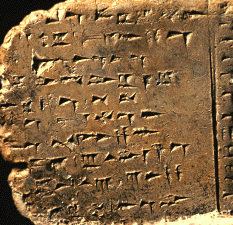
A story by Nicola Davis in The Guardian announces that the origin of the scrolls is once again open to interpretation.  The reason is somewhat technical—scrolls that were written on vellum (animal skins) had to be prepared for writing.  One of the steps involved chemically treating the writing surface with a fine powder (the details are beyond me) so that it could be written upon.  We’ve reached the point where the salts left behind can be tested for place of origin.  The Guardian story notes that the Temple Scroll—one of the important non-biblical texts—was not prepared at Qumran (the site where most of the scrolls were found).  That means that the scroll itself came from elsewhere, depending upon with whom you speak.  The scrolls gather controversy like the Ugaritic tablets gather dust.  

Part of the charm here is that there are many unanswered questions about these ancient texts.  Who exactly wrote them is debated.  Their find-spot suggests they were hidden away by the quasi-monastics who lived in nearby Qumran, but this doesn’t mean they necessarily wrote them.  It’s still debated whether the Qumran community was made up of Essenes or not.  One thing we do know about them is that they were able librarians.  The scrolls themselves are symbolic of the strife in the region, having been discovered just as Israel was declared a nation.  The scrolls were quickly politicized.  They were kept under the auspices of a small group of academics and priests for many decades.  And they still have a way of catching headlines.  Even when its a matter of who powdered their faces.


Not so Hollow

It is difficult to say how an idea might grab you.  I really have no idea why Washington Irving’s “The Legend of Sleepy Hollow” took my childhood imagination prisoner and has kept it stoutly locked up over all these years.  Perhaps it was the Disney version seen as a child that left me with shivers of wonder akin to a species of joy.  The autumnal setting, the implied ghost, the ambiguity of the final scene.  I used to be as avid a philatelist as one can be in a small town, and the Sleepy Hollow stamp of 1974 held me transfixed long before I ever encountered Tim Burton’s vision of the legend.  After having watched the silent Headless Horseman a couple of times, I went back to The Sketch Book of Geoffrey Crayon, Gent., and read the original again.  This time I followed it up with the appendix in my edition, written a decade or two after the story by an older Irving.

The 1922 movie runs fairly close to the literary original (for the most part), especially when you add the appendix.  The appendix (in the edition I have—The Modern Library, 2001) is an essay titled “Sleepy Hollow.”  It reflects on Irving’s recollections of what Sleepy Hollow was like in his youth (he returned to the area to settle later in life).  The village church, which features in “The Legend,” provides a source of much of his reverie and this is incorporated into the early cinematic version as well, in the Sunday morning scene.  I also noticed how frequently psalmody enters the original story.  The tale does not mention the Bible, but psalmody was an early form of church music, and “The Legend” has Ichabod use it when he’s afraid as well as for teaching students to sing, for a few shiny shillings.

Washington Irving is sometimes credited with the invention of the short story as a literary form.    His younger contemporary Edgar Allan Poe worked in that format, and the two of them contended with making a living (the former more successfully) purely as literary writers.  Irving’s spooky tales, however, often have something of the comic about them.  His story-telling style uses folksy, folkloric exaggeration and humor to prevent it from becoming too dark.  Poe would snuff the candle and let the fear be unhindered.  I knew of Sleepy Hollow before I discovered Poe, and this recent resurgence is perhaps a way of exploring my own literary roots.  It’s nearly half-way through September already, and Tarrytown beckons. 


Write Brothers

Work interferes with my concentration.  I suspect I’m not alone among writers in this regard.  Just last week I had two fiction pieces accepted for publication (one of which won honorable mention), but the little time I can allot to writing is divided between fiction and non.  Up until now the non has been more successful at finding publishers, but last week might’ve tipped the balance a bit.  As someone who works well more than eight hours daily, culling that time for creative enterprises can be difficult.  I’m told that Isaac Asimov, in the days before personal computers, kept three typewriters, each with one of his projects ready to go.  He would work on the one he felt like at any given time without having to reload a single typewriter with a half-finished piece.  My laptop has the dubious advantage of keeping multiple windows open in which several projects are simultaneously active.

At the moment I have three book projects going; two nonfiction and one that will become novel number seven, if it ever gets finished.  Not only that, but my short stories file has many contenders for my rationed time.  Long ago I lost track of just how many tales there are—some are on disc and others are on paper.  Some are finished, awaiting revision, and others have just begun clawing their way into written form.  The problem is finding the time to work on them.  The oft-heard lament of the working writer is that life is more working than writing.  And having had some minor affirmation of my fictional functionality recently, I’d love to explore that a bit more, but who has time right now?  Even as I finish typing up my blog post for the day the hour to begin work is looming.

Stephen King’s advice to wannabe writers is to read.  A lot.  Although I do my best to keep this dictate among my personal commandments, I run into the immobile object of nine-to-five-plus repeatedly.  If I take a vacation (which is seldom) it is often “to get away,” but writing is more a matter of aging in place.  Finding your comfortable spot where your thoughts flow freely and where the coffee pot’s just in the kitchen and if an idea catches you before sunrise you can spend time wrestling it even after light filters in through the curtains.  Those are rare days since weekends are for doing the chores neglected in your forty-five-plus hour work week.  And settling between fiction and non is never an easy decision, especially when one has just received a vote of confidence before login time on a Monday morning.  For now, however, I have to concentrate on work.


Permanent Change

Maybe you’ve experienced it too.  The sense of change in a large city like New York is palpable.  Although I don’t commute in much any more, I noticed it when I made daily treks to the city—change is constant.  If the skyline’s forever evolving, on street level things are more than keeping pace.  In the seven years of my daily commuting I saw buildings built and razed in the same location.  Scaffolding is a constant hazard.  Public art pieces are placed and then replaced.  Change.  I was reading about Yijing, better known as I Ching, the other day.  One of the spiritual classics of China, this “Book of Changes” reflects a worldview common in eastern Asia that is quite at odds with that that developed in ancient Greece.  Many Greeks believed permanence was reality, those in China who read the spiritual masters believed that change was reality.  The older I get the more I think the author(s) of Yijing got it right.

I’m not an expert on the religions of southern or eastern Asia, but I have studied the major ones.  To those outside the field of religious studies, it may be surprising that the field is as large as it is.  In the United States alone there are an estimated 40,000 denominations, and that’s just within Christianity.  To be an expert in any one takes years of study.  Add in the many religions of other locations, such as Africa and Asia, and you’ve got more than one lifetime’s worth of work lined up.  A common—the most common, in fact—course in collegiate religion curricula is “World Religions.”  I’ve taught it myself.  The problem is nobody’s an expert in all of them.  Still, I found reading about what used to be called “eastern religions” (with that poisonous cultural bias that the unchanging west is the correct vantage point) full of surprises.

Scientists well into last century liked the idea of a steady-state universe.  Permanence.  When Edwin Hubble noticed other galaxies were moving away from ours (and, by the way, first noticed that there were other galaxies), the Big Bang theory developed to explain this motion.   Change, it turns out, is constant.  It may be slow at times, and at others it’s like the skyline of a major city like New York, shifting several times in a single lifespan.  I’ve read some of the spiritual classics (in translation) and I always come away with a new sense of wonder about the many ways of understanding the world.  And I ponder what it will take to change the attitude that religions aren’t worth studying.


The New Purple

Those of us who grew up Evangelical hold an unusual place among our liberal peers.  We’re often able to peer around, over, and under that wall that has been built between those who want a faith-based nation and those who want a free one.  Angela Denker is a fellow traveler on this road, and her book Red State Christians: Understanding the Voters Who Elected Donald Trump is a useful roadmap.  Some of us fall further from the tree than others, but one of Evangelicalism’s more endearing traits, when taken seriously, is the love of those who are different from you.  That love is often forgotten in the political rhetoric daily whipped into a froth by an unstable president being used by his party to install agendas that hardly fit the moniker “Christian.”  That’s why books like this are so important.

I confess that reading studies such as this make me uncomfortable.  Uncomfortable because my Evangelical past haunts me worse than any ghost, but also because Denker is clearly right that basic humanity is being left in the garbage as battle lines are drawn up in what could be a great, diverse nation if a leader were determined to work for unity.  I recently wrote about lunar landings.  Kennedy was a Catholic who had to work to bring a nation together around a common goal.  Instead of tearing the country apart for his personal aggrandizement, he pointed to the moon.  Sure, there was a xenophobia concerning the Soviet Union, but at least in this pocket of the world there was a sense that we should work together.  When religion entered politics with Richard Nixon and his followers, a deep rift opened up.  The two topics you were never to discuss—religion and politics—were now in the same bed.

Red State Christians is an extended road trip on which Denker interviews people who largely fall under the Evangelical umbrella.  Some of them are Catholic.  Some of them are Hispanic.  Some of them are less concerned with social issues, but are hard-working laborers often overlooked by the Democratic Party.  The resulting pastiche is one in which Americans are cast not in sharp relief, but rather with the hazy edges that are a far more accurate way of understanding human beings.  Many, it becomes clear, elected Trump out of fear, or out of fear of his opponent.  These aren’t bad people, but they are people afraid.  This wasn’t an easy book to read, but it is an important one.  And those who want to work for a future that might include realms beyond the moon might find this work a small step in the right direction.