Upstate Reading

In terms of cash flow I don’t fall into the wealthy bracket.  My assets are largely in pre-printed paper form, and when I visit the local Little Free Library it’s generally to donate books rather than to take them.  Over Labor Day weekend I was in Ithaca.  One of the more famous features of the town is its weekend Farmers’ Market.  Indeed, the north-south corridor through town is a continuous traffic jam during Market hours.  Not only are there farm stands in the permanent open-sided structure, but there are a few craft booths and several places to buy al fresco fair from local restaurants.  In the summer parking can be hard to find, but the place has a carnival-like atmosphere nevertheless.  It also has a Little Free Library.  I’ve been to the Market many times but I’d never noticed it before.

Upstate New York is beautiful but it tends toward the conservative end of the political spectrum.  Ithaca is a pixel of blue in a screen of red, and that strangely showed in the Little Free Library.  Many of the books were either Bibles or popular kinds of devotional titles.  Given that Cornell isn’t known for its religion department (Ithaca College has a respectably sized philosophy and religion department, however) these books aren’t the kind you’d expect to find in an institution of higher education.  That’s why I was surprised to see a near mint copy of Bart Ehrman’s The Lost Gospel of Judas Iscariot on the shelves.  The Gospel of Judas hasn’t been big news for a few years now, but this was a book that suggests a different demographic than your average evangelical readership.

Like Ehrman, I once made a living as an adjunct at Rutgers University.  Indeed, it was this commonality that helped me to get to know him a bit.  He’s gone on to a kind of fame rare for biblical scholars.  Indeed, to have a sufficient number of copies of your book printed to end up in a Little Free Library—in other words, you have to have more cachet than your garden variety Ph.D.  In my local community LFL I like to leave books for others to take.  Just last week I stopped by and noticed that the summer had depleted the stock.  Ironically, I had noticed one of Neal Stephenson’s novels in the same circumstances as Ehrman’s.  I’m glad to see intelligent works on offer for the reading public.  And trading books with no money involved suggests to me that there’s a better form of economy than material greed.  All it takes is a Little Free Library and a little good will.


Pointing to the Moon

The failure of India’s  Chandrayaan 2 to maintain contact, intended to make India the fourth nation to successfully conduct a lunar landing, sent me reading about the moon.  I remember the first manned landing, which happened when I was six, so the idea that we could make it that far seemed less impressive than it really is, I suppose.  I was fascinated by early space travel, and part of this may have been because of the moment of silence announced in school the day Apollo 13 safely returned to earth after the oxygen tank explosion that made its landing impossible.  As I was reading about the many moon missions that took place before I was born, I was surprised to learn how many nations are still attempting to reach our nearest neighbor.  This year alone China, Israel, and India have all attempted to land up there.

Israel’s mission called its lunar lander Beresheet.  It was the first attempt to land the Bible on the moon.  Beresheet is the Hebrew title of Genesis.  The US missions were named Pioneer, Ranger, Surveyor, and Apollo.  Ironically for the persistently religious nation, our only supernatural title was the name of a Greek deity.  Israel was true to its roots with its naming convention, but there is kind of a paradox involved.  In the world of the Bible the earth is the center of the universe and the moon is a quasi-living being circling about our stationary fix in this fictional view of the cosmos.  That’s not to say our own views may not some day be regarded as fictional as well, but simply that we now know the view in Genesis is incorrect.

Of course, the word “genesis” can mean a purely secular beginning as well.  It is a compound word that is often translated as “in the beginning.”  As such, it is appropriate for the first attempt at a moon landing, or any other great venture.  Still, it is instantly recognizable as the first word in the Bible, indicating a kind of strange juxtaposition where the biblical moon—which is not the same as the astronomical moon—are brought together.  Unlike the book of Genesis, the moon has been reached many times by others before.  The old and the new meet in this attempt to reach into space.  Meanwhile our problems continue down here.  Maybe that’s why we continue to attempt to reach the heavens.  And in that sense, no better title applies than that of the book that somehow defies rational explanation.


Horseman Horror

Yesterday was distinctly autumnal around here.  Cloudy and cool, the overcast was definitely moody although the equinox is still a couple weeks away.  Still, the mood was right for the Legend of Sleepy Hollow.  The earliest full cinematic adaptation of Washington Irving’s story is the 1922 silent feature The Headless Horseman, starring none other than Will Rogers.  Now, Irving’s story is fairly brief, and to get nearly a full seventy-five minutes out of it, the tale lends itself to some padding.  The film makes a great deal of Ichabod Crane knowing Cotton Mather’s A History of Witch-Craft, and even being accused of being in league with the Devil that leads to a  disturbing scene where he’s nearly tarred and feathered.  In reality Mather’s book was Wonders of the Invisible World, but the point of the film is better made with the fictional title.

Having watched Tim Burton’s 1999 version—Sleepy Hollow—many times, I was taken by the introduction of the Bible into the story.  The groundwork, however, was laid by Edward D. Venturini’s version.  True to the story, Ichabod teaches Psalmody in his role as schoolmaster.  Venturini’s film has a contrived scene in the church on Sunday that includes a lengthy sermon with everyone—even the usher—falling asleep.  The episode, which is lacking in Irving’s original rendition, introduces the Bible into the narrative.  The connection is thin, but nevertheless present.  Burton picked up on the religious element and built it firmly into the plot as Ichabod Crane’s backstory as a skeptic, raised by “a Bible-black tyrant.”

As someone interested in the integration of religion and horror, early examples, despite the comic aspect of Venturini’s version, are often instructive.  The comedic spirit is actually in the original; Irving’s tale gives a caricature description of Crane that gives the lie to the handsome protagonists beginning with Jeff Goldblum on through Johnny Depp and Tim Mison.  Will Rogers plays the homely image to its hilt, and although lighthearted, the movie has some classic horror elements.  To arouse his dozing parishioners, the minister yells “Fire!” When they awake asking where, he states “In Hell,” which sleeping churchgoers can expect.  Although the eponymous headless horseman is shown to be Brom Bones, a remarkably effective early scene presents a skeletal, ghostly rider that haunts at least the imagination.  The sun is out this morning, and the brooding skies of yesterday have passed.  They will be back, however, as the season for ghost tales is only just beginning.


Plumbing Depths

This past week we had a plumber here for a day.  Our house has been owned by a succession of DIY weekend warriors who had more confidence than ability when it came to things like electric and water (which, I’ve learned, you want to keep apart).  Somehow our home inspector failed to spot these costly fixes, and I try to think of them all as investments—a concept foreign to a guy with my background of living paycheck to paycheck.  In any case, all this plumbing has me thinking deep thoughts about water.  And depth.  Things are seldom what they seem—there’s more below the surface, and those who struggle with the depths often come up with sayings we call profound.  And they often express them in poetic form because, when you get deep enough, words themselves break down.

I often consider this in the context of science.  Physicists break things down into formulas.  There’s a certain uniformity, they tell us, until you reach the quantum level, then the rules change.  I sometimes see this as an analogy with the staid nature of scientific prose versus the depth of good poetry.  Or even, dare I suggest it, profound fiction.  These sometimes explain our world better than the accepted facts of mundane existence, such as water always seeking the lowest point.  There comes a profundity, however, at which down becomes up.  The behavior of water, which we want in our houses but only in controlled locations, is somehow indicative of this.  “Deep calls unto deep” as one ancient source says.  And the plumber walks away with a good chunk of your cash.

Learning about science in school, I was always taught that good science is elegant—there should be beauty in a theory that explains the world.  I’ve often wondered how this fits in with a reality that is often messy—chaotic even.  Ancient peoples from the area that produced our Bible believed water to be chaotic.  It had to be controlled by the gods.  It is vital for life, we need it and yet it wreaks havoc on dry land as those who experience hurricanes know all too well.  The world into which I was born was one of indoor plumbing.  Once water gets in, as our leaky roof attests, it introduces chaos in a place we want to stay dry.  When water won’t behave like we want it to, however, we no longer call on the gods.  We call a plumber and pay our offering with profound reverence.

Young Dr. Wiggins contemplates chaos


Correct Auto

I’ve tried turning it off, but it sometimes doesn’t work.  Every time there’s a system update (about every other hour, now) the new system reloads autocorrect.  True, my weary fingers are glad for the help when they just can’t spell hypocoristic, but it does seem that autocorrect, although the results are often funny, has no sense of humor.  As a writer I often use ironic misspellings.  I sometimes have my irony interpreted as ignorance, but if writers aren’t misunderstood they’re not doing their jobs, I suppose.  The thing that gets to me is that those who program autocorrect—although sometimes they’re right—can’t let us express ourselves as we wish.  The other day I wrote something with  a deliberate misspelling.  When I hit the “post” button I realized I’d been autocorrected to a nonsense word in the context.  I thought I’d turned autocorrect off.

Now don’t get me wrong—I’m not the world’s greatest speller.  Sometimes I use words with the slightly wrong connotation.  My choices, however, are generally deliberate.  Unless my device has selected them, that  is.  I suspect that autocorrect is appreciated by those who type on tiny screens.  The affluent, I notice, wear iWatches.  I wonder if they carry tiny people in their pockets whose thumbs can fly across such minuscule surfaces.  “No,” someone told me, “it has voice recognition technology.”  I was reminded of some embarrassing mispronunciations I’ve made.  In seminary the homiletics professor had an individual session with me.  “Given your educational background,” he told me, “you don’t mispronounce many words.”  Oh, but I do.  I just save them for the most embarrassing situations.

My inner critic’s a pretty active guy for his age.  He doesn’t need autocorrect to make me realize how little I know.  That’s the thing about technocrats, though.  They like to correct us based on the most common combinations of these letters.  Sometimes I glance back at something I wrote and find a word I don’t even know replacing something that was, in fact, correctly typed in the first place.  I write in a program called Scrivener.  My Mac’s too old to run Word, and Pages isn’t bad, but it doesn’t allow for the complex architecture of my thoughts (and I’m no architect; I can’t even spell it).  In other words, I have to turn autocorrect off not only on my device, but also in the individual applications I run.  But then there are days when verisimilitude just won’t flow the way it should without it.


Power of Parables

Parables come in all sizes and shapes, horror movie-shaped, some of them.  In my perpetual struggle to catch up, I finally got to see Get Out.  One of the raft of well-made, intelligent horror films that have been released recently, it’s been out long enough that I suspect my spoilers will be well known.  The Armitage family, resident in upstate New York, has been kidnapping and using African-Americans to make up for the perceived weaknesses of their family and friends.  One of their main means of obtaining victims is through their daughter Rose, who brings her boyfriends home for the weekend so they can be hypnotized by her psychiatrist mother and operated on by her neurosurgeon father.  The reveal comes slowly, but the discomfort begins early on.

Released early in the Trump White House tenure, the movie is a study in an intense xenophobia that nestles somewhere between Guess Who’s Coming to Dinner and The Stepford Wives.  It’s inherently uncomfortable watching Chris Washington, the protagonist, being treated as if his very presence requires constant comment in the world of white privilege.  He, of course, had misgivings before ever climbing into Rose’s car, but her convincing display of liberalism was enough to overcome his hesitation.  For me, watching the film made it clear that privilege is something assumed, even when it isn’t had in any explicit way.  The Armitage family and their friends are well-to-do but even if the setting were more mundane the message would still have worked—our culture imposes and reimposes its message of white superiority in subtle ways that the camera captures here.

Quite apart from its nature as a parable, Get Out is a demonstration of the social consciousness of horror.  Its reputation as a debased, low-brow appeal to all that’s unsavory to watch is misplaced at times.  While Get Out is uncomfortable it’s that way for a reason.  Were it not, it would lose its important message.  All privileged people need to be able to see through the eyes of those who are culturally disenfranchised, and although the “us versus them” mentality is problematic it has to be faced honestly and openly.  The very fact that a human construct like race could be used as the basis for a horror film in America raises questions that ought to make all of us squirm.  Setting the story in New York, where prejudice might be supposed not to remain only underscores how deeply its roots have grown.  Horror with a conscience is perhaps as much a vehicle for social change as it is a genre more honest than often supposed.  That’s how parables tend to be.


Burger Impossible

On the way home from Ithaca, we’ve learned the hard way to avoid I-80 through the Poconos on a holiday weekend.  Past experience indicates that about 80 percent of the population of New Jersey (to be fair, a percentage of that may be those from New York City) tries to squeeze through the Delaware Water Gap at just about dinner-time the day before work starts again.  There is a longer alternate route, I-476, the turnpike, which you catch north of Scranton and exit in Allentown.  The only issue with this plan is that, unless you want to exit the turnpike to try to find food in rural Pennsylvania, there’s only one travel plaza between our entrance and exit.  It’s a nice enough stopping point, but for a vegan on the road options are limited.  As we pulled in we noticed there was a Burger King.  Would they have the much touted “impossible burger”?

It turns out that they did.  Having last had a whopper well over two decades ago, mouth memory may have faded a bit, but I can honestly say this was like the whopper I remembered.  If you hold the cheese and mayo, you have a vegan version.  This discovery made me strangely happy.  For years at remote locations (and some urban) we’ve stopped when the only other options are meat based and had the BK veggie burger.  It’s not too bad most of the time, but if you want to think you’re eating meat while not contributing to the massive environmental degradation of industrial farming, the impossible burger seems like a reasonable option.  This is one area of technology that I’m glad seems to be catching up with ethics.

I often ponder how much our western point-of-view is based on the Bible.  Our reluctance to include animals in our ethics is another example of how the hard line between species has been applied.  Even scientists are susceptible to worldview bias.  When we realize we’re all part of a continuum of biological relatedness, it’s a lot more difficult to argue for our special place in the divine eye.  At the same time, insisting one’s ethics be applied to all is a form of fascism.  I’m just glad my conscience can be assuaged with some plant-based food options.  After all, I’ve been on the road for a few hours and I’m sitting here happy to be eating at Burger King.  It’s a matter of perspective.


Masked Reality

Before I make my confession you need to consider that I spent much of my professional life as a seminary professor.   Never ordained, I nevertheless donned the cassock and taught future priests what they’d be assumed to know (the Bible) while trying to earn an academic reputation through my publications.  It was a double life in which one half involved the church.  Shortly after that job ended I saw trailers for Nacho Libre, a movie in which Jack Black plays a monk who moonlights as a luchador, a Mexican professional wrestler.  I never saw the film, but I had been raised on a white trash diet of World Wrestling Federation fandom, back in the day when that involved gathering around the television to watch grown men posturing and preening while knowing that none of it was really real.  I secretly wanted to see Nacho Libre.

Recently I visited friends who had the movie.  They warned me that it was corny, but I had already supposed that.  What I didn’t realize until after it was over (for movie viewing is now followed by internet viewing) is that it is based on a true story.  “Based on a true story” doesn’t mean, of course, that a movie accurately portrays events, but I had no idea that a Mexican priest had actually supported an orphanage for over two decades as a masked wrestler under the name of Fray Tormenta.  I followed up the movie with a little web research because the film was remarkably respectful of the church.  The character of Ignacio never criticizes Catholicism, and he clearly cares for the orphans for whom he serves as the cook.  His wrestling winnings go toward purchasing better food for them.

Earlier in the day we watched the movie I’d talked to one of my friends about how religious life, no matter how seriously it’s taken, involves acting.  People generally put on masks before going to church (or any other function in which they interact with others).  Religion requires a level of piety impossible to sustain in the real world.  Early in the history of Christianities it became clear that the church would hire some religious specialists to try to take on the lifestyle toward which all faithful should aspire.  I’ve trained many priests.  I’ve seen them when they’re in mufti.  I know that in the vestibule, at the altar, or in the pulpit they’re wearing masks.  Many of them have the heart of Nacho Libre, but outside the church doors they still have bills to pay and family and friends who know them as they really are.  As we slipped the DVD in I didn’t know what the movie might be like, but it was based on a true story in more ways than one.


Significant Places

Upstate New York may not get the attention that the state’s largest city does, but it is a place of wonder.  One of those sources of significance is the unique blend of individuals who’ve impacted both American culture, and, in turn, my life, that called this region home.  It’s difficult to describe what I’m feeling as I’m standing next to Rod Serling’s grave.  This is a man who held a profound influence over my outlook by letting his imagination go where it would.  It’s more than the Twilight Zone—although its theme is one of the ringtones on my phone—it’s the sense that I somehow knew this man I never met.  It’s also the sense that his gravesite is so humble, in a rural area outside a small town, the kind that often featured in the stories he wrote and presented.  It’s the sense of connection.

As I young person I practiced writing short stories based on the mood set by the Twilight Zone, with a dash of Ray Bradbury thrown in.  From a small town myself, imagination was my means of enlarging my world.  We didn’t have the money to go many places but the magic box in our living room could take me to weird places alive with transcendence.  The results were beyond price and there was something deep and liberating here, even for a kid whose religion said it was all nonsense.  Even religion requires escaping sometimes.  I know the publishing world has moved beyond what was fashionable in the sixties and seventies, but that can’t dislodge the shard in my chest right now.  If there are spirits in cemeteries, they are here.

Some time ago I began, as I had time, uploading my photos of famous writers’ graves (along with those of other recognized names) on Pinterest.  On the way to Interlaken, I wondered aloud why nobody seemed to show an interest.  I find cemeteries peaceful places, and sacred spaces are those where people significant to us have been, in some form, at some time.  I know Rod Serling loved upstate New York.  It was his escape from the busy life of a writer whose cachet was marketable back in the days when anything seemed possible.  Retreats are those places we go to restore ourselves when work simply won’t allow creative people to have unstructured time.  I wasn’t expecting a huge mausoleum or towering monument here.  Others have found their way to this place nevertheless.  I am in a sacred place and the quiet here is kind of a prayer.


Gods, Monsters, and Publication

One of life’s great ironies is that those of us not born to wealth have to spend the years we’re young enough to enjoy ourselves stabilizing our situation until suddenly we realize we’re too old to do that kind of thing any more.  I know I’m being overly dramatic, but it often does feel like life operates backwards.  My professional career began where I’d hoped it would end, as a professor.  I taught and published for almost twenty years and really nobody paid much attention.  At least I had my teaching.  I also had a family to support, so I had to accept the shift to publishing when that came along with an offer of a full-time job.  Thus it has been for about a decade now.  Within the last decade colleagues have begun to approach me, asking me to contribute to academic volumes, or to be involved in pursuits that are more associated with professors than editors.  I could do with more irony in my diet.

All of this is a long-winded invitation to check out the new Journal of Gods and Monsters.  I probably won’t be writing articles for it; lack of library and research time (both of which I had when invitation-free) assure that my scribbling will be non-technical and hopefully of the more general interest crowd.  Then why am I telling your about this journal, fresh from the box?  I’m on the Executive Advisory Committee and the first Call for Papers has been issued.  Now, this blog really has no way to include attachments that I know of, so if anyone wants in on the ground floor for this journal please contact me (the About page on this website says how).  I contributed to the first number of the first volume of the Journal of Ancient Near Eastern Religions and look where I am now!  You just never know.

In addition to the books on which I’ve been assiduously working, I’ve got a number of commitments to edited volumes and encyclopedias (these invitations waited until I was safely out of academe before rolling in).  The monster crowd is, I assure you, a welcoming one.  As we seem to have turned the corner into autumn a touch early this year, and I see leaves beginning to change before August is out, my mind turns toward the realm of the uncanny.  It may be less academic than ancient religions, but the world of monsters feels much more relevant these days.  If you’re a researcher in these realms I’ll be glad to send you a call for papers.


https://godsandmonsters-ojs-txstate.tdl.org/godsandmonsters/index.php/godsandmonsters


Better Places

I have to confess that I’d never heard of Ottessa Moshfegh before.  Shame on me, I know.  As a wannabe writer, I feel compelled to know other writers’ names.  Hang in literary circles.  Etc.  The good news is, however, that I found Homesick for Another World in an indie bookstore.  I’d gone in for something else that they didn’t have, but I don’t like walking out with nothing, especially when it’s a small store.  Besides, I trust the taste of most independent store owners. 

I can’t remember the last time I read a book of short stories all the way through.  As with most writers some work appeals to you more than others.  In my mind the first and last stories stick the firmest.  The latter, “A Better Place,” is haunting, almost Shirley Jacksonesque.  Others make you uncomfortable in your own skin.  This is a rare talent.

Finding a writer who, using simple words and expressions, takes you to another place is a rare gift.  The short story (the only kind of fiction I’ve actually published) is a versatile and engaging form of literature.  Books collecting them are often good for picking up when you have a little time and putting down for a while again.  I felt compelled to go through this whole work, being drawn into the weird and somehow familiar worlds of characters who seem to have no purpose, no goals.  It’s almost as refreshing as Kafka or Camus.  To be a writer who requires only one name to evoke a genre must be glorious.  These stories are strange without recourse to the supernatural, and they defy easy genre assignment.  (This makes publishers crazy.)

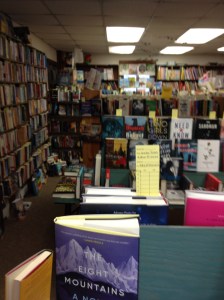
There’s an earnestness and a longing in this collection.  A kind of nihilistic spiritualism.  A wanting with no particular object in mind.  I read a lot of fiction, some of it very good.  The kind that leaves you a little stunned and questioning what reality is.  This is that kind of book.  Had I not gone into that indie shop that Saturday morning I never would have found it.  I certainly didn’t know to look for Ottessa Moshfegh.  Here again I’m reminded of the value of the bookstore experience.  The ability to browse without clicking or scrolling feels like a luxury to me now.  I may have to pay more than Amazon’s competitive pricing, but then this is like a finder’s fee for being in the real world.  Even if the book makes you question that reality when you’re done.


The Holy

It’s perfectly natural.  Trying to make sense of things, I mean.  It’s been a little difficult in America for the past three years or so, given that nothing seems to add up beyond greed and narcissism supported by a senate majority.  Still, as I retreat into my horror films I realize that there’s a logic to it.  Over the past several months I’ve been attempting to articulate it.  You see, I have a couple of presentations to give on Holy Horror in October and one of the questions likely to arise is why.  Why bring together the sacred and the scary?  Those who’ve studied religion formally—and many who’ve not—are aware of Rudolf Otto’s classic The Idea of the Holy.  It’s outdated and I’ve been waiting for someone to write its replacement, but we’re past the era when one scholar corners the market.  Has nothing new emerged this past century?  Nevertheless, Otto’s main ideas still make sense, before he lapses into a Christocentric view.

Mysterium tremendum et fascinans isn’t an incantation, but with a little imagination the Latin makes sense.  The holy, according to Otto is a mystery that is both terrifying (tremendum) and fascinating.  To the laity in the pews this may be strange, but chances are pretty good that your minister has read this book.  In the monotheistic west, the divine is terrifying.  It’s not splitting hairs to suggest terror and horror differ, nor is it unreasonable to suggest they have much in common.  Horror seems more embodied—a working-class variety of terror.  Still, both have that element of fascinans.  We fear but we can’t look away.  I don’t have the time to sit and ponder that a Gilded Age academic had.  Otto didn’t have to keep up with Facebook and Twitter.

Although academia required far more than eight hour days, the time during those days wasn’t spent “on the clock.”  As one intellectual I admire once quipped, staring out the window is work.  Not as far as HR is concerned, however.  Productivity in an industry under stress is its own kind of mysterium tremendum, I guess.  It doesn’t really allow for unstructured hours to read, take notes, close your eyes, and read some more.  Work measures inspiration in terms of currency, which is one of the problems that stretches past beyond these last three years.  Struggling hard with an idea is like wrestling an angel until dawn.  You can’t win, and you can’t lose.  But when the sun clears the horizon it will be time to be at your desk and ideas will have to wait another day.


Reading Railroad

Rereading books takes time.  When I was a professor my reading time was largely limited to the summer and winter breaks.  Those who haven’t experienced the academic lifestyle firsthand may not realize just how incredibly busy you are during term time.  Class prep, grading, delivering lectures, leading seminars, committee meetings, office hours—it really is much more than a nine-to-five job.  Time to sit down and read through books is limited, and since those books are heady, academic tomes, they take considerable time.  (I’m reading an academic book at the moment and I can only get through a finger-full of pages at a sitting.)  All of this means I’m generally reluctant to reread books.  Not that I’m a traditional academic anymore, but because I have a huge and growing stack of books I haven’t read yet.

Nevertheless, a project on which I’m working required rereading Gerald Brittle’s The Demonologist.  I read this about two years ago, while commuting.  The thing about reading on a bus is that the quality of reading time is strained.  Recall isn’t the same as when you’re in a comfy, stationary chair, and no stranger’s head is lopping onto your shoulder as they doze.  (Yes, that happens, and frequently for those of us on the first bus of the day.)  In any case, my copy of this book doesn’t have an index and I couldn’t remember if some specific instances were discussed.  The only thing for it, then, was to read it again.  My second reading was done with more skepticism than I could conjure on a bus ride, but still my original sense remains: we willfully cut out much of human experience if we stop our ears completely.  At least in principle.

Ed and Lorraine Warren were self-taught ghost-hunters.  More often than not, their cases turned into what they believed were demonic cases.  Since academics tend not to publish much about such things, the self-taught are pretty much free to declare themselves experts—just switch on reality TV and check me on this.  Experts are those with experience who are willing to share it.  The other day I met someone who, like me, used to live the commuting life.  We both agreed that telecommuting was a more authentic way to exist—your otherwise mandated three or four daily hours traveling can be more sanely used at home.  Still, we had to agree, bus time could be used for activities like reading, and once you stop commuting you have to carve time out for it.  In such a situation rereading a book is at times necessary.  When I was a professor, I reread frequently.  But then, it was mostly articles or books that I wouldn’t take on in their entirety.  In the reading life there’s never enough time.


Meatings

It was almost a little too real.  As I looked at the fake blood—this wasn’t a horror movie—I had a hard time accepting this wasn’t the real thing.  I mean Beyond Meat’s vegetable-based sausage.  My daughter recently sent me a captivating article about artificial meat.  Unlike many paeans to its virtues by fellow vegetarians and vegans, this was written by an omnivore who unabashedly stated that we’ve reached the point where synthetic meat has surpassed the real thing in flavor and the eating experience.  The piece on Outside made me glad.  Feedlots, apart from being the largest industrial polluters in this country, are a horror film based on a true story.  The way we treat “food animals” violates just about every ethical stance in the book, and it’s a big book.  We do it for profit, of course.  Now that artificial meat is turning a substantial profit, those who slaughter are starting to pay attention.

I recently ate at a local restaurant where our waiter recommended the cauliflower burger.  The thought wasn’t appealing.  Don’t get me wrong, I do like cauliflower.  I prefer it raw, however, since cooking brings out its more cruciferous qualities.  In any case, our server said, “It’s new on the menu.  We offered it once before and so many people requested it that we’ve made it a regular item.”  Now we don’t exactly live in a hippie haven here.  Still, enough people are asking for alternatives that we’re discovering it pretty easy to find plant-based protein in some pretty remarkable places.  It put me in mind of my most challenging course in college: biomedical ethics.

A class that asked, and then pressed on very sensitive questions, biomedical ethics required a term paper.  I wrote mine on animal testing.  This was back in the 1980s, and technology has moved on since then.  Even back in those dark ages of Reaganomics, artificial tissue was being lab grown, eliminating the need for animal testing on many products.  Now we’re reaching the point where the same may apply to comestibles.  I’ve long used vegetarian alternatives (now vegan ones) and they’ve increasingly improved.  When I had the most recent alternative, however, I couldn’t believe it wasn’t meat.  It was too real.  I’m not morally opposed to verisimilitude, I assure you.  The closer they get to the real thing, the better it is for the animals who’ll never need to be born to be killed by us.  It’s just I find the fake blood upsetting, and I’m happy to be reminded that this is only a simulacrum after all.


Clear Thinking

I first heard of Norman Ohler’s Blitzed: Drugs in the Third Reich before it found a publisher.  Even at that point I found the idea fascinating.  My knowledge of the Second World War isn’t deep.  I was born less than two decades after it happened, so it was still heavy in American consciousness, but as a child I wasn’t much interested in history.  (I was a fan of monsters even then.)  Like many people, since November of 2016 I’ve had a renewed interest in how the Nazis rose to power, and how a highly intelligent nation could follow someone as unstable as Hitler.  When I spotted Blitzed on a discount table at the Moravian Book Shop I figured it was a good opportunity to learn more.

Never a drug user myself, I grew up in a culture where such use was prevalent.  I had never realized, however, just how ubiquitous drugs were in Nazi Germany.  Ohler begins by noting the use of crystal meth in keeping German soldiers awake and alert for days at a time, thereby allowing Blitzkrieg to take place.  The offensive on the western front would likely not have worked without it.  The story gets seedier from there.  Hitler, a vegetarian who eschewed drugs and alcohol, had a personal physician who began giving him daily injections of vitamins and what we’d likely recognize as placebos for a number of physical ailments.  Even as decisions were made for genocide, der Führer was being injected with hard drugs of the opiate family, eventually becoming an addict.  Decisions about the fate of an entire nation were being made by a leader so high that straight thinking wasn’t a possibility.

Ohler is careful not to claim that Hitler’s excesses of hatred and megalomania were the results of his drug use.  They were there well in advance of his decline.  Outside the bunkers in which Hitler spent much of the war, drugs were widely used, and abused, in the German military.  In order to try to entice young men into what would become suicide missions, high doses of drugs were provided, often enough to prevent the effective outcome hoped for.  This is a fascinating, sordid story.  It’s a side of the tragedy of the war that we don’t often hear, and it’s a further indication of just how easily madness spreads.  Reading the descriptions of Hitler’s personality, in this particular era, was frightening.  Especially since history has a nasty tendency to repeat itself.