Evangelical Angels

Angels are everywhere at this time of year.  The Christmas stories of the gospels of Matthew and Luke have made them an indelible part of the tradition.  It’s not unusual for entirely secular individuals to be decorating with them and they are generally without controversy in public displays of holiday spirit.   A colleague once asked me why Americans were so credulous when it comes to a belief in angels—the numbers of believers are quite high, statistically.  I wonder if it’s because we need them.  Considering that the Republican Party is the Evangelical’s party, it’s no small wonder that even atheists embrace angels.  We all could use a little help from on high.  This time of year, such hope can be disguised behind tinsel and bows.

America must seem a strange country to those who immigrate (or had immigrated, when that was possible).  We wear our religiosity—and this is not the same thing as true religion—not only on our Christmas trees, but even on billboards by decidedly secular highways.  It’s as if even all the things America stands for, such as love of money, guns, and automobiles, only hold together with the saccharine glue of a sickly sweet religion.  A Bible-believing nation that has no idea what the Bible actually says and lauds a president who breaks at least a commandment a day and gains no reprimands.  We have shown our red neck to the rest of the world and yee-haw we are proud of it.  And we got the Good Book to prove it.

After all this shakes out we’ll be needing some angels, I suspect.  My colleague felt that sophisticates, big city skeptics, ought to be more willing to dismiss unenlightened beliefs such as those in spiritual beings.  The thing is, spiritual beings serve a very useful purpose.  They keep us honest—and I don’t mean in an Evangelical way; I’ve seen Evangelical honesty and it’s as corrupt as the Devil.  No, I mean that angels are important to show that we have hope.  Maybe they are secular angels—even the Bible doesn’t give any description of them at all, so how can you tell a secular from a religious angel?  That lack of pedigree doesn’t mean we don’t want them watching over us.  Belief is an important part of being human, secular or not.  The billboard space tends to go to those who want your money, and that applies to the ones that appear to be religious as well.  If this is the way the religious behave, we’d better hope there are angels everywhere.


Reasonable Religion

Part of the pushback against religion, it seems to me, is based on the fear that there might be something rational to it after all.  Sorry to get all philosophical on you on a Saturday morning, but the idea has been bothering me all week.  You see, reductionist thinking has already concluded that religion is “emotion” and science is “reason,” and only the latter has any validity.  When’s the last time you met somebody and asked “How are you thinking?” instead of “How are you feeling?”  Neurologists are finding that reason and emotion can’t be divided with a scalpel; indeed, healthy thinking involves both, not reason alone.  Funnily, this is a natural conclusion of evolution—we evolved to survive in this environment—our brains developed rational faculties to enhance emotional response, not to replace it.

I know this is abstruse; go ahead and get a cup of coffee if you need it.  What if emotion participates in reality?  How can emotion be measured outside of individual experience?  We experience it all the time without thinking about it.  From the earliest of human times we’ve had religion in the mix, in some form.  Perhaps we are evolving out of it, but perhaps neurology is telling us that there’s something to it after all.  Something immeasurable.  Chaos theory can be quite uncomfortable in that regard—every coastline is infinite, if you get down to nano-divisions.  When you measure something do you use the top of the line on the ruler or the bottom?  Or do you try to eyeball the middle?  And how do you do it with Heisenberg standing behind you saying there’s always uncertainty in every measurement?

Absolute reality is beyond the grasp of creatures evolved to survive in a specific environment.  Religion, in some form, has always been there to help us cope.  Yes, many religions mistake their mythology for fact—a very human thing to do—but that doesn’t mean that emotion has nothing to do with rational thought.  It seems that instead of warring constantly maybe science and religion should sit down at the table and talk.  Both would have to agree on the basic ground rule that both are evolved ways of coping with an uncertain environment.  And both would have to, no matter how grudgingly, admit that the other has something to bring to that table.  Rationality and emotion are entangled in brains whose functions are simple survival.  Pitting one against the other is counterproductive, even on a Saturday morning.


Christmas at the Bus Stop

I had to make one of my periodic treks into New York City this week.  Unlike most years when a warm spell comes after the onset of winter, we’ve kind of fallen straight to the heart of the season this year and those of us standing in line for the bus were experiencing it via wind chill.  The cold got some regulars to talking about Christmas.  Although I’m not the oldest one who makes this long trip, the majority of the commuters this far out have yet to attain my years.  Those chatting at the stop had kids at home that still believe in Santa Claus.  It made me recall how we trick our kids with all kinds of quasi-religious folkloric figures, but also how seriously some adults participate in the mythology as well.

Among those chatting, the leaving out of cookies and carrots was almost canonical.  The cookies are for Santa, of course, and the carrots for the reindeer.  The more I pondered this, the more it became clear that this is a form of thank offering.  The story of Bel and the Dragon, in the Apocrypha additions to Daniel, tell of how priests leave out food for an idol.  The offering is gone in the morning and the credulous worshippers assume the statue has eaten it.  Religious offerings, except those entirely burnt up, were often used to support priesthoods.  Santa has his elfly acolytes, of course, but the priesthood for his cult is that of parents eager to make Christmas a special time for their children.  Capitalism’s big pay-off.

Then one of the commuters mentioned how she had her husband leave a footprint in the fireplace ash to add verisimilitude to the ruse.  We never had a fireplace when I was growing up, and I often wondered how Santa got in when we had no chimney to come down.  In any case, my hazy morning mind thought once again of Daniel and Bel.  The way that wily Daniel exposed the fraudulent priests was by sprinkling—you guessed it—a fine layer of ash around the offering after the priests had “left” for the night.  In the morning he showed the people the footprints of the deceptive heathens to the people.  The statue hadn’t eaten the food after all!  Serious consequences followed.  Christmas, despite its commercialization, brings fond childhood memories to many of us, and we’re reluctant to let that go.  The one man in on the discussion (it wasn’t me) said that when he was growing up they had a somewhat different offering.  “My dad,” he said, “told us to leave Santa a beer and a sandwich.”  This guy’s name might’ve been Daniel.


Post Thanksgiving

Yesterday morning, like many others mesmerized by the commercialization of holidays, I had the Macy’s Thanksgiving Day Parade on the television.  I can only speak from my own experience, of course, but I know that growing up poor we used to watch this, and that my wife’s family, from different circumstances, also watched it.  The friends with whom we ate our main meal watched it, and given the advertising revenues, I imagine many other people tune in every year as part of the holiday tradition.  What struck me were the testimonials just before or after the commercial breaks.  Celebrities shared what they liked about the holiday and many of them, unsurprisingly, focused on food.  Many indicated that overeating was pleasurable.  I began to think of what it means to be a nation of foodies.

Not everyone is of a cenobitic sensibility, but focusing on the food seems to be paying more attention to the finger pointing at the moon than to the moon itself.  Commercials for television shows of sweaty, nervous chefs wanting to be recognized as the best cooks in the world struck me as somewhat decadent.  Like many professionals I’ve had occasion to eat in “fine restaurants” from time to time.  Do I remember the food for long afterward?  No.  More often I recall the people I was with.  What we talked about.  The food, chefs may be pained to hear, was incidental.  There were deeper issues afoot.  If the internet’s any indication, I’m in the minority here.  Foodies rule.

Special foods on holidays are, naturally enough, a holiday tradition.  Many have their origins in the changing foodstuffs available as the seasons wend their way through their invariable cycle.  Thanksgiving is like the ancient festivals of ingathering—the celebration of plenty ahead of the lean months of living on what we’ve managed to store for the season when winter reigns.  Some animals cope by hibernating until food becomes available again.  Others scavenge their way through chilly, snow-covered days.  Gluttony, however, isn’t primarily a sin against one’s body; it’s the sin of taking more than one’s fair share.  Unequal distribution of wealth is a national sin that grows worse each year.  On Thanksgiving there are many people who don’t have enough to eat.  Jobs can be lost through no fault of one’s own, and want can haunt late November just as readily as jouissance.  Driving home we passed a shopping mall brimming with cars after darkness had fallen.  The larger holiday of Black Friday had begun.


Goddess Lore

From where I sit to write this blog in this particular season (when it’s too cold to sit in an unheated attic) I watch Venus rise in the eastern sky.  While it is still dark, I notice a bright yellow glow appearing over the top of a business located on the eastern side of the block.  It hovers there a moment before disappearing briefly behind various rooftop accoutrements of the building across the street, appearing again minutes later on the other side.  The planet rises rapidly before sunrise, and with the unnatural markers of human structures, it’s fairly simple to keep track of her progress with occasional glances out the window.  Venus is, as I’ve mentioned before, both the morning and evening “star” of antiquity.  We now know her identity as a planet rather than a goddess, but we’re becoming more attuned to planets’ roles as mothers, or at least we should be.

Some ancient peoples considered our own earth as a mother.  It is the womb in which we gestate as living beings.  Without the warmth she gives we could not survive, and even our forays into nearby space are possible only with the replication of her body heat through artificial means.  It may be metaphor, yes, but metaphors may be truer than bald statements of chemical compositions and mathematical formulas.  Scientist, politician, or theologian, none of us survive without our planetary nurture.  This thought is sobering in the light of government policies over the past two years, which have denied that human pillaging of nature is problematic.  The Republican Party, which collectively lacks respect for our earthly home, has followed thoughtlessly in the tracks of a man proud of his refusal to read.  And so I look to Venus.

Venus is beautiful.  We know, however, that her surface is hot enough to melt lead.  Soviet-era probes landed there and melted.  Planets, it seems, can unleash fury that mere humans can’t hope to withstand.  One of the forgotten graces of nature, it seems, is the warning sign.  Even as the rattlesnake warns before striking, our mother has been sending messages that we’ve been going too far.  Hurricanes are growing stronger and threaten to scour us off the very face of the land we disrespect and exploit.  Venus, it turns out, is too hot to handle.  Mars, whom the ancients feared for his propensity to irrational war, is too cold.  It’s difficult to imagine where politicians think we might go when our own mother turns us out.  I would invite them over to watch Venus perform her morning dance outside my window, but to see it you must first believe in goddesses.


Leftovers

It looks like I forgot to click “publish” yesterday, so my blog post never appeared.  With apologies for doubling up, I need to complete the trilogy today.  So here goes…

Unlike All Saints Day, which, we were told, was a day of obligation, All Souls Day, today, was not.  It was kind of a leftovers day.  Ironically, it developed into Día de Muertos—the Day of the Dead—along with Halloween and All Saints.  Yes, there are many who declare, and rightly so, that Día de Muertos is something different.  It is and it isn’t.  Cultures around the world have always felt that at this point in the year something odd was going on.  The carnal summer was becoming the spiritual autumn.  Thoughts of those who’d died come back.  So it is a three-day celebration—not officially recognized in the United States (it would interfere with business, which is, as we all know, a thing not to be imagined)—has become a commercial boon.

Still, not being among the saints, I have to wonder if the leftovers—All Souls—are somehow second-class citizens in the afterlife.  Does the social stratification we experience daily here carryover to there?  The view of Heaven among the poor is generally one of comfort and equality.  Fairness, which is in very short supply down here, will finally see the end of the moral arc of the universe, to borrow from a departed sage, bend toward justice.  And sharply.  The idea is ancient and powerful.  Primates of other species don’t object to having leaders.  They do, however, reject leaders who abuse power.  And so it is that we’ve evolved beyond that.  Civilization teaches us our place.

The Day of the Dead has become commercial, along with Halloween.  Why not stretch out the profits, which, after all, come from the leftovers?  There is a capitalist vision of Heaven, you see, and it is one we see working out on earth these days.  Those with money take power and use their money to buy more power that in turn leads to more money for them.  We call it “making a living.”  Those who are wise, however, recognize something deeper in Día de Muertos.  It is the time when we welcome family home, indeed, when family becomes more important than job, or status, or power.  It is a very human, if supernatural, holiday.  All Souls, it seems, has received less than its fair share of attention.  The Day of the Dead, in its own way, warms up those leftovers.


Headline News

Some headlines just can’t be resisted.  George Knapp: Christian Fundamentalists in the Pentagon Shut Down Government Paranormal and UFO Probes Due to Demon Fears” is one such headline.  It appears on the blog of Jason Colavito, a name I recognized from the book The Cult of Alien Gods: H. P. Lovecraft and Extraterrestrial Pop Culture that I read several years back.  Skeptical of many strange claims made, Colavito criticizes journalist George Knapp for some sloppy reporting.  If you go all the way down the rabbit hole, you will end up in some very weird places indeed!  What caught my attention here, however, is the connection between demons and UFOs.  More than that, the claim that government funding was deep-sixed for fear of the Devil.  (Has anyone else noticed that it’s October?)

This isn’t the first time I’ve read about this.  Having grown up Fundamentalist, I often heard talk of the Devil’s wiles.  One of the things he had his demons do, I was told, was fly around in UFOs to deceive people into thinking demons were aliens.  If this sounds far-fetched to you, remember that God made dinosaur bones to plant in the ground to test people’s faith in Genesis 1.  That’s just the kind of universe we live in.  Better get used to it.  The real problem, and one with which Colavito concurs, is that high ranking military officers (and other government officials) believe the Fundamentalist screed.  This is a matter of documented truth—much of our government policy is dictated by the evangelical agenda.  Stranger than fiction.

In 1952 there was a UFO flap in Washington DC.  No matter how you choose to explain it, this is an incident on the public record, and the Air Force responded with its famous temperature inversion explanation.  At the same time, some Fundamentalists were thinking that demons had improved on the bat-wings they’d been using for millennia.  They now zipped around in silvery discs with the same object as they’ve always had—to dis the Almighty.  As entertaining as such a story may be, it becomes scary when it might indeed be the motivation for government action.  I don’t know about you, but when I look at just how much of my meager paycheck goes to the powers that be, I want to know that rational people are spending it wisely.  Wait.  Well, I thought some of them were rational until a couple of years ago, about this time.  In any case, we do get some entertainment value for our cash, which is some comfort I suppose.  Keep watching the swamp!


Read, Mark and

One of the persistent questions of Christianity, given that there are four Gospels, is how to account for the differences between them.  The issue isn’t unique to Jesus-followers, however, as the composition history of the “books of Moses” shows.  Discrepancies in Genesis got the whole ball rolling, after all.  In fact, once I learned about historical criticism I decided that I’d better stick to the Hebrew Bible—there are some things you just don’t want to know about your own faith.  The way doctoral programs are set up these days, you can’t specialize in both testaments anyway, although that’s becoming a lot more common among scholars in these latter days.  In any case, I was reading about the Gospel of Mark lately and the question kept coming up of whether certain phrases went back to Jesus, were coined by Mark, or had their origin in the early church.

The picture that emerges from this kind of jigsaw gospel is of Mark sitting down, pulling his sources together like a graduate student in the days before computers.  Only Mark won’t get a doctorate when he’s done.  More recent scholarship asks the question of what if Mark wasn’t really a completed book after all—we read the gospels through lenses that were ground in the eighteenth century, at the earliest.  Nobody thought to question that Moses or Mark would sit down to write a book just like anyone did then.  (People writing books on their phones in electronic form only, as they do these days, will play havoc with future historical critics and their theories.)  Maybe these weren’t meant to be finished books.  Check out Gospels before the Book by Matthew Larsen and you’ll see what I mean.

The Bible, in other words, is a very complex book.  We know little of its authors beyond Paul of Tarsus.  We don’t even know that they were setting out to write Holy Writ.  Bible is a matter of interpretation.  As I thought about Mark—whoever he was—shuffling his papers about, mulling over what it would mean to become the first evangelist, I thought how like us we’ve made not only God, but also the writers of sacred texts.  True, they weren’t worried about tenure committees, or bad reviews, or being accepted by prestige presses.  It seems, however, that they were also not thinking of what readers down the millennia would do with their words.  When it’s all done we still don’t know who said what, but at least we have persistent questions that can’t be answered.  And job security ensures that Bible reading will continue as long as there are discrepancies to debate.


Getting Dirty

Composting is a very biblical activity.  Adam, according to the second creation account in Genesis, was formed from the divinely created dirt.  Some scholars try to capture the word-play in that story by suggesting “human” was made from “humus,” but since that sounds like chickpea dip it may not help so much after all.  Besides, we now know that soil has a complex and fascinating history.  Erosion grinds up rocks.  Organic matter dies and decays, forming the loosely packed substrate in which plants can survive, slowly breaking up the more dense pieces through the transformative power of water.  It is, imprecisely speaking, a miracle.  When Adam drops dead, he becomes once more part of the soil from which he was formed.  It’s poetic.  Elegant.  Economical.

Now that we have a house we’ve decided to try our hand at composting.  We’d considered it many times over the years since, what with recycling and hoarding, we’d managed to get our weekly garbage down to one fairly small bag.  Besides, since our government won’t be nice to the planet, somebody has to.  Institutional people that we are, my wife and I had to read up on composting before giving this very natural decomposition a try.  Things have to be just so for the process to work perfectly.  It was in the process of this reading that the biblical aspect became clear to me.  

The trick is to make sure the neighbors don’t complain about the smell.  That, in part, determines what can or can’t go into the compost bin.  Meat and dairy can’t go into the mix.  Since I’m primarily vegan such things aren’t generally here to be disposed of in any case.  Even the drier lint can go there, for the clothes that we wear become part of who we are, right Henry David?  And here’s where there’s a danger of TMI, although it’s good theology—cast-offs from our selves can also be composted.  Hair, for example.  The composting literature we have seems to take Adam himself out of the equation by specifying pet hair, but hey, mammals are mammals.  The longer I thought about this, the more obvious it was that burial, ideally, is a form of composting.  Giving back to the earth from which we’ve sprung.  That simple wire bin out by the garage is in the process of making the substrate for new life.  We may not be farmers, or gardeners like Adam, but composting feels like giving back somehow.  It’s an act of creation.


Goblins out There

From Wikimedia Commons

You step away from the telescope for a few months and see what happens.  That may sound like a recipe for some kind of cosmic soup, but as we find ourselves so busy with earthly matters it’s hard to keep up with the heavenly.  I’ve just been reading about the discovery of “The Goblin”—appropriate as we tiptoe into October.  The Goblin is officially a dwarf planet named 2015TG387, which falls trippingly off the tongue.  For those of us who never even saw Pluto before it was demoted as a planet, the distance of this planetoid boggles the mind.  It also makes space feel somehow less empty.  In fact, our solar system’s much more crowded than it was when I took astronomy class in college.

The universe—space—is close kin to our ideas of religion.  “God,” however defined, is “up there.”  As Galileo encouraged telescopes turned outward we began to discover mundane, if complicated, ways of explaining the universe.  Nobody looked through the eyepiece and saw the deity waving back.  Space was cold, dark, and largely empty.  Then the idea eventually grew that it was full of dark matter which, like spiritual entities, can’t be seen.  Unlike spiritual entities, however, it can be hypothesized.  Calculated, even if not measured.  And since it isn’t supernatural, it’s just fine to keep in our cosmic soup.  The problem with any recipe, however, is that it seems that each time you make it the results are slightly different.

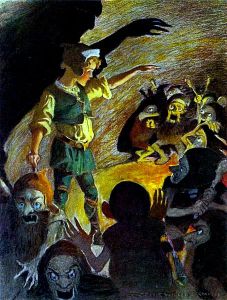
It’s somehow appropriate that our new space neighbor is called the Goblin.  The idea of a cosmos devoid of any intelligent life—supernatural or no—is somewhat scary.  Looking at the headlines of what we’re doing to one another down here, and nobody willing to take the reins of reason, we increasingly hope for something beyond mere nature in the cold, dark reaches above.  And that we’ve found such a thing as a goblin—a supernatural entity if there ever was one—is telling.  In fact, all our planets are named after gods.  We can blame the Greeks and Romans (and even the Mesopotamians) for that.  Still, the tradition continued onto the worlds they couldn’t see: Neptune and Uranus and, for a while, Pluto.  We can’t escape the idea that what’s up there is more powerful than our minuscule human troubles.  Our slowly eroding atmosphere is all that keeps us alive down here.  And now there’s a goblin circling all around us, so far away that few will ever even catch a glimpse.


The Falls of Lucifer

The Devil is everywhere.  At least if we go by the many places named after the dark lord.  Over the weekend in Ithaca, we visited Lucifer Falls.  Like several of the cataracts in the area, this is an impressive waterfall that exposes the many layers of the gorge it has carved out over the eons.  Part of Robert H. Treman State Park, the falls were impressive after all the rain we’ve been having here in the east.  But why are they called “Lucifer Falls”?  The literature on the park begs ignorance as to the origins of the name, noting that it was likely taken from the original Iroquois name.  If that’s the case, it’s likely been distorted in transmission.  Many such satanic names are.

Apart from the fact that Native American names for geologic features weren’t based on the Christian trope of God v. Satan, early European settlers heard what they wanted to hear.  Devil’s Lake in Wisconsin, which we used to visit in my Nashotah House days, was more properly translated “Spirit Lake.”  Since the Christians who encountered the native name believed that indigenous religion was inspired by the evil one, they recast the spiritual lake into an infernal one, at least in name.  People will still vacation there, thank you very much, while retaining the baptismal moniker that an intolerant religion bestowed upon it.  There’s nothing evil about Lucifer Falls.  It is an astonishing testament to what nature can do when left alone.

Well, at least for a while.  Like its more famous cousin Niagara, Lucifer Falls, upriver, was harvested for its ability to turn a mill wheel.  The old mill still stands today in the park as a testament to how the river was exploited.  Mills aren’t naturally evil, of course.  They turn to produce the things people need—in this case flour.  They can also, however, be symbols of corporate greed.  Those who own them can exploit more than just the water, and mills became a name for many other places of industry that eventually stole the lives and livelihoods of those whose work in them was cheap.  William Blake’s “dark satanic mills” remains a memorable phrase testifying to what happens when the wealthy, when corporations—which are “persons” with no feelings—are allowed to make decisions.  Treman State Park’s old mill was the center of a community that apparently didn’t experience such exploitation.  It was just a mill.  It’s picturesque waterfall was just a waterfall.  The name, however, still speaks volumes.


Riveting

The days of angry white men backlash are hopefully numbered.  One thing this strange phenomenon of privileged males feeling under threat has brought to the surface is the long struggle of women for the basic acknowledgment of human equality.  Ironically, it took a horrible war to move the cause forward.  Rosie the Riveter became a fixture during World War Two, blazing the message that women could do the tough jobs men had always done, now that males were off trying to kill one another overseas.  These images of Rosie have found new life in the era of Trumpism that has objectified women in the crudest possible ways, because it’s, well, monkey-see monkey-do in the world of politics.  Just consider Brett Kavanaugh and try to challenge the point.

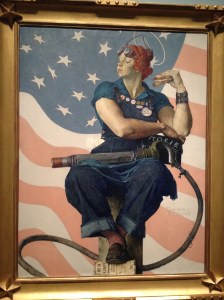
One of the more famous portraits of Rosie, back when Fascism was an evil thing, is that painted by Norman Rockwell.  A pugnacious Rosie eats her lunch with her feet on Main Kampf and her riveting gun in her lap.  (These days she would need to have her feet on an elephant rampant.)  Something about this painting always bothered me.  I could never put my finger on it.  It certainly wasn’t the confident look on Rosie’s face—she’d earned that and deserved it long before it became a reality.  Even the patriotism at that time was tasteful.  No, it was her posture.  There was something uncanny about it.  Then I learned that Rockwell had consciously copied Michelangelo’s Isaiah from the Sistine Chapel ceiling.

Isaiah, according to that famous rendition (Isaiah has never been a popular subject for paintings, for some reason), has his head turned at that peculiar angle because an angel is whispering in his ear.  Instead of a riveting gun, he’s packing a nascent Good Book, but he is receiving a direct message from on high.  I like to think it might be “The Spirit of the Lord is upon me, because he hath anointed me to preach the gospel to the poor; he hath sent me to heal the brokenhearted, to preach deliverance to the captives, and recovering of sight to the blind, to set at liberty them that are bruised, to preach the acceptable year of the Lord,” but then I’ve always been a dreamer.  Rosie, in Rockwell’s rendition, is prophetic.  She is proclaiming an equality which, inexplicably, coming up on a century later, is still unrealized.  Why?  The angry white man only recognizes God made in his own image.


Stand-in Line

Pop culture borrows from religion without knowing it.  Or maybe it’s just that religion has become so irrelevant that people no longer care.  Whichever may be the case, those who contribute to pop culture have a rich treasury from which to take withdrawals.  This occurred to me while waiting for a bus into New York.  Many people don’t want to stand in line (who does, really?).  In the Park-n-Ride subculture, you may leave an avatar in your place.  It’s probably not called an avatar, but since there’s nobody here to ask, I’m going to use the pop culture name.  You put your bag on the pavement, marking your place and then go sit in your car.  Since I’m going to be sitting in a big car for the next two hours, I prefer to stand outside.

The idea of an avatar is mediated to most people through either computer language or the movie.  I first encountered the term in the former sense in Neal Stephenson’s Snow Crash.  I was an internet neophyte and had trouble conceiving a virtual world in those days.  Some time later came the latter.  James Cameron’s film embodied the idea—linked through software, the tired hardware of physical bodies could be given new life.  In some senses it was an even better life.  Now everyone knows what an avatar is.  Perhaps except that the idea is native to Hinduism.

Hinduism was never an organized, intentional religion such as Christianity.  It is rather a wide array of traditional beliefs that, in the light of missionary activity, had to be given a name.  There are many gods in Hinduism, and when a deity descends to earth s/he appears in a form recognizable to humans—an avatar.  Not being an Indologist, my understanding of the concept is very basic, but it’s enough to know that this religious idea found a role in pop culture first through computer representations of human beings.  We had flattered ourselves with being gods, since we had created a virtual world.  A world we couldn’t physically enter.  Avatars were, therefore, how we wanted others to experience us.  Snow Crash is peopled with all kinds of representations.  The internet today, nearly 30 years on, has many more.  After all, there are many gods.

I glance at my watch.  The bus should be here any minute now.  When it enters the lot I’ll see the deities behind these canvas and leather avatars.  They’ll be less impressive than I’ve imagined them, I’m sure.  And although we’ve created virtual reality, I still have to get on a physical bus to go to virtual work.


Cthulhu You Knew

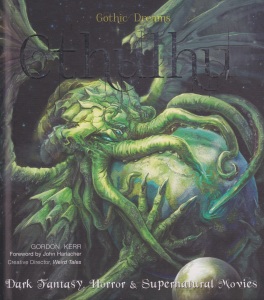
Humans tend to be visually oriented.  Arresting images stop us cold, causing us to focus on what we’re seeing.  As a tween I could be transported by large, lavishly illustrated, full-color books of other worlds.  While these went the way of Bradbury, I still sometimes recollect scenes that stopped me in my young tracks, making my juvenile mind wonder, what if…?  As an adult I realize “coffee table” books are heavy and a pain when you’re moving.  Printed on specialized paper, they have more heft than your mass-market paperback, or even most academic tomes.  Nevertheless, Gothic Dreams Cthulhu was a book that carried me, like a time-machine, back to my younger years.  Unlike in those days, however, I read the text as well as lingered over the images.  And I wondered about Cthulhu.

You see, I didn’t know about Lovecraft as a child.  The only reading regularly done in my family was Bible-oriented.  I discovered science fiction and gothic literature as a tween and, living in a small town, had no one to guide me in my choices.  Rouseville (the town pictured in the background on this website) had no public library.  My reading was left to my own, uninformed devices.  I discovered Cthulhu through my long fascination with Dagon.  I’d pitched Dagon as my dissertation topic, but settled on Asherah instead.  While teaching religion at the University of Wisconsin Oshkosh, I discovered Lovecraft, and Cthulhu, through Dagon.

Gordon Kerr, the author of Gothic Dreams Cthulhu, might be forgiven his hyperbole about H. P. Lovecraft.  Lovecraft was not a great writer—that’s not intended as any kind of slight, I hasten to add.  Classically, however, he didn’t have the level of literary finesse of Edgar Allan Poe, for example.  Still, Lovecraft created credible worlds.  His was a life of imagination—one might almost say divinity.  He was a creator.  Cthulhu has become a cultural icon.  With the magic of the internet bringing a writer still obscure to international attention, many people who never read horror fantasy nevertheless know who Cthulhu is.  Or they think they do.  As Kerr explains, the descriptions by Lovecraft himself are spare, thus the variety of ideas represented in the delicious artwork on every page of this book.  As Lovecraft earns more academic attention, surely others will notice the religious potential of the Great Old Ones that were, in their time, gods.  A guilty pleasure read, to be sure, Gothic Dreams Cthulhu fits well into this serious world of chaos we’ve created for ourselves.


Away and a Stranger

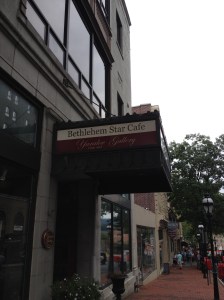
“And Joseph also went up from Galilee, out of the city of Nazareth, into Judaea, unto the city of David, which is called Bethlehem.”  Strangely enough, the great physician (although we know nothing of his medical practice) Luke was writing about a place an ocean and a sea away from here.  The place names of eastern Pennsylvania demonstrate the religious awareness of the early colonial Europeans who brought their Bibles and diseases to this nation.  Bethlehem, Pennsylvania was known more for being a house of steel than being a house of bread.  It’s just down the road from the little town of Nazareth, made famous by The Band’s classic hit, “The Weight.”  The road to Emmaus is nearby.  And the major medical facility is, you guessed it, St. Luke’s.

The Band had an influence somewhat surprising for those who may have trouble recalling their nondescript name.  “The Weight” is a story of a traveler coming to, of all places, Nazareth, Pennsylvania.  So taken by the song was a Scottish band that they adopted the name Nazareth before informing us that “Love Hurts.”  This is something the evangelist and purported doctor Luke presumably knew.  If you go down from Nazareth even unto Bethlehem, you’ll find the steel city recast as the Christmas city.  For those of us who grew up in the western part of the state, Pittsburgh was the real steel city anyway.  When I was growing up, Pittsburgh was the 16th largest city in the country.  It now sits at 65th, because, like Bethlehem it had trouble drawing people without the natural hardness that is Pennsylvania.  There’s a parable in a city transforming from a heavy metal to a holiday.  There’s no Pittsburgh in the Bible.

When Luke begins his Christmas narrative (think of this as one of those “Christmas in July,” or August things), quoted above, he ironically leaves Mary until the next verse.  Joseph, whom later tradition will say had nothing to do with the conception anyway, still gets first billing.  One wonders what might’ve been different had Mary led the way.  It was much later, after the gruesome crucifixion account, that Emmaus came into the picture.  Two unnamed disciples were walking along that road and didn’t recognize who Jesus was.  Had they kept walking, I wonder if they might’ve ended up in Pittsburgh, for the biblical names soon give way to places like Kutztown and Fleetwood, the latter of which, I have to admit, I never got into.  Had Mary taken a load off in Nazareth, this story would’ve been completely different.  Thus saith The Band.