Augustine’s Secret Sin

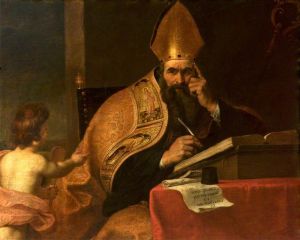
I’m curious: what do you think of Augustine? Augustine of Hippo was an odd blend of saint and sinner. I don’t mean “saint” in the sense of being so designated by the Roman Catholic Church, but in the sense of having reputable and progressive ideas. For example, Augustine argued that science, such as it existed in his day, had to be taken into account when understanding Christianity. If the Bible’s account of creation didn’t match what we knew of the world, then literalism had to go—that kind of thing. This was quite liberal for someone in the fourth-to-fifth centuries. He believed in reason, to an extent. The sinner side of the equation goes beyond his Manichean days, however. The sins I’m referring to are his dangerous and long-lasting theological assumptions that’ve helped to hold back civilization throughout history.

It was Augustine, for example, who gave us the idea of original sin being involved in sexual reproduction. The church has always been cagey on why we should reproduce when the second coming is right around the corner, but Augustine declared that from our very conception (which he couldn’t understand scientifically) we were tainted with sin. But that’s not the particular sin to which I’m referring. Augustine also spread the persistent idea that curiosity itself was a sin. Christianity, in his view, was a “need to know” religion, and curiosity about the natural world could lead to uncomfortable answers. He held this in tension with his belief that we should accept what science teaches, but there were many questions, he decided, we simply shouldn’t ask.

Religions have often come to this crux. Science has a strong explanatory track record. Religion is frequently based on old texts, written in an age when science was but an infant. As the power of rationality grew, the role of miracles shrank. Over time the proof of theological structures began to crumble. And since life was all about correct theology, those edifices had to be shored up against the onslaughts of reason. If this sounds hopelessly outdated, I’ll have to confess that many of my students at Nashotah House believed reason was tainted by original sin. Augustine had the answers they believed; somehow rationality had stopped with him. Human curiosity, Augustine felt, was a sin. All questions should’ve ended with his arguments. It’s this kind of theological bravado that gets us into the mess we find ourselves in today. Voting blocs that never question what their religious leader tells them. Never curious enough to ask “Why?” Augustine was a brilliant man, in many respects. He was also a sinner of the highest degree.


Noah’s Phone

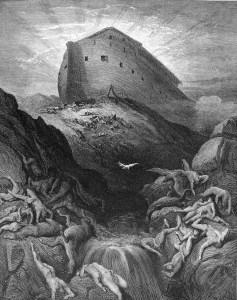
The world-wide flood is a great story. We find it in many cultures, so the idea obviously captured the attention of ancients as well as moderns. What’s strange is that, with the development of human knowledge so many people continue to accept it literally. The only science that can be bent enough to make it work is one where God breaks all the laws of physics and biology to kill everyone, just to make a point. Why bother to make it rain 40 or 150 days? Why not just create the requisite water instantaneously? It would be just as believable. Nevertheless, literalists look for explanations for how this might’ve happened. It’s not to convince God, of course. The goal is to convert unbelievers by showing that the myths of Genesis are literally true.

When I came across a story on Mysterious Universe by Paul Seaburn titled “Academic Claims Noah had Cell Phones, Drones and Nuclear Power,” I was hooked. The academic is a Turkish professor of marine sciences. Using modern technology—rather like the detritus seen scattered in the background of Darren Aronofsky’s recent movie version—he postulates that this could’ve happened. The real issue is why. Not why the flood; the Bible answers that. Why would a scientist feel the need to prove a myth scientifically? Biblical scholars call the flood story an etiology. An etiology is a story to explain the origins of things. That’s its purpose.

Noah’s flood explains why it rains. It also explains why this dome that covers our flat earth doesn’t fill all the way up anymore. It explains why animals are sacrificed and why rainbows occasionally appear to grace the sky after it rains. We also know that the story borrows from an even earlier Mesopotamian myth where the god who causes the flood isn’t even Yahweh. The people of Israel were conquered by the Assyrians and Babylonians and they told flood stories about their gods. The Bible counters with two stories (yes, just like the creation accounts) mixed together in this snow-globe universe of Genesis. Is it easier to believe this or to claim that Noah had access to Verizon, steel manufacturing, Einsteinian physics, remote-control flying machines, and artificial insemination (to help the animals recover)? It’s like when someone suggests natural explanations for the plagues of Egypt. Such special pleading doesn’t prove miracles, but rather it demonstrates that all this could happen without any gods involved. And you’re still going to have to mop up all that water when it’s over. I’m sure it will make for a great story some day.


Devil of the Time

There can be little doubt that evil prospers. We’ve suffered through a year of an evil administration and we’ve seen the government increase the suffering of its own people in deference to the wealthy. And ours is only a mild case of evil. Jeffrey Burton Russell, over the course of some years, wrote three sequential books about evil. The first, The Devil, I reviewed last year. Having just finished the second, Satan: The Early Christian Tradition, it has to be said that the concept definitely evolves. The period between the New Testament and the fifth century was a rich one for diabolism. The writers of this period became increasingly theological in their efforts to make sense of what is obviously an unjust situation created by a theologically good God. These were inventive writers, if somehow less than convincing.

Russell is a careful explainer. He summarizes the views of the “church fathers,” pointing out where their logic fails. This isn’t some liberal trying to dis the Devil, however. Russell acknowledges that he believes a Devil of some kind must exist. Reason, however, must also be applied. It’s difficult to believe that people in the early Christian centuries were willing to take such leaps of logic. Of course, they didn’t have many options for opting out. God was the great explanation for so much of their world. Fitting an all-powerful deity into logic when there’s abundant suffering in the world requires a certain flair for casuistry. No matter how the equations work out, an all-powerful God can’t be all good, not in this universe. Speculation about the Devil, or Satan, ran logic through its courses. Who was this being, and how did he get to be the way he is?

The theologians argued without any glint of irony. This was serious stuff. The Bible, famously, has little to say on the matter. Early thinkers such as Tertullian, Origen, and Augustine had volumes to say on the subject. None of them came up with a workable solution. Logic and the Devil just don’t fit. Theology is always a struggle since it deals with intangibles. Laws of logic sometimes simply don’t apply. If the feeble human imagination can conjure a good world without needless suffering, one has to wonder, why can’t an almighty deity do the same? Is this a god of limited imagination or, as the classic theological chestnut puts it, one who sees more than humans do? You can ask, but you won’t receive an answer. The Devil, it seems, really is in the details.


Peter and the Red Giant

Now that my book has been sent off to the publisher, I’m working on the next project. This one has me delving back into the Greek of the New Testament. It may be, some would say, that I’m no longer an expert in such things. Coming to Koiné Greek, however, after lingering among languages like Ugaritic and Akkadian, feels like coming home. It’s Indo-European, after all. One of the books I’ve come back to is 2 Peter. This is a curiosity among the canonical books. All but the most conservatively predisposed of scholars note that this little letter didn’t actually come from the Peter. The idea of using someone famous as a literary pseudonym was a well known and widely accepted practice in ancient times. In fact, the prefix “Pseudo-“ on classical writers is so common that I feel just a little self-conscious. Nevertheless, 2 Peter contains fascinating ideas.

The Bible was influenced, of course, by many outside sources. One of those sources was Zoroastrianism, the religion of ancient Persia. This came to mind because 2 Peter is the only book in the Bible that describes the end of the world as burning and melting. These ideas are tied to the purifying fire of Zoroastrianism. In that religion an evil deity, Angra Mainyu, corrupted this world. Fire, in Zoroastrian thought, is holy. At the end of time, when the blessed ascend to a heavenly mountain, a river of fire will pour down, burning and purifying the polluted earth left behind. The idea is powerful and evocative, and obviously some early Christian writers cottoned onto it. Including 2 Peter.

The idea, in the Bible, stands isolated in this one single book. The real concern of the epistle is false prophets, though. Still, the worldly should take note. The universe in biblical times consisted only of this relatively flat planet—which wasn’t even a planet then—with a starry dome overhead and a fiery Hell beneath. Ironically, 2 Peter’s end is similar to that predicted by modern astronomers. A star the size our sun will likely bloom out into a red giant, parboiling the earth in its death throes. Seems the Zoroastrians, and Peter, may have been correct after all. The thing is they both had an escape hatch that will only come with interplanetary migration, according to science. But then, all of this assumes there will be a world left after the Trump administration. And speaking of false prophets, I wonder what 2 Peter would’ve had to say about that?


Playing Piano

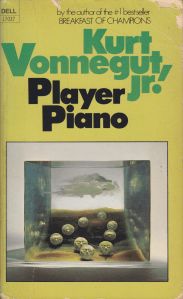
It must be very difficult to write books that make the future believable. With the speed of technological change, it’s getting more difficult all the time. Some exceptions are modern dystopias that take civilization back to square one. We’ve come close enough in reality already to be able to imagine such things. While not really a dystopia—although it kinda is—Kurt Vonnegut Jr.’s Player Piano extrapolates what a future in the service of machines might look like. Some elements are incredibly 1950s—everyone still smokes, all communication is on paper, computers run by punchcards, and attitudes are hopelessly parochial—while others are on point for today. The world has been mechanized and an even more obvious class system than our current one has been established. Of course, those top few reap all the rewards and wonder why those below them are dissatisfied.

What’s really noteworthy, though, is that Vonnegut uses religion to address the situation. In this, his first novel, he has a minister leading the revolution against the system. This clergyman does so by finding and nominating a “messiah”—a figure around whom the dissatisfied might coalesce. In a world many characters characterize as evil, the solution is offered by religion. Well, not exactly. Vonnegut’s famous satire is beginning to appear even here and the revolution that religion fuels can’t overcome the human love of machines and gadgets. In many respects, this book is an extended parable. I can’t help but think that Vonnegut would’ve recognized our love of devices as a symptom of his humanity being declared useless by machines.

Kurt Vonnegut isn’t a religious writer, but like many authors he recognizes the motivating power of belief. There are agnostics aplenty in Player Piano, Indeed, the protagonist is never sure of what he believes. The larger questions, however, still persist: do we advance human potential by making things easier? All of us now have to be varying degrees of experts on computers to find even the most rudimentary jobs. There is really no opt-out anymore, and what’s more, few would take it if there were. The phone in my pocket has changed my life in ways I can’t call entirely good. As we get closer and closer to our media, we’ll want more intimate contact—implants are already starting to exist. Vonnegut, in his sardonic way, was asking even in the early 1950s if we had really improved our lot via such invention. In the end, of course, it doesn’t really matter because for better or worse, our tech is here to stay.


Kings and Fiends

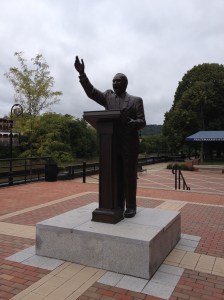
Martin Luther King Jr. was, and is, a symbol of hope. This day, as we’re encouraged to think of progress, we’re mired under leadership that less than a week ago used derogatory language to describe people that aren’t white enough for his liking. Those who, like King, have a dream, are under attack by a government that has pledged its allegiance to the dollar. The dollar in the hand of the white man. From the days of the prophets on the dream of a just and fair society has been the ideal. Instead we find ourselves under the ultimate party of privilege that likes to quote the Bible but which admires Pharaoh far more than Moses. They claim to see the promised land, and that land belongs only to them.

I was too young, as a seminary student, to appreciate I was walking the same halls as Dr. Martin Luther King. Sitting in the same classrooms. It had all been before my time. Because of the Bible I first took an interest in history—eager to learn how we’d come to this place. Ronald Reagan—who now amazingly seems rather benign—was making it difficult for the poor by promoting “trickle down economics.” We all saw how that worked. The modern-day Pharaohs may not wear the impressive headdress of antiquity, but they’re no less fond of owning slaves. King understood that non-violence comes with a cost. It takes time. Unlike the present administration, he understood the difference between right and wrong.

The Pharaoh in the White House makes it difficult to appreciate any progress at all. We have come to see what it means to be a nation that solely, utterly worships Mammon. The voice of the Bible is weak and shouted down by those who see no gain in it for themselves. There were surely those in Egypt who were poor but who appreciated the Pharaoh. At least he was enslaving those from somewhere else, according to Exodus. According to the Good Book it was God himself who opposed this system, but now, according to the evangelicals, God has blessed it. It is the will of God to rob the poor of their health care so that the rich can add even more to their too much. On this Martin Luther King day we struggle to find hope in such a world. The hope is there, but we have to be willing to dare to dream.


Sticky Labels

Who gets to decide on their own label? We all generally know how we’d like people to think of us, but labels are limiting and divisive. An article by Tom Gjelten on NPR describes why “2017 Has Been A Rough Year For Evangelicals.” The label “Evangelical” is so protean that most people outside the specialist camp really have no idea what it means. A colleague of mine at Nashotah House used to defensively declare himself an Evangelical while holding somewhat progressive social views. I know Evangelicals who find the whole Trump charade distasteful and, quite frankly, wrong. They are, however, pasted with a label that has passed its expiration date. This label doesn’t come off easily.

The real issue is not Evangelicalism, but politics. In the version of Evangelicalism in which I was raised was non-weaponized. Yes, we believed that others should convert to “true Christianity” but whether they did so or not was their decision. In college, fellow Evangelicals in a very conservative setting declared that legislative morality was no morality at all. This was in the Reagan Era, when the GOP “discovered” the huge “bloc” of untapped voters—the Evangelicals. They discovered that this particular bloc could be rather easily swayed from voting in its own best interests, socially and financially, but emphasizing certain hot button issues. It was a political game that many Evangelicals simply didn’t recognize. You love Jesus, you vote Republican. Now these Jesus lovers must love Trump.

This discord is what Gjelten is addressing. Some Evangelicals are discussing changing their label. This can happen, of course, over time. The Moral Majority became the Religious Right became the Christian Right. Powered by televangelists when television was king, they now have to try to control the internet so the mediating influence of secular thought can be dammed. Among the casualties along the way is Jesus. The modern Evangelical movement no longer adheres to the teachings of the carpenter from Nazareth. The issues on which he spoke plainly and repeatedly have been relabeled as “liberal” and therefore evil. If you can keep the Jesus brand, eviscerated of its core beliefs, you can gather a bloc of dupes who’ll flush their own healthcare and financial wellbeing simply because sheep will follow any shepherd. Ironically, the Bible itself warns of the dangers of following false shepherds. None of that matters anymore. And those who joined the group because of that Bible wonder now who they really are.


Honest Doubt

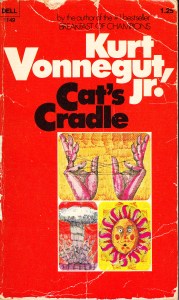
Kurt Vonnegut was never required reading in my high school English classes. I read Slaughterhouse-Five when I was in seminary, and picked up a few of his other titles in the dearly departed Boston Book Annex. A couple of these used books have been waiting patiently over the decades, and so I selected Cat’s Cradle to be perhaps the last book I finish this year. As far as I can recollect, the Vonnegut books I purchased while in seminary had no particular order or reason. A friend had recommended The Sirens of Titan, but Cat’s Cradle was what would now be called an “impulse buy.” Reading it, I rediscovered why I like Vonnegut so much. I also found out the book revolves around religion.

Regular readers know that I tend to find religious themes in secular books. It’s partially human radar and partially an unfortunate occupational hazard. Occasionally I’m pretty certain the author had no intention of including or developing the themes I discover. Cat’s Cradle, however, places religion front and center. The story involves a journalist on the trail of one of the developers of the atomic bomb. He unintentionally coverts to Bokononism, a religion made up by a castaway on the island of San Lorenzo. The religion, based on the teachings of a still-living sage, revolves around the idea that all its sacred writings are lies. Think about that a moment.

Lies, in which we’ve all had a crash course since January, are among the most insidious of human accomplishments. We value and crave the truth. We all believe that we believe it, but there are differing opinions as to what it is. Some opinions are backed with evidence, and others with flimsy fabrications. To declare a religion based on lies is, of course, to undermine the whole enterprise. Vonnegut was a noted iconoclast, but there’s a brilliance in declaring a religion to be knowingly based on falsehood. In fact, we’re seeing it happen before our very eyes. The religion formerly known as Christianity, once upon a time, took into account the teachings of Jesus of Nazareth, as recorded in the gospels. Modern Christianity—Evangelicalism—has completely thrown Jesus out of the equation in all but name. Branding, after all, is everything. This modern faux religion suggests hating your fellow creature, taking advantage of the poor, and believing falsehoods to be the most sincere of truths. It’s alive and released on the earth even now. And it is far more scary than even ice-nine.


Nothing Better

While it may seem that the largest challenge on a blog like this is writing all these words every day, that’s often not the case. Early on in my blogging life, I learned that images draw readers in. That may no longer be the case, but I do try to ensure that my posts have apt illustrations. Due to the fact that I can’t keep up with technology, I no longer know where these images are even stored, so when I was seeking a picture—amid thousands—that I had saved on my backup drive, I came across a series of photos taken in central Pennsylvania. These showed some road-cuts with obvious and impressive folding of geological layers characteristic of orogenous zones. Geologists only discovered the earth was ancient in the nineteenth century, and evangelicals have been disputing it ever since.

Genesis, so the spotless thinking goes, says the world was created in six days. So, by God, in six days it was created! When Darwin simply put the pieces of the puzzle together, evangelicals objected loudly. They started electing US presidents in the next century—a blink of the eye in geologic terms. They don’t dispute non-biblical dinosaurs, however. Their kids would object. The impressive sedimentary layers (or for that matter, igneous or metamorphic) were, they claim, made by God to look old. To fool us. That’s the kind of deity he is. So I got to thinking of a “to do list” for a God with nothing better to do than to oversee intricate and complicated layers of rock that make sense in geological time, but which, apparently, are only planted here to test the faith of brand-spanking new Homo sapiens.

One thing such a deity might do is take care of social injustice. Since he is a father, I suspect we ought to listen to his son, my evangelical friends. Jesus of Nazareth seemed pretty set on helping other people and everyone loving one another. This was, of course, between stints of helping make the planet look older than it actually is so that sinful scientists could trick their compatriots into going to Hell by believing false evidence. There are so many things you could do if you had the time to make such intricate traps. Why not write another book, for example? The Bible could use a good sequel. But no, it is far better to spend divine time making a world look older than it is. And if I had been able to save the time looking for that image that took over half an hour to find, a post such as this would’ve never been created at all.


Who Can You Call?

They’re scratching their heads. The media, I mean. In this distorted world of Trumpism, newspapers have rediscovered religion. Some say Trump is the altar boy of the evangelical right with people like Franklin Graham wetting himself over the president. Others say evangelicals want to change their name to distance themselves from Trump. Everybody seems to want to know who evangelicals are, but they’re afraid to ask. The weird, or perhaps expected, thing is universities decline to help. For years now they’ve been cutting positions in religion, a topic no longer relevant or of any interest. Academics aren’t always good at seeing what’s right in front of them, of course. So it is that the media’s scratching its collective head. Is he or isn’t he? What can you say about a man who’s so clearly heathen and yet a sparkling example of Christ-like compassion and values?

It’s doubtful whether any university administrator or televangelist could finger Jesus of Nazareth in a police line-up. They have no idea of who he was or what he taught. All that matters is he was God and he protects unborn babies so that he can arm them with automatic rifles when they’re of age. Oh, and he’s definitely not a woman. Or gay. Is that about it? Just in the past week major media outlets have run stories about the evangelical relationship to the commander-in-thief who’s told more lies in his first year than all other presidents combined. Who said Jesus of Nazareth was honest? He just stood for the right causes.

Having grown up evangelical, studied religion with evangelicals, and having been fired by evangelicals, I know them well. They have a mental capacity for biblicism that’s nearly incomprehensible. The Bible is so sacred that no other book should be placed atop it. It should never be set on the floor. Memorizing chapter and verse is more important than knowing what they might mean or how to live by them. This is old-school blind faith. And proudly so. Trump doesn’t know the Bible but he says he does. His actions resemble the carpenter from Nazareth’s about as much as Joseph Stalin’s. He was a good Christian, too, wasn’t he? After all, the Bible says Russia is our ally. Reagan—another evangelical—may’ve said they were our worst enemy, but one thing we know for sure about the Good Book: it never lies. For that it takes evangelicals and politicians.


Inventing Christmas

While not always classified among the most intellectual of writers, Charles Dickens was a complicated man. Able to conjure words that reflect emotions, often making readers laugh and cry, he was the undisputed bestselling author of his day. This holiday season the movie The Man Who Invented Christmas explores one of the probable reasons for Dickens’ celebrity—the resuscitory success of his first holiday novel, A Christmas Carol. The film was based on a non-fiction work by the same title, written by Les Standiford, subtitled How Charles Dickens’s A Christmas Carol Rescued His Career and Revived Our Holiday Spirits. As an author who found early fame, it might seem counterintuitive to those of us who’ve never found any that Dickens’ career would need rescuing. In the publishing world, fame has to be sustained since few books keep on selling and selling. And Dickens didn’t always help himself.

Dickens’ choice of Christmas as a theme was, obviously, driven by his own warmth regarding the season. As Standiford makes clear, however, it was also driven by money. Like many in today’s world, Dickens had established his comfort at pecuniary liability—he lived on credit. He also supported other family members and although he cared for the poor he often resented those who cost him money through irresponsibility. Christmas was a time when, he hoped, people might be encouraged to give. Some of that money, naturally, would go toward the purchase of his book. Although the story was secular, it gained the approbation of many in the church—it encourages thinking of others and being generous. Complicated.

As we get closer to Christmas this year, it seems that Dickens’ message bears loud and constant repeating. Here in the States, our government has taken on a decidedly Scrooge-like cast when it comes to the poor and unfortunate. Indeed, “bah, humbug” might well be the new motto of the Grand Old Party. Shown evidence of the guilt of the miser in chief they only claim that those who discover such truth are lovers of false truth, such as claiming that the poor really suffer with want. They close ranks to ensure that the downtrodden can never vote them out of power and claim that Bob Cratchit’s problem is that he’s lazy and Tiny Tim is a burden on the misunderstood wealthy who only ever wanted to help others. A huge difference is that Dickens knew his novel was fiction. This holiday season the ghosts visiting us will be the emaciated spirits of democracy past, present, and future, and that of human decency.


In Control

Those who know me know that I treat my workdays like clockwork. I leave the apartment every day, catch the same bus, and leave work at the end of the day, all according to schedule. Traffic is a variable, of course. Yesterday as I came out of the Port Authority Bus Terminal at 7:15, blunted with my reading on the bus, I noted we were a bit late for my liking. I got to work before 7:30, though, and was interrupted by a message from my brother, asking if I had made it out of the Port Authority okay. I was a bit confused—weather delays do happen, but what could have made today any different than any other Monday? It was then I learned about the bombing. It happened five minutes after I left.

Now, I’m not trying to over-dramatize this. I was above ground and the bomber was below. I didn’t even hear it go off, although there were a lot of sirens on my way to work. The only serious injury was to the bomber himself. What really got to me, when the idea had time to settle in, was how close I’d been. So were thousands of others at the time. Over the summer I went to Penn Station just after what had been assumed to be a terrorist attack. Jackets and personal effects lay scattered on the floor. People had dropped things and ran. In that case it had been an innocent tazing of an unruly passenger that had set off the panic. I’m not a fan of fear on the commute. I don’t think, however, that we should give in to the rhetoric that our government will surely use to describe all this.

Millions of people live and work in New York City. Such things as these disrupt the flow of our daily lives, but we can’t let the agenda of fear control this narrative. I felt a tinge of it when I headed back to the Port Authority at the end of the day. Police barricades were still up on 8th Avenue. Reporters with cameras were at the scene. A potential killer had been here just hours before. This is New York. Without the overlay of fear, this was simply business as normal. Any city of millions will harbor potential killers. If terror controls the narrative, it has won. If politicians use this fear to win elections, the terrorists win them too. I’m doing what we must do to defeat the fear. I’m just getting back on the bus.


Ravages and Kings

I was recently thinking about King Saul. If it’s been a while for you, Saul was the “first king” of Israel, according to the books of Samuel. Saul had a problem. That problem’s name was David. David was younger, more popular, a gifted musician and lady’s man. In sudden fits of rage Saul tried to kill David, more than once. An unstable man was in charge, but claiming God’s sanction he was safe from any kind of impeachment. In the words of Mel Brooks, “It’s good to be king.” So Israel limped along under weak leadership until Saul got himself killed in battle. I couldn’t help think that this story shows just how relevant the Bible remains today. Mad kings are difficult to displace. They have their fans and, to quote Alfred, “some men just want to watch the world burn.”

David’s reign was no picnic either. He had his Bathsheba affair, and was constantly making war as well as love. He pretended to be insane to save himself from Saul, but he was loved by Yahweh and thrived. Oh, and he wrote the book of Psalms. It’s a bit of a shock when this much feted king gives Solomon, his son, his last words. Instead of some pious sentiments or perhaps a last-minute poem, his final instructions are a hit list. “I promised not to kill Shimei, but you made no such promise.” Wink, nod. And Solomon reigned, bragging of groping a thousand women. One of the one percent, he was fabulously wealthy and ultimately couldn’t hold his kingdom together. And none of this is even prophecy!

Why do we put up with mad kings? The world is full of good, and able people. They have a very difficult time getting elected in a democracy. They had trouble even when it was a monarchy. Yes, power corrupts. We know that. Those who are truly mad, however, learn to live by gaming the system. Lies are alternative facts and truth is fake news. Other elected officials, apparently incapable of reading the newspapers, follow the leader. Like lemmings, they ignore the cliff just ahead. Ironically the Bible has a role to play in all this madness. In fact, many people seem to think Israel had a cozy little history. They’re the ones who’ve never read the Good Book. Even during the golden reign of David there were schisms and political murders. All you need to do, however, is say God told you to, and even a madman can become a saint.


Dominus Flevit

I couldn’t believe I was actually there. Ever since I was a child I’d read about this place. The city conquered by David and visited by Jesus. The city around which most of the Bible rotated. Jerusalem the golden. One of the perks of working on an archaeological dig was the opportunity for weekend travel, and here I was, amid camels and cars and churches and synagogues and mosques, in Jerusalem. No amount of reading prepares you for such an experience. Suffused with the rich mythologies of three major religions, this city is like a dream. So much had happened here. The church I was attending at the time was only the latest in a long succession that informed me that God himself had actually been killed here and had risen again. The ultimate game-changer. The once in forever event of all time had taken place right here.

Gnu Jerusalem from WikiCommons

But this was not a city at peace, despite its name. There was a bombing the first weekend I was there. Young men and women in military garb carried scary looking weapons openly in public. Even civilian bus drivers wore pistols. Jerusalem had a long history of violence, but that didn’t justify it. If God had really been here—in either Jewish, Christian, or Muslim contexts didn’t matter—how could this city be so prone to terror? In the old city old men sat around hookahs, placidly smoking. Tourists, many bearing crosses, thronged. Jerusalem, however, was also a very political place. The fragile, Christmas bulb-thin peace of the region involved the city being divided up and not being claimed by Israel alone. Even that man driving his goats through these ancient streets knew that.

Trump, to the cheers of evangelicals who want nothing so fervently as the end of the world, has said he’ll recognize Jerusalem as the capital of Israel. This political move of weaponized ignorance will almost certainly lead to war in the Middle East. Another war. An illegitimate presidency leaving a frothing sea of corpses in its wake. Negotiating in this part of the world is like haggling with that street vendor for a pair of sandals. You go back and forth on the price. You act insulted and walk away. You come back and haggle some more. It’s a delicate dance. This is no place for egomaniacs who can’t understand such subtleties. Just ask the last Caligula who wanted his statue set up as a god in this city. Jerusalem is home to too many jealous gods, and those who are self-appointed divinities will only leave the city, the world, in tears.


Spiritual Education

The water was hot. Notoriously hot. Our Junior High School had been built in the days of the prison esthetic, with heavy, cinderblock walls painted in penitent colors. And the water was famously hot. One of our gym teachers, nameless here forevermore, challenged us to be men. It takes a kind of courage mostly illegal these days to lecture a room full of naked boys, but he once came in during mandatory shower time to tell us that anyone who could hold their hand under the hot tap for a full minute would get an A in gym. Since he was an ex-Marine nobody was foolish enough to take him up on this challenge. At least not in my class. It’s difficult to be courageous when you’re unclothed.

The incident I recall, however, occurred at the opposite end of the spectrum, in art class. You may remember those days when you wove reed baskets to take home to your mom. The thing about reeds is that they’re brittle unless soaked in hot water. That was the key to working with them. Make them supple with hot water and then when they dried, they’d be remarkably sturdy, if somewhat lopsided. We had been weaving reed baskets when someone, unbeknownst to the teacher, had filled the sink with water as hot as our old school could deliver. Thinking it funny, since even in those days educational budgets were under threat, somebody dropped one of the very limited number of heavy reed-cutters into the sink, now at the very bottom of a basin of very hot water. I was not the guilty party; I don’t know who was. The drain was plugged from the bottom. Very funny, no?

At the end of class. the teacher was not amused. “No one leaves this room until that cutter is out of the water,” she flatly said. The first bell rang. She stood in front of the door. We would be late for the next period. Perhaps it is the weakness of character my religion instilled in me, but I’ve always had a great fear of not doing what I was told. It lingers to this day, that Fundamental unworthiness. This body of mere flesh is weak and prone to sinfulness. The clock was ticking. Teacher wanted the guilty party to suffer the price of their prank. I pulled up my sleeve, plunged my hand into the scalding water, pulled out the reed-cutter, slapped it on the counter, and walked out the door. We were released to class and the searing pain didn’t last long physically, but spiritually it has never gone away.