Rumors of Wars

Now that Black Friday and Thanksgiving are behind us, the holiday season compels us to think of what comes next. Whether it is Hanukkah or Christmas or Kwanza, people are preparing to celebrate during the longest nights of the year, hoping to encourage light to return. It is a most primitive urge. Darkness is easy to come by; light takes a little more effort. In the western world the season was largely instituted by the celebration of Christmas, although this took many, many years to catch on. Now it is a begrudging nod in the direction of workers who spend more and more of their time on the job since the internet makes it difficult to claim that we are unavailable. Smart phones, smart watches, tablets, and computers are ubiquitous, so access to work email is only a click away. In any case, the holiday season invariably brings stories of offended people to the surface.

A recent piece in The Baxter Bulletin, sent to me by my wife, rehearses the story of Baxter County, Arkansas and the challenge against a nativity scene on a courthouse lawn. Such stories always seem to me to be cases with no winners. A courthouse should remain neutral territory, but the nativity scene hardly seems an offensive weapon. I can’t claim to know a great deal about the history of creche scenes, but it doesn’t appear likely that they were ever covert attempts to convert. They were celebrations, and nobody has a problem with them as long as they’re kept on private property or church garths. I do wonder, however, if driving them out of public sight really has any purpose. We all know that this time of year is gearing up to holidays when the ordinary takes the back seat for a few days and we can stop the rat race and reflect on a wonderful myth of biblical proportions.

Tree, bush, or asherah?

Tree, bush, or asherah?

Similar stories are unfolding in countless venues now that December is practically here. Even stopping into Starbucks for a cup of coffee can land you in the middle of a culture war. It would seem to me that in this troubled world we might instead try to focus on peace. Whether or not the story of the manger has any historicity at all, the fact is the first century was a period of extreme unrest. This was a moment to pause and imagine what a world without war might be like. Now the holidays have become an occasion for declaring a new kind of sniping war about who has the right to make reference to a legendary event. Or where they may do so. In some cases there may be legitimate cause for concern. Most of the time, however, only those fixated on belligerence manage to draw everyone in to a fractured fairy tale of a holiday season where money is at stake.

As Others Think

As analysts step in where angels fear to tread, we have been given expert opinion on why ISIS’s terror in France was counterproductive to its goals. A few voices have chimed in stating that the result of escalation is just what an apocalyptic group hopes for. Rational people, having no idea how a fundamentalist thinks, are scratching their heads. Long I have wondered why universities and other bastians of higher education haven’t sought the advice of experts. No one can understand fundamentalism who hasn’t experienced it personally. Problem is, most people who have experienced it are experiencing it still. Those of us who thought our way out of fundamentalism are passed over repeatedly for university posts, while those better connected (surely not of fundamentalist stock) are handed influential positions from which to scratch their heads. You want to understand fundamentalists? Ask someone who’s been there.

There is nothing rational, in the common parlance, about fundamentalism. It has, however, its own internal logic. If you believe with every mitochondria in your body that the Bible (or any holy book or doctrine) that you were taught is true, and truly believe it, no amount of reason can convince you otherwise. This is (partially) because the ultimate cause of all events is open to question. Science does not address ultimate causes—it can’t. The endlessly creative human mind, however, can rather simply conjure them. If God is the ultimate ultimate cause, and if God said, x, y, or z, then other interpretations are simply wrong. If God has decided an apocalypse is necessary, what use is reason in the face of the impending certainty? Is there no way out?

There is. Some of us have made it. We, no matter our credentials, are not generally well-connected drones of the middle class. Fundamentalism is prized by the poor. Those who have no future on this earth look for another, better world. This is a perspective I understand very well. Our increase in ease of communication and exploding technology with ease of access have only given new tools to those who think in terms of ultimate causes only. You can’t talk a suicide bomber out of action with reason. You need to know the language of belief. We glory in our lack of belief and rationalism. We, however, close our eyes to the fact that the vast majority of people in the world are believers. And we won’t talk to them because they make us uncomfortable. We have written our own recipe for apocalypse.

From NASA's photo library

From NASA’s photo library


Apocalypse When?

We want to understand what worms through the mind of terrorists, and yet we don’t want to be bothered with religion. For decades universities have been shutting down departments of religion because they don’t make money. Religions aren’t materialistic in that way. In the light of the attacks on Paris over the weekend, many have been turning to the media to learn more about ISIS. A piece in the Atlantic by Graeme Wood, published back in March, pointed out how we have tended to see the movement as political, not religious. Wood, however, demonstrates the apocalyptic intentions of the leaders of ISIS. They are religious. Just because you carry guns and high explosives doesn’t mean you don’t believe.

Apocalyptic thought and politics are a deadly combination. The United States is not immune. Knowing the bent of George W. Bush’s distortion of Christianity, his terms in office were very frightening for many of us. Some Christianities, as well as some Islams, not only anticipate the end of the world but earnestly long for it. Pray for it. In the case of some Fundamentalist Christian sects, world leaders should orchestrate events to force God’s hand in bringing about end times. The fact that we had a president sympathetic to those beliefs should send shudders down anyone’s spine. The idea of an apocalypse is a religious one—there is nothing secular about it. We know the history of the concept, although universities eschew those who look that far back. Zarathustra, also known as Zoroaster, devised a new religion that reflected the basic dualism we all feel: good versus evil. The only way that good could ultimately win in such a worldview was through the complete destruction of evil. And evil wasn’t going down without a fight. This idea influenced Judaism during the Exile, and thus Christianities adopted it. And Islams. No moral relativism here.

The horsemen close in

The horsemen close in

Religion is not evil. Historically it has attempted to be a moral compass to guide believers toward right over wrong. The fact that any religion faces opposition shoves those weak of mind into an apocalyptic state. Gather the horsemen and try to prod God into action. We don’t see divine activity on any kind of scale that we would recognize. The religious events of the past—the Islamic expansion, the Crusades, the Jewish revolt against Rome—these events are merely political. Those who’ve been conditioned to see God behind human activities, however, view such things very differently. Apocalypses are religious events. No amount of reason will convince a convicted believer to look elsewhere for consolation. Yet we press on with guns and bombs and ignorance of what makes religions tick. And tick they will. No matter how secular we might wish the world to be.


City of Lights

As the civilized world struggles to make sense over the senseless attacks of ISIS in Paris, the question of where to turn emerges. An attack has taken place. Innocent people have died. We are in mourning, and we want to analyze what happened to make the world feel a little less insane. As my wife pointed out an article on CNN, I was shocked by the terms in which the attacks were described. Here I read about ISIS extending its global reach. Top leaders, we’re told, planned the attack. And ISIS is “getting into the international terrorism business.” These phrases are common in just about every business meeting I’ve ever attended. This commodification of terror frightens me. The way we’ve chosen to handle terror is by making it into a business. These are human lives that have been lost—futures of the most promising kind. Not only are we the victims of blind terrorist groups, but we are victims of a world that can’t see beyond capitalism.

Terrorism is not a business. It is evil, but in a world where religious value is never invoked outside the few who still find meaning in matters of the soul, the vocabulary has been lost. How do we deal with ISIS? Just like you would any business. A hostile takeover bid? Gather your resources, make some deals, and if retaliation takes innocent lives, well, some bonds and chattels aren’t worth that much anyway. Have we lost the ability to describe the world in anything other than economic terms? Is humanity simply another business?

Paris_SPOT_1017

I do not wish to downplay the horrible events that took place in Paris Friday night. At least 120 are dead for doing only the kinds of things people do on a Friday night. Yet there is a terror that has been creeping through the world that refuses to be named. When it feels threatened it clears out Zuccotti Park. It has taken over our institutions of higher education. It buys political offices and rewards those at the top until the rest of us become commodities. Yes, some goods are lost or damaged during shipping. We need to have a metric to measure that. And when our eyes are streaming with tears we grasp the nearest—the only way we have of describing what has happened. A new business has come to town. When terror becomes a business all hope is already lost.


Uisce Beatha

The idea of a state church, I have to admit, sometimes seems not so bad. Before you click off this page in disgust, please let me explain. Once in a great while, I think about what state churches really are. From the most ancient of times, religious institutions supported governments and governments gave money to state religions. It isn’t a perfect system, but the reason it sometimes appeals is that it might prevent the kind of religious quarreling that we see in the run-up to every election: whose religious vision will govern us? I get theological whiplash. Wouldn’t it be easier to have a state church and be done with it? After all, those who live under state churches really aren’t obligated to believe in the teachings, but just to pay for them.

I’m only being facetious here, of course. We all know that in reality where religions and governments get too intertwined human misery results. The Reformation should have taught us that, if nothing else. The crimes of ISIS continue to show that religious belief makes a poor basis for government. Another case that my wife recently pointed out to me is in the quiet and civil nation of Ireland. Ireland has the stereotype of being Catholic, but according to an article in The Guardian, more than 90 percent of state-run schools there are under the control of the church. For some residents, like the family featured in the article, this becomes a conflict when schools won’t admit the unbaptized. Admissions committees with holy water may be a concept that many people find strange, but the fact is churches can set rules just as strict as secular bodies. No baptism, no confirmation, no matriculation.

I would, I think, be concerned as such a parent. Once my child was admitted and enrolled, would not the teaching go against what was being taught at home? Do governments have the right to decide a child’s religious outlook? Here is the dark underbelly of the apparently benevolent state church. Belief, of all things, is an intensely private matter. Many church goers do not understand the deep beliefs of their religious body, and since we seldom stop to think about religion we just do as we’re told. Education, it seems to me, should be very much aware of religion. Instead we see the opposite happening, at least in this country. If we pretend religion doesn’t exist, it will just go away, right? There is a reason that the church teaches that baptism is symbolic drowning. Only for those, however, who pay attention.

Angel's view of Ireland?

Angel’s view of Ireland?


Still There?

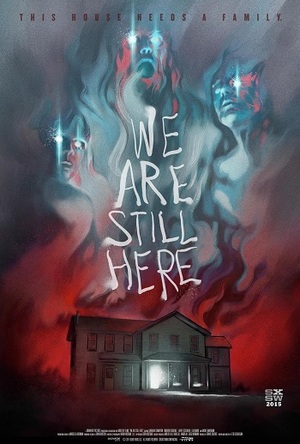
We_Are_Still_Here_film_festival_poster_2015

Keeping up with much of anything is hard to do, given work and commuting schedules. Often a horror movie will pass without even a notice until it’s on the sale shelf or free on Amazon Prime. On an October afternoon nothing feels more appropriate than a moody, ghost driven film. All these caveats are to introduce We Are Still Here, a movie that has received commendable ratings from the critics but which seemed pretty conventional to me. I’m not a fan of gore, and the finale has plenty to go around, still, the pacing is about right and the landscape is vacuously beautiful. I have to confess that I’m not sure of what was happening, although the newspaper shots during the credits were supposed to explain things. Haunted house, check. Townspeople acting badly, check. Spooky presence in the domicile, check. The menace is referred to in several different ways, but what is clear is that it wants a sacrifice.

To me this is what is at the heart of the connection between religion and horror. Sacrifice is wasteful by definition. Gods, who are demanding creatures, ask for people to give up something they could use to propitiate divine displeasure. We’re never really sure why gods have such anger issues, but it does seem like a universal trait. In We Are Still Here the “god” lives in the basement described as “hotter than Hell” and its choice of not slaying the intended victims is never really clearly explained. Perhaps that’s the point. Sacrifice is something that gods want. Reason has nothing to do with it. People in films like this seem to be minding their own business, doing what people do. Then the gods demand death. It is a religious trope older than the Bronze Age.

The film reminded me about the somewhat earlier and scarier Burnt Offerings. Ironically in the latter, there aren’t any burnings as there are in We Are Still Here, but there is a house that thrives on human sacrifice. Both houses demand a family and destroy it. Indeed, apart from sacrifice, such movies tend to be a critique of ownership. The house owns the people, not the other way around. And the house, in some sense, is a deity. We Are Still Here doesn’t give a full explanation. It puts the viewer through the usual paces for a horror movie with appropriate startles and grotesque deaths. Like most members of its genre, it reaches for religious backing to make it all hang together. It has the good grace not to be obvious about it as well.


Playing God

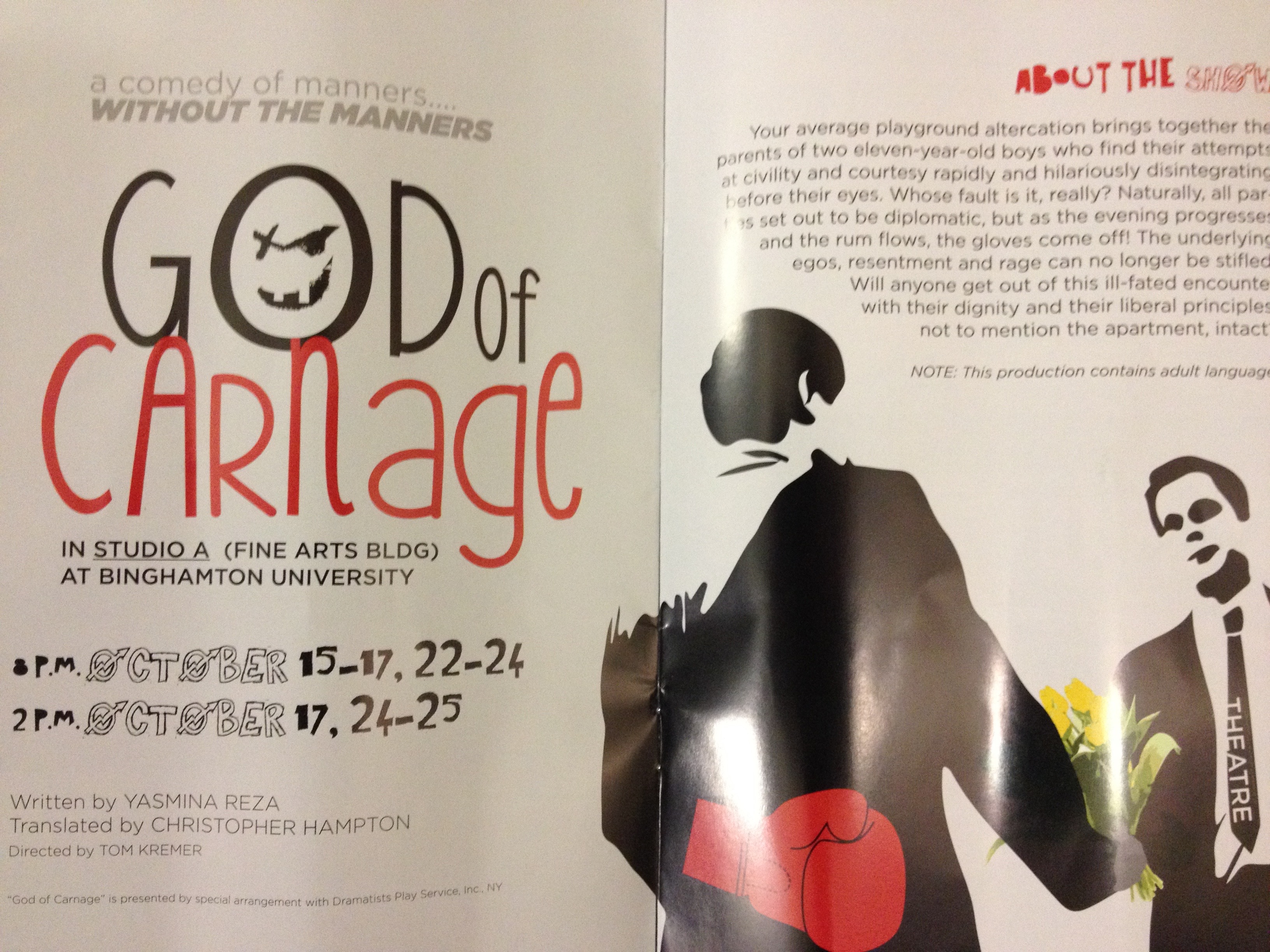
College is a rare time in life. Unlike any time after you find yourself with a diversity of intelligent and talented people open to possibilities that life tends to close shortly thereafter. At Parents Weekend at Binghamton University we took advantage of this wondrous juxtaposition to enjoy student talent. One of those offerings was the play “God of Carnage” by Yasmina Reza. It isn’t literally about God, but rather about two couples whose children had a playground fight. Parents try to solve the crisis, only to end up showing that they are really the ones who need to grow up. One of the vexed parents claims he believes in a God of carnage—that all people will seek their own good first and will eliminate those who get in the way. Perhaps might is right.

IMG_2587

The play is quite funny as the negativity grows and hidden assumptions come to the surface. There are no heroes here. In fact, any factor that might divide people does: gender, socio-economic status, race, sense of importance in the work one does. Each is turned into a weapon to make oneself appear more acceptable than others. Ironically, acceptance is just what’s missing here. Each of the four characters is alone and only finds company in teaming up with another to point out someone else’s foibles. As in most plays, the circumstances are exaggerated, and as in real life, peace is harder to attain than it should be. The god of carnage here is the individual desire to exceed at the expense of others.

The play reminded me, in a rather literal way of the verse stating that a child shall lead us. Not that children are entirely innocent, for they are people too. They can’t be held accountable in the same way adults are. We do our best, but our intentions seldom rise to our ideals. Our own needs and desires get in the way. In my experience of over half a century, most of us never really grow up. Selfish behaviors are magnified in a setting like New York City where so many agenda are crowded in together. If we believe in a god of carnage—that our own desires are more important than those of others—our differences will only emphasize that. Apart from high school and college performances, I have been to few plays in my life. Each time I attend one, however, I learn a bit more about how art reflects reality. And if we could only learn to consider others to be just as important as ourselves, the god of carnage would be the one who ends up unemployed.


Babylonian Boogle

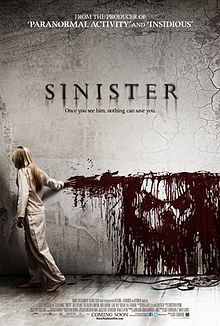
220px-SinisterMoviePoster2012

I confess. I’ve fallen behind on my horror movies. My work schedule doesn’t allow for much down time, and on weekends when I spend time with family, well, horror films aren’t their favorites. So on a weekend afternoon when I was alone, I finally saw Sinister. I remembered seeing ads for it a few years back, but far enough back that I didn’t know what to expect. As I’ve often asserted on this blog, horror frequently draws its spookiest material from the deep well of religion, and Sinister once again emphasizes this point. With clear connections to The Shining and Ringu, Sinister does keep you in its web. Of course, ritualized murders are by their nature scary, since those who perpetrate them have taken leave of reason. I don’t read true crime because I have to sleep, and I’d rather not know what some psychopath has eating his brain as he plans his sacrifices. So it comes out in fiction.

The protagonist, crime-writer Ellison Oswalt, consults with a Professor Jonas, whose name those acquainted with the Bible can’t separate from Jonah, to find out about ritual crimes. Jonas informs Oswalt that the occult symbols found at a couple of the murder sites are unconventional. He eventually traces them to Bughuul, a Babylonian deity that eats children. The religious element couldn’t be clearer. Bughuul, who is a god fabricated for the movie, is effectively frightening in the film. But for the ritual element to the murders, the story might have passed as just another gruesome offering to audiences who want a little fright in their October. Religion makes it scarier.

The second appearance of Professor Jonas reveals that, like Ringu, watching the films that tell the story is dangerous. He delves into iconography. Icons, according to orthodox tradition, take part in the reality they represent. Bughuul knows that, and merely by watching the films, or looking at pictures (icons) you open a portal between his world and that of the viewer. By the time Oswalt learns this it is, of course, too late. Again, the element of terror is introduced through religious thought. Bughuul (Mr. Boogle) is a morbid iconographer. The reality of the evil is represented in the “artwork” itself. Once you’ve seen an image, you can’t unsee it. So it is that Sinister draws on religion to plumb the depths of fear. It is surprisingly effective, even on a sunny afternoon when I’ve had too much time alone.


Fundamental Fear

Something truly scary landed on my desk. Working for an organization that has many different departments, there’s no way to know everyone. So when something bible-ish arrives in the mail, it gets directed to me. Now, I don’t follow the afterlife of creepy religious people through prison, so it took a few minutes to remember who Warren Jeffs is. I knew I’d read about him but I couldn’t remember where. Then I remembered the Fundamentalist Church of Jesus Christ of Latter-Day Saints. Jeffs was once the head of this church before being put into prison for child sexual assault crimes. So why had he sent a copy of Jesus Christ Message to All Nations to my publishing house? It is already published, and it is rather modeled on the Bible, at least at a surface level. No letter, no instructions. Just a book that I felt I needed to wash my hands after touching.

IMG_2571

I’d not heard of this book before. The author is boldly listed as Jesus Christ. “President Warren S. Jeffs, Mouthpiece of God” it says, given credit for, I suppose, putting pen to paper. What’s to prevent me, I wondered, from claiming God wrote what I framed into words? It is far too easy a claim to make and the credulous follow where the bold lead. That’s the way human authority, unfortunately, often works. Someone with a surfeit of testosterone declares that he speaks with absolute authority—I think of angry atheists as well as televangelists here. Such sense of irrational conviction must feel god-like. I can only guess from the sidelines. And I wonder about those who wrote what are recognized as scriptures in other religions.

Did those who wrote the books of the Bible, for instance, ever feel that they were writing unquestioned truth? Might they not have been a bit more circumspect? Maybe they were writing in the heat of inspiration, but not with the confidence of claiming divinity. Somehow I doubt even that. Writing is a human activity. The creator of an entire universe shouldn’t need to use it. Still, religions are often built around written texts. Parts of the New Testament claim to come from Jesus of Nazareth, although he’s not the actual writer. I guess he must have been working on later works of which I’ve never heard. And I do wonder how the doctrine of the faulty vessel applies in cases like this. I know better than to ask a Fundamentalist of any stripe, because I already know the answer they would give.


The Bald Truth

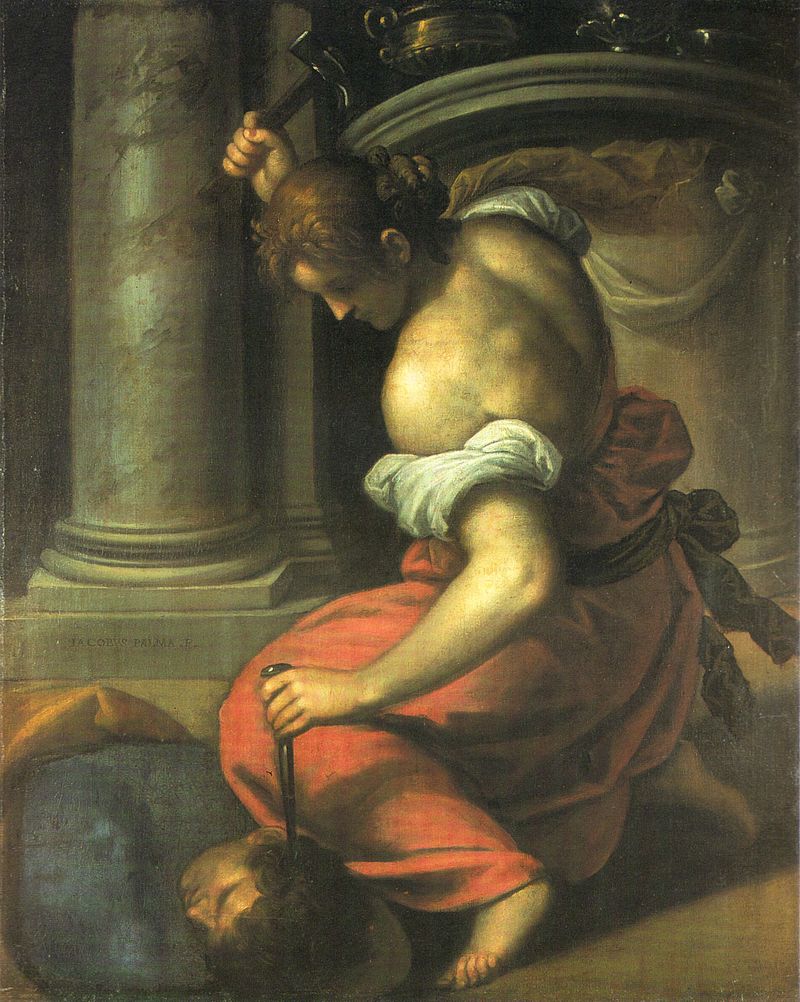
The book of Judges is one of the most fascinating in the Bible. The “judges” are colorful characters, often rule-breakers, who ultimately seem to deliver the early Israelites from their enemies. Many of their names are familiar: Samson, Gideon, and Jephthah. Well, Jephthah may be a stretch for those who haven’t read the book lately. Anyway, among the most interesting facets of the book is the fact that there are female judges. The most prominent is Deborah. Although she doesn’t seem actually to fight in battle, she leads Barak and he is able to defeat the Canaanites, through the agency of God, of course. The story is told in great detail of how the Canaanite general Sisera gets his chariot bogged down in the mud, flees the field, and finds the tent of Jael, who invites him in. After she lulls him to sleep she drives a tent peg through his skull, killing him. Jael is celebrated for her part in the deliverance.

Gory images aside, I’ve been thinking of Sisera. I wonder what he looked like. I realize that he may not have been an historical person, but still. The Bible is generally shy about describing the outward appearance of people. We get a few people with details revealed, but Sisera is not one of them. The reason I’m wondering is that I’ve got an image lodged in my head. A childhood story that we were read about Deborah showed Sisera as a bald man with a beard. Totally bald. I know that complete baldness can and does occur, but the little iconography of Canaanites we have doesn’t show them as being particularly bald as a fashion statement. As I was reading about Sisera the other day I tried to picture him as a man with a headful of hair, and I just couldn’t do it. The image was too mentally jarring. Sisera was bald.

The images that we’re shown as children, especially for powerful stories, have a way of becoming canonical. It’s like learning to tie your shoes. The first way that leads to success is the right way. We never need to learn another. How many images of Sisera does one person need to have in his or her head anyway? So my Sisera is bald. Religions often provide us with images that impact us for the remainder of our lives. The impressions laid on young gray matter are not easily erased. Now that I know many of the stories in the Bible have no historical veracity, I still can’t help but think of the early images I learned. These are the canonical images and anything else is too difficult to contemplate. My Sisera will always be bald.

Palma got it wrong.

Palma got it wrong.


Camping Out

Garsh-darn-it, I’ve missed the end of the world again! I’ve been so busy lately that I hadn’t bothered to pay attention to that which really matters. So here I find myself in the post-apocalyptic world and still waiting for a bus. Was that all there really was to life? I mean, I just found out that the world was ending on the day of. Couldn’t I get at least 24 hours’ notice? (I wish we’d all been ready?) A group called eBible Fellowship, followers of the late Harold Camping, figured out that his prediction of the end for May 21, 2011 was only the shutting of Heaven’s doors. I’d been wondering where that draft was coming from. According to the Radnor Patch, the actual end of the world, according to eBible’s calculations based on Camping’s spiritual algebra, was yesterday. That could explain a lot.

Apocalyptic groups have often had a problem getting the exact day right. No surprise there, however, since the Bible says even Jesus doesn’t know. Historically, there have been a number of options available to the budding apocalyptist. You can simply go very quiet and hope nobody notices. You can commit mass suicide (not recommended). And others would seem to suggest that you can claim it did happen, but that we just haven’t noticed yet. That was the response of some of Charles Taze Russell’s followers when 1914 saw the continuation of the world, despite a war that has scarred it ever since. Maybe the world has ended many times before. Still, the rest of us still find ourselves too busy to notice.

Here it comes.

Hyakutake, 1996. My first comet.

Apocalypticism is most prominent among those groups that hold to a biblical dating of the world. If it has only been here about 6000 years, then its imminent end seems entirely plausible. Those who take a longer view, more on the order of billions of years, seem a little less worried. That’s not to say that the world couldn’t end. A reasonably sized asteroid could finish it for our species. We wouldn’t need a supernova to do us in. Still, we can learn something from the chiliasts. We can learn that introspection is not a bad thing. We don’t need to hoard weapons, canned goods, and water, but we can stop once in a while and ask if all this insane running around we all do is really worth the effort. Since the world has ended, I’m thinking I might slow down a bit. I’ve got a lot that I still want to accomplish, but given that it’s all over, what’s the rush? I just wonder if they’ll buy this kind of reasoning at work.


Biblical Violence

756px-Winchester_House_910px

Sarah L. Winchester, it is said, was a haunted woman. The widow of William Winchester, she was heir to the tremendous amount of money brought in by sales of the renowned Winchester rifles. Fearing the haunting of all those killed by the weapons, she built what has now become a tourist attraction—an unfinished mansion that was intended to prevent those ghosts from living with her. With the spate of recent multiple shootings, we might wonder how many other gun manufacturers are living haunted nights in their comfortable homes. A recent petition has been circulating to stop Spike’s Tactical from producing The Crusader assault rifle. Predictably, the sales have been so overwhelming that the religious rifle is on backorder.

The Crusader, as the photos reveal, is emblazoned with Psalm 144.1 “Blessed be the Lord my Rock, who trains my hands for war, my fingers for battle.” It also features a Crusader’s cross and trigger setting labeled, Peace, War, and God Wills It. Blasphemy in carbon fiber. I suppose I’m hopelessly naive, not being aware that guns could be purchased online, but the overwhelming demand is nevertheless disheartening. It used to be that the Christians were the good guys. You certainly didn’t have to worry about them shooting you. That was the job of the heathen. So many multiple shootings took place this summer than I couldn’t keep track of them all. I live in a world where guns play no role and I wonder if everyone wouldn’t be happier if we didn’t lay down our arms and learn how to get along.

Of course, the Bible is a book where violence against enemies is permitted, and, in places, even encouraged. Society has repeatedly declared that there is no need for experts trained in how to interpret the Bible, and this is what happens. Psalm 144 is a poem for deliverance from enemies. Historical criticism would likely place the piece as written during a time of war. The era in which the majority of the Bible was written was anything but peaceful. Those parts of the Good Book that are particularly extolled are often those that suggest that the answer to war is peace and that setting aside your own will for the well-being of others is something we should all be doing a bit more often. But we cannot deny that “Peace, War, and God Wills It” aren’t part of the violent worldview we also encounter in sacred writ. I wonder what Mrs. Winchester would have had to say about such mixing of the Bible with guns.


The Day After

I don’t mean to be insensitive. Sometimes I get so busy that I don’t even look at the date for days at a time. This can’t be good, but I was surprised when the anniversary of 9/11 caught me completely unawares this year. That’s the kind of summer it’s been. Not acknowledging 9/11 to New Yorkers is like making ethnic jokes—it’s inherently offensive. The City is always subdued on this date of infamy. Coming the same week as Labor Day this year, I think my timing was just off. In my family, September was always the month of birthdays. My present to my brother of the 12th was late in 2001. I wanted to find something old. Something solid. Something time-honored. I wanted a sense of stability to return to a chaotic world. Being an inveterate fossil collector, I went to a local rock shop and bought him a fossilized cepholapod shell. It wasn’t much, but it was a message and a metaphor.

Today, being a birthday and a day after, feels a little like an apology to me. At the time of 9/11 I knew a few colleagues teaching in New York, but in 2001 I’d not really known the city. I’d visited a few times. I was still employed, although my personal career trauma was, unknown to me, already underway. And looking at the state of the world some fourteen years later, I wonder how much better things are. We haven’t suddenly improved, and as a nation we seem more deeply divided than ever. Candidates who resemble their caractitures more than actual people frighten me. The rhetoric is a sermon of doom. Have we all forgotten how that morning felt?

Television reception was poor, or it may have been the tears falling from my eyes as I watched, at the safe distance of Wisconsin. We’d just sent our daughter off on the school bus and now wanted her back home. I called my brother in Pittsburgh in a panic. The news had said a plane had crashed in southern Pennsylvania somewhere. It seemed the the possibilities of horror were endless that day. And yet. I awoke yesterday fretting over work. My mourning routine was harried and frantic. I didn’t even know what day it was. I glanced a paper headline on the way to work and realized that I’d overslept a tragedy. Some scars never heal. Those wounds cut by religion are the deepest. So we find ourselves on the nexus of a tragedy, a birthday, and a new year. How we respond is entirely up to us.

Time2Remember


Psychobabel

Evolution, we’re told, has one goal: survival. As an unthinking process of nature, evolution “programs” us all to desire survival for ourselves and our offspring. Even attributing that purpose too it is to suggest it’s more a willful agent than a blind process. People, on the other hand, are meaning-seeking creatures and so there’s bound to be some disappointment involved. I was just discussing with a friend how it seems that people just can’t agree on evolution mostly because of the strident claims on both sides. The New Atheists make claims beyond the evidence that survival to reproduce is the “only” role of evolution and we are “just” animals with too much gray matter, and that consciousness is “merely” electro-chemical activity in our brains. Creationists, for their part, say evolution couldn’t possibly account for structures as complex as we see in nature, and therefore a deity much be involved. The rancor grows until both sides end up despising the other. People who look for the middle ground are not newsworthy and fade into the scenery. I wonder if we’re evolved to ever get along.

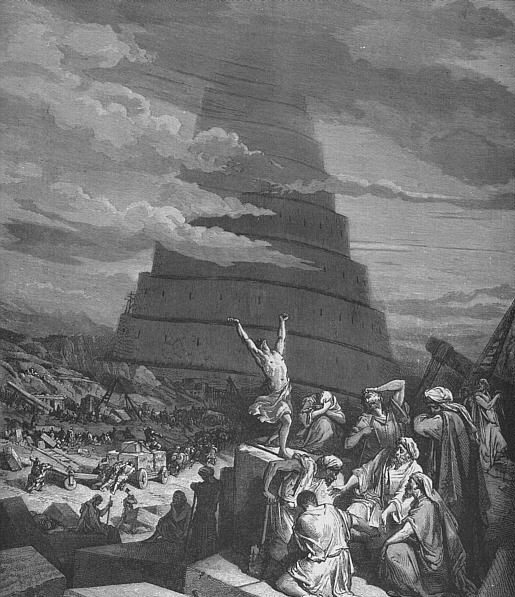
My wife mentioned that it’s like the Tower of Babel story. Here is the tale of God making humans inevitably talk past one another. We can’t understand and so we argue and criticize and insult. A more scientific explanation might be that perhaps we’ve tipped the evolutionary balance with our species-specific success. We are by tar the most numerous species of any large animal. (At least that we know of.) Having put ourselves as lords and masters of the food chain our challenges have become mental and we turn ourselves to the question of who’s right instead of simple survival. Sacred books can’t guide the discussion, but reason alone. And reason, as we all know, has its limits.

Confusion_of_Tongues

The great irony in all of this is that, if we’re evolved to seek meaning, we’re not equipped to find the truth. As neuroscientists have pointed out, the brain’s function is survival, not truth finding. Our desire to know the truth is a human avocation abstracted from consciousness. We’ve not adequately defined consciousness, but since there aren’t many large predators hunting us down anymore, that brain-power has been diverted elsewhere. Despite all this, we don’t see world peace spontaneously breaking out. Even on a smaller scale we find prejudice and hatred and insane mass production of weaponry when our only predators are ourselves. Evolution, we’re told, has only the goal of survival. Being an unthinking principle, even ascribing it this much conscious decision-making is merely a matter of convenience. Does the Tower of Babel mean we must hate those who differ from us, or does it perhaps suggest that the real goal is better understanding?


School Bible

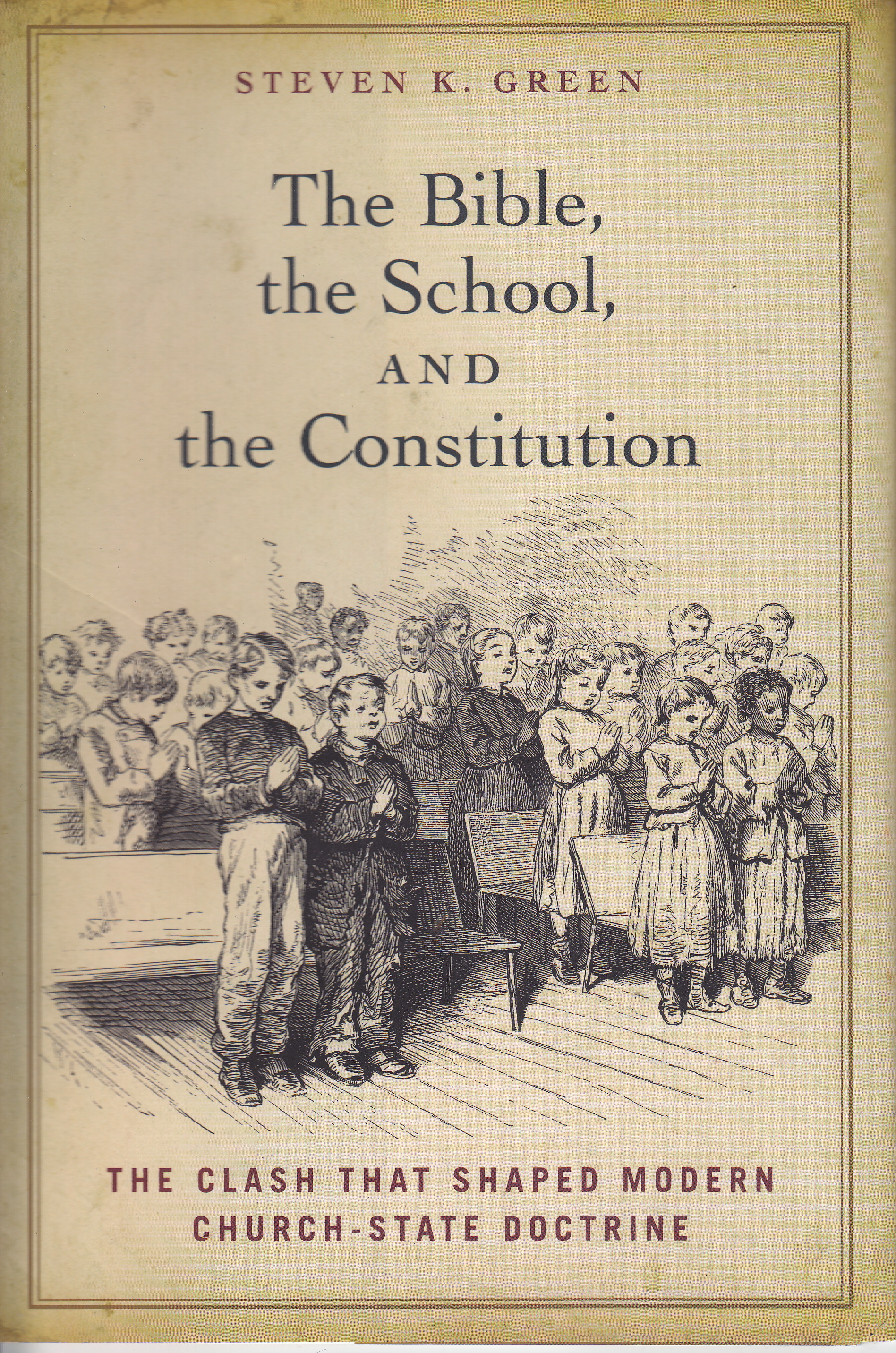
BibleSchoolConstittnAs a very young scholarlet, I recall the horror expressed when some form of prayer was expelled from public schools. It had to have been in the late ’60’s. Maybe early ’70’s. The nation, it seemed, was headed for Hades in a hurry. Little did I know that this was part of a long, drawn-out—tired, even—battle. Steven K. Green’s The Bible, the School, and the Constitution: The Clash that Shaped Modern Church-State Doctrine gives pretty close to the full story. Bible reading in public schools was foundational, in the beginning. In the early days of public education, the Bible was ubiquitous. It was considered non-sectarian since practically everyone was a Protestant. When the religious mix of the country began to diversify in the mid-1800’s, a new dynamic emerged. People got upset. There were riots. People were killed. Legislation was proposed that would explicitly add God—Jesus even—to the Constitution. Who knew?

Green’s study takes a close look at the various cases that arose around the time of the Civil War regarding the Bible in school. Protestants, it seems, didn’t appreciate that Bible reading, in the King James Version, without comment, violated Roman Catholic policy. The first to challenge Bible reading in public schools were Christians. Secularists only joined the fray later. I’m oversimplifying, of course. Some Catholics wanted equal time, the reading of the Douay Bible instead of King James. Others wanted Catholic schools to receive state funding. Nobody was really aware of other religions such as Hinduism or Buddhism. It was a country of limited religious imagination. Various groups tried in various ways to get God—their God only—into schools as the default deity. And so the fun continued.

For me, it was eye-opening to realize that all of this isn’t new. The legislation, since long before my grandparents were born, has been heading in the direction that led to the aggrieved tears in my youth. Green points out, however, that the conflict has never been completely resolved. School vouchers and a long spate of evangelical presidents have had their impact on our children. The Hades that we feared has only come with the weaponizing of our culture, largely by those who want Bible reading back in the schools. The thing we fear finds us through the thing we love. Ironically the issue never seems to be education. God or guns—it’s the power that we want. The early debates revolved around morality. How could kids be moral without Bible reading? How the definition of morality has changed. We, as a nation, still can’t figure out religious freedom or how to let kids be kids.