Voting Vicissitudes

“Remember, remember, the fifth of November, the Gunpowder Treason and plot. I know of no reason, why the Gunpowder Treason, should ever be forgot.” Election day fell on November fifth, and as I watched V for Vendetta again, I was reminded how true it rings. Religious leadership takes over government, the common person becomes an enemy of the state, and criticism is treason. Tea, anyone? I’ve always had a soft spot for dystopias, but the world of V is entirely too plausible at times. I have watched rational people transformed by fear and the certainty of religious dogma into those who will do what they are told without question. The movie always gives me a profound hope that the human spirit is larger than the powers that be. V can also stand for Vote.

I cast my ballot knowing that a vote against a governor who enjoys the bully image was indeed close to a lost cause. People are enamored of power. In my deepest Jedi dreams, however, I know that the most powerful moment in Star Wars is when Obi Wan turns off his light saber to allow himself to be struck down. There is a power, one upon which entire religions are premised, in the self-sacrificial act. It’s not that I have anything against Parliament; I saw it just this past year and enjoyed the experience in a way that Guy Fawkes could perhaps not have appreciated. As Evey says, “this country needs more than a building right now. It needs hope.” I guess we can hold on another four years. V can also stand for five.

“He’s a deeply religious man and a member of the conservative party. He has completely single-minded convictions and has no regard for the political process. Eventually, his party launches a special project in the name of ‘national security’.” So V tells Finch concerning a dictator who could be wearing any number of political masks in our world. We hand power over to those who encourage our fears rather than those who inspire our imagination. Camelot died in 1963. It is not so difficult to imagine a world so much better than the one we’ve constructed, but plutocracy does prevail when people do not take the implications of their religion seriously. When we only glance at the surface, the deeper message gets lost in the mythology of it all. November fifth is a myth that still has the potential to change the world. If we would allow it.

VoteV


World War 1.2

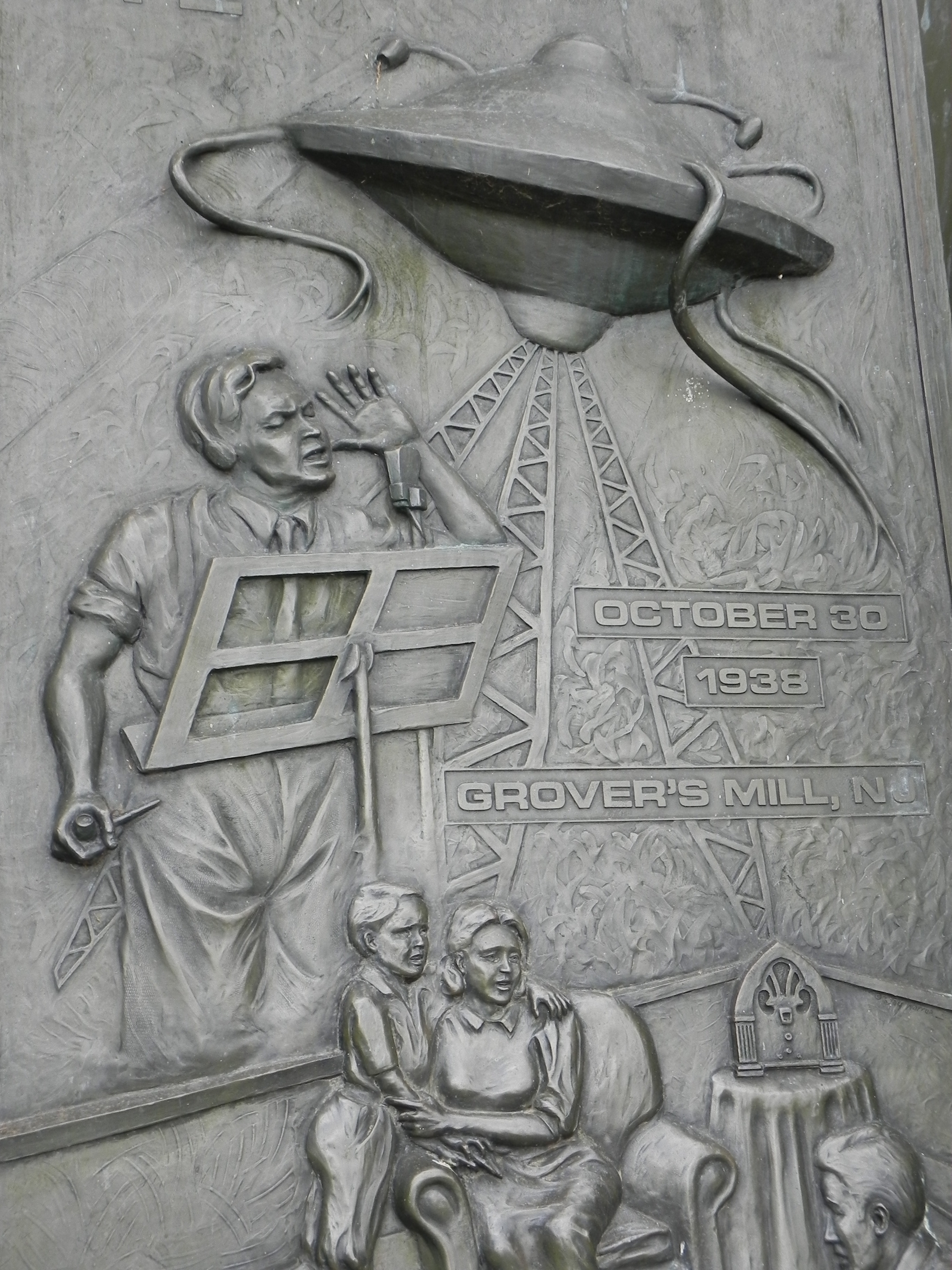
75 years ago today Orson Welles presented a radio drama version of The War of the Worlds. Perhaps it was the looming fear of the Second World War in a society that hadn’t yet overcome the trauma of the First, or perhaps too few people had read H. G. Wells’ novel, but the result was surprisingly catastrophic. Panic arose as listeners supposed that the invasion was real—the broadcast, although announced as a radio drama, followed a news bulletin format that overrode the rational faculties of many. This episode would influence government decisions about what to reveal to the public for years. And, naturally, it all began in New Jersey. Unlike the novel, the radio broadcast set the invasion, initially, in Grover’s Mill, New Jersey. This tiny town is difficult to locate even today, falling as it does between the busy north-south roadways that run through the central part of the state.

DSCN4241

The Hindenburg disaster had taken place the previous year in Lakehurst, New Jersey. Welles, impressed by the radio coverage of that celestial fear, used those broadcasts as models for his play. A few weeks ago I ventured to Grover’s Mill to let my imagination roam free for a while. A great deal of history may have been determined by that broadcast and the public reaction. We are ready to believe that danger lurks above. The First World War began to make early use of the airplane as a weapon. The sky, previously, had been obtainable only with the slowly moving balloon. Only eleven years earlier Charles Lindbergh had crossed the Atlantic by plane for the first time. The Second World War would see air combat as a major component of victory, also for the first time. My mother grew up in New Jersey, watching planes searching for German U-boats off the shore. The skies were not so friendly then.

DSCN4239

As I stood in Grover’s Mill, I recollected an unpublished book I once wrote about the weather in the book of Psalms. The thesis, somewhat loosely, suggested that for the average person the sky reflects the mood of the divine. Dramatic clouds still look angry, even when God is removed from the equation. The Reagan era gave us all new things to fear raining down on us from the skies. September 11, 2001, brought the skies crashing to the earth again. Invasion from above is an apt way to add a chill to Halloween, for it takes the prerogative of the deity and makes it either human or alien. At least most people who believe in God think he’s on their side. When the Wright brothers took their heavier-than-air craft briefly to the skies in 1903, The War of the Worlds had only been on the market for five years. The coming decades would drive God from the skies and we would come to learn that what falls from above would no longer have our best interests at heart.


Human Resources

I’m thinking about how we blithely accept cruelty and christen it “just business.” It’s legal, and even encouraged. Was a time when you wouldn’t dare trade with a stranger because he might cheat you. To make a deal implied a relationship. To get away with something unseemly you had to be able to look someone in the eye and take advantage of her or him anyway. Oh, we’ve sanitized it alright. Most workers never meet the CEO. His hand doesn’t even deign to sign the paycheck. The workers are forced to trust nevertheless. Don’t worry, it’s just business. Or is it?

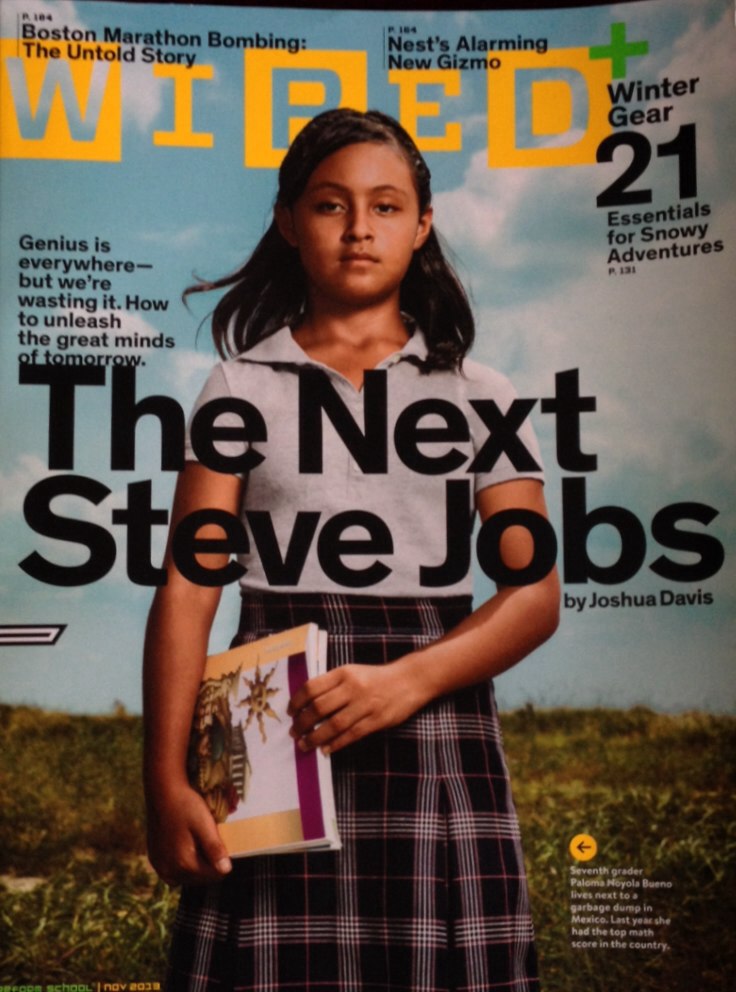
Wired GeniusThe system, of course, favors those with the loudest voices, and those voices speak the language of Mammon. We don’t dare upset the order, believing we will get ours some day. Delusion is so sweet. On the cover of Wired magazine is a little girl. The caption reads, “Genius is everywhere—but we’re wasting it… Seventh grader Paloma Noyola Bueno lives next to a garbage dump in Mexico. Last year she had the top math score in the country.” Careful, Wired, you’re beginning to sound socialist. Bueno was on the cover of a major magazine because she was discovered. Those who remain hidden far outnumber those who claim far more than their share of capital. You don’t make it to the top unless you crawl over the other caterpillars. When you reach the top, as Trina Paulus sagely warned, you find there’s nothing there. Just human detritus beneath your feet.

Business has come to mean “cold and impersonal.” Keep the human element out of it. In fact, the term “just business” is a very effective shield against all kinds of unethical behavior. And it is the model on which we shape our society. Is it any wonder that the economy takes such precipitous tumbles? Funnily enough, those who support “business ethics” such as these most vehemently also claim the title “conservative Christian.” Unless Christianity has thrown its moral compass into the sea, there’s no legitimate way to claim the latter half of that moniker. We praise and wonder at our Einsteins. How many of them died in the gas chambers and ovens of the Nazi regime? How many of them have starved in Africa? How many never rose above the crippling poverty of Mexico? Perhaps it is time we as a society demanded a stop to the wastage. “Waste not, want not,” should be our mantra. And if those at the top can’t show what they’ve done to help their fellow human resources, perhaps they should live next to the garbage dump. Don’t take it personally, one percenters, it’s just good business.


Carrie the Cross

Carrie1976With all the buzz about the new Carrie movie just released, I decided to go back and watch the Brian De Palma version again. I’ve written here before about the religious symbolism of the movie, but I have to confess to never having read the novel. This time a particular symbol stood out, and I’m not sure whether it derives from De Palma or King. Crosses abound in the 1976 Carrie. This is a bit odd because of the indeterminate religion of Carrie’s mother. Clearly she has a belief in Jesus, but an odd Jesus it is. In Carrie’s prayer closet the statue—presumably of Jesus, since it is never clearly identified otherwise—is of a man whose abdomen in pierced with arrows. Those familiar with saints immediately recognize Saint Sebastian, but the arms are outstretched, as if this poor victim were both crucified and superfluously shot with arrows. The traditional cross, however, seems to be missing in that dark room. It reappears on prom night.

While Carrie is getting ready for the prom, her crazed mother peers out the window at passing cars, telling Carrie that Tommy isn’t coming. In one shot, as two cars pass in the street, there appears an inverted white cross on the road. I supposed at first that this was a painted parking space marker, but then, this is a residential street, and no such markers appear in other shots. Carrie’s mother had accused her of being a witch, and the upside-down cross is an oft-claimed symbol of Satanism (not the same, however, as Wicca). At the prom, Tommy insists that Carrie vote for them as the prom queen and king. When Carrie makes her x, the camera angle rotates slightly to reveal the sign as a Latin, as opposed to Saint Andrew’s cross. After Carrie kills everyone and goes home, her mother stabs her and, chasing her through the kitchen, makes the sign of the cross with her knife. Finally, Sue—in a dream?—wanders to Carrie’s burnt down house to lay flowers at the foot of a “for sale” sign that is a white cross, with the clashing words “Carrie White Burns in Hell” scrawled on it.

I may have missed more since the use of the symbol only dawned when the passing cars pointed me toward it. There is a strange kind of misuse of the cross here—not visible on the Sebastian-Jesus, and ultimately also Carrie’s mother figures, but inverted on the street, a sign of pride at the voting, made with a knife by the mother, and scrawled with an arrow pointing to Hell in the final scene. Carrie’s fiery end appears to confirm her mother’s interpretation of telekinesis as witchcraft. There is no forgiveness in this film. Well, I suppose I’ll have to go see the remake now. And maybe even read the book. I need to know if I’m just seeing things or if I’m still sleep-deprived from worrying about jobs and a surfeit of imagination as October’s chill settles in.


Sleepy Hallow

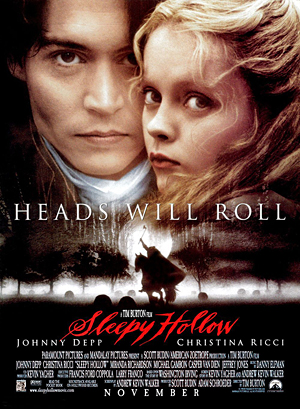
Sleepy_hollow_ver2Upon occasion I found movie clips to be of great help in explaining ideas in religion classes. A movie whose clips I used sparingly, due to concerns for squeamishness, was Sleepy Hollow (the Tim Burton movie, not the modern television series). Upon viewing it again recently, I was impressed by just how much religion is intertwined in the narrative. This is especially interesting since Washington Irving’s story does not contain much in the way of religious symbolism or motifs. From the beginning of the film, Rev. Steenwyck is one of the conspirators, making the church complicit in the attempt to subvert the van Garrett will. When Ichabod Crane arrives in Sleepy Hollow the cleric drops a Bible—a recurring motif in the movie—on the table beside him, telling Ichabod it is the only book he will need. Christianity and Paganism clash throughout the film as a number of the women are revealed to be witches, either “innocents” or practitioners of a darker kind of magic.

In flashbacks Ichabod Crane recalls his mother’s white magic that draws the ire of his ordained father. Indeed, Ichabod’s father is a stylized amalgamation of Roman Catholicism and Protestantism blended into one. His harsh white chapel houses an inquisitorial torture chamber in which he murders his wife. Seeing her pagan symbols in the fireplace ash, he too drops a heavy Bible to point out his wife’s sins. When he stalks off from his medieval chamber of horrors, the camera angle shows him to be headless—he is the true terror, rather than the Horseman who was raised by magic and appeased by the simple return of stolen property—his head. Even in the present Rev. Steenwyck is both an adulterer and a murderer. The melee in the church leaves the final three conspirators dead.

The white witches, however, are marked by their purity. Mother Crane is so light that she can float up into the air. Katrina van Tassel draws chalk icons to protect Ichabod, indeed, the whole town, from evil. While Ichabod refers to his father with the evocative phrase “Bible-black tyrant,” his mother was an innocent child of nature. In the film Ichabod moves from the rational view of life to one that allows for the supernatural, in the form of magic. True, the Horseman cannot cross onto the consecrated ground of the church (another Catholic concept mixed in with the Protestant milieu), but the faith that saves Ichabod’s life is the book of spells given to him by Katrina. Yes, the physical book stopped a material bullet, but it was faith the put the book in the pocket in the first place. All very appropriate to bring students’ minds to religion in the autumn of the year.


Sun Devils

Unbelievable. The unrelenting sun of Arizona is unbelievable. Even a “cloudless day” back east is only an approximation. Here it is literal. And like all things literal, it attracts the Fundamentalists. I spent the day on the campus of Arizona State University, the country’s largest university by enrollment. Outside the student union, a couple of bands were banging away in the heat, but when I passed by in mid-afternoon they’d been replaced by a street preacher. He was nattily dressed and provocative. When I first walked by he was talking about students being either “a wicked homosexual, a wicked pot-smoker, or a wicked feminist” and went on to throw in some choice words such as “Obama-loving sinner.” Nobody seemed to be paying him much mind. I went on to a couple of appointments and when I passed that way again, at least ninety minutes later, he was still at it. Now he had a small crowd. Students virtuously challenged him as he claimed that he was without sin, “yes, I am Christ-like” he said to one question, and proceeded to tell anyone that challenged him that they were not children of God and that they should run to Hell because they would enjoy it so much.

Preachit

The more I watched this charade, the more trouble I had believing that the preacher was sincere. He quoted, out of context, of course, chapter and verse. He literally thumped his Bible. His hatred for anyone who disagreed with him was plainly evident. I felt embarrassed on so many levels. This is a state university, and the man had a clear agenda of hatred and intolerance. I was here to meet the religion faculty. Everything students were being taught in their classes was being shot down by an ancient book that had relevance only by being quoted out of context. And all of this on a campus whose mascot is the Sun Devil. Devils abound on campus, but the worst, it seemed to me, preached loudest.

Somewhere along the way to enlightenment, this kind of Christianity slipped the rails to become its own self-righteous force. What right had this man to tell students they were wicked? To me they seemed hospitable, peace-loving, and kind to the stranger in their midst. The preacher, self-fascinated, claimed to be without sin. I guess that gave him the scripture-sanctioned right to cast the first stone. Good thing he wasn’t in the crowd when Jesus rescued the woman caught in adultery. When a few students pointed out his flaws in reasoning, which were many, others applauded before he flew back to his out-of-context biblical backbone. More quoting, more thumping. The sun was out in full force in Arizona, but somehow it failed to fall on one man who proclaimed himself better than all others.


Quack, Quack, Honk

HappyHappyHappy Although I’ve never hunted, there is an undeniable sense of power involved with shooting a shotgun. Maybe it’s the harsh kick against your shoulder as a clay pigeon many yards away explodes in mid-air and a trickle of gunpowder scent tickles your nostrils. It is a temptation, however, I think most people—present writer included—should avoid. I don’t own a gun and I don’t watch television. I suppose that makes me a kind of pariah in my own country, but when I heard about Phil Robertson’s book Happy, Happy, Happy: My Life and Legacy as the Duck Commander, I knew I would eventually read it. I’ve never seen Duck Dynasty, but like Phil Robertson, I grew up in a family that middle-class folks would consider poor. Even now, many decades and degrees later, I’m still playing catch-up, unable to afford a house. Worried excessively about college payments. So how did Robertson do it? How did he become a millionaire and find a publisher? According to his book the answer is simple: Jesus Christ.

Happy, Happy, Happy is an engaging memoir. While I disagree with most of what Robertson says, it’s hard not to like him. A simple, self-made man from humble circumstances. He hides his master’s degree well. Like Augustine, however, it was only after a misspent youth that he insists others don’t do the same. “God grant me chastity,” Augustine once quipped, “but not yet.” Robertson found Jesus, or the other way around, in his mid-twenties. He, not unlike many victims in recovery, gives the credit to God. His answers are simple: read the Bible, live by it, kill ducks, and everything will be fine. Interestingly enough, two of his four sons, raised on the Gospel, also went astray before seeing the light. This is not schadenfreude on my part: I have personal experience with family “on the wild side” and I would never wish it on anyone. It’s just that the law of averages isn’t so great here. For half the boys the Gospel wasn’t enough, at least at first. The darkness pushed them toward the light. Simple fixes almost never lead to viable long-term solutions.

Phil Robertson is another of those reality TV phenomena of the “plain folk” that so fascinate media types. They can’t seem to get enough. Some of us authentically paid that price below the selective eye of the media. For some of us, the answers are much more complex, if not distressing. Hard to put that up on the screen and guarantee your advertisers that people will watch. We only want complexity knocked down. Even the fun Big Bang Theory wouldn’t be nearly so popular if the smart guys didn’t get their comeuppance week after week. I am moved by Robertson’s story. His devotion to the Gospel is admirable and it is clear that it makes him happy (happy, happy). If I ever met him I would probably nod politely in agreement, although my experience has diverged from his. We would probably have to eat at separate tables, despite my good will. The fact is, he has lots of guns and I have none.


Dying for Religion

devotedtodeathReligions never lose their ability to surprise. This entire concept of belief is one with which I am intimately familiar but about which I’m completely puzzled. If we’re honest, we don’t know from whence belief comes or why it is so effective in keeping people balanced. (There are fanatics for rationalism just as surely as there are for religious faith.) When I saw R. Andrew Chestnut’s Devoted to Death: Santa Muerte, The Skeleton Saint, I figured it would be a good read for October, when Halloween comes so readily to mind. Although I’ve studied religions all my life, I’d never heard of Santa Muerte, “Saint Death.” Probably this is because, as a representative of folk religion, Santa Muerte is not an “official” religious figure. Folk religions are what the faithful actually believe, rather than what the religious officials declare that they will believe. Many a deluded bishop would learn to his chagrin, if he deigned to speak with mere laity, that his platitudes count only in the high court of theological heaven. Saint Death is more like the experience of the rest of us.

Chestnut, a scholar of Mexican religions, discovered Santa Meurte while living in Houston. His book is a narrative introduction to the background and history of the religion, its beliefs and practices, and a consideration of what the skeleton saint offers so many Latinos. Although the news in the northern reaches of America often does not bear it, Santa Meurte has regularly made the headlines in southern climes. As a symbol of death, and therefore potential protection from death, Santa Meurte has gained notoriety by her worship being taken up by drug runners and convicts. Mexico’s regrettably long struggle with poverty and sometimes corrupt governments has led to a society in which death is very familiar. As Chestnut demonstrates, Santa Meurte likely has her roots in the Grim Reaperess of plague-ridden medieval Spain, and she has been a somewhat hidden figure in Mexican Catholicism for at least a century or two. Her first public exposure came in 2001, and since then her association with the criminal element has been repeatedly highlighted in the media.

Santa Meurte, however, is a source of consolation for those who have little in life to anticipate but death. Often, in societies driven by the acquisition of wealth, plutocrats forget that justice comes in the guise of the Reaper. To the believer, Santa Meurte is not evil. She is a natural offshoot of the Catholic veneration of saints in a culture where human aspiration is quickly and unfeelingly snuffed out. Those in positions of power claim the Santa is Satan, but they may be looking in the wrong place for evil. Pointing to the Gospel statements that death will be overcome, they overlook the passages that insist on giving away all that you have will make you ready for the kingdom of heaven. Death, even if trumped at the final trump, will greet us all by and by. Santa Meurte is a very practical saint. Chestnut’s book is a good choice to read when the chilly wind shakes the trees for their particular October rattle of dry, lifeless leaves.


When (Nearly) Everything Changed

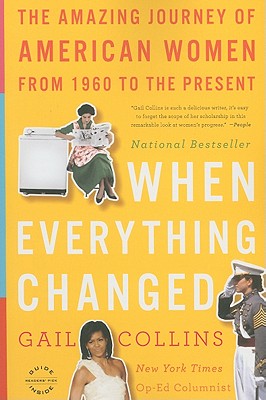
WhenEverythingChangedMy wife and I just finished reading When Everything Changed: The Amazing Journey of American Women from 1960 to the Present, by Gail Collins. (In the spirit of the book, I wash the dishes while my wife reads to me.) Although Collins does not dwell on the religious motivations in “traditional” women’s roles, I couldn’t help pondering how religions, rather than encouraging equal rights, have often acquiesced to the unfair treatment of women as a matter of principle. That principle is often abstract and theological. More often than not it is also mythical. As society changed to allow a greater measure of equality in social roles for the sexes, religious leaders held back, concerned more about doctrine than people. This is perhaps the most disheartening aspect of religious belief—as a human phenomenon it too easily loses sight of humanity.

Historically, of course, the roles of the sexes were tied to reproductive necessities. Women with nursing children (and startling low mortality rates) could not do the heavy work required in the agricultural societies of antiquity. I am aware that this is over-simplifying—it seems clear, however, from the materials left to us from the earliest literate cultures that a basic biological divide determined appropriate roles. Not only were women victims of high mortality rates due to difficult childbirth, but infant mortality was also high. In such circumstances it was important to guard those who survived from the potentially dangerous work of protecting flocks and tilling fields. And this was the time when the ancestors of our religions emerged. Technology improved survival rates and quality of life, but religious dogma is very slow to evolve. Some dogmas still don’t even accept the idea of evolution.

Back to When Everything Changed. Yes, bottles and birth control gave a new freedom to women. Day-care and daddy involvement also helped. And yet, not everything changed. Seeing the progress, religions tended to cry “foul!” and insist that, for women anyway, nothing had really changed. No doubt Collins is correct about a large swath of life in the secular sector. Most jobs are open to both sexes, and issues of fairness, although still lagging, are starting to be addressed. Many major religious bodies, however, still hold women in a subordinate role. Basing their reasoning on theologies long outdated, they insist than nothing has really changed at all. If only the wisdom of women and their experience were taken seriously many religions would have changed for the better as well. Only when that happens will we be able to consider that, in Collins’ hopeful words, everything will have changed.


Twilight Zones

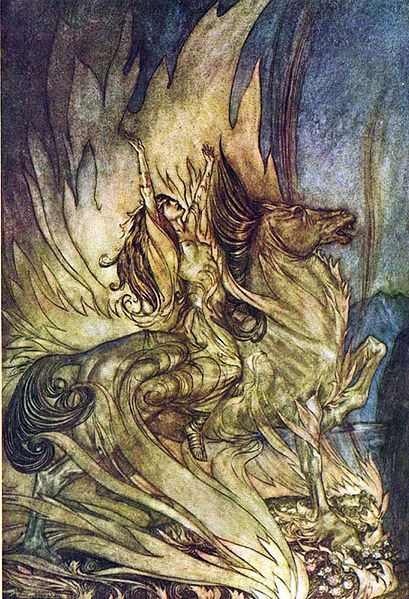
It was twilight last night when I drove into Binghamton. My thoughts naturally turned to The Twilight Zone since one of my childhood heroes, Rod Serling, had grown up here. Binghamton University was also the professional home of novelist John Gardner, of Grendel fame. Seeing the colorful leaves fading to the gray of a falling evening, I thought of how evocative a word “twilight” is. We are creatures with an in-born fear of the dark and twilight is our last hope of light before the night settles in. Maybe it was having just so recently read Grendel, but twilight and gods together brought “the twilight of the gods” to mind (it might have helped that a sudden thunderstorm broke out at the moment). When I first saw the word Götterdämmerung, in junior high school, I thought it must be a potent swear word, what with all those doubled letters and umlauts. My German teacher calmly explained that it was the fourth and final cycle of Richard Wagner’s opera, Der Ring des Nibelungen and it translated to Twilight of the Gods. It is itself a translation of the Norse word Ragnarök, with its single umlaut. Even though it wasn’t swearing, the concept sent a shiver through me anyhow.

I’ve never sat through a performance of The Ring, but I have heard the music with its famous Ride of the Valkyries. Based on Norse and Germanic mythologies, The Ring has deep roots in a pagan mythology where night plays a prominent role. Although J. R. R. Tolkien denied having been inspired by Wagner’s work (there was a certain political incorrectness to it, along about the early-to-mid-1940s), both four-part cycles draw on the Norse mythology that continues to fascinate us with movies like Thor and The Avengers. What impacted my young mind the most, however, was the very concept that the gods could be defeated. How was such a thing even possible? We were raised to believe good conquers evil. How can the gods—even pagan ones—lose? It was a world-distorting concept for someone yet to face high school.

Last night I was literally in the twilight zone. Having driven through the Endless Mountains region where autumn’s reds and yellows inspired me with just how colorful death can be (a European friend once confessed to me that driving along a wooded road in Pennsylvania his first autumn here he had to pull over and weep for the beauty), twilight was already on my mind. October fades into the twilight of the year. The mythologies of the northern races, the Norse and the Celts, seem almost obsessed with the ominous, growing darkness. There is a beauty to it, but also an abiding fear. Are the gods powerful enough? It was a question first raised when my eye fell on that striking word Götterdämmerung that somehow became a part of me.

409px-Ring63


Shut Down? Shut Up?

So, what does it mean really?  Can you tell the difference?  Although it is undoubtedly a pain for many government workers, and a huge, colossal waste of tax-payers’ money, I guess the Tea Party showed us!  Over something as simple and humane as healthcare, the neo-cons have shut down the US government.  To be honest, I can barely recall the last time this happened.  Why do I suddenly feel the need to sit on a rocking chair on the front porch and kvetch? Perhaps we don’t pay them enough to care?  Maybe the poor just aren’t worth saving?  What can possibly be going through the minds of elected officials who are willing to punish the entire nation just because they can’t pack up their marbles and go home?  Of course, I am presuming that they have marbles to pack up.  As a tax-payer of over thirty years (pushing on forty), I think I have earned the right to say, “Children behave!”  The Tea Party shenanigans have been childish from the start, trying to co-opt the spirit of rebellion against tyranny in a country that plainly has too much.  Too much time on its hands, among other things.

I often ponder how a nation with the resources of the United States can proudly tote one of the most inhumane healthcare systems in the developed world (and I’m not talking about Obamacare!).  We live in a country, if best-selling author John Green is to be believed (and I’m a believer), we pay more for healthcare than countries with socialized medicine and get less out of it.  Why do we put up with it?  Tea, anyone?  Who has the actual gumption to climb aboard a ship and throw the cargo overboard?  Today we call it piracy—hey! Stop that download!  And we throw people into jail for it.  But shut down the government?  That’s okay.  The bus still runs and I’m still expected at work.  Oh, and I work for a UK company.  The irony of it all. When I lived in the United Kingdom, people complained about the healthcare, but I will say there was no child left behind, if you get my meaning.

Our military, I see, remains open for business.  We won’t cut off the life-support of the Tea Party’s favorite department.  We have our priorities.  Somebody has to defend the millions that can’t afford health insurance.  There was a time when Christianity was all about healing and taking care of people.  Of course, in those days it wasn’t yet called Christianity, or even the Tea Party. It was just a guy and his healing touch.  Today, some of the most abstract tenets of a fully corporate religious infrastructure determine who it is that deserves health care and who does not.  Call it morals or call it marbles, we have a right to decide who can be afforded and who cannot.  And anybody who tries to start legislating fair treatment better not try to stand in the way of our comfortable worldview where those who can afford to withhold compassion can do so under the rule of law, and the unborn smile until they become born when they will soon have to fend for themselves with a government that demands monetary exchange for bodily health.  Gee, my blood-pressure seems to be up.  Good thing the doctor’s office is open.  At least I hope it is.

Outside the United Nations

Outside the United Nations


Heat’s Up

800px-GISS_temperature_2000-09_lrg

I must admit being perplexed. Days ago, although many of us have long known it to be true, climate scientists announced unequivocal evidence that human activity is responsible for global warming. I have perhaps been naive in my supposition that the “full speed ahead and damn the torpedoes” approach of some fundamentalist groups that welcome anything that speeds along the apocalypse, has played a major role. Maybe it was because so many politicians openly sided with such groups that that I supposed the two concepts to be connected. I suspect, however, that it may be something much more insidious. How can any intelligent person refuse to admit the facts when the consequences are nothing shy of catastrophic? How can elected officials turn a blind eye to the desolation of their own planet? It must be more than simple ignorance. But what?

Those in my generation—however we are currently classed—have been declared to be those attempting to make up for the excesses of the “me generation.” I’m not sure who the “me generation” is, but I know when I see individuals who allow their personal gain to endanger everything that has come along since the Sumerians invented the wheel, I feel a little queasy. What could the Zeitgeist have been that infected so many minds with such a godlike sense of entitlement? We call the younger demographic the “entitlement generation,” but when I taught them in college, they were much more environmentally conscious than many elected officials. They at least could see beyond their own wallets. They take pride in recycling.

It would seem to me that even if (and it doesn’t) the Bible suggested that the world itself would end to bring about a better one, we assume too much divine prerogative when we proactively destroy the only ground upon which we stand. Has any religion ever been so truly shortsighted? And that’s asking quite a lot, if you think about it. Or is religious faith just an excuse to gather wealth at the expense of others? Does God want you to be rich? If so, it would seem, God would also want you to act responsibly. According to a report in The Guardian, there is no longer any question that the climate blame lies with us. Perhaps now that the smoking gun is on the table we will do the right thing. But then again, I admit to being perplexed. Maybe it’s just my generation. Or maybe I’m just hopelessly naive. I’m entitled.


Ban Ban Go Away

I always seem to discover banned book week in retrospect. With the insane amount of time put into getting to and from work, and actually working, my daily bus ride is my main vehicle (literally) for reading. For eating forbidden fruit. Historically speaking, the first literature was religious literature. Much of it, if anybody bothered to read it, would end up on banned book lists, I’m sure. The Bible is granted a special amnesty, given its reputation as a divinely penned parchment, but it too has its share of unseemly topics. Sex is there almost from the beginning. Violence too. We could go further, but sex and violence are usually sufficient to land a book on the list. And the choices are always so period specific. Catcher in the Rye seems downright tame in the new millennium (or, indeed, Kate Chopin’s The Awakening), and yet we still find new books to condemn. I wonder if such books aren’t forming a new kind of scripture.

There was a time when religion challenged social convention rather than championed it. Religions have been co-opted and domesticated by political interests. Can you imagine the man who overturned money-changers’ tables in the temple on the floor of the stock exchange? We have quantified everything, even—especially—human beings. That which can be quantified can be measured and that which can be measured can be sold. Religions, but only those upholding the status quo, grease those wheels nicely. If we had a chance to know religious founders personally, I suspect we would have found banned books in their libraries. Ideas can be dangerous things.

Despite my generally kind words on this blog, I do read books that I don’t like from time to time. I would never challenge the right of the author to express his or her ideas, nor the publishers (no matter how misguided I think them) for promoting them. I am not the one to quantify. Looking over the American Library Association’s list of banned and frequently challenged books, however, I realize that my fiction-reading hours would be slim indeed. We tend not to ban non-fiction, challenging though it may be. It is the imagination that offends. Such is the power of fiction. Last week was banned book week. Time to look over the list of latest condemned editions to find what to read this week. I am always looking for future scriptures.

The usual suspects...

The usual suspects…


Monsters are Due on Main Street

MedievalMonstrosityNow that the slow descent into darkness has begun, my mind naturally turns to monsters. In the early days of this blog I felt as though I had to justify writing about monsters when I was limiting myself (mostly) to religion, but it is now clear that many scholars have recognized the connection. Monsters cross over boundaries, and, given religions’ focus on proper borders, declaring monstrosity is often a sacred task. That comes through clearly in Sarah Alison Miller’s Medieval Monstrosity and the Female Body. Utilizing mainly three medieval texts, Miller draws out how they present various aspects of the female body as monstrous. Predictably, the source of their conviction is frequently the viewpoint of the church, the dominant institution of the Middle Ages. Biology was a touch more advanced than it had been in the biblical period, but despite the figures, many writers assumed the male to be the default model of humanity and the female somewhat suspect. Given the multiple pluralities of the natural world around them, this idea is passing strange.

This book is not for the squeamish. Miller plumbs the depths of bodily fluids and the beliefs surrounding them in a pre-scientific era. Male writers wondering at the changes the female body undergoes, however, may have been a necessary stage in the growth of knowledge. It is easy for us today to suppose that equality should have been always on their minds, but Scripture, a large source of authority for medieval mentality, had cast the sexes into an uneasy opposition. The only figure in the Bible who seems sensitive to the unfairness of it all is Jesus. And even his viewpoint couldn’t change the conservative conviction that somehow God was truly the über-male and that all the females of nature were somehow subordinate. Dare we say it? Monstrous.

Miller closes her brief consideration by delving into the writings of Julian of Norwich. Julian was a most remarkable mystic who wrote of God in strikingly feminine terms. Turning those boundary-violating bodies into the sacred, here was one medieval writer who saw the female as normative, salvific, even. Julian never commanded the kind of authority that a male cleric could, but as Miller shows, even men in this period were considering the feminine aspects of a wounded deity. Reformation, however, snapped a masculine, Protestant lid on any such speculation. Today, ironically, many Protestant traditions have, at first reluctantly, admitted female clergy. The religious body of the Middle Ages, the Roman Catholic church, still keeps women in a separate, somehow subordinate role. Monsters come in many forms and they break down boundaries. Some borders, however, may be meant to be breached.


No Singing Matter

Canticle for LeibowitzA Canticle for Leibowitz, by Walter M. Miller, Jr., is one of those books that I read years ago, and when I picked it up again found that I remembered very little of it. I suppose this is one of the hazards of extensive reading—some important things get lost in the noise. I recall having read A Canticle for Leibowitz when I was a grad student at Boston University, and I remembered the detail of a grocery list being taken for holy writ in a post-apocalyptic world where, in a strange reincarnation, monks have once again become the guardians of knowledge. Little else remained. Perhaps part of the reason is that the book requires more experience with the church than I had in those days. One might suppose a seminarian would have about as much ecclesiastical experience as one might need. Not so. It did teach me, however, to read provocative books.

Like most dystopias, there is a deep bleakness to A Canticle for Leibowitz. In the light of recent developments in the papacy, the book is remarkably prescient. In the final pages of the final section, a radiation-sick woman and her young child, in constant pain, seek the government sponsored euthanasia camp. Abbot Zerchi, however, condemns this as a sin against God. Doctrine takes the place of compassion, and only moments later the final atomic strikes wipe the abbot and his monks off the earth forever. Yet there are monks on a spaceship, ensuring that any future planets will have the same uncompromising doctrine planted there as well. For a book published in 1959, it sounded incredibly contemporary. Miller’s anger still echoes throughout. The church builds societies that destroy themselves. A cycle of futility.

I wonder what the result would be if more people read such stories. It is, of course, easy enough to shut out any implications we don’t like and claim it is all a silly piece of fiction. The problem is that Miller is not too far off base. Our civilization does own much to its religious institutions. Those institutions sometimes have considerable trouble relinquishing control when society finds its grounding in science and technology. It is difficult to believe divine proclamations from above in the age of the space telescope. Yet, even so, we still elect to power politicians who look back millennia for the instructions on how to treat those of other genders or races. To do so, as Miller recognized, is to begin building bombs all over again. And even old Ecclesiastes declared that there is, in a Leibowitzian twist, nothing new under the sun.