On Target

Time, especially weekend time, is a non-renewable resource.  Since I barely have enough time as it is, I do my best not to squander it.  Yesterday we had to visit our local Target—we don’t buy at WalMart because there’s an ethics even to shopping these days.  When we got inside it was obvious that a lot of people had the same idea.  I’d never seen Target so crowded, and I’ve been in one on a Christmas Eve.  We had only a small basket of purchases, so before long we headed for the checkout and saw an enormous line.  Not being afraid of tech, we went toward the self-checkout and found that line long as well.  Long and not moving.

Soon it became clear that all the registers were down.  Store employees were handing out free bottled water and snacks, like airports used to do with cancelled flights.  We were in for a good long wait.  When we finally reached the register, which had started to come back online, the manager was helping those trying self-checkout.  Since the system was still not really functioning, you could check out one item at a time—after several tries, each time requiring the manager to enter his pass-code—and pay for it and restart the process for the next item.  We asked about the outage.  He said it was global, all Target stores were down.  “You’ll have a story to tell,” he said.  My mind was actually going toward technology and its limitations.  How much we rely on it.  Without tech this blog would not be.  A lot of famous people would be unknown.  How would we find our way from point A to point B?  Or look up a phone number?

The internet is beguiling in its ubiquity.  We use it almost constantly and it’s always there for us.  So we’ve come to believe.  In addition to spreading the tissue of lies that is the Trump administration’s agenda of using post-truth as a means of power, it must be supported by a whole host of experts—those 45 routinely dismisses as irrelevant.  Clouds were gathering outside, and I had a lawn yet to mow before the day was out.  Indeed, my wife and I had intended this to be a quick trip because weekends and sunshine are a rare mix.  As we bagged our six items and thanked the manager, we could see the line still snaking the length of the store.  Had we more time we might’ve come back another day.  Instead, we had briefly fallen victim to something that an old-time punch register might’ve solved.  And a time when the pace of life itself was just a bit slower.

The Lagoon

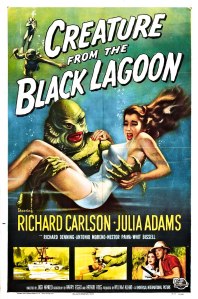
My current book project has me watching The Creature of the Black Lagoon again.  One of the Universal monsters—indeed, arguably the last of them—the Gill-man fascinated me as a child.  There was a strange contradiction here.  The creature had evolved in the Devonian Era and remained unchanged into the 1950s.  But the movie opens with a voiceover of Genesis 1.1.  There’s a mixed message here, appropriate for scriptural monsters.  Watching the film again brought back many of the innocent perceptions of youth, as well as the trajectory of my own life.  I don’t often get to the theater to see horror movies anymore, but at the same time the Universal monsters aren’t quite the same thing as modern horror.  As a genre it had to evolve.

Strangely, as a fundamentalist child, the evolution aspect didn’t bother me.  I was after the monster, you see.  The backstory was less important.  Growing up, at least in my experience, means that the backstory becomes more essential.  It has to hold together.  There are, of course, inaccuracies in the story—many of them, in fact.  Still, within the first three minutes Genesis and evolution are thrown together in a happy harmony that belied what I was being taught at church.  The Gill-man is a monster mainly for being a creature out of time.  When modern humans invade his lair, he defends his territory.  The story might’ve ended there, had he not spied Kay.  He doesn’t so much want to kill her as get to know her better.  For a movie posthumously rated G, it has a body count.  Five men die but the Gill-man apparently just wants to evolve.

There’s been a recent resurgence of interest in Creature from the Black Lagoon with both the publication of The Lady from the Black Lagoon and the death of Julie Adams this year.  The Gill-man seldom shows up in the same billing with Dracula or Frankenstein’s monster, or the Wolf-man.  He’s a bit more inaccessible in his watery abode.  Both cold and hot-blooded, he represents how science and Scripture might get along, at least on the silver screen.  The film holds up remarkably well, if a modern viewer can handle the pacing.  Underwater filming was pretty new back in the day, and watching humans swim in many ways suggests the truth of evolution in its own right.  These aren’t the childhood observations of the movie, but rather the reflections of a guy wondering if there might not be some hidden wisdom in the monsters of yesteryear.


Dolls and Puzzles

Maybe you’re anticipating it too.  Annabelle Comes Home, I mean.  My latest book, Nightmares with the Bible, has a chapter on The Conjuring universe, and with the recent death of Lorraine Warren I’ve been working on another piece trying to fit this whole puzzle together.  “What puzzle?” did I hear you ask?  The puzzle, I answer, between what really happened in the Ed and Lorraine Warren investigations.  You see, the paranormal is one of those things we’ve been taught to laugh at, and we’re told that people who “see things” are dweebish kinds of gnomes that don’t see the light of the sun enough.  Reality television has brought some of these ideas into vogue, what with ordinary people gathering “scientific” evidence of ghosts and the rest of us scratch our heads while hoaxes are revealed on the B reel.  But still, Annabelle lives.

It has also been announced that The Conjuring 3 is in development.  For some of us—and I’m well aware that movie-making is an industry and that profit is its goal—the question of what’s real can be as haunting as any ghost.  You see, I buy into the scientific method, as far as it goes.  That caveat is necessary, however, since science is neither able to nor interested in assessing all the strange things people see.  Our senses can be fooled, and a great many people haven’t developed the critical ability to scrutinize their own observations skeptically.  Skepticism itself, however, need not become orthodoxy.  It’s like any other tool in our mental box—each has its own purpose.  A car engine is dismantled in order to rebuild it in working order.  And there may be a ghost in the machine.

That’s what gets me about this whole Conjuring thing, and beyond that the contested livelihood of the Warrens.  There may be such a thing as mass hysteria (the current state of the US government can hardly be explained any other way), but the Perron haunting that was the subject of the first film provides, I think, a good test case.  A family of seven living in a house where they experienced things not only collectively and individually but also in different combinations would seem to be a place where multiple angles could be used.  According to Andrea Perron’s written account, the Warrens’ investigation never really took off there.  That didn’t prevent a very successful movie franchise from being launched, loosely based on their story.  And getting at the truth is never as simple as buying your ticket online and waiting for the show to begin.


Let It Lie

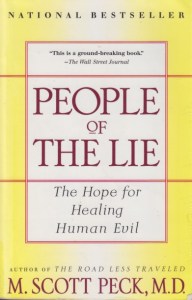
At the grave risk of over-simplifying, the list is brief: destructive scapegoating behavior, intolerance of criticism, concern with public image, and deviousness.  These characteristics, back in 1983 (note well the next year), were widely considered the description of evil.  Now look at the White House.  What do you see?  I know that I’m reading into the current situation, but how can one not?  I have never read anything by M. Scott Peck before.  Growing up I saw The Road Less Traveled on many, many bookshelves of friends and clergy.  I recently picked up Peck’s People of the Lie because, along with Malachi Martin’s Hostage to the Devil, it convinced many in my generation that demons actually exist.  At the time, still pretty much a Fundamentalist, I didn’t require any convincing.  Reading Peck’s People, however, in the era of Trump is a frightening thing.  And not just for the politics.

I always find books by psychologists and psychiatrists difficult to read.  I admit to having had a less-than-ideal childhood, and although self-healing is possible such books make me think I should spend my free time in therapy rather than writing.  In any case, People of the Lie is difficult in another respect as well—the labeling of evil.  Peck advocated for the scientific study of evil.  Good and evil, however, have generally been considered values rather than facts.  Science studies the latter while religion and philosophy deal with the former.  Not that lines in the sand are intended to be permanent.  Still, what one person calls evil may not be what others call evil.  Peck focuses primarily on narcissism and laziness as sources of evil.  He may very well be right, especially with the narcissism aspect, but some of the patients he described certainly didn’t seem evil to me.

Many aspects of this book could be discussed on a blog like this.  No doubt many of them will be, in sublimated form, in future posts.  Books, however, are part of the context in which they’re read.  In Peck’s day, the great political evil still fresh in many minds was the Vietnam War.  Today’s world, however, is one where Vietnam, Watergate, and even to a great extent the tragi-comedy of the W administration have all been eclipsed.  The cult of personality headed by one of the most obviously narcissistic individuals this nation has produced makes what Peck labeled “evil” seem perfectly normal.  And those who have the authority to do something about it either sit idly by, or worse, use it for their own means.  Roads less traveled indeed.


Targeted by Technology

We get along in life, I believe, by routinely ignoring the rather constant dangers that surround us.  Oh, we’ve taken care of the larger faunal predators, but we’ve replaced them with ourselves.  Our success as a species leads us to places we might not be comfortable being.  I was recently exposed to the documentary National Bird.  It’s about drones.  Not the friendly ones from Amazon that we hear will soon be delivering books to our doorstep, but the military grade kind.  I first became aware of how pervasive the military use of drones is while reading Wired for War (on which I posted here some years back).  The difference between that academic knowledge and watching the documentary is the human element.  Drones are assassination machines with high explosives and they are subject to no regulation.

Many of us feel, occasionally, some level of discomfort with how much information “they” have on us.  We don’t even know who “they” are or what they want.  Using the internet, we give them our information.  Caving to our desire for instant communication, we carry around smart phones that know where we are constantly.  Martin Luther once said you couldn’t stop birds from flying over your head, but you can prevent them from making a nest in your hair.  It’s becoming harder to shoo them away.  The nest is well established.  Our houses are easily found on Google maps, and drones can keep constant watch, like weaponized guardian angels.  Only they’re not our guardians.  As National Bird makes clear, drones kill civilians.  Women and children.  The conversations of the operators reveal how much they’ve bought into the jingoism of the “war on terror.”  The film also deals with the human cost of those who operate drones.

Technology stands to make life better, for some.  Watching people who have very little, who live in what would be considered poverty in this part of the world, being bombed by people remotely, is disturbing.  The operators, trained as if they’re playing a game, kill and then have to deal with it.  The use of tech to try to sanitize brutality was dealt with decades ago on a particularly famous episode of Star Trek appropriately called “A Taste of Armageddon.”  Rather than try to resolve conflict we, like those of Eminiar 7, readily accept it if it’s kept at a distance.  Only drones aren’t science fiction.  We’ve been using them for over a decade now, and we prefer not to think about it.  This isn’t an option, unfortunately, for those who’ve been targeted by technology.  The predators are still out there after all.


Identified or Not

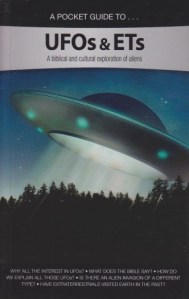
Okay, so this will require some explanation.  It came about like this: I was in a used bookstore.  (This in itself requires no explanation, of course.)  I noticed a slim book, cover out, called A Pocket Guide to UFO’s and ETs: A biblical and cultural exploration of aliens.  Biblical?  I picked it up only to discover it was from Answers in Genesis.  Please note: I do not buy books or paraphernalia of Fundamentalist groups unless I can get it used.  I don’t want to support this particular weirdness in any way.  Well, the money for this used book was going to support a used bookstore and not a religious aberration, so I figured it would be good to see what the Fundies have to say about a topic that seems to have started to engage public interest again.

The book begins by helpfully pointing out that if there’s life on other planets the Bible doesn’t mention it.  And since the only way it could’ve got there is by evolution—for surely the Almighty would’ve said something about it in his book, if he’d invented it—the whole idea is a non-starter.  Evolution, as everyone knows, is a satanic idea meant primarily to challenge the Bible and secondarily explain the diversity of life forms on earth.  And since earth is the only planet the Bible recognizes, it is the only one with life.  So, UFOs, it stands to reason don’t exist.  Well, that’s not quite fair.  They do exist but most can be explained away and those that can’t may well be demonic.  Since there can be no aliens, and since some sightings can’t be otherwise explained, then demons—which the Bible does mention—must be responsible.  They (demons) can also explain why other world religions exist.

There’s plenty in here to offend just about everyone apart from the Answers in Genesis crowd.  The screed spends quite a bit of time knocking down ancient astronaut ideas, and taking Erich von Däniken to task.  Science is useful in explaining how pyramids were built, but not in how the rock used to build them was formed (it takes far too long to make limestone the old fashioned way; God simply used a variety of different rock types to make the one inhabited planet more interesting geologically).  And those UFO religions?  Inspired by demons, no doubt.  In fact, even reading a little book like this could lead you to become interested in the subject, so be careful!  In fact, the safest thing of all (and I’ve only got your well-being in mind) is to leave it on the shelf.


Idol Thoughts

The Enlightenment led, in some respects, to a condescending view of the past.  Historians know, for example, that the basics of science and engineering predate the Middle Ages.  Just consider the pyramids.  The people of antiquity were anything but naive.  We tend to think in Whiggish ways, despite our awareness of past achievement.  Perhaps it’s because we misunderstand past religious thought.  After all, the Enlightenment is generally understood as freeing the human race from “superstition” and leading to empiricism.  Empirical thinking had been there all along, of course, only it hadn’t been the sole way of making sense of the world.  Consider, for example, the “idol.”  In the biblical world food was left for statues of the gods, but it seems to me that people were smart enough to figure out that images didn’t actually eat it.

Elaborate rituals, of course, attended the making of gods.  These symbolic actions were said to make this object more than just a piece of wood, stone, or metal.  Assuming it required food, however, strains credulity.  The symbolic nature of the offering, however, was accepted.  The same is likely true of the offering of food to the deceased.  Even in ancient Israel the time-honored practice of leaving sustenance for the dead was carried out.  Was this symbolic rather than naive?  I tend to think so.  Reason told the ancients that the dead ceased to move, and therefore to eat and drink.  It was nevertheless a sign of respect to leave food, which, in a world of frequent malnutrition, could have been put to better use.  It was a symbolic sacrifice.

Surely they didn’t understand the fine interactions of nature that require microscopes and telescopes to see, but their knowledge relied on the divine world to address what remained mysterious.  We still, for example, have difficulty predicting weather.  We understand that the atmosphere is subject to fluid dynamics and countless minuscule factors that contribute to it.  We’re also aware that global warming is a reality.  Like the ancients we can choose to ignore, or pretend that the obvious doesn’t exist.  Like them, we do so for a reason.  Our political leaders are unwilling to stand in the way of the wealthy.  Reelection and all its perquisites—including personal enrichment—are simply too enticing.  Empirical evidence is worth ignoring for such emoluments.  When we feel tempted to assert our superiority over those of past ages, we might pause to consider that we still offer food to idols.  And get just as much in return.


Rock Solid

Old interests don’t die so much as they become sublimated.  As a child I picked up a cheap “gem display” in a small cardboard box at a yard sale, probably for a quarter.  A couple of the samples were missing, and those that remained were tiny, but I was fascinated that rocks came in such varieties, especially since the ones I tended to find on my own were all shades of gray.  Science education wasn’t especially great in my small town, and besides, I had a massive interest in not going to Hell, so religious study took precedence over my predilections toward scientific studies.  Still, as a child and later, I read a lot about science and I never doubted that it could teach us about the natural world.  Years later I rediscovered my love of rocks.  I joined the Wisconsin Geological Society.  I bought a rock hammer.  I began hounding.

One of the first truisms you learn about life is that movers don’t like heavy things.  Seems that if you are in the business of helping people move (for money, no less), you might be stoic about such matters.  But I have yet to move and not have the guys complain about all those boxes of books.  Well, the rock collection is even heavier.  I discreetly marked the boxes “heavy collection,” hoping nobody’d say “What you got in here, rocks?”  Because, well, yes.  I like rocks.  While in Wisconsin the collection grew—we lived in a house at Nashotah, and we had space.  I had a rock tumbler going in the basement.  We attended rock and gem shows.  Then we moved three times in three years.  I became embarrassed of my petrine peccadillo.

On my way out the door yesterday, I spied a fossil I’d picked up in Ithaca.  Immediately my old inclination to rocks returned.  I don’t know why I bought so many books on geology and seriously considered changing professions after my academic position fell apart.  Perhaps in a life so unstable rocks seemed solid, reliable.  Or maybe it was nostalgia for my young days when a cheap white box of neatly labeled specimens provided hours of transfixed wonder.  I still pick up interesting rocks, and even go to places where collecting is permitted.  This whole world under our feet is full of surprises and an interesting stone can send me into a reverie that is, if I’m honest, as spiritual as it is scientific.  


Digging Bad?

Academics, as a rule, focus on books by other academics.  Theirs is a specialized vocabulary with specific goals (tenure, then an Ivy League position).  It’s easy to see, sometimes, why they distrust books by those of us outside the academy.  We aren’t as constrained, and can say some speculative stuff.  I just finished Evil Archaeology: Demons, Possessions, and Sinister Relics, by Heather Lynn.  Now, most academics I know won’t take seriously a book where the author is cited by “Ph.D.” on the cover.  That’s a sure sign of trying to impress a lay readership.  This book is clearly heartfelt, and personal, but it does raise a host of questions regarding sources and details. I found myself wondering where the author found out so much about Pazuzu when I, who hold a doctorate in ancient West Asian studies, had such trouble locating sources.  Then I checked the bibliography.

Even academics have been known to cut a corner or two, now and then.  For my last book I didn’t have access to a university library so I had to make do with what I could get my hands on.  (JSTOR is not cheap for individuals, in case you’re wondering.  If you teach and you get free access from your library, you don’t know how lucky you are!)  So it is with my present research.  I muddle along, often buying used copies of the books I need, sometimes from eBay.  Researchers can be driven that way.  Lynn’s book covers a lot of territory, and not all of it seems related to demons.  Little of it covers archaeology in any detail.  But then, it’s not intended for academic readers.  I learned a thing or two.  I also distrust a thing or two she claim (having once been in the academy), but there’s no doubt she’s trying to do a service in this book.

Demons cut a wide swath.  Lynn discusses bits and pieces from here and there, and at times her treatment is rather a gallimaufry of anecdotes.  There are interviews, personal experiences, and urban legends.  It does seem hard to believe that scientists worldwide are studying demons in order to explain illnesses, though.  For me, finding a new book on demons just when I was finishing my draft on the same topic, it was imperative to read what she had to say.  It’s clear she’s seen some of the same movies I have.  I like to think that, as an inbetweener I can still read academese as well as regular writing.  You always find interesting things there in the middle.


No Animals Harmed

Out for a walk after work the other day, I spied a black cat.  Not the superstitious sort, I didn’t let this deter me from continuing on.  Then I noticed that it was a mere three or four feet from a ground hog that was just as large as, if not larger than, the cat was.  They were staring at each other, weighing their options.  The ground hog didn’t appear too concerned.  Then a rabbit hopped up, on the other side of the cat.  A perfect syzygy of fauna that remained still for a moment in a tableau of nature.  About the same time as the cat noticed  the rabbit, the rabbit noticed it back and quickly hopped away.  The cat crouched and slunk after the bunny and the woodchuck ambled off at its own pace.

Not only was this conjunction an odd combination of three species of mammal—four if you count me—but it was such a conscious interaction that I had to think of it as almost human.  Three very different individuals, probably all with eating on their minds, had to assess how to interact, wordlessly.  As far as I could tell the drama ended amicably.  The cat looked well fed, in any case, and the rabbit far outdistanced it from the start.  Chuck was unconcerned.  Although the hard line still exists in science, drawn between ourselves and our fellow animals, I’m convinced that they have a share of consciousness.  We’re told that they’re mere “machines” following instinct.  These three “machines” along the trail were sure acting like they were thinking.

What are they thinking?

As the situation played out, no violence ensued.  Three individuals out enjoying the spring happened to find themselves in a scenario that called for negotiation.  The cat, like Republicans, felt compelled toward aggression, I should imagine.  It had a choice: take on a larger, more worthy foe, or turn its attention to the weaker, more vulnerable prey.  Naturally, it turned toward the weaker of the two.  There were differing agendas at play here, and with a dose of consciousness added in, these critters behaved so like human beings that I felt compelled to share it.   The ground hog and rabbit looked on the situation with some wariness.  They thought about it, and each took the prudent route to safety, for the time being.  Nature, it seems, will find its balance if we let it.  And we, if we would acknowledge it, still have something to learn from nature.


Different Kind of Salvation

It’s encouraging and disheartening all at the same time.  And seldom has the evil of money been so obvious.  Last night I attended an environmental panel discussion at a local church.  It was encouraging to see so many people out on a rainy, chilly night in Bethlehem, a city famous for its might steel mill.  Everyone there knew the problem and agreed that something had to be done.  As the speakers gave their presentations it became clear just how corrupt politicians are.  Corruption is bipartisan, of course.  In the name of “economic growth” we allow the fracking rape of our state despite the known and proven environmental hazards.  Despite the fact that Pennsylvania has a green amendment in its state constitution.  Money, as Cyndi reminds us, changes everything.

Shortly after even Mitch McConnell admitted climate change is real, at the state level climate deniers are running things.  It brought to mind the frightening and omnipresent teachings of my Fundamentalist youth: the sooner we can destroy this planet the sooner we’ll make Jesus come again.  Convinced of the absolute certainty of that second coming, there is almost a mandate to ruin, pillage, and plunder natural resources because the Good Book ensures us that, upon a white horse the savior will come in the nick of time.  Politicians, elected officials believe this.  They also believe in mammon.  If you’re gonna go down, you might as well do it in style.  Like John Jacob Astor on the Titanic.  It’s the way of the aristocrat.  Rising seas drown rich and poor alike.

It was a miserable night to be out.  The weather has been freakishly off for some time now, and all the science—real science, that is—predicts it’s only going to get worse.  How the government became the enemy of the planet that gave it birth would be a fascinating story if only it were fiction.  The truth is we’ve elected people that can be bought.  And bought easily.  Laws are passed that violate the constitution of this commonwealth and meetings are held behind closed doors.  Local activists are very active while most of us struggle to keep ourselves employed, heads, as it were, above water.  We need to pause now and again to consider what a wonder this planet is.  We must learn that the only power money has is that which we freely give it.  Rain was pouring down.  Brontide was actual thunder as the state legislature drew up chairs for the last supper.


Sustain Chapel

It seems that holidays come thick and fast in the spring, especially when Earth Day follows directly on the heels of Easter.  Given the hard time mother earth has been having with too many Republicans waging war on her, it’s worth taking a few minutes to consider finity.  Our planet is not infinite.  The resources with which it came loaded out of the showroom are all of limited supply.  Somehow we’ve managed to convince ourselves, at least in this hemisphere, that there’s always more where that came from.  Unless, of course, you’re referring to the degrees that contribute to global warming.  Of those, the GOP narrative goes, there really aren’t any.  No credible scientist doubts climate change, although those who are already old and who are benefitting from it will claim otherwise.  Any story depends, of course, on the teller.

Over the holiday weekend I was out of town.  Driving home a few hours I was distraught at just how much litter lines our otherwise scenic highway system.  Stuff falls off of trucks and, despite advertising against it, out of car windows.  The few trash bags piled for pickup by the earth-conscious can’t keep up with the cast-offs of a throwaway culture.  We desperately need to take the narrative back from those with the loudest, and most incoherent mouths.  We all rely on this same planet and the power we cede to the wealthy is due to our complicity in their claims of ownership.  They’ve proven themselves, should I dare to be biblical, unfaithful stewards.

The earth, it is true, is a place of immense beauty.   It’s not aesthetics alone, however, that motivate us.  We simply cannot survive without this biosphere in which animals, plants, microorganisms, and minerals coexist.  We evolved in it.  The mythical narrative of special creation unwittingly played into the hands of those who will claim it all for themselves if the rest of us don’t deny that they had indeed “earned” the right to be considered the most prestigious.  Our societal sin of rewarding bad behavior has led us to this crisis.   We pollute far beyond our needs.  We “speculate,” hoping that “development” will lead to “growth.”  The wealthiest build rockets to escape our planet, but there’s nowhere to go.  Might it not be better to invest in this gift that we already have?  To learn the lessons of nature?  To become students in the classroom of Mrs. Earth?  There have been many holidays lately, but this may indeed may be the most important of them all.


Mystic Connections

Those of us who find rationalism a bit too constricting sometimes find solace in mysticism.  My reading of late, which is mostly research for Nightmares with the Bible, frequently touches on mystics of the past.  This isn’t a new fascination.  All the way back in college, as a religion major, I mentioned to one of my professors that I found it appealing.  A frown settled across his academic face.  “Mysticism is dangerous,” he said.  He went on to explain that churches (he was Presbyterian, and I Methodist) had belief systems into which mystics—those who experience the divine directly—didn’t fit.  A direct experience of the divine could cast doubt on church doctrine and nothing, as you might guess, is more important to true believers than dogma.

That discussion at such an impressionable age set me aback.  Here as we enter (for the non-orthodox) the Triduum, or “Great Three Days” the faithful are hoping for some kind of divine experience, I expect.  Many of us will spend two-thirds of it working.  In any case, if nothing mystical happens why do we bother?  Mysticism is equally deplored by science since it suggests something that doesn’t fit into rationalism’s toy box.  A universe where the unexplained—and oh so subjective!—direct experience with naked reality threatens to undo all the neat columns and tidy formulas that describe the entirety of existence.  Conventional churches tend to agree because you never know what God might do if you open that box.

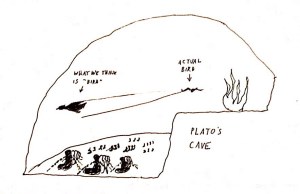
There are religions that welcome mysticism.  They recognize that human-built systems are only approximations—Platonic shadows, if you will, cast upon the cave wall.  Mystics are those who, temporarily unchained, dare to turn around and face the fire directly.  Who knows?  They might even catch a glimpse of the sun itself.  More conventional religions are run like businesses.  You come to a certain building at a certain time.  You perform prescribed actions on cue.  You place your money in this specific receptacle at this specific time.  Leave and forget it all until next week.  Our younger generations don’t find this engaging, just as they see through the lie of the inherent fairness of capitalism.  I can still see the frown of my theology professor.  The old systems are falling apart even as those not too weary after work will head to Maundy Thursday services for a slip of bread and a sip of wine.  The mystic, however, doesn’t know what might happen next.


Aging Tech

When I get an idea my first impulse is to grab an envelope and pencil and start scribbling.  I run around with an older crowd.  Many of my generation don’t appreciate how much a single “share” can do for a blog post, or what a simple link to a page can do.  I have college friends who have no email addresses and who are invisible on the web.  I guess this is a young person’s playing field.  I suppose one of my reasons for writing about horror is that it keeps me in the younger demographic.  I don’t know too many people my age who are fans of “the genre.”  Sci fi is a little more acceptable, I suppose.  Still, I’ve been thinking quite a bit about why I find horror so fascinating.  There’s actually something redemptive about it, at least in my reading of the material.  It’s also a coping mechanism.

One reason that people tell stories (and read stories), according to psychologists, is to learn how to handle situations they might encounter.  This is on a subconscious level most of the time, otherwise speculative fiction simply wouldn’t apply.  I can’t recall having been in a crisis situation and stopping to think what a Stephen King character would have done in such circumstances, but I suppose that might be in the back of my mind somewhere, along with information about all the things I’ve mislaid over the years.  The older you get, in a technologically rapacious society, the more things there seem to be worthy of horror stories.  I haven’t even figured out the last round of devices before the new generation’s introduced.  No wonder so much of horror has to do with being attacked by monsters that look innocent.  Clinically engineered in a clean room.

Image credit: Pattymooney, via Wikimedia Commons

Some of the horror comes from the inherent instability of a constantly upgrading tech.  My laptop’s a few years old.  While a little younger than that, the device that sits on my laptop is also not fresh from the factory.  The last time I tried to back up the contents, the external hard drive (new from the factory) refused to do what I commanded.  While I did eventually figure it out, I wasted a good deal of my scarce free time working out how a device I couldn’t control was in fact controlling me.  Younger folks grew up with this kind of problem solving drilled into them from kindergarten on.  Now I find myself in a world of devices I can’t comprehend and which don’t even react the same way they did last time I bought the exact same one.  I ask my fellow quinquagenarians what to do and I watch as they grab an envelope and pencil.


Science of Compassion

It has been several years now since I’ve been directly (or indirectly) involved in robotics.  During my daughter’s high school years I was active in the FIRST Robotics program, spending some week nights and many weekends supporting the kids—far more clever than me—building and competing with the robot.  It was during this time that I came to know some of the mentors involved.  They knew I was looking for a job in a field not their own.  Instead of wringing their hands like my professorial colleagues did, they made concrete suggestions as to how to go about finding a reasonable position.  Unlike many religion professors, they were willing to go out of their way to help.  It’s a lesson I’ve never forgotten.  A somewhat well-known religious leader is known for having said “by their fruits you will know them.”  So it is.

One of these friends recently sent me a New York Times story about a disabled toddler.  Because of our government’s very compassion health care system, this boy was denied access to a wheelchair.  When the local high school robotics team learned about it they designed and built a motorized chair for the boy.  Again, my point couldn’t be more obvious.  This team did what was the right thing.  They didn’t stand around saying the family would be in their thoughts and prayers.  No, they did something about it.  While the story made me feel good, it also saddened me.  I’ve been part of the religious studies community for at least three decades now.  When I lift up mine eyes to the hills, however, whence cometh my help?

Please don’t get me wrong—I know probably better than most how difficult life and funding can be as a humanities academic.  I also know, however, that humanities are nothing without humanity.  How easy it is to forget that when a tenure-track position opens up!  There are creative solutions possible.  I have suggested them to those empowered to enact them from time to time.  Their response has generally been to explain why it can’t be done rather than giving it the old college try.  In robotics you try to see if it works before deciding it can’t.  Perhaps there’s a message here for those who hear.  Engineers find solutions while many academics find excuses.  There’s any number of reasons not to help the boy get a wheelchair: somebody’s going to have to pay for this, there are other things that demand the students’ time, there are government agencies who already do the work.  Or.  You can try because it’s the right thing to do.  Whose fruit tastes better, I wonder?