Autocracy and Its Victims

Human rights ought to be fairly simple.  The recognition that all people are human is complicated by that infamous human construct of money, even when autocracy’s involved.  I recently became aware of the plight of the Uyghurs.  If it were not for the efforts of some local faith communities, I would never have heard of them.  The Uyghurs are a Turkic population in what is now northwest China—a disputed area that has fallen under one of the superpowers of the Asian world.  Muslim by heritage, the Uyghurs fall into the category of peoples adhering to an organized religion, which the government of China has consistently resisted—indeed, feared.  The current plight of the Uyghurs is that they are facing “ethnic cleansing” by the Chinese government, which uses claims of terrorism to lock at least hundreds of thousands (perhaps significantly more) Uyghurs into “reeducation camps.”

Like most governments with secrets to hide, China does not permit foreign journalists or academics into these camps.  Children are being separated from parents—those of us in the United States would be well served to pay attention to this—so that the young may be culturally assimilated into the China that Beijing envisions.  The Uyghurs, like the Tibetans, are seeking international political protections and recognition.  Minority groups like this easily fall under threat.  In many communities men are taken to the reeducation camps (from which they never come out) and their families are supplied with a male Chinese boarder who watches to make sure they no longer adhere to their Islamic faith.  Reports from those who visit the region demonstrate how much at threat all of us are from autocratic governments, especially when other governments are easily bought.

We in the western world are prone to accept the propaganda that Islam is a terrorist religion.  It is not.  Most people are surprised to learn that the nation with the highest Muslim population is Indonesia.  Iran is not even in the top five.  Iraq is not in the top ten.  Our western bias blinds us to the religious realities, and diversities, of east and south Asia.  China, however, has long repressed organized religions, making it irresistible to many Christian missionaries.  It has, despite being the home of Daoism and Confucianism, become hostile to movements that allow people to organize.  Religions, of course, have long been such organizing movements.  If we do not support the rights of other religions, especially under the whims of autocracies—which are growing even in “the free world”—then we are gazing at our own future. 


Permanent Change

Maybe you’ve experienced it too.  The sense of change in a large city like New York is palpable.  Although I don’t commute in much any more, I noticed it when I made daily treks to the city—change is constant.  If the skyline’s forever evolving, on street level things are more than keeping pace.  In the seven years of my daily commuting I saw buildings built and razed in the same location.  Scaffolding is a constant hazard.  Public art pieces are placed and then replaced.  Change.  I was reading about Yijing, better known as I Ching, the other day.  One of the spiritual classics of China, this “Book of Changes” reflects a worldview common in eastern Asia that is quite at odds with that that developed in ancient Greece.  Many Greeks believed permanence was reality, those in China who read the spiritual masters believed that change was reality.  The older I get the more I think the author(s) of Yijing got it right.

I’m not an expert on the religions of southern or eastern Asia, but I have studied the major ones.  To those outside the field of religious studies, it may be surprising that the field is as large as it is.  In the United States alone there are an estimated 40,000 denominations, and that’s just within Christianity.  To be an expert in any one takes years of study.  Add in the many religions of other locations, such as Africa and Asia, and you’ve got more than one lifetime’s worth of work lined up.  A common—the most common, in fact—course in collegiate religion curricula is “World Religions.”  I’ve taught it myself.  The problem is nobody’s an expert in all of them.  Still, I found reading about what used to be called “eastern religions” (with that poisonous cultural bias that the unchanging west is the correct vantage point) full of surprises.

Scientists well into last century liked the idea of a steady-state universe.  Permanence.  When Edwin Hubble noticed other galaxies were moving away from ours (and, by the way, first noticed that there were other galaxies), the Big Bang theory developed to explain this motion.   Change, it turns out, is constant.  It may be slow at times, and at others it’s like the skyline of a major city like New York, shifting several times in a single lifespan.  I’ve read some of the spiritual classics (in translation) and I always come away with a new sense of wonder about the many ways of understanding the world.  And I ponder what it will take to change the attitude that religions aren’t worth studying.


The New Purple

Those of us who grew up Evangelical hold an unusual place among our liberal peers.  We’re often able to peer around, over, and under that wall that has been built between those who want a faith-based nation and those who want a free one.  Angela Denker is a fellow traveler on this road, and her book Red State Christians: Understanding the Voters Who Elected Donald Trump is a useful roadmap.  Some of us fall further from the tree than others, but one of Evangelicalism’s more endearing traits, when taken seriously, is the love of those who are different from you.  That love is often forgotten in the political rhetoric daily whipped into a froth by an unstable president being used by his party to install agendas that hardly fit the moniker “Christian.”  That’s why books like this are so important.

I confess that reading studies such as this make me uncomfortable.  Uncomfortable because my Evangelical past haunts me worse than any ghost, but also because Denker is clearly right that basic humanity is being left in the garbage as battle lines are drawn up in what could be a great, diverse nation if a leader were determined to work for unity.  I recently wrote about lunar landings.  Kennedy was a Catholic who had to work to bring a nation together around a common goal.  Instead of tearing the country apart for his personal aggrandizement, he pointed to the moon.  Sure, there was a xenophobia concerning the Soviet Union, but at least in this pocket of the world there was a sense that we should work together.  When religion entered politics with Richard Nixon and his followers, a deep rift opened up.  The two topics you were never to discuss—religion and politics—were now in the same bed.

Red State Christians is an extended road trip on which Denker interviews people who largely fall under the Evangelical umbrella.  Some of them are Catholic.  Some of them are Hispanic.  Some of them are less concerned with social issues, but are hard-working laborers often overlooked by the Democratic Party.  The resulting pastiche is one in which Americans are cast not in sharp relief, but rather with the hazy edges that are a far more accurate way of understanding human beings.  Many, it becomes clear, elected Trump out of fear, or out of fear of his opponent.  These aren’t bad people, but they are people afraid.  This wasn’t an easy book to read, but it is an important one.  And those who want to work for a future that might include realms beyond the moon might find this work a small step in the right direction.


The Holy

It’s perfectly natural.  Trying to make sense of things, I mean.  It’s been a little difficult in America for the past three years or so, given that nothing seems to add up beyond greed and narcissism supported by a senate majority.  Still, as I retreat into my horror films I realize that there’s a logic to it.  Over the past several months I’ve been attempting to articulate it.  You see, I have a couple of presentations to give on Holy Horror in October and one of the questions likely to arise is why.  Why bring together the sacred and the scary?  Those who’ve studied religion formally—and many who’ve not—are aware of Rudolf Otto’s classic The Idea of the Holy.  It’s outdated and I’ve been waiting for someone to write its replacement, but we’re past the era when one scholar corners the market.  Has nothing new emerged this past century?  Nevertheless, Otto’s main ideas still make sense, before he lapses into a Christocentric view.

Mysterium tremendum et fascinans isn’t an incantation, but with a little imagination the Latin makes sense.  The holy, according to Otto is a mystery that is both terrifying (tremendum) and fascinating.  To the laity in the pews this may be strange, but chances are pretty good that your minister has read this book.  In the monotheistic west, the divine is terrifying.  It’s not splitting hairs to suggest terror and horror differ, nor is it unreasonable to suggest they have much in common.  Horror seems more embodied—a working-class variety of terror.  Still, both have that element of fascinans.  We fear but we can’t look away.  I don’t have the time to sit and ponder that a Gilded Age academic had.  Otto didn’t have to keep up with Facebook and Twitter.

Although academia required far more than eight hour days, the time during those days wasn’t spent “on the clock.”  As one intellectual I admire once quipped, staring out the window is work.  Not as far as HR is concerned, however.  Productivity in an industry under stress is its own kind of mysterium tremendum, I guess.  It doesn’t really allow for unstructured hours to read, take notes, close your eyes, and read some more.  Work measures inspiration in terms of currency, which is one of the problems that stretches past beyond these last three years.  Struggling hard with an idea is like wrestling an angel until dawn.  You can’t win, and you can’t lose.  But when the sun clears the horizon it will be time to be at your desk and ideas will have to wait another day.


Somebody’s Coming

Sometimes updates don’t help.  That’s because evil is so good at masquerading as righteousness that constant vigilance is required.  Michelle Goldberg’s Kingdom Coming: The Rise of Christian Nationalism was recommended to me by someone at a local church.  I’ve been giving educational talks to help people understand what Evangelicalism is, so I figured I’d better read it.  The optimistic epilogue to this otherwise excellent book allowed relief after the 2006 midterm elections.  Of course, nobody back then could’ve believed an even less intelligent president than W could ever be put forth by the GOP.  That doesn’t mean Kingdom Coming shouldn’t be read.  It should.  And it should be required reading (aw, gee!  Homework?).  There have been many studies that have demonstrated repeatedly that Christian Nationalism is highly organized and well funded.  Meanwhile intellectuals scoff that religion is dead.

I spent most of the last week in a kind of panic.  I have another public talk coming up, and I needed to read Goldberg before that.  Yes, it is dated.  But yes, we have Trump’s bumbling form of “leadership” with a well funded, highly organized Evangelical subculture calling the shots.  Forget the politicians—they’re only interested in money—it’s everyone else who suffers from America’s growing fascism.  The fact that the GOP won’t stand up to 45 shows that we’ve already turned the corner toward das Vaterland.  Anyone the Republican Party elects from now on could be the new dictator.  Christian Nationalism stands behind this as journalists scratch their heads.

Goldberg’s book has likely been shelved because eight years of Obama made it seem like the threat was gone.  The problem is, silence works to the benefit of Christian Nationalists.  Perhaps the most frightening thing about all of this is that many intellectuals simply don’t take the threat seriously.  At the same time I was reading this, I was also reading about Nazi Germany (because I’m such a cheerful guy).  The parallels are blatant and entirely too obvious to miss.  Christian Nationalism has an agenda and it is fascist in nature.  Even obeying the words of Jesus takes second place to the political objective of making America in their own image.  This may sound alarmist, but it’s based on solid information.  The Devil, they say, is most powerful when people don’t believe in him.  Those who would make America into a theocracy would claim to follow the other guy, but looking at their tactics, it’s pretty clear who’s really in charge.


Horror Homeroom

With a happy coincidence I discovered a website called Horror Homeroom.  Featuring articles and podcasts and reviews on horror films, I felt its siren call.  Then I learned it is run by a professor at nearby Lehigh University, making it even closer than I initially supposed.  I wanted to be part of the conversation.  You see, after years and years of being a Bible scholar and having to fight to find any kind of interest whatsoever in what I had to say, I’ve found the horror community extremely welcoming.  Perhaps because we all know at some level that horror is considered transgressive—it isn’t unusual to find critics who still claim it’s debased—we find each other.  There’s an aesthetic to horror, and it isn’t about gore and violence.  Horror, when done well, is an excellent marker of what it means to be human.

Life always ends in death.  Many people spend as much time as possible trying to avoid thinking about it.  There is, however, great creativity in facing squarely what you cannot change.  Well, that’s a good sounding excuse anyway.  All of this is by way of announcing my guest blog post on Horror Homeroom.  A few weeks back I was quite taken with The Curse of La Llorona.  Not that it was a great movie, but it had a way of coming back to haunt me.  Part of it has to do with the poorly understood way that local customs blend with imperialistic religions.  Faith is a local phenomenon.  Once you switch off the televangelist, you’ll begin sharing beliefs of your neighbors.  There’s no such thing as a pure religion.  Pure religion is one of the most dangerous myths there is.

Those of us who study religion professionally have been taught to call the blending of religions “syncretism.”  I’ve stopped using that word for it because it assumes that there are pure forms of religion.  Religion always takes on an individual element.  We make it our own when it gets translated into our personal gray matter.  The idea that there is a pure form of any religion requires an arbiter of greater rank than any here on earth.  You can always say “but I think it means…”  Horror, I suspect, latched onto this truth long ago.  Without some hint of doubt about your own individualized belief system, it’s difficult to be afraid.  Horror need not be about blood and gore.  Often it isn’t.  Often it’s a matter of asking yourself what you believe.  And once you answer it, opening yourself to asking questions.


Building on Water

I try to keep up.  Really, I do.  Although my specialization is in ancient religions, at heart I’m an historian of ideas and I try to keep up with the origins of the many Christian denominations.  You see, with so many competing versions of the one correct way to please God it pays to hedge your bets.  Thing is, there’s so many options and some seem to spring out of nowhere, like toadstools after the rain.  The other day I attended a local community event.  One of those kinds of affairs where local organizations set up tents and sometimes sell food.  Many of the tents were for churches.  As supporters of community values (mostly) this isn’t unusual, even with the declining numbers in the mainstream.  Then I heard a voice.

“Do you read?” the man asked.  I confess to having a bookish look, so I admitted I do.  “We want you to have a free book,” he said, handing me a plastic bag (warning sign one) containing a small paperback and several fliers.  Now, I was here to look around and maybe get a bite to eat, so I thanked him, tucked the bag under my arm and walked on.  Only on the way home did my wife look at the contents.  The church—for it had to be a church giving such things away—was one of which I’d never heard.  This would’ve been disorienting if it weren’t for the fact that ever since college—where I learned quite a lot about denominations—I’ve been noticing new varieties of Christianities, cropping up somewhat frequently.  Each seems to believe it has found the answers, despite the threadbare denominations that have been around for centuries.

I make fun on nobody’s search for meaning, or the truth.  It is, after all, a lifelong quest.  I am suspicious of those who claim to have already gotten there, however.  For those traditions that declare they’ve found the answer centuries ago, the passing years with their constant changes have worn on them.  Especially if they’re awaiting a divine cataclysmic ending to it all that’s been delayed for a couple of millennia now.  Others are, apparently, wanting to pump some fresh air into these tired lungs.  This group featured a website “the famous one [all one word].com.”  I was surprised and a touch saddened to see Jesus relegated to the role of a media celebrity.  But then again, I can’t keep up like I used to.


Religious Studies

Prominent public intellectuals, as opposed to us obscure private ones, often brashly castigate religious thinking.  They may be aware that the vast majority of the world’s population is religious, but there’s  a kind of arrogance that comes with public adulation, I suppose.  I was just reading about the European Middle Ages and I was reminded once again just how seriously religion was taken and how the very foundation of civilization is based on it.  During said Medieval Period everyone knew—note I don’t say “believed”—knew that human beings had eternal souls.  They also knew there were eternal consequences to our actions and therefore correct religion was absolutely essential.  The Enlightenment began to change some aspects of received wisdom, but not all.  Many intellectuals who led the charge still believed in God and Heaven and Hell.

Whenever I consider the sorry state of academic religious studies today, and look at how politics are unfolding, my thoughts turn to history.  Just because we no longer think in a certain way is no reason to forget just how formative religion is to human life.  The Republican Party has cynically accepted this as a means to power.  While leaving left-leaning intellectuals to debate their choices, they roll toward electoral victory.  They acknowledge that people are religious, and that’s what it takes to win their trust.  Where was Dawkins when Brexit was decided?  It may not have been religiously motivated, but nationalism is closely tied to religious thinking.  While religious thought may be gullible it’s not necessarily so, and without those who think religiously there’s no way to a true majority.

I’ve always had more questions than answers, and one of my largest unanswered ones is why prominent public intellectuals don’t think studying religion is important.  Religious thinking isn’t going away just because they say it is.  In fact, the data show exactly the opposite.  The Middle Ages are quite instructive for understanding the way people behave.  Although belief in the religious structures may be eroded, people still want to find a way to continue their impact beyond their earthly lives.  Modern Nimrods are just as concerned with image as religiously motivated Nimrods were.  To understand where we are it’s necessary to look back.  Looking back entails a certain comfort level with ways of thinking that many moderns find embarrassing.  Religion is part of who we are.  Looking around we can see the consequences of denying it. 


Glossophobia

For a guy so full of phobias that there’s no elbow room at Hotel Fear in my head, people are sometimes curious as to why I don’t suffer one of the most common sources of terror: speaking in front of crowds.  Glossophobia is extremely normal.  I suspect it’s one of evolutions tricks for keeping metaphorical cooks out of the allegorical kitchen.  If we’re all talking at once, who can be heard?  The internet will prove to be some kind of experiment in that regard, I expect.  Thing is, I’m not what most public speakers appear to be: confident.  I’m not.  Beneath the surface all kinds of phobias are vying for the next private room to become available.  Over the weekend I had a public speaking engagement, and that made me consider this again—why doesn’t it bother me?

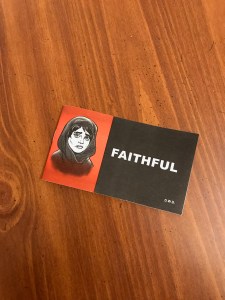
Although the answer to “why” questions will always remain provisional, I have an idea.  It’s kind of creepy, but true.  In my fundamentalist upbringing, I was taught that my life was being taped.  You see, it goes like this: since the book of Hebrews says “And as it is appointed unto men once to die, but after this the judgment,” some Fundies like Jack Chick illustrated this as an outdoor cinema in Heaven.  Or rather, in the clouds just outside Heaven.  Here you’d be summoned, buck naked, as soon as you died.  Other nude souls would gather round the big screen and your entire life would be projected for all to see.  Since everyone’s dead there are apparently no time constraints.  As a kid I realized that I was being watched.  All the time.  Now, I’m not conscious of this constantly, but I did translate it to public appearances.  We’re all, it seems, actors.

With a lifetime of performing experience, by the time I was a teen I wasn’t afraid of public speaking.  Introspection was a big part of my psyche, and when I had a speaking engagement, I knew that I had to be conscious of what I did and said, because people would be watching me.  I learned to play the part.  I did take a college course in public speaking, and even a preaching course offered by the Western Pennsylvania Conference of the United Methodist Church, but both of these were long after I’d begun taking public speaking roles.  I make mistakes, of course, and early on I learned to laugh at them before the audience did.  We were all being taped, after all, and there’s no outtake reel before the pearly gates.  Strange, but true.  If you’re afraid to speak in public just remember—you’re being watched, all the time.


AKA

“Professor?”  While not technically correct, I was surprised and not unpleased to hear the title yesterday while on the streets of Easton.  One of the greatest compliments a former teacher can receive is word from a former student.  While dressed in Saturday clothes on the way to the country’s oldest continuously operating farmer’s market, I wasn’t sure the voice intended was for me.  I’ve been out of the classroom now since 2011.  Sure enough, one of my students from Rutgers recognized me and called out.  We had an ersatz but wonderful conversation after a completely chance meeting.  Already since graduating he’s had a few different jobs, but he remembered the classes I’d taught and I recalled that he’s the person who started me reading Neil Gaiman.  Teaching is, you see, a two-way street.

I’m doing a guest service at a local church next Sunday.  In preparation I’ve had lots of emails (for me).  One of them was from the music director.  He opened by calling me “Reverend.”  I’ve never been a reverend.  The idea isn’t unappealing but I’ve gone pretty far down the path of independent thinking and any church that would ordain such as me would need to be comfortable with that.  In fact, I heard a sermon recently by an Episcopal priest and was pleasantly surprised at how welcoming and, dare I say, liberal it was.  I was never really welcome in that club, I know.  When I was still fairly fresh out of seminary and working on my doctorate the idea of being “Rev. Dr.” was still appealing.  Now I go by my first name.

Labels.  I tend to eschew them.  Like my young colleague I’ve had to learn that work doesn’t necessarily define you.  (I’ve had many employers, however, who not only beg, but insist to differ on that point.  The ideas of owning individuals die hard, apparently.)  On the weekend, though, off the clock, people are calling me “professor” and “reverend.”  I’m generally sitting in a corner with my laptop on those early mornings calling myself a “writer.”  For none of these things do I receive any pay.  (Well, perhaps some for writing, but very little and very infrequently.)  The move to our new location was a chance, I think, to try to remake myself.  A chance to figure out what labels, if any, really fit.  Better throw “telecommuter” and “remote worker” into the mix.  Those are the ones, come Monday morning, that matter most.


Ghouls and Dolls

It was my plan—as if plans ever really work out—to see Annabelle Comes Home on opening weekend.  July got away from me but I finally found my way to the theater yesterday.  My current book, Nightmares with the Bible, deals with demons in cinema.  One of the chapters covers The Conjuring universe, and since this is the sixth film in that diegesis (with one tangentially attached spin-off) watching the movie was as much research as it was fun.  While the demon utilizing the doll Annabelle is clearly the main villain, the film, as in most of the franchise, interjects any number of entities.  Ed and Lorraine Warren, in real life, kept a museum of occult objects in their house.  This room contained items that had figured in their cases—they maintained demons didn’t possess objects, but people—including the doll Annabelle.

The new film maneuvers three girls (Judy, the Warrens’ daughter, her babysitter, and a friend) into the house alone.  One of the girls releases Annabelle from her blessed case, and a nighttime of terror ensues.  The demon behind Annabelle animates several of the haunted objects, so the girls have to deal with many ghoulish threats.  The film knows it is following tropes such as a car breaking down by a cemetery at night, and the idea of a babysitter being attacked by monsters, and at times it gives a slow wink to fans of the genre.  Still, there are plenty of genuinely creepy moments and a few jump startles.  It also shows the clearly demon in its “true form” at the climax of the film.  When it does so, it matches traditional renditions.

Set to become the highest grossing horror series of all time, The Conjuring universe mixes films that claim to be “based on a true story” and others, such as Annabelle Comes Home, that use real settings but without claiming to follow actual events.  What I found engaging about this particular movie was the fact that the youngest girl, Judy Warren, was the one who figured out how to re-capture the demon.  There are holes in the plot, of course, but featuring a young woman not requiring a man’s help to trap a demon is somewhat unusual in a Catholic diegesis.  True, she doesn’t perform an exorcism, but Judy does contain the evil without a priest, or even her father’s direct help.  As this diegesis wends its way into American folklore, moments like this are increasingly important.  Even though there are demons here, the women don’t require men to do the heavy lifting. 


Born Once More

Every once in a while a reader, either here or on other social media, asks me what my religious beliefs are.  The expected answer to such a question is the standard label of a denomination of some sort.  My response, however, is that knowing the group I belong to (and I do) should not effect the way my thoughts are viewed.  With the exception of some groups suspected of mind control, standard religions are generally trusted as being motivated by pure intentions.  Having both attended and taught in seminary settings, and knowing a great number of clergy, however, it becomes clear that denomination is less important than one might think.  In short, I answer this question in the public forum of neither classroom nor blog as I truly believe there’s nothing to be gained by readers/students knowing where I personally seek meaning, denominationally.

It’s no secret that it was once the Episcopal Church.  (I could not have taught at Nashotah House otherwise.)  It was made pretty clear after being at said seminary for many years that the Episcopalians had no official place for me.  Even when I worked a few blocks from the church’s headquarters in New York City I could find no one willing to listen or consider my credentials.  Its Church Publishing branch wouldn’t consider me in their book wing.  Were it not for some former students who still minister to me, it was clear they did not miss me.  So it was with some surprise that I found myself in Nativity Cathedral in Bethlehem on Saturday for their Celtic Mass.  The Cathedral itself is lovely with a négligée of wrought iron tracery for a reredos, appropriate for a city built by steel.  Eight angels with outspread wings stood atop it.  Like most sanctuaries, it was a place of refuge from the busy, noisy street outside.

The reading from Amos 7 stood out to me.  Lectionaries, by definition, take pericopes (selections) out of context.  Amos’ vision of the plumb line is actually part of a series of visions, but here stands alone with the episode of Amaziah trying to send Amos back to Judah.  The prophet responds by saying he’s not a prophet, but just a guy who’s received a message from God.  In ancient times there were prophets paid for their services.  They supported the government positions and governments made sure they were cared for.  The situation hasn’t much changed, at least among conservative religious groups under a Republican administration.  There were other parallels here, but saying too much on them might end up giving too much away.


Bible Misunderstood

Okay, so I wrote a post a couple days ago about evangelicals challenging Trump’s China tariffs because it will raise the price of Bibles.  Little did I know that Miriam Adelson wants a “Book of Trump” added to that very Bible.  Now, heroes are a personal business; to each their own.  Adding someone to the Bible, however, especially when that person has no idea of what Jesus said, is problematic.  Biblical and ecclesiastical scholars know that even if most Christians agreed books simply can’t be added to Scripture.  Many think the Gospel of Thomas should qualify—it may actually be closer to the words of Jesus than some of the canonical gospels and was putatively written by a disciple.  Thomas, however, will never make the cut.  Early bishops and elders in the church set pretty firm limits to the New Testament.  

Some religious traditions, such as Mormonism, have gotten around this impasse by writing entirely new sacred texts.  Loyal Trump followers might indeed fit the description of what used to be called a cult.  Thing is, George W., and George H. W., and even Ronald Reagan were more religious than the incumbent and nobody suggested adding them to the Good Book.  Our world has somehow flipped upside down in the last three years.  All I know is that in the photos of Trump with the most Jesus-like Pope in modern memory the Holy Father wasn’t smiling.  Then again, the Pontiff would likely not autograph Bibles if asked to do so.  Has anyone suggested a book of George Washington?  There’s such a thing as getting carried away.  

The Bible, apart from being the sole recognized authoritative text of the world’s largest organized religion, is an iconic text.  This means that the Bible is recognized as an important book—perhaps even a stand-in for God—without considering what it actually says.  This was a major point behind Holy Horror and it’s essential to understanding American political behavior.  Manipulating Scripture for political ends is generally the most cynical of approaches to the Good Book.  In America you can drive down highways and see the Bible advertised on billboards.  Large segments of an increasingly secular society are still motivated by it.  There was a time when it was believed that such cavalier suggestions as that of Ms. Adelson would constitute blasphemy, or would at least profane the founding book of Christianity.  In the minds of some Trump has clearly become a god.  So it was in Rome before the fall.


A Decade

Please pardon my being sentimental, but today marks one decade of blogging on Sects and Violence in the Ancient World.  I realized, thinking this over, that I used to make some interesting, perhaps even quotable statements back then.  Why not, I thought, farm those older posts to celebrate what I was thinking when I was a tenth-of-a-century younger?  So for today’s post, I’m presenting some quotable quotes from July 2009, starting with one of the zingers from my very first post.  For convenience, I’ve even provided the links to the posts so you can see them in context, if your July has somehow not filled itself up already.

Sects and Violence in the Ancient World, by the way, was the name given when one of my nieces thrust a recorder in my face and asked me what I would call a blog, if I had one.  She subsequently set this site up for me.  One aspect of the title may not have been evident: it’s a quasi-anagram for my initials.  It has been, from the beginning, mostly metaphorical.  Without further ado, then, a few of my favorite lines from a decade long gone:

“He had a sidekick called Cypher (sold separately), and arch-enemies with such names as Primordious Drool and Wacky Protestor. I marveled at the missed opportunity here — they could have called them Text Critic and Doctor Mentary Hypothesis!” First post: Bible Guy, July 12, 2009. <https://steveawiggins.com/2009/07/12/bible-guy/>

“Technology has outstripped reality.” Asherah Begins, July 13, 2009 <https://steveawiggins.com/2009/07/13/asherah-begins/>

“Black and white are not in the palette of serious religious studies.”  God is Great (not)?, July 14, 2009 <https://steveawiggins.com/2009/07/14/god-is-great-not/>

“When he [Aqhat] refuses to release it to the goddess he is unfortunately pecked to death in a hitchcockian demise by a swarm of buzzards with attitudes.” Sects and Violence, July 15, 2009 <https://steveawiggins.com/2009/07/15/sects-and-violence/>

“Indeed, one may think of them [religion and monsters] as fellow ventricles in the anatomy of fear.” Vampires, Mummies and the Holy Ghost, July 16, 2009 <https://steveawiggins.com/2009/07/16/vampires-mummies-and-the-holy-ghost/>

“Better to consider it [weather] human than to face unfeeling nature.” Changing Faces of the Divine, July 18, 2009 <https://steveawiggins.com/2009/07/18/changing-faces-of-the-divine/>

“As the gods are drinking themselves senseless (how else can the latest Bush administration be explained?)…” Drunken Moonshine, July 20, 2009 <https://steveawiggins.com/2009/07/20/drunken-moonshine/>

“As usual, we kill off what we don’t comprehend.” Not Lion, July 22, 2009 <https://steveawiggins.com/2009/07/22/not-lion/>

“A bonobo was recently documented as uttering the word ‘yes’ to a keeper’s question, officially making her more articulate than some clergy I’ve known. Even today there are churches that still call their leaders Primates!” Religious Origins, July 23, 2009 <https://steveawiggins.com/2009/07/23/religious-origins/>

“I never used a computer regularly until I began my Ph.D., and then it was only a glorified typewriter, qwerty on steroids.” Who We Were, July 27, 2009 <https://steveawiggins.com/2009/07/27/who-we-were/>

“I grew up in a blue-collar household where paying ladies for favors was itself considered a sin.” Yes, Mammon, July 28, 2009 <https://steveawiggins.com/2009/07/28/yes-mammon/>

Where do you suppose we’ll be a decade from now?


Trumping the Bible

The media is chattering about one of the very many contradictions of evangelicals who support Trump.  Since I have a foot in the world of the Bible business, I read with interest how Trump’s tariffs on China will put Bible publishers in a bind.  You see, the Good Book is generally sent offshore since printing costs (and technologies) are too expensive to replicate in God’s new chosen nation itself.  This lack of divine foresight should be a bit disturbing.  The entire evangelical enterprise is based on their reading of Scripture, and the belief that the divine choice of America is behind such momentous events as 45’s election.  Maybe we should check our pipes for lead.  In any case, Bibles, which are printed cheaply in high volume overseas, are set to become too expensive to give away because of the great pretender’s tariffs.

A few media outlets have picked up this story, including one that noted Trump’s favorite Bible verse is “an eye for an eye, and a tooth for a tooth.”  The famous lex talionis statement was famously, well, trumped by Jesus who said that the ideal was to turn the other cheek.  In a rather Philistine way, evangelicals have sided with a man who says Jesus was wrong.  If you want to check up on me in your Bible you’d better get your wallet out.  Ironically from a Republican point of view, tariffs are themselves the breaking of the commandment of free trade.  Still the party that claims to believe that does nothing to prevent the sale of their souls, cash on the barrelhead.

Many evangelicals may find the idea of Bibles as a business distasteful.  It is, however, extremely profitable for those on the supply end of the deal.  Bibles are printed at a volume that would make most authors green, and due to its size the Good Book requires specialized paper most of the time.  This is so much the case that Bibles not printed on “Bible paper” just don’t feel like sacred writ.  Since costs of living in the United States are quite high, and since this kind of specialized printing would be too expensive in this situation, publishers outsource God’s word.  Some publishers have been pleading with the government to exclude books from Trump’s tariff so the Good News can continue to spread.  The fact is that only one deity, called Mammon in the Bible, runs this enterprise.  And to continue to buy Bibles at the evangelical rate will soon be requiring an act of sacrifice.  I guess the lex talionis still applies.