Day of Memorials

I admit that I’m as guilty as the next guy of thinking of holidays primarily as a day off work. A boon from the gods of capitalism so that we can come back to the job rejuvenated and more productive than ever. It doesn’t matter the occasion—I don’t have time for things like haircuts and dentist appointments with the usual round of early to rise, early to work. Holidays become islands of blessed respite in an endless ocean of labor for the man. So I wanted to take a moment to reflect on Memorial Day. Memorial Day is a time to remember those who have died—grandfather, grandmother, America. We take a moment to consider what we have lost. Then it’s back to business as usual.

My father was a veteran. He died many years ago now and I don’t write much about him because I really didn’t know him at all. That doesn’t mean I didn’t want to please him. Any boy wants to make dad proud. I tried the hard work route, and even gave Boy Scouts a try. The things of my youth have been slowly dying. Democracy is merely the latest victim. I shouldn’t be surprised—when it no longer becomes profitable, even the least offensive system of government can be bought and revamped to fit the needs of the greedy. Never mind the will of the masses. They’re the ones who lie under the gravestones for which today stands. No one can be rich without great numbers of poor against which to measure himself. Remember that; it’s Memorial Day.

Since Memorial Day doesn’t lend itself to commodification—let’s face it, outside Halloween death’s a downer—we can make it a day of sales. While you’re earning money without working, why not spend some of it? We seem to have lost the gist of holidays. Those who’ve died in vain believed in a democracy that their heirs have thrown away in scorn. If that for which we say we believe has become moribund, it appropriately becomes the focus of Memorial Day. My grandparents lie buried far from here. They were Evangelicals who wouldn’t recognize their faith reflected in those who still cling to the brand. I remember grandma sending money to Oral Roberts. She didn’t live to see him claim God would take him unless he had even more money. Now we hear the same thing from Pennsylvania Avenue. And tomorrow we all go back to work.



Biblical Popes

It was the end of the world. The year was 1979, if I recall. One of those occasional manias that sweep the nation weighed heavily upon my high school. My English teacher—for her class was at the very hour of the appointed end—sensibly scrapped her lesson plan for the day and had us each write an essay. Would the world end or not, during this very class period? We then shared what we wrote. I recall one answer—not my own—quite clearly. “The Bible says when the reign of Pope is short after the long reign of the previous Pope, the world will end.” (This was just after the death of Pope John Paul I.) A moment’s thought revealed that there are no Popes in the Bible. How could anybody think there were?

Of course, we were at the end of a decade whose bestselling book was Hal Lindsey’s The Late, Great Planet Earth. It was part of what analysts call John Todd Phase of the world’s end scenarios. Or was it the Pat Robertson Phase? In any case, all kinds of obscure signs floated in the air. But Popes in the Bible? Had any of my classmates even read the Good Book? This may have been the only occasion when it was beneficial to have been raised a fundamentalist. I’d already read the Bible many times through and it said nothing about Popes. Not even the Catholic translations.

The iconic role of Holy Writ in secular society is greater than many people suppose. “The Bible says” is practically gospel because few people will check it out. I knew from my conversations with clergy, even as a teen, that few ministers had actually read their own foundation document the whole way through. That leaves them vulnerable to the “cloud of unknowing” whether something is biblical or not. The only way to find out is to sit down with the tome and start reading. Although today such sites as BibleGateway make reading the Good Book online remarkably easy, it’s still a commitment of many hours immersed in an arcane world and mind-numbing lists of who begat whom once upon a time. Examined closely, the Bible is an odd book as far as Holy Writ goes. The same applies to the scriptures of many world religions. Somewhere along the line someone decides that this book, or collection of palm leaves, or set of scrolls, has divine origins. And since world scripture is vast, there’s got to be something about Popes in there somewhere, for when the next end of the world scare comes along.


Which Bible Again?

Which Bible? That’s a fair enough question. No matter how much you want to deny it, western culture always has been and always will have been biblically based. That being the case, it’s best to know which Bible we’re talking about. The Protestant Bible is America’s Good Book. Although there were Catholics before Protestants were a gleam in Luther’s eye, the latter laid early claim to the Bible. When a Bible appears in a social or civil religion context, it’s most likely Protestant. The Catholic Bible contains extra material—that which Protestants call The Apocrypha. Satisfied that Luther was right to leave the Deuterocanonical books out, their role as fake good news has never been questioned. If the King James was good enough for Jesus and Paul, they say, only half in jest.

Some Evangelicals belong to the King James only movement. They come up with alternative facts when faced with the reality that the King James translation includes the Apocrypha. Yes, it’s right there in black and white. The Authorized Version of the Bible included the “Catholic books.” I was reminded of this the other day when I was searching for a simple factoid—how many words are in the King James Bible? The vast majority of websites give the unquestioning answer of 783,137. They may then break it down into “Old Testament” and New. Almost always they leave out the Apocrypha. The word count there is 152,185, and if my math serves, that brings the total to 935,322—not quite a million words. The Good Book is a big book.

The King James Onlyists (yes, that’s a thing) have bigger problems than the Apocrypha. What King James is the onlyist? The KJV you buy in your Christian bookstore is one of the many 18th century revisions of the 1611 King James. You see, translations are hardly stable. They change over time. Even the Revised Standard Version isn’t completely standard. I noticed while reading it as a kid that words had been changed over time. If our beloved Onlyist friends want to be purists and go back to the 1611 then they’ll have the problem of the Apocrypha to deal with. So which Bible? It’s a fair question. Catholic Bibles are bigger. Some Orthodox traditions also include such exotic books as Jubilees and 1 Enoch. And, from this we should take a lesson. Where there’s 1 Enoch, there’s always another not far away.


Ask an Evangelical

News stories this year have plowed up a frequently repeated question: what’s an Evangelical? This was the subtext to a Washington Post story that declared “Half of evangelicals support Israel because they believe it is important for fulfilling end-times prophecy,” as if it’s news. The media’s a little shy, I get it. Those of us who grew up Evangelical could have told them that at least 40 years ago. As a child I knew that Israel had to be fully restored for Jesus to return. Politics, we thought, were holding God hostage. You see, if the Bible says something, and it’s infallible, then even the Almighty has to obey it. And some parts seem to indicate that Israel has to be restored—interpreted a certain way—before Jesus gets his invitation back.

This Evangelical support isn’t because they love the Jews. No, no. Let’s not get personal about this. It’s because the second coming isn’t coming until the pieces are laid out in order. The Bible’s like a crystal ball, only it’s holy. It can predict the future with great precision. You can be sure someone like Trump is in there someplace, maybe in the passage where an ass speaks. In the 1970s it was Nixon. The wonderful thing about prophecy is that it’s made with interchangeable parts. As Millenniarians know, if you get your year wrong never apologize. Simply recalculate and keep preaching as if nothing happened. The Almighty is a forgiving God. At least to those He likes.

Intellectuals seem to think Evangelicalism is contagious. Well, to be fair, historically it has been. That was the whole point of camp meetings. Most Evangelicals aren’t too shy to tell you what they believe. In fact, their reading of the Bible sort of insists that they do. If you’re too bashful, many of those in the academy (or even formerly so) started out in their ranks. Rare is the biblical scholar who decided on that field of study purely based on intellectual curiosity. There was likely a method to their madness. Yes, of course Evangelicals support any politician who moves the embassy to Jerusalem. Tis a consummation devoutly to be wished. The divine heels have been dragging for a couple of millennia now, so it’s time to get this show on the road. All you have to do is ask an Evangelical. They’re not hard to find; in fact, they seem to be everywhere these days.


Belly Fires

A friend recently sent me a story from Smithsonian.com about how Evangelicalism arose partially in reaction to protests against the Vietnam War. Not that they were protesting it, but rather other mainline Protestants protesting drove evangelicals further to the right. Having grown up evangelical, I think I understand their strange reasoning fairly well. It was illustrated, for example, in a meeting of the Nashotah House board of trustees. Now, confidentiality rules—which I support—prevent me from providing details, but as you can imagine board meetings involved differences of opinion. I was a faculty representative (voice, but no vote), and I had a point to make. Being Episcopalian I politely and calmly raised my hand. At the same table one of the student representatives (voice, but no vote) was waving his arm like he had to find the nearest restroom, and quick. The chair called on him, ignoring my learned gesture. “He has a fire in the belly,” the chair said, “let’s listen to him.”

A fire in the belly. Not exactly an empirical—or even rational—reason to select one comment above another in my opinion. It was outward and dramatic gesticulation that caught the chair’s attention. Cooler considerations could be easily ignored. Nashotah House wasn’t exactly Evangelical. It was conservative, to be sure. What this episode taught me, however, is that society responds to those with bellies strangely warmed. Mainstream Protestants, for the most part, want comfortable faith experiences. Reason, after all, suggests decorum. Over 90 percent of the many, many mainline sermons I’ve witnessed have been staid and calm. Back in John Wesley’s day enthusiasm was an actionable offense in ecclesiastical eyes. Was the fire in the heart, or in the belly?

A little to the right…
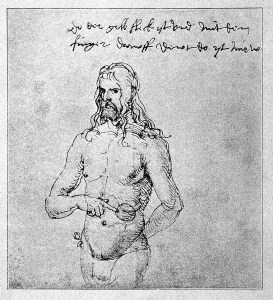
L0006082 Self Portrait of Albrecht Durer
Credit: Wellcome Library, London. Wellcome Images
images@wellcome.ac.uk
http://wellcomeimages.org
Self Portrait of Albrecht Durer.
Finger pointing to left side of torso.
By: Albrecht DurerPublished: –
Copyrighted work available under Creative Commons Attribution only licence CC BY 4.0 http://creativecommons.org/licenses/by/4.0/

So, what does this have to do with the Smithsonian story? Evangelicalism is driven not by the head but by the midriff. John Wesley’s conversion account was famous for his statement that his heart was “strangely warmed.” An inveterate doubter of his own salvation, Wesley needed to be certain. His thermo-cardiac episode helped to comfort him in the face of the lapping waves of the lake of fire at his feet. Having been evangelical once upon a time, I think I understand this constant Wesleyan concern. The fear of Hell is never easily overcome. The Greek word for strong emotion can be translated “to feel it in the bowels.” Examined more rationally, we know what moving bowels lead to. We see it every day as Evangelicals drive all three branches of government. The fire in the belly wins over cooler heads every time.


Secularcist

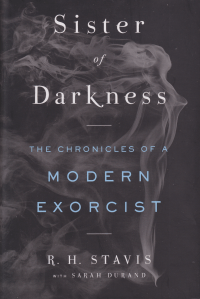
It should be fairly obvious that I’ve been researching demons lately. In the current political climate, it feels like a natural thing to do. Where there are demons, there are also exorcists. Many times those who write books on their experience in this realm will lapse into something along the lines of, “If there are demons, then Catholicism has to be true. All of it.” Or something like that. I have to admit that reading the better written accounts makes me start to think that way. R. H. Stavis’ Sister of Darkness: The Chronicles of a Modern Exorcist is another approach altogether. A secular exorcist, Rachel Stavis doesn’t use the time-worn rituals of movie fame. And her book offers an interesting rationale for her exorcisms—she sees entities.

I have often wondered if “growing up” isn’t largely teaching ourselves to discount what we perceive as children. I’m sure I’m not the only kid who was told there are no such things as monsters but didn’t fully internalize that “fact.” Besides, some things are worse than monsters. In any case, Stavis states that she sees entities and it’s clear from the book that she does indeed believe this. This isn’t for show. She describes various types of demons and how she learned to exorcize them. It’s a fascinating account. Her explanations won’t convince everyone, and her answers of where demons come from remain somewhat vague, but her clients swear by her methods. And she’s upfront about wanting her work to increase the good in the world by banishing evil.

I know many Christians who’d be ready to stone a pagan even for such a good deed as exorcizing a demon. Stavis doesn’t belittle any religion, however, and leans a bit toward Wicca herself. As I read I imagined what a reader convinced of the rectitude of one and only one religions would say. Only Jesus can drive out demons? (Judaism had, and still has exorcists, as do some sects of Islam.) Since a demon is a Christian monster, only a Christian can drive it out? One of the more interesting facts of the history of exorcism is that it was, in the Middle Ages, sometimes an interfaith exercise. The three major religions represented in Europe (the Abrahamic triad) recognized that any of the three could drive out demons. Each welcomed the help of the others. We’ve gone backwards since then. We haven’t again yet reached the stage where we realize that anyone doing good is on the side of good. Even demons, it seems, are conservative these days.


Latter-Day Scouts

Physically strong, mentally awake, and morally straight. And prepared. That’s what Boy Scouts are supposed to be. My attempts to become an Eagle Scout were about like my attempts to become a priest—fraught with peril from the beginning. As a child I wasn’t physically strong, for one thing. The runt of the litter, I was scrawny and often sick. Mentally awake remains a reasonable goal, as does morally straight. Such are the realities of life. Then why are the Mormons parting ways with the Scouts? In a recent Washington Post story by Samantha Schmidt, the Latter-Day Saints are formally separating from the organization now known as Scouts. Whether it’s because they now allow girls to join, or if it’s because they’ve openly permitted gays, the Scouts are no doubt becoming accommodationistic in the eyes of some. In a pluralistic world it’s the only way to survive.

Girl Scouts, on the other hand, have historically not raised the question of sexual orientation. When the social dynamics of a society disadvantage girls, it’s natural that an organization to help build confidence and positive self-attitudes should exclude boys. They have no official affiliation with any religious group. I didn’t realize until reading this article that Mormon boys were automatically part of the group formerly known as Boy Scouts. It fits the image, though. If you’ve ever been on a Boy Scout retreat, however, you know that image and reality aren’t the same thing. I dropped out of Troop 3 after frequent leadership changes frustrated me from getting beyond Tenderfoot. Besides, church was taking over more and more of my life at the time. I guess I was headed for morally straight. Our troop, after all, met in a church basement.

This is about symbolism, of course. To be a Boy Scout meant you were making an effort to be good. In fact, it was kind of hard to grow up thinking you could be good without that guidance. Boy Scouts, they used to say, helped the elderly across the street. Apparently what they do behind closed bedroom doors raises the specter of morality. When I was a kid the issue seemed to be more the mentally awake aspect. The Scouts I knew were like everybody else. There was no special purity there. I never knew anyone who made it all the way to Eagle. The Boy Scout law was like a twelve-step program: trustworthy, loyal, helpful, friendly, courteous, kind, obedient, cheerful, thrifty, brave, clean, and reverent. I wasn’t a Mormon, but the church had proved itself a rival. Especially for the reverent part.


Call It What You Will

I didn’t even know the House of Representatives had a chaplain. Then Paul Ryan fired him. I wondered once again if evangelicals were interested in religion at all. We all have labels we’d like to claim but lack of legitimacy prevents us from keeping them. My secret wannabe title is rock star, but given that I can’t sing and can’t play any instruments, I have trouble retaining it. Evangelicals, however, have no challengers. They are so flexible they’d make Proteus blush. Such theological promiscuity, traditional religion teaches, will have its comeuppance. If 45 has accomplished nothing else, he’s forced the religious right to show its true, secular colors. Of all the great ironies of the situation none is greater than the fact that “nones” of whatever description hold up the weightier matters of morality better than those most vocal about their faith. Evangelicals, however, control the narrative and claim to do so with God’s own authority. They have few challengers.

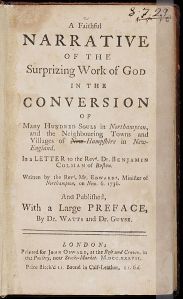
Source: Beinecke Rare Book & Manuscript Library, Yale University via Wikimedia Commons

Then, mere days latter, Rev. Patrick J. Conroy was reinstated by the whiplash GOP. Did somebody warn the religious right that “religious” was part of their name? “Hypocrisy” comes from a Greek root meaning to play a theatrical part. As my stepfather used to tell us, “do as I say, not as I do.” He was a secular man, so his hypocrisy could be overlooked. Noble, even, at times. When those who stake their entire identity on WWJD promote, vocally and enthusiastically, an unrepentant candidate for sinner of the year, you’ve got to wonder if even hypocrisy has lost its punch. How can you reason with people who refuse to reason? We used to lock them away in asylums. Now we throw them into the swamp.

Double standards are the new normal, I guess. Nobody really paid any heed when the fall of the towering televangelists showed, decades ago, that the idol they proclaimed as true religion was rotten to the core. Oh, they made the headlines for a while, but their tumble did nothing to dissuade their true followers. Evangelicals control their own narrative. For many decades now higher education and the media have pretty much ignored religion as a force for social change. Once upon a time Evangelicalism meant change based on ideals that more or less fit the recorded words of the carpenter from Nazareth. Now that its inspiration is the ninth circle below, those who have access to the funds of higher education prefer to put their money elsewhere. Why study something that threatens democracy on a daily basis? Why bother trying to understand Evangelicals? Call it what you will—there’s no way to object to anyone claiming whatever name they want. I should know; I’m a rock star, after all.


Original Sinner

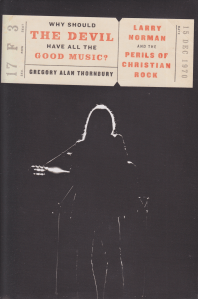
Musical preferences are a personal matter. In the case of the kind that loudly thunders from open car windows, often they should be more so. Still, music is a deeply moving phenomenon. When a musician is paired with a compelling personal story, it can be quite a gripping narrative. Gregory Alan Thornbury’s Why Should the Devil Have All the Good Music?: Larry Norman and the Perils of Christian Rock is one such account. Although Larry Norman was never popularly famous—many people today have never heard of him—he was a tremendously influential person. Like most true innovators he was, as Thornbury shows, a difficult person. He often had more enemies than friends, but there can be no doubt that he lived, at least in his own mind, by his convictions. And on his own terms.

I didn’t know until reading this brief biography that it was common for Larry Norman to wait around after concerts and talk with fans. When a friend invited me to see Larry in concert I was, as is generally the case, so wrapped up in my own issues that I hadn’t done much research. I was thrilled to see the artist that I, like Thornbury, had discovered during college. It was my friend’s idea to go backstage to talk to him. To this day those few minutes remain some of the most thrilling of my life. Norman was a name dropper, according to those who know, and I’ve met a few famous people over the years, including Jeff Bezos, but Larry was different. The breadth of his impact on rock in the 1970s and into the ’80s, was vast. Many secular artists count him among their most profound influences. And he had time to sit and chat with a seminarian from nowhere.

While my friend and I waited to see him, the guy in front of us wanted to play Larry a song. In an act of hubris I can’t fathom, he’d brought his own guitar to the concert. Larry kept saying “I don’t understand why you want to do this.” But surely he knew. Throughout his career he helped start many younger artists on their track, some to Christian stardom, others to more quiet lives. He had, however, something he couldn’t give away. Larry Norman was a true original. Despite his uneasy dalliance with fame, he was willing to sit and talk with a star-struck young man who would go on to become a lifelong admirer of an artist who remained true to himself, even if he was too Christian for some and too secular for others.


In God’s Name

If anyone ever bothers to go through my personal zibaldones (if the word’s unfamiliar, please use the search box for my post on it) they’ll find my personal shorthand. It’s not extensive since I’m a firm believer in explaining things and if I don’t write things out I often can’t decipher what I meant. One of the shorthand marks that I do use is the Greek letter theta. Those who know me will have no trouble guessing that it stands for “God.” Or more appropriately, “theos” the Greek word for God. This particular Indo-European lexeme has a venerable history and appears in such forms as deus, Zeus, and deity. Although in a case such as Zeus it can be used as a personal name, it is, in fact, a title. Somewhat like “president” used to be. And it can be used for any number of divinities.

In the Bible there exists a well-placed concern not to dis the Almighty. God—to use his title—had a temper and was known for not being afraid to show it. Among the Ten Commandments is one not to take God’s name in vain. Scholars argue over what exactly that means, but Judaism, on the ground, had to make decisions about it in a practical way. The best way to avoid divine wrath was never to say the divine name at all. God’s name isn’t “God.” That’s a universal word, applicable to any garden variety divinity. God’s personal name, we think, was Yahweh. To ensure the keeping of the commandment whenever this noun was encountered in the Good Book, the word “Lord” was used. That’s the convention behind Lord in small caps in some Bible translations. If you don’t say the name you can’t break the commandment.

In more recent days, in print culture, a further caution has been introduced. In academic writing it’s common to see “G-d.” I can guess the origins of this convention, but I have to admit that concern can lead to obfuscation. Nowhere does Scripture proclaim that you can’t use the title of the ineffable one. I can’t help but think this is following the conservative tendency to see the use of “God” in exasperation as swearing. The fact that another common swear abbreviates itself as “G. d.” might caution against using this particular combination in an effort to preserve the sanctity of the title. No one ever doubted that Baal was a god—but note the carefully lower case “g”—or for that matter, Mars or Zeus. Or, just to be safe, B-l, M-rs, and Z-s. May I suggest, based on personal experience, that theta might be used instead? But only if referring to the true G-d.


Christian Nationalism

Apparently we’ve forgotten the Second World War. In our touch-screen, never-have-to-get-off-the-couch culture of convenience, we’ve completely disregarded the millions that, yes, died in vain. You see, Christian Nationalism is on the rise, according to a story my wife sent me from the Huffington Post. About as much an aberration from literal “Christianity” as you can get, this movement believes America’s success is tied to its role as a Christian nation. Such believers, if they can even see that such rhetoric leads to war, don’t care. For the fact is that the economy of China is poised to pass, if it hasn’t already done so, the economy of what used to be United States. Call it Confucian Nationalism, but I have the feeling that when two giants try to get into the same compartment things tend to get unpleasant.

Serious thinking is a natural resource of which America has clearly run out. Easy answers, empty of content—junk food of the mind—are easily tweeted out from a personality that declares his own opinions truth. Everything else is fake news. Evangelicals, it’s sorely obvious, need to read The Analects. Don’t claim that its obscure; I’ve read the Bible. If you think you can figure Paul out, well, that’s what I’d call “fake news.” Oh, and by the way, Paul was anything but a nationalist. For all his faults, he knew that Christianity is nothing if it’s tied to nationhood.

Instead we puff out our chests and, ignoring the Bible on this very proverb, become the blind following the blind. If God has a plan he’d better reveal it to his 45th prophet soon because there are some enormous gulfs in the road and he insists on walking without a cane. American exceptionalism is built on the backs of the poor and helpless. They are also the ones most easily swayed by its perverse rhetoric. Nations must separate themselves from their religious beliefs. We’ve seen what happens when incompatible religions become the identifying factors of countries. As long ago as the 1970s I’d learned that nationalism was a powerful force for evil. I hadn’t been alive during the Second World War, but the world into which I’d been born was entangled in Vietnam. We were halfway around the world playing the bully, but it was because of capitalism, not Christianity. The end result, however, was the same. Unimaginable human suffering. Death, pain, and sorrow. And we’ve decided that the Prince of Peace wants us to head down that road again. “Vanity,” I hear Qohelet whisper.


Pittsburgh Demons

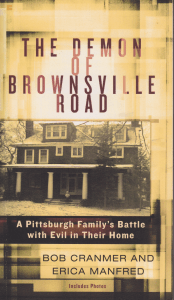
Far be it from me to question someone else’s demons, but every story has at least two sides. After reading Bob Cranmer and Erica Manfred’s The Demon of Brownsville Road: A Pittsburgh Family’s Battle wit Evil in Their Home, I have to wonder about the other side. I have no doubts that strange things happen behind closed doors. Indeed, the aspect of space, or location, has far more entanglements than our science allows. I don’t question the haunting described in the pages of this book—Bob Cranmer was once a prominent political figure in Pittsburgh and has the credibility that comes with elected office (or at least used to). What is open to question is the interpretation.

The Catholic tradition, which is involved here, does accept that a demon can infest a house. The way this account is laid out, however, is as a personal battle between Cranmer and the demon. The story is not unlike Amityville—family moves into house, discovers it’s haunted, and has to decide what to do about it. They call in a priest. From there the stories diverge. Cranmer’s family started experiencing various misfortunes. These were attributed to the demon. The story is strongly patriarchal; Bob Cranmer is a take-charge kind of guy and he alone can take on this fallen angel in the final instance. There are priests involved—including a prominent monsignor in Pittsburgh—but also clergy from other faith traditions and a paranormal investigation group from Penn State. Did the events happen as described? I don’t know. I wasn’t there.

A few things seem a little off here, though. A Catholic official stating that sex between married couples drives off demons? The discovery that the sins in this house stem from it being an illegal abortion clinic? That Native Americans murdered a family now buried on the property? The book doesn’t give documentation because it’s not that kind of book. Don’t get me wrong. I’m glad the Cranmer family finally found relief from the presence that was haunting their home. Even watching a movie like The Amityville Horror makes people uncomfortable because the idea is so scary—home is a sanctuary and when it’s invaded by an invisible (in this case sometimes visible) enemy it becomes a nightmare. The reader is left with the impression that it came down to a battle of wills and that of a former Republican politician was stronger than that of one of Satan’s minions. Some things, particularly in the climate these days, are difficult to believe.


Good Book Gone Bad

The Bible is a book of horror. This isn’t the main point in Holy Horror, but the fact is terror is never far from the surface in the Good Book. My days as a young scholar of the Bible were defined by the works of feminist scholars. One of the influential books of that generation was Texts of Terror by Phyllis Trible. Not hiding behind a masculine orthodoxy, she looked at how various biblical stories appeared from the eyes of female readers. There is indeed terror everywhere. The evils of slavery condemn that hideous loss of agency when one human being becomes considered the property of another. Women, before the feminist movement began, were taught that the Good Book demands this perverted social structure. They are indeed, in the eyes of its patriarchal world, property.

Important as this realization is, the terrors of Scripture go deeper. Even overlooking the genocides—the numbers make it difficult to take in the horrors of the individuals classed as faceless victims—there are multiple accounts of gruesome murders and violence in the Bible. Wars were an annual expectation. Diplomacy was often considered religious compromise. “Us verses them” mentality led to constant conflict. When it came to executing one another, the denizens of the Good Book could be quite inventive. No doubt women and foreigners were poorly treated on a daily basis, but when left to their own devices with divine voices in their heads, the men of Holy Writ knew how to terrorize one another quite effectively.

Even after the message of Jesus of Nazareth, which included love and care and compassion, the Bible goes on to close with the violent visions of Revelation. Perhaps it’s not appreciated so much in the present day, but the Apocalypse had a difficult time making it into the Good Book. Unfortunately the reasons weren’t that it was a book of horror, but the very fact that its status was debated should give us pause when hiding behind the rhetoric of a canon with its door slammed shut. The Bible contains some high, soaring words of noble thoughts and divine consolation. God can be an empathetic lover. With its status, in toto, as a book of divine revelation we have to pay serious attention to the fact of its participation in the genre of horror. Much of this is in the backstory of the films I discuss in Holy Horror. Others may have already explored this dynamic of Scripture, but it’s often a Good Book gone bad.


Defining Evangelicals

Like most Americans I have trouble getting over the button-down image of Evangelicals that has now become so distinctive. In reality Evangelicalism has nothing to do with Jesus, but it comes down to basically two things: a conservative haircut and belief in the superiority of males. The latter point is made by Rodney Hessinger and Kristen Toby in an opinion piece on Cleveland.com. Asking the question that’s on all logical minds—how can Evangelicals stand by a president who credibly cheated on his wife just after their child was born?—they come to the conclusion that patriarchy trumps all forms of righteousness. I know this from sad personal experience. The Bible, Evangelicals claim, gives men the headship of the household. They may sin, yes, but even with that their lordship must remain intact. That is the non-negotiable fact of Evangelicalism.

I was a teenage Evangelical. I grew up in a household where my mother refused to divorce her alcoholic husband because it was against Evangelical teaching. Sexual sins were well nigh unforgivable. In fact, adultery, of which 45 has credibly been accused, was a death-penalty offense according to the Good Book. About the only thing worse than sexual sins way lying. I can’t believe I’m getting old school on Evangelicalism, but I have to say Fundamentalism isn’t what it used to be. In college I knew people who believed we should reinstitute stoning for adultery. Instead we now use it as an excuse to elect unqualified presidents. And yes, we’d like to keep the brand, thank you. Commandments have now become negotiable.

Our society is very sick. Unlike the narrative Evangelicals weave, the illness is within them. Divorce rates are higher among Evangelicals than among atheists. Evangelicals are more likely to own guns than Unitarians. Evangelicals will lie more readily than any agnostic. Some of the more extreme want to reintroduce slavery. Through it all they claim to follow the Bible. Their support of Trump has given the lie to what they claim as a religious faith. Even Jesus, meek and mild, had harsh words to say about adultery. This is something you just don’t do. Promise your faith to one woman until a porn star comes to play at your resort—I don’t recall that being in Scripture anywhere. Evangelicalism hasn’t lost its soul, it’s lost its mind. Given what they’re doing in his name, Jesus must be rolling over in his grave.


Movie v. Book

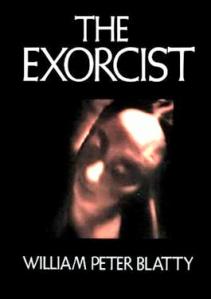
The debate is about as old as celluloid itself; which is better, the book or the movie? The response obviously depends on personal taste, and I suspect that many people base their answer on criteria that can’t exactly be quantified. Often it’s a matter of the specifics—which book? Which movie? In my own experience I’ve done it both ways, read the book first and watched the movie initially. I’ve even gone to movies not realizing there was a book and, of course, some movies aren’t based on books at all. You couldn’t grow up when I did, however, and not know that The Exorcist was a movie based on a book. I never saw the movie in a theater. There was a lot of buzz about it in my hometown, of course. I hadn’t been introduced to modern horror yet—still being a Fundamentalist at the time—and besides, it was rated “R” and I wasn’t.

I finally got around to reading the book. At this point in my life I’ve seen the movie several times, so I knew how the story was “supposed to go” beforehand. The fact that William Peter Blatty wrote the screenplay suggested it would be close to the novel, and indeed that’s the case. Novels, by their nature, tend to have more information about the storyline than is obvious from a film. The author can take time to explain things that don’t translate visually, including scenes where one character lectures another, like this blog. Since I’m writing a book about demons in movies, I paid careful attention to this. One of the themes from the novel that didn’t make it to the movie was witches.

That surprised me a bit. I had seen the movie first and it was plenty scary just as it was. I had to remind myself that my younger years coincided with the rebirth of the fear of witches. Literal ones. I’m not an astute enough sociologist to say whether the “witch hunts” of McCarthyism led to a hypostatized fear of real witches or not, but people were afraid in those days, as I recall. The Exorcist tapped into cultural fears in a way rare for a horror movie. It spoke to the fears of the era, but it didn’t mention witches. I couldn’t help but make the comparison with Rosemary’s Baby, which hit theaters shortly after The Exorcist. Rosemary believes the Satanists are witches. There’s a whole supernatural concoction of malevolent entities on the loose. Witches, ultimately in the novel, are simply one avenue the desperate Chris MacNeil explores to find out what’s wrong with Regan. The movie, wisely in my opinion, chose to leave it out. Demons are scary enough on their own, but of course even that’s debatable.