Who’s God?

There shall be wars, and rumors of wars. The Bible says nothing about being able to declare what future people might have to say about God. According to a story on the Washington Post website, Larycia Hawkins, a political science professor, was suspended from Wheaton College for claiming that the God of Islam is the same as the Christian God. Administrators felt this was one of those cases where the famous statement of faith required of Wheaton faculty was violated. Seems to me the administration might want to sit in on a class in history of religions. Everyone knows that Wheaton takes great pride in its Evangelical heritage, bordering on a kind of extreme conservatism. Even so, this seems extreme.

There is much we don’t know about the early history of most religions. Probably one of the resons for this is that, apart from the founder, we’re never sure if a new religion will take off. Many religions have started and then quietly (or not so quietly) died away. At the earliest stages nobody really knows which way it might go. We do know that by about the time of the Exile, the early Jewish faith was fast becoming monotheistic. Christianity, although disputed by some, also followed in that mold, accepting the God of Jesus of Nazareth (himself a Jew) as the one God. Here many Evangelical histories grow a little weak when focus is shifted to Arabia. The cultural context that led to Islam involved a world of pantheistic worship, but Mohammad was well aware of, and appreciative of, Judaism and Christianity. Recognizing that his faith shared the same books as the other two, his understanding of Allah was clearly the same God as the one worshipped by the Jews and that Jesus had called “Father.” The three monotheistic religions of that region, historically, have always shared the same God.

IMG_2472

Disowning a deity, I suspect, comes with some anxiety. As Islam expanded and Christianity itself became an imperial religion, clashes were bound to happen. Invective included calling the enemies “pagan” or “infidel” (technically two separate things), and as so often happens, rhetoric became mistaken for fact. Since Islam and Christianity were different religions, so the thinking went, they must recognize different gods. Triumphalism is seldom subtle. Fact checking wasn’t so easy back in those days. Suspending a professor for stating the truth is, I fear, nothing new. Some schools require statements of faith so that they may ensure academic freedom is a myth. Ironically, they seldom have trouble with accreditation. The ideology of a war between religions offers a doleful prognosis for a world where religions really need to try to understand each other and where obvious historical facts should count for something.


Who the Devil?

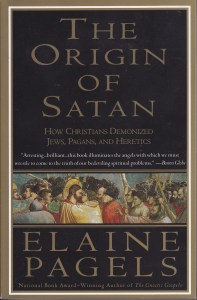
OriginSatanThose who’ve studied the history of ancient West Asian religions know that the concept of a devil, as a character, derives from Zoroastrian origins. In Zarathustra’s dualistic worldview, the forces of evil were concentrated in an “anti-God,” who, upon contact with the emerging monotheism of ancient Israel, became the satan. While scholars still argue about exactly what the role of the satan was, it is clear that it was a role, and not a name. The job of the satan was in some way to bring to accounting wicked deeds. By the time of the New Testament, “the Devil” had developed into an embodiment of evil more along classic Zoroastrian lines. What Elaine Pagels explores in The Origin of Satan is encapsulated in her subtitle: How Christians Demonized Jews, Pagans, and Heretics.

This is not a book about the historical development of the figure of Satan, but rather a study of how early Christians (and to an extent, Jews) viewed “the other.” Naturally she does discuss Satan, who developed along the lines suggested above, but more specifically she addresses how the accusation of being “of Satan” was used. Interestingly, it was generally utilized by those of ancient times to describe those of their own religion, but who held different viewpoints. Sects of Christianity and Judaism generally accused other sects in their own religious tradition of being “satanic.” Foreigners and pagans, well, what would you expect of them anyway? Those closest, ironically, are those most despised. Even early converts to Christianity from Roman polytheism tended to view their former religion as satanic. Satan, in other words, is “the other.” But not the far other. The near other.

While the book is full of Pagels’ usual erudition, it is also disappointing. Not as a book, but as a fact. Religions that claim God only wants us to love one another and treat each other well rely too readily on the figure of personified evil to castigate their enemies. As Pagels demonstrates, even as early as Augustine of Hippo there were those who realized Satan was not a “physical” being, but a symbol for evil. Yet on through the Middle Ages Satan would continue to be evoked to murder women and men thought to be witches or heretics. Satan, it seems, is simply a word for our darkest urges to harm those different from ourselves. We know that religions often have noble intentions. Perhaps the most noble could be to rid the world of Satan, and I don’t mean the mythological figure we all recognize without a hint.


Only Hummus

I remember the moment well. I was in Jerusalem on my own. Although in my early twenties, I really didn’t know much. The man at the vending cart didn’t speak English, but I was hungry. My first experience of falafel would certainly not be my last. After I married a few years later, I introduced my wife to the various Middle Eastern foods I’d tried. Hummus became a personal favorite, especially after I became a vegetarian. There are plenty of things for vegetarians to enjoy, and many cuisines of the world have less meat-heavy options than many restaurants I’ve experienced in the States. Hummus, to get to my point, can be rather bland. It is generally inoffensive, and people of many dietary and religious restrictions can eat it. The Christian Century ran a blurb recently about a hummus restaurant in Netanya, Israel. This eatery offers a fifty percent discount to Jewish and Arabic customers who sit together. Here is a workable idea for peace.

We all have to eat. Half the trick to world peace is getting people who dislike each other to sit down and do it together. Those of imperialist bent may not realize, or even be able to see, that we have more in common than most agitators think. Human needs are the same, and often, very easily provided. You like hummus? I like hummus! We must not be so different, after all. If instead of weaponizing themselves, radical believers armed themselves with food to share, not nearly so many warplanes would have to take to the air. I admit I’m an idealist. I don’t think peace is impossible. We can choose to focus on what divides us, or on what we have in common.

IMG_2641

Perhaps if I’d never traveled to Jerusalem I would never have tried hummus. I didn’t travel for the food, but travel led me to a kind of serenity. Both falafel and hummus are made primarily of chickpeas, a versatile vegetable that has a verisimilitude of peace. If we could learn to eat together we would find it harder to hate each other after that. Sharing our mutual needs sometimes, as the restaurant owner in Netanya understands, requires a financial incentive. Although it may be lucre that lures those who are different to the same table, it is the peace itself that, I believe, will keep them coming back.


From Solid to Gas

“Ignorance of the law is no excuse.” I couldn’t believe that the woman at the police station actually used that phrase on me. The only time I’d ever heard it uttered before was on Gilligan’s Island. After all, we were talking about a parking ticket. I’d arrived in Boston, after driving through four states, with a massive headache. I was moving into an apartment in Winthrop, and all the cars along the street were lined up with their left tires along the curb. I simply did what everyone else had done and went to bed to sleep off my debilitating pain. In the morning I had a ticket under my windshield wiper. I explained that I’d just moved to town from another state, I was a student, and that all the other cars were parked the same way. Then she said it.

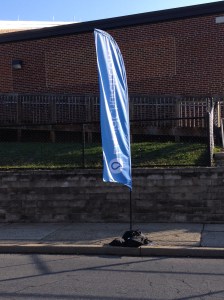
IMG_2625Ignorance, it seems to me, is the only response in the face of laws far more complicated than they need to be. I always thought, for example, that it was against the law for churches to meet in public schools. I’m no lawyer and what with voucher programs and other legislation that has been approved by the Reagan-Bush empire, I’m just not sure any more. So when I drove past the local middle school I was surprised to see banners all over the place proclaiming Liquid Church was meeting there. Liquid Church? They have a slick website (advertised on the banners) and they had guys directing traffic in the local school lot, which was frighteningly full. When had this happened? When had the school which had refused to allow a robotics league, approved the meeting of an evangelical church in the building? I can’t guess about the legality.

One of New Jersey’s fastest growing churches, according to its website, Liquid Church is flashy and trendy. This is God for the twenty-teens. Like businesses these days, it has “core values” as well as beliefs. Those values? Grace wins. Truth is relevant. Church is fun. The beliefs are pretty basic evangelical standards. But what is it doing in my local school? Having attended churches where anything fun smacked of Satan, perhaps I’m just a little bit jealous. Maybe as a guy who tries always to obey the rules, who doesn’t speed, and who actually follows traffic conventions in parking lots, I’m just a little confused. I thought there used to be a wall here. Now there seems to be nothing but rules anyone is free to concoct. I miss Gilligan’s Island.


Star Lords

Things are done differently in the UK. I suppose that’s obvious, but I have always noticed on my trips between our respective countries that some things that go without saying here or there receive the opposite treatment overseas. We are, however, united by a common religious heritage that sometimes goes unrecognized. A recent opinion piece by Giles Fraser in the Guardian discusses the banning of a commercial featuring the Lord’s Prayer in cinemas. The first difference that came to mind is that advertisements for something like the Lord’s Prayer seem unlikely in the United States. We are a biblically-based, biblically illiterate society, and if someone is willing to put up the money, advertisements are a no-brainer. A second difference is, as Fraser points out, there is fear that the Lord’s Prayer might offend people. Surely there are those who will take offense, but Fraser points out that there is nothing offensive in this prayer. It isn’t an attempt to convert. It is reflective, irenic, peaceful.

The point of this opinion piece, apt when Christmas wars are in the air, is that freedom of religion requires a dose of common sense. Yes, many atheists are offended by religious practices, but the question is whether we can ever completely avoid offending one another over belief. Beliefs differ. Not even everyone agrees with “live and let live.” The problem is that some offensive ideas lead to violence. We’ve forgotten how to talk with one another. In this world of uber-security, we find difference terrifying. Religious difference especially. So the angry atheists suggest religion should be driven indoors and rendered mute. Which violates what some religions are all about.

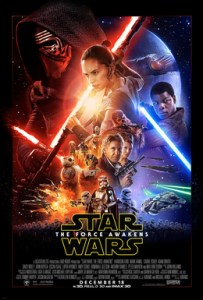
The British ad was to take place before the airing of the new Star Wars movie. One need not be a detective to discern the deep and inherent religious message in the original series of the franchise. Indeed, people were disappointed with the prequels because they had lost that sense of mythic grandeur that Joseph Campbell had been so helpful in instilling in the original trilogy. The films were made with religion in mind. Hidden behind a mask, perhaps, but clearly there. If Yoda had uttered something like the Lord’s Prayer, it would have been accepted as merely part of a movie. And as the reboot trilogy shows without doubt, movies have the power to offend.

Star_Wars_The_Force_Awakens_Theatrical_Poster


Private Miracles

Despite rumors to the contrary, the Roman Catholic Church is skeptical of miracles. Quick to point out pareidolia where it occurs, looking like the Blessed Virgin in a tree stump or highway underpass, this is no credulous organization. Everyday miracles, doctrinal ones, of course are accepted. Transubstantiation is a quotidian miracle as the mass is no mere ritual. Flashier miracles—even some very impressive ones—are treated with suspicion and the rigor of Scotland Yard. When one of my regular readers pointed out the bleeding communion host in Kearns, Utah, I knew I had to check it out. As is to be expected in such cases, the Catholic Church does not disappoint. Some are calling it a miracle, but those who are do not speak for the Diocese.

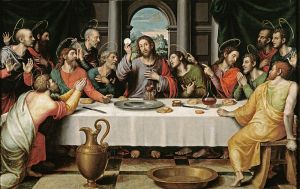
Keeping in mind that my source for the story is Fox (Fox news seems more interested than most in this incident), apparently what happened is that a parishioner returned a host to the priest during communion. The priest put the host in a glass of water to dissolve it, but instead it began to “bleed.” Church officials were called in to investigate. There are several things odd here, although I’m no inquisitor, that make me wonder about the veracity of the story. First: Fox news. There are other outlets as well, so I’ll let that go at the moment. When a person was given a wafer at Nashotah House and for whatever reason turned it back in, the celebrant simply ate it. Priests, by definition believers in miracles, need not worry about germs. Protecting the host from desecration was the main thing. Putting it in a glass of water? I suppose that’s acceptable in some places, but even an Episcopalian would be shocked. And why was the host returned? Surely it wasn’t defective.

The Eucharist is the central rite of the liturgical churches, and it isn’t taken lightly. Although it is a miracle-laced event, it is expected that the transformation will follow the prescribed rite. I sometimes ponder what priests would do in the face of a genuine, unexplainable wonder. The side of the believer that yearns for validation would surely want to put it on Fox news for all the world to see. The private side would want to let it happen without any need to say anything about it. Keep it a private miracle. In a year when Starbucks red is a sign of an impending war, I wonder if a bleeding host is the most apt way to get the attention of the unfaithful when a simple cup of coffee will do.

800px-Última_Cena_-_Juan_de_Juanes


Rumors of Wars

Now that Black Friday and Thanksgiving are behind us, the holiday season compels us to think of what comes next. Whether it is Hanukkah or Christmas or Kwanza, people are preparing to celebrate during the longest nights of the year, hoping to encourage light to return. It is a most primitive urge. Darkness is easy to come by; light takes a little more effort. In the western world the season was largely instituted by the celebration of Christmas, although this took many, many years to catch on. Now it is a begrudging nod in the direction of workers who spend more and more of their time on the job since the internet makes it difficult to claim that we are unavailable. Smart phones, smart watches, tablets, and computers are ubiquitous, so access to work email is only a click away. In any case, the holiday season invariably brings stories of offended people to the surface.

A recent piece in The Baxter Bulletin, sent to me by my wife, rehearses the story of Baxter County, Arkansas and the challenge against a nativity scene on a courthouse lawn. Such stories always seem to me to be cases with no winners. A courthouse should remain neutral territory, but the nativity scene hardly seems an offensive weapon. I can’t claim to know a great deal about the history of creche scenes, but it doesn’t appear likely that they were ever covert attempts to convert. They were celebrations, and nobody has a problem with them as long as they’re kept on private property or church garths. I do wonder, however, if driving them out of public sight really has any purpose. We all know that this time of year is gearing up to holidays when the ordinary takes the back seat for a few days and we can stop the rat race and reflect on a wonderful myth of biblical proportions.

Tree, bush, or asherah?

Tree, bush, or asherah?

Similar stories are unfolding in countless venues now that December is practically here. Even stopping into Starbucks for a cup of coffee can land you in the middle of a culture war. It would seem to me that in this troubled world we might instead try to focus on peace. Whether or not the story of the manger has any historicity at all, the fact is the first century was a period of extreme unrest. This was a moment to pause and imagine what a world without war might be like. Now the holidays have become an occasion for declaring a new kind of sniping war about who has the right to make reference to a legendary event. Or where they may do so. In some cases there may be legitimate cause for concern. Most of the time, however, only those fixated on belligerence manage to draw everyone in to a fractured fairy tale of a holiday season where money is at stake.


Bucking Star

Entitlement comes in many forms. Culturally we’ve been sensitized to substituting “holidays” for “Christmas,” although the reason we spend money at this time of year is well known. Although technically not a Christian nation, the United States has a large number of Christian believers and always has. Charles Dickens certainly participated in the invention of Christmas, but the commercial aspect is very much an American thing. So much so that we can’t wait to get Thanksgiving out of the way to dip our fingers into Black Friday, a holiday in its own right. Starbucks has, for many years, shifted to a banal, neutral winter-themed cup design, to get customers into the spirit of spending. Who really needs to pay five dollars for a cup of joe? Wrap it like a present and the cash flows more freely. So the tempest in a coffee pot over the “war on Christmas” by choosing a simple red (and by default green) cup design became front-page headline news recently. Had we dissed the Almighty or the babe in a manger by going red?

Religious groups feel increasingly threatened. Not everyone thinks globalism is a good thing. We try to educate our children, but many religious groups insist on home schooling to avoid the contamination of an open mind. Any act, no matter how trite or banal, may be perceived as an attack. Nobody seems to think that stopping in to pay so much for a cup of coffee may be a sin in its own right. The economy has tanked and bumped along the bottom ever since I’ve entered the professional sector. And yet, Starbucks has flourished. No matter how down you are, a little arabica stimulus can’t hurt. It has, apparently, become the bellwether of how Christmas-friendly we really are.

IMG_2605

Ironically, the Christmas decorations begin appearing in stores before the spectre of Halloween. Stop in to pick up some last-minute scares and you’ll find them on the bargain rack as the red and green tide take over the valuable shelf-space. We gleefully move from one spending holiday to another. And in the midst of it all, we stop to complain about the design of our coffee cup? I try to avoid disposable items whenever I can. I don’t collect holiday cups from coffee vendors. I wonder what all the fuss is about when the world is full of so many serious problems. If I sound cranky to you, there’s a good reason. I haven’t had my morning coffee yet.


The Religion Industry

The American Academy of Religion and Society of Biblical Literature annual meeting can be a heady place. Religionists tend to be “big picture” people, looking at things from the perspective that this is what life is all about. How much bigger can you get? Religion is, after all, a matter of perspective. As quickly becomes clear from glancing across the crowds—there is a literal myriad here—a great diversity exists. Ironically and irenically violence, beyond an occasional rudeness, is absent. There are believers and non-believers and they actually talk to each other civilly. They want to understand, and in an increasingly polarized world understanding religion seems like a very sensible thing to do.

It feels, however, like an industry to me. Religion evolved out of primal fears. Nobody knows for sure where it started, but someplace (or someplaces) along the course of human development, the idea took hold that humans weren’t the final word in terms of power or direction of their own destiny. There is something beyond us. It may be a tao, or it may be a god, or it may be something we haven’t even conceived yet, but there is something larger than us. The scientific paradigm, on the other hand, starts by assuming human superiority, at least in terms of rationality, over the entire universe. Teasing things apart, looking at the smallest units and building up a big picture from there, it all comes down to equations and concepts understandable in empirical terms. If there is a tao, or gods, and if they don’t leave some physical footprint, they must be left outside the frame. Until the religion industry arrives.

Every field of study has its crackpots, but those thousands milling about me as I stand in a booth with knowledge for sale are mostly sincere. The official study of religion takes place in higher education. Its practice is left elsewhere. The Dalai Lama is not here. The Pope is not passing through adoring crowds. Even Mike Huckabee hasn’t put in a guest appearance. We are not always the friends of those who do religion, for this is a complex industry. Our role is to ask how religion works. Beyond that, we try to fit it into a larger picture—one that expands beyond the universe itself. Out to where a mysterious force may lurk. A force that reminds us that human effort, as strenuous as it may be, must acquiesce in the presence of the unknown.

IMG_2612


As Others Think

As analysts step in where angels fear to tread, we have been given expert opinion on why ISIS’s terror in France was counterproductive to its goals. A few voices have chimed in stating that the result of escalation is just what an apocalyptic group hopes for. Rational people, having no idea how a fundamentalist thinks, are scratching their heads. Long I have wondered why universities and other bastians of higher education haven’t sought the advice of experts. No one can understand fundamentalism who hasn’t experienced it personally. Problem is, most people who have experienced it are experiencing it still. Those of us who thought our way out of fundamentalism are passed over repeatedly for university posts, while those better connected (surely not of fundamentalist stock) are handed influential positions from which to scratch their heads. You want to understand fundamentalists? Ask someone who’s been there.

There is nothing rational, in the common parlance, about fundamentalism. It has, however, its own internal logic. If you believe with every mitochondria in your body that the Bible (or any holy book or doctrine) that you were taught is true, and truly believe it, no amount of reason can convince you otherwise. This is (partially) because the ultimate cause of all events is open to question. Science does not address ultimate causes—it can’t. The endlessly creative human mind, however, can rather simply conjure them. If God is the ultimate ultimate cause, and if God said, x, y, or z, then other interpretations are simply wrong. If God has decided an apocalypse is necessary, what use is reason in the face of the impending certainty? Is there no way out?

There is. Some of us have made it. We, no matter our credentials, are not generally well-connected drones of the middle class. Fundamentalism is prized by the poor. Those who have no future on this earth look for another, better world. This is a perspective I understand very well. Our increase in ease of communication and exploding technology with ease of access have only given new tools to those who think in terms of ultimate causes only. You can’t talk a suicide bomber out of action with reason. You need to know the language of belief. We glory in our lack of belief and rationalism. We, however, close our eyes to the fact that the vast majority of people in the world are believers. And we won’t talk to them because they make us uncomfortable. We have written our own recipe for apocalypse.

From NASA's photo library

From NASA’s photo library


Apocalypse When?

We want to understand what worms through the mind of terrorists, and yet we don’t want to be bothered with religion. For decades universities have been shutting down departments of religion because they don’t make money. Religions aren’t materialistic in that way. In the light of the attacks on Paris over the weekend, many have been turning to the media to learn more about ISIS. A piece in the Atlantic by Graeme Wood, published back in March, pointed out how we have tended to see the movement as political, not religious. Wood, however, demonstrates the apocalyptic intentions of the leaders of ISIS. They are religious. Just because you carry guns and high explosives doesn’t mean you don’t believe.

Apocalyptic thought and politics are a deadly combination. The United States is not immune. Knowing the bent of George W. Bush’s distortion of Christianity, his terms in office were very frightening for many of us. Some Christianities, as well as some Islams, not only anticipate the end of the world but earnestly long for it. Pray for it. In the case of some Fundamentalist Christian sects, world leaders should orchestrate events to force God’s hand in bringing about end times. The fact that we had a president sympathetic to those beliefs should send shudders down anyone’s spine. The idea of an apocalypse is a religious one—there is nothing secular about it. We know the history of the concept, although universities eschew those who look that far back. Zarathustra, also known as Zoroaster, devised a new religion that reflected the basic dualism we all feel: good versus evil. The only way that good could ultimately win in such a worldview was through the complete destruction of evil. And evil wasn’t going down without a fight. This idea influenced Judaism during the Exile, and thus Christianities adopted it. And Islams. No moral relativism here.

The horsemen close in

The horsemen close in

Religion is not evil. Historically it has attempted to be a moral compass to guide believers toward right over wrong. The fact that any religion faces opposition shoves those weak of mind into an apocalyptic state. Gather the horsemen and try to prod God into action. We don’t see divine activity on any kind of scale that we would recognize. The religious events of the past—the Islamic expansion, the Crusades, the Jewish revolt against Rome—these events are merely political. Those who’ve been conditioned to see God behind human activities, however, view such things very differently. Apocalypses are religious events. No amount of reason will convince a convicted believer to look elsewhere for consolation. Yet we press on with guns and bombs and ignorance of what makes religions tick. And tick they will. No matter how secular we might wish the world to be.


City of Lights

As the civilized world struggles to make sense over the senseless attacks of ISIS in Paris, the question of where to turn emerges. An attack has taken place. Innocent people have died. We are in mourning, and we want to analyze what happened to make the world feel a little less insane. As my wife pointed out an article on CNN, I was shocked by the terms in which the attacks were described. Here I read about ISIS extending its global reach. Top leaders, we’re told, planned the attack. And ISIS is “getting into the international terrorism business.” These phrases are common in just about every business meeting I’ve ever attended. This commodification of terror frightens me. The way we’ve chosen to handle terror is by making it into a business. These are human lives that have been lost—futures of the most promising kind. Not only are we the victims of blind terrorist groups, but we are victims of a world that can’t see beyond capitalism.

Terrorism is not a business. It is evil, but in a world where religious value is never invoked outside the few who still find meaning in matters of the soul, the vocabulary has been lost. How do we deal with ISIS? Just like you would any business. A hostile takeover bid? Gather your resources, make some deals, and if retaliation takes innocent lives, well, some bonds and chattels aren’t worth that much anyway. Have we lost the ability to describe the world in anything other than economic terms? Is humanity simply another business?

Paris_SPOT_1017

I do not wish to downplay the horrible events that took place in Paris Friday night. At least 120 are dead for doing only the kinds of things people do on a Friday night. Yet there is a terror that has been creeping through the world that refuses to be named. When it feels threatened it clears out Zuccotti Park. It has taken over our institutions of higher education. It buys political offices and rewards those at the top until the rest of us become commodities. Yes, some goods are lost or damaged during shipping. We need to have a metric to measure that. And when our eyes are streaming with tears we grasp the nearest—the only way we have of describing what has happened. A new business has come to town. When terror becomes a business all hope is already lost.


Imagining Things

Having a child in college is one way for me to stay attuned to popular culture. You can absorb quite a lot by simply paying attention while on campus. For example, on the last several visits I’ve heard the song “Demons,” by Imagine Dragons, being piped into various venues. Given the biblical language of the song, I wondered about its origins, but, like many a distracted parent, had too much on my mind to pursue it. Well, on a recent visit, the song got stuck in my head. Partially this was because during an a cappella concert the Christian group did a cover of the song. This sent me to the internet—the only place where information on contemporary culture is instantly at your fingertips—to do a bit of poking around. Secular groups, after all, frequently use biblical references unnoticed.

When I learned that two members of Imagine Dragons were from Brigham Young University, I just had to know if they were Mormons. From what I’d seen of concert photos, white shirts and ties were rather conspicuous by their absence. Indeed, it turns out, according to the web, that the group does have some LDS in its bloodstream. I’m not so naive as to think that being of a particular religious background makes rockers religious. The debates raged in college over whether U2 was a Christian group because some of them were Catholics. I don’t recall seeing any crucifixes on the album art. This is all especially intriguing because Christianity and rock-n-roll are considered by many to be natural enemies. The origins of rock in the sexually suggestive blues had many 1950’s parents quite worried.

Religion changes, however, once you get away from the parents. I’ve known Mormons that I couldn’t identify as such until they told me. I’ve known Catholics about which I still harbor doubts. Religious affiliation is sometimes purely cultural. That won’t prevent you from being excluded from consideration for a teaching position at any of their schools, however. Scholars of religion can be the greatest believers of fiction to be found. Still, I have to admit to myself that the song “Demons” does keep me coming back. I wonder if the Christian group performing the song was aware of its Mormon tinge, or if they even cared. Sometimes theology can be had for a song.

ImagineDragons


Burden of Democracy

Speaking of revisionist history, I see that I’m negligent on updating my Egyptology. In a year when you need an Excel spreadsheet to keep track of the sheer number of GOP presidential wannabes, I had to ask my wife who Ben Carson was. She sent me a story explaining how the league of presidential dreamers believes that the pyramids were ancient Egyptian grain silos. His reason for believing this has nothing to do with archaeology or with history and everything to do with the Bible. Now, other presidents of too recent memory have had strange biblical beliefs as well. And that raises the intractable question of how you run a democracy with religious freedom. Some people like to claim religious belief is a matter of choice, but that is rarely true. At a young age we are programmed to accept what our parents or guardians tell us is true. Studies of the brain suggest that once wired for concepts of how God works, the circuitry is difficult to displace. In a country where most people can’t tell a Seventh-Day Adventist from an eight-hour clock, they may be surprised that a brain scientist might believe the pyramids were built to biblical specifications.

From WikiCommons

From WikiCommons

The Adventists are a literalist sect. And they are not the only ones who believe the pyramids have something to do with Joseph and the biblical famine that set the stage for the exodus. It is an idea I encountered as a child, and I didn’t even have a denomination to call my own. Religious belief can be, and often is, completely separate from rationality. Some very intelligent people are biblical literalists. The real problem is that the Bible doesn’t mention the pyramids at all, but then most Americans know as much about the Bible as they know about Seventh-Day Adventists. If people actually knew how much incentive George W. Bush had to start Armageddon, the turn of the millennium would have been far more tense than it was. And that’s saying something.

In our democracy, we want freedom of religion, but we don’t want to be bothered with the details of what a religion teaches. Like many, I was shocked by the headlines of a potential president grossly misunderstanding history, but as soon as I learned Carson is an Adventist everything clicked into place. I would suggest that it is a moral responsibility in a democracy to learn something about religion. We like to think we can fudge on that part of the homework. If we want the freedom of having anyone capable of becoming president, we need to learn something about a human being’s deepest motivations. No matter how much reporters and skeptics want to laugh and scorn, religion makes many decisions for by far the largest majority of people on the planet. The thought that a democracy can thrive without learning what truly motivates its leaders, I would suggest, is the most naive position of all.


Uisce Beatha

The idea of a state church, I have to admit, sometimes seems not so bad. Before you click off this page in disgust, please let me explain. Once in a great while, I think about what state churches really are. From the most ancient of times, religious institutions supported governments and governments gave money to state religions. It isn’t a perfect system, but the reason it sometimes appeals is that it might prevent the kind of religious quarreling that we see in the run-up to every election: whose religious vision will govern us? I get theological whiplash. Wouldn’t it be easier to have a state church and be done with it? After all, those who live under state churches really aren’t obligated to believe in the teachings, but just to pay for them.

I’m only being facetious here, of course. We all know that in reality where religions and governments get too intertwined human misery results. The Reformation should have taught us that, if nothing else. The crimes of ISIS continue to show that religious belief makes a poor basis for government. Another case that my wife recently pointed out to me is in the quiet and civil nation of Ireland. Ireland has the stereotype of being Catholic, but according to an article in The Guardian, more than 90 percent of state-run schools there are under the control of the church. For some residents, like the family featured in the article, this becomes a conflict when schools won’t admit the unbaptized. Admissions committees with holy water may be a concept that many people find strange, but the fact is churches can set rules just as strict as secular bodies. No baptism, no confirmation, no matriculation.

I would, I think, be concerned as such a parent. Once my child was admitted and enrolled, would not the teaching go against what was being taught at home? Do governments have the right to decide a child’s religious outlook? Here is the dark underbelly of the apparently benevolent state church. Belief, of all things, is an intensely private matter. Many church goers do not understand the deep beliefs of their religious body, and since we seldom stop to think about religion we just do as we’re told. Education, it seems to me, should be very much aware of religion. Instead we see the opposite happening, at least in this country. If we pretend religion doesn’t exist, it will just go away, right? There is a reason that the church teaches that baptism is symbolic drowning. Only for those, however, who pay attention.

Angel's view of Ireland?

Angel’s view of Ireland?