Sun Devils

Unbelievable. The unrelenting sun of Arizona is unbelievable. Even a “cloudless day” back east is only an approximation. Here it is literal. And like all things literal, it attracts the Fundamentalists. I spent the day on the campus of Arizona State University, the country’s largest university by enrollment. Outside the student union, a couple of bands were banging away in the heat, but when I passed by in mid-afternoon they’d been replaced by a street preacher. He was nattily dressed and provocative. When I first walked by he was talking about students being either “a wicked homosexual, a wicked pot-smoker, or a wicked feminist” and went on to throw in some choice words such as “Obama-loving sinner.” Nobody seemed to be paying him much mind. I went on to a couple of appointments and when I passed that way again, at least ninety minutes later, he was still at it. Now he had a small crowd. Students virtuously challenged him as he claimed that he was without sin, “yes, I am Christ-like” he said to one question, and proceeded to tell anyone that challenged him that they were not children of God and that they should run to Hell because they would enjoy it so much.

Preachit

The more I watched this charade, the more trouble I had believing that the preacher was sincere. He quoted, out of context, of course, chapter and verse. He literally thumped his Bible. His hatred for anyone who disagreed with him was plainly evident. I felt embarrassed on so many levels. This is a state university, and the man had a clear agenda of hatred and intolerance. I was here to meet the religion faculty. Everything students were being taught in their classes was being shot down by an ancient book that had relevance only by being quoted out of context. And all of this on a campus whose mascot is the Sun Devil. Devils abound on campus, but the worst, it seemed to me, preached loudest.

Somewhere along the way to enlightenment, this kind of Christianity slipped the rails to become its own self-righteous force. What right had this man to tell students they were wicked? To me they seemed hospitable, peace-loving, and kind to the stranger in their midst. The preacher, self-fascinated, claimed to be without sin. I guess that gave him the scripture-sanctioned right to cast the first stone. Good thing he wasn’t in the crowd when Jesus rescued the woman caught in adultery. When a few students pointed out his flaws in reasoning, which were many, others applauded before he flew back to his out-of-context biblical backbone. More quoting, more thumping. The sun was out in full force in Arizona, but somehow it failed to fall on one man who proclaimed himself better than all others.


Whence Jesus?

Either he did, or he didn’t. Exist, that is. Jesus of Nazareth, I mean. When a friend sent me a link to a conference on proof of the non-existence of Jesus, I had to look. Such claims have been made before, but new documents are being found all the time and I supposed that I had been too busy commissioning books on religion to find out what was happening in religion. After all, the Gospel of Judas emerged, reversing, for a while, the idea of Judas’ good-guy/bad-guy polarity. A Coptic fragment suggested Jesus had been married. Maybe something new had come along. The story on PR Web announces that Joseph Atwill will unveil his new discovery later this month, proving that Jesus did not exist. While the article doesn’t give too many specifics (why would anybody come to the conference if it did?), the initial hype seems overblown. The gist of it is that the Romans invented a peaceful messiah to try to calm the foment to rebellion that constantly plagued the borders of the empire. Is he onto something?

Perhaps what Atwill has unwittingly stumbled onto is the truth that proof derived from ancient written documents is notoriously difficult to verify. Historians have criteria for determining whether ancient documents are “historical” or not. Their methods, while not foolproof, have rescued some great lights of human thought from the netherworld of fiction: Socrates, Solomon, and Gilgamesh, a shaky consensus holds, were historical characters. Of course, each of them has their detractors. No one is perhaps as contentious as Jesus of Nazareth, although, all things considered, his historical place is fairly secure. The Gospels are not eyewitness accounts. Paul seems to have been misinformed on some points. No authentic, contemporary documents describe Jesus. If, however, he was an obscure figure until some thirty years after his death, we would not wonder at such lack of attestation.

What does it mean to be a historical person? I used to pose this to my students. Each of us in the classroom knows we exist. There are records to prove it. How many of us, however, will make it into the history books? After the zombie apocalypse occurs, and civilization collapses, written records may be destroyed. Are we, Guy Montag-like, destroyed with our papers? Historical existence is something determined by others long after we are gone. Most of us don’t stand a chance of making it into the twenty-second-century’s history books. We simply will have been. But what of Mr. Atwill’s proof? Well, we don’t have it yet. Even if he has a letter from Caesar Augustus or Tiberius saying “let’s make up a story of a baby born in a manger,” it is pretty certain that the historical importance of Jesus will remain secure. If you can drive through any one-horse town in this country without finding a church of some kind or another, perhaps I may be wrong. In another century or so, I won’t be in the history books, but I will be history.

Come listen to a story 'bout a man named Josh... (photo credit Ricardo André Frantz, WikiCommons)

Come listen to a story ’bout a man named Josh… (photo credit Ricardo André Frantz, WikiCommons)


Dying for Religion

devotedtodeathReligions never lose their ability to surprise. This entire concept of belief is one with which I am intimately familiar but about which I’m completely puzzled. If we’re honest, we don’t know from whence belief comes or why it is so effective in keeping people balanced. (There are fanatics for rationalism just as surely as there are for religious faith.) When I saw R. Andrew Chestnut’s Devoted to Death: Santa Muerte, The Skeleton Saint, I figured it would be a good read for October, when Halloween comes so readily to mind. Although I’ve studied religions all my life, I’d never heard of Santa Muerte, “Saint Death.” Probably this is because, as a representative of folk religion, Santa Muerte is not an “official” religious figure. Folk religions are what the faithful actually believe, rather than what the religious officials declare that they will believe. Many a deluded bishop would learn to his chagrin, if he deigned to speak with mere laity, that his platitudes count only in the high court of theological heaven. Saint Death is more like the experience of the rest of us.

Chestnut, a scholar of Mexican religions, discovered Santa Meurte while living in Houston. His book is a narrative introduction to the background and history of the religion, its beliefs and practices, and a consideration of what the skeleton saint offers so many Latinos. Although the news in the northern reaches of America often does not bear it, Santa Meurte has regularly made the headlines in southern climes. As a symbol of death, and therefore potential protection from death, Santa Meurte has gained notoriety by her worship being taken up by drug runners and convicts. Mexico’s regrettably long struggle with poverty and sometimes corrupt governments has led to a society in which death is very familiar. As Chestnut demonstrates, Santa Meurte likely has her roots in the Grim Reaperess of plague-ridden medieval Spain, and she has been a somewhat hidden figure in Mexican Catholicism for at least a century or two. Her first public exposure came in 2001, and since then her association with the criminal element has been repeatedly highlighted in the media.

Santa Meurte, however, is a source of consolation for those who have little in life to anticipate but death. Often, in societies driven by the acquisition of wealth, plutocrats forget that justice comes in the guise of the Reaper. To the believer, Santa Meurte is not evil. She is a natural offshoot of the Catholic veneration of saints in a culture where human aspiration is quickly and unfeelingly snuffed out. Those in positions of power claim the Santa is Satan, but they may be looking in the wrong place for evil. Pointing to the Gospel statements that death will be overcome, they overlook the passages that insist on giving away all that you have will make you ready for the kingdom of heaven. Death, even if trumped at the final trump, will greet us all by and by. Santa Meurte is a very practical saint. Chestnut’s book is a good choice to read when the chilly wind shakes the trees for their particular October rattle of dry, lifeless leaves.


More Fun than a Barrel

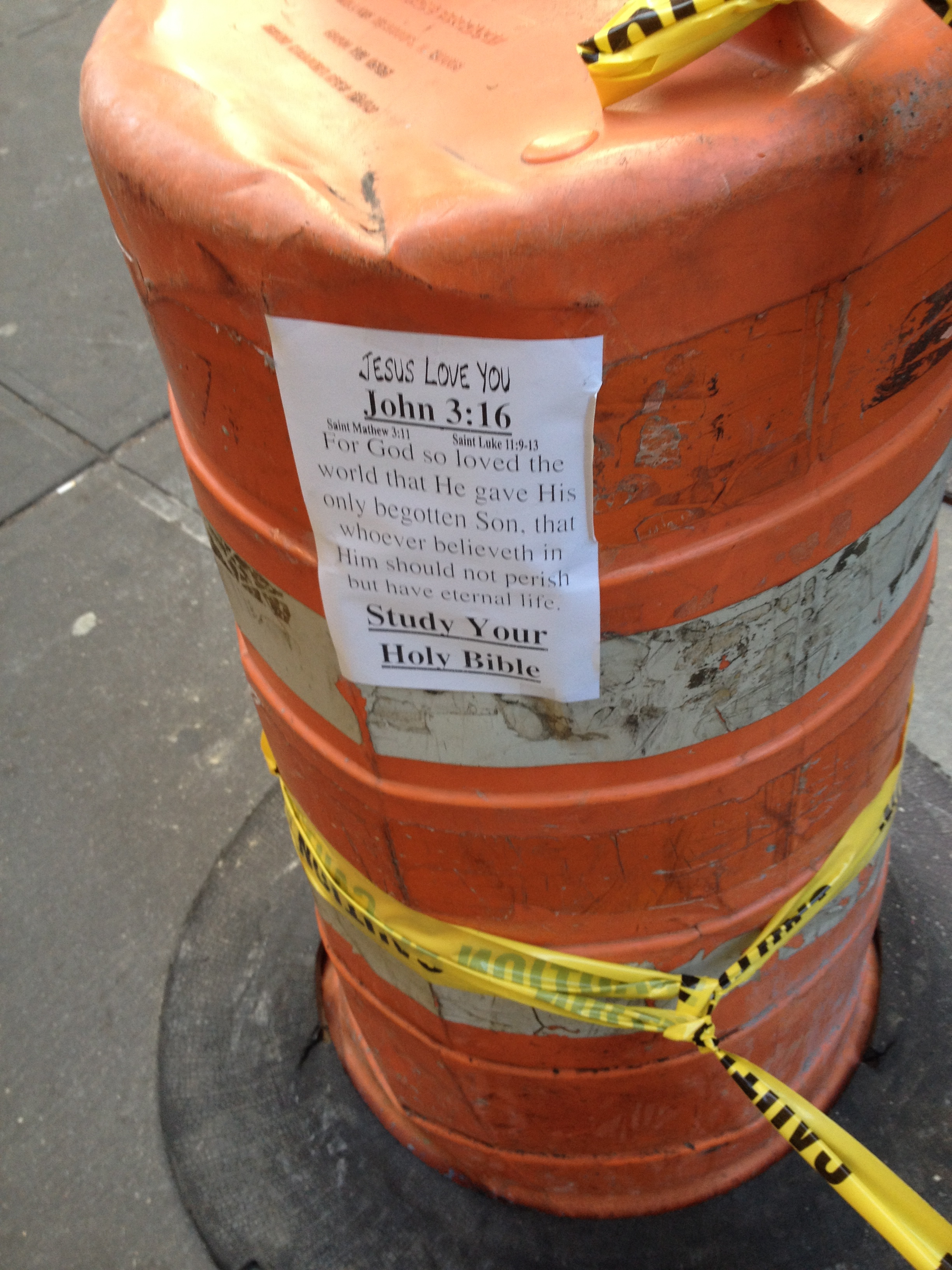
To mere mortal eyes, a traffic barrel on a Manhattan street might seem like a pretty gritty object, hardly worthy of religious veneration. Seeing leaflets advertising eternal life taped to these barrels might suggest a profound disconnect—what hath Heaven to do with traffic control?—unless one is familiar with the ardor of religious devotion. And besides, many construction sites in Midtown bear the infamous “Post No Bills” warning. When I spotted a few of these informal fliers over the past few days, however, I couldn’t help but think about religious conviction. As someone raised in an evangelical tradition, it is difficult to convey the fear in which I found myself living. Hell seemed like more of a constant threat than Heaven was ever a promise. And my young experience in a blue-collar setting had taught me that you seldom get what you hope for, no matter how hard you work for it. Somehow, no matter how good I tried to be, Hell seemed more likely than Heaven. And the Bible does suggest that if you don’t try to tell others, you’ll be held eternally responsible.

IMG_1024

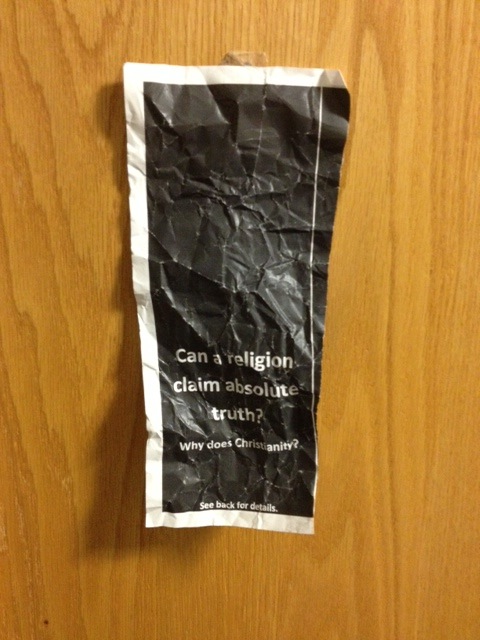
Religious conviction and fear are not far apart. I recently spoke with a Roman Catholic believer who suggested that the fear of God has been under-emphasized of late. I do suspect that it has been parodied quite a bit, but it is difficult to assess if it has truly gone underground. Perhaps among theologians it has. Like most people, I don’t read theology. For the average believer, however, fear probably plays some part in the equation that keeps her/him coming back week after week to hear the same message over and over. My daughter sent me a flier that has been appearing all over her college campus. It is a bit ambiguous, but from my own college days I recall that the young are especially vulnerable to religious coercion. Conviction is like that.

religiontruth

From my own college days I recall the earnest discussions about how far one should go to convert others. The underlying motive was always fear. Getting into Hell is so easy—we were born to it, according to some. If you just live you life as a good person, helping others and trying to improve the world, you’ll still end up there. Such is the power of eternal punishment. One of my friends, when he went to restaurants, would leave a religious tract instead of a tip for the working-class waitresses. “It’s far more valuable,” he explained, without a trace of irony. I wouldn’t be surprised to find one of those tracts taped to a dirty old traffic barrel these days. Sometimes the ardor with which we approach religion simply overlooks the more obvious implications.


Heat’s Up

800px-GISS_temperature_2000-09_lrg

I must admit being perplexed. Days ago, although many of us have long known it to be true, climate scientists announced unequivocal evidence that human activity is responsible for global warming. I have perhaps been naive in my supposition that the “full speed ahead and damn the torpedoes” approach of some fundamentalist groups that welcome anything that speeds along the apocalypse, has played a major role. Maybe it was because so many politicians openly sided with such groups that that I supposed the two concepts to be connected. I suspect, however, that it may be something much more insidious. How can any intelligent person refuse to admit the facts when the consequences are nothing shy of catastrophic? How can elected officials turn a blind eye to the desolation of their own planet? It must be more than simple ignorance. But what?

Those in my generation—however we are currently classed—have been declared to be those attempting to make up for the excesses of the “me generation.” I’m not sure who the “me generation” is, but I know when I see individuals who allow their personal gain to endanger everything that has come along since the Sumerians invented the wheel, I feel a little queasy. What could the Zeitgeist have been that infected so many minds with such a godlike sense of entitlement? We call the younger demographic the “entitlement generation,” but when I taught them in college, they were much more environmentally conscious than many elected officials. They at least could see beyond their own wallets. They take pride in recycling.

It would seem to me that even if (and it doesn’t) the Bible suggested that the world itself would end to bring about a better one, we assume too much divine prerogative when we proactively destroy the only ground upon which we stand. Has any religion ever been so truly shortsighted? And that’s asking quite a lot, if you think about it. Or is religious faith just an excuse to gather wealth at the expense of others? Does God want you to be rich? If so, it would seem, God would also want you to act responsibly. According to a report in The Guardian, there is no longer any question that the climate blame lies with us. Perhaps now that the smoking gun is on the table we will do the right thing. But then again, I admit to being perplexed. Maybe it’s just my generation. Or maybe I’m just hopelessly naive. I’m entitled.


Monsters are Due on Main Street

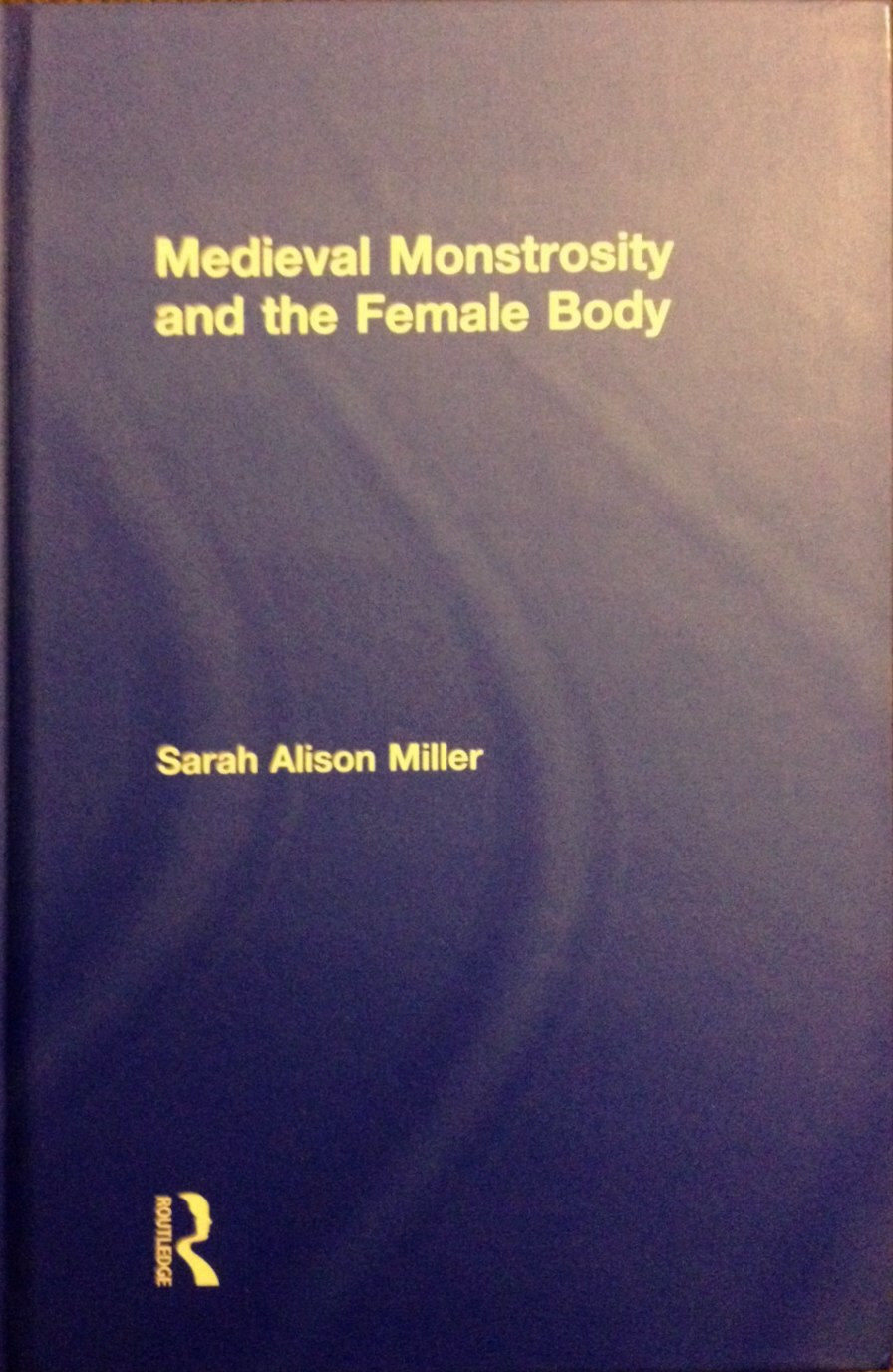
MedievalMonstrosityNow that the slow descent into darkness has begun, my mind naturally turns to monsters. In the early days of this blog I felt as though I had to justify writing about monsters when I was limiting myself (mostly) to religion, but it is now clear that many scholars have recognized the connection. Monsters cross over boundaries, and, given religions’ focus on proper borders, declaring monstrosity is often a sacred task. That comes through clearly in Sarah Alison Miller’s Medieval Monstrosity and the Female Body. Utilizing mainly three medieval texts, Miller draws out how they present various aspects of the female body as monstrous. Predictably, the source of their conviction is frequently the viewpoint of the church, the dominant institution of the Middle Ages. Biology was a touch more advanced than it had been in the biblical period, but despite the figures, many writers assumed the male to be the default model of humanity and the female somewhat suspect. Given the multiple pluralities of the natural world around them, this idea is passing strange.

This book is not for the squeamish. Miller plumbs the depths of bodily fluids and the beliefs surrounding them in a pre-scientific era. Male writers wondering at the changes the female body undergoes, however, may have been a necessary stage in the growth of knowledge. It is easy for us today to suppose that equality should have been always on their minds, but Scripture, a large source of authority for medieval mentality, had cast the sexes into an uneasy opposition. The only figure in the Bible who seems sensitive to the unfairness of it all is Jesus. And even his viewpoint couldn’t change the conservative conviction that somehow God was truly the über-male and that all the females of nature were somehow subordinate. Dare we say it? Monstrous.

Miller closes her brief consideration by delving into the writings of Julian of Norwich. Julian was a most remarkable mystic who wrote of God in strikingly feminine terms. Turning those boundary-violating bodies into the sacred, here was one medieval writer who saw the female as normative, salvific, even. Julian never commanded the kind of authority that a male cleric could, but as Miller shows, even men in this period were considering the feminine aspects of a wounded deity. Reformation, however, snapped a masculine, Protestant lid on any such speculation. Today, ironically, many Protestant traditions have, at first reluctantly, admitted female clergy. The religious body of the Middle Ages, the Roman Catholic church, still keeps women in a separate, somehow subordinate role. Monsters come in many forms and they break down boundaries. Some borders, however, may be meant to be breached.


What’s a Sukkot?

It’s not every day you see a lulav and etrog, even in Manhattan. You can tell life’s too busy when you miss that it’s sukkot. Not that I’m Jewish, but I have been invited to sukkot a time or two by a friend, and it was always a fun, relaxed occasion. A festive little booth in the back yard, sweet wine and cookies. Running the rat race in New York City it is sometimes easy to forget. On my hurried footrace to some place or another, I noticed a group of Orthodox Jews standing along East 42nd Street with lulav and etrogs in hand. So distracted was I that I only vaguely wondered, “why are they holding those at this time of year?” Several blocks later, entering the Port Authority Bus Terminal I saw a man just standing as the crowds parted around him like the Red Sea. In his hands lulav and etrog. Finally it dawned on me: sukkot. It is fall, the time of year when I used to be able to enjoy the bounty of nature and the good-natured holidays. A time before when.

800px-EtrogC

The Hebrew Bible prescribes a set of three pilgrimage holidays: sukkot, shavuot (pentecost to the Greek, or Christian), and passover. Of the three, all associated with the exodus from Egypt in some traditional way, sukkot is the most lighthearted. The command to live in booths is said to be a reminder of the dwelling in tents during the wilderness wandering. Anthropologically speaking, it probably goes back to an ancient tradition of living in huts during the harvest when you don’t always have time to go home and tuck yourself comfortably in every night. Combines hadn’t been invented, and harvesters had to work long hours to ensure that the crop was gathered in. Eventually it became a celebratory occasion. Nice of Moses to allow a bit of festivity here.

Back while at a certain seminary in Wisconsin, a local Jewish friend used to invite my Hebrew Bible class to sukkot. Numbers were small, and invariably wary—were they going to be proselytized by the other? No, but they were invited to shake the lulav and etrog, sip a little wine, and chat about Leonard Cohen. A bit of a cultural exchange in the midst of prolonged indoctrination. I often wonder if my friend continued the tradition after I was asked to leave. The Christian school never made any reciprocal invitations, of course. Ecumenism is often a one-way street. So I stopped a moment at smiled at the stranger in the bus station, solemnly holding lulav and etrog aloft. Life is a bit too busy when we can’t even take a moment to consider all the things we take for granted every day.


No Singing Matter

Canticle for LeibowitzA Canticle for Leibowitz, by Walter M. Miller, Jr., is one of those books that I read years ago, and when I picked it up again found that I remembered very little of it. I suppose this is one of the hazards of extensive reading—some important things get lost in the noise. I recall having read A Canticle for Leibowitz when I was a grad student at Boston University, and I remembered the detail of a grocery list being taken for holy writ in a post-apocalyptic world where, in a strange reincarnation, monks have once again become the guardians of knowledge. Little else remained. Perhaps part of the reason is that the book requires more experience with the church than I had in those days. One might suppose a seminarian would have about as much ecclesiastical experience as one might need. Not so. It did teach me, however, to read provocative books.

Like most dystopias, there is a deep bleakness to A Canticle for Leibowitz. In the light of recent developments in the papacy, the book is remarkably prescient. In the final pages of the final section, a radiation-sick woman and her young child, in constant pain, seek the government sponsored euthanasia camp. Abbot Zerchi, however, condemns this as a sin against God. Doctrine takes the place of compassion, and only moments later the final atomic strikes wipe the abbot and his monks off the earth forever. Yet there are monks on a spaceship, ensuring that any future planets will have the same uncompromising doctrine planted there as well. For a book published in 1959, it sounded incredibly contemporary. Miller’s anger still echoes throughout. The church builds societies that destroy themselves. A cycle of futility.

I wonder what the result would be if more people read such stories. It is, of course, easy enough to shut out any implications we don’t like and claim it is all a silly piece of fiction. The problem is that Miller is not too far off base. Our civilization does own much to its religious institutions. Those institutions sometimes have considerable trouble relinquishing control when society finds its grounding in science and technology. It is difficult to believe divine proclamations from above in the age of the space telescope. Yet, even so, we still elect to power politicians who look back millennia for the instructions on how to treat those of other genders or races. To do so, as Miller recognized, is to begin building bombs all over again. And even old Ecclesiastes declared that there is, in a Leibowitzian twist, nothing new under the sun.


Com-Passion

I suppose it is always premature to hope that ancient institutions are likely to improve. Like many other followers of developments in religion, I was pleasantly amazed to read reports of Pope Francis declaring that, in my vernacular, that the church should not be so stuck in the rut of doctrinal abstemiousness that it forget mercy and charity. How sad to see that hours later he was forced, Galileo-like, to recant somewhat. The forces at work are far more powerful than the vicar of Christ. In some minds religion is doctrine. I know whereof I speak. For several years of my professional life I worked for a doctrinaire institution where any hint of mercy was considered a kind of Protestant mewling before a God who would’ve made even Jonathan Edwards tremble. Although officially released “without cause,” I can’t help but think that my own pastoral sensitivities were at fault. I don’t believe that religions thriving on condemnation deserve the title.

Ironically, I was at Notre Dame University when headlines about the Pope’s declaration that the church should not obsess about homosexuality and abortion appeared in the papers. It was with a kind of wonder that I heard an academic say, “the Pope is sounding more Lutheran all the time.” I’m not naive enough to suppose that the pontiff is suggesting a change in doctrine—there are rocks so heavy that the Almighty himself can’t lift them—but that the leader of the world’s largest church was suggesting mercy and compassion outweigh legality felt as if Amos or Micah had just walked into the Vatican. The next day the Pope had to come out and strongly condemn abortion. Politics, it seems, will always trump human understanding.

IMG_0996

We live in an era of iron-willed religions. The human element often vanishes beneath a frowning providence that wishes for clocks to be turned back decades, if not centuries. These religions have no place for improving the human lot in this sinful world—it is much easier to condemn than to contemplate compassion. Religion is hard, for people find forgiveness a difficult doctrine to accept. Jonathan Edwards dangled his spider over the eternal fires of hell, but ecclesiastics today suggest that swift shears taken to that silken web would solve all the problems. Time for change? Not in this century. Religions, too, evolve. But evolution doesn’t equal improvement. Many an agnostic has become so because of the reality of “nature red in tooth and claw.”


Our Lady of Culture

So I’m in the land where sport and religion become one.  Notre Dame is an intimidating university for a small Protestant like myself.  Like on a first date, I’m never sure what to do with my hands.  Standing below the famous “touchdown Jesus,” more properly, the “Word of Life,” I feel small indeed.  For a long while in US history, Catholicism was treated like some kind of cult.  Those of us reared Protestant were taught to fear “them” and their ritualistic ways.  I’m more afraid that someone might ask me about football stats.  Sports is a religion I’ve never studied.

IMG_0997

Culture is like a colossal Cuisinart.  Lots of stuff goes in, all of it more or less equal, and the blades begin to whirl.  Sports, religion, fast food, alcohol, a dash of education, and we’ve got an American classic.  The only time that sports come to my mind is when they start to take on the flavor of religion.  The level of the devotion of fans is the envy of many a church.  In fact, the word “fan” was borrowed from the lexicon of religious behaviors.  It is not difficult to sense the pride in football here, but then, sports are often a civilized way to assert one’s self-worth in a culture where self-worth feels under threat.  It is hard to recall a time when the Fighting Irish were not mainstream.

“High culture” has put itself on the endangered species list by becoming inaccessible in a culture that doesn’t value education (not to reflect on the academics I’ve seen at Notre Dame, which are pretty impressive).  I cringe, however, when I see polished politicians basking in their lack of introspection on issues that impact the entire human race.  They seem proud to declare themselves untainted by education.  They will support sports, however, and particularly football where violence is padded, but still encouraged.  It is culture for those who enjoy the lowest common denominator.  In the airport I noticed another “touchdown” character who, in some quarters in more recognized than the deity soaring over Notre Dame’s venerable stadium.  I was in the true presence of culture even before I boarded the plane.

IMG_0977


Grace, Virtually

Although Yom Kippur is now over, I have a confession to make. My wife just showed me eScapegoat, the website where you can confess your sins over the virtual priest laying electronic hands on a disturbingly cute animated goat. Even before I owned a computer (or one owned me), and even before I knew of the internet, I used to joke with friends what the technological revolution would mean for religions. Would we eventually go to an ATM for virtual communion? Would the screen glow with the words of the eucharistic liturgy, Rite 1, or would it be more contemporary (Jesus raised the glass and said, “This blood’s for you!”)? Would a physical wafer come through the slot? If so, would it have to have been pre-consecrated? So our bemused musings ran. But our idle thoughts held a touch of prophetic insight, it seems. Can the force of religion come through the keys upon which your fingers rest? The monitor that glows like heaven itself? Whence electronic salvation?

There can be no doubt that religion is a huge topic on the internet. I generally don’t go looking for it, because it will come to me. Religions, by their very nature, spread. They are aggressive memes, wanting desperately to replicate themselves. Our frail human minds want so much to believe that we have found the truth, and once we have, we want to share it with others. Bibles were among the first books off the first printing press. Television soon evolved televangelists. The internet became the home of virtual religion. For some it is reality, nothing virtual about it. Concepts such as grace, however, defy any kind of clear exposé, there’s always shadows in this room. Can it make its way, preveniently, through the wires and waves of the internet?

eScapegoat is lighthearted, but I can’t help but wonder if there isn’t a more serious side to it. Confession on the internet can be cheap. Anonymity (excepting, of course, the NSA) is easily maintained. Your confession, visible to the faith community, is really between you and the Almighty, right? The book of James tells us confession is good for the soul, or something similar. We all know that admitting a mistake has its own cathartic release, but I found confession, in my Anglo-Catholic days, terribly invasive. Surely I knew that I’d made errors, and I knew that I felt badly about them. Did I really have to tell someone else so that I would feel bad about them all over again, reopening wounds that had already begun to heal? Isn’t this the beauty of eScapegoat? You can make a serious confession that others will see anonymously as a joke. Our poor, blinking goat will pay the ultimate price.

800px-William_Holman_Hunt_-_The_Scapegoat


True Possession

Jheronimus_Bosch_050_detail_01

Demons are among the earliest of supernatural creatures. Although sources can be spotty, they appear in the first advanced civilization known, that of the Sumerians. Even with their technology and scientific sense, early people still knew that demons had great explanatory value. Why did things sometimes utterly fall part? Why did some people act so weird? Why did the good will of the gods not always shine through? Demons, while not exactly tricksters, are the demoted gods who cause problems. They also harbor possibilities too, if an article sent by a helpful relative is anything to go by. According to the BBC, a trio of styled and battle-trained young exorcists are about to take to the airwaves to ply their trade in a show called Teen Exorcists. Savannah and Tess Scherkenback join preacher’s daughter Brynne Larson as a trio of demon-dropping debutants ready to take on the powers of Hell. All three, according to the article, are home-schooled.

I’m not quite sure what to make of demons. Aware of more rational explanations of human psychoses and inevitable misfortune, there doesn’t seem to be much room for second-rate deities in the world any more. Still, writers like Matt Baglio and Malachi Martin narrate enough strangeness to make you wonder if we might’ve been a little too hasty in dismissing the supernatural. Especially after staying up late to watch The Exorcist. And it’s not just that it’s three young girls casting demons into the pit—according to Acts Philip’s daughters were prophets and Mark says people who didn’t even know Jesus were pretty handy with the rite. It’s the whole issue of demons. According to the BBC, the girls believe England is especially afflicted because of the Harry Potter novels. (The spells, they say, are real.)

The team of three and Rev. Larson do, unlike Ghost Hunters, charge for their services. And even a duck hunter on television can strike it rich. Simon, later known as Simon Magus, offered the apostles money to gain the power of the Holy Spirit, according to Acts 8. Rebuffed, Simon turned against the fledgling Christians. If there were reality shows back then, I suspect he’d have had one. The three girls are black belts in karate, adding to the television appeal, but demons, we’re told, are incorporeal. That’s right—they have to be fought without physical violence. Armed with Bibles and crosses (no crucifixes, since this is a Protestant exorcise) three young girls take on the dark side of the spiritual world. The chief of the demons, however, is named Mammon. Against that one there seems to be no defense.


No Cult

MakingAmericanReligiousFringeThe image of hundreds of lifeless bodies in the jungles of Guyana foregrounded by a metal tub of poisoned Flavor Aid is a difficult one to forget. If it were not for the media, however, most of us never would have heard of Jonestown. The term “cult” was applied to Jim Jones and the People’s Temple, just as the word was increasingly becoming a pejorative term for those with “other” beliefs. Sean McCloud’s Making the American Religious Fringe: Exotics, Subversives, and Journalists, 1955—1993, is a probing study into what makes a religion “mainstream,” versus a “cult.” (I know, too many “scare quotes.”) McCloud considers the role that journalists, as reporting in major news magazines, have had on determining American views of what is normative religion. If, that is, normative religion can be posited at all. It is quite clear, upon reflection, that any religion has some odd beliefs: you can’t wear this or eat that, you have to be at this place on this day, you must shave your head, etc., etc. The question McCloud explores is why some end up being called cults and others do not.

Scholars of religion have abandoned the term cult, for the most part, because of its arbitrariness. The defining markers of “cults” are unclear, and one religion influences another so that a continuum forms from Moses to Moonies. That’s not to say religions are all the same, but it is to say they are not so different either. The declaration of a religion as a cult, if based on belief systems, is tenuous. All religions make claims impossible to verify. Some, very traditional, are also very small in membership. Religions have been fabricated from antiquity to present, and even as I write this new religions are likely being conceived somewhere. McCloud points out that the popular media gave us the distinction between “mainstream” and “cult.” That distinction itself may be more telling than the differences between various groups of believers. It is the language of exclusion—true religions versus false religions. And any more than one religion, if considered seriously, is problematic.

Religions, old and new, large and small, make truth claims. These claims cannot be tested this side of eternity, so they must be taken by faith. The minds of many will be turned toward extreme actions motivated by idiosyncratic understandings of religion today. McCloud shows us that fringe is an integral part of the fabric—religion is woven from the experience of people through the millennia of our existence. And yet we still have no consensus. We have enough experience, however, to know that when one religion unravels another will be woven from the dangling threads. Some will be misguided, although all will claim to have the truth. Until that ultimate truth is definitively known, the best policy seems to be avoiding the temptation to call those of a different faith a “cult,” when “religion” does just as nicely.


Down the Garden Trail

According to NBC, a new “Christian” alternative to Boy Scouts USA is being launched in (over)reaction to the vote to allow gay teens to “join” the organization. Calling themselves “Trail Life USA,” this redeemed-only organization is supposed to be “safer” than other scouting options. This issue, of course, is all about perception. There have been gay Boy Scouts from the beginning and there will be gay Trail Life members. People are people, and just by saying that a sexual orientation is excluded does not mean that it will be, or ever can be (nor should be). “This is not another church program,” John Stemberger, one of the founders, is quoted as saying. “This is going to be a masculine outdoor program to raise young men.” The subtext is sluggish with irony. I am reminded of the scene in Disney’s Mulan where Yao, Ling, and Chien-Po are about to climb the pillars to the emperor’s palace in drag and the song “Be a man,” starts its reprise. Masculine outdoor program indeed.

Photo by Bruce Anderson, Wikipedia Commons

Photo by Bruce Anderson, Wikipedia Commons

The idea of separating youth from the realities of the world to keep them safe is like taking them into the woods without telling them there may be bears. Those of us who’ve spent nights in the woods know that hating bears is a ridiculous posture to take. Bears, even when gnawing on your arm, don’t hate you. They simply exist. It is the balance of nature. Studies of nature have time and again revealed that homosexuality is far from unnatural. Several species practice various homosexual behaviors and I am certain that the more we observe nature the more we will find ourselves mirrored in it. Nature can be quite encompassing in that way.

Christianity also has a long history of being at a kind of equilibrium with homosexuality. The all-male priesthood of the Middle Ages could hardly be classified as all self-denying heterosexuals. Even some televangelists of the most Protestant stripe have confessed to gay encounters and episodes. New uniforms and solemn promises will not change the way a person is born. Of course, if the child is Jewish or Hindu or Muslim, he will need to abide by a statement of Christian belief. What of Mormons or Seventh Day Adventists? Thankfully lines drawn in the sand are easily washed away. Exclusion may have been the trope of the Christian past, but as Boy Scouts boldly go where every man should’ve gone before, Trail Life, it seems, may have been appropriately named. It’s life John, but not as we know it.


Divine Sex Change

One of the greatest problems in reconstructing ancient religions is the ambiguity of the evidence.  Most ancient artifacts are not labeled (they probably didn’t need to be for the original viewers) and few have textual materials explaining them.  This became clear to me when studying the famed inscription found at Kuntillet Ajrud in the mid-1970s.  The most (in)famous aspect of this artifact was that an inscription overlapped a doodle, and due to the urgent desire to interpret the inscription a particular way, the line drawing was supposed to be an illustration of the inscription.  The inscription is commonly translated as something along the lines of “I bless you by Yahweh of Teman and his asherah.”  Many scholars took asherah to mean Asherah, the goddess, despite no evidence for pronominal suffixes on personal names in classical Hebrew.  The doodle shows three figures, perhaps related, of which two were said to be Yahweh and Asherah.  Despite the very clear resemblance to the Egyptian dwarf-god Bes (Kuntillet Ajrud is between Israel and Egypt), it was argued that the figures in the “foreground” should be considered Yahweh and his main squeeze, Asherah.

KuntilletAjrud

The artistic analysis of these doodles has always been torturous. Tiny, perhaps insignificant, details were ascribed great importance—particularly those indicating the gender of the figures.  For the Yahweh-Asherah connection to work, one had to be male and the other female (with the male preferably in front).  The problem was that both figures seemed to have penises (in keeping with Bes’s typical representation).  In order to make it clear that the right-hand figure was female it was claimed that she was wearing a lion skin and the “penis” was literally a tail, the leopard’s tail, seen between “her” legs. The problem seemed to be a possible scrotum appeared to be present.  The left-hand figure, larger (therefore, in front) had a clear scrotum, and that sealed the case, in a manner of speaking.  Little chestal circles were said to be breasts on the right-hand figure, but male nipples on the left-hand figure were lacking.  Oh, and they were dancing, as shown by the woman playing the harp in the “background.”  Believe it or not, seriously scholarly debate raged over this—nothing short of the discovery of Yahweh’s wife seemed to be at stake!  A colleague recently emailed me to tell me the final report of the archaeologists concludes that the “scrotum” on the right-hand figure was a mere dust smudge and so, aha!, she is a female after all!


I argued years ago that this drawing was clearly a representation of Bes. The connection with the inscription is accidental (the jug on which the inscription occurs is full of doodles); if someone wanted to illustrate an inscription, they would not draw figures that actually obliterate part of the caption. Assumption is built on assumption here, however, making for a very shaky foundation indeed. Don’t get me wrong: I would like to see Yahweh as happily married as the next deity. It is not good for the god to be alone. Still, it is going to take more than a divine sex-change operation to transform Bes into Asherah. If nothing else this divine gender-bender ought to serve as a cautionary tale for scholars, yet somehow I doubt that it will. We see what we want to see.