The Spice of Religion

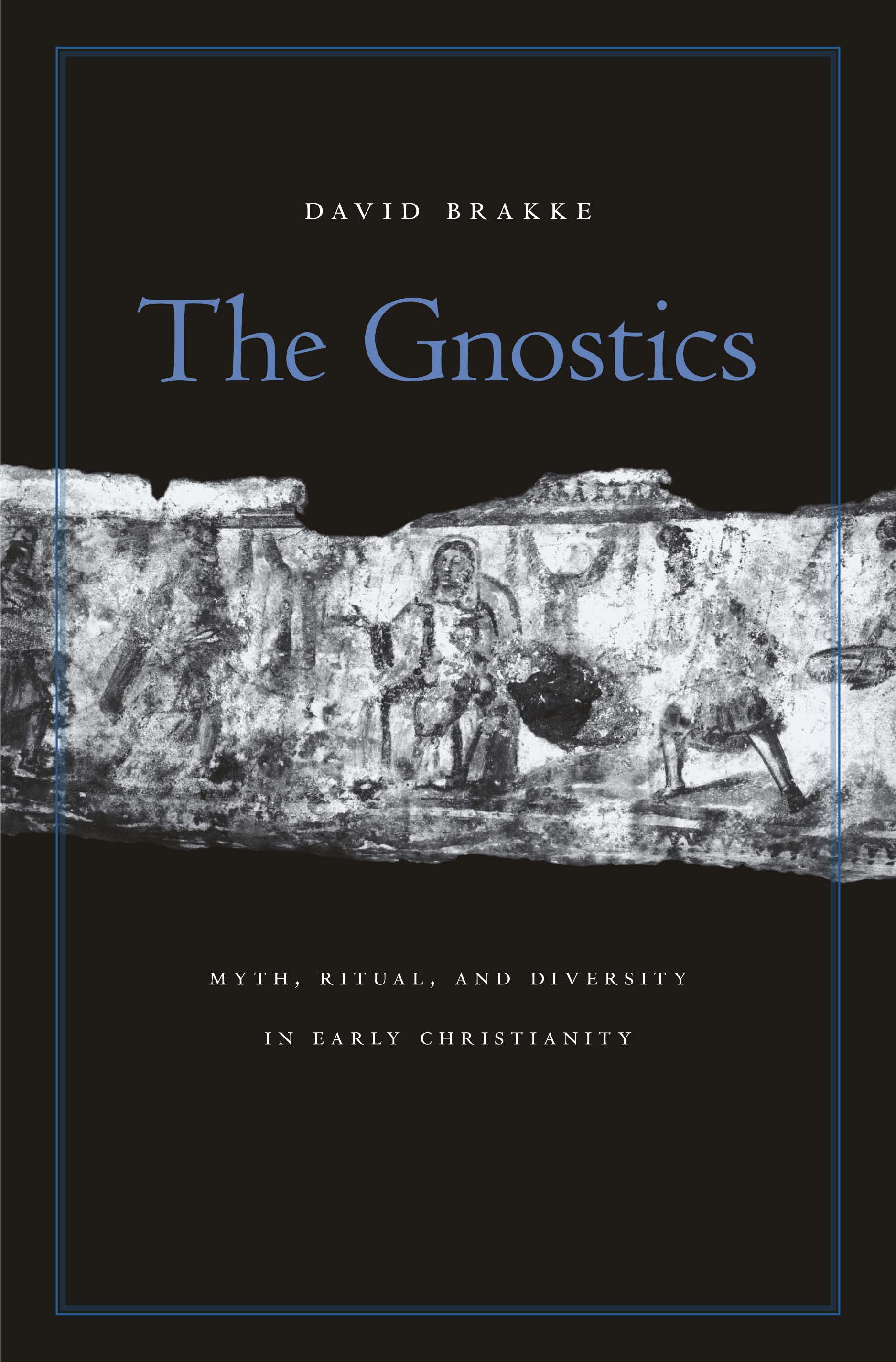
BrakkeGnosticsI haven’t really forgotten about the Bible. It has been such an integral part of my life that I couldn’t escape it if I tried. Going into religious studies, however, I feared New Testament studies. You see, having gotten a taste of historical criticism with good old J, E, P, and D, I was afraid what might happen if I looked Q a little too closely in the face. We now know, however, that the New Testament was just as redacted as the “Old,” and that there wasn’t a single variety of Christianity, even in the first century. I just finished David Brakke’s The Gnostics: Myth, Ritual and Diversity in Early Christianity. Brakke admits right up front that some will see him as not being radical enough, but since middle-of-the-road is a comfortable place to be, I found his introduction in the realm of the little bear, just right. The old story, perhaps originating with Irenaeus of Lyon, is that Christianity began as a monolithic faith and then came along these spoil-sports like the Gnostics and soon nobody could keep the truth straight any more. This is, of course, an over-simplification.

Religions are constantly shifting. As Brakke points out, there was no definitive Christianity when Christianity was still Jewish. Paul never calls himself a Christian, and he was, by his own declaration, Jewish. His interpretation of Jesus varies greatly from that of the eponymous John, of Gospel and Epistle fame. No, there never was a single Christianity. Probably from the very beginning there were Gnostics too. And, again with Brakke, they would have supposed they were following what was to become Christianity as well. Same world, different worldviews. They were not sinister and plotting, any more than other varieties of Christians were sinister and plotting. They were trying to live out lives in accordance with what they thought life was all about.

It has become clear over the last several decades that Christianity never really did unify into a single belief system. Constantine certainly gave it his best shot, but Christianity had spread beyond the bounds of the Roman Empire already, and heterodoxy was rife. No account of Late Antiquity can be honest without noting all the fighting going on among true believers about who was a, well, true believer. Really. Tensions existed early between eastern and western brands of Christianity and schisms became as common as missals. Nobody was really able to put Christianity back together again. In fact, this Humpty Dumpty never was an uncracked egg. I’m afraid I’m taking liberties with Brakke here, but the basic truth remains. Christianity came in its own 57 varieties, most of which didn’t blend very well. The Gnostics come out looking pretty good. That is especially the case when the proto-orthodox start gathering stones. In such a case, it is perhaps time to read the Gnostic scriptures to get a little perspective.


Fearful Christianity

So some North Carolina Republicans want to declare themselves a state religion. I wonder which one it will be? Hmmm, let me think… Whatever that religion will be it will be one that is afraid. Only religions that are uncomfortable with challenges have to back themselves with militaristic force. Seems to me some North Carolina politicians have never read a book on Medieval history. Ironically, the religion they wish to select was probably itself the result of the Reformation, the original challenge to state religion in the history of Christianity. It is also clear that these misguided lawmakers have not fully acquainted themselves with the vast diversity of forms of Christianity. The Christianity they want is televangelist, conservative, Protestant Christianity. Even that, however, is no longer a uniform religion. Why would there be more than one channel?

Those who spend long hours gazing at religion, both from inside and outside, realize that religious belief is not, cannot be, a static entity. Should a genuine apostle walk into an evangelistic Christian service today, chances are great that said apostle would leave wondering what religion this was. According to the Bible itself (ironically, taken only partially seriously by those who promote it) the first Christians were communists. Those who refused to sell everything and give it to the common good were struck dead, or so the book of Acts tells us. My guess is that free market economics has trumped the Holy Spirit here. What legislators really, really want is a religion to back up their secular plans.

Which Christianity would they choose? Who would be welcome in New North Carolina? Mormons? Mennonites? Methodists? Catholics? Well, at least Catholics vote the right way on key issues. Or some of them do. What we are talking about is actual state support of religious ideology. In a country where some of the finest state universities do not even have departments of religious studies, the University of North Carolina, Chapel Hill, has one of the finest in the country. And not all the faculty fill North Carolina’s preferred demographic.

IMG_0019

Religions do not take such rear-guard actions unless they are afraid. What does Christianity fear? It depends on which Christianity you mean. Studies have shown that over 41,000 Christian denominations exist. Think about that a minute. If one flavor-of-the-month Christianity becomes official state religion, what becomes of the other 40,999? I’m no math whiz, but it just doesn’t add up. Seems to me that before states start declaring their religions publicly funded, legislators should go back to school. They should be required to take Religion 101. Might I suggest they enroll at UNC Chapel Hill?


Buy Their Fruits

A lot of things get thrust at you in Midtown Manhattan. Many of them are religious. As I was out on my lunch break, a Buddhist monk walked up to me on Second Avenue. He thrust out a pretty token that looked like those skinny cards that used to come in with Sugar Daddies. I get a lot of things held out at me, and since I can imagine how dispiriting it must be to have people ignore you all day long, I have taught myself to take their chit as a matter of reflex. The monk looked pleased. We were outside 815, the headquarters of the Episcopal Church in the United States. I reached out my hand and he said “Buddha peace.” That was nicer than most of what I’d heard from the people who worked inside the church to which I’d dedicated years of my life. Without a beat my Buddhist friend continued, “temple donation.” I had to wave him off with a smile. Religions, no matter how placid, are out to earn a buck.

In the neighborhood of my office lurks a psychic named Sharon. I wouldn’t know Sharon if I ran into her, but I suppose the reverse wouldn’t be true. Actually, I have no way of knowing if she’s really psychic or not. She has guys. These guys hang out on the four corners of my block and hand out fliers for Sharon’s psychic readings. The guys with the leaflets aren’t psychic, I take it, because a walk around the block, on which I recognize each and every one of them, always lands me back in the office with a pocket full of psi. I see that Sharon is a third generation psychic and that she is adept at foreseeing negative energy. I would advise her not to walk past 815. If I bring in my slips of paper I get five dollars off a reading. I don’t know how much Sharon charges, but I do know that I don’t need anyone to foresee negativity in my life. I’ve got a hard enough time dealing with it when I don’t see it. And I save five bucks each time.

I sometimes wonder, as I walk past 815 Second Avenue, if anyone in there knows how badly one of their faithful was hurt by priests and bishops who had the blessing of the church. No one from the central office ever consoled or tried to comfort a person whose career had just been lifted off the rails and flung off the cliff by the machinations of some of their own. Even now those who go in and out the doors as I stand there have no idea what was done to a lonely guy on the street. In the name of the church. I think of the hollow sound of coin ringing in the coffers. I think of Judas trying to return his thirty pieces of silver. I think of money lenders’ tables being overturned. I think of Buddha peace. One hand holds out a medallion for me. The other is palm up, waiting for a return on the sacred investment.

you shall know them

you shall know them


Palming the Truth

For some today is Palm Sunday. For others it is not. And I’m not referring to those outside the Christian camp. For many Eastern Orthodox Christians, Lent is just beginning as others prepare to celebrate Easter. Such divisions in the priesthood of all believers. The message was brought home to me when a friend emailed me an article from Archon News headlined “For the first time since the Great Schism, Ecumenical Patriarch to attend Pope’s inaugural mass.” For those of you outside the thrill-a-millennium Catholic-Orthodox drama, it might help to know that about the middle of the eleventh century, Christianity experienced its first major schism. The issues were insignificant to all but those who had far too much time on their hands, but the list of grievances grew and festered for centuries until a clean-shaven Pope and heavily bearded Patriarch stopped inviting each other to one another’s parties. It seems that Pope Francis may be seeing the beginning of the end of that particular tiff.

Christianity is one of the most fragmented faiths in the world. Tens of thousands, yea, myriads of denominations exist. And if some of them got together and compared notes, I suspect they’d be shocked to learn that they are just the same as some of the others. Religious belief is deeply personal and highly individualistic. Belonging to a religious body is more a matter of commitment than it is a full agreement on every point—rather like a marriage, I suppose. The funny thing is people join religions that they like, suspecting that these copacetic beliefs will somehow save them from Hell. You can literally write your own ticket to Heaven, based on this system. No religion is right because all religions are right. And we wonder why people are eager to kill one another over matters of belief.

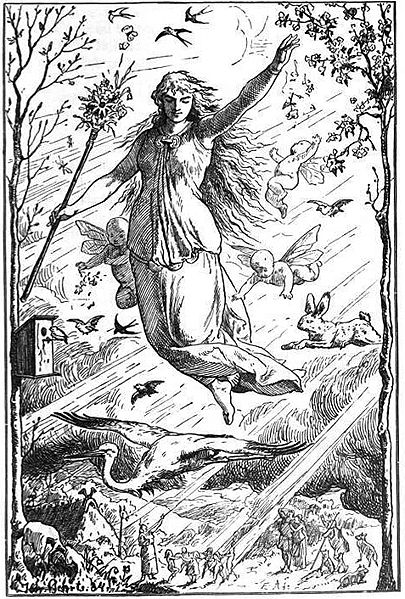
So, is it Palm Sunday or not? It depends entirely on your point of view. Roman Catholicism, followed by many Protestant groups, considers the first Sunday after the first full moon after the Vernal Equinox to be Easter. Never mind that all this equinox stuff smacks of its Pagan forebears—even Easter is named after the Germanic goddess Ostara. I can’t pretend to know how various Orthodox groups calculate their Easter, but the fact is that both dates can’t be right. Unless, of course, one of them is really a celebration of Ostara. Or maybe both are. And if it comes to a matter of debate, it will mean the birth of even more denominations.

Ostara laughs to see such sport

Ostara laughs to see such sport


Free Think Ing

It is not exactly pride that I feel when I see my undergraduate college featured in a Chronicle article entitled “Group Aims to Help Conservative Parents Counter ‘PC Indoctrination’ at Colleges.” I almost feared to scroll down the page. Yes, good old Grove City College has to thrust its manly credentials into the face of reason once again. The problem is that what such conservative groups decry as “indoctrination” is, in reality, critical thinking. It took me a long time to learn this distinction. I grew up in a conservative family, but I didn’t choose Grove City because of its flaming commitment to sixteenth-century values. I chose Grove City because it was a selective, intellectually honest school close to home. Being a first generation college student, I had no family tradition on which to draw. Guidance counselors didn’t know what to do with a religious kid who seemed to have some smarts. Other colleges seemed so far away. I didn’t even know what I wanted to study. You see, being raised in humble circumstances you learn to react to the many unpleasantries that life throws at you and there really isn’t time to plan out a future. It never works out that way in any case. I felt driven, but I didn’t know where I was going. Some day I hope to find out.

In the meanwhile, Grove City College has grown even more reactionary than when I was there in the 1980s. The Chronicle article states that “Conservatives have long complained about a perceived liberal bias in higher education,” and that Jim Van Eerden, an “entrepreneur in residence,” (shudder!) at Grove City has started the ironically named “FreeThinkU” to counter the liberalities students receive in school. Talk about your mixed messages! I wonder if Van Eerden has ever considered that Free Thinking has a long association with the very progress he abhors. Free thinkers gave us the gifts of evolution, rational thought, and for a while anyway, free love. Free thought gave us Kate Chopin, J. D. Salinger, and Margaret Atwood. They literally gave us the moon and have landed our probes on Mars. Somewhere lost in space a metal plaque is spinning in infinity with a naked couple and directions to planet Earth. I think the mis-named FreeThinkU might be better rechristened as Don’tUThink.

Higher education has a long, long history with religious thinking. Early universities were often outgrowths of theological colleges. Over the centuries, as our thinking matured, the ways of the past were recognized for what they were—outdated, short-sighted, unchanging for the sake of being unchanging. The reality that meets our eyes through the lenses of logic sometimes claims beehive hairdos and horn-rimmed glasses and greased back business haircuts as its victims. The earth is warming up. We did share a common ancestor with the apes. Our universe is even larger than we ever thought. And yet “FreeThinkU” suggests that we need to set the clock back a little. Maybe just a couple of centuries, but enough to hold our kids in the twilight of misperception. Progress has to be more than raping the earth and getting rich. Free thinking has to be a willingness to use the minds we have. I wonder what the aliens will say when they land here, our Pioneer 10 plaque in hand. If they land in Grove City, I suspect, they might feel they were sold a false bill of goods.

From the alumni mag; think about it...

From the alumni mag; think about it…


HRH vs C of E

An article from the Sunday Daily Mail, the UK newspaper, opens with the headline “Queen fights for gay rights.” I was pleased, as most even-minded individuals would be, that discrimination is being addressed by Her Royal Highness. Then the implications began to kick in. Having domiciled many years among the Episcopalians, I couldn’t help but smile knowing that the monarch is the head of the Church of England. Figurehead maybe, but on the books, the buck stops in Buckingham, not Lambeth. For decades I’ve seen the Anglican communion fracturing over what is a non-starter, theologically speaking. The only reason to protest homosexuality is the loss of potential life. For anyone who believes that sex is for procreation only, I would advise trying to counsel all the spermatozoa who just didn’t make it to the egg in time. Procreation is filled with an extravagant exuberance of over-production. Walk under any oak tree or stand among the wondrous helicopters of a maple tree in early summer and ponder what’s falling at your feet.

It seems to me that what’s lacking in the religious world is love. Loving, committed couples are ostracized for being just what God made them, while self-righteous critics wag their parsimonious fingers. And this is done in the name of God. I have friends of all gender orientations, and never have they given me cause for moral concern. In fact, I have trouble categorizing them together as a group; they are individuals to me, not pigeonholes. Some churches have trouble because prejudice has become dogma. Even the Roman Catholic Church allows for sex between couples when conception is virtually impossible, as when a woman is pregnant yet doesn’t yet know it. Just try not to enjoy it too much. The life potential ends the same way. Millions must lose for every winner. Consider the ethical implications of a deity who didn’t design a one-shot, sure-fire sperm for each act. Surely it would’ve been possible to engineer for an omnipotent divinity.

Instead many mainstream churches are assiduously drawing lines in the sand, claiming that one gender, one orientation, one race, only is welcome on the side of the 144,000. The rest can, quite literally, go to Hell. Is this what religion has become? Imagine what good might be done if all that energy were poured into addressing poverty, starvation, or inadequate water supplies. Imagine those who represent the winners in the reproductive race receiving care and attention rather than those who will, by a massive margin, stand no chance of survival whatsoever. We could make this a better world instead of prolonging the suffering of those who’ve done no wrong. Those holding the balls are trying to make up the rules of the game. The Queen of the Realm seems to be saying it’s time to start playing fair. Long live the Queen!

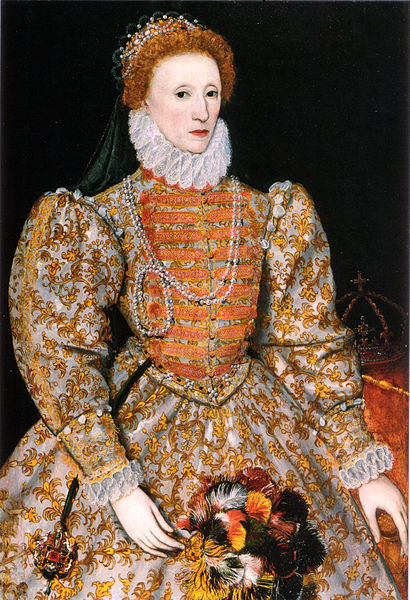
The first queen of the Church (of England)

The first queen of the Church (of England)


Religion and Its Discontents

IMG_0575

Travel broadens the mind. I’ve always felt that travel, for those who pay attention when they do it, is one of the best forms of education available. When I do campus visits for work, my time is spent talking to faculty, but on my walks between appointments I keep an eye out for my own education. This past week at the University of Texas in Austin, I couldn’t help but notice how much religion still plays into the lives of many people—even undergraduates. One of the first things I noticed as I approached campus was the sign outside a Methodist Church announcing a sermon series entitled “When Christians Disagree.” Anyone with experience within, let alone between, denominations knows that disagreement is endemic. It would be difficult to find a single point of Christian teaching that is universally held among Christians without at least one group of dissenters. In my own experience, disagreements run deeply within Christian denominations, and the hatred experienced is often more fierce than that between Christians and “heathens.”

IMG_0574

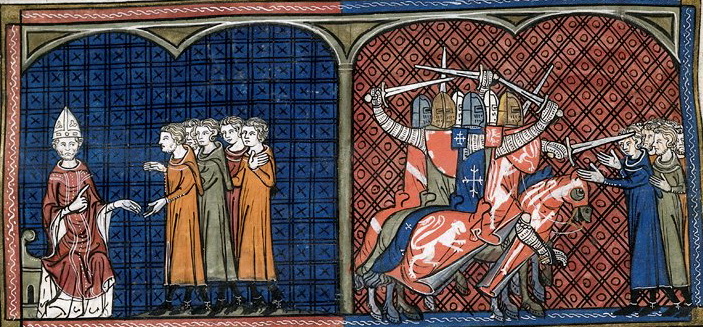
Well, maybe not between some Christians and Islam. So on a campus kiosk I found posters for a seminar entitled “Muhammad: Messenger of Peace.” In a largely Christian context, Muslim students have a difficult time with their religion being castigated in the media and in popular thought. Almost all religions are capable of violence (I was going to write “All religions” but I couldn’t think of any instances where Jains have incited violence), but most highly value and promote peace as the ideal. Few religions are actually founded on violence. I’ve heard many Christians make the claim that Islam is about conquest, pointing to the rapid expansion of Islam following the time of Muhammad. They often overlook the Crusades, one of the most violent Christian reactions to another religion in history. Is Christianity all about violence? Who is “the prince of peace” anyway?

IMG_0579

On a bulletin board I saw a notice for Asatru, the Pagan Student Alliance. If any religious group is misunderstood, surely it is Pagans. Christian missionaries liberally used “pagan” to denigrate the old religions they encountered throughout the world. Often attempts were made to eradicate such beliefs completely. With some success. Many forms of paganism today are revivals of the old religions, and a few are actual survivals. The Pagans I know are moral, peace-loving people as well. Claims of human sacrifice (often fabricated) aside, paganism was, and is, an attempt to make peace with the planet upon which we find ourselves. Peace, it seems, is a desideratum of many religions. If we studied college campuses, where such beliefs are encouraged to coexist, we might find a model that would work for people in the “real world.” And perhaps peace really would have a chance.


Austin City Limits

Maybe it’s just because Texas feels like the brass buckle of the Bible Belt, but I had moral qualms about landing in George Bush International Airport this afternoon. Texas has so many worthy heroes, but in the land of Rick Perry, recent Republican politics is king. Not queen. But king. It felt like a work of supererogation to drive to Austin after a three-and-a-half hour flight to Houston, but Texas reminded me of Illinois with palm trees. And cacti. Well, okay, and longhorns. One could get culture-lash flying here from New York. Before I embarked I had visions of my rental car being a huge Cadillac with real steer horns for a hood ornament. I just couldn’t picture myself in a ten-gallon hat.

I sometimes wonder how religion could’ve come to divide a nation such as the United States. Founded on the principles of religious liberty, lately one party has been claiming the right to legislate morality for all, deeply polarizing a populace that should be able to accept differing viewpoints. Still, there are issues on which human rights insist there can be no compromise: women have equal rights with men, and have the right to self-determination just like men. It truly amazes me that such common sense can even become a divisive issue. If we could agree on even that, we’d have to declare it progress over the objections of the Religious Right. My thoughts wander that way when I tarry in the south. It’s really a pity. The people are friendly here and the landscape has its own beauty. Are we really that different?

I’m not altogether convinced that this isn’t just a case of prejudice masking as religious sensibility. Religions can be all too gullible when they feel their honors might have been impugned. While I regularly express my opinion here, I do respect nearly every form of sincerely held religious belief. None of us has all the answers, and it seems the height of hypocrisy to insist that anyone is right all the time. Nevertheless, my sojourn beneath the Bible Belt has me wondering about the origins of various religious squabbles. Or maybe it was the just the long drive along the “presidential corridor” after touching down at an facility that most websites still refer to as simply, Houston International Airport. Travel broadens the mind—it is, in fact, an excellent form of education. Maybe if we got out more we would all get along better.

From here we all look the same.

From here we all look the same.


Wolves and Sheep

A state of the university address might not be a bad exercise.  If I might be so bold, as an inveterate outsider who nonetheless has tried to play by the rules, I have been cast in a supporting role—I think a few of my observations might be valid.  Some of my more pastoral colleagues try to reassure me that editors influence more people than professors, but in fact, the professors are the ones with the luxury to write books.  I get to sit on the bus and read them.  I do read many proposals before they become full-fledged books, and, interestingly, I get to discern how someone becomes an “expert.”  I worry a little about this latter point.  When it comes to religion, there are a few too many experts and dreadfully too few places for them to find gainful employment.  This is a volatile mix. I often run across religion experts who have professorships because they are of the right brand.  In a way that is almost inconceivable in any other profession, schools where religion is taught are actually allowed to discriminate.  This fact may even stretch out, in the case of some religions, to more objective fields.  Some religions teach that illness is spiritual rather than physical.  Some of them have medical schools, staffed by believers.

This comes back to the privileging of belief.  We all believe things, and most of us (if not all of us, when the lights are out) include some irrational things in that realm.  Beliefs can change, but not easily.  In the case of religions, most often we are taught our beliefs.  Sitting back and thinking about those truisms is the ultimate of academic enterprises, and yet few matters have a greater impact on society as a whole than the belief structures of people.  If you want to start a university for your brand of religion, after all, the law protects you if you keep your biases on your sleeve.  These people get to write books with the credibility that pathetic posers, like the current blogger, are doomed to lack.  You see, if someone is an expert, they have to have an institution to prove it.  That’s the way higher education works.

I read lots of stuff.  I sometimes think maybe I read a little too much because the ideas begin to affect my beliefs.  Nevertheless, it is a risk I’m willing to take.  It seems to me that if a religion is really as secure as they all pretend to be, you’d be willing to invite a few interlopers in your doors—a few wolves in wolves’ pelts.  If the sheep have to run, think of it as a chance to test their belief systems.  If the sheep overcome the wolves, then they will have earned the stars in their crowns.  Sometimes I am criticized for my liberal approach to things.  One thing my training has taught me, however, is that systems carefully reasoned through don’t shy away from challenges.  That’s a major difference on many belief-based structures.  Beliefs do not appreciate being challenged.  They want to be right.  But then, don’t we all?  It seems to me that the time for allowing prejudice against other religious views has outlived its usefulness.  If the truth is the truth, after all, it will be able to stand any fright that the wolves might bring.

Dore_ridinghood


Portrait of God as a Young Man

Famed swing state Ohio is back in the news with Jesus in the front lines. It was an unlikely setting to notice such a thing. I was sitting in a conference room at work, awaiting the start of a meeting. A laptop was set up with a projector, and the homepage cast upon the screen was msn.com. There, on the wall at work was Jesus’ name.

The story has to do with a public school in Jackson City. A student group had donated a portrait of Jesus to the school in 1947, but in a multicultural world the constitution sometimes has to take on the Prince of Peace.

CompositeJesus

While the legal issues are thorny, I have an even more probing question to ask. What makes a portrait a religious object? There is a fair bit of dispute about the historical Jesus—who he really was, where he was from. Despite the sangfroid of the New Atheists, there is little reason to doubt that there was a historical person Jesus. If that is the case, what makes his picture any different than that of Woodrow Wilson or Ronald Reagan? Or Churchill, with his religious-sounding name? One could argue that we don’t know what Jesus looked like—and this is true—but neither could we really identify many historical figures before the advent of photography.

The making of a picture into a religious object comes down to intent. Intent on the part of those who hung it, and on the part of those who view it. The 1940s were a different era. The Second World War was just ended, America was proudly Christian after fighting for the cause of truth, justice, and, well, the American way. Could the school group have donated Jesus in that era as the portrait of a great man? Without supernatural implications? I suspect we all know the answer to that.

Fast forward a few decades. The world has changed drastically. We are multicultural. The internet entertains us with such stories as this. If not for the internet, and a casually chosen homepage, I would never have even heard of Jackson City, Ohio. Is it possible that we could look at a picture of Jesus in our day without religious adoration? Quite possibly. But the furor raised by the religious right every time a perceived slight stirs up the dust would seem to make such an association impossible. Any prominently displayed picture of Jesus in a government location, no matter how local, is perceived as a religious act. It seems that we’ve lost our ability to appreciate the wider realm of possibilities. And that is sad. Who was Jesus, really? Historians and theologians come to no consensus on the issue. One thing is for certain, he’s sure to set people against one another wherever he appears.


Popeless

414px-Benedykt_XVI_(2010-10-17)_4 Pope Benedict XVI managed to catch many of us off-guard with his early retirement option. Not within living memory, or even very dusty, antiquated memory has a pope resigned. Such is the draw of power. Of course the founder and putative CEO of the organization stepped down at 33, or so the story goes, but after that the urge to stay on only grew. The papacy, some traditions claim, is as old as Christianity. Others suggest that the stresses and strains that eventually led to the primacy of Rome in the western church were much more intricate than that. Modern research has also indicated that one-size-fits-all Christianity really didn’t even exist from the beginning. Different groups claimed to be Christian but were labeled heretical by other groups. The Roman Catholic Church is still the single largest Christian denomination in the world, however, and that translates to quite a lot of weight.

According to the book of Acts, the first Christians were a communal lot, holding everything in common. Although we can’t call them communists, in a sense they were. It didn’t take long for that structure to break down, however. Before long it was obvious that leaders would emerge in the movement. At first they wouldn’t have been priests, but eventually that age-old designation came to describe what the clergy did. Worship became ceremony, and ritual requires expert leadership. Various religions have tried to break down the hierarchical structure of having one person over the others, but in this masculine world of CEOs and prestige, well, there’s only so much you can share.

What’s really striking is that no pope in 600 years has stepped down. There could’ve been many occasions. Presiding over about a sixth of the world’s population must be a heady experience, especially for a religious person. Already the speculation is thick on who the next pontiff might be. The fact that the faithful are already chomping at the bit shows something of the nature of the creature (one can’t very well say “beast” in such a context). The papacy has become a symbol in its own right, and even megachurches can’t hope to top their numbers. The Pentecostals, however, are racing to catch up. The two types of Christianity are about as far apart as possible while remaining under the same Lord. I suspect by the time the next pope vacates the office the religious landscape will be very different. Perhaps Benedict XVI is wise to call the game on his own terms.


Maltese Faction

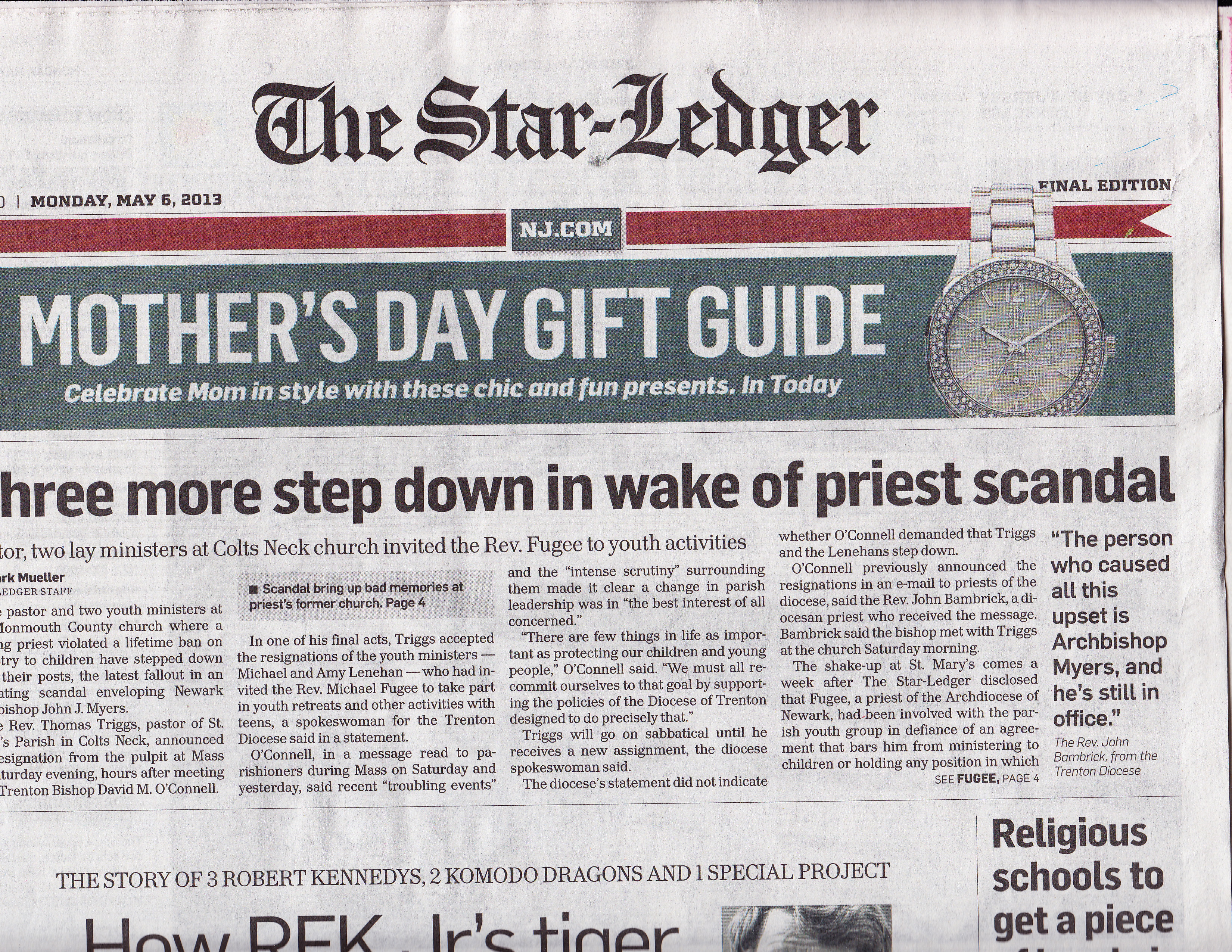
The Crusades remain one of the most celebrated episodes of religious violence in the history of the church. I am certain that many would put forward other instances of official violence to rival the piecemeal warfare of the Middle Ages, however, the Crusades still jolt many Muslims for their unflappable conviction that God gave the Holy Land to them. Ironically a bit of good emerged from the carnage in the form of sometimes secret orders of knights whose charge was originally to care for injured and sick Christians. Thanks to Dan Brown everyone knows of the Knights Templar. There were, however, several of these orders spanning the eleventh to the sixteenth centuries, and some of them survive today. In Sunday’s New Jersey Star-Ledger a story appeared of the 900th birthday of the Knights of Malta. I don’t recall having heard of them before, but then, it has been many years since my last class in Medieval Christianity. And no wonder—they don’t even appear in Wikipedia under that name.

What is so interesting about the Knights of Malta is that, like the Vatican, they have the authority to act like a country. According to the Associated Press, the knights can issue their own passports, stamps, and money, and have diplomatic relations with real countries and even have observer status in the United Nations. The blurring of the lines between religion and politics, as any student of history knows, has deep roots indeed. The Knights of Malta, however, own no territory (no, their eponymous island isn’t theirs). A nation with no territory. At least the Vatican has its own city. The Knights still exist for their charitable works and, it is to be hoped, not for the conquest of lands legitimately owned by others.

The Sovereign Military Order of Malta (“sovereign” and “military” were omitted in the press), is a sub-branch of the Knights Hospitaller, the oldest surviving chivalric order in the world. It is nice to think that the church might still have a few knights up its sleeves. The concept of chivalry has largely been absorbed into chauvinism, however, and even now the Knights of Malta are men. Along with the Vatican, that makes two entities run completely by males that assert their own sovereignty. In the twenty-first century it would be nice to think that we wouldn’t need monied men in robes in order to help out those in need. But then I’ve always been prone to believe in myths. And knights tend to follow after daze. Crusades, however, have far outlived their putative usefulness.

Good knight?

Good knight?


God’s Country Club?

Heaven is a sparsely populated place. Considering its vast celestial real estate, vis-a-vis the earth, it must be downright lonely. Maybe that’s the way the elect like it.

Official teaching, as it is often called, for many churches is downright brutal for those who dare explore. This past week the sin of Rob Morris, a Lutheran Pastor (Missouri Synod) who had the audacity to pray for the children slaughtered in Newtown, Connecticut in the same room as—gasp—Jews and Muslims, has been in the news. You see, Missouri Synod pastors aren’t allowed to worship with those outside their brand, and the president of the Synod, Matthew Harrison, insisted on an apology from Morris. Never mind the twenty-six coffins in the room. This is about doctrine!

Exclusion is part of what gives religion a bad name. Yes, there are some people who appear evil—I’m glad I’m not often put in the place of judging that. For some Christian sects, however, the gate is very narrow indeed, and the path exceptionally difficult. More than one Christian denomination, presumably those not so good with arithmetic, officially teaches that only 144,000 will be saved. A thousand gross, and not one more. These poor sinners keep hoping they’ll get in without adding up the hundreds of generations standing in line before them. I get the sense that their heaven wouldn’t exactly be paradise for any of the rest of us who happened to slip in. If the world were full of people like me, I think I’d be on the first space shuttle off to parts unknown.

Overlooking the gross insensitivity to the fact that Morris was trying to heal his community after a tragedy where children—children! To whom most religions give a free pass into heaven—were being mourned, we must wonder what the paradise of Missouri Synod Lutherans looks like. A heaven without diversity. Smiles must be rare indeed. And long, long, long naps very common.

For those of us committed to the common good, heaven on those terms is no ideal place. In fact, I doubt that God would be tempted to spend much time there. I think that God was present at the interfaith prayer vigil, and that Rev. Harrison has yet to receive an apology postmarked “Heaven.”

Rules is rules.

Rules is rules.


Scouting for Boys

I guess losing a bid for a presidential nomination sanctions a guy to speak for God. Of course, that goes for just about any Republican these days. I’m frankly amazed that Moses managed to write the Ten Commandments without them. So Rick aptly-named Santorum has gone after the Boy Scouts. To remove the duplicitous ban on gay scouts, according to Santorum, is to remove God. Obviously Mr. Santorum was paid no attention in Boy Scouts himself. I spent many hours at Scout camp and I can attest that God was already the last thing on most boys’ minds. Maybe our former presidential hopeful ought to look back a little further, for Webelos and Cub Scouts may imply the love that dare not mewl its name. I predict this: if the ban is lifted, as it should be, no one will notice the difference. Santorum will continue beating his dead horse and the rest of America may achieve just a hint of maturity.

“Scouting may not survive this transformation of American society, but for the sake of the average boy in America, I hope the board of the Scouts doesn’t have its fingerprints on the murder weapon,” Santorum declared, according to CNN. I have to wonder what he knows about the average boy in America. Or the average girl. Santorum would have a difficult time finding the word “gay” in his Bible, for it is not there. But apparently God is not God without someone to hate, without the “Right” to show him the way. And God favors straight, white men, as the last presidential election clearly shows.

Any religion that makes someone feel better by repressing others is not worthy of propagation or emulation. Look at any oppressed group. What’s the backing always cited by the oppressor? Is it not narrow religious belief? Anyone can say “God says.” There—I just wrote it. And I could distort the Bible to make God dance to my prejudices as well. The problem is that I recognize how cheap and tawdry such eisegesis is. Of course, hot air expands. The Texas governor that God told to run for president, but then changed his divine, omniscient mind, and who never thought closely about the implications of that—aka Rick Perry—also had to weigh in on the issue. CNN quotes him as stating, “Scouting is about teaching a substantial amount of life lessons… Sexuality is not one of them. It never has been; it doesn’t need to be.” Mr. Perry needs to spend a weekend at camp with his eyes and ears open and his mouth shut. In the best of all possible political worlds, his bosom buddy Rick Santorum will be right there beside him. Maybe it will take a little child to lead them after all. And that actually is biblical.

From WikiCommons, AgnosticPreachersKid--worth a thousand words

From WikiCommons, AgnosticPreachersKid–worth a thousand words


Ad Lib

Somewhere in the back of my mind I’ve had a notion to research and write a book on the history of “bad words.” Being raised Evangelical, I had a preternatural fear of saying something that might damn me to Hell, and even today working in Manhattan, I still flinch when I hear f-bombs falling all around me. Still, the concept of “bad words,” although almost universal, is very odd. We all know the tired jokes of a particularly offensive word in one language being common in another, with an entirely different denotation leading to embarrassing situations. No set of sounds, inherently, means anything bad. Surely it is the intention behind such outbursts that lead to accusations of profanity or blasphemy. I wonder how it got started. The Bible says nothing about bad words—in fact it contains a few—but it does warn against thoughtless curses. That’s because ancient people believed curses really worked.

As I stepped out in the dark to pick up the paper this morning I was curious, then, when a front page story announced, “At school, cursing’s out—for girls only.” The school in question turns out to be Queen of Peach High School in North Arlington, New Jersey. According to Leslie Brody the girls at the school were asked to take a no cursing pledge yesterday, while the boys weren’t. The real story here, however, is not my curiosity about “bad words,” but an insidious sexism. One of the teachers is quoted as saying “We want ladies to act like ladies.” And, of course, what lady would ever have anything to cuss about? Being paid lower wages than a man for the same work? Being blocked out of clergy positions in some churches? Being regularly maligned as “the weaker sex” who, like Eve, bear the guilt of bringing sin into the world? If anything, it seems to me, women have more cause to swear than men.

Just when I’ve been lulled into thinking we’re making strides toward equality, such stories dash the ice water of reality into my face. Who decided that it is appropriate for gentlemen to cuss? Can they just not help it? Are the same words any more offensive for slipping past feminine lips than masculine ones? I’m still not convinced about the entire bad word concept. As someone who smiths words every day, indeed, whose living depends on words, I find all words have their uses. It’s really a matter of context. And if I were a girl being told not to say what boys can say, I think I might have some choice words to add to that conversation.

Good, bad, and ugly.

Good, bad, and ugly.