Which God?

In Sunday’s newspaper (that’s the kind of week it’s been) an op-ed piece ran with the title “Is God real? Putting the idea on trial.” Written by a priest, Geno Sylva, the article tells how a Wisconsin church set up a mock trial where the litigants argued the case. The trial did not reach a consensus on the matter, even when a great deal of “money” was at stake. Rev. Sylva is okay with that, noting that the main thing is to keep the conversation around God going.

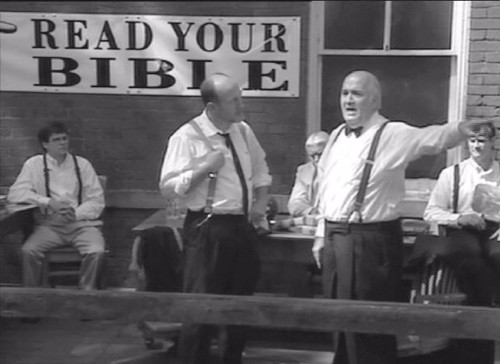
The article brought to mind the Scopes Monkey Trial, another case where God ended up, indirectly, in the dock. It also occurred to me that the real issue is not the existence of God. Juries, and even—gasp!—lawyers don’t demonstrate the truth. The lawyer’s job is to convince people to approve of his (or her) argument—many famous cases are known where the lawyer knew his (less often her) client committed the crime. The argument gets shifted to guilt (one of the favorite tactics of the God of the Bible)—is the defendant guilty or not? Not did the defendant do it. Now let’s put God in the equation. God is not on trial here—remember, it is God’s reality that is being debated.

It appears that God, as an abstract, does not and cannot matter. The mere existence of God proves nothing. Rev. Sylva mentions Einstein as a believer. Well, in a very qualified way. Einstein’s “God” was non-interventionist; the laws of relativity ran the universe. Enter the atomic bomb. QED. The existence of God is not meaningful to believers if God does nothing. The purpose of worship is, after all, to please and interact with God. If God exists like an ancient, unmoving statue, nobody’s happy. The kind of God that worshippers want must be at least able to hear prayers, and must be able to do something about them. Their God is interventionist. This is not Einstein’s god.

Arguing whether God exists proves nothing. It would be like arguing that the universe exists. If it does, so what? What Rev. Sylva’s faithful need to know is does God do stuff. Is there promise of heaven or threat of hell? Or, less crassly, does the ethic of God compel me to do good? Is God, as the old hymn says, “mighty to save”? A god who merely exists is an academic or intellectual curiosity. No more. Will Rev. Sylva’s congregation be happy with that? It seems likely that if the verdict denied God’s existence the party on the side of the Lord would simply appeal to a higher court.

What's really at stake?


Political Games

The Lord is in a changeable mood these days. So many GOP wannabes and so many disappointing results in Iowa. The fact that politicians now routinely rely on religion to get elected is bad enough, but the very mockery they make of the faith of their followers is criminal. This is the surreal paradox of a nation based on religious freedom—we are free to believe, well, whatever. It never fails that as the weekend rolls around newspapers trot out the religious stories. Men and women who live otherwise secular lives wash into churches like a spiritual tsunami, and by the time the rinse cycle comes, they’ve already got their sights set on the post-game show. In everyday life religion seldom enters, but when it comes to the polls, it counts for everything. Maybe if god didn’t have so many golden boys (the one golden girl dropped out of the race) all of this would be a little easier to bear.

The problem, speaking from the point-of-view of someone experiencing a little too much Christianity at the moment, is that the early form of the faith was a bandaid solution. You see, Jesus’ early followers thought the world was about to end at any minute. This was before the Republican Party even formed, and long before Joseph Smith made up a story about rose-colored glasses and an Italian angel named Moroni. The religion had no longevity plans. All the faithful were supposed to be gone by the end of that first century, and now, some twenty centuries later, they’re running for office in a nation equipped to bully the world. The logic of the situation dictates that if any one candidate is telling the truth of god’s sanction the rest are all pathetic liars.

When politicians began courting religious conservatives in an unconscionably cynical act of sympathy, they were taking out a promissory note they never intended to pay. The nature of religion, however, is to accept even what is improbable—even better—what is impossible. This faith, even after eight years of Bush failing to keep his promises to deliver on the issues they so crave, remains intact. The substance of things hoped for, the evidence of things not seen. Now, less than four years later, they are ready to believe all over again. And as long as we are looking for the impossible, is it too much to ask that religion be left out of politics so that the business of running the nation might be done with at least a modicum of rationality? Now that deserves to be called faith!

GOP's favorite game?


Unorthodox Accreditation

While going about my editorial duties, I found myself directed to the webpage of the Antioch School of Church Planting in Ames, Iowa. Okay, I’ll admit that the fact that I spent the holidays in Ames may have been what actually motivated me to look. Over the past twenty-some years I’ve spent many holidays in Ames, but I never knew of this particular institution. I had been checking up on somebody’s status when I found the Distance Education and Training Council. The DETC is an accrediting body. In a world where we can’t take anyone’s word for it—especially not a bunch of academics’ many words for anything—we have invented accrediting bodies. These watchdog groups maintain the high academic standards that we like to mix well with our beer and football to make the American college experience. The DETC, however, scopes out remote education programs. Often these schools have no campus. The ASCP is accredited by the DETC.

So I poked around Antioch for a while. The name is taken from the ancient Syrian city where the early Christians first earned their title. It became clear in a fraction of a second that this accredited program is an ultra-conservative answer to seminary education. How to get what looks like a regular degree to improve your indoctrination. Instead of being bemused (one seemingly appropriate response), I was actually a little bit disturbed. Education occurs every day in non-structured ways. I can get a whole life lesson just walking across Times Square. When we want standards of comparison, however, we rely on tried and tested schools to offer us degrees. When a program that supports opinions that run counter to the educational system’s standards gets accreditation, we all need to watch out. Somebody call the Bureau of Weights and Measures!

The distrust of academia often does not apply to such self-promoting schools. Americans tend to love self-made doyens who bring education down-home. As far as I could tell from the website, the Antioch School is an extension of a local Bible Church that is intended to provide future clergy with home-baked degrees. That in itself isn’t a problem, of course, but when the wider public doesn’t know the inner workings of higher education, and generally distrusts it, who’s to say whether any degree is valid or not? Aren’t all bachelors created equal? Not really. Accrediting doesn’t prevent abuses from slipping through the system—I’ve seen it happen firsthand, right under accrediting teams’ noses. It is a game we play. You can earn a master’s degree or a doctorate in planting churches. And if you ask me, that’s the same thing as getting a degree in planting corn, only much less scientific.

No way through this maze.


Alas, 2012

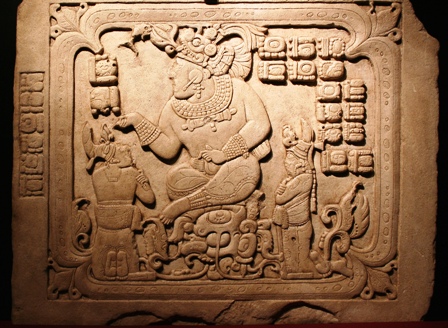
Having just survived a year with two purported Christian apocalypses, we now enter 2012 with its more potent Mayan apocalypse. The mysterious Mayan people, we are led to believe, could not foresee a world beyond 2012, and many otherwise rational people are seriously nervous about it. Whether it is the unread pages of the Bible or some stone inscription in a language most people have no hope of verifying, we venerate ancient wisdom. Especially when that wisdom indicates the dissolution of the entire world. I would suggest that the reason we do this has to do with the society the Bible built.

All the available evidence suggests that many early Christianities existed. Even the early disciples couldn’t always agree among themselves. Serious research over the past several years has indicated that what won out as “orthodox” Christianity was but one stream of the many faiths inspired by Jesus’ life and teaching. Gnosticism, surviving only in very small pockets today, was equally deserving of the title “Christian” and perhaps even outnumbered the “orthodox” variety early on. Other sects and splinter groups counted themselves among the followers of Jesus only to be labeled “heretics” by more dominant groups. Eventually one branch received government sanction and became the official copyright holder of the title “Christianity.” Amid all this confusion brewed a concern of correct teaching. The main reason was that many early Christianities believed the end of the world was imminent.

Gathering the writings to prove their point (more or less) into the Bible, this “orthodox” variety continued to grow and splinter. By the end of the First World War, technology had revealed just how much damage people could do to one another. “The war to end all wars” proved to be anything but, launching the world into a sequel within less than two decades. These wars were apocalypses in the own right for millions of people. Armchair theologians yearned for that old time religion and since saints and apostles were all long gone, the Bible was the only thing tangible left. Throughout the twentieth century the Bible grew in grace and stature until it became a god itself. Because of the veneration of this now ancient document, other ancient texts became sacred by association. Enter and exit the Mayans. These people would have been forcibly converted to Christianity, had they hung about. Because their writings are old, however, they are treated like Scripture. Therefore we tremble.

You don't have to read it to believe it!

We have lost our fluency with ancient rhetoric. Our finesse with self-destruction has underscored the point. 2012 will not see the end of the world unless it is caused by our own death-wish that has grown from the Mayan earth heavily fertilized by misinterpreted writings of early Christianities.


Seneca Falls

Located in central New York, along the northern end of Cayuga Lake, is the village of Seneca Falls. Based on a vote by residents last year, the village is being dissolved today. With a population of almost 7,000 people Seneca Falls is the largest village in New York ever to be dissolved. The move brings me a personal sadness. Not because I have ever been to Seneca Falls (I haven’t), but because it is a historically significant location.

On July 19–20, 1848, The Seneca Falls Convention met. It was one of the earliest gatherings of women’s rights proponents held in the United States. Led by Elizabeth Cady Stanton and local Quaker women, the Convention met to provide a platform for Lucretia Mott, a Quaker leader known for her public speaking on women’s issues. The Quakers, in a rare historical twist, generally acknowledged the validity of female religious participation equal to that of men. The Convention produced the Declaration of Sentiments and its resolutions, which argued for women’s right to vote. Even Frederick Douglass gave a favorable assessment of women’s suffrage at the conference.

One of the long-term results of these early steps became the nineteenth amendment to the United States Constitution. The amendment was passed only in 1920. The state of affairs for women still has far to go before it can be called true equality. Certainly some aspects of society have improved, but women still fall under the pay scales of men and are often barred from leadership roles they have every right to hold. Finland, India, Liberia, and Sri Lanka have all had women presidents. In the United States, Seneca Falls is dissolving.

The reason that women have been relegated to secondary status is generally because of religion. The gods seem to favor one set of genitalia above another. Most pantheons operate under the control of a masculine god. Of course, the rationale given is often based on scriptures written by men but passed along to the divine male for proxy authorship. We need more Seneca Falls Conventions, only they should be held in a higher court, not one inch shy of heaven itself. One of our national resolutions, as this year ends, ought to be finally to take seriously the spirit of our founders and bring equality for all to life.

O little town


Exposed or Expelled

I live in a relatively small town. Having grown up in communities of 10,000 or less, I am used to the ways of those who live close to their neighbors. Even in small towns people live secret lives. Returning to my small town from Iowa, the headlines for New Jersey’s largest newspaper feature a coaching assistant at Immaculata High School, the Catholic school in my town. Patrick Lott, Assistant Principal at another local school, is an assistant football coach at the aptly named Immaculata. He is accused of videotaping boys in the shower. As if not disturbing enough, this is the third Immaculata individual to be arrested for sex crimes in the last twenty years. While each individual instance is bad enough, it is the long-term pattern that is even more disturbing.

The setting of a Catholic school has long been a trope for abuse of power. In this respect it mirrors ecclesiastical history. Such is the way of human institutions. When they are placed on a pedestal and proclaimed divine, trouble starts. The problem arguably began as long ago as Augustine, and before him with Paul, the architect of Christianity. Both men spewed many negative words about sexuality, with or without abuse need not matter. Their views—which one might be tempted to call perverted were they not from religious men—perceived sex as a bizarre form of divine punishment. Funnily, neither one has much to say about why a good God designed such a sinful system for animals to propagate as well.

Sexual predators, of course, are not limited to Catholic schools and parishes. It does seem, however, that those religious institutions that most vocally castigate sexuality are the ones most often caught with their metaphorical pants down. Why such things happen is better answered by psychologists and sociologists than it is by theologians. What is always interesting is observing the response by religious leaders. The shock and distress may be real enough, even when one school claims a hat-trick of the sexual kind. I have no answers to proffer, merely some lay observations. If religions dropped their pretensions instead of their pantaloons, the world might quickly become at least a more honest place. If individuals with problems sought medical help rather than theological forgiveness, we might actually begin to make some progress.

Is this the right message?


The Newt Roars

Today marks the final day of my Iowa odyssey. The state that is about as heart-of-the-nation as you can get is chaffing under the weight of political lard as the caucuses near. According to the Huffington Post, Newt Gingrich is roaring mad about the negative ads that are choking the airwaves. You’d think with a life in politics he’d be used to it by now. Religion, of course, is playing an undue role in this season’s GOP contest—everyone knows Mitt Romney is a Mormon and publishers are scrambling to get out books on that religion as fast as their authors can write. Rick Perry, to the chagrin of many, bears a Methodist affiliation and the religious sensibility of Genghis Khan. Of course, Newt appears relatively calm as a Catholic, at least for the time being. Jack Kennedy, however, he is not.

The Republican Party began a flirtation with religious conservatives as early as the Nixon years. Pundits realized that, like the Alaskan oil reserves, religious fundamentalists were an untapped resource to grease the rails to election day. Overjoyed to have a voice in high profile public office, the conservative Christian crowd began to wilt from the perceived failure of Jimmy Carter and began to glom onto the media image projected by Ronald Reagan. We all suffered through the Bush years, hearing more about God from the president than we heard about the soaring national debt or the coming crash that would implode upon the working class that elected him to office (so they say). Now, facing the choice of candidates wealthy enough to run for office, many are finding the choices on the shelves of the spiritual marketplace a little understocked.

Back in the days when America was young, the founders laid down rules declaring that no religious tests would be imposed on those running for public office. Their fears proved prescient and uncannily accurate. Today perhaps the biggest test any candidate has to pass is his or her religious affiliation. Can we imagine a Mike Huckabee, Sarah Palin, or Michele Bachmann without their Bibles tucked under arm? Religion has no corner on the market for sanity. Many, in fact, would argue that the indications sometimes point in the other direction. The corner America has painted itself into is not so much shaded with red, white, and blue, as it is with the muddy brown of religious slurry that has become the new politics. Newt, newly minted from his Southern Baptist heritage, is mad about mudslinging. I think Americans should be enraged about religion slinging instead.


Church of Siliconism

Some of us have been dragged into the electronic age kicking and screaming. Our apartment at home is full of books, and they are made of paper, not plastic. In college, some of my friends and I vowed we would never use computers—harbingers of a cold, new age. It was a vow I kept until working on my doctorate (pretty much). Despite keeping this blog, I really have very little native intelligence about the world of circuit-board, integrated circuit, and chip. I would probably be the last person to have thought to ask for an iPhone—I frequently forget to take my cell phone with me, and when I do, I sometimes neglect to turn it on. So I was stunned to find an iPhone with my name on it yesterday. I looked at it like an alien baby, wondering what it might eat. As the day wore on, however, I started to see some of what it might offer.

Siri, the software personal assistant for iOS, responds in a friendly voice to questions asked. “She” (and you can’t help personifying her) is like a personal portal to the mind of the Internet. You want a pizza? Siri knows the location of all the places in your neighborhood that deliver. You wonder what the most recent nation in the world is? Siri will look that up for you. (South Sudan, as of yesterday, according to her sources.) My brother-in-law, intrepid with electronics, and knowing my background, asked Siri about God. She replied, “Humans believe in spiritualism. I believe in siliconism.” Someone at Apple clearly has a sense of humor, but the more I began to parse this statement, the more I realized Siri could use a personal assistant in the religion field.

Spiritualism is not the same as spirituality; the former is the belief in ghosts and the religions that accompany that belief, such as Theosophy. Clearly in an American market, any product that denied belief in God, even by implication, would become the product of a witchhunt. The sad image of heaps of iPhones being melted as leering evangelicals look on is disturbing but unfortunately easy to conjure. Best to program Siri to deflect any potential ire with humor. The second component of her pithy reply is siliconism. As a religion, it is clearly underway all ready. Who reading this blog can imagine life without electronic media? Be honest! What does a computer believe? Do androids dream of electric sheep? Does Siri say her prayers as she’s being shut down for the night? What does it mean to believe? So now I have an iPhone. The day before yesterday I couldn’t find my app with both hands. Now I have a personal religion consultant. I suspect I’ll be starting a new religion by the end of the day—the First Church of Christ, Programmer. Its headquarters will be wherever a true believer is located at the moment, as long as s/he has an iPhone. Blackberry users will, of course, be considered heretics.


Silent Might

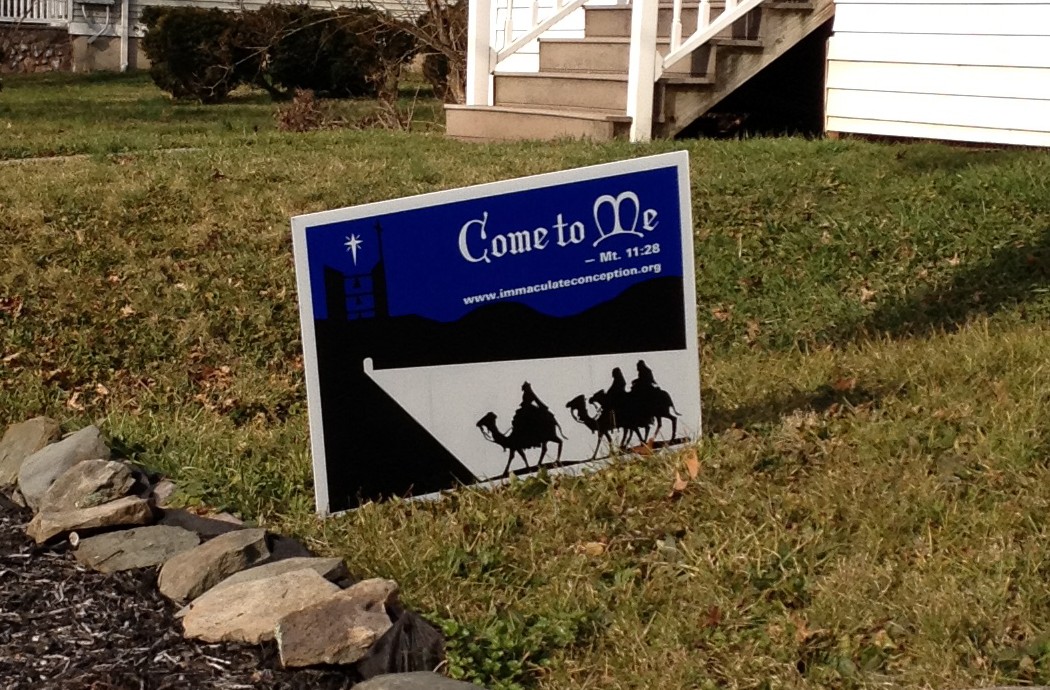
Iowa is a state for reflection. For many years Christmas in Iowa was a family tradition, but living on the east coast makes such pilgrimages rare. On Christmas Eve in Ames, we drove past a Nazarene Church decked out for the holiday with a sign reading, “Jesus Came for You.” Perhaps I watch too many movies, but the images that came to mind were of Rambo and The Terminator—menacing figures who’ve sought out their victims for revenge. Coming for you was a threat rather than a promise. Who can forget Arnold’s “I’ll be back”? Was the child who came sent with a mission of punishment or of peace? To hear presidential candidates and other evangelicals tell the Christmas story, it is clearly the former—the Rambo of God who blows away the sins of the world—that we should expect. The Prince of Pieces.

That version of Christianity that likes to present itself as the default, the natural form of what the church has taught all these years, has a strong current of threat running through it. God never shows up unless there is a problem—an absentee father only too swift to remove his ample belt to begin a sound thrashing. Religion often thrives in the context of menace. Teaching that people are evil by nature and only good when under promise of Hell, such believers understand the coming of Jesus to be cause for fear and alarm. According to Luke, the angels began their message with “Fear not.”

How Christmas is understood reflects on the view of Christianity that believers choose. For the advent and arrival of an emissary can be cause for celebration or of fear. In some mangers the infant conceals a cudgel and woe to those who suggest equal treatment of all or a non-literal reading of favorite prooftexts. This time of year stands as an excellent test of what this child will grow up to be in the minds of his latter-day cohort. What arrival should we anticipate? If it is the Jesus of the politicians and evangelicals, we only have to look at the headlines to discover the answer.

What child is this?


England’s Christian Gift

As much a part of the holiday season as Santa Claus and baby Jesus, the Salvation Army bell-ringers are out in full force. As I drop a quarter in the bucket, I ponder the strange lineage of this denomination. When the cheerful holiday shopper convivially donates spare change, few, I suspect, know that they are supporting a church. The Salvation Army is one of the bewildering number of denominations to spring from English Christianity. The Church of England, small in the United States, but imperial in much of the world, grew amid a religious unrest that spun off countless dissenters. We all know the story of Henry VIII and his not-so-merry wives. His political move to focus the official religion of England on the crown led to the Puritan resistance. Puritans left England for the Netherlands, and then on to America where they flocked to New England to develop into Calvinistic Congregationalists.

Meanwhile back in Amsterdam, some of the English Separatists evolved into Baptists. Baptists were also congregational in polity and also found the religious freedom of America to be appealing. (Now they select our elected officials.) The Puritans had helped develop the Presbyterian movement as well, with dissenters in Switzerland. Still at home in Britain, the Church of England waffled between Catholicism and Protestantism for some time. The evangelical fervor that emerged with the Wesley family led to the Methodist Church, which remained attached to the Church of England until its founder’s death. In America the Methodist Church grew rapidly. During the era of religious revivals the Adventist movement grew out of Methodism, as did the Church of the Nazarene, the Holiness movement, and Pentecostalism. All of them today are major denominations. Even the Anabaptists tip their wide-brimmed hats in the direction of the English dissenters. The Plymouth Brethren, inventors of the Rapture, were another English-derived denomination, as were the Wesleyan Churches.

What does all of this have to do with the Salvation Army? The Salvation Army was founded in London by a Methodist minister, William Booth, and his wife Catherine. The movement adopted quasi-military mythology and ranks, and soon grew into a church of its own that supported what would later become the Social Gospel cause. Known primarily for their charitable works, they are yet one more splinter from the tree of English Christianity. Perhaps the Christmas tree is an appropriate analogy for the Christianities to spring from Henry VIII’s loins. Like the pine’s many branches, each with its ornaments, Christianity in England sent its twigs in all directions. Counted together, the descendants of English Christianity far outnumber any other Protestant grouping. Just a thought to share while waiting for the quarter to drop.


Tebow or Not Tebow?

It is time to bow to the inevitable. I am not now, nor have I ever been, a sports fan. Every web page I open, however, seems to feature Tim Tebow, as if the media had never seen an evangelical before. Where have people been? What is even more amazing is that this athletic kid has invented an entirely new human gesture, “the Tebow.” Incredible what young folks can accomplish these days. And as Saturday Night Live has showed us, Jesus really isn’t that much of a football fan after all.

Ashamed at my naiveté, I decided to research the history of tebowing. What I found shocked and amazed me. Like so many modern day marvels, Tebowing seems to have been invented by those prescient Sumerians. Even before humans perfected the Tebow, semi-divine characters showed them how. This cylinder-seal depicts the monster Humbaba illustrating the correct posture to Gilgamesh and Enkidu. They do not, apparently, take kindly to his correction.

In the example below we see a rare double-kneed Tebow performed by an Asian football god while a hopelessly underchurched Joe Paterno looks on, hopelessly standing.

Fast forward a few centuries to a seasonal scene and we find shepherds tebowing to some baby. It is a fair guess that they suppose the baby to be a football incarnate.

Lest we think the Tebow has been coopted by the Christian crowd, we must remember that no religion has a copyright on humility. In this scene from Norse mythology, a clearly pagan Hermod tebows before the goddess Hela. She does not look amused.

Americans, who after all claim to have invented the Tebow, can trace the gesture back to our founding father himself. In this famous painting of George Washington at Valley Forge, just after the crucial touchdown, the great man can be seen tebowing in the snow.

The snow is a great segue to the Cold War. Here, in a government photo, we see Soviet naval infantry tebowing as they contemplate the big game. They are not now, nor have they ever been, Broncos.

Now, none of this resembles the education I received during my three degrees in religious studies. No matter. ‘Tis the child becomes the man, as they say. And since a little child shall lead them, we can all learn to tebow as if there were no tomorrow. If the actual Tebow is as bright as the sports-scholarship students I taught at Oshkosh, Rutgers, and Montclair, the education of the future will include a lot lower academic expectations and, I suspect, lots and lots of Levis with holes in the knees.


Darkest Night

One of the more endearing of human weaknesses is our fear of the dark. For those who live north of the equator, we have just experienced our longest night. It is no coincidence that the religious holidays that occur in winter feature light. In our helplessness against the encroaching darkness, we light our Christmas trees and Hanukkah candles, adding just a bit more light to the world. Among the oldest of all holidays is the day that marks the birth of light’s resurrection. One need not be a pagan to appreciate the solstice and the inherent hope it bears for the return of the sun.

In this season we often see signs and hear laments about the absence of Christ from Christmas. Jesus was not born in winter, according to our best reckoning. One of the carols that drives me mad with distraction is “In the Bleak Midwinter” with its maudlin description of “snow on snow on snow”—clearly written by someone with limited experience of winters in Israel. Christmas falls near the solstice because people have from earliest memory recognized the sacredness of this season. When Jesus was born nobody knew he was to become so famous as to have one of the most popular Facebook pages ever, and so nobody thought to write it down. Even the Gospels the disciples never give a rousing chorus of “Happy Birthday” while on the dusty highway. What we’re celebrating is that night will not reign forever.

Having evolved to favor our eyesight, but lacking the standard mammalian nocturnal nature, we feel vulnerable in the dark. Even if Jesus hadn’t been born we’d be celebrating at this time of year. It might have been the re-living of the mythic Golden Age of humanity under Saturn that the Romans called Saturnalia, or it might have been the rejoicing over the resurrection of the beloved god Balder among the Norse. We might have had to wait until the days were noticeably longer to fete the goddess Brigid with the Celts at Imbolc, but we would have marked the occasion. Instead of cursing the pagan darkness, as the saying goes, we would light our feeble candles as a sign of hope. The reason for the season is the fact that the longest night is over and once more our days will slowly return light to our lives.

Here comes the sun


Legislating Reality

The follies that plague humankind come in an almost cyclical form. As old Ecclesiastes wrote, “there is nothing new under the sun.” I just finished D. Graham Burnett’s Trying Leviathan: The Nineteen-Century New York Court Case That Put the Whale on Trial and Challenged the Order of Nature. Other than the fact that the subtitle accounts for a good portion of the book, this account shows just how little we’ve progressed. At the heart of the book is Maurice v. Judd, a New York case of 1818 in which a whale merchant contested an assessor’s fee on “fish oil” by claiming a whale was not a fish. In “trial of the century” style, star witnesses were called in, bringing science to the docket. It was known, even in these pre-Origin of Species days, that a whale was a mammal, but what soon became clear as Burnett laid out the facts of the case was that the Bible held sway. Genesis divides the classes of nature into beasts, birds, and fish. This simplistic taxonomy was held by many in the nineteenth century to be a sacred statement of fact. If whales lived in the water, they were fish. The fact that they nurse their young, who are born live, and that they share the skeletal template of land creatures and have warm blood, and breathe through lungs, simply did not matter. If Genesis says fish, fish it is.

My mind immediately jumped ahead just over a century to the Scopes Trial. Once again, science was bent over the knee of Genesis and poised for a paddlin’. And the challenges still have not stopped. Call it Intelligent Design, or Answers in Genesis—anything but mythology—and it will keep coming back for more. Already, in 1818, lawyers were arguing that science could be decided in the courtroom. Facts only muddy the issue. If Genesis weren’t enough, Jonah’s “great fish” was called a “whale” in the Gospels, so, QED. There is no debating Bible science. Just to prove the case, we’ll bring it to trial so that twelve people with no science training can decide the issue based on rhetoric. Disciples of dogma. No surprise that the jury found the whale to be a fish. There’s no stopping a true believer.

My wife gave me this book because of my enormous fondness for Moby Dick. In both books the discussion of killing and butchering whales bothers me immensely, but I know that Melville is running after a beast of a metaphor and that whale-boat skimming across the surface of the ocean has lanced a far greater prey than a white whale. The creationists, however, fail to see the beauty of mythic images. Anyone who’s even watched a court drama on television knows that the truth is not what courts seek. Courts seek to convince a jury, whether a person is guilty or not. No matter if it’s a while whale or a white bronco involved. Truth is much more subtle and fragile. Truth can be discerned by facts. But the Bible is a heavy book, and when dropped from a great enough height, can fracture even the laws of nature. Like Ahab, the creationists are never truly gone forever.


And Lowe

Hate is harder to muster for people just like us. I mean, if they live like us and look like us, what grounds do we have to distrust and fear them? This appears to be one of the premises behind the TLC show “All-American Muslim.” Many people know Muslims without knowing it and fear them without being aware of whom they fear. With this insidious kind of fear and hatred, religion must be involved.

Over the weekend, CNN online ran an article noting how Lowe’s is pulling advertising from the program. It seems that conservative Christian outcry is rising like the children of Israel in Egypt; the Muslims aren’t shown as bad guys—they’re like your next-door neighbor! Fear of takeovers has long been on the Neo-conservative agenda. If Romney is elected we will by overrun by Mormons. If we sleep, we’ll awake to Muslim neighbors. And we certainly can’t expect to all get along. If it weren’t for the media, we would probably never even know they held a different religion.

I’ve lived lots of places. With the exception of Grove City College and Nashotah House, I never once was aware of the religion (if any) of my neighbors. If they are civil and respect my right to believe what I will, they are entitled to the same. Religious supersessionism and maybe a pinch of jealousy play into this attitude of keeping others a minority. Is it because Muslims and Mormons are more effective at winning converts? The modern evangelicals have been relying on political bullying to get their way. Why not learn to appreciate your neighbor’s religion instead?

Religious freedom is a two-edged sword. Many of those who are worried now were quite happy when they were in the clear majority. When the lines get blurry the trigger finger gets itchy. Come on, Lowe’s! Educating ourselves about other religions is the best home-building project out there.


R-e-s-p-e-c-t A-l-l

Every great once in a while a politician makes a statement consonant with the principles of the nation. Over the weekend Robert Menendez, one of New Jersey’s U.S. senators, make a public announcement of his support for the Respect for Marriage Act. Admitting that 15 years ago he voted for the Defense of Marriage Act, which would not recognize homosexual unions, Menendez has searched his conscience (a rare commodity among elected officials) and has come to realize this “Defense” Act for what it is: legislated immorality. It is immoral for a government to deny rights to committed couples based on the gender of either party. Gender is a social construct that may or may not align with sex—even the concept of two completely distinct sexes is now seriously questioned by biologists. The old measuring rod of ability to procreate together just does not match reality: infertile couples are granted the same rights as other married couples, so why not same “gender” couples? As Americans we often like to vote without thinking too deeply about the topic.

The value of procreation is obvious. Birds do it. Bees do it. Even educated fleas do it. (Cole Porter knew what he was writing about.) When did we become so fixated on this one aspect of sexuality that we let it become the sole purpose of sexual behavior? Many religions recognize sexuality for what it is, a form of human interaction. The end result may be a new child, but it is not so as the result of the vast majority of couplings. Christianity (in some quarters) early on took a dim view of sex, and soon began to relegate it to procreational necessity only. Even then you were supposed to try hard not to enjoy it. The Catholic Church even relegates the biblical siblings of Jesus to the role of step-siblings; children of Joseph from a prior marriage, despite what the Bible says. Such distortion of nature could only come at the interference of religion. And as long as we’re busy regulating sex, let’s add a few statements about the only appropriate outlets for that committed relationship. Never mind who gets hurt. It’s all gonna burn.

I, for one, salute Senator Menendez for his willingness to open his mind. Too often the “government for the people” is excised from Lincoln’s Gettysburg address. When did we the people pass to the government the right to decide whom we might love? The agenda set by the Religious Right is religious wrong, and too many tax-paying citizens are the heirs of its paranoia. It is time the government began serving the entire electorate rather than just the Southern Baptists and their friends. Nobody is attempting to regulate their sex lives, as Ted Haggard, Jimmy Swaggart, and Newt Gingrich will gladly attest. Keeping the zipper firmly up is not the strong suit of televangelists or politicians. If we’re going to have double standards here, let’s at least open the game to same-sex marriages. Those who feel threatened by the fair treatment of others need to gaze long in the mirror and ask why.