Ghosts of Nashotah House

A recent search for “Nashotah House” + ghost (not unsurprisingly) brought up my blog. Perhaps I was being bated, but I’ll bite anyway. Who can resist a good ghost story?

A wee history lesson will help to set the scene. Nashotah House is/was a seminary of the Episcopal Church nestled in the woods of what had been the frontier in Wisconsin. Established in 1842, it was originally conceived of as a monastery — an ethos it has tried to maintain ever since. It is a residential campus with both students and faculty required to live on the school grounds. I taught there from 1992 to 2005, long enough to see some strange things.

I admit up-front that I don’t know what to believe about ghosts. Very nearly ubiquitous as a cultural phenomenon (and firmly related to religion), ghosts permeate the human imagination. It is not at all unusual that ghost stories should thrive in a gothic setting like Nashotah; a simple web search will bring out the traditional hauntings of the place, especially those of the black monk. When I made my first visit to campus there were some distinctly creepy vibes that I wrote up as being non-priestly jitters amid the secretive life of the black-robed clergy. For my first two years I would be there for just part of the week, so instead of the usual faculty house to reside in, I was assigned to live in an apartment in Webb Hall. Known simply as “the Fort” for the solidity of its limestone block construction, Webb Hall had been built for a former dean, Rev. Dr. Azel Cole, as a grand three-story residence for the priest and his wife, Betsy. (Episcopal priests can marry, creating a steady siphoning of Roman Catholic priests who love both the liturgy and the ladies.) My apartment was on the third floor of the Fort, the highest point on campus. As the living dean showed me around, I had that oppressive, “something’s not right” feeling, despite the fact that the living room had been newly furnished and had a spectacular view across campus.

The dean pointed out the amenities of the spacious apartment, but when we reached the kitchen/dining area, we found something unusual. In the very center of the floor was a single dining plate, shattered. The dean muttered something about how the cleaning lady must have missed it on her rounds when she had prepared the apartment for my arrival. Otherwise the apartment was spotless. There was a door leading to a private chapel that Dean Cole had constructed. I was told it was no longer used since the only access was through the apartment, but the dean supposed I would be interested in seeing it. We stepped inside and it was coated with cobwebs and a thick layer of dead black-flies covered the floor, especially near the windows. The dean informed me that it was kept locked to prevent clandestine, unapproved Masses from being performed there by renegade priests on the faculty.

The creepiest room, however, was my bedroom. A spare room (for sleeping only, no doubt), furnished with only a new bed and side-table, it nevertheless felt crowded. When something finally did happen in that room it was after I had moved to a regular faculty residence.

[For the rest of the story please see the Full Essays page]

Assyrian Dreams

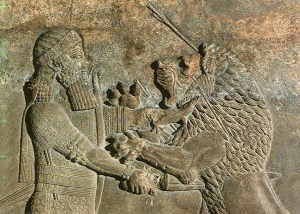
All through my formal education I had learned about the Assyrians. My first introduction to them was as the evil empire that destroyed the chosen nation of Israel, inspiring countless myths of the ten lost tribes. Upon further study they appeared in a more positive light — they were one of the great, formative Mesopotamian peoples who had gone through considerable trouble inventing much of our culture for us. They also had a penchant for over-running smaller and weaker nations, but then, everyone has their foibles. When I saw their striking bas-reliefs in the Boston Museum of Fine Arts, and later in the British Museum, I was deeply impressed by their ability to project hostility. Bulging biceps, braided beards, dreadlocks and attitude enough to be the envy of any gangsta, these guys could subdue you with just a solemn nod in your direction.

A good day for Assurbanipal, not so good for the lion.

A good day for Assurbanipal, not so good for the lion.

But the Assyrians over-extended themselves. Conquering further and further from the homeland, they couldn’t keep a stony eye from Egypt and Anatolia all the way to Persia. Media (not the paparazzi) eventually tumbled Nineveh and Babylonia stepped in to take on the burden of predominant empire. The United States hadn’t been invented yet, so somebody else had to dominate the Middle East. With the influx of Arameans and the machinations of the Persians, Mesopotamian culture became a cherubic mix of peoples. Assyria ceased to exist as a separate nation, and once the Arabian tribes launched into the region, all genetic bets were off. Racial purity was a dream of the past. So the Assyrians dissipated, joining their neighbors in a happy, amorphous Mesopotamian culture.

In Shamash we trust.

In Shamash we trust.

Then, after procuring a doctorate in Ancient Near Eastern studies, I took a job at Gorgias Press. Suddenly the Assyrians were back! That was one on the other end of the telephone! Visions of dreadlocks and skewered lions came to mind, and in my confusion I asked my colleagues if I’d slept through that lecture. No, it turns out, the Chaldo-Assyrians are a relatively new incarnation. Named Assyrians by nineteenth-century European missionaries, this predominantly Christian people has adopted and tried to assimilate the heritage of the ancient Assyrians. They still exist today, I’m told. Instead of swords and lion hunts, they wear camouflage and hunt with automatic rifles. But their flag hearkens back to their ancient, pre-Christian religion. That flag, their rallying point with high antiquity, bears the emblem of the eight-rayed Assyrian sun. Jesus, meet Shamash. Son versus sun. I guess it is time for me to go back to school again and see if I can get it straight this time.


Ortho-right or Ortho-wrong?

As a child reared in a seriously religious household far, far away from anything with even a whiff of orthodoxy about it, my first encounter with this traditional form of Christianity involved more curiosity than fear. What was this religion that claimed to go back to the very earliest apostles? Did Jesus wear one of those unusual hats? I never recalled seeing paintings of Peter, or Mark, or even Thomas wearing a medallion of the theotokos. Apparently I’d been routinely misinformed. The haunted, deeply spiritual grimaces on the faces of orthodox students my age were almost intoxicating. It was all new and exotic to me.

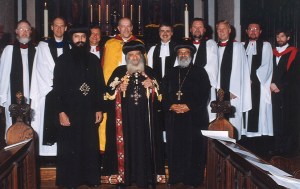
Several years later I find myself having been subjected to a variety of orthodoxies and the only thing they seem to have in common is the conviction that all the others are wrong. I once had a boss who was enamored of Greek Orthodoxy. (I later learned that this is the gateway orthodoxy, leading to more foreign strains.) Presently his interest shifted to the Russian variety and I eventually found myself cowering in the glare of the Coptic Pope Shenouda III’s eminence. How had a kid from humble beginnings come so far? A couple jobs and a few hundred miles later, my new boss turned out to be Syriac Orthodox. Phone calls to the office would come in languages I’d never even heard before. Being a northern European mutt, maybe I was simply jealous of the pride of ethnic purity. No fancy traditional dress to haul out for exotic dances at annual celebrations of mutthood (Lederhosen and stuffy tweed, anyone?)

Basking in the eminence of the Coptic Pope

Basking in the eminence of the Coptic Pope

All of this exposure to orthodoxy has led to heterodox thoughts in my heretical brain. It seems that the basic premise of orthodoxy is that the final truth was revealed just once, up front, and it left no room for growth. The expectation that Jesus would shortly be back didn’t leave much space to consider what complications would set in once people developed nuclear weapons, landed themselves on the moon, or devised genetic engineering. Complexities and complications that early Christianity could never have foreseen chaw like ravenous beavers on the stilts propping up this edifice. I am a firm believer in religious freedom and have never urged anyone to change her or his personal faith. But I do seriously wonder how any religious system, in the light of our limited brains, could ever expect anyone to believe that it had comprehended the whole of all truth for all time. It is all too wonderful for one condemned by a birth outside of ethnic Christianity.


Yes, Mammon

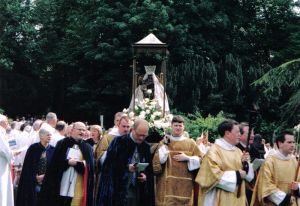
In the continuing coverage of the most recent New Jersey scandal the Star-Ledger, on Monday’s front page, posted a picture of San Giacomo Apostolo in Hoboken. San Giacomo is traditionally the brother of the equally mythical St. Ann. The statue, which stands outdoors in a public street, has monetary donations tacked to it. The image flashed me back to my Nashotah House days when students became visibly excited nearing the date for the procession of Our Lady of Walsingham at the proto-shrine in Fond du Lac, Wisconsin. Seminarians would beg for an opportunity to hoist the holy statue, or at least be a lowly acolyte. (These were grown men, mind you — many of them seeking the priesthood as a second career.) I never attended Walsingham, but it was my understanding that pilgrims and penitents at the festival also adorned their lady with money in hopes of some gift of grace. I grew up in a blue-collar household where paying ladies for favors was itself considered a sin.

Looks like Our Lady has put on some weight

Looks like Our Lady has put on some weight

While on a recent trip home, I saw a church for sale. As I started to break out my checkbook, I recalled how closely money and religion are tied together. The more I pondered this, the clearer their ancient, entangled roots became. The religiously observant bringing gifts to the temples of their gods was a standard act of piety and civic duty in the ancient world. Temples were expensive and the staff could only be supported by continuous donations. In the Ugaritic tale of Kirta, our protagonist seeks a son and makes a vow to Lady Asherah that if he successfully procures a wife he will make a statue of her in silver and gold. The favors of gods may be purchased. Today credit cards are accepted, but we are still caught in the web of those who claim God has asked them for your money.

For sale, God not included

For sale, God not included

When I was a teenager a friend invited me to attend a public presentation by some visiting Rev. Harrington, a popular evangelist. Several times during his high-energy sermon he sent the collection baskets around. The first time it was for your standard church offering. The second time was for any change you had in your pockets. The third time was for a special blessing. For those who had checkbooks ready, a thousand-dollar donation would get your name on a personalized plaque in his private jet. Years later I saw Harrington on television during an interview on his private estate. He puttered around it in a customized golf cart with wheels designed not to scuff up the gold-plated bricks that constituted the drive before his opulent mansion. “If we’re going to walk on streets of gold in heaven, I want to get used to it here,” he casually explained.

So, as an (unofficial) agent of Asherah, if you are seeking to make a divine investment, get out your checkbooks and I’ll tell you where to send the donations (checks made to “cash” please!).


Sects and Violence

Religion-sanctioned violence has a long (overly long) pedigree. Early myths going all the way back to the Sumerians incorporate violence on the part of the gods. Depending on one’s school of interpretation, this could be seen as “form following function” — people saw the violence inherent in nature and projected its causation onto the source of nature, namely, the gods. Ancient people did not perceive of the world in terms of natural phenomena. “Nature” behaved the way it did with will and reason, the will and reason of the gods.

The stories preserved from ancient Ugarit stand as witness to this conceptual world. In one story, Kirta by title, the eponymous king Kirta seeks a family and has his wish granted by El and Baal. Hedging his bets, he makes a vow to Asherah that he forgets to fulfill. Asherah sees to it that Kirta’s divine gift comes undone. More obvious is the tale of Aqhat, another divinely granted child. Aqhat is given a bow by the craftsman god Kothar-wa-Hasis, only to have it coveted by Anat. When he refuses to release it to the goddess he is unfortunately pecked to death in a hitchcockian demise by a swarm of buzzards with attitudes. Violence is introduced into the human realm by the gods themselves.

Today, some 3,000 years after Ugarit, we still find ourselves living with violence sanctioned by religion. Whether it is as obvious as extremist factions of a religion calling for outright attacks on others, or as subtle as self-professed righteous believers destroying a colleague’s career in the name of Jesus, religion is used as a mental crutch for striking others. While I can not walk all the way with Christopher Hitchens, I do have to acknowledge that when it comes to human-on-human violence religion is a socially accepted motivation, no matter how pure its original intentions.

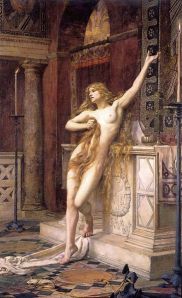
Hypatia, a scholar-martyr due to religious violence

Hypatia, a scholar and martyred victim of religious violence