Why Islam

Radical ideas emerge in the most unlikely of places. In the world of religion the rule is generally to criticize first and then attempt to understand later. This is the burden of revealed religions where the only evidence to test is subjective experience. Lessing offered us the parable of the three rings: God gave humanity three religions (Judaism, Christianity, and Islam) without indicating which one was the correct one. Even before Lessing attempted to provide some kind of resolution to this intractable dilemma, proponents of each of the monotheistic traditions had already made up their minds. The divine buck stops here. Our society places little emphasis on learning about religion. Religion is something we do, not something we have to read about. Given the tremendous motivational force of religious belief, this situation would seem to be a set-up for disaster. Read the headlines and judge for yourself.

I was pleased, therefore, to come across the website WhyIslam.org. Written by Muslims to answer questions by non-Muslims, this non-judgmental, informative website seeks to educate. Despite its rapid growth in the western world, many people are poorly informed about Islam, what it stands for, and how it relates to Judaism and Christianity (especially). The media tends to focus on extreme cases of religious believers; unfortunately they are often the most newsworthy, capturing the limelight in the name of their faith. Whether or not religion was the motivation for an act of terrorism (certainly not limited to Muslim believers), once such an act is perpetrated the religious beliefs of the guilty parties are also suspect. Instead of trying to understand a different religion, the knee-jerk reaction is to fear it. WhyIslam.org is an attempt to counterbalance that fear. Education is the St. George to the dragon of fear. Instead, however, our governments often try to cut back on education and the trench only grows deeper.

If we are to survive the world of competing religions, open conversation is necessary. I’ve been ensconced in institutions where discussion was viewed as compromise and vehement hatred against the foe was considered the only legitimate response. This passed for education. Many seminaries are too busy indoctrinating students in the minutiae of their own tradition to open them to learning about other religions. What are they so afraid of? If a religion is really real, it should never quail in the face of competition. What is the danger in learning about fellow believers? Religions make many assumptions about their own priority—natural enough with regard to core beliefs. If they all encouraged learning about each other, perhaps religious violence would transform into religious education. Islam has much to teach the rest of the world, if the rest of the world would visit sites like WhyIslam.org and be willing to listen.



Biblical Sex

Legislation covering female reproductive health maintenance has finally passed. Even in a nation where equality is highly touted, women will have, until 2013, been treated as more expendable than men. A few years back I read Mary Roach’s Bonk: The Curious Coupling of Science and Sex. There I learned that even as of the publication date of her book, many aspects of the female reproductive system were still poorly understood. The reason: lack of interest by (mostly) male scientists. Of all the great equalizers of humanity, it might be expected that religions would step in to champion the cause of citizens routinely treated as objects and chattels. Instead, the opposite has been the case. Most religions, and even until the last century Christianity in the forefront of them, relegate women a secondary status to men. Religion is all about power. Now that legislation will allow women basic reproductive rights without extra fees, Catholic hospitals are concerned about the implications. “They defied the bishops to support President Obama’s health care overhaul. Now Catholic hospitals are dismayed the law may force them to cover birth control free of charge to their employees.” Thus begins an article in today’s paper by Ricardo Alonso-Zaldivar of the Associated Press.

Instead of cheering equality, the church is muttering about medieval conceptions of conception. The entire idea that life begins at conception was not even possible in the biblical world where sex did not involve sperm and ova—such things were unknown in those days. The Bible has a few clues to when human life begins, and generally it is thought to be at first breath. Semen should not be wasted, however, since it was thought to be the full set of ingredients to grow new people. The uterus was simply a waiting area, a comfy place to grow with regular womb service. Men were the creators, women were the deliverers. That idea of reproduction formed the basis for all biblical and other ancient legislation on the subject. Comprehending “conception” as now scientifically understood, was only possible with the invention of the microscope. In response, a sexually underdeveloped church decided that the new data strengthened the male hold on ecclesiastical authority. Once the seed is planted, there’s no uprooting allowed. What male, after all, has ever had to carry an unwanted pregnancy to term?

Female religious leadership was recognized in many early societies, and even in some branches of early Christianity. No legitimate rationale exists for saying half the human race is disqualified on the grounds of basic hardware. After all “male and female created he them.” Concerns of “purity” for an age when menstruation was not understood could be marshaled to the cause of male supremacy. That mystery was solved when conception became clear. An unequal result emerged nevertheless. Since women couldn’t be discounted on genetic grounds, they could on the basis of “impurity.” And here we are two thousand years after pre-scientific Christianity was conceived, still waiting while a coterie of all-male bishops castigates normal health care for females. Believers like to suppose that their leaders receive special word from the mouth of God. Those leaders tremble in the face of true equality for the very first word the Bible has to say on the subject is “So God created man in his own image, in the image of God created he him; male and female created he them.”

Who's superfluous here?


Livin’ On a Prayer

Am I the only one who finds it disturbing that Neo-Con politicians are naïve enough to believe that prayer will solve all our problems? Where was God during the Bush years, for crying out loud? And yet headline after headline speculates about Texas Governor Rick Perry’s prayer-fest scheduled for Saturday. What is more disturbing than the lack of imagination on the part of would-be candidates is the sheep-like following on the part of a large segment of the electorate. If God is going to step in and take charge, he had a great chance back on May 21 and refused to pick up the option. If God was behind politics, why did George W. Bush fail to find Osama Bin Laden? If God is running things, why are so many unemployed? Ah, but the religious pundits have a pat answer: America is a sinful nation. What it takes is religion, Texas-style.

In the many years I spent at Nashotah House, the majority of our students hailed from Texas. They represented the conservative hard-line and doctrinal strappadoes that caused much suffering but still somehow didn’t placate an angry God. That, of course, says more about Nashotah House than it does about Texas. Perhaps it is the logical evolution of a country that began with prominent ministers gleefully describing sinners in the hands of an angry God. Nearly three centuries later and we are being told God is still angry. Thou shalt not hold a grudge, eh? The problem seems less about sinful folks just trying to get by (a la Bon Jovi) than about politicians using their religion to get elected. Centuries down the road it will be the topic of some new series of History’s Mysteries that an affluent, educated, and generally forward-looking nation cluttered its governing bodies with politicians who believed the answer to complex problems is to bow their heads and tell God how to fix it. Are we really half-way there, or have we spread our arms to embrace Jonathan Edwards once again?

In MSNBC’s article on Rick Perry’s prayer day, it is noted that the book of Joel is cited as an inspiration for the event. For such a brief book, Joel has been at the forefront of a ton of damage wrought by prooftexters. Joel wrote three brief chapters about a locust infestation for which the suggested response was prayer. One wonders if Rick Perry simply prays when the termites begin to gnaw on his expensive home, or does he call Ortho instead? Joel was truly old school. The locusts in his day meant literal mass-starvation. No chemical romance to solve the problem there. Unfortunately we don’t know how that one turned out—Joel doesn’t say. I’m just glad that Governor Perry hadn’t been reading Psalm 137 when inspiration struck, and can I get an amen from the pro-lifers on that?

Ricky used to work on the docks?

P.S. Matthew 6.5.


Slash and Burn

Extinction is an evitable part of life in the universe we’ve inherited. Throughout the eons of our planet mass extinctions have occurred several times, and the new world that emerges is strange and unexpected. We as primates owe our existence to such a natural occurrence at the end of the Cretaceous Period. We evolved religion, which, in some species, bestows the right upon us to alter, or even destroy, our environment. The lame reasoning that generally accompanies such amateur theologies is that a deity is about to sweep down and reclaim those “he” (inevitably) likes. All the rest are just part of a hellish charade to make the righteous feel their entitlement more acutely. So we now find ourselves facing, as scientists warn, another great extinction. This one is of our own making.

The causes are not too difficult to discern. For centuries the dominant religions in the western world have preached messages easily mistaken for selfishness. The perverse aberration called the “prosperity gospel” is one such bastard theology. (I use that term in its literal sense here: the prosperity gospel claims false parentage in declaring that Jesus rewards the affluent with material wealth.) An article in Sunday’s New Jersey Star-Ledger points out that the unprecedented human involvement in extinctions. Using Haiti as a test-case, Faye Flam of the Philadelphia Inquirer notes that 99 percent of that nation’s forests have been wiped out as the poorest people in the western hemisphere seek wood for the basic necessities of life. Just over six hundred miles to the north begins one of the most affluent nations in the world where as long as we get our own, the rest of the world can go extinct. We are so blessed. While the loss of forest barely keeps the people of Haiti alive, it drives unnumbered species to extinction.

Entitlement is an odd phenomenon. Without those further down the food chain, the advantages of privilege disappear. When there are no poor to support the wealthy, the comparison fails. The same is true on a species level. As privileged Homo sapiens, we have climbed to the top of the mountain and made ourselves gods. Other species are counted as chattels to be divided up among the wealthy. The rarer they are, the more valuable. Problem is, once rarity reaches extinction there’s no turning back. Our environment placed us in this position and gave us the grey-matter to figure it out. Instead we liken ourselves to gods who do not need this world that gave us birth. Biology disagrees, as time will tell.

Icon of the prosperity gospel.


In God We Lust

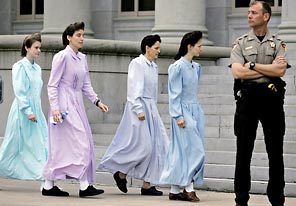
One of the entrenched ironies of human mentality is that reason will not suffice to change religious views. Many studies have repeated demonstrated that faith is impervious to logic, and this has appeared with Ektachrome clarity in the case of Warren Jeffs. Rev. Jeffs, the leader of the Fundamentalist Church of Jesus Christ of Latter-Day Saints, has painted himself into a mental corner that makes the logic of legal proceedings appear as slapping the idiot. Logic and faith do not connect. Any Christian who has read the letter to the Hebrews should know that. Nevertheless, Rev. Jeffs, having illogically dismissed his team of lawyers, has been attempting a divine defense to justify his alleged sexual abuse of minors. He remained silent during his opening statement, despite judicial advice that such a tactic might harm his case. Breaking silence yesterday with a nearly hour-long sermon, faith responded to logic and was found wanting.

Society at large fails to consider that studies of religion have been carried out from multiple angles over many decades. We have erudite studies of the philosophy of religion, the psychology of religion, the anthropology of religion, and the sociology of religion. They all point to the human origins of this phenomenon, often demonstrating that a basic disconnect remains when religious belief is brought into the harsh light of logic. Neurologists and biologists have explored the utility of religion as a survival tactic, and evolution seems to have blessed it. Yet trial lawyers, judges, law enforcement officials, and politicians—often themselves religious individuals—are charged with apprehending and convicting others who simply take their religion to extremes. Religions make untenable demands on adherents. God has a poor record of turning up in the courtroom. His divine statements are absent from the stenographer’s tape.

Not knowing the details, it is difficult to find much sympathy for Rev. Jeffs, should he be found guilty. Yet at the same time, his interpretation of religion differs only in a matter of degree from other religious sexual ordinances. Is it normal for a clergyman to live a lifetime of enforced celibacy? Although signing on the dotted line may indicate a tacit agreement with church policy, what young man can clearly anticipate the pressures of decades fighting biology and psychology? Yet the practice is perfectly legal. Until the nearly inevitable inappropriate results squirm out. Public rancor runs high, as it should, against child molesters. The children are innocent victims. The perpetrators, however, believe themselves to be following divine dictates. It would seem that much suffering would be ended if God would go on the record here, so that we might have solid evidence with which to judge the case. If it please the court.

Photo credit: Tony Gutierrez, AP, from The Seattle Times


Defining Humanity

Positions of power replicate themselves. In a sense this is understandable as power is the most addictive substance on the planet. Once superiority is asserted, it will never allow itself to be uprooted. With the recognition of homosexual marriage in New York, many heated reactions sprouted from the position of power man-plus-woman (always in that order) camp. Such a response was predictable and anticipated. I suspect it is largely based on fear. I have many friends with differing sexual orientations than mine. Raised to castigate such individuals, that outlook became increasingly difficult to uphold once I got to know my gay friends as people. I count them among my most loyal friends. People are people.

The problem lies in labels. Humans are natural categorizers: bird, fish, or mammal? Predator or prey? Religious or secular? We want our world to stay true to categories we devise. People, however, are seldom easily classified. Still, we try: skin color, ethnic ancestry, religious heritage, sexual orientation. People are people. The world of trite classification is ending, and those in positions of power tremble. Anything that is different might upset the economic balance that keeps those on top in their positions. (My own amateur observation, however, is that the economic balance is naturally top-heavy and readily upsets itself. It seems to have been that way since before this blog began.) Would we not do better to try to understand those who are different than ourselves?

As an exercise in this direction, I recently read Alvin Orloff’s smart satire, I Married an Earthling. As my long-term readers know, I have a slight soft-spot for aliens, and this story of a gay man finding nothing but rejection on earth and eventually marrying an alien seemed quite fitting in the present climate. Not part of the gay subculture, many aspects of the story were foreign to me, but what was painfully clear throughout is that people are people. Some are accepting, others are not. When reality offers so few options that he must flee his own planet, Chester, one of the protagonists, takes to the stars. At a couple points before his exodus, he notes the role that religion played in his antagonists’ outlooks. The book is lighthearted and funny overall, but the serious issue remains. Those in power tend to horde privilege. When that happens, economies—material and spiritual—collapse.


Cross Swords

Occasionally the symbol of the Prince of Peace is used as a weapon. A current case playing out in New Jersey revolves around a Livingston man and his convictions. Originally erected for Lent, the homeowner in question placed a wooden cross within a municipal right-of-way zone where signs and potential distractions to drivers are prohibited. When informed of the violation the owner removed the original cross and placed a larger one just within the right-of-way zone. When asked to remove it he contacted the Alliance Defense Fund—a group of Christian lawyers (which sounds apocryphal to me) who advocate the spread of the Gospel. This bizarre case is now being cited as a test of a land-use law that protects religious expression. A few inches would have resolved this entire mess. Had the homeowner placed his second cross beyond the restricted zone, no fuss would have been made.

I don’t really feel safe in a world where bands of renegade Christian lawyers rove about seeking to support the violation of public safety ordinances. Instead of friendly persuasion the cross is here used as a cudgel. Perhaps wearing one’s religion on one’s sleeve ought to be accompanied with a measuring tape. Certainly there are those impressed by the masculine chest-thrusting implied in defying laws to assert one’s particular take on religion. Pushing such issues to the point of public funds being spent to enforce a law throws the action into sharp relief.

Some varieties of Christianity (and other religions too, I’m sure) thrive on the fiction of persecution. Is the quality of life of the homeowner affected deleteriously by not being allowed to place a cross in a no-sign zone? Is it not rather an attempt to set, in H. Richard Niebuhr’s phrasing, Christ against culture? What friends (besides lawyers) does it win to the cause? Having gone through a phase myself where PDR (Public Display of Religion) was considered the only way to be authentic about belief, I think I might understand the original intent of the homeowner. A clergyman, however, long ago set me straight with a frank discussion of subtlety. What I came to realize is that shoving only leads to shoving back. Perhaps moving the cross six inches would be the equivalent of turning the other cheek? But when the other cheek is turned, lawyers don’t get paid.


After the Carapture

When my wife showed me the first news article about “Carmageddon” I shrugged my shoulders with a noncommittal “meh.” Now that the nation has somehow managed to survive the two-day closure of a highway in Los Angeles, commentators are wondering what this reveals about our cardolatry. As a nation, the United States worships cars. Last week predictions were made that traffic jams of biblical proportions would disrupt the second largest city in the country and that not even God would be able to sort out the mess. In Norway, in the meantime, a right-wing conservative Christian decided to tip the scales of justice by becoming a mass murderer. Why do we glory in our own destruction?

Human beings only developed what we recognize as religion after the advent of the city. Cities require temples and temples require religious infrastructure. Priests had much to gain in antiquity by proclaiming the wrath of God—the angrier the deity the more offerings that roll in and the wealthier priests become. Religion has evolved over the five-and-a-half-thousand years of civilization, but it has never had a true conversion. It is one among many ways of coping with the stresses of becoming an urban population. We live in cities and we have traffic jams. We live in cities and learn from those far different from us. We live in cities and bomb our enemies in the belief that God finds those far different from us evil. Apparently God approves of the killing of teenagers. Just ask old Ramesses about that one.

Norway is among the most non-violent and secular cultures in the world. Los Angeles is a liberal city among one of the most religious cultures on earth. They experience the wrath of God in different ways, according to the media. Cities gave us religion. When we had had religion long enough, cities began to withdraw from that particular approach to life. When we can’t get our cars where we want, it is the wrath of God. When we can’t get the government to follow our personal religious quibbles, we take the prerogative to introduce the wrath of God. We long for the end of what we have created. No matter how we achieve such destruction, we’ll find religion planted squarely in the middle.

What's coming to your neighborhood?


Robot Ethics

One of the benefits of being affiliated with Rutgers University, if only part-time, is keeping a finger on the pulse of the future. No, I’m not on any admissions committees. Rather, this week, now available on YouTube, the university is advertising its robotics ethics program, geared mainly toward high school students. Perhaps reading Robopocalypse is not the best introduction to robot ethics, but it does raise a very serious issue—how do robots and ethics fit together? We haven’t even figured out human ethics yet! One of the principal concepts behind any ethical system is intention: did a person (or rarely, a higher animal) mean to do what it did? If an action has brought harm to a person, we need to know if it was intentional or not. In a world where artificial intelligence is just around the corner, we need to sort out how this will apply to mechanical minds.

Perhaps—if human minds are just soft computers—when robot minds are created they too will have a god concept. Neurologists and philosophers and theologians debate when the human concept of god originated and no consensus has emerged. It may be a by-product of “mind,” however we define that. If computers are eventually assigned true mind, will they also believe in God? According to Wilson’s fictional construction in Robopocalypse, Archon thinks “he” is “god.” Humans tend to project God out there somewhere. None of us has the power ascribed to God, and even if individuals claim otherwise, we don’t actually believe we are divine. Would a computer know?

Pressing just a little further on this, human ethics are always subject to corruption. It is clearly seen, almost advertised even, in politics. Not only do we find government leaders with their trousers down or with dirty money in their hands, we also find the same in ecclesiastical settings. Would robots become corrupt? Wilson calls the corrupting agent a virus, a real enough phenomenon. According to the Rutgers video, within two generations every home will have robots in it. The question is: what will their ethics be? I probably won’t be around to see it happen, but I do have a profound hope. My hope is that whoever fabricates robot ethics will be well aware of the failure our governments and religious institutions have made of the attempt.

Danger! Danger, Will Robinson!


Parry Hotter

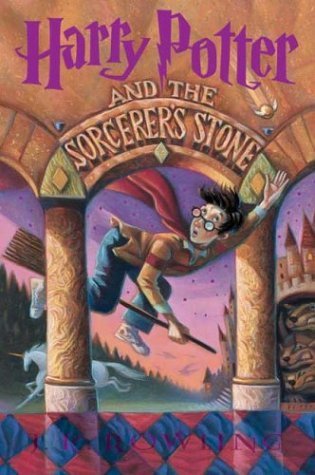
With the final Harry Potter movie opening this weekend, it is clear that the brainchild of J. K. Rowling will live forever. When the books first started to gain popularity numerous Christian groups protested that children would be tempted into witchcraft by the appeal of the young protagonists. Ironically, standard Christian teaching denounces the power of witchcraft, although some groups do still acknowledge a very active devil. Now that the series has run its course–all the movie spin-offs of the novels are complete–many are coming to the realization that the message is profoundly ethical if not downright religious. As usual with knee-jerk protests, the message is missed for the medium, and those with fragile faith clamor for a spell of their own to put an end to opposition.

Joining the bandwagon late, I first started reading the Harry Potter books when the third or fourth volume had been published and public interest was riding high. I haven’t kept up with the movies, however, last watching Goblet of Fire at a theatre in Wisconsin while contemplating my own position at a school like Hogwarts, minus the magic. The books, however, convey the message more clearly–the power of evil is real, good is not always what it seems, and institutions can’t save you. The importance of love (the main thrust, many would contend, of the preaching of Jesus) is the driving force behind the story from the moment Lord Voldemort (the Darth Vader of the twenty-first century) failed to kill young Harry Potter. Perhaps the true concern that many religions have with Rowling’s work is that it has trumped the traditional mythology with a bit more style and panache.

As a regular Protestant Christian, Rowling expresses traditional beliefs in her writing. The fantasy of witchcraft, however, has always maintained a lure for those cut out of society’s pathway to wealth, recognition and ease. In the days before Christianity, the early Israelites believed the power to be real to the point of making witchcraft a capital offence. Of course, omnipotence had not yet been invented. Once a deity becomes all-powerful, why should fear remain concerning magic? More likely protests against Harry Potter had less to do with the witchcraft than with the insecurity that many believers feel about God. The plan doesn’t seem to be unfolding as the Pat Robertsons and Timothy LaHayes are saying it should. Doubt is a much more powerful force, it appears, than magic.


Cherry Pie

It is one of those days when it is too hot to move. The heat is the kind that gives you a headache, and the Internet beckons. Thus I came across Cherry Hill Seminary. Having been a seminary professor in a previous life, I’m always interested in the craft. This particular seminary, however, is unlike any other. Advertising itself as “the first and only graduate-level education for Pagan ministry in the world,” Cherry Hill offers pastoral education for those who identify themselves as Pagan. I find the concept fascinating. In an age where the standard offerings of the religious marketplace are experiencing their own kind of recession, the alternatives seem to be flourishing.

Just last night I was explaining to my class how the difference between the religious and the pagan is simply a matter of perspective. Used pejoratively “pagan” means any non-Christian, generally. “Infidels,” “heathens,” or “godless fill-in-the-blanks”—religions crave the handy moniker to make those who are different into “the other.” It is easier to detest a person with a label. Cherry Hill Seminary, however, offers a respectful view towards religious education. The school, which offers its program online, has the goal of educational accreditation. From some of the seminaries I’ve experienced, the bar should not be too high. My only concern is that the uniqueness of this program might fade into the background against some of the weirdness that ATS accredits among the mainstream schools.

Starting at least as early as the Bible, religions have looked upon each other as dogs straying into a bigger dog’s yard. Each one wishes to be the strongest one, the most respected and applauded. Why should paganism be excluded? Requiring a bachelor’s degree for admission, Cherry Hill offers courses in Text, Tradition & Interpretation; Nature, Deity & Inspiration; Pagan Pastoral Counseling; Public Ministry & Expression; and Pagan Advocacy & Leadership. Some of these offerings sound more informative than various seminary classes I suffered through. And on days when it’s hot like this, fantasies come easily. It is not too hard to imagine, especially based on my own experience, being treated more humanely by a pagan than by one who claims my own religious heritage.

When the cherry tree blossoms...


Right by the Numbers

Reading about ancient religions helps to focus the long view. I’m brushing up on ancient Egyptian gods for my Ancient Near Eastern Religions class. Seeing how various gods rose to prominence with the fortunes of their patron kings or priesthoods suddenly struck a chord for modern-day religions as well. Many of society’s most conservative like to think that this is the day of Yahweh (or, not to put too fine a point on it, Jesus). This pre-biblical god has come into his own with the rise of the Catholic Church, following on from the conversion of Constantine, into the post-Reformation development of Evangelicalism. With the superiority of numbers and fiscal wealth, there is no disputing the one true god, is there?

What happens when the ultra-selfish free market consumes itself to a point that other cultures rise above it? Already outnumbered in souls by China and India what will Americans say when Buddhism or Hinduism outstrips Christianity? Is religion proven correct purely by the numbers? Cultural dominance has become inseparable from religious truth for many brands of Christianity. If in doubt, check out Andrew Schlafly’s Conservapedia (if any state would like to take him off New Jersey’s hands, you are certainly welcome). Being the right religion means being the might religion. Somewhere along the way it seems that the message of Christianity has become equated with bullying others around. I think Jesus must have gotten pushed around quite a bit as a kid on the playground.

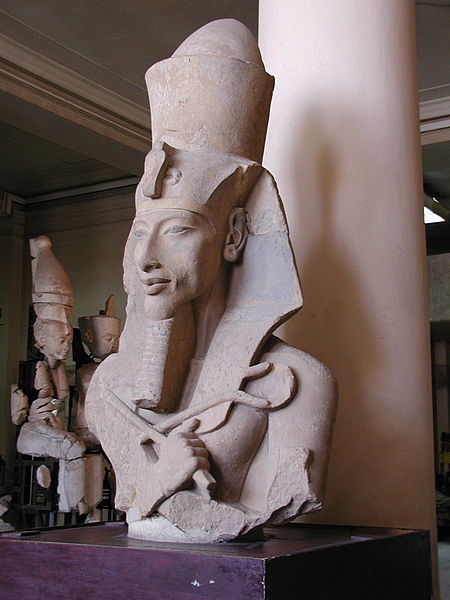
What's behind that self-satisfied smile, Akhenaten?

When Amenhotep IV became king of Egypt, the priesthood of Amun had grown very strong. Probably in an effort to suppress this powerful rival, the king changed his name to Akhenaten and promulgated the sole worship of Aton. Some like to give Akenaten credit for being a monotheist. To me it seems more likely that the old pharaoh was attempting to show intolerant bullies the way to behave: use religion to political advantage. If the opposition disagrees, shut them down. Problem is, this doesn’t work well over the long term. As soon as the unpopular king died, the former religion reasserted itself and things went back to the way they had been. Tut, tut. Seems like religious bullies never learn.


Religion Underground

Imagine a world where the affluent live in lofty houses and the poor, working class citizens trudge to long, dreary, factory shifts in order to keep the system working from their underground world. Although it’s not exactly post-recession America, it is not too hard to imagine. On my final day of vacation from relative unemployment, I watched Metropolis for the first time. A 1927 silent film, this movie of a dystopian world run by an unsympathetic ruling class is experiencing somewhat of a revival. Panned by early critics, the film is now often categorized as a classic of the silent era. It was also the most expensive silent movie ever filmed. Shot in Germany between the two world wars, the story follows a surface dweller who has fallen in love with a troglodyte. It even has robots.

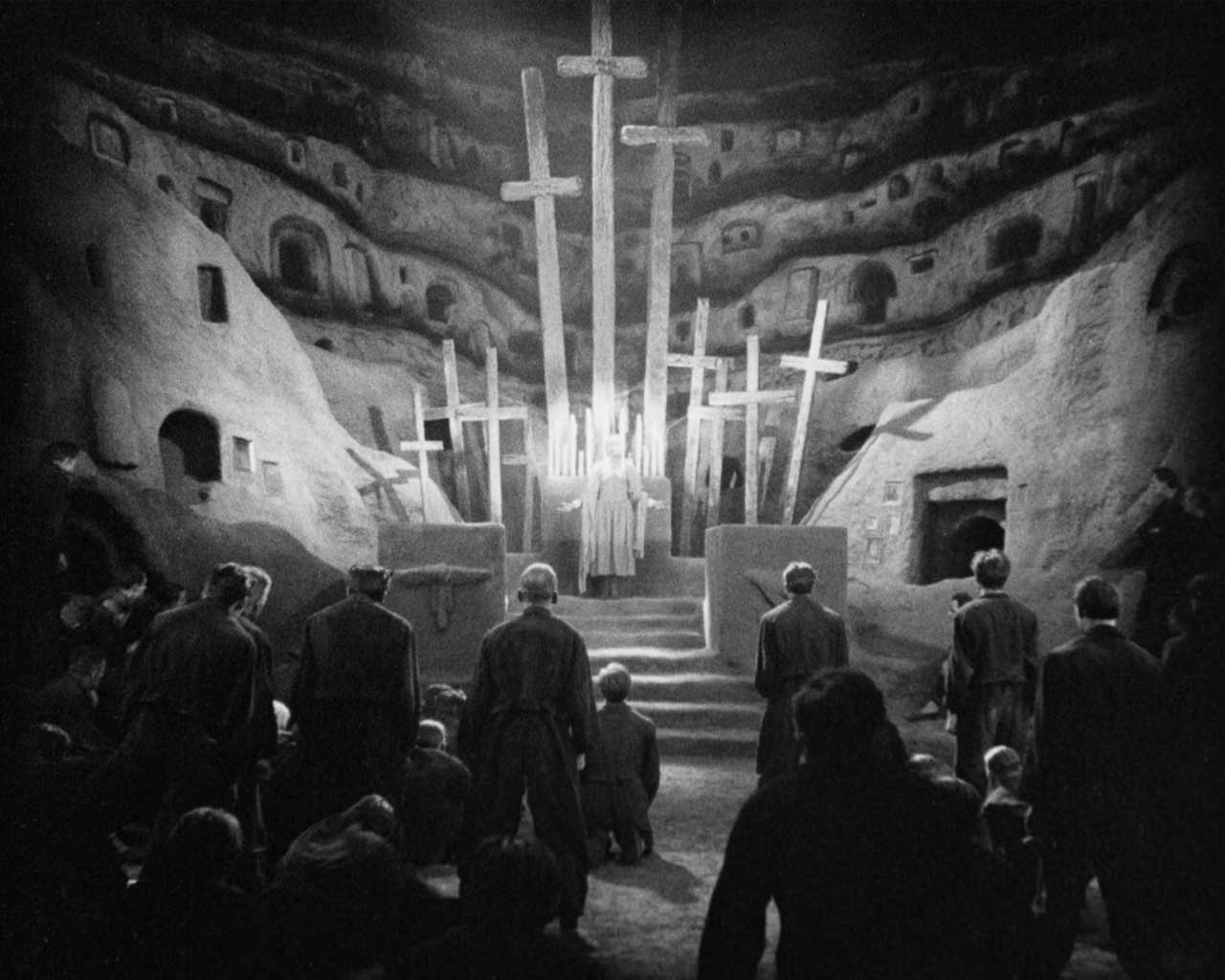
This Fritz Lang film fits in this blog because of its many biblical references and themes. Freder, the protagonist, falls in love with Maria, a working-class preacher among the underground laborers. Following Maria to the underworld, Freder sees the gargantuan machinery that runs the lives of the poor, and when workers die in an accident he calls out “Molech!” Molech, the putative god of child sacrifice in the Hebrew Bible, is shown as a fiery factory door consuming the forlorn men who dutifully march inside. Maria, however, teaches love and patience in suffering. In an underground cathedral she is the sole cleric long before most denominations recognized women as ministers. She compares the skyscrapers of the rich to the tower of Babel and insists that a mediator will come. With its strange blend of Christian and communist themes, this film made a significant impact in its time.

In our own day of entrepreneurship with faux-Christian backing it goes unnoticed that the Christianity of the first century was what might be called communistic. According to the book of Acts, early Christians keep their goods in common to ensure that everyone had what they needed. Among the disciples, Judas kept the common purse. What marked these early Christians as exceptional in the eyes of their earthly overlords was the concern that they had for one another—selfishness had no part in their religion. When Christianity became the religion of empire the lure of worldly goods distorted it almost beyond recognition. Christian industrialists built the tower of Babel with its leering Molech beneath the surface of the ground. Judas, it seems, has become the ideal role model for such a religion.

Maria's underground cathedral


Hope Soap

I have the distinct good fortune of an occasional sanctuary. I married into a family that owned a share in a remote cabin on a pristine mountain lake. When I can afford it, I make the long journey during the summer and wonder why anyone would ever want to live anywhere else. When I began coming here in the 1980s, the preferred method of bathing was in the cold waters of a meltwater-fed lake. Although I’m extremely sensitive to cold, I’d nevertheless take the plunge and I’d always take my Dr. Bronner’s Magic Soap with me to lessen the environmental impact. My wife and I bought our Dr. Bronner’s at a local health-food store and were pleased not only with its eco-friendliness, but also with the many religious/philosophical sayings printed on the bottle in tiny script. After using Dr. Bronner’s yesterday, I decided to learn a little more of the religion on the bottle.

Dr. Bronner's in its natural environment

Emmanuel Heilbronner emigrated to the United States shortly before the Second World War. His parents were murdered in the Holocaust, but Heilbronner, shortening his name to Bronner, developed a religion that promoted love and peace, making him a popular figure in the hippie movement. He called his philosophy All-One-God-Faith or the Moral ABC and he had tenets of his religion printed on each bottle of his product. The factory he founded remains unmechanized and produces over a million bottles a year. The soap is not animal tested. Ironically, the bottle I used yesterday was purchased back when Dr. Bronner was still alive: visits to the lake are tragically brief and the soap is concentrated and lasts a long time.

Dr. Bronner’s religion is a blend of his father’s Judaism with Christianity and a sprinkling of Islam. Bronner was a promoter of the benefits of monotheism, and his eccentricity may partially be accounted for by the fact that he was treated with shock therapy in an asylum while developing his philosophy at the University of Chicago. Society has a way of trying to silence those who speak with conviction—especially if the conviction doesn’t lock step with those who secretly admire McCarthy. It is fitting, in tribute to this free thinker, to give the final word to Dr. Bronner: “1st: A Human being must teach ‘Love His Enemy’ to help unite all mankind free or that being is not yet Human! Jesus #1. Based on African astronomer Israel’s: ‘Listen Children Eternal Father Eternally One:!’ Exceptions? None!”


Patriot Games

Earlier this week I had the occasion to find myself in Newark’s Liberty Airport. I had mentally prepared myself for a government-sponsored groping (I find full-body scanners immoral and, no matter what the Patriot Act says, illegal) but I managed to make it through with just emptying my pockets and walking around in my stocking feet. Once I arrived at the gate area, I was once again struck by the duplicitous use of religion in America. Posted above each gate was a small banner reading “God Bless America” surrounding a stylized flag. I thought of the Hindus, Buddhists, and atheists flying out of that terminal (and in Newark I am certain there were all three species, in spades). Since 9/11 the staffs of the large New York City airports are justifiably cautious, but the blending of nationalism with divine will always makes me nervous. Especially since the weightier implications are so readily ignored.

In the biblical world the ideal was that travelers would be treated fairly. Someone away from home is already at a disadvantage. In ancient times the traveler deserved special consideration, not to be swindled or met with unfairness. Looking around at the prices merchants charge for those who’ve gone beyond the gate and have no choice, it struck me how when religion and economy collide, economy always continues on unscathed. The weary traveler, according to the Bible, especially deserves fair treatment. Charging extra to someone already at a disadvantage violates just about every biblical standard that echoes through those unread pages. God bless America? Only if it fills the coffers.

The sentiment expressed in “God bless America” is vastly at odds with the way we behave. Taking advantage of others is the bane of prophets and messiahs alike. Taking care of the poor, the disadvantaged, the traveler—this is the biblical ideal. Instead it is easier to band-aid over our sins with posters asking God’s blessing on our insincerity. Many people fear Islamic fundamentalists without taking into account the more subtle damage done by our own homegrown variety, giddily holding hands with an unfettered free market. Cheating the traveler may not be as wicked as blowing up an airplane, but both these tangled vines, in the biblical view, spring from the same root.