In the Bleak Midwinter

Labels. They can be problematic. Given our human brain structures, we are predisposed to patterns and categorization. Is it edible or not? Predator or prey? Like me or different from me? We constantly scan our world, categorizing as we go, holding our people, experiences, and places in a temporary, floating mode of immediate recognition. I’ve had people who read my blog ask me, “What are you?” My guess is that they want a simple, pat answer: Christian or not, religious or not, dangerous or not. The more specific the better, since the more precise the label the better fit the box we stuff you into will be. Given the trajectory of my unorthodox career, it is common for me to be labeled as “theologian.” It is a categorization I deny, but since the study of ancient texts and myths generally falls under the rubric of “theology” it is not entirely inappropriate. I prefer to leave theology to those more intelligent than myself.

It is with great joy, therefore, that a new blog has emerged from a worthy theologian. Bleak Theology makes its premiere today. I have known the talented writer, Burke, for some time. And I know that some fantastic things will appear on this blog. In its own words: “Bleak theology is anxious, but not despairing. It is pessimistic, but not hopeless. It is materialistic, but not idolatrous. It doesn’t always have hope, but it certainly would like to have that hope… It’s a theology that gazes troublingly up at Mt. Moriah; that sits in sack and ashcloth and resists cursing God and dying; that cries out that everything is meaningless (meaningless!); that sits by the rivers of Babylon and cries; that staggers away from the crucifixion disillusioned; and, after seeing the stone rolled back and the dead vanished, leaves the tomb and tells no one.” We have great things to anticipate. Melancholy is its own variety of joy, as some of us are continually discovering.

Labels. Some people make a lot of the alphabet soup one is legitimately able to put after one’s name. A friend once told me that he’d heard a Ph.D. insist on being called “Doctor” by the attendant when he pulled into a gas station. I have a label for such people, and it fits better than the one they prefer. I have known and worked for Ph.D.-bearing individuals who just as dumb as the rest of us. Sometimes even more so. Theology is not a discipline where advanced degrees are required, for either those who have them or those who don’t. The fact is we’re all thrown into this same world together and, like it or not, no one has the answers. Some may don their papal tiaras or their fancy academic robes with striped sleeves, and claim hegemony, but the truth is we are all seekers. The best company one might hope to find is with the person who honestly struggles. Embrace bleak theology and eschew easy classification. There may be no hope for us yet.


Frankenstein’s Monster

“We are about to unfold the story of Frankenstein, a man of science who sought to create a man after his own image without reckoning upon God. It is one of the strangest tales ever told. It deals with the two great mysteries of creation – life and death.” So begins Universal’s 1931 classic Frankenstein (a movie that my wife kindly indulged me with for Christmas). Watching the film as an adult highlights many nuances unnoticed by even many a childhood viewing. The theatrical introduction of creating a man “without reckoning upon God” was heady stuff in the pre-atomic world. It was a simpler time before men had embraced god-like power (I use “men” intentionally here; even the credits for the movie ironically cite the noted feminist author as “Mrs. Percy B. Shelley”), and audiences were indeed shocked in theatres just 80 years ago.

The now tame movie was originally subjected to heavy censorship. Even the liberal states of Massachusetts, New York, and Pennsylvania censored the line where Dr. Frankenstein cries out, “Now I know what it feels like to be God!” A divine thunderclap was dubbed over the words to obliterate the blasphemous line. In Kansas (perhaps not surprisingly, given recent political developments) 32 scenes were cut, paring the movie down to half of its original 70 minutes. I suppose all that would have been left would have been the scenes of dancing Germans; the Lederhosen would have been frightening enough. The accidental drowning scene was overwhelming for many sensibilities in a pre-concentration-camp footage world.

I read Mary Wollstonecraft’s novel long before I ever saw the movie, and I was struck at how sad the story was. Of all the classic monsters, Frankenstein’s creation easily garners the most sympathy. A creature that did not seek to be brought to life, forced into destitute and desperate circumstances by a population who could not, or would not try to understand, Frankenstein’s monster retains the potential to be any one of us. Although audiences today rarely blanch at blasphemous words, we still permit a society that creates Frankenstein’s monsters through crafty politics and tax breaks. Perhaps when taking authority public officials should add a line from the movie to their oaths of office, only it could be demurely obscured by a well-timed thunderclap.


The Politics of Dentistry

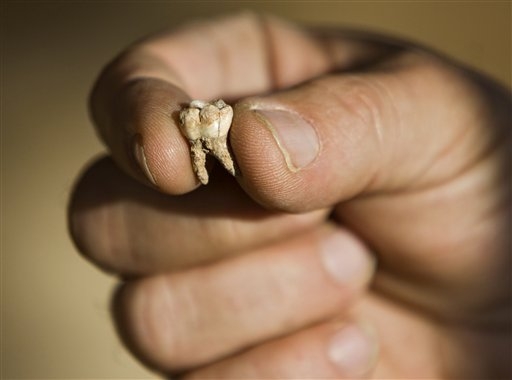
A story from the Associated Press on NPR this week announced the discovery of some teeth. No ordinary teeth, these perhaps belonged to Homo sapiens at 400,000 BP (“Before Present,” no apologies to gas-guzzlers). And they were found in Israel. Archaeologists from Tel Aviv University are quoted as stating this could rewrite the story of human evolution, suggesting that modern humans emerged some 200,000 years earlier than thought, and in Israel instead of in Africa. Now those are some ambitious choppers! Coincidentally, the discovery was announced the day I was discussing the earliest human occupation of the Levant in my Winter Term class. Of course. One of my students pointed the article out to me.

One of the endlessly fascinating aspects of archaeology and paleontology is the constant surprise of discovery. Often I have to remind myself that the past only exists in reconstruction. Once the moment is over it is lost forever, only to be rebuilt by specialists in documents and artifacts. Reconstruction, however, often comes with a political price tag. Anyone who follows the claims based on archaeological finds knows the folly of discovery. In disputed territories the work of archaeologists is used to stake claims to modern land ownership. Who in the world would not want to own the first location where modern humans emerged on the planet? What staggering claims could be made!

I have always sensed a comfort when thinking of human origins in Africa. Far from the (modern) industrialized mayhem of “civilization,” early hominids took their first tentative steps in Africa. Cut off from the rest of the post-Pangean continents except via the narrow passage of the Sinai, Africa harbored our pre-sapiens ancestors. Once they reached Asia and Europe, they interacted with Neanderthals, as genetics now demonstrate. Interaction led inevitably to extinction, so politics had to have been involved. To find the pre-political Garden of Eden, we need to cast our eyes on Africa. Anthropologists are even now disputing whether the teeth are of Homo sapiens or not. I find, when I’m in the dentist’s chair, it is best to leave politics out of the discussion.

From the Associated Press


Pleasant Points of Prayer

Point Pleasant Beach, New Jersey, is a fine place to meet the ocean. On the first day my wife and I were scouting out apartments in the state, my brother drove us to Point Pleasant Beach after dark that October evening. The rollers were thundering on the deserted beach as we raced down to dip our fingers in the Atlantic. We went back on sunnier days to enjoy the miles of delightful beach for which the state is justly famous. Point Pleasant has an old-fashioned boardwalk, hearkening back to more innocent days when entertainment was carnival style and the only electronics involved were the blinking, colorful lights. As a borough, however, Point Pleasant Beach has been opening its council meetings with the Lord’s Prayer for six decades. A judge has called that practice to a halt, according to Saturday’s New Jersey Star Ledger.

Perhaps the greatest challenge to all religions is globalism. Historically, the religions of antiquity developed when pockets of human habitation were relatively isolated from one another. Yes, people traveled, but not with the ease or frequency borne by steam or gasoline engines. Religions evolved slowly and took on the local character of the only people most believers were likely to ever meet. The ancient religions of trading centers already show the traces of syncretism that religious purists so abhor. When the sea-farers of antiquity met new people it was only polite, politic, and profitable to share their religions. Monotheisms, however, demand complete adherence to doctrine. They don’t mix well. In today’s world where travel is easy (if accompanied by strangers groping your privates, if you choose to fly) and lifestyles and religions become connubial, civil meetings have to take their new clientele into account.

The Lord’s Prayer is about as inoffensive piece of Christianity that may be muttered. Nevertheless, it makes assumptions about the religious make-up of the community. New Jersey is startlingly diverse in constitution. It is a fascinating experiment in people from all over the world learning to live together. In the past sixty years the ethnic make-up has shifted and no longer can boroughs assume that all members are Christian. The prayer does affirm the wish that the kingdom of the patriarchal Christian God should establish itself on earth. And as much as tradition is to be valued, so much is religious government, on any level, to be feared.

Simpler times on a New Jersey beach?


Watchmen Tell Us

When the local Blockbuster went belly-up a few months back, I was one of the vultures picking the bones. With new DVDs continually creeping up in cost, I look for bargains wherever they might exist. Occasionally I find something for just a couple of dollars that really makes me think. Although I don’t go to theaters often, a couple of years back the previews all featured The Watchmen. I’m not a graphic novel reader either, so it was doubly doubtful that I would ever gravitate to this film. But here it was on sale. Very cheap. The previews had shown Dark Knight-like action and despite my own declarations, I had to admit that I was curious. So I’ve watched it a couple of times and have been intrigued by what an (absentee) role God plays in the movie.

I won’t go into much detail since the story is complex and, to my surprise, sophisticated. Nevertheless, the Watchmen – retired crime-fighters both good and bad – forced out of practice by the government, fear the approach of nuclear war and try to fight back. At several junctures characters declare that there is no God or that they believe there is no God. The setting is an alternate reality in the 1980s, but the crossover between that world and this is evident. Godless heroes may save the day, but with a tremendous human sacrifice required. At first viewing, I was stunned. The message was so bleak and hopeful. The movie could have been made with no mention of God, yet, briefly, his absence was underscored. Strangely, the Bible features in a bedroom scene where a future hero is spending the night with his girlfriend. Why the Bible? Why here?

I would be the first to admit that I do not have the proper background to comprehend the plot. Generally I like to read the book before I see the movie. One of the recurring motifs in the movie version is the doomsday clock that moves dangerously close to atomic war. On top of the Bible is the hero’s watch, ticking inexorably down to midnight. Even I can figure out that the countdown to doomsday is based on the Bible. What the import of this is, however, I can only guess. What kind of world has no God but still has Bibles? A world where Watchmen aren’t wanted and yet are sorely needed. Who will save us now?


Peace on Earth

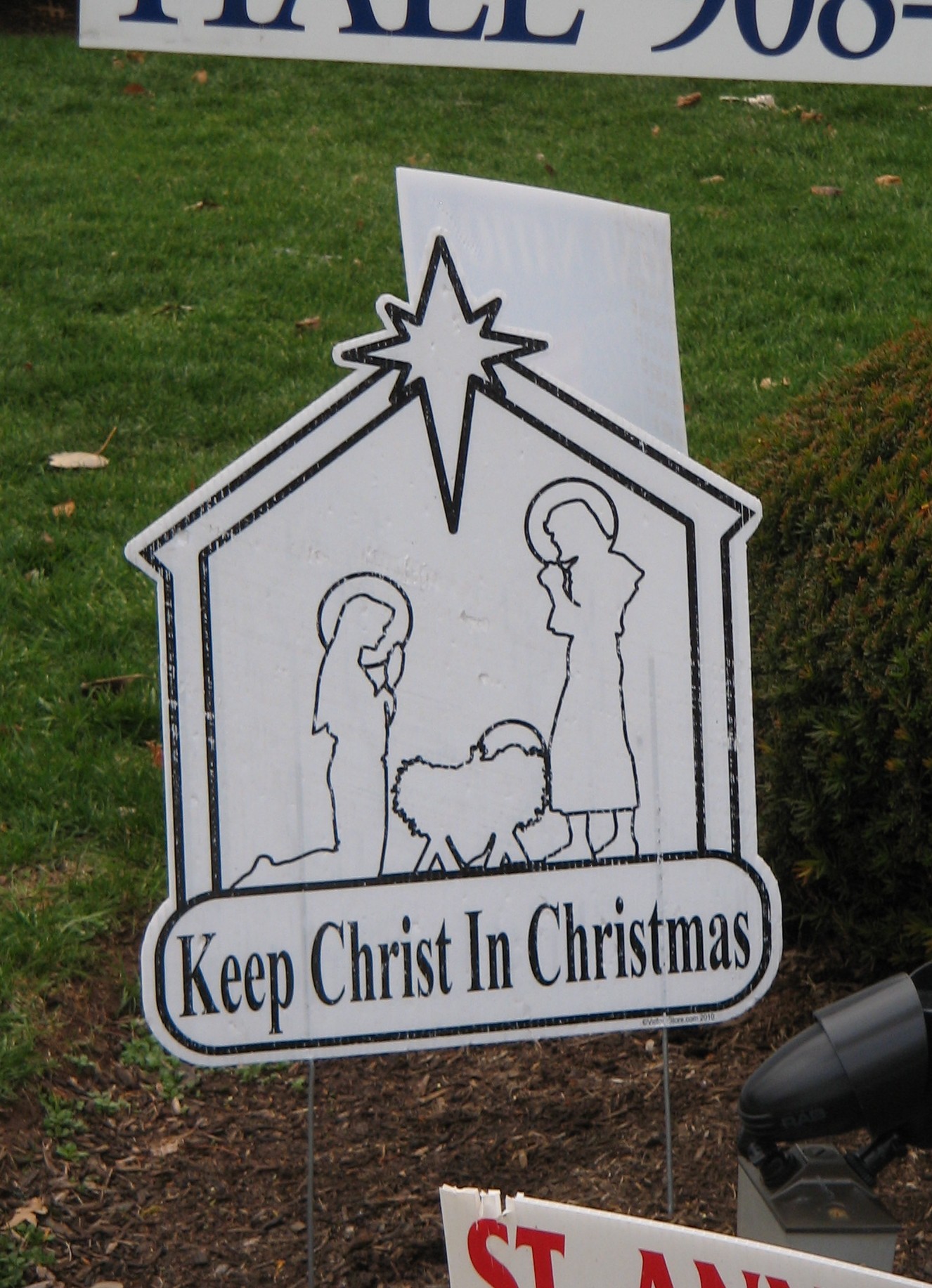
One of the most ironic of Christmas messages is “peace on earth.” The irony comes in the means of declaring that peace. Apparently first-century angels were declaring peace to the entire world, according to Luke. The peace that we see proffered, however, often extends only to those like us. What is the harm in extending Christmas joy to all? Must one be a Christian of a particular stripe before the joy of giving can be bestowed? Over the last several years various Christian groups have sought to reclaim ownership of the holiday they borrowed from the pagan Romans, Celts, and Anglo-Saxons. Make it exclusively ours. Peace to us, and let others find their own way home.

In a season of charitable giving, understanding seems to have fallen off the list of Saint Nicholas. In his guise as Santa Claus he makes the rounds of the entire world, according to the mythology that children are told. Do we ever really picture Santa delivering gifts to those who live in Iran, North Korea, or Afghanistan? Does peace on earth apply to them? The thing about peace is, unless everybody has it nobody has it.

Can we learn to share Christmas? Those who fret over Xmas forget that first-century Christians abbreviated Christ with an X (chi in Greek), just as they represented him by a highly stylized fish. Today an empty fish on your bumper declares what an X cannot, apparently. The message is that Christmas belongs to us, not secular pretenders who just want an excuse to make their kids happy. For most of the history of Christianity, Christmas had been a low-key event, barely noticed by most of the faithful. When the possibility of material gain was added in, however, the holiday became especially holy. Should we share the doctrine but not the gain, or should we make Christmas a gift to all the world – a season when all might reasonably hope for peace?


The Bible Tells Me So

As part of my regular Hebrew Bible class, students prepare classroom presentations for the end of the semester. This gives them a break from constant lecturing and also serves the function of initiating discussion. I assign social issues for them to discuss vis-à-vis the Bible; they can discuss these with each other in group-sessions throughout the semester. Since no one knows “the answer” when it comes to the Bible, I figure we can all learn from each other. I’ve been using this exercise for four years now, and at a school the size of Rutgers, you’d expect a wide variety of perspectives. This occurs, to be sure, as does more predictable stances. After fourteen weeks of instruction, most of them can only find the Bible a trove of prooftexts.

Learning to integrate biblical study into a rational worldview is difficult in our cultural climate. From nearly every medium from which religion wafts – Internet, television, newspaper, personal sermonizing – it comes out literal. The Bible/Quran says… (fill in the blank). What occurred to me during the student presentations is that scriptures of all descriptions become dangerous when their context is lost. Politicians, often among the arguably least educated members of society, argue about what the Bible says. Problem is, the Bible was written from a pre-Enlightenment viewpoint, a perspective that is out of reach to all but the most utterly naïve. Even to understand worldviews from the pre-Enlightenment you need to spend years of serious historical study.

So here’s our dilemma: we live in a society enamored of a book it doesn’t understand. Bible verses are used like Band-aids, pasted over every perceived rupture of continuity, but never quite reaching to the ends of the wound. Even after a semester of bald instruction – in the case of Nashotah House three semesters – students generally revert to what they know. To learn what the Bible instructs, take a pair of mental scissors, snip around the pericope, and tape the verse over the issue. There is, however, always a backside to the page. And most students never learn even to turn the page over to see if both sides agree. They could be ready for a life of politics.


I Can’t Ear You

I bought a box of Q-tips in the store the other day. I noticed that the package shows humans using the cotton swabs in a variety of ways: around the eyes, nose, eyebrows, even on a computer keyboard. Everywhere but an ear. The suggestive shape of the Q-tip, as well as the received wisdom of everything from the South African name “ear buds” to Mad magazine, indicates that they were invented for ears. We all share that somewhat unsavory habit of forming earwax, and doctors warn that using cotton swabs may impact the matter and lead to complications of hearing. Q-tips (originally “Baby Gays” – check out the Q-tips website) are no longer for ears. In the back of my mind I supposed that it was because of lawyers. All it takes is one litigious sophomore and companies run to their attorneys to show that the faulty application wasn’t their suggestion.

Laws run our lives. One of the most famous, but by no means the first, law-givers was Moses. I’m pretty sure Moses didn’t say anything about what to stick in your ears, but he did lay down the laws that Neo-Cons still argue should govern our lives just like the Quran governs the laws of Iran. The laws of the Torah, however, were only meant for the Israelites. Nevertheless, laws have become means of growing wealthy. If we can prove on a technicality that my dumb mistake was somebody else’s fault, why not have that person (or better yet, company) sued to within a millimeter of their lives claiming “damages”? The law has become a means to protect the special interests of those in power. As someone who has tried scrupulously to keep the law my entire life, I sometimes find that old Moses seems to have turned against me.

Laws are meant to protect the rights of people. When did laws shift to becoming instruments of entrapment and means of income? Just before leaving Wisconsin I was driving my family home from a movie. We were talking and laughing when I came to a speed-trap area of my local town where the speed limit drops from 45 to 25 m.p.h. within a matter of inches. Religiously I always complied. Today, in the spirit of the moment, I neglected my usual caution and was pulled over. A policeman young enough to be my son lectured me on unsafe driving (I began driving when he was still wearing diapers, and I had never been given a ticket before because I am not a speeder) before issuing me a citation. My wife couldn’t believe it – she knows that I never speed. One of my last memories of Wisconsin is being unfairly targeted by a law devised to bring money to the local police force. It has nothing to do with safety, since there were no houses or buildings for several hundred yards yet after the slow-down zone. Has the law come to free us or oppress us? Lawyers watch our backs, and law-makers watch their wallets. I want to ask Moses, but I’m afraid I won’t hear him. I seem to have a cotton swab stuck in my ear.

Lead us not into temptation...


Holiday Cheer

Christmas carols are, it seems, intended to fill holiday shoppers with good cheer. Good cheer opens wallets and purses and everybody is happy until January’s bills make their epiphany. Until then, sing songs of gladness. Princeton University, one of the few financially stable institutions of higher education, each year gives a gift to the community. Some Sunday in Advent a free university Chapel Choir concert is given in a campus chapel the size of a modest medieval European cathedral. The music varies from year-to-year, but seldom is the church not full with locals taking time out from holiday shopping or grading papers. One of the carols yesterday, was the 1914 French piece, “Christmas Carol for Homeless Children.”

Princeton, like most schools, does have a heart buried beneath its deep, cold, jobless front. Chapel choirs like to shake up the status quo by throwing in an occasional piece that requires somber thoughts and social consciousness amid the joy. The French carol dates from that fearsome first year of World War One, a time when France was especially under the gun. The wish for the world at the time was peace – material gain had not yet become the measure of God’s grace. The hymn is sober and wrenching:

We have no more house nor home!
Enemies took all we had;
all gone, all gone,
even our own little bed!
The school they burnt;
they burnt our teacher, too.
They burnt the church and also the Lord Jesus Christ,
the poor old beggar too who could not get away!

Singing it in French may take away the vinegar of the words, but wartime is not the only circumstance that finds people without sufficient means. Even unchecked capitalism will lead to the same results. Only, instead of the Lord Jesus Christ being burnt, he is sold in the markets to make a tidy profit.

Baby Jesus says, "Bring on the gold!"


Hunting Vampires

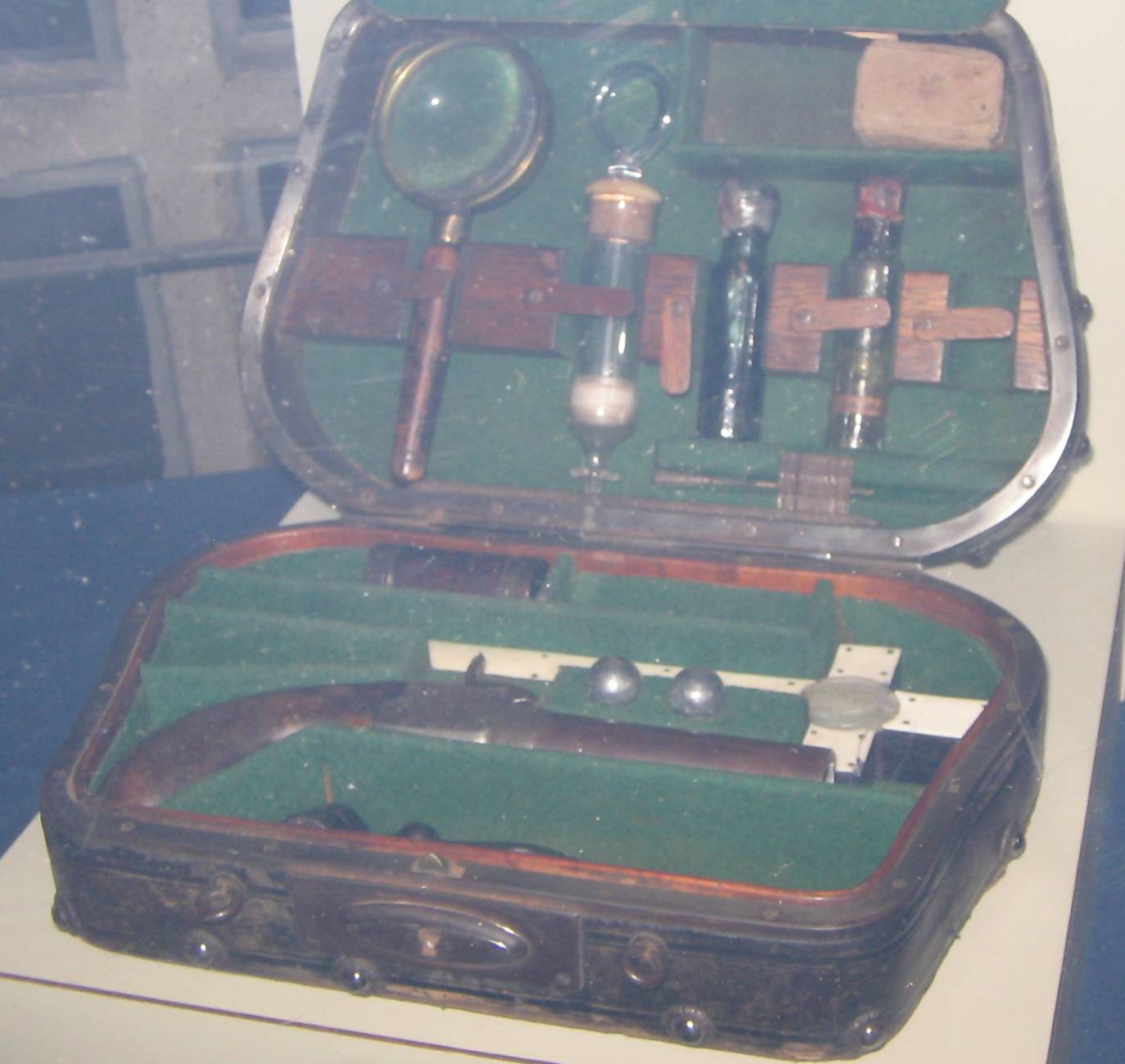
The Mercer Museum in Doylestown, Pennsylvania is a treasure trove of Americana from the turn of the last century. Henry Chapman Mercer, in addition to being wealthy, had the foresight to realize that society was rapidly changing, even back then. He undertook the collection of everyday artifacts from many human industries, poured himself another castle-like concrete building, and housed the baubles there. It is a fascinating walk through nineteenth-century America. And if you visit on a cold day it feels as well as looks like Currier and Ives have just passed through. My main draw, however, was a vampire hunting kit.

If only I had a polaroid lens...

Prominently displayed, the kit includes a Victorian Protestant’s tool chest for any blood-sucking eventuality. A cross (sans corpus), a pistol with “silver” bullets, glass vials with various apotropaic ingredients, even a little stake, all in custom-cut green velvet. Unfortunately, the kit is believed to be a forgery, although the items in it are from the Victorian era. The silver bullets are, for example, pewter. As the placard notes, vampires do not exist, but that doesn’t mean people didn’t believe they might have existed. The museum, naturally enough, hoped that the Victorian era kit might be authentic. Scientific analysis has revealed otherwise despite the fact that many people continue to believe in something that has no basis in reality.

Belief constitutes reality. Otherwise, how could it be that thousands, if not millions, of people don’t accept the fact of global warming? Brash barons of unhindered industrial progress insist that humans can’t harm the planet – it’s just too big. We can suck out all the resources that billions of years have deposited in intricate recesses and that nature has sprouted right on the surface. For, they say, God has given them to us. They believe that. If we held a mirror up to them, what would we see? Maybe we would be forced to change our minds and go after that vampire-hunting kit after all.


Mercer Metaphor

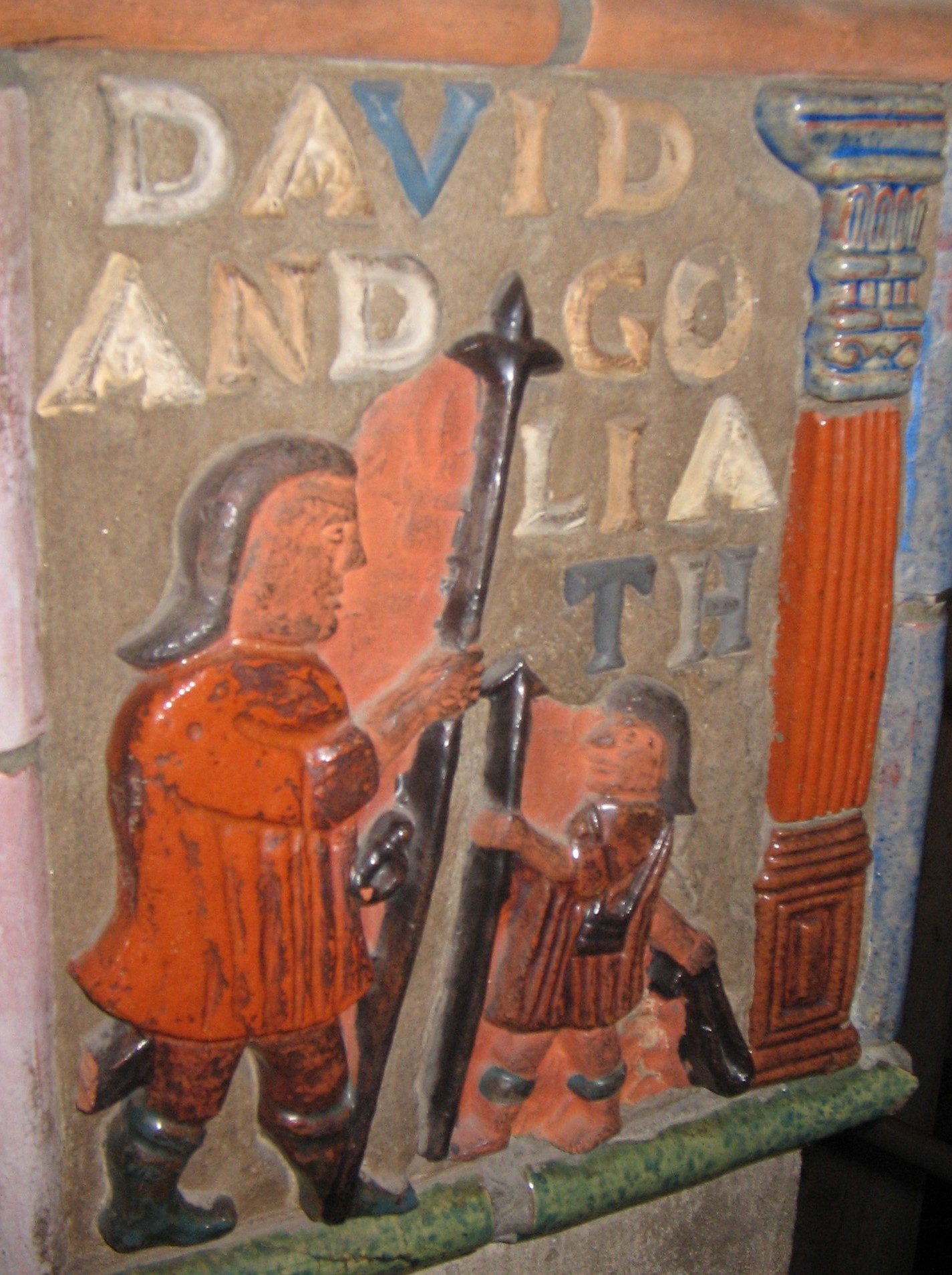
Not being a follower of the rich and famous, I had never heard of Henry Chapman Mercer before visiting his house. Mr. Mercer has long departed, but he was a tile-maker with a very rich auntie back at the turn of the penultimate century. Being from Doylestown, Pennsylvania, Mercer poured his money (literally) into a castle made of concrete. This sturdy, labyrinthine structure, called Fonthill, is a five-story museum that is an hommage to ceramics and the art of tile making. The friends who introduced us the museum enticed me with the information that Mercer had embedded Sumerian tablets in the wall of his concrete mansion. Indeed he had. Standing in the house that Charles Dickens once visited, I realized that the literary connections stretched beyond Sumer to the lifetime of Mercer himself. And right in the middle was the Bible.

Who might that giant be?

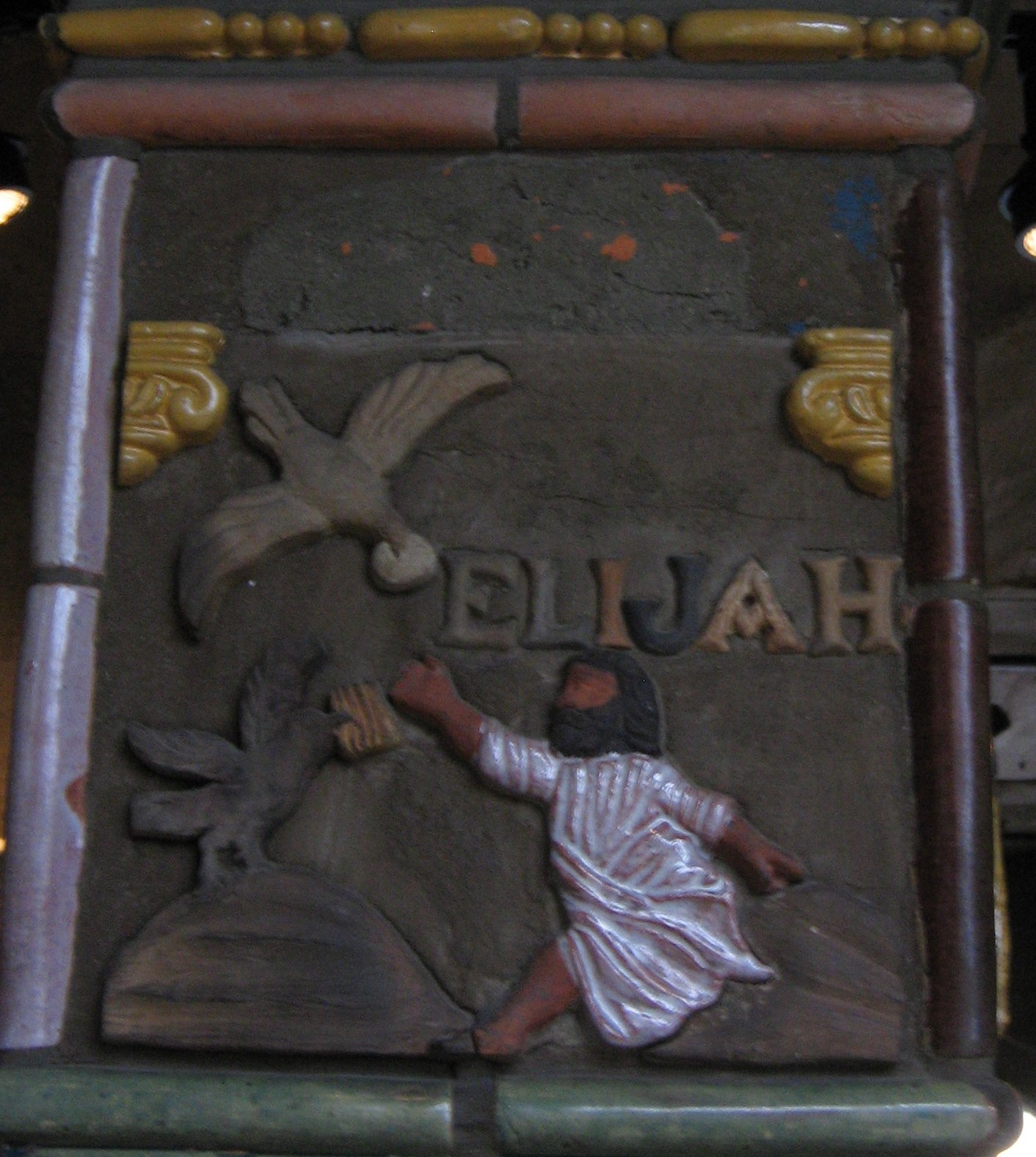
There is so much to see in every room of Fonthill that I could not hope to take it all in. No photographs are allowed inside, so I was desperately trying to remember every square centimeter that I was lucky enough to examine. The Bible, however, came in the form of clay. Mercer designed tiles. A tile factory still sits on the grounds of the house. Many of these tiles depict biblical scenes. Perhaps sharing a shudder with most of the wealthy, Mercer had concerns for the afterlife. The Bible is the balm in Gilead. Although I couldn’t take photos in the house, pieces made from the same molds adorned the nearby Mercer Museum that we visited later that day. Both buildings lack adequate heating but abound in human-made stone. I snapped a couple of biblically themed tiles before eagerly heading to the warmth of the car.

Elijah reaches for a handout

Meanwhile the news declares that unemployment benefits are being shortened by a bloated government. Those who’ve been forced out of work by a capitalism out of control will now have to make their own jobs, it seems. Bush-era tax breaks are being desperately defended by congressmen who look surprisingly well fed. The rich have never had it so bad. Henry Mercer did not have to work for his money, yet the Bible adorns his monument in stone. Fonthill is definitely worth the trip to Doylestown. While you’re there, look for the ubiquitous Bible. The Bible, although possibly the most misunderstood book in human history, lends its gravitas even to the vaunted towers of Babel.


Impossible Kingdom

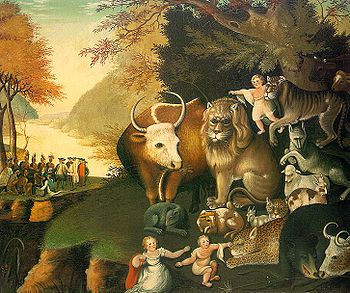
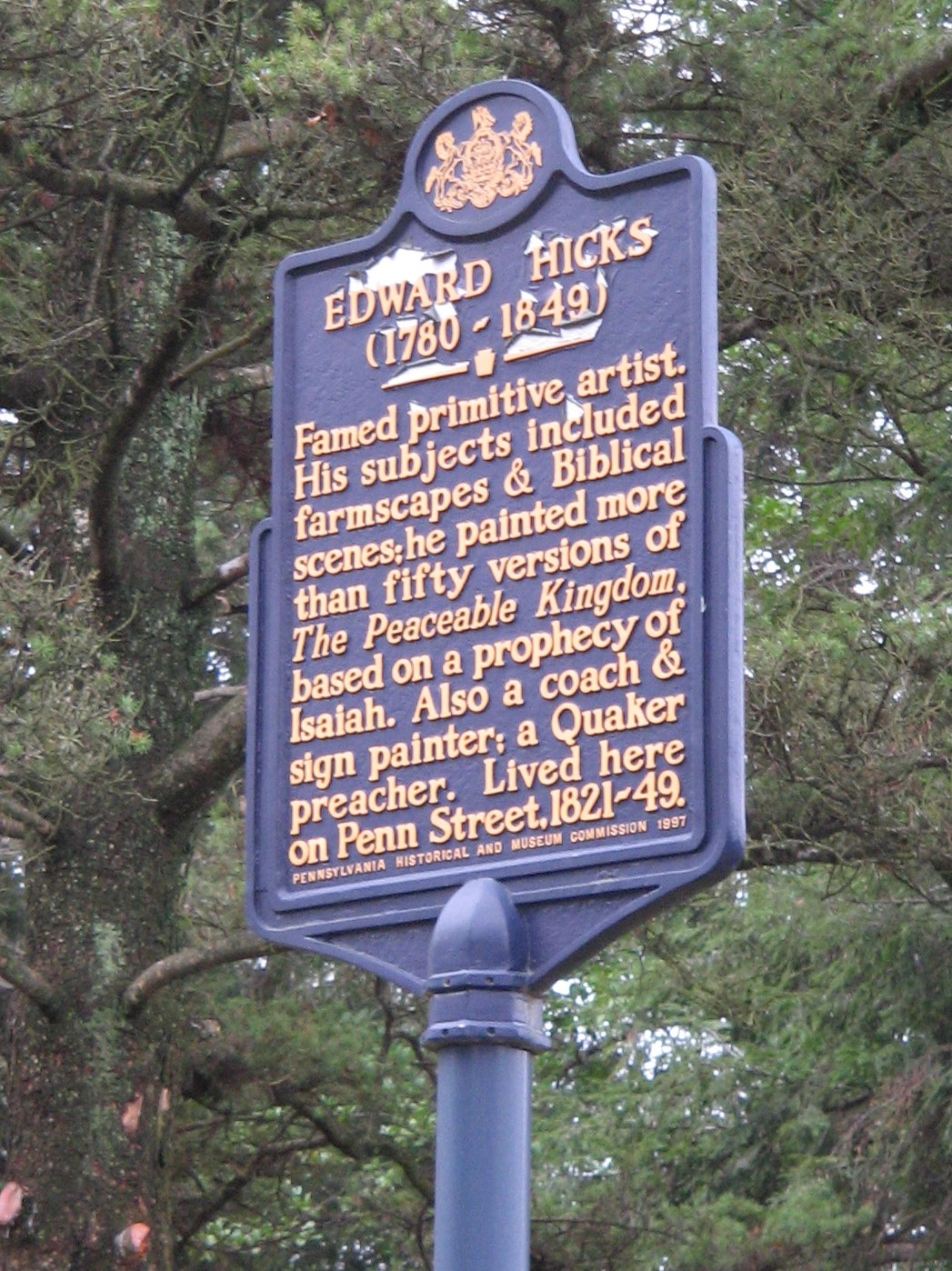
Over Thanksgiving we visited friends in Newtown, Pennsylvania. Newtown was the home of the Quaker painter Edward Hicks, famous for his many renditions of The Peaceable Kingdom. On a chilly Black Friday we walked to his former home, visited his Meeting House, and stopped by his grave. The Quakers, whose presence is much more palpable in the eastern part of the state, were the original Pennsylvanians. Their pacifism defined them, and the peaceable kingdom was their ideal world. A world without strife, without greed, without televangelists and politicians. It is a compelling vision.

A peaceable kingdom

The Society of Friends recognized no human leader to their movement that sought direct experience of the divine. In the Bible such a vision pervades early Israel where the rule of God was expected to be enough; no king was needed for this kingdom. The ideal world, however, was plagued by human ambition and selfishness. Before the first judge hung up his hat they knew that they’d need a king. A monarchy, as they were warned, that would bring about its own set of intractable problems. Leadership inherently creates inequalities. Just ask any accountant who keeps track of a governor’s expenses. Kinglets are just as bad as godlets.

We read about the excesses and abuses our leaders stockpile in the name of public servanthood. Yet, for all that, the world is not at peace. An increasing number of nations are joining the nuclear club, poising their missiles over populations of innumerable people in need. The peaceable kingdom has no king, and the visions of the prophets are cloudy and uncertain. Visiting the quaint, affluent hamlet of Newtown, it is possible to believe in the vision of one of their defining personalities. Just don’t open the newspaper or turn on the television. Because, like the Israelites, we have many eager kings lined up outside the door.

Is the peaceable kingdom dead?


Brave New Whirled

Today marks the triumph of capitalism. Having just finished reading Aldous Huxley’s Brave New World for the first time since my undergraduate days, I found it strangely appropriate and prescient. Huxley foresaw a bleak future where comfort and convenience outweighed concerns for truth and meaning. As the World Controller of Western Europe reveals to Mr. Savage, it was the Nine Year’s War that made people so docile that they would accept complete government control over their private lives. Read “9-11” for the Nine Year’s War, and he pretty much nailed it. Americans today put up with severely restricted freedoms because only the rich and powerful are truly free. We even have Huxley’s “feelies” – we just call it the TSA checkpoint at the airport.

“But I don’t want comfort. I want God, I want poetry, I want real danger, I want freedom, I want goodness. I want sin.” So says Mr. Savage shortly before his tragic end. The remainder of society – those willing to play along with the game, those willing to be anesthetized with the little perks the government throws their way – are already dead. “Let them eat cake.” We have our hedonistic day of shopping frenzy, looking forward to the soma of Christmas. We will comply despite the dehumanization the unemployed, the unwary traveler, the racially profiled, face every other day. As long as we have our electronic toys and the network into which they may be plugged, guide us o thou great Patriot Act. Freedom is not free. Orwell called it doublethink. Today it is doubleclick.

Novels have the capacity to say what libraries full of dusty dissertations cannot. Perhaps the future has not turned out quite the way Orwell or Huxley or Burgess predicted, but they were not far off. November has become the month of the novel. The Office of Letters and Light hosts National Novel Writing Month (NaNoWriMo for those in the know) each year to encourage others to find their creative voice. The challenge: write a 50,000-word novel fully in the month of November. I finished mine in just over two weeks. Perhaps someone who has the good fortune to break into the publishing world will once again sound that warning shot before society takes its next Huxleyian turn. But until then, anyone who says they don’t need a gramme or two of soma, well, they’re just plain lying.


West Texas Dead

A small item from the Star-Ledger wire services proclaims, “Former priest accused of trying to hire hit man.” Since the story was bylined Texas I started to wonder if the accused was someone I knew. Nashotah House boasted more Texans than any other statehood citizenship when I was there, so it was natural enough of a gut-level reaction. Fortunately, it was wrong. A former Catholic priest named John Fiala stands accused of trying to hire a neighbor to assassinate a teenager who’d accused him of sexual abuse. In a travesty of at least three of the ten commandments, a man of the cloth allegedly attempted to bare false witness (the error is intentional).

We hold clergy to a high standard in our society. The mystique of being “called” by God, secreted away in a provocatively named “seminary,” and emerging ontologically superior to other humans has a touch of whimsy that is difficult to dismiss. Having twice been a victim of seminary, once as a student and for even longer as a faculty member, I learned some important truths about those trained for ministry. They are merely human. In fact, my best students were those who recognized and embraced this fact. When I was informed that an ultra-pious candidate was about to “shed the shackles of the laity” and would return from his weekend ordination “ontologically transformed,” I rolled my non-ordained eyes. I had seen the test scores and intense faculty evaluations. Ontological change? We should be so lucky.

So, a man barred from any sexual outlet seeks a silent victim. We should not wonder. Attempting to get a neighbor to become an assassin is a bit over the top, even for most Texans. It does, however, illustrate my point that the laying on of Episcopal hands does nothing to change the essence of a person. Clergy are just as human as anyone they serve. It is when they think otherwise that problems arise. Secular students in the halls of Montclair State University are talking about the Vatican’s changing collective mind on condoms. Discussion and exegesis of the issue cover the front page of the New Advent website. Too bad the decision hadn’t been made a few months earlier. This situation might not have emerged at all. As the paper states, “the Sacred Heart of Mary Parish in the West Texas community of Rocksprings [is] a rural enclave known for sheep and goat herding.”

Don't let it get your goat


Condom Not?

Newspapers and the Internet have been abuzz with Pope Benedict XVI’s leaked proclamation that condoms may be useful for male prostitutes in preventing the spread of AIDS. Many are astonished, and not a few heads have been scratched at the declaration from the stalwart bastion of “sex is only for procreation” Christianity. The announcement, while humanitarian, is deeply troubling. From ancient times it was recognized that human sexual behavior had more than procreational importance. The matter has been investigated by psychologists since the nineteenth century and the same conclusion was drawn: people engage in sexual practices for a variety of reasons. Meanwhile, the church has been holding out with a Hebrew Bible viewpoint enhanced by the personal outlook of Paul.

In the ancient world, the microscopic world of reproduction was unknown. What was actually happening in conception was misunderstood. Judeo-Christian sexual mores were based on faulty information, from a biological point of view. In such a view, the all-potent male gamete (inappropriately called “seed,” as if a womb were just a place for pre-formed humans to grow) was capable of producing life on its own. Reading a handful of Greek myths will demonstrate this principle nicely (since the Bible has a more demure and blushing way of discussing the idea). The concomitant concept that seed should not be wasted led to the faulty idea that, in the unforgettable words of Monty Python, “every sperm is sacred.” That mental construct has been used by the church to make women subservient to their biology in a way that never applied to males. The Pope’s declaration underscores this double standard.

If male prostitutes may use condoms with the church’s blessing to prevent the spread of AIDS, the only motivation left for heterosexual birth control is female control. The “lost cause” of male reproductive potential in male prostitutes does not apply in heterosexual unions? God holds married couples to a different standard than male prostitutes – why? Is the sperm in these two cases unequal? The Pope is undoubtedly on the right track by endorsing the use of condoms, but the church still has a profound distance to go before it can look women in the eye and say, “we believe you are truly equal with men.” Oh yes, and not blink while saying it.

Remember, these guys lost to the Greeks...