Tax Dollar Peep Shows

Yesterday’s New Jersey Star-Ledger ran a column by Paul Mulshine entitled “It may be 2010, but it sure feels like 1984.” The topic, of course, is the increasingly invasive procedures that TSA officers have been granted. For a guy who “held it in” every day for the six years of middle and high school because of bashful bladder syndrome, the airport has begun to feel like the shower room after gym class. Having been raised with the idea that certain body parts were to be viewed by God alone (and the occasional physician), being undressed in front of others was a nightmare scenario. I still avoid public restrooms when at all feasible. Now TSA officials have tickets to a free “scope and grope” fest whenever you want to fly. I say the terrorists have already won.

Perhaps by coincidence, in trying to keep up with my daughter’s reading assignments, I have started to reread Aldous Huxley’s Brave New World. The grandson of Thomas Huxley, Darwin’s bulldog, Aldous had written a foreword in 1946 that was affixed to the front of my college edition of his novel. In it he states his bleak vision of a future where governments have all become totalitarian and control vast numbers of slaves made willing by apathy (read “world-wide web” or “Internet”). Showing your private parts to a total stranger who then gets to grope you later? This is freedom? Abandon hope all ye who enter here.

Have these TSA officials been trained, seriously trained, to deal with the fact that they see what many people would pay good money to glimpse? (Well, not in my case, but you get the picture.) Where are their credentials? No, wait, don’t show me that! If I decide to display myself in public, I could easily be arrested for indecent exposure, but if a pervert wants a free look, all s/he has to do is apply to TSA. What will it take for Americans to shake off their electronically induced haze and say “No more!”? Perhaps I am alone in feeling vulnerable naked before strangers. Perhaps others enjoy giving it all away. Is it not better to survive that flight so that another stranger gets a gander at the jewels when you fly back home? You can kiss my arse goodbye and call it government work. 1984? Brave New World? I think Silence of the Lambs might be a better paradigm.


Hallowed Be Thy Game

I don’t follow sports. At all. This may seem an unmanly confession, but I think of it as more a silent protest against a society that pays excessive bonuses to people who play for a living. It’s not that I have anything against physical fitness – I still jog regularly and have been known to rattle the free-weights around a time or two – it’s simply the recognition that the more difficult achievements, intellectual achievements, are undervalued. Not that I make any claims of being an intellectual – I have no time for those who tout Ph.D.s like intellectual currency – but I see things from a different angle. Usually when I reach the sports section, I simply flip over the whole wad of pages to get onto what’s next. Today, however, a front-page sporty headline caught my attention, “‘God Can Turn Mistakes Into Miracles’ is the message Michael Vick sent out…” I confess, I don’t know who Michael Vick is. But he knows what God can do in some sports venue.

I grew up with God. The information I was given was that those who devote the majority of their time and attention to God will receive their reward. Not always in money, despite what the Prosperity Gospelers bray, but at least in kind. Being the kind of person who likes to follow things through to their logical conclusions, I ended up with an appropriately named “terminal degree” in religious studies. The prosperity came in the satisfaction that I could teach others for a reasonable, if low-end, salary and continue my goal of deeper understanding. Then Prosperity Gospelers took over the seminary and those of us without material cache were kindly kicked out. I was jogging between seven and nine miles a day, looking for answers.

The headlines this year have included tragic college sports-related injuries, one of the more dramatic from my own part-time home of Rutgers. Immediately medics rush to the field and prompt, professional medical care is given. I am covered by no medical plan. Many athletes take my classes, and they can count on the good graces of God and university officials to take care of them. In my opinion they are just as capable of learning as any other students, but the incentives just aren’t there. Why earn a degree in a field that will plant you on your backside all day for minimum returns when you can perform miracles in the athletic world for more money than the average citizen can even imagine? If God can turn mistakes into miracles, perhaps this misspent life of religious studies can turn into a lucrative position after all.

Miracle or mistake?


Round Tables and Belligerent Gods

One of those bits of mail in my part-time lecturer mailbox at Rutgers informs me that the Oxford Round Table is hosting a discussion entitled “Civilization at Risk: Nationalism, Religion and Nuclear Weapons.” Given that the cost for attending is about what I make for teaching one of my adjunct classes, and the fact that they spelled “civilisation” the American way, my guess is that the target audience resides on this side of the Atlantic. Still, the topic is indeed vital. Nationalism is a relatively new plague to arise in the human menome. Cultural differences matter little in the face of nationalism; the real issue in this ideology is dominance. Nuclear weapons add a unique poignancy to the issue, but the heart of the matter is clearly behind door number two: religion.

Religion usually makes the list of the hallmarks of early civilization. Along with complex governance and the arts, it is considered one of the aspects that marked the break from merely subsistence living. Religion, however, in its monotheistic form has more divisive power than nearly any other aspect of civilization. Polytheistic religions hardly worried if people worshipped the “wrong god.” Monotheism bears a larger burden, and that burden is not dissimilar from that of nationalism: dominance. Let’s face it – what kind of respect can you expect for a god who can’t throw the brimstone behind all those threats? And if your god doesn’t readily ante up (no visible actions, depending on who you read, since the first or the seventh centuries) then the devout must take up the spear, cudgel, or atomic weapon to prove the honor of their all-powerful god.

Uranium in the hands of an angry God

Is there a solution to the “Middle East” crisis? I’m no politician, but I would make the following humble observations. The crisis as it exists today is as much about nationalism as it is about religion. Religion serves as a convenient excuse when one’s way of life feels threatened. (Push any Neo-Con into a corner and when all the cards are on the table it will amount to precisely this.) We all want things our way. If we can’t get it, we can take it by dropping the G-bomb. It may be apt that the region of the world that instituted civilization is destined to destroy it. A cosmic symmetry pervades the idea. It might be a lot less messy if we’d all admit what the arguing is really all about.


New York Sinning

Men’s Health, a magazine I’ve never read, is making a foray into spirituality. Or at least religiosity. According to an article in the Friday New Jersey Star-Ledger, the magazine noted for its washboard abs and iron biceps is poised to claim New York City among the least devout cities in the country. Even lower on the scale are New Jersey’s own Newark and Jersey City. Quite apart from wondering what a magazine whose cover frequently involves suggestions on how to improve your sex life has to do with religious devotion, the criteria for this assessment also give pause. According to the article, a city’s saintliness is measured by the per capita number of worship venues, the diversity of religious groups in the city, and the amount collected in donations. Interesting criteria.

I’ve spent enough time in New York to know it is hardly Heaven – still it is one of my favorite venues – but that it is hardly Gomorrah’s brute step-brother either. Per capita places of worship as a measure of spirituality overlooks size of venue and number of services. A Midwestern town with a dozen churches, each with a dozen members and with one service a week scores ahead on such a scale against a city with more than 2000 churches, 1000 synagogues and 100 mosques, many with multiple congregations. Diversity of religious groups? Surely New York and New Jersey must come out in front on that! I’ve been to Europe, and even Israel, and there are days when I’d swear New Jersey has a higher percentage of ethnic groups than any similar-sized region I’ve experienced.

My main concern, however, is with the amount of donations criteria. “Where your treasure is, there your heart will be also,” a famous guy once said. Was the treasure monetary? Precisely the opposite seems to have been the point. True, money today is often a measure of value, but it is not the only such measure. In fact, the same guy who made that statement once said a poor woman’s two cents were worth more than the lucrative eternal investment of the wealthy. I don’t doubt that New York, Newark, and Jersey City have their share of innovative sins. Their citizens, however, are just about as religious as people are anywhere. In my opinion the trouble is not in the souls of the masses, but in the design of the assessment. But with pecs like that, what does it really matter?

A God's eye view of Sin City


What Would Noah Do?

Unfortunately, religion and politics do mix. A story on POLITICO.com announced on Wednesday that the House Energy and Commerce Committee chair hopeful, Rep. John Shimkus has declared Genesis on the side of conservatives. Stating that the Noah myth (not his exact words) promises God won’t flood the earth again, Shimkus claims we have nothing to fear from global warming. In a twist that makes some of his fellow conservatives squirm, Shimkus admits global warming is a reality but suggests that we really don’t need to worry about it because “the Bible tells me so.” Time for Shimkus to go back to Sunday School.

Part of the problem lies in the concept of Bible itself. The Hebrew Bible isn’t too much of a self-referential work, claiming to be pure words of divine gold. Paul, on the other hand, found the Hebrew Bible useful to cite against enemies, and his admirer who wrote letters to Timothy in his name took the idea even further. For all that, the Bible wasn’t finally settled on for a couple more centuries. Once the concept took hold, however, the world could never be the same. A book written by humans had become direct revelation from the word of God himself. The Bible makes few such lofty boasts about itself, but its less conscientious followers are not nearly so shy. As I demonstrate repeatedly in my classes, the Bible has become a magic book.

Politicians now feel comfortable claiming God as their ally because “he said so.” Without having ever critically engaged Scripture, or even having read it in its original languages, those in positions of public trust know enough to flaunt it. And it always scores points with Americans. Liberals fear the ramifications of using the Bible while Neo-Cons charge bravely ahead to places Noah himself would fear to go. Maybe it’s time to put the Bible back in the schools. Only this time it should be taught by people who realize that the Enlightenment has taken place and that we can’t rely on magic to save us from dangerous situations we ourselves have created.

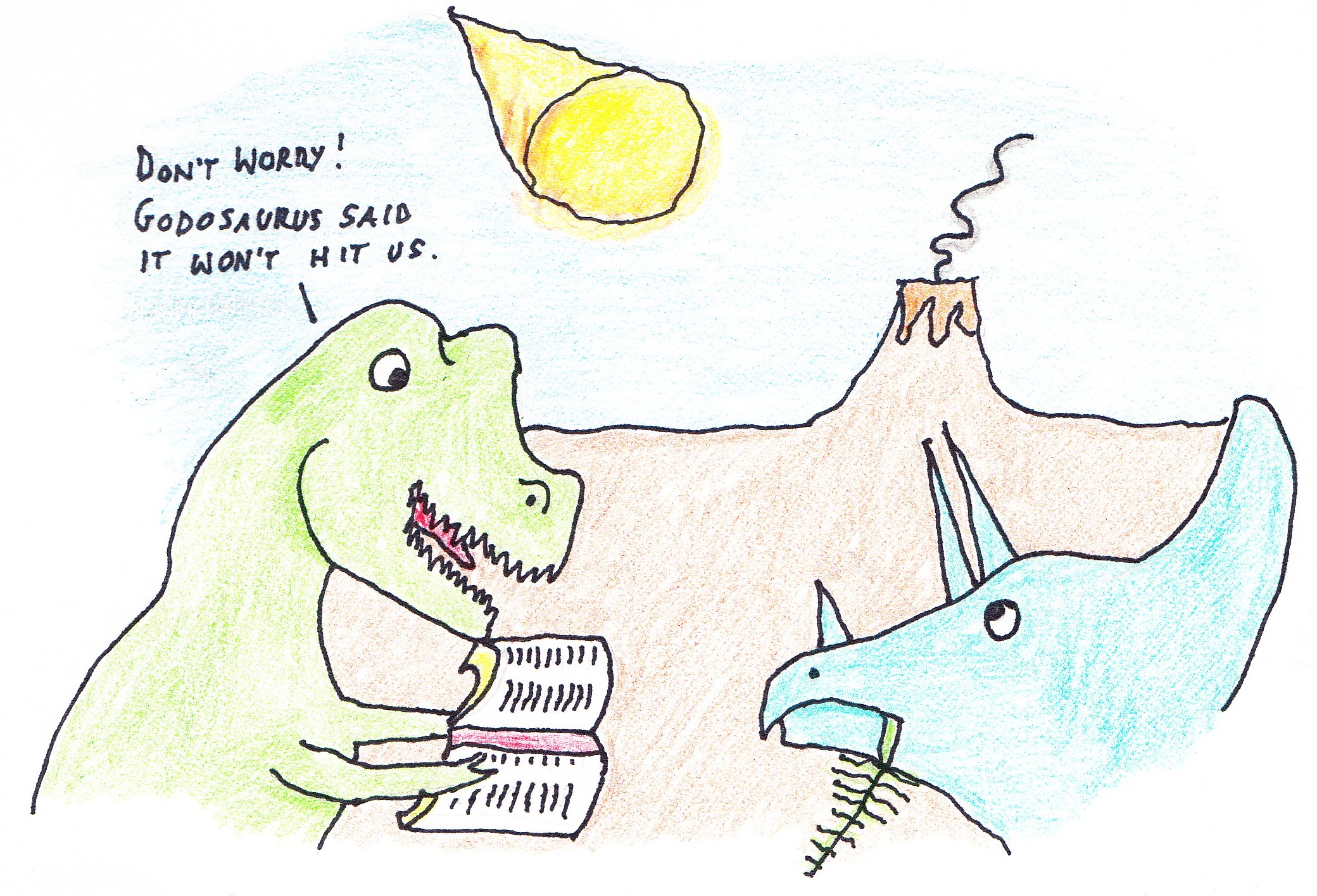
The lesson from the Cretaceous Period


Foxhole Atheists

It’s Veterans Day and prayer makes the headlines. The old adage about no atheists in foxholes comes to mind as those who fought for the values we hold reminisce about the not-so-happy days before the 1950s when the last semblance of normalcy in American life apparently died. The New Jersey Star-Ledger quotes a World War II veteran who participated at the Battle of Normandy saying “I might have prayed more than I ever prayed before.” No atheists in foxholes. As a lifelong pacifist, I have always believed that war is a terrible waste. 3.5 billion years of evolution and the best we can come up with is to hurl supersonic lead slugs at each other over who gets what and who deserves more than who else. I don’t deny that veterans should be honored – my father was a veteran – but war should not.

A sad truth is that many wars, probably in the history of the modern world, most wars, have been fought for religious reasons. The idea that God demands certain things ultimately leads to fighting over what it is God wants. Both sides often claiming the silent deity is on their side. Millions of mere mortals have had to pay the price. Hey, can’t we just talk about this?

War may very well have evolutionary roots. Studies of chimpanzees suggest that homo sapiens are not the only overly aggressive primates. If we deny our cousins religion, however, only homo sapiens fight for mythological causes. One of the great ironies of life is that the most advanced technology trickles down to civilian life from military applications. If something is new, it must have a tactical use against the enemy. Once the enemy is subdued, we can share the wealth. I grew up hearing about “godless Communists.” I watched in dismay as Bush declared a new crusade. I shudder when I read that Iran is developing long-range missile facilities. God is the midst of all this. Veterans protected us from the human-level wars of a bygone era. In our own homemade Armageddon, however, our own technology will doubtless become the weapons in the hands of an angry God.

If God be for us...


Jesus Gets a Head

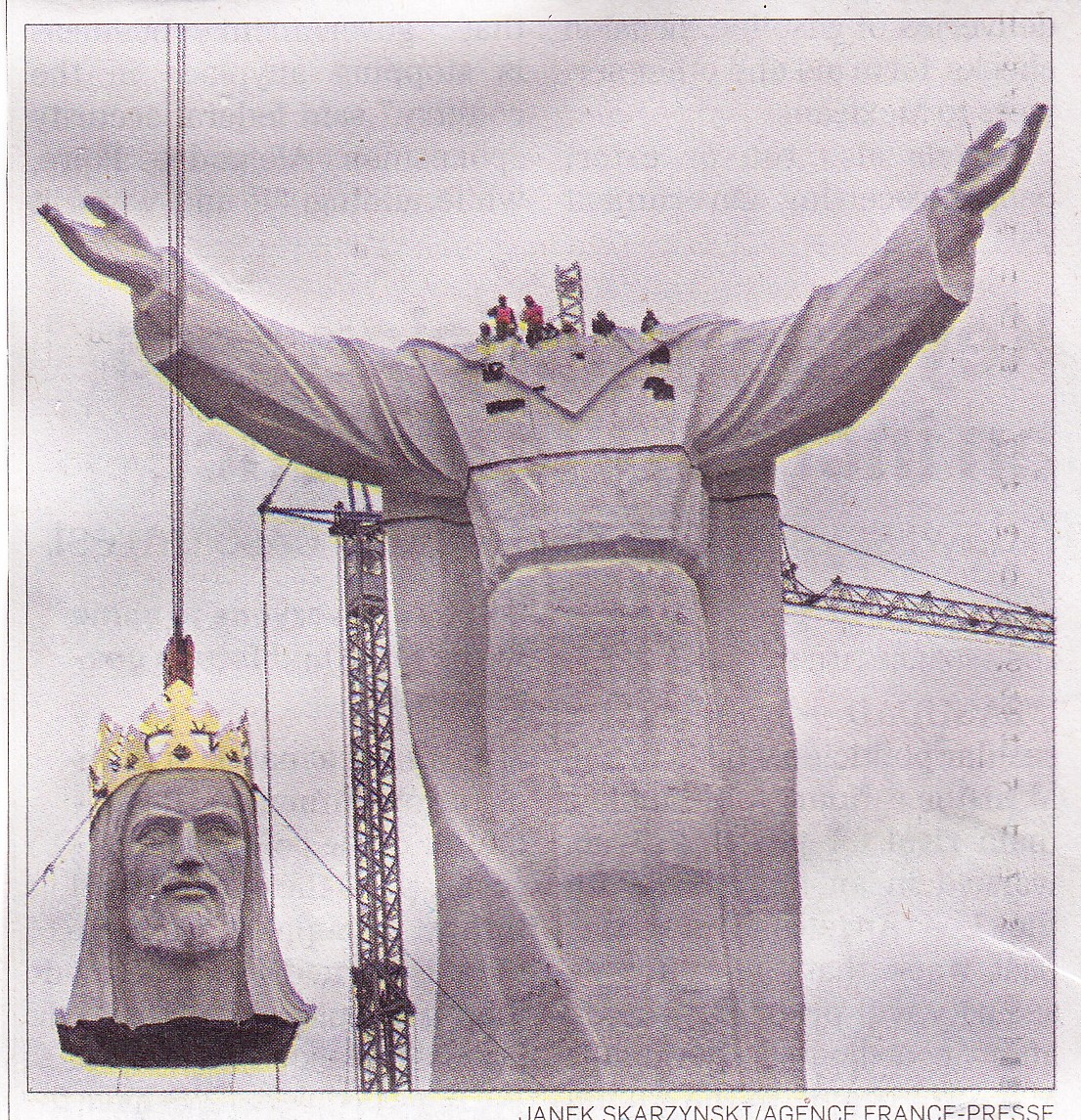
Sunday newspapers often contain stories calculated to appeal to the purveyor of the unusual in addition to the usual current events. When my wife pointed out an article in yesterday’s paper about the new (unverified) tallest statue of Jesus in the world, I was instantly intrigued. A Polish priest by the name of Sylwester Zawadzki created the statue which tips the yardstick at somewhere between 108 and 167 feet (a little triangulation might be helpful here). Noting that Rio de Janeiro’s Jesus is 125 feet tall, some are claiming this as the largest Jesus in the world. According to the article, some Poles feel the statue is tacky and in bad taste. Others rejoice that a very large likeness of what Jesus may have looked like now overlooks Swiebodzin.

Religions frequently display their colors. Knocking down crosses for crescent moons or stars of David for crosses is a religious activity as old as monotheism itself. Zawadzki claims that he was called by Jesus to do this task. According to the Gospels, Jesus seemed to focus more on his message than on himself, but the two have become so intricately knotted that the Jesus icon has come to stand for everything from preserving fetuses to longhair free-lovefests. What Jesus is depends on the eye of the beholder. As the gold-crowned head was lifted by crane onto the awaiting shoulders, a cross was lifted from the shoulders of Zawadzki who expressed thanks at having been able to fulfill God’s will.

Construction workers gathered at the base of the statue for photos, wearing safety helmets. Working on Jesus, like any construction zone, can be hazardous. If it is the will of Jesus to have enormous statues erected in this faithless world, are safety helmets really necessary? It is all a matter of perspective. Many people in the world are in need. Many do not have the resources they need to survive. Where is the triumph here? I understand the artistic urge, I sympathize with the need to stand out. But is the will of Jesus to be represented in larger and larger formats, or is it to help those who feel physical need day by day?


Golden Eagles

I used to be a Boy Scout. Not a very good one, but I did try. Eventually, before even reaching the rank of “Tenderfoot” I dropped out. I often wonder what life would be like if I’d gone on to be an Eagle Scout, like Gerald Ford. Would I have made president? Or at least Assistant Professor? Last night I attended a workshop for Girl Scouts. My daughter is about to embark on the program that leads to the Gold Award, the highest honor a girl can attain in the organization. I want her to succeed where Dad failed. Maybe earn herself a better life.

Girl Scouts are as organized as Methodists and as legalistic as Jesuits. As we sat listening to the requirements, I was stunned by the degree of technicality. You can do this, but not that, that, or that. I remember now that I didn’t make Eagle Scout. What struck me as most intriguing, however, is the fact that certain projects are disallowed for theological reasons. In order to earn a Gold Award, the Scout must conceive, lead, and implement a social service project. It is a noble goal. In society many people are hurting and in need, and governors, representatives, and senators do not seem to notice. Yet, the leader of the meeting noted – if the project involves “controversial” issues, it will be declined. Controversial issues are things like abortion (i.e., women’s rights), or gay rights.

While I agree, it is not safe to put girls in the line of fire, I thought about these issues. The reasons that they are controversial is that Evangelical Christianity has made them so. Evangelicalism is a strain of Christianity that has a trajectory that went on the offensive in the 1960s. Charging the emotions of regular Americans with the terrors of gay love and dead fetuses, it raised these issues to national consciousness and made them a part of every political campaign in the latter part of the last millennium and into this one. These are points of great human suffering. The answers are not easy, but the fact remains – neither is a biblical issue. Yet girls are prevented from taking on issues that may have the most solid and tangible impact on their future. I was saddened.

I have no complaints with the Girl Scouts. It is a shining example of an organization that gives girls the confidence and tools they need in a hostile environment. I am disappointed, however, that a small but vocal cross-section of Christianity has made certain topics – topics that need to be addressed – off-limits for concerned young women.


All You Zombies

Not being a cable subscriber bears a burden all its own. Not only would paying the extra monthly fees for television prove a hardship, but the constant temptation to watch it would rate as a deadly sin. So on this “All Saints Day” I find myself wondering if the world is still out there after last night’s much-touted “The Walking Dead” premiere. The new AMC series has been written up in local papers and this week’s Time magazine. The latter calls it “a zombie apocalypse.” The fascination with zombie goes beyond holiday-fueled monsters. As James Poniewozik states in his Time article, zombies symbolize society’s insecurities: pandemics, terrorism, economic instability. The unrelenting undead remind us that death is perhaps not the worst thing to fear.

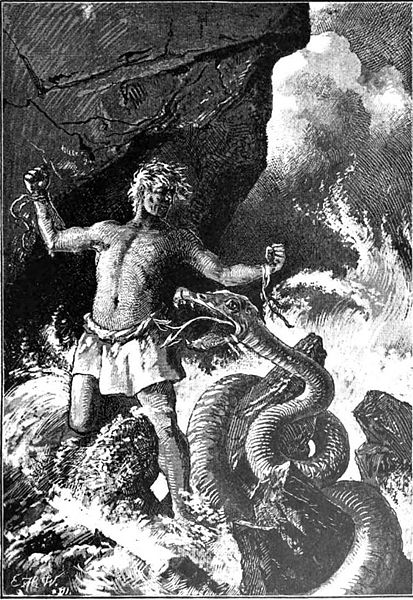
The religious side of this trend is fascinating. Revenants have no place in traditional Christian, Jewish, or Muslim theologies. Perhaps the closest semi-sanctioned version is the golem, a soulless protector of persecuted medieval Jewish communities. Traditional zombies are inextricably connected with magic, a means of manipulating the physical world through supernatural means. Like modern vampires, modern zombies have shifted from supernatural to biological, or at least scientific-sounding, explanations. Even Night of the Living Dead had an errant satellite to blame. The zombie has been reborn in a secular context, making it safe for religious believers to add it to their repertoire of fictional ghouls. And yet, the religious aspect has not completely vanished. The “apocalypse” that accompanies “The Walking Dead,” whether it is Armageddon, 2012, or Ragnarok, is a religious concept. Humans simply can’t face the end of the world without religious implications.

Audiences feeling a little let down after October’s terminal scare-fest, however, might find some cheer that Halloween is an end, but also a beginning. It is the start of the darkest time of year. Very soon not only do we drive home in the dark, but light will not have dawned by the time we start the car for work. In northern reaches of the globe, people can’t help but feel a little stress at finding our accustomed visual assessment of our world a little bit impaired for months at a time. And when we see that shoddy-clothed stranger straggling along in the half-dark, it may be time to remind ourselves that despite the naturalized zombie, there are still those who prey on their fellow humans. They may not be the undead. They may dress well and drive expensive cars and live off what they can legally draw from that stranger on the street. They may be the true harbingers of the apocalypse. They are the ones we should really fear.
Whose apocalypse?


La Puerta

A musician who has always deserved more acclaim than he has received in his solo career is John Cale. A founding member of the Velvet Underground, a band whose lyrics and insistent – if at times atonal – music capture their era far more effectively than most, Cale has gone on to produce some songs provocative enough to rival those of Lou Reed himself. On his Paris 1919 album, the song “Hanky Panky Nohow” contains these thoughtful lyrics: “nothing frightens me more than religion at my door.” These words are, ironically, prophetic. Religion at the door, in public office, behind major media corporations, has become an insidious threat to the founding principles of this nation. Right, Ms. O’Donnell?

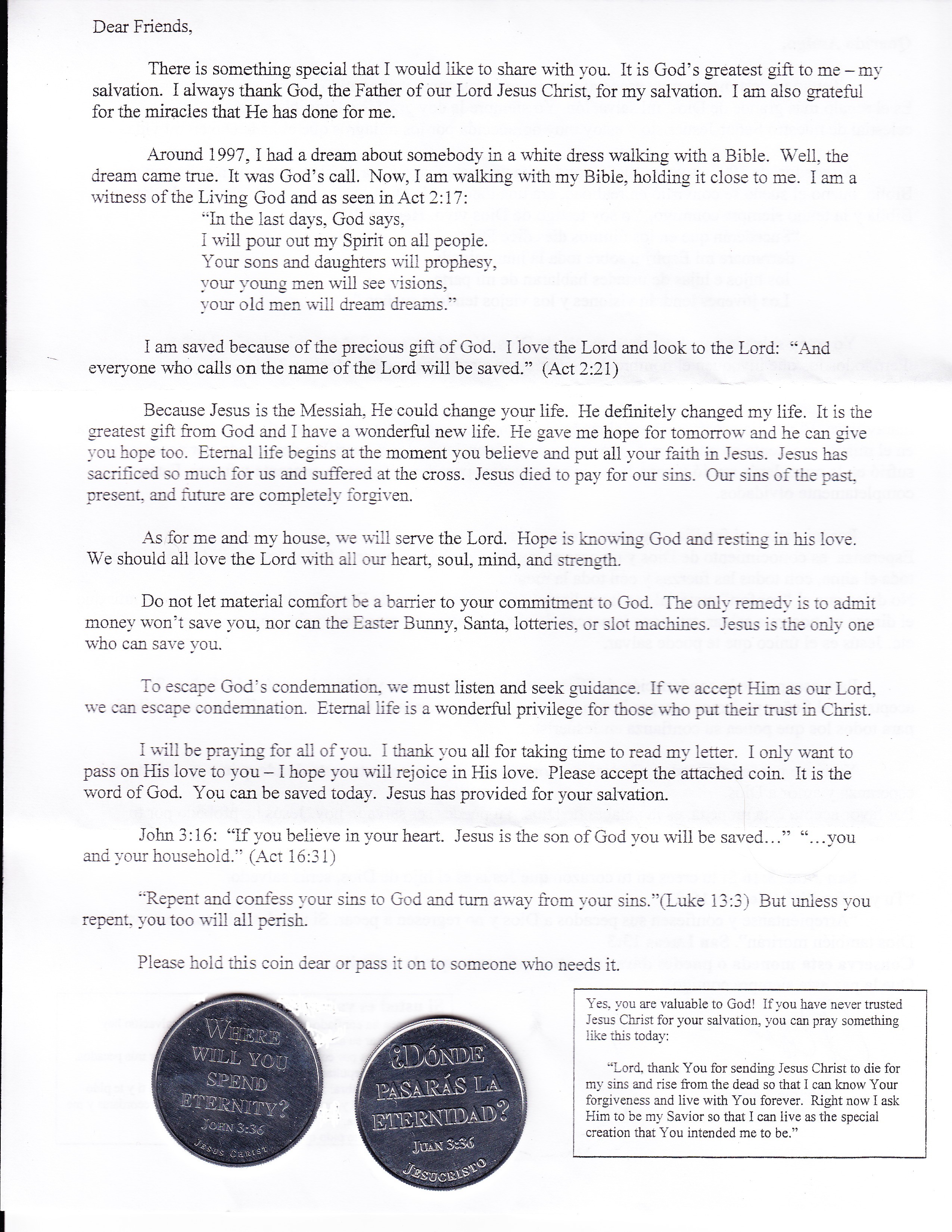
Yesterday morning I went out to get the newspaper. Although I live in a relatively safe town, we are classified as the “Greater New York City” area, and I’m always suspicious of anything unexpectedly left on the doorstep. There was an unaddressed, blank, sealed white envelope there that jingled when I nudged it with my foot. At first I thought it might be a set of keys left at the wrong house, but when I did finally open it I discovered a bilingual set of aluminum faith coins. An accompanying letter assured me that God wants to save me and shared with me a dream of somebody in a white dress carrying a Bible. The letter, amazingly, misquotes John 3.16.

I am the frequent victim of Jehovah’s Witness visits. I have students handing me booklets that will save my soul. I receive offers of golden miracle crosses in the mail – I still carry mine around, but prosperity has continued to elude me – with the assurance that God wants only the very best for me. I open the paper and see the suffering of the people of Indonesia. I see a column about teen suicides resulting from bullying with victims as young as twelve hanging themselves. I see overweight politicians feathering their already overstuffed nests. I turn back to the anonymous letter. “Please hold this coin or pass it on to someone who needs it,” it instructs. I think I’m going to need a truckload of coins. Nothing frightens me more.


Zombie Walks

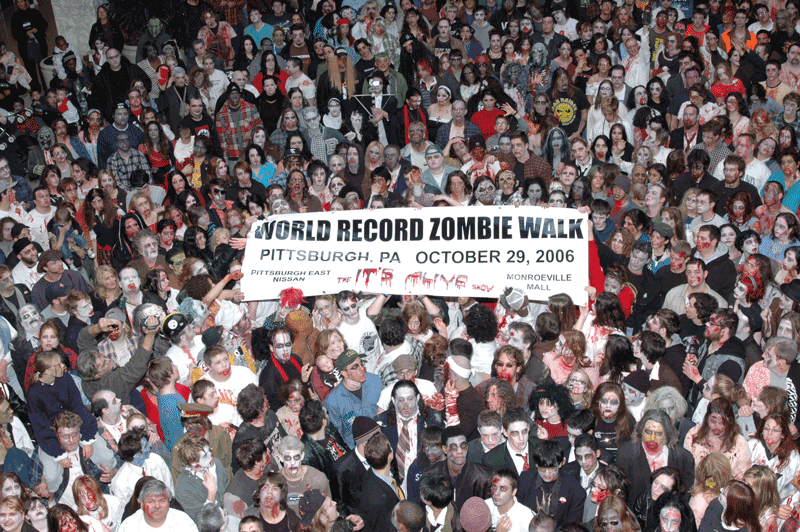
As October nears its creepy climax, signs of the macabre have become abundant. A trend that has reached new heights in recent years is the zombie walk. Various cities or regions host large groups of brainless, reanimated corpses in parade (rather like a Tea Party, I should imagine) to welcome in the darker half of the year. In a most unconventional display of cultural unity, groups of strangers meet for the purpose of sharing their fascination with the undead. Given the inherent potential for overly enthusiastic participation, these events are usually held during daylight hours and are becoming as accepted as trick-or-treating on Halloween.

Fear of death is sublimated in a conquest of the same with less definitiveness than traditional resurrection, but with a more gritty and graphic triumph of life. Organized religions have had difficulty maintaining numbers in much of the “developed world” while this new danse macabre has taken on a life of its own. Many find claims of divine authority in institutions that refuse to make clean breaks with sex scandals or threats of Quran burning somewhat disingenuous, while nobody questions the motives of zombies. They simply do what it takes to survive. An honest zombie stumbles toward eternal life.

Credibility is less easily commanded than it had been in former times. While many voices, such as Tea Partiers’, are claiming the need to erase the sixties and seventies and subsequent decades from the calendar so that the authoritarian Father can be returned to power, thinking people are asking what the plan might be. Is it time to break down that putative wall between church and state and declare America a plutocratic, evangelistic Republic? Never mind that inevitable conflicts will break out over who has the right to set doctrine and public policy – most citizens will be found out walking with their fellow zombies, welcoming in the darkening season.


The Power of Hope

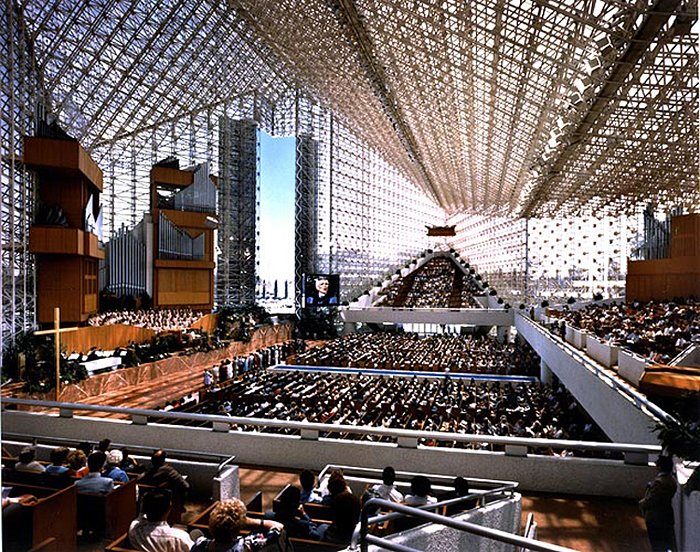
My wife pointed out at article on MSNBC yesterday that stated Robert H. Schuller’s Crystal Cathedral is filing for bankruptcy. Internet reaction has been predictably hostile, clawing at the craven, money-driven industry of television ministry. There is no question that many television ministries quickly grow corrupt under the lure of immense wealth. The average American citizen is glad to part with some money if it can buy favor with the man upstairs. When a minister is able to construct such edifices as the Crystal Cathedral with the good-will offerings of the faithful, well, s/he’s an entrepreneur, the kind of people God likes, according to the Tea Party. Schuller was famous for his positive thinking and insistence that God will do great things for you. When recession hits, however, not even God remains solvent.

According to the article, various corporate sponsors of the Cathedral are having difficulty holding up their end of the contract. Positive thinking extends only as far as the goodwill of the banks. Is there any question who the real god is here? Americans love the non-biblical concept that God helps those who help themselves. Making more money than a humble clergy-person ought to make may improve the sense of optimism, but it loses touch with where the average citizen lives. It is easy to be optimistic when you have a heavenly bankroll on your side.

Yes, but can it keep birds from flying over your head?

Over the weekend my family looked at slides from our years in Europe. The great cathedrals, even if in ruins, convey a sense of stoic strength, genuine commitment. Built with the hard-won resources, if not the actual physical labor of the local populace, these cathedrals were made of stone. I recall standing in the nave of Salisbury Cathedral while the tour guide pointed out that the very stone pillars supporting its huge steeple were bowed under the weight of all that stone above. Some day it may collapse under its own pressure, but it will have always survived longer than the Crystal Cathedral. Religion, if I may use a metaphor, is more authentic when it deals with stone rather than glass. The religion that struggles with the intractable realities of daily life will inevitably last longer than the feel-good, glass-plated, Tea Party serving “religion” of feel-good Christianity. It is too bad about the Crystal Cathedral, but maybe the entrepreneurs should be asking serious questions right now about which god they truly serve.


Wasps

I just finished reading Iain Banks’ The Wasp Factory. It is a disturbing novel on many levels; even the back-cover comments warn against reading it. The reason for mentioning it on this blog, however, is that it is so full of religious ideas that it would be a shame not to address them here. I won’t put in any spoilers for those who might, even with adequate warning, want to read the book.

The wasp factory of the title is a divination device. The narrator, Frank, does not believe in God because of the unfairness and cruelty in the world, although he is also a frequent perpetrator of cruelty. As he seeks revenge on animals other children, Frank views their suffering as a form of punishment from the God he disbelieves. At one point, after his brother Paul dies, Frank compares him to his old dog Saul, also unfortunately deceased. At this point he reveals, “Paul, of course, was Saul.” Death is the Damascus Road experience in this world devoid of a deity, but one where death is considered far more certain than life. At one point Frank declares the sea to be a mythological enemy, a point of view shared by the Bible and many ancient societies.

Frank is a neurotically ritual-bound individual. No matter how gruesome, his tasks are part of an elaborate system that must be repeated in order to maintain its efficacy. At one stage Frank declares, “this is like intellectuals in a country sneering at religion while not being able to deny the effect it has on the mass of people.” This statement is more insightful than it first appears – it is the dilemma of many who attempt to understand religion who are considered a luxury not to be afforded by society. Frank is a paradigm: people are religious, even in heterodox belief systems. The Religious Right has understood this for decades: talk religious talk and they’ll vote for you. Most people have no way of checking out what form this religion might take. It makes me almost as nervous as The Wasp Factory itself.


Eve’s Orchard

One of the innocent pleasures of autumn is apple picking. Not living in the country, many of us rely on the local orchards that open their trees and furrows to the public during the fall so we can feel once again in touch with nature. It may be only temporary, but this farm life is authentic and revitalizing – especially under a cerulean blue October sky. So it was that we joined our anonymous friends to pluck fruit and feel a part of the organic world away from laptops, palms, and cells. Picking apples always brings Eden to mind. In fact, no matter how secular the class I teach, if I ask students what picking fruit from a tree – usually I have to throw in the snake as well – represents, invariably most guess Adam and Eve. Of course, in the patriarchal world of the Bible, Eve gets the rap for taking the first bite, but a more sensitive reading reveals maybe this was what God intended all along.

Tasty fruit of knowledge

Within a generation of the origins of Christianity, a negative spin had been placed on that fateful fruit. This was the willful disobedience of sin rearing its ugly head in Eden. Of course, Genesis does not refer to the act as a “sin” – the word first occurs in the story of Cain and Abel. The human striving for knowledge, for the prerogative of the divine, the sadder but more informed life, was now a matter of blame. In the Greco-Roman cultural milieu where men set the standards, woman became the harbinger of sin and decay. Adam stood chastely by, happily clueless until Eve insisted he try this brand of iniquity. Pure fiction. And yet it is this version that has retained cultural currency in the western world. Blame it on Eve.

The patriarchal version


So much of our reading of the Bible is based on prior expectations. Even Bible translators know that they can’t go too far a field from the standard that the KJV set. When western Bible readers first cut their teeth on English prose, it was the dulcet tones of Elizabethan English that captured their attention. And the mores of Shakespearean England combined with the harsh repressions of a simmering Calvinism led to a Bible choked with sin to the point that a little fruit enraged the creator as much as fratricide just a chapter later. The fruit had rotted on the tree, and women were to blame. Perhaps it is time that we recognize the filters before our eyes when we approach the Bible. If we can understand that the patriarchalism is not the point, but merely the cultural shading of the time, we can release the message that the fruit is good. The temptation was not to become evil, but simply to become human.


Demo C. Rats

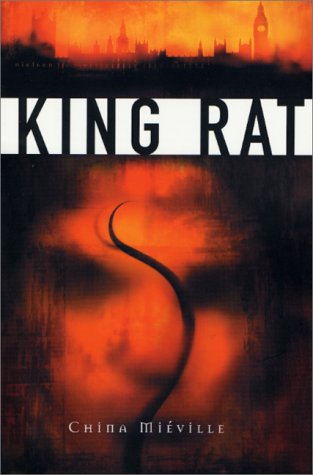
I just finished China Miéville’s novel King Rat. I’ve been thinking a lot about rats lately. This retelling of the tale of the Pied Piper of Hamelin has a strong Marxist flavor that intrigues the reader into greater possibilities. Each week as I drive the many miles required as a professional adjunct, I think about the bourgeoisie of academia. Many university programs are simply not possible without the many adjuncts willing to be exploited in order to keep them going. While the adjunct is kept below a certain number of courses so that costly benefits do not need to be paid, full-time faculty are kept below a certain number of courses so that they are free to build the university superstructure. Some teach no courses, do no research, and conduct no administration. It is a fair guess whether they even bother to breathe or not. Yet they are paid full salaries and benefits. Academic fossils paid simply to exist.

Saul, the rat-man who would be king, has a conscience. He was raised by his human father to appreciate the sense of what Karl Marx wrote. As the novel progresses, the rats congregate around him, wanting him to be their king. I have been an adjunct instructor for five years now. As I have watched my prospects grow slimmer, my work load has increased for less and less payback. I frequently chat with full-time colleagues who appreciate everything I’m doing. This academic year I am scheduled to teach eleven courses, strictly part-time, of course. Otherwise someone might have to pay benefits. This week one of the schools I teach at actually expanded parking privileges for adjuncts. Not to be nice, but because they had to.

Saul, the would-be king. So biblical. So human. At the end of the story he lives up to his idealism, granting rats autonomy without being sure how it will play out in the real world. There was a time when academics were idealists. Universities are now, like all other aspects of “modern life,” businesses. I’m sure that full-time instructors devote very little thought to those who work for table-scraps to support the system that underwrites their comfortable lifestyles. Certainly a university president or dean would loose nary a wink of sleep over those who’ve given themselves over to the task of Atlas, holding up their sky. It is business as usual. And as the bourgeoisie know, every aspect of life is business. What happens when the rats go free? The end of the story has not yet been written.