Defining Evil

Recently someone said, in a conversation in which I was involved, that understanding evil as entirely a human construct wasn’t working for her.  This particular person is rational, with a scientific outlook, and very politically aware.  There was a pause among the others in the conversation, almost as if embarrassed.  Can anyone admit the existence of evil these days without at least a chaser of irony?  I have to admit that I too was caught off-guard, but for different reasons.  I guess I have always supposed the struggle of good and evil was obvious.  If I hadn’t thought in these terms the last four years in the United States would’ve convinced me.  The degenerate depths to which corruption in this country have sunk leave me hard-pressed for any other answer.  

With an enabling Republican senate, a president who won a contested election with the help of a foreign nation with clear wishes to destabilize the United States (they succeeded), is now trying to destroy the Post Office so that voting by mail can’t be effective.  He does this in the wake of a pandemic for which he personally largely bears the blame.  Instead of admitting that he’s unaware of how to fix the mess he’s made, his focus is solely on keeping himself in power.  Exposé after exposé has been published, but the desire to hold power has blinded an entire political party to the natural correctives built into the system.  What is the use of stacking the judiciary, Mr. McConnell, if the nation you wish to judge falls apart under your watch?  What good are federal judges in a nation gone amuck?

A government, any government, that devalues any classes of human beings—be they of different ethnic backgrounds, differently gendered, or in some way disabled—is participating in what simply can’t be chalked up to bad behavior.  Well over 150,000 US citizens have died from a pandemic that is still receiving a blind eye by the Grand Old Party.  Confused, the sheep of those diabolical feedlot owners think the whole thing is a hoax and refuse to wear masks, making them into a political statement.  They will be sacrificed on the altar of retaining power.  In the Bible the figure that acted like this was called Molech.  Now those who support it are called Evangelicals.  My friend in this conversation, I believe, was struggling to come up with a way to understand what she sees happening around her.  Although taught that there is no such thing as objective evil, she wonders how to make sense of what’s obvious to anyone with eyes to see and ears to hear.


Laboring

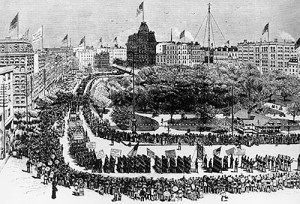
I can remember when Labor Day was about honoring workers.  I suppose it still is, in some circles.  At the top, however, the strategy is to give all the breaks to the wealthy and convince those they exploit that it’s for their own good.  In as far as Trump has a playbook, this is on page 1.  All around the community I see poor, exploited people with Trump signs on their houses.  And they’re big.  Great.  Never been bigger signs.  The policies he’s enacted, however, have taken money from their pockets and lined those of the wealthy.  Why do you think he refuses to share his tax records?  Tax fraud is a crime.  If you’re a laborer, anyway.

I grew up working class and I still think that way.  I’m skeptical, though.  I don’t take anyone’s word for it.  That’s what happens when you become a professional researcher.  Looking at actions instead of words is most instructive.  As my step-father used to tell us, “Do as I say, not as I do.”  Pay no attention to the man behind the curtain.  Just let him pick your pocket and tell you he’s been on your side all along.  Can Labor Day be anything other than a lie under such circumstances?  The American aristocracy has both a firm grip and tax incentives not to improve the lot of those who are barely getting by.  And yet we take a day off and pretend that everything’s fine.

Polls repeatedly show that those in power have no idea of the realities of the lives of the working class.  They can’t name the price of a loaf of bread and, especially in the present day, don’t care to.  Many people in the United States fear socialism.  Ironically, many of them are “Christians” who completely ignore the socialism of the book of Acts.  Early believers, the Good Book says, pooled their resources and shared everything out equally.  It’s a pity it didn’t last.  Nations with socialized medicine—the only humane way to live—have handled the pandemic better than those that rely on health insurance at the same time its own government is trying to dismantle the only plan that would cover everyone.  Why do we find it so hard to care for the workers?  Maybe this Labor Day we can stop and think for a little while where we’d be without those who actually keep things going.  And maybe in November we’ll vote to help them out.

What Labor Day used to be; courtesy Wikimedia Commons


Walnuts

The walnuts are always the first to turn.  At least around here they are.  Their yellow leaves began to litter the bike path in August.  Their nuts can be quite a hazard to a jogger if it’s not quite light.  Still jacketed with their spherical rind, an unexpected foot landing on one can lead to a rolled ankle or even a fall on the pea gravel.  Such incidents led me to wait until it’s light enough to see clearly before going out for a jog.  You see, I like to exercise before starting work, so I jog at first light.  In June this can mean heading out even before five if the weather’s clear.  Since I start work around 6:30 this is a comfortable time to go.  Nobody else is on the bike path then.  And with Covid lurking, that’s a good thing.

The earliest sunrise comes about a week before the summer solstice.  By the time summer officially begins I already have to delay my jog slightly.  This is one of the great disappointments about Daylight Saving Time.  After winter’s long darkness, it starts to get light in the morning and I think to myself “I’ll soon be able to jog before work again,” but then we set the clocks back and set sunrise progress back by another month.  During the darkling months of the year I have to jog at lunchtime.  The changing walnuts always warn me that such a time is drawing near.  Already here in early September I’m getting back late for my usual work time since the sun is reluctant to throw its first crepuscular rays over the brow of the hill before six a.m.  The problem with this is that many more people are out on the bike trail at six than I ever see at five.  And often they don’t care to share.

There are a couple of older guys who walk abreast, taking up pretty much the whole trail every day now.  They hear me coming, look back, but like the marching band in “American Pie,” refuse to yield.  Single file for them is a sign of weakness.  I have to divert into the dew-soaked grass on chilly mornings to get around them with my now-wet feet.  I long for the days when I could easily jog before they even think of heading out to the trail.  The solitude of half-light.  The walnuts are the prophets of the tree world, however.  Their fruit is both nutritious and dangerous.  Scattered across the trail in the persistent dusk of a cloudy morning, they’re both a hazard and a warning.  And it’s a sign that the morning jog may already have to wait until mid-May to reappear.


A Little Bit

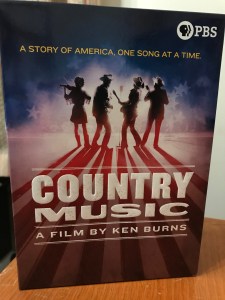
I don’t know about you, but I have a complicated relationship with genres.  As a fiction writer I have great difficulty classifying what I write, and that shows in the reluctance of publishers to embrace it.  We tend to suppose that some kinds of Platonic types exist out there by which we can map what we find here in the physical world.  These genres, however, are far more permeable than they seem.  My wife and I just finished watching the eight-part Ken Burns documentary Country Music.  Neither one of us is what you might call a fan of the genre but I can say that I learned an awful lot.  My stepfather was a country music fan, so many of the names and songs, particularly of the early years, were familiar.  What became clear throughout the century or so covered by the films was that the dividing line was always a blurry one.

While today we tend to think of country music as a southern phenomenon, the documentary made clear that its beginnings were folk music.  And folk lived most places.  While certain styles predominated in certain ages, across the years it was hard to tell some country music from pop music and rock (especially in the early days of the latter).  Even rock is difficult to classify.  What it often comes down to is self-identification.  An artist or band that identifies as country is country.  It is a distinctly American art form and it quite often identifies with religion.  Like rock, it also has some roots in gospel music.  When it becomes secular, gospel can go into many unexpected places.

Another association—again, a generalization—is country music and conservatism.  Partly it’s the promoting of Americanism, but partly it’s based on a false perception.  Performers are actors, after all.  Many of the “clean cut” examples of country singers struggled constantly with drug abuse (often considered the demon of rock-n-roll) and alcoholism.  It’s often right there in the lyrics.  The listeners, however, tend to think of them as stories.  That was the other great takeaway from the series—people are drawn to the stories.  I think that’s something we all know, but country music often excels at the hard-luck story that resonates with people down on their circumstances.  I’m not about to become a country music fan, but watching this series, like any educational venture, has opened me to a new tolerance for what I previously classified as a genre that didn’t have any appeal.


Laughing Maher

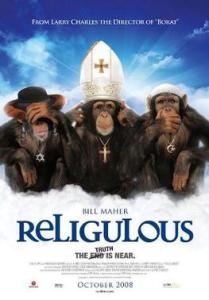
I recently rewatched Bill Maher’s Religulous.  I posted on it some years ago, but time changes perspectives.  Thinking back over the fun he makes against the religious, it is really only the Fundamentalist stripe that he scorns.  Whether Christian, Islamic, or even Jewish, he has little tolerance for those who take their sacred texts literally.  The Vatican scientist he interviews makes it through unscathed, but mainly because he’s arguing Maher’s point that the Fundamentalists aren’t at all stable.  Having noted that, Maher barely scratches the patina of the whole wide spectrum of religious outlooks.  Many of them are quite sensible, and some don’t even rely on the supernatural.  What he seems to have overlooked is that there is a vast complexity to religious thinking and people who believe aren’t always benighted.

Long, hard reflection on religion may be rare, but traditionally the seminary was the vehicle for those with the capacity for such thinking.  (Today seminaries are likely to accept just about any applicant and churches are facing shortages of clergy, making the rigorous thinking an elective course.)  It’s easy to make fun of the monks in their scriptoria, but those who learned to think logically—scientifically even—about matters of belief informed the best philosophers and other ”thought leaders” of the time.  If religion was the inspiration of scientific thinking (which then developed into humanism), it can’t be all bad.  Certainly there are and always have been abuses of the system.  Like science itself, thinking through this is a complex exercise.

Religulous is a fun movie.  Bill Maher is a likable narrator and he admits, at several points, to not knowing whether there is a God or not.  It is pretty easy to spot those whose religious beliefs are really more scarecrows than solid granite.  Literalism is pretty indefensible in the age of smartphones and the internet.  We’ve been far enough into space to know there’s no literal Heaven “up there.”  But this doesn’t mean religion has no value.  Many, many sensible religious people exist.  Most of them don’t cause trouble for society or embarrassment for their co-religionists.  Extremists, however, do both.  Unswayed by the damage they do, convinced with no evidence beyond personal feeling, they are willing to risk very high stakes indeed.  Those are the ones Maher is trying to take to task in his documentary.  On the ground religions are complex and psychologically helpful.  Complex subjects, as any thinker knows, bear deep reflection.


Never Too Late

In these weary days of bleak news, I’m always glad to find a bit of cheer.  A friend recently shared the story of Giuseppe Paternò from The Guardian.  Paternò is a 96-year-old first time college graduate.  As the story explains Paternò had wanted to attend college his entire life but being raised in poverty he never had the opportunity.  We all know how life is a rushing river that snatches you in its current, and thus Paternò found himself unable to attain his dream.  Until his nineties.  Just this year he graduated from the University of Palermo.  What really spoke to me about this story is that Paternò is now considering working on his master’s degree.  While some might wonder if this is practical, to me it demonstrates that knowledge is never wasted.

We live in an era where education is seen as either a useless luxury or as just another business.  Both views are fatal to our civilization.  We have reached where we are by progressively educating our young (and old) so that our collective knowledge-base grows.  When education is seen as a business (and I saw this in my ill-fated university teaching career) it becomes something different.  This isn’t on the part of the faculty, for the most part, but on administrations.  Paying corporate-level salaries to administrators—schools top-heavy with deans—they can’t afford to hire faculty and cut departments that aren’t profitable.  Knowledge, in turn, suffers.  Paternò, I sincerely hope, avoided the politics of academia.  A man hungry for knowledge, he studied philosophy at an age when most of us think people should just sit around and stare at the walls all day.  Knowledge should never be wasted.

Those of us who’ve been excluded from the academy sometimes try to continue our contribution.  Some of us still write books and articles.  It does nothing for our promotion or tenure.  It certainly doesn’t bear much in royalties.  “Why do it?” a friend once asked me.  When we cease seeking knowledge we stagnate and die.  We see this playing out in the politics of our day.  Washington houses many who see education as a threat to the unrestrained acquisition of mere money.  This is why universities suffer—they are not businesses.  One size does not fit all.  At their best they’re places where those of us raised in poverty can go to have our eyes opened.  And they are places where even nonagenarians can go to contribute to the growth of knowledge.


Enough

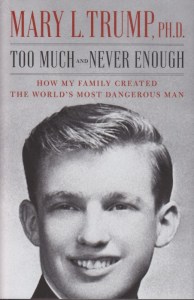
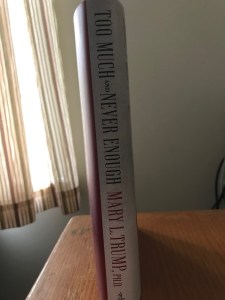
Stories of the wealthy never interest me unless they have a mysterious, ageless cousin who’s really a vampire.  Unfortunately fantasy can’t save us from the reality of a once great nation that’s now crumbling.  As I wrote earlier on this particular book, we already know, at some level, what it says.  Mary L. Trump, who alone has courage among her family, exposes quite a lot in Too Much and Never Enough: How My Family Created the World’s Most Dangerous Man.  There’s no point in ascribing blame for deeds done.  I also fear there’s no hope that justice will ever be served in this case.  Dysfunctional families are all too real and all too common.  Some of the traits (but none of the money) from Fred Trump’s cruelty were as familiar to me as my own childhood.  A powerful, overbearing stepfather riddled with a sense of his own inadequacy, taking it out in his own empire within the walls of his house.  The damaged children it leaves behind, each struggling to cope in their own way.

The family Fred Trump raised was bound to become damaged goods.  It is to the everlasting shame of the Republican Party that it could come up with no other viable candidate for the highest office in the land.  Not so long ago I would’ve written “world,” by that day’s gone past us.  Not only did “the party” accept his nomination, it has enabled him, as Mary Trump shows, every step of the way.  Knowing that something is deeply wrong—that more people will have to die in this country of Covid-19 than anywhere else, just to stoke one man’s ego—and refusing to act should be a sin in anybody’s book.  Who still emerges as his defender?  The Evangelical.  This mess is so convoluted that it will take historians (presuming anyone survives it) decades to try to unravel it.  That’s because nobody in the GOP has any empathy for those already born.  Strange form of “Christianity,” that.

This book is a depressing read.  Still, I’m glad I did it.  Not that it will change much.  Those who are psychologically like Trump, incapable of distinguishing truth from fiction, will say it’s all lies.  You can always play that card.  There are facts, however, and they are recorded.  Those who are able to weigh evidence know (and already knew) that a dangerous man had been coddled by a dangerous party that puts self-interest over nation.  You know, I think there may be a vampire in this story after all, but I just don’t have the heart to look any further.


Narrow Passage

While on a rare family visit (it’s scary to get out too much) we visited Watkins Glen State Park in upstate New York.  My mother’s family has roots in this area, and we’ve visited it several times in the past.  There are always people there, but in manageable numbers.  The website declared it was mandatory to wear a mask (“New York tough”!) and to keep social distancing.  It perhaps didn’t help that we went during a heat wave when a walk along a waterfall-laced path seemed like a refreshing idea.  I guess I had in my head the modest crowds we’d encountered in our many past visits.  We were, however, not the only tourists (although somewhat local) with that particular plan.  Not by any metric I can conceive.

If you’ve never been to Watkins Glen, the park has a Civilian Conservation Corp-built stairway and trail (approximately 600 stairs) through a glacial and water-cut gorge.  The sedimentary layers are fascinating for anyone with an interest in geology and for those who like to ponder the millions of years required for the laying down and lifting up of multiple bedding planes.  The gorge itself has a curvilinear appeal that is almost mystical.  Waterfalls produce negative ions which, everyone knows, tend to make people happy.  I was, however, more on the terrified side of the spectrum.  It became clear even before we reached the gorge that there were hundreds of people already in the park.  Most of them unmasked.  Large crowds gathered around the more picturesque waterfalls, blocking the narrow walkways.  Tourists have no idea what “six feet” might possibly mean.  Stair-climbing is an aerobic exercise, and wearing a mask in such circumstances is the only smart thing to do.

While on the considerably less crowded trails of the Pennsylvania outdoors venues we more commonly frequent, I’m nervous when someone walks even more than six feet away in the opposite direction.  This felt like a nightmare to me.  Too many people paying too little heed to the mandated caution.  I’ll be quarantining myself for two weeks for sure.  Maybe more.  I don’t get out much in any case, but even though we were obstructing our view through cloudy glasses and trying to get adequate oxygen through made-to-specification cloth masks, there’s only so much that prophylactics can do.  I jog at first light to avoid other health nuts on the local trails.  I go to stores only for necessities.  Being in a canyon with the careless invincibles inspired less than confidence in this petrified pilgrim.  Knowing human nature, it seems closing popular state parks until people get smart may be the best way out of a tight squeeze.


No So Innocent

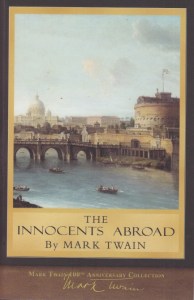
Mark Twain’s best-selling book in his own lifetime was his first commercially produced one: The Innocents Abroad.  Originally a set of letters sent during an excursion to parts of the Mediterranean basin with stops in Europe and the Levant, it’s difficult to read today.  Although satirical with much of it clearly for fun, Twain’s humor about those other than Americans embodies an attitude that would fit into Trump’s America a little too comfortably.  Other religions are strange and therefore wrong, for example.  People in the regions visited did not bathe frequently enough and were often singled out for their looks.  There’s something rascally about the behavior of the American visitors, chipping away at monuments so that they might take a piece of history home with them, yet never failing to feel superior.

I had to remind myself constantly that this is a period piece.  It contains much of the gritty humor for which Twain became justly famous.  Travel broadened him also.  A southern abolitionist, Twain nevertheless never overcame some of the racism into which he was born.  My wife and I were reading the book because of its early description of western visits to Palestine (there was no Israel at the time).  Keeping in mind that travel to much of that part of the world was expensive (his trip was sponsored by the newspaper for which he worked) and difficult, his account is actually one of the early modern travelogues on what would eventually become a fairly common pilgrimage.  Twain, like all of us, was a product of his time.

Twain’s diary famously reveals what he came to believe about religion.  There are inklings of it here.  Although he refers to the manner of dress of the ship’s passengers as “Christian,” and although he casts aspersions on Islam frequently, he reserves his most biting humor for his own brand.  During their visit to Smyrna (one of the seven cities of the book of Revelation), for example,  he writes, “Thick-headed commentators upon the Bible, and stupid preachers and teachers, work more damage to religion than sensible, cool-brained clergymen can fight away again, toil as they may” (page 327 from the 2018 SeaWolf Press edition).  Still, the assumption of the rightness of Christianity is something that he would eventually come to question.  His humor does often fall flat in an era of government support of racist, sexist tropes.  And the impressions made on those they met was summed up in his contractually-obligated note to the paper: “Many and many a simple community in the Eastern hemisphere will remember for years the incursion of that strange horde in the year of our Lord 1867, that called themselves Americans, and seemed to imagine in some unaccountable way that they had a right to be proud of it” (page 526).  Some things, it seems, haven’t changed despite the time elapsed.


Who Watches You

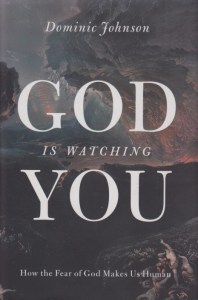
When my wife saw Dominic Johnson’s God Is Watching You on the top of my pile she said “Are you sure you want to be reading that?”  Her question was justified, of course.  I was raised in a religion where the punishment of God was very much on the surface.  Heaven’s carrot was nothing next to Hell’s stick.  I still suffer from that religious outlook in innumerable ways.  Johnson’s subtitle, however, is How the Fear of God Makes Us Human.  Johnson, who holds doctorates in evolutionary biology and political science, is well placed to try to untangle what those of us with just one doctorate in religious studies deal with constantly: what is religion?  The main idea of the book is deceptively simple—we have evolved the way we have because we feared (and continue to fear) supernatural punishment.

Johnson establishes that sociological and anthropological studies have shown that humans respond much more readily to punishment than reward.  Reward is like icing—you can eat a cake without it and still enjoy it—while punishment is like the threat of all food being removed.  You see the difference?  One has a far greater motivating factor than the other.  This idea spins out into many aspects of religion, and even perhaps hints at the origins of religion itself.  I have often written on this blog that animals exhibit religious behavior.  We don’t speak their language so we can’t know for sure, but some of what various animals do seems very much like what we do in church, synagogue, mosque, or gurdwara.  Accusations of anthropomorphism fall flat, to me.  We evolved, did we not?  Then why do we resist pointing out in animals where that behavior sticks out like a sore opposable thumb?

Human societies worldwide share the fear of divine punishment.  Interestingly, even a significant portion of atheists admit fearing it too.  Often those who know me ask about my preoccupation with fear.  It sometimes shows in my writing about horror, but I think Johnson may well have the key in his pocket.  Religion is about fear.  It’s not just about fear, but it clearly is about avoiding divine (however defined) wrath.  Lose a job or two broadly defined as religious and disagree with me.  Am I sure that I should be reading this book?  Now that I’ve finished it I can definitively say “yes.”  While I don’t agree with everything in it Johnson has clearly hit on something that all people who study religion should know.


November Dreaming

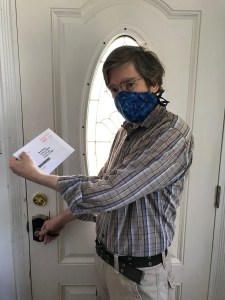
I recently took part in a non-partisan postcard-writing effort sponsored by Moms Rising.  The idea is simple enough: encourage people to get out and vote.  Such is the state of our country that some people see this as a liberal agenda.  An anti-patriotic act.  Who would object to people voting (apart from the Republican Party, that is)?  Apparently we’re now simply supposed to accept what the present administration hands down, including its desire to retain power legally or illegally.  Those who suggest that people should be given their constitutional voices are considered radicals.  This would be ironic were it not so dangerous.  The only reason the powers that be are in office is because of an election, and one that was “won” by that gaming of the system known as the electoral college.  Now that Covid-19 is ravaging our country, those who refuse to do anything about it want to strengthen their grip.  And their followers blindly say “Amen.”

Postcard writing does not involve telling the potential electorate whom to choose.  The message we’re instructed to write is simply encouraging others to vote.  Gerrymandering and making people stand in Covid-laced long lines have been “tactics” used by current supporters of the modern-day plague to keep their hold on power.  When trying to get people to vote is considered an act of sedition we need to stop and think what democracy has become.  If you don’t believe everyone should vote then you have no right to object—your voice is your vote.  I stand with Moms Rising to test the room.  Let’s see if what’s happening here is really the will of the people.  And I don’t mean that house of lower education, the so-called electoral college.

If you’re inclined to help with the effort, all it costs is a little time.  Check out Moms Rising’s website.  They’ll send you a packet of postcards for free with a postage-paid envelope to mail them back.  All you need to do is write a sentence or two in the blank space on the back, put the cards in the envelope, and drop it in a mailbox.  It costs so little and so much is at stake.  Time is a commodity, I know.  Given that our time is running out, however, it seems that sparing a bit of it to keep democracy breathing is important.  No— vital.  My regular readers know how I often express my wish/need for just a little more time to accomplish what I’d like to squeeze into a day.  I’ll gladly sacrifice ten minutes for the good of the country I call home.


Everybody Knows

One of my favorite Leonard Cohen songs is “Everybody Knows.”  On a related note, the best-selling book in America last week was Mary Trump’s Too Much and Never Enough: How My Family Created the World’s Most Dangerous Man.  With the publisher citing 900,000 copies sold upon release, it produced numbers that most publishing houses only dream of.  I’d preordered it on Amazon but for the first time ever I did not have a copy on the day of release.  There were a lot of people ahead of me in this line.  That’s even more remarkable than it sounds because we all pretty much know what the book says.  We also know that its subtitle is true: we have a very dangerous man (daily rising Covid deaths show this to be true) given free rein by Republican senators.  Even adults without high school educations that I talk to know there is something seriously wrong.  Indeed, anyone who knows how to fact-check can see it.

A very popular way to deal with inconvenient truths is to posit a conspiracy theory.  Evangelicals (now defined as Trump supporters) have long used conspiracies as ways of explaining how facts simply don’t support their views.  From the moment “alternative facts” left the lips of the administration in January 2017 I knew we were in deep, deep trouble.  Funny thing is, many Evangelicals had to read Orwell in school, like the rest of us.  How they could support anyone that had such a long, long track record of criminal cases against him before placing his hand on the Bible and swearing to uphold a constitution he’s been daily dismantling since is anybody’s guess.  Daily life, it seems, is now a conspiracy.  

One of my favorite Leonard Cohen songs is “Everybody Knows.”  The lyrics suggest that whatever it is we want to keep secret everybody, well, knows.  That’s what’s so distressing about America’s current decline.  Everybody knows that being president is a very difficult position and that it’s only handled adequately by well-trained and smart people who, despite their faults, put country above self.  With the election of 2016 it was clear from even before day one that ego was the driving factor behind 45.  Americans love their outrageous television personalities and somehow think that appeal on the small screen somehow translates to leadership ability.  We’ve learned before that this isn’t true.  I haven’t read Mary Trump’s book yet—it just arrived in the mail—but when I do I’m sure I’ll find out what everybody knows.


Like an Egyptian

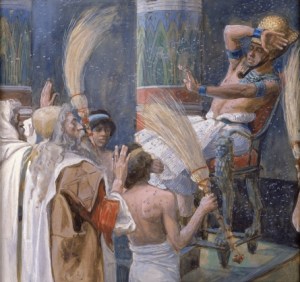
“And Pharaoh’s servants said unto him, How long shall this man be a snare unto us? let the men go, that they may serve the Lord their God: knowest thou not yet that Egypt is destroyed?”  The words are from the Good Book.  Specifically Exodus 10.7.  They’ve been on my mind as the coronavirus is beginning to yield in all developed nations but our own.  Let me set the scene: the Israelites have become slaves in Egypt.  Moses was sent to set them free, but a Trumpian Pharaoh stood in the way.  Plague after plague was sent, but the president, er, I mean Pharaoh, refused to acknowledge what the evidence indicated.  Moses would appear before the senate and declare the coming disaster.  In the mythical world of the Bible, though, the senate actually saw reason.

“Knows thou not yet that Egypt is destroyed?”  Instead of addressing the Covid-19 crisis the White House has decided to turn a blind eye.  Nearly one-fourth of the worldwide cases of the disease are recorded in the United States.  In the past week several record-setting days of new case numbers were set even as the administration was insisting that schools be opened without any plans, or even ideas about how to help.  “Have them make bricks without straw,” you could almost hear echoing around the Oval Office.  Ah, indeed, this is the most biblical of administrations.  Our economy has been tanked for years to come.  The environment has been degraded to the point of disaster.  And yet Moses is ignored.  The real plague was the Pharaoh.

“This is the finger of science!”

Exodus is a story of liberation.  What’s more, according to the Good Book, God himself wanted Israel to be set free.  The Pharaoh, it seems, was not personally afflicted with the plagues until the darkness fell.  Prior to that, if it didn’t affect him personally he simply didn’t care.  Too many self-aggrandizing monuments to be built to his own name.  Ancient Egypt was like that.  Meanwhile plagues brought the mightiest nation of the time to its knees.  Beyond that.  It brought them prone.  Most of us, I expect, are ready to get on with life.  We’ve been self-isolating for over three months and yet the number of cases continues to increase.  We could use a word or two of guidance from a sympathetic leader.  Instead we’re entering hurricane season.  I can’t speak for anyone else, but I’ve got my Bible all ready.  And right now it’s open to Exodus.  


Layers of Brick

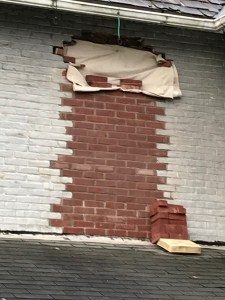
If, like me, you can’t see a neighbor’s brickwork without thinking of “A Cask of Amontillado,” then I need not explain why I watch horror films.  I know that as of late some literary scholars have challenged the idea that Edgar Allan Poe wrote horror.  There is now, and always has been, a bias against the genre.  In fact, many would point out that Rod Serling’s Twilight Zone wasn’t really horror, no matter how creepy some of the episodes were.  Some would cast Ray Bradbury into that lot as well, and others would not.  I spend a lot of time pondering this because those of us who enjoy some of what’s called horror are often cast as misfits.  And misfits have a lot in common with monsters.

The connection with religion is a palpable, yet intangible one.  It does seem that religion has its origins in fear and as it branched out it came to have different emphases.  Jesus, for example, apparently stressed love, at least according to the gospel of John.  That religion of love came, eventually, back around to fear.  Calvinism, especially, is suffused with it.  There’s a reason that it is the religion expressed in particularly effective horror.  Apparently they meet similar needs, but psychology is not an exact science, and our tastes in it differ.  Even our interpretations do so.  As the bricklayer puts down row after row of masonry, the thoughts get walled up in days where work prevents serious consideration of the deeper questions.

It’s been years since I’ve read “A Cask of Amontillado.”  The story has stayed with me, however, whether it’s horror or not.  Stories about imprisonment are like that.  The other day a police car stopped outside our house.  We live in a working-class, but descent neighborhood.  From the bits and pieces glimpses out the window revealed, there was a problem with a car that had been parked on the street for quite a while, and that didn’t belong to any of the local residents.  The natural response to seeing that car just outside was fear.  We fear criminals and we fear the police.  We fear what Covid-19 is doing to us, even to those of us who’ve managed not to contract it.  Traditional religion would tell us punishment comes from the Almighty.  These things are all related.  And across the way the bricklayer keeps up his work, row after row.


Independence Day Wishing

It’s Independence Day and what we most need independence from is our own government.  History is full of ironies.  Federal holidays falling on a Saturday, for instance.  In any case, here we are on the Fourth of July and still stuck under a repressive government that a small portion of people like.  Republican groups supporting Biden are starting to arise, but we can only dream on Independence Day.  Many of us would like to be independent of the coronavirus, and not a few people are acting like we are.  Cases are spiking, so the rest of us are staying indoors.  Fireworks are okay, but I have trouble staying awake until dark these days and more often than not they just keep me awake as I’m starting to doze.

Maybe for Independence Day I’ll take leave of reality.  Maybe I’ll imagine a government that isn’t so utterly corrupt that some people might have some faith in it.  Maybe I’ll dream that black lives matter and that our leaders would believe it.  Maybe I’ll think what it would have been like if caring officials addressed the Covid-19 crisis directly instead of brushing it off, so that like all well-run nations cases would be going down here instead of back up.  There’s so many possibilities and the one thing they all have in common is that they point to independence from the Trump Administration, if that’s what it can be called.  Maybe it’s time to light a sparkler of hope.

Independence Day can be a day of looking forward instead of looking back.  If we can look ahead we might see a country where anyone will be allowed to exist and not be condemned by “Christianity.”  We can come to see that privileging any one “class” or “race” or “sexual orientation” is a form of bigotry from which we can and should be independent.  We can try to think what it must be like to experience life from somebody else’s skin.  We can try to understand instead of standing ready to condemn that which is “different.”  Fact is, everyone is different from everyone else, it’s only a matter of degree.  And difference can unite rather than divide.  The whole idea behind uniting different states was that those who were different could support one another and figure out how to make room for everyone to fit.  It won’t be easy to do, but we might use today to envision a country where we can work together, and figure out that leaders who bring people together are the only hope we have for the future.