Melting Psalmists

With weather like this, I could use a Psalm or two.  Of course, in my mind, weather and Psalms are closely connected.  Here in the mid-Atlantic states, we’ve been experiencing a heat wave.  Unlike many parts of the west, such heat here in the east is accompanied by very moist air, meaning that cooling down is only possible in a large body of water or air conditioned interiors.  We have neither readily available at our place, so we try our best to keep cool and compose psalms, mostly imprecatory, I fear, about the weather.  Although it was thunderstorms that stirred my interest to write Weathering the Psalms, I included a chapter about temperature, for the Psalter sings of hot and cold as well as lightning and thunder.

The world of ancient Israel was quite different from that of North America.  There are mainly two seasons in the Levant—dry and rainy.  The dry season isn’t always as hot as we tend to imagine it, although the day I visited Masada the air temperature was about 120 degrees.  Enough to make a dip in the Dead Sea look inviting.  The Bible often views high heat as a form of divine punishment.  Although we human beings have expanded to fill just about every ecosystem our planet has to offer, we thrive in central California conditions.  Not all of us can live there, however.  And it’s a good thing that global warming’s a myth since it’s awfully hard to function when it is over 90 degrees for days in a row.  WWDD?  What would David draft?  Perhaps, “I’m melting”?

The interesting thing about the global warming myth is how real it feels.  I suppose the solution is to use more fossil fuels to help keep cool.  Fans, arctic air conditioning, lingering languidly at the open freezer door.  I stand here sweating, wondering what the Almighty could possibly find wrong with a country that is now great again.  One that takes children from their mothers yet insists birth control is evil.  One that loudly and punishingly insists guns should be in every home.  One where the elected head of government is involved in over 3,500 lawsuits, yet gets to appoint justices in the Supreme Court.  David got caught, if not in flagrante delicto, at least within a couple months of adultery with Bathsheba.  Instead of paying her off, he had her husband murdered.  But then—and here’s the key difference—he humbled himself and repented.  The sweet Psalmist of Israel might yet have something to teach us yet about weather and the Psalter.  Until the United States becomes the chosen nation again, I think a cold shower will have to do.


Rains and Bows

It’s raining and I’m here for an outdoor event. Here, in this case, is Ithaca, New York. The event is the parade that’s an integral part of the Ithaca Festival. As people have been laying out their chairs and blankets along the route since morning, it’s a fair guess that if we don’t stake out our few feet of available public space we’ll miss the parade. And yes, it will rain on my parade. The problem is waiting in the rain. With one hand holding an umbrella and water getting in anyway like a leaky roof, there’s only so much you can do. Reading a book—my default activity—is out of the question. I know very few people here and since I’m acting as a placeholder, there’s nobody to talk to. Tom Petty was right after all.

The parade itself turned out to be a celebration of diversity. Ithaca is what America could be. The various liberal organizations, eager to educate, marched by to cheers and bonhomie. There’s nobody judging here. This became clear in a particularly striking juxtaposition (for which I have no photos, because it was raining) in the parade lineup. A group of Mad Max-themed metal rockers went by in a gnarly truck decorated with torches protruding from fake human skulls. Dressed in future period costumes from the movie diegesis, they produced the guttural, primal roar that is an accusation against current society. Then, like Mel Gibson shifting to The Passion of the Christ, the group immediately behind was a Bible Baptist Church. Add water and mix.

For this I’d sat in the rain for a couple of hours. Forced to relax, I watched the water on the fabric over my head as beads crawled together, joined one another, and scurried, animal-like, from the umbrella to the ground. The drops may look uniform from a distance, but they’re diverse. They come in different sizes, and perhaps because of the distorting character of the nylon, they took different shapes. Placed together in one location, it was natural, it seemed, for them to come together for a common goal, which was the ground. There was a parable playing out here right over my head. While it didn’t seem to be the case at the time, it clearly was a lesson to be shared. Had it been sunny, I would’ve been reading a book. Sometimes it takes sitting in the rain to learn something that should be obvious no matter what the weather.


My Heavens

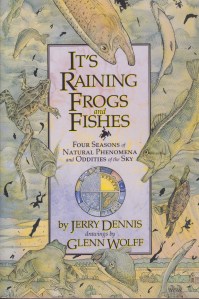
The details escape me. I was a student at Grove City College, working on a paper. In the library I ran across an article about a rain of fish. Always interested in the unusual, I was surprised to see such a piece in a reputable journal, and up until that time I’d never heard of Charles Fort or his gathering of such accounts from around the world. That paper was in my mind when I picked up It’s Raining Frogs and Fishes by Jerry Dennis and Glenn Wolff at a used bookstore. Subtitled Four Seasons of Natural Phenomena and Oddities of the Sky, it was published by the mainstream Harper, so I figured it wasn’t too far afield from reality. It turned out to be more the subtitle than the title, but an engaging read nevertheless.

There is a small section on rains of fish and other strange objects, but the book is really a tribute to the sky. Although I’m not an anthropologist, I have long been intrigued by the fact that people everywhere associate the sky with the divine. From the human perspective, it’s massive and all-encompassing. No matter where you stand on this planet, the sky extended over you, engulfing the horizon and implying even more beyond. It is responsible for our weather, and without the buffering of our atmosphere no life would’ve evolved on the earth at all (and that would be a pity because I enjoy writing this blog). Perhaps even before there were humans proper, our ancestors thought there was something divine about the sky.

While the firmament can’t be contained in a book, this one tries to consider just about everything you might find in the celestial realm. From extremes of weather to meteors to strange things falling from the sky, it tells of rain and snow and sunshine, insects, bats, and birds. The four seasons don’t really function as the best conceit for the book, since the sky is eternal and many of the aspects discussed are present all year long—the moon is with us always and the sun rises and sets even in winter. Nevertheless, this strange and alluring book demonstrates how the sky makes us what we are. Even though it was written in the last century it warns of global warming—then merely an idea—and shows how humans are capable of destroying that which gives them life. That article back in college suggested that the impossible happens, and that, given how the world is going, causes me to look upward with wonder.


A Parable

Once upon a time, in a land far, far away, there was a holiday known as Earth Day. Now, Earth Day was a poor holiday. She didn’t prostitute herself to commercialism, she wasn’t attached to any religion, and people didn’t even get the day off work. Still, she was an optimistic holiday. One of her prophets was a woman named Rachel Carson. A science writer who could see that our rampant greed and fatal shortsightedness were leading to environmental catastrophe, Carson wrote books of warning. People began to take heed. An ecology movement was born. New concepts like “sustainability” and “stewardship” and “moderation” became part of national consciousness. Other nations joined in. Earth Day was born. She was a happy child.

But there were demons in this land. Huddled in filthy holes in the ground, these demons cared only for owning as much of the earth as they could. They wanted to heat the planet so much that Earth Day couldn’t survive. They would drown her in the waters of her melted ice caps—her very tears. These demons couldn’t do it alone. They lived in the dark and since they cared for no one else, they had to find a Devil among them. A Devil who could quote Scripture. Such a Devil, they reasoned, would make the followers of the dead God join them. The followers of the dead God were like sheep without a shepherd. And the demons had all the money in the world. So they decided to kill Earth Day. Nobody would stop them.

With Earth Day gone, the weather went wild. Winds constantly blew. Hurricanes of new and intense savagery emerged year after year. The demons laughed, for when the people’s things were destroyed they would have to buy replacements. The demons would become even richer. The followers of the dead God clapped their hands in glee. But the demons and their Devil didn’t know that Earth Day couldn’t die. They did as they pleased, taking what they wanted from the what they supposed was her corpse. Then the weather, Earth Day’s dearest friend, began to do what it would in its rage. The demons awaited summer when they might feel hot again, but summer only comes after Earth Day. Oblivious, they lived their lives of plunder and greed until the followers of the dead God were all gone and they had no one left from whom to steal. Rejoicing in their acquisition of all the earth, they failed to notice the storm. Earth Day was returning and all their wealth could not save them.


Ouch! Ouch!

The cold and flu season seems to have had an extended life this year, what with snow still falling in April and yet another week of cooler weather in the forecast. Although there’s no cure for the common cold, we do have the ability to prevent many maladies with a vaccine. Under eight years of Republican governance, New Jersey had become quite friendly to those who don’t want their kids vaccinated, despite being the most densely populated state in the union. The reason many objectors give? “It’s against my religion.” There was a massive outcry recently when a bill was approved that requires religious objectors to state what their religion is and what exact tenet of that religion vaccination actually violates. The statements of those opposed show that religion was largely being used as an excuse by those who didn’t want their children inoculated. Confirmation class has a purpose after all.

Social responsibility, of course, reaches beyond the home. In fact, it begins as soon as we open the door. Add to that the fact that most people can’t describe the basic beliefs of their own religion accurately and you have a real case for contagion. When you sign up to join a religion—what a capitalistic idea!—you generally go through training classes to let you know what you’re publicly proclaiming you believe. Given that religion deals with everlasting consequences, you might think most people would pay close attention, embedding the facts deeply. That, however, often isn’t the case. Beliefs are handed down like family heirlooms, or are gleaned from watching television (usually Fox). One’s religion is useful for making excuses, but people hate to be challenged on this point.

In the right’s continuing war on social responsibility, they’ve been pumping the media full of anti-vaccine fear. Vaccines, they’ll aver, use human embryos. Any other other form of conspiracy theory can be used to turn hoi polloi against them. Our society was built into what it is by as many people as possible agreeing that when it comes to the good of all, individual prejudices sometimes have to be overlooked. It’s natural enough for parents to be concerned for the wellbeing of their children. It’s sadly ironic when their “religion” tells them that the most basic protections are somehow evil. Who can help but to think of Abraham holding the knife above a bound Isaac on the altar? That is, if they happen to be of a certain religion, and if they paid attention during their version of confirmation class.


Hypocrisy, Defined

Things look pretty Stormy in DC. I suspect my Republican background is showing when I say I don’t condemn sex workers. If they’re not exploited and they like what they do, hey, a job’s a job. The evidence, of course is that Trump had an affair with Stormy Daniels when his wife was recovering from the birth of their son. And hush money was paid right before the election. This is public knowledge. What I find interesting are the responses that Republic congressmen have been giving journalists. In a recent story in the Washington Post, various congressional leaders of the GOP were asked if Obama had been caught in such a situation would they have pursued impeachment. “Of course,” they answered. When asked why this didn’t apply to Trump, they simply shrugged. There’s a word for that.

Hypocrisy may seem like an old-fashioned notion these days. Indeed, when I was growing up I frequently heard it from Fundamentalist pulpits. It was considered, along with lying, to be about one of the worst sins possible. Now Fundamentalists are lined up behind Trump (who’s lined up behind Stormy apparently) and saying all of this is just fine. The Lord’s will is being done. Moderate Evangelicals are scrambling to find a new label for themselves, for their vaunted title has been taken by a party that will condone anything as long as rich white men benefit. Cheat on your wife while she recovering from giving birth? That’s the new Fundamentalist way! Congressmen, it seems, don’t want people to look too closely into such things. My, there’ve been a spate of recent retirements lately, haven’t there?

I grew up and grew away from Fundamentalism. Although it seems counterintuitive, this sharped my moral sense considerably. Poll after poll shows that actual morality, according to Fundie standards, is more often lived by liberals than conservatives. Divorce rates are lower, for example, and we tend not to own guns. So, even when the skies over the Potomac are growing stormy, the elected officials of God’s Own Party smirk and say, “Doesn’t the Bible command you ‘Love thy neighbor’?” They take it literally, of course. And it’s just fine that the leader of the free world exploits women. Many of these same people gathered to condemn Bill Clinton for loving his neighbor in the blue dress. Hypocrisy was a bad thing back then. “I did not have sex with that woman,” became a mark of national shame. Now presidents brag of grabbing women by their private parts and the Republican Party claps its hands and says, “Hypocrisy? Never heard of it.” Does it look like another storm to you?


Odd One Out

The older I get, the more I realize I’m the one that’s weird. Go ahead and say it, “You’re just now figuring this out?!” This epiphany came to me on a stiff breeze. To understand you have to get the idea of commuting on New Jersey Transit. Although twice in one week my route was blessed with a brand new bus, the general operating procedure is to use the oldest, least reliable buses on my route. It is one of the longest routes the company runs into New York City, which means that it is one of the most expensive. You’d think they’d use their best buses, but then you’d be thinking like me. Breakdowns aren’t as frequent as they had been for a while, but other discomforts are fairly common. Just this past week, for instance the heat was stuck on high. Add about 50 bodies to an enclosed, overheated space, and well, let your imagination go.

Now interstate buses aren’t like the school species. The windows don’t open. There are, however, two escape hatches in the ceiling. When I got on board I noticed immediately that it was a sauna bus. The last time this happened (and yes, this wasn’t a unique situation in my experience) passengers opened the escape hatches to create a breeze. Problem was, it was winter this time. The day was struggling to reach 40 degrees outside. As we hit the highway the wind was blowing full against those in my row and I learned what wind chill really can be. There wasn’t much traffic, so the bus was tooling along at about 65. I could feel my left eye beginning to freeze up. My book pages were flapping wildly in my blue-tipped fingers. The personal nor’easter cut right through my winter coat. In my row we were lined up like eskimos, all bundled up. There were no free seats to which we might move. I couldn’t reach the hatch to close it. Nobody said anything.

Here’s where the weirdness comes in. As I child I was raised being taught that true believers think of others first. Other people may not see it, but I consciously try very hard in subtle ways to make sure others get what they need before me. I’m learning not everyone necessarily thinks that way. If I had a degree in fluid dynamics I might be able to describe airflow on a speeding bus. Instead, let me put it this way: the guy who opened the hatch was sitting in the row in front of it, out of harm’s way. The icy blast didn’t hit him, but it did everyone behind him. Passengers tend to think of themselves first. I’m sure I do, too. Just trying to get home after a trying day of work is, well, trying. It’s just that some folks try not to do things that cause others pneumonia, no matter how warm they feel. But then, I’m the odd one, I know.


Sky Mercies

While in a used bookstore recently, I was going over the science titles. I like to read accessible science since I often find it approaches religious ideas in secular terms. Once in a while even the terms of these disparate disciplines coalesce. I spied a volume on the top shelf titled The Mercy of the Sky. The spine showed a purplish cloud-bank, and the very concept set me wondering. We’d just been through a bomb cyclone the day before with wind bellowing through our apartment. Many trees were down and power was out for several people I’d overheard talking that day. I stared at the spine, thinking perhaps this would be a good follow-up to Weathering the Psalms, but as I already had books in my hands, and since I’m not the tallest guy around, it seemed beyond my reach. Of course, after I left I thought more about it.

The previous day’s nor’easter had revived that sense of a storm as divine anger. Strong winds, my wife commented, are generally disturbing. They make it difficult to sleep. It’s hard to feel secure when the heavens are anything but merciful. Although the wind is easily forgotten, it’s among the most easily anthropomorphized of natural phenomena. And it’s ubiquitous. Everything on the surface of the earth is subject to it. Indeed, the atmosphere is larger than the planet itself. Is it any wonder that God has always been conceptualized as in the sky? The quality of the mercy of the sky, we might say, is strained.

Danger comes from the earth below us, the world around us, and the realm above. Like our ancient ancestors staring wonderingly into the sky, it is the last of these that’s most to be feared. The wind can’t been seen, but it can be felt. It cuts us with icy chills, drenches us with dismal rain, even flings us violently about when its anger compresses it into a tight whirl. We can’t control it. Unlike other predators it requires neither sleep to refresh nor light to see. Its rage is blind and it takes no human goodness or evil into account. After a great windstorm, the calm indeed feels like a mercy. Elijah on Mount Sinai stood before a mighty wind, tearing the land apart. It was the still, small voice, however, that captures his imagination. There’s a calm before the storm, but it is the stillness in its wake that most feels like the mercy of the sky.


Weather Psalm

As the northeast coast digs out from yesterday’s nor’easter at least we can thank God that no business days were lost. At least none based on the status of New York City schools. Some NYC businesses base their decision on whether an adult snow day is in effect or not on the decision of whether or not to close the public schools. If kids are expected to make it to school, well, pull your socks up, thrash through the snow, and get some work done. I was fortunate enough to be able to work from home during the event that began like a snoreaster. By the time I would’ve usually been on the bus it wasn’t snowing. Roads were wet, but it seemed like a normal day. So it continued until about 10:00 a.m. Then it really did snow.

I’ve commuted long enough to know that, as grueling as getting up early and trying to get to the city may be, the evening commute is always worse. It may seem hard to believe that there are traffic jams before 7:00 a.m. most days, but around 5:00 p.m. all bets are off. The news vendors were lamenting the fate of those who had to find their way home in a foot of snow, even as it was still coming down swiftly. Nature doesn’t abide by our work schedules. Many companies don’t care if you can’t get out—you chose to work in the city. If it takes you three hours to get home, that’s not a work problem. It’s a personal thing. On personal time. Choose wisely.

All of this makes me reflect on the way we think of work these days. Commuting into the city shouldn’t be a dangerous job like being on an Alaskan fishing boat is. Chances are the actual daily work consists of sitting in a cubicle staring at a screen. Eye strain, carpal-tunnel syndrome, and boredom are the only real dangers here. Unless you’re taking the George Washington Bridge, carpool tunnel is a far more sinister threat. If you make it home in time to come back in tomorrow, then it’s all good. We do this so that we can earn money to spend, mostly online. We haven’t quite got to the point yet where we can wire our physical bodies to the internet so that we can stay at home and work 24/7. But it’s coming, just like the next nor’easter. In the meantime, I have a bus to catch.


Of Our Being

It happens every year. What with my commute schedule and personal disposition, I read a lot. This blog and Goodreads are my accounting system for keeping track of the thoughts that arise during all of this. Every year I get stopped by my first really important book that I’ve read since December’s roundup of last year’s titles. Paul Bogard’s The Ground beneath Us is this year’s first such book. Subtitled From the Oldest Cities to the Last Wilderness, What Dirt Tells Us about Who We Are, this tour of several fascinating locations is a wake-up call. Divided into three sections—Paved and Hallowed, Farmed and Wild, Hell and Sacred—Bogard’s book offers a kind of travelogue with the additional reminder that how we’re treating the land is the most terrifying example of what lack of foresight imaginable (why, Prometheus?) looks like. In a world with a rapidly growing population, we’re paving and building at unprecedented rates. World harvests, experts say, will last only another sixty years. Then we starve.

A dilemma I’ve struggle with here before is the fact that nobody owns this world. Nobody but those driven by money. There’s little that can stop them. This is exemplified by his chapter on fracking in my native Appalachia. Companies protected by loopholes—nooses, actually—devised by Dick Cheney can take over a town and destroy its environment. And this was even before Trump. And this is only but one example. Those who look soberly at where we’re going—and the melting permafrost in the northern hemisphere is about to make the globe nearly uninhabitable for our species—are ignored because they stand in the way of profits. Everybody loses. As a species we have neither the will nor the power to prevent it. Epimetheus reigns.

Not just doom and gloom, The Ground beneath Us is a thoughtful reflection on the human spirit. The titles of the subsections reveal that sacred ground—one of my recurring themes on this blog—is very real. Bogard isn’t a religionist, so you can’t accuse him of special pleading. His moving accounts of visiting sites hallowed by any number of factors, whether violence or simple belonging, reveal what home really means. What a dangerous, maybe even sinful, concept ownership can be. With chapters covering areas as diverse as Mexico City sinking under its own weight, to Ames, Iowa where what we’re doing to the soil is studied, to parts of Alaska accessible only by air, Heaven and Hell are daily and plainly played out before us. This is a very important book. We can only hope enough people will read it before it’s too late.


Emulating Icarus

According to a story by Sarah Kaplan in the Washington Post, NASA is preparing to send a probe closer to the sun than any human-made object has been before. If you’re like me, this might conjure those childhood fascinations of being blasted by impossible heat—maybe in a science fiction story of a colony on Venus, or a crew hurtling out of control in a capsule being pulled inexorably toward the inferno of the heavens—on a hot summer’s day. The Post story makes an inevitable reference to Icarus, the character from Greek mythology who flew too close to the sun. The tale has long been a parable for human overreach, but this time it seems that scientists are taking it literally. The technology used to shield the craft from Old Sol is incredibly impenetrable, and it may have applications as we try to figure out how to escape this planet we seem bent on ruining completely.

Earth flies around its personal star in what’s become known as the Goldilocks Zone—that place where it’s neither too hot nor too cold for life. But don’t wander outside in the northern hemisphere in February without a coat. The weather down here can be fatal. We live on that teeter-totter of the extremes in which our frail bodies can survive. Temperatures range from -88 degrees at Oymyakon, Siberia (at this point whether Celsius or Fahrenheit hardly matters, but for the record, it’s -126 F) to 136 in the Libyan Desert. In this incredible range of 262 degrees people can be found at all shades between. Stepping out my front door one January in Nashotah, Wisconsin the thermometer read -42. That was without wind chill. It was the kind of cold you could feel immediately through all the layers. Humans can’t survive it without artificial means of heat. And yet we have a star overhead where temperatures reach 27 million degrees in its core. Out beyond Pluto our universe reaches near absolute zero, at -459 and change, on the Fahrenheit scale.

It’s a universe of extremes. That friendly sun in the sky was recognized as a deity from earliest times. Even the Bible retains hints of clandestine solar worship. Icarus, however, lost his fear of extremism. There was nothing too outrageous to try. As long as wings of wax can hold you aloft, why not attempt to reach all those zeroes? Millions sound great until they’re exceeded by billions. At that point even the sun isn’t hot enough for some.


Noah’s Phone

The world-wide flood is a great story. We find it in many cultures, so the idea obviously captured the attention of ancients as well as moderns. What’s strange is that, with the development of human knowledge so many people continue to accept it literally. The only science that can be bent enough to make it work is one where God breaks all the laws of physics and biology to kill everyone, just to make a point. Why bother to make it rain 40 or 150 days? Why not just create the requisite water instantaneously? It would be just as believable. Nevertheless, literalists look for explanations for how this might’ve happened. It’s not to convince God, of course. The goal is to convert unbelievers by showing that the myths of Genesis are literally true.

When I came across a story on Mysterious Universe by Paul Seaburn titled “Academic Claims Noah had Cell Phones, Drones and Nuclear Power,” I was hooked. The academic is a Turkish professor of marine sciences. Using modern technology—rather like the detritus seen scattered in the background of Darren Aronofsky’s recent movie version—he postulates that this could’ve happened. The real issue is why. Not why the flood; the Bible answers that. Why would a scientist feel the need to prove a myth scientifically? Biblical scholars call the flood story an etiology. An etiology is a story to explain the origins of things. That’s its purpose.

Noah’s flood explains why it rains. It also explains why this dome that covers our flat earth doesn’t fill all the way up anymore. It explains why animals are sacrificed and why rainbows occasionally appear to grace the sky after it rains. We also know that the story borrows from an even earlier Mesopotamian myth where the god who causes the flood isn’t even Yahweh. The people of Israel were conquered by the Assyrians and Babylonians and they told flood stories about their gods. The Bible counters with two stories (yes, just like the creation accounts) mixed together in this snow-globe universe of Genesis. Is it easier to believe this or to claim that Noah had access to Verizon, steel manufacturing, Einsteinian physics, remote-control flying machines, and artificial insemination (to help the animals recover)? It’s like when someone suggests natural explanations for the plagues of Egypt. Such special pleading doesn’t prove miracles, but rather it demonstrates that all this could happen without any gods involved. And you’re still going to have to mop up all that water when it’s over. I’m sure it will make for a great story some day.


Street Clearing

Not driving to work definitely has its advantages. Although studies suggest commuting takes a great toll on hapless riders, the stress of driving in traffic—more often just sitting in traffic—also takes its pound of flesh, and more. A recent snowstorm had me reflecting on this. Once in a while I like to demonstrate that the male of the species is worth keeping around, so after the Bomb Cyclone that closed schools and offices in the trial-state area a couple weeks back, I went out to brush off and start the cars. It’s not that women can’t do this, but it’s more the fact that nobody wants to do it that motivated me. Besides, I have a secretly fond memory of the years of enforced, Dr. Zhivago-esque labor on our Lake Erie snow-belt blessed driveway. My stepfather’s shack sat atop a long, unpaved driveway. Ironically, although he drove the borough snow plow, he insisted that we boys do the shoveling at home. Maybe that’s where I get it. A poor family, our winter coats were substandard and aching fingers and toes, not to mention frozen faces, were pretty typical. I hated every minute of it. Or did I?

Bundled up against the arctic winds that had brushed a noticeable breeze past my face the night before (in the present-day) when I climbed into bed, I stepped out in first light. Immediately the cold found the small gap between my gloves and sleeves and began to work it’s chilling magic. Before the powdery snow was even off the car my fingers were numb and painful, reminding me of an unfortunate frostbite episode as a child. Unconsciously I found myself smiling. I’m no longer forced to do this. Kindness is a far better motivator than hate. At least as a renter I didn’t have to shovel the drive.

Afterwards, inside an apartment that we all habitually decry as too cold, I quickly warmed up. There’s a pleasure in doing something so that someone else doesn’t have to. I miss that, working in New York City. Focused on getting to work, it’s far too easy to step past those for whom even a glance is a blessing. Those who sleep in cardboard boxes on nights like that through which I felt an annoying draft, although secure inside. I see the police “evicting” tenants of paperboard towns even as I glimpse Trump Tower in the distance. The storm they called a Bomb Cyclone. We clear the streets quickly so that we might get back to work and make more money for the one percent. Studies show commuting is killing us. It seems the cold is doing so as well.


Gaston Avenue Freeze-Out

I was not, as yesterday’s post indicated, looking forward to the renewed commute into New York City. We’ve been having a cold snap here in the Northeast, and although it’s nothing by Midwest standards, standing in it waiting for a bus isn’t the most comfortable of situations. It was cold enough that I didn’t dare take my gloves off to check the time, but my body clock told me the bus was late. The cold was creeping through all my layers and the thermometer said it was in the single digits, and breezy. I’d been a human popsicle for about a quarter of an hour when a pair of headlights pulled in the parking space nearest me. The driver got out—one of the regular commuters on my line—came over and said, “The bus is running late, won’t you sit in my car?” I was truly touched.

It’s easy to think people just don’t care. Those of us on the early morning commute know each other by sight, but not by name. We all awake far too early and put up with expensive, but unreliable bus service. We don’t talk on the bus, each of us using the time as we see fit. It feels like being alone. This offer of kindness was a welcome start to 2018. Many women would be rightfully leery of letting a man they don’t know sit in their car in the dark. Human kindness, however, is a quality that overlooks differences in times of need. She asked what line of work I was in. When I said “publishing” she replied “Ah, so that’s why you read all the time!” I was surprised she even knew that about me. Commuters touch only at the edges, like marbles in a jar.

In the Middle Eastern desert regions there’s a law of hospitality. If you find anyone lost in the wilderness, you help them. It doesn’t matter if they’re a friend, enemy, or stranger. Knowing that anyone might find themselves in such a hostile environment needing help, the tradition is to give assistance. You give water to the person in need. In these days of foreigner-bashing, I feel compelled to note that this woman is not a native-born American. Standing in the exposed cold of my shelterless bus stop I was at the mercy of the weather and human kindness. In a nation bent on expelling “the other” I could’ve had an even more uncomfortable long wait for an expensive government service for which I handsomely pay and which often doesn’t deliver. There are parables everywhere for those with eyes to see.


Healthy Hurricanes

Three major hurricanes into the season and our Republican government has nothing better to do than try to think up new ways to take away our healthcare. In an effort—no victory is too insignificant—to show that the swamp is being drained, the Grand Old Party wants its own constituents to sicken and die off just to prove a point. Meanwhile Thurston Howell can’t find a charted island even after being marooned on it. Puerto Rico is a territory of the United States. Perhaps the White House should use some of its tax money to purchase a map and a history book. Houston is still recovering from Harvey and 45 spends his time campaigning for the loser in Alabama. Not even Shakespeare could have come up with tragedies like this.

Morality, at least in the post-Reagan elephant wing, used to be in line with evangelical Christianity. When I grew up in that tradition I was taught it meant fair treatment for all, regardless of race or social location. Since my childhood that brand of Christianity has become more exclusive, it seems. God now, contrary to the Gospels, rewards the wealthy. He tends to favor gentiles, but only those of caucasian stripe. Those who are poor and suffering should learn to speak English and stay out of the sun. Act like proper suburbanites and hurricanes will never strike you. Oh yes, and you need not fear being stuck by the sun by day either. You don’t even need to read your Bible. In fact, you can ignore it as long as you know enough to proclaim to others you alone know what it means.

So far 2017 has been a year of natural disasters. Earthquakes, hurricanes, and further from home, multiple landslides and monsoons. And even volcanoes. It’s tempting to see some biblical correlations here, but that’s playing fast and easy with the great torment from which our fellow human beings are suffering. Far more important is to show that we can repeal healthcare in a nation that has been spared, to a great extent, the worst the world has had in store so far this year. Oh, except for Puerto Rico. Does anybody have a map app on their phone? And while you’re at it, check to see if maybe some developer has come up with software to help govern an affluent nation. Preferably one linked somehow with Twitter. We mustn’t forget our priorities.