Net Worth

Net worth—a strange concept for human beings—is calculated on the basis of how much cash you’re “worth.”  While on that lonely task of sorting through the attic, I came across many boxes of books for which we didn’t have room in our apartment.  Our guests, who’ve been few, feel obligated to comment on how many books we have, as if it’s an infirmity to be delicately broached.  Or for which something might be prescribed.  I grew up believing that what we call “net worth” should be assessed in how much a person knows.  Knowledge, not money, in my fantasy moments, would drive the world forward.  Books are cheap (generally, but you don’t want to know what I’ve paid for some of these volumes when I really needed them!) and don’t retain resale value, except perhaps in the textbook market.  They’re considered a throwaway commodity.

Although I didn’t read it, a recent bestseller claimed you could find happiness by removing clutter, and high on the priority list of things to ditch was books.  Will you ever read that again?  For me the question is rather, will I ever need to look something up in there again?  Surprisingly often the answer is yes.  Considering the fact that books are knowledge, they’re a remarkably good bargain for the price.  Regardless of clutter.  Perhaps that’s a kind of wisdom itself.  Books are heavy, though, especially in any numbers.  Weight means something.  What they contain has the potential of being priceless, even though it’s available to anyone else with a copy.

I used to watch Antiques Roadshow, back in the days when you could still get television reception with just an antenna.   You always felt bad for the poor hopeful who’d brought an old book, dreaming of riches.  Apart from handwritten manuscripts, books are mass produced, almost by definition.  The printing press, after all, was designed to produce multiple copies.  Sure, if you go back far enough, or you have a tome rare enough, you might get a nice price for it.  Everyone I saw on the Roadshow left with their disappointment worn obviously on their faces.  You’re better off buying a vase.  That’s only if your bottom line is your net worth, though.  If you want to strive for what’s really important in life, I’d go for the book almost every time.  Of course, while up there moving those boxes around I began to wonder about the net worth of a good back brace as well.


The Moved Unmover

To say it was an easy move would be a lie.  I write this on a beautiful, cool, clear July morning.  Only I can’t even calculate the last time I slept.  Not new house syndrome, but that move!  Our personal account manager at International Van Lines was supposed to call us between 4 and 6 p.m. on Friday to confirm the time of the move.  She would also tell us how much money was needed, in cash, by the movers.  In cash?  She’d taken my deposit by credit card; why couldn’t the balance be paid that way?  She was supposed to call to clarify.  I suspect my tone makes it sufficiently clear that she didn’t.  I went to bed not knowing if we would be moved or not—I only reread her email after packing the last box (or so I thought) at 7 p.m.  The IVL offices were closed.

I awoke at 3:30 to an email saying they would be there between 9 and 11 a.m.  And they would be wanting an uncomfortably large amount of cash.  My wife went to get it, and three guys and a truck arrived at 9:15.  I could see their faces blanche at the walkthrough.  They’d been told it would be a ten-hour job.  It turned out to be seventeen.  Nothing makes you feel a cad quite like being thought a snake-oil salesman.  Our bill of lading was just a bit short of reality.  Packing the truck wasn’t finished until 9 p.m.  Unpacking until 2:30 a.m.  Our three guys were joined by two more for the unpacking.  Most everything went into the garage because, well, no stairs.

Twice during the day the amount of cash needed was upped by a significant amount.  This was one of those “we’re in it now” situations.  We paid what was requested.  The internet guy was arriving potentially by 8 a.m. this morning.  Who can sleep knowing the alarm is set for four hours from now?  And our labeling scheme was so arcane that, well, most everything ended up in the garage.  The movers themselves?  Absolutely fantastic!  I’m sure they’ll be talking about this move for months to come.  

Looking outside, the yard wants mowing.  The internet guy is coming.  Who needs sleep when my life of telecommuting begins tomorrow?  The good news is it took only half an hour and one trip to the garage to find the coffee filters.  I’m looking out at a beautiful, crisp morning.  Over an Everest of boxes.  But you won’t know any of this until the internet guy gets here.  Somehow I sense we just accomplished something quite extraordinary.


Moving Day

So, it’s moving day.  Amid all the packing and sorting—outside the regular 9 to 5—I realized that this was the first move I’ve made outside the constraints of academia.  Well, maybe not strictly so, but I left Nashotah House in the summer, and I was unemployed when I moved to New Jersey to start in the publishing world, so there was no office work involved.  The move without changing a job is a tricky thing.  And exhausting.

I didn’t write about the process early on, in case it didn’t happen.  Buying a house is an exercise fraught with peril and it can collapse at several junctures over the three-or-so months it takes to finalize things.  Then there’s the move itself.  Back in January I found myself setting books aside that I thought I might not need again in the next few months.  We started hauling boxes down from the attic to pack those books in February and March.  We finally made an offer on a house in May, and now, seven months after the process began, we’re ready to move.  Or so I tell myself.

Our last move didn’t go exactly as planned.  Like Bartleby and Loki, we were moving from Wisconsin to New Jersey, perhaps seeking our destiny.  Who knows—maybe undoing the universe?  We hired Two Men and a Truck to move us.  My brother in New Jersey said he’d meet the truck since it was going to take us a little longer to get there.  On arrival day, no truck.  We called the company to find that the said Two Men had actually abandoned said Truck in a parking lot in Chicago.  Although embarrassed, the big Two Men upstairs made no offer of a discount on the move, even if it cost my brother an extra day of work.  We’re hoping for better things this time around.

International Van Lines didn’t call the night before, like they said they would.  After a somewhat restless night (should I stay or should I go?) my usual 3 a.m. internal alarm kicked in.  An email, like a thief in the middle of the night, told us when to expect the big guys and their vehicle.  Moving is kind of like prophecy in that regard.  In any case, for those accustomed to early posts, there will be a delay tomorrow since the internet people are finishing the virtual move around 11 a.m.  Church time on Sunday.  If we pull this move off, I might have to admit there are miracles after all.


Moving Books

One of my anxieties about moving is that commuting time was my reading time.  Enforced sitting for over three hours a day meant consuming book after book.  Now I have to carve out time to read.  Life has a way of filling the time you have.  I say the following fully aware that you’re on the internet now, but one of the biggest time drains is the worldwide web.  Humans are curious creatures and the web offers to answer any and all queries.  (It still hasn’t come up with a satisfactory answer to the meaning of life, however, IMHO.)  Even when I’m working on my current book, a simple fact-check can lead to surfing and before I know it, I’m out to sea.  That’s why books—paper books—are such a good option.  A footnoted source meant another trip to the library, and libraries led to more reading.

I’m a Goodreads author.  I like Goodreads quite a lot, and I actively accept new friends there.  In the past I set goals of reading 100+ books per year.  Aware back in January that a move might take place, I lowered my expectations.  I figured, even without commuting, that 65 books would be attainable in a year.  Of course, Goodreads doesn’t count the books you write, only those you read.  I had to tell even Amazon Author Central that Holy Horror was my book.  Moving, however, is a liminal time.  Every spare minute is spent packing.  And you still owe “the man” eight hours of your day.  That rumble that you feel is the moving truck growing closer.  Reading time has become scarce.  I fear I’m becoming illiterate.

And Goodreads makes me think of Twitter.  I’ll just click over there a while and wonder why I can’t seem to grow a following.  Ah, it turns out that you have to tweet often and incessantly, with erudite and trenchant things to say.  The birds chirping once a second outside my window can’t even keep up.  Problem is, I have a 9-to-5 job, and I’m trying to write Nightmares with the Bible.  And there’s just one more fact I have to check.  Wait, what’s the weather going to be like today?  Gosh, is that the time?  I have to get packing!  That moving van will be here only hours from now.  I need to calm down.  The way to do that, in my case, is to read a book.


Extra Baggage

So, I’m packing.  Have been, on and off, since January.  One of the most dreaded moments of packing is the closets.  You know how in horror movies the villain often hides in closets?  We have no danger of that.  Any monster foolish enough to try it would be suffocated under tons of stuff.  Some houses may have walk-in closets, but I am inclined to call a mining company whenever I need to find anything in ours.  Our closets have led full lives.  It’s almost 100 degrees outside and I’m excavating.  We’re at that stage of “absolutely need to keep?” instead of “do we want this?”  Then I came upon it.  The layer of SBL tote bags.  Like a paleontologist of ancient academia.

If you’ve been a member of the Society of Biblical Literature you know what I mean.  Every year the Society wants you to realize value for your money, and they give you a tote-bag to help you haul home the books you’re going to buy.  Long-time attendees know to pack an empty suitcase inside their regular one just to accommodate the books.  (That could also account for about ninety percent of my packing—we have more books than a small town public library.)  But it’s not the books that are the problem today, it’s the bags.  I’ve been attending SBL since 1991.  Do the math.  I seem to recall that they didn’t do tote bags back in Kansas City, but soon after they became part of the agenda.  And I have an impressive pile of them in my closet.

Too small for groceries—especially in the early editions, back when we could meet in smaller venues—and too impractical for anything other than books, they multiply in our closets.  What professor doesn’t have his or her iconic briefcase already?  Reduce, reuse, recycle they say.  At least half of my totes have never been reused.  Zippers?  Who thought of that?  Pulling handfuls out of the closet, I marvel at their colors.  I can’t remember everyone walking around with a red bag—what year was that?  (San Francisco, 2011.)  The black leather edition—remember that one?  (SBL, n.d.)  The bags aren’t really useful for packing, on a movers’ scale.  You can imagine the burly guys outside their truck scratching their heads at this impractical conveyance.  Like so much else in life they’ve become mere souvenirs.  From the French word for something like “remembrance,” souvenirs are meant to take us back to the place in vivid detail.  I fear that many past meetings have run together into a blend of biblical arcana.  I’m sure that’s just me.  Still, I’m responsible for this new discovery.  I’d I’ll need shortly to decide whether these totes go into the museum or back into the landfill that moving inevitably creates in a throw-away world.


Not Enceladus

I’m moving.  It turns out that transport companies don’t offer service to Enceladus, and inter-planetary moves are expensive, so we’re moving just one state over.  If, by chance, you know me from work you need not worry—my job will remain the same but the commute will become tele.  Over the past several weeks my wife and I have been sorting through the accumulated effects of thirty years of married life.  Our current apartment has an attic.  Uninsulated, there are few days when it’s not too hot or too cold to stand to be up there for very long—kind of like other planets, come to think of it.  Also neighbors don’t appreciate creaking floorboards over their heads the hours I’m awake.  Going through things that were hurriedly packed to get out of Nashotah House was quite poignant.  That’s the way fragments of past lives are, I guess.  You see, that was an unexpected move.  Life has a way of being complicated.

One of the more remarkable discoveries was how much we used to put on paper.  As a scholar of ancient documents, I have an inherent distrust of electronic media.  To be written means to appear on a permanent—as much as material things can be permanent—medium.  Back in my teaching days assignments were handed in on paper.  Grading was done on paper.  Teaching evaluations were distributed on paper.  Academic publications were done on paper.  In order to be a professor you needed a house.  I taught at five different schools over a span of nearly two decades.  There was a lot of paper to go through.

The academic mindset is seasonal.  I kept waiting for summer to come to have time to sort through everything.  Outside academia, I’m still learning, summer is just another series of work days.  Yes, you can cash in vacation time, but you’ll not have that entirely sensible canicule hiatus that allows you to examine what you’ve accumulated and determine if you’ll ever need it again.  It was like archaeology in the attic.  When volunteering at Tel Dor in the summer of 1987—summers were like that, as I said—I learned that by far the majority of pottery found at digs is discarded.  There are literally tons of it thrown away.  You can’t keep it all.  So the attic was a kind of triage of memories.  Not all of this was going to fit in the new house.  Decisions had to be made.  I guess I was thinking that if a company could take us to Enceladus they’d have figured out how to transport everything.  It turns out that to escape earth’s gravity, you have to get your ship as light as possible.  With over half a century of memories, however, there’s bound to be some weight to be left behind.


Melting Psalmists

With weather like this, I could use a Psalm or two.  Of course, in my mind, weather and Psalms are closely connected.  Here in the mid-Atlantic states, we’ve been experiencing a heat wave.  Unlike many parts of the west, such heat here in the east is accompanied by very moist air, meaning that cooling down is only possible in a large body of water or air conditioned interiors.  We have neither readily available at our place, so we try our best to keep cool and compose psalms, mostly imprecatory, I fear, about the weather.  Although it was thunderstorms that stirred my interest to write Weathering the Psalms, I included a chapter about temperature, for the Psalter sings of hot and cold as well as lightning and thunder.

The world of ancient Israel was quite different from that of North America.  There are mainly two seasons in the Levant—dry and rainy.  The dry season isn’t always as hot as we tend to imagine it, although the day I visited Masada the air temperature was about 120 degrees.  Enough to make a dip in the Dead Sea look inviting.  The Bible often views high heat as a form of divine punishment.  Although we human beings have expanded to fill just about every ecosystem our planet has to offer, we thrive in central California conditions.  Not all of us can live there, however.  And it’s a good thing that global warming’s a myth since it’s awfully hard to function when it is over 90 degrees for days in a row.  WWDD?  What would David draft?  Perhaps, “I’m melting”?

The interesting thing about the global warming myth is how real it feels.  I suppose the solution is to use more fossil fuels to help keep cool.  Fans, arctic air conditioning, lingering languidly at the open freezer door.  I stand here sweating, wondering what the Almighty could possibly find wrong with a country that is now great again.  One that takes children from their mothers yet insists birth control is evil.  One that loudly and punishingly insists guns should be in every home.  One where the elected head of government is involved in over 3,500 lawsuits, yet gets to appoint justices in the Supreme Court.  David got caught, if not in flagrante delicto, at least within a couple months of adultery with Bathsheba.  Instead of paying her off, he had her husband murdered.  But then—and here’s the key difference—he humbled himself and repented.  The sweet Psalmist of Israel might yet have something to teach us yet about weather and the Psalter.  Until the United States becomes the chosen nation again, I think a cold shower will have to do.


Breaking Day

When does the day start?  Years of awaking around 3 a.m. may have distorted my perceptions a bit, I suppose.  Here in the mid-Atlantic states, the sun is never up that early.  Year round I get out of bed when it’s still dark.  I’m not complaining—this is generally a peaceful time, a rarity in New Jersey.  If the bus didn’t come so early I’d get an awful lot done in a day.  But when does the day really begin?  I rise early to write.  Computers have changed my writing style quite a bit.  I used to write everything by hand.  Even as a kid with a second-hand typewriter, I preferred longhand first.  I still do, truth be told.  It’s slow, though, morning’d gone before I got too far.

So I get up and boot up.  I’m not sure that I’m crazy about my computer knowing so much about my personal life, but one thing it simply can’t understand is that I’m an early riser.  Many days my laptop will condescendingly ask me if I mind if it reboots—it’s been updating software when it thinks I’m asleep.  For the computer, day doesn’t begin this early.  Sometimes I worry that my blog doesn’t get readers because the new posts come up around 5 a.m., before I jump in the shower and head for the bus.  If things don’t appear in the feed at the top of the page, well, they’re old news.  I admit to being guilty of that myself; yet knowing when it’s day has consequences.  Maybe I should be posting a bit later?

For some reason my computer likes to send me notices.  Like I’m not already paying attention.  I’m sure there a setting someplace I could change, but I’m busy most of the time and figuring that sort of thing out takes longer than I have time for.  Birthday notices for complete strangers—maybe they’re connected on LinkedIn?—appear, at 9:00 a.m.  I’m at work already by then.  I think this is my devices’ way of letting me know that it’s a nine-to-five world.  As an erstwhile academic I never cottoned onto that.  I started getting out of bed at 4 a.m. when I was teaching so I would have time to write before daily chapel.  I also taught classes that ran from six-to-ten (p.m.) while at Rutgers.  When does the day start?  When does it end?  The decision’s not mine, as my laptop’s only too happy to remind me.


Rewriting Dictionaries

When this is all over we’re going to need a whole lot of new definitions.  As news became public of the US government literally ripping crying children from their mothers’ arms and keeping them in cages, with the full blessing of the Republican Party, blame began to fly.  The liar-in-chief said it was the Democrats’ fault (of course), although they were the ones advocating for immigrants.  So he signed an executive order to stop what he started and proclaim himself a hero for doing so.  The images were so outrageous that even Evangelicals seem to have been shaken from their lotus-induced adoration of Trump to limply and lately raise a hand in protest.  Almost forgotten is the fact that in November of 2016, and even before, many were saying this was an Orwellian candidate.  We were warned that this would happen.  We walked into this with our eyes wide open.

Fox News, however, prefers to broadcast with its eyes shut.  A charming young man named Adolf can look appealing if you pardon the saliva dripping from his lips and the hatred in his eyes.  All you have to do is say “America” loud enough and long enough and the mindless will agree to just about anything.  This nation was founded on the abuse of children, after all.  That’s how you show you’re a big, strong, man, right?  That and carry your gun out in public where everyone can see it.  I can’t help but think overweening masculinity is the heart of the problem.

Another part is unclear definitions.  “Pertaining to or in keeping with the gospel and its teachings” is how Dictionary.com defines “evangelical.”  Problem is, there’s no part of the gospel that justifies the Grand Old Party.  I seem to recall Jesus saying something about “Let the children come to me, forbid them not.”  Or something like that.  And, oh yeah, “for such are the kingdom of Heaven.”  The Republican Heaven is starting to look a lot more like Purgatory to me.  The only difference is that Purgatory is intended to prepare the soul for Heaven.  Besides, what has any of that to do with Evangelicals—whoever they are?  They’re certainly not Catholic.  Unless Catholics support Trump and then they can be Evangelicals too.  Anyone’s allowed to join as long as their skin isn’t too dark.  This is a world where a police officer can become a prophet and a heart a spade.  As long as we can keep the brand everything will be just fine.


Moving Plans

I’m moving. I’m seriously considering Enceladus. Oh, you haven’t been? One of Saturn’s icy moons, Enceladus was discovered to have the basic elements of life as Cassini plunged to its death in Saturn’s shroud. But why Enceladus? I want to make space great again. You see, in my native country all sense of fair play has fled one of the political parties, of which there are unfortunately only two. There haven’t within my lifetime and many decades before, been any contested wins by Democratic candidates. There have been two by Republicans, among the last two elected, and yet they keep changing the rules about who can appoint Supreme Court justices. When I was a kid stacking the deck got you kicked out of the game. What’s fair’s fair.

I hear that on Enceladus they are open to actual intelligent life. You see, they’re evolving and they know it. Unlike my native planet, they believe representative government should be, well, representative. There should be some account taken of the majority. There are no Fundamentalists on Enceladus. See, there they realize that an outgoing president has the legal authority to appoint a judge, bypassing the senate. They believe, I hear, that the senate is controlled by a being called “the adversary.” One of their recruiters told me that the phrase translates, in Hebrew, to “the Satan.” They believe the adversary should not be able to change the rules every time. They’re not Fundamentalists, but they believe in Hell. They say it’s three planets from the sun, make a left at Lisbon.

Of course, they don’t see the sun much on Enceladus. They orbit Saturn, which doesn’t emit any light of its own, although it has the coolest set of rings in the solar system. It’s icy there for a reason. But the employment situation favors the workers. They believe in rationality there. They don’t put children in cages. Their scientists have studied the primates on our planet and have found that all species of them, except one, will reject leadership by individuals who bully the group. They have documented studies—for they believe in science there—that show chimpanzees will drive out an abuser of power because even they have a sense of fair play. Of course, chimpanzees don’t have a senate, but on Enceladus, some joke that it’s hard to tell the difference some times. They have a sense of humor there which, I think, goes a long way toward balancing out the chill. I’m moving, and Enceladus is firmly in the running.


Homo Labelmaker

It’s okay to hate the white man. Mitch McConnell has become the icon of what “the white man” really is. Hatred can be just. Even the Good Book says, “I have hated them with a perfect hatred.” I am not a white man. A few months ago I took a community course on racism. The only male participant in the class, as it turned out. The teacher at one point, asked me my race. I answered that I don’t see myself as having a race, nor do I see other people as having races. We are people. I am not white. He is not black. Being “white” seems a choice to me, a mindset. To me, it is a marker of privilege. If you grew up in poverty, you’re only white if you choose to be. We must get beyond our simple labels.

Believe me, I know the counter-arguments. Our shameful history allows no one to forget. As someone “not of color”—who wants to be colorless?—I am automatically privileged. I’m treated differently by others simply because of the way I look. I don’t like that, because I believe in fairness. It’s part of evolution. The point is that since race is a human construct, we should be able to deconstruct it. Privilege thrives on feeling special, better than others. The white man is the GOP, even the female members of the party. The white man is one who gloats that checks and balances can be destroyed so that he always and forevermore will win. The white man is a slaveholder. I choose not to be a white man. I choose to join the entirety of humanity. Personhood over race.

Christianity, ironically, has been dragged into this distorted outlook. It is seen as the white man’s religion. Women, in this view, are explicitly subordinate. While the New Testament says little about race—one of the earliest converts was an Ethiopian eunuch—it was written and lived out in a Jewish milieu. White men like to select verses from the Good Book to take out of context to support their own wishes. It’s very convenient to have God on your side. If we decide to deconstruct this view we have to insist on refusing to be labeled. That’s not to condone the sins of racism past. The white man doesn’t believe in evolution because that makes race random rather than a deliberate act of God at the appropriately named tower of Babel. Besides, the thinking goes, any creature not human is here for exploitation. God, according to the Bible, is so colorless as to be spirit only. To be god-like is to reject labels, for spirit cannot be seen.


Divisive Devices

In some kind of vague attempt at spring cleaning—yes, I know it’s late for that; I’m always running behind—I’ve been taking some old electronics for recycling. You know the pattern: you replace a piece of equipment and set the old one aside and next thing you know it’s become a handy horizontal surface upon which you can stack other things you don’t have time to deal with right now. House-cleaning day should be a national holiday in a country of inveterate consumers. In any case, this exercise in household archaeology has revealed quite a bit about just how much we owe to our technological overlords. I’m still of the mindset that anything over $20 is expensive. When it comes to any piece of electronic hardware, my wife and I have a serious tête-à-tête as to whether we really need it or not. I mean, we both grew up with pen and paper.

Everything’s electronic these days. During my vernal excavations I’ve come across more than one device that I can’t identify. “What this thing?” I ask. I don’t remember buying it, although there must have been some serious discussion first, and I’m not even sure what it does. At the time of purchase, I know, it felt pretty urgent. So we are led like sheep to the hardware. Is your house cluttered with old photos? Digitize them! Too many CDs? Thousands of MP3 files fit onto this device! But what about when devices clutter up your house? Who even uses an iPod anymore? Or a digital camera? We still have a few rolls of actual film sitting around, waiting to be developed.

My grandmother lived from the first heavier-than-air flight to Neil Armstrong stepping foot on the moon. As someone pointed out the other day, kids these days can’t figure out how to use a rotary-dial phone. I won’t find one of those tucked in the closet anyway, because they were owned by the phone company. I’m not sure who actually owned this dial-up modem in front of me—if that’s what it is, but chances are that Verizon won’t have any use for it anymore. These are strange days when you feel nostalgic for a wide-ruled tablet and a pencil freshly sharpened from a hand-cranked device bolted to the wall by the classroom door. And I think it’s still spring.


You’ve Never Seen

In spite of accusations of puerile voyeurism, horror is a genre containing many deep films. I have no training as a film critic, but it’s evident that among the more weighty of horror heavyweights is The Exorcist. Mark Kermode is, on the other hand, a film critic, and his book named after the movie demonstrates just how much a viewer can see. I’ve watched The Exorcist quite a few times and there were things I’ve consistently missed. I also realize that I’ve only ever seen The Version You’ve Never Seen (the 2000 theatrical re-release). Having been too young and far too skittish to have seen its debut, I’ve been happy—if that’s the right word to use with such a production—with the version I’ve seen. That’s the human condition, I guess. Kermode made me wonder what it would’ve been like to have experienced it before the spoilers became universally known.

Yes, there are striking special effects—especially for the early 1970s—but the message is what really holds the depth. The story is the classic struggle of good and evil. Demons are, after all, a form of evil personified. The fact that a young girl is the victim may be a little too true to life, but it also gives the drama considerable emotional resonance. In the end, according to the view of the writer and director, good wins. The struggle, as they portray it, is real and costly. It’s always informative to find out what those who made a film thought it was about. Even with the motive of making money, many involved in the industry still have the hearts of artists. Maybe even priests.

Having learned at the feet of post-modernists, we know that no interpretation—even that of the creators—is privileged. Just as there’s no such thing as “only reading,” no one “only watches” cinema. The acts of reading and watching inherently involve interpretation. Kermode draws that out nicely in this little book. His interpretation, as insightful as it is, is but one way of looking at it. Was The Exorcist the version originally released in 1973? Bill Blatty and Bill Friedkin disagreed to the end about what the definitive version was. The many sequels and spin-offs have reinterpreted the story in their own ways. So it is with the struggle against evil. There’s no one single way to go about it. Some make horror movies to demonstrate that point precisely. At least in my view they do.


Wolves Again

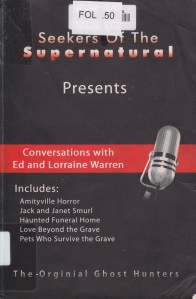
Although I don’t read movie reviews until after I’ve seen a film, I have a confession to make. With rumors swirling of The Conjuring 3, and since a chapter of Nightmares with the Bible will involve The Conjuring, I was a little curious what it might be about. Word on the street—and by “street” I mean “internet”—is that it will feature the case of Ed and Lorraine Warren that’s presented in Werewolf. Co-written by William Ramsey (the victim) and Robert David Chase, the book describes the strange malady of Ramsey, who never actually changed into a wolf, but for inexplicable reasons (at the time) thought himself a wolf and took on a wolfish look as he attacked people. The reports suggest he had preternatural strength at such times.

Since most of the Warrens’ books are concerned with demons, it should come as no surprise that in this case that was the diagnosis as well. With no real reason given, once upon a childhood evening Ramsey was possessed and occasionally broke out into violent fits. He landed in a psychiatric hospital a couple of times, but was eventually released. Noticed by the Warrens on one of their trips to England, Ramsey was invited to come stateside for an exorcism. According to the book, the rite was successful at least up until the time of publication. That’s the thing about demons—you can’t always tell for sure when they’re gone.

It’s pretty obvious why such a story line would appeal for a horror flick. You’ve got a werewolf, an unnamed demon, and an exorcism—there’s a lot to work with here. Weird things happen in the world, and there’s not too much to strain the credulity in this case. It would seem possible that a mental illness could cause much of what’s described as plaguing Ramsey, though. Its episodic nature is strange, I suppose, and the Warrens had a reputation for spotting demons. I did miss the conventional elements of the exorcism, however. No demon forced to give its name, no levitating and no head-spinning. Not even a bona fide bodily transformation. They’ll be able to fix that in Hollywood, I’m sure. Credulous or not, there will always be people like me who feel compelled to read such books. And since there’s no final arbiter but opinion in cases of the supernatural, that can leave you wondering.


Mythologies

Now that Holy Horror will be appearing soon, I’ve been neglecting my horror movies. It’s not on purpose, I assure you. I don’t feel comfortable speaking as a writer—publishers tend to agree with that, and besides, my job is more of being a reader—but my experience of it suggests you never have enough time. (Or money; movies never come with no costs.) With another book under contract and a lot more going on behind the scenes than I reveal on this blog, as Morpheus says, “Time is always against us.” So when my wife showed me a story about Hereditary, I knew my list of must sees would only continue to grow. I haven’t even seen Get Out yet!

Beyond being simple guilty pleasures, horror films area also a means of coping. I know this because although they’re generally very successful at the box office, I’ve rarely met anyone who admits to watching them. Horror thrives on secrets. We act one way in public, and a different way when we shut the door and pull the drapes. Since we’ve outlived our belief in gods and heroes, cinema has taken the role of mythology in modern life. Crammed with archetypes—and yes, stereotypes—movies act out age-old themes in impressive displays of color and sound. You might even learn something without trying. Mythology may have originated in stories told around the campfire, but science never displaced the need for hearing them again and again in different media.

I’ve taken to writing books about films because it’s clear that meaning lies there for many people. The invention of cinema and television forever changed culture. Yes, there’s cheap, thoughtless material available in both formats. Still, movies have an ability to convey truths in a way that sermons often fail to do. The values they depict are often very human ones. Horror, for example, isn’t about blood and gore. It’s about survival. That’s not to say the protagonists always reach a happy ending, but we learn from their mistakes. There’s a reason you shouldn’t open closet doors in a house not your own. Those who do, however, often find uncomfortable truths inside. Holy Horror looks in the closet at the way the Bible functions iconically in horror. Since writing it I continue to notice the Bible in horror and I feel affirmed in the conclusions I drew. And if only I had a bit more time, I’d be watching more mythology. And the list only keeps getting longer.