Basic Catholic

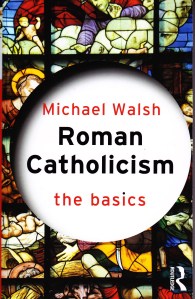
One thing upon which we all might agree is that we don’t have enough time. Publishers, eager to find an angle that will help them survive an age when we believe knowledge should be free, have shown a preference for short books. (An exception to this seems to be novels—consumers appear to like getting lost in a long story.) One result of this is the brief introduction format of book. That’s what Michael Walsh’s contribution to The Basics series is. Roman Catholicism is somewhat of a challenge to explain in less than 200 pages. You have to stick to, well, the basics. Having sojourned among the Episcopalians many a year, I felt that I had a fairly good grasp on Catholicism, but as I was reading it struck me that to really understand it, you have to be it.

One thing the Roman church has going for it is direct continuity. Making claims of having been there since the beginning, as an organization they have a leg up over other groups that boast more recent origins. We respect, or at least we tend to, organizations with such longevity. Tracing itself back to Saint Peter, the Catholics have continuity with spades. Or crosses. Of course, one of the things Walsh addresses is how change happens in such a long-lived group. Councils and synods, new scientific information and new Popes. Catholicism today isn’t the same as it was in Pete’s day. Walsh does a good job of guiding us through all that up to the time of Pope John Paul II, who, it turns out, raised global awareness of the papacy in the world as it existed then.

One thing we might agree upon is that Pope Francis has changed perceptions of what it means to be Catholic. The church remains mired in medieval thinking about matters such as gender and sexuality, but since this little book was published there have been steps forward. Even this popular pontiff, however, can’t change the decrees that went against the majority opinion regarding birth control, as Walsh somewhat guardedly notes. Or the ordination of women. He observes at the very beginning of his little book that Catholics know all about and deeply respect authority. This brief introduction helps to get a sense of how things ended up the way they are. We know that Pope Francis has started to speak out on such things, but men like to keep authority, as we all know. And even Popes have just so much time.


Endings

It’s hard not to feel sorry for survivors. In a hostile world, the ability to resist the entropy lapping at your toes is a feat that inspires admiration. Although independent bookstores are making a comeback, there aren’t many around. An evening spent at Barnes and Noble, if allocated well, can evoke some sympathy even for a dying giant. While my wife had an appointment next door, I spent a good while in the fiction section—really the only part of our local B&N that is well stocked. My time among books, excessive to some, is my solace. It’s not a bad vice to have. Seeing others out shopping for books also delivers a message of hope to a world disinclined to read.

In the B section I saw an edition of A Clockwork Orange. If you read my post on Anthony Burgess’s book in the last few weeks, you’ll know that the American edition has always lacked the last chapter. I wondered if maybe, just perhaps, if this edition might contain the missing ending. It has been several decades since the original embargo. I picked it up and, indeed, the last chapter was intact. I stood in the aisle and read it. Say what you will about Barnes and Noble, but nobody thinks this kind of behavior odd. Once again I was transferred back to Alex and the world of his droogs, only to discover that the ending was something like I had anticipated. If you’ve read the standard American edition you know that it ends abruptly. Writers know how to draw a story to a close. Herewith I offer a spoiler alert.

Alex, now 18, has a new band of droogs. They sound quite a bit like his previous gang. Then he notices he doesn’t feel like the old ultra-violence one night. He goes to a coffee shop where he finds Pete, his old gang-mate, now married and holding a respectable job. He realizes with a kind of horror that having a child and wife appeals to him. He’s growing up. Critics often said Burgess was a moralist with Christian sensibilities. The original ending to A Clockwork Orange might suggest that’s true. Alex may be converted, but he’s unrepentant. Indeed, as he thinks of being a father he envisions his son being just like he was, and the cycle of violence and reform spinning on and on into the future. Shortly after I closed the cover, my wife met me in the store. I was amazed at how 15 or 20 minutes immersed in reading had shifted the mental world I inhabited. New information had changed me. This is the power of books, even when they’re found in Barnes and Noble.


No Help Wanted

Not talking to strangers is something that takes time to grow out of. Somewhere in the back of my mind lurks that fear of when my mother told me what to do if someone tried to grab me as a child. Stranger danger, we now call it. I seldom strike up conversations with those I don’t know, but I’m glad to respond if someone speaks first. So it was that I found myself at the checkout of a Walgreens drug store answering questions about my coat. Well, not exactly my coat—I still have a protest button and a safety pin on it. The safety pin is a symbol adopted in the wake of Trump, and is just as sorely needed now as it was when Pantsuit Nation began the trend. The button is outdated, from Stand CNJ. My wife and I attended the meetings of this grassroots activism group for several months, until they started meeting on weeknights. For commuters that’s the kiss of death.

The woman at the checkout asked what Action Together (the outdated name) was. Caught off guard—I was trying to remember my PIN—I said off-handedly that it was a group for addressing social causes. “What kinds of social causes?” she asked. I couldn’t tell if she was asking because she wanted to join or to challenge. Fight or flight? I punched in my number and mentioned a couple of social justice issues that I thought might appeal, such as fair wages. An older person, she was likely a minimum wager, so I was a little surprised when she said, “If you raise our wages, prices will go up, and it’ll just get worse.” I’m no economist, but I’ve noticed throughout my life that prices go up regardless of wages. I can remember when gas was 27 cents a gallon. My first several jobs were minimum wage. I wasn’t quite sure how to answer her. Here was a woman victimized by the economy and yet she, like Winston Smith, apparently loved Big Brother.

One of the strange things about social activism is that you end up trying to help people who don’t want to help themselves. The poor have been convinced that billionaires and woman-gropers look out for their best interests, financial and moral. Even when they pass a budget that will cut off their own life support, they still believe. Those who want to help are the enemy. When the Party says jump, we know what to answer. And who is Julia anyway?


Time Killer

The internet, while it’s no longer free, still at least offers many opportunities to connect. No matter what your obscure passion, you’ll find others who share it online. In my own little shadowy corner of the web, I’m keenly aware of the time requested of others. When you stick a piece of writing in front of someone’s face, you’re demanding a real commodity of them—their time. I keep the vast majority of my posts here under 500 words. Google will now tell you how long it’ll take to read my musings, so I won’t even ask 15 minutes of your time. Others, however, don’t always get the message.

The internet has also granted those who write copiously the ability to send long messages to complete strangers. People I don’t know find my name and send me lengthy emails, perhaps supposing an editor simply chooses material at random to publish. I even get requests on LinkedIn that begin with “Seeking representation.” I’m not an agent, and I’ve had a great deal of trouble finding one to represent my own fiction. Those who know me sometimes ask why I don’t write something longer (I do—my third book is on its way), but the fact is I respect your time far too much. My thoughts about religion in modern life ask only a few moments of your time to think, I hope, about matters profound and important. Then click off to another site. Besides, this blog contains well over a million words by now, and that is plenty long.

I try to read every email from an actual human. I also read about 100 books a year, not including those I read all day long at work. My world is made of words. I do not, however, have unlimited time. Sadly, when I walk into a bookstore I often look at how thick a book is. How much of my time is an author demanding? Don’t get me wrong, there are plenty of books with a weight problem on my shelves, many of them read from cover to cover. Still, they’re asking for my trust. Trust that the time spent won’t have been wasted. The web is a great place to kill time. It’s also a place, occasionally, to pause and reflect. This blog is no super-site with myriad hits every day, but it’s a place that makes little demand of your time. And it is my sincerest hope, dear reader, that time spent here is never simply killed.


Why Horror?

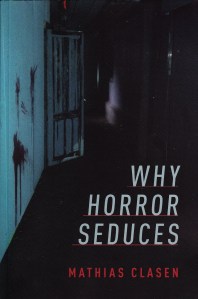
Some people wonder why I like horror. Well, “like” is hardly the proper verb here, I’d rather go the passive route—why I’m compelled by horror. That fits better. But isn’t compel a transitive verb? What’s the object? It really depends on the circumstance—compelled to read, watch, or look at. Quite apart from grammatical imponderables, I keep finding myself coming back to horror and I frequently wonder why. Mathias Clasen may have answered that question for me. Why Horror Seduces is a fascinating study that considers biological and psychological explanations for why we’re compelled to watch or read or play horror, even when we find it distasteful. And it’s not just excusing bad behavior!

As fairly weak creatures that are prey as well as predators, human beings have always placed a high value on security. We’ve driven most of our predators to extinction, but we still have other people to worry about. And microbes. And things that come from space. And, after all that, we still die. These are, realistic or not, things we must face. Horror allows us to confront them and assists us in considering “what would I do if…?” Clasen delves into an evolutionary theory of horror—we’ve evolved to need it. Negative emotions are some of the most ancient, leading us to self-preservation in a hostile environment (something our own government is teaching us anew even now). Watching or reading how people cope in such settings provides us with valuable information. In other words, horror is a learning opportunity.

From that perspective, it doesn’t feel so bad to have written a book about horror movies. I’m participating in the long struggle of humankind against forces that are out to get us. As with most things evolutionary, we need not know why we do them for the whole thing to make sense. Our brains reward us for behavior that is conducive to survival—we like to eat, sleep, and reproduce. Reward centers in our heads go crazy. Then we go to the theater to see the latest, greatest horror film. What may seem counterintuitive here is that we are engaging in a similar kind of activity to other atavistic survival techniques. Watching these movies, reading these books, (and for those who do so, playing these games,) has a basic biological utility. Who knew? And once I get brave enough to crawl back out from under the bed, I may feel better about myself for admitting I like horror.


Wise Women

At a neighborhood holiday gathering the topic of a local living nativity came up. This year they need some wise men (don’t we all!) and some of the women mentioned that wise men should have beards. As the wearer of an old growth facial forest, I became the subject of a couple of queries—could you be a wise man? I replied that I wasn’t smart enough, but in the back of my mind I was attending the last church nativity play I’d been in. It was at the Church of the Advent, Boston’s high Episcopal establishment. I was cast as a centurion and was directed to deliver my lines woodenly. Being who I am, I did as I was told. I was invited to the cast party on Beacon Hill anyway. It was one of my few brushes with society folk in Boston.

Like many boys raised in church, I’d been cast in such plays before. One of three boys each born just one year apart, I was assigned the role of wise man along with my brothers. Far too young to grow a beard, I wore a costume made by my mother and carried a jar from a science experiment as a gift for baby Jesus. Being poor, we had no gold—or even frankincense or myrrh—lying around. In school we’d done this science project where a solution grew crystals up the inside of an ordinary coffee jar and out over the top. Stain it with food coloring and you have a gift fit for a king. So the illusion went.

The Christmas we celebrate today isn’t based too much on fact, but it is a prime occasion for plays. It’s a dramatic story, although the New Testament has to be bent and twisted to make it all fit into the comprehensive narrative of proselytizing playwrights. The king nobody recognizes being born in a barn. The creator of the universe being rejected by the very world for which he (the baby was always a boy) was responsible. The story is as timeless as Dickens’ Christmas Carol, and it’s enacted thousands of times each year in churches large and small across the country. Is there any reason that, as long as we’re straying into realms of imagination, the wise visitors shouldn’t be female? The ability to grow facial hair has little to do with any kind of intelligence. In fact, we’d be much better off right now with a woman in charge.


Inventing Christmas

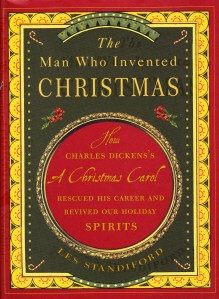
While not always classified among the most intellectual of writers, Charles Dickens was a complicated man. Able to conjure words that reflect emotions, often making readers laugh and cry, he was the undisputed bestselling author of his day. This holiday season the movie The Man Who Invented Christmas explores one of the probable reasons for Dickens’ celebrity—the resuscitory success of his first holiday novel, A Christmas Carol. The film was based on a non-fiction work by the same title, written by Les Standiford, subtitled How Charles Dickens’s A Christmas Carol Rescued His Career and Revived Our Holiday Spirits. As an author who found early fame, it might seem counterintuitive to those of us who’ve never found any that Dickens’ career would need rescuing. In the publishing world, fame has to be sustained since few books keep on selling and selling. And Dickens didn’t always help himself.

Dickens’ choice of Christmas as a theme was, obviously, driven by his own warmth regarding the season. As Standiford makes clear, however, it was also driven by money. Like many in today’s world, Dickens had established his comfort at pecuniary liability—he lived on credit. He also supported other family members and although he cared for the poor he often resented those who cost him money through irresponsibility. Christmas was a time when, he hoped, people might be encouraged to give. Some of that money, naturally, would go toward the purchase of his book. Although the story was secular, it gained the approbation of many in the church—it encourages thinking of others and being generous. Complicated.

As we get closer to Christmas this year, it seems that Dickens’ message bears loud and constant repeating. Here in the States, our government has taken on a decidedly Scrooge-like cast when it comes to the poor and unfortunate. Indeed, “bah, humbug” might well be the new motto of the Grand Old Party. Shown evidence of the guilt of the miser in chief they only claim that those who discover such truth are lovers of false truth, such as claiming that the poor really suffer with want. They close ranks to ensure that the downtrodden can never vote them out of power and claim that Bob Cratchit’s problem is that he’s lazy and Tiny Tim is a burden on the misunderstood wealthy who only ever wanted to help others. A huge difference is that Dickens knew his novel was fiction. This holiday season the ghosts visiting us will be the emaciated spirits of democracy past, present, and future, and that of human decency.


In Control

Those who know me know that I treat my workdays like clockwork. I leave the apartment every day, catch the same bus, and leave work at the end of the day, all according to schedule. Traffic is a variable, of course. Yesterday as I came out of the Port Authority Bus Terminal at 7:15, blunted with my reading on the bus, I noted we were a bit late for my liking. I got to work before 7:30, though, and was interrupted by a message from my brother, asking if I had made it out of the Port Authority okay. I was a bit confused—weather delays do happen, but what could have made today any different than any other Monday? It was then I learned about the bombing. It happened five minutes after I left.

Now, I’m not trying to over-dramatize this. I was above ground and the bomber was below. I didn’t even hear it go off, although there were a lot of sirens on my way to work. The only serious injury was to the bomber himself. What really got to me, when the idea had time to settle in, was how close I’d been. So were thousands of others at the time. Over the summer I went to Penn Station just after what had been assumed to be a terrorist attack. Jackets and personal effects lay scattered on the floor. People had dropped things and ran. In that case it had been an innocent tazing of an unruly passenger that had set off the panic. I’m not a fan of fear on the commute. I don’t think, however, that we should give in to the rhetoric that our government will surely use to describe all this.

Millions of people live and work in New York City. Such things as these disrupt the flow of our daily lives, but we can’t let the agenda of fear control this narrative. I felt a tinge of it when I headed back to the Port Authority at the end of the day. Police barricades were still up on 8th Avenue. Reporters with cameras were at the scene. A potential killer had been here just hours before. This is New York. Without the overlay of fear, this was simply business as normal. Any city of millions will harbor potential killers. If terror controls the narrative, it has won. If politicians use this fear to win elections, the terrorists win them too. I’m doing what we must do to defeat the fear. I’m just getting back on the bus.


Old Salt

Time has been at a premium lately, but when I have a few spare moments I like to read the Oxford Dictionaries blog. Those of us who make a living with words often find them utterly fascinating. Simon Thomas’ post, “Worth their salt: words and phrases with roots in ‘salt’” brings a number of interesting facts to light. Salt, now on the list of public enemies, is essential to our well-being in small doses. His clever post includes “salt of the earth,” a phrase biblical through-and-through. It reminded me of the fact that the Bible’s become so porous that few people can say what’s actually in it. It’s kind of a big book, and who has the kind of time needed to read it all, let alone remember what it did or didn’t say? Many phrases are attributed to Holy Writ that don’t appear within its covers, while others that do come thence are thought to originate elsewhere. Strange but true.

We may never come to an agreement on what Jesus actually said, but “salt of the earth” is a phrase attributed to him. Indeed, he may have coined the term “saltness,” but I haven’t researched that thoroughly. The idea of essences, I’m told, is outmoded. But the idea is fascinating—what is salt that has no taste? Would it work to clear our roadways in winter time? There’s a layer of salt on my car already, and it only just snowed for the first time this year. We all know what salt is, what it tastes like—but what is its essence? (If such things exist?)

Thomas notes that Roman soldiers were paid it salt. I wonder if this was behind a phrase my step-father used to use about work. Although he and I did not get along, now that he’s gone I come back to the hidden bits of wisdom he sometimes shared. He worked very long hours, and seemed happiest when he was doing so. Early in the morning he’d limp through the house and say, “Time to get back to the salt mine.” He wasn’t a literal miner, although we lived in coal country. Salt could mean food, and the salt mine was where you worked to provide food for your family. I may not have gotten along with my step-father, but he worked hard to support a family with three kids not his own. He may have been bitter about that, but today anyone who stays with a family in hard times is considered salt of the earth. And that’s biblical.


The Art of Commuting

You can tell when the holiday season settles on the city. The commute home takes longer because developers simply can’t ignore a highway and the potential it has for shipping in the lucre. Highway 22 is built up in several spots—it’s kind of like a 20-mile long roadside mall between where the bus enters it and my exit. Holiday shoppers right after work clog this artery faster than fried eggs for breakfast every day. We crawl, penitent, wanting only to reach home. You get to know the regulars on the bus. You may not know their names, but their faces and personalities become clear enough. The man sitting across the row from me was someone I couldn’t recall having seen before. Lots of people, of course, go into New York occasionally. A stranger on the bus isn’t exactly rare.

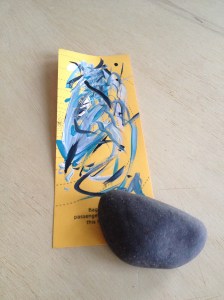
Near my stop I slip into the empty seat next to the aisle to get ready to disembark. He looks over at me and asks if he can give me a bookmark he’s made. Worse than talking to strangers is taking candy from one. He encourages me by telling me he does it to promote his work, since he writes haikus and does paintings. I accept one and learn of the website unfoldingmind.com. He then asks what I’ve been reading. If you read my posts in order, you can see my last book was The Exorcism of Anneliese Michel. There’s a reason I don’t tell my fellow passengers about my literary choices. I say it is a book about an exorcism and he takes it in stride, asking if it was an actual case.

I had my own unfolding moment then. Not only was it the case that I could mention exorcism in casual conversation, but a man considerably younger than me knew what it was. Stop and think about that: prior to the movie and novel, The Exorcist, very few modern people even knew about the rite. Strangers on a bus, both artists in their own way, I like to think, knew what this was. I look at my bookmark, some original art with a haiku on it, and think of the many interesting people that make this bus their temporary domicile. Occasionally, amid the snoring phone-movie watchers, is another passenger using the long ride home to open his or her mind. The bookmark is now amid the artifacts of my personal museum. And my words, hardly poetry, are a tribute to those who practice the arts that make us human.


Ravages and Kings

I was recently thinking about King Saul. If it’s been a while for you, Saul was the “first king” of Israel, according to the books of Samuel. Saul had a problem. That problem’s name was David. David was younger, more popular, a gifted musician and lady’s man. In sudden fits of rage Saul tried to kill David, more than once. An unstable man was in charge, but claiming God’s sanction he was safe from any kind of impeachment. In the words of Mel Brooks, “It’s good to be king.” So Israel limped along under weak leadership until Saul got himself killed in battle. I couldn’t help think that this story shows just how relevant the Bible remains today. Mad kings are difficult to displace. They have their fans and, to quote Alfred, “some men just want to watch the world burn.”

David’s reign was no picnic either. He had his Bathsheba affair, and was constantly making war as well as love. He pretended to be insane to save himself from Saul, but he was loved by Yahweh and thrived. Oh, and he wrote the book of Psalms. It’s a bit of a shock when this much feted king gives Solomon, his son, his last words. Instead of some pious sentiments or perhaps a last-minute poem, his final instructions are a hit list. “I promised not to kill Shimei, but you made no such promise.” Wink, nod. And Solomon reigned, bragging of groping a thousand women. One of the one percent, he was fabulously wealthy and ultimately couldn’t hold his kingdom together. And none of this is even prophecy!

Why do we put up with mad kings? The world is full of good, and able people. They have a very difficult time getting elected in a democracy. They had trouble even when it was a monarchy. Yes, power corrupts. We know that. Those who are truly mad, however, learn to live by gaming the system. Lies are alternative facts and truth is fake news. Other elected officials, apparently incapable of reading the newspapers, follow the leader. Like lemmings, they ignore the cliff just ahead. Ironically the Bible has a role to play in all this madness. In fact, many people seem to think Israel had a cozy little history. They’re the ones who’ve never read the Good Book. Even during the golden reign of David there were schisms and political murders. All you need to do, however, is say God told you to, and even a madman can become a saint.


Anneliese or Emily?

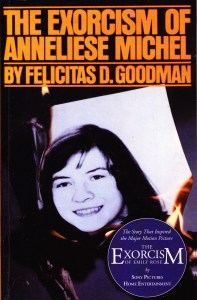
If it weren’t for the movie The Exorcism of Emily Rose, the name of Anneliese Michel would undoubtedly be less recognized than it is. Probably the first exorcism movie since The Exorcist to move the genre in a new direction, Emily Rose was based on the real life case of Anneliese Michel. There were significant differences between film and reality, however. Michel was from Bavaria, and she died at the age of 23 rather than being an American teenager like Emily. The story caught media attention because it was discovered that Michel had died after an extensive, months-long exorcism. Charges were made and the priests and Anneliese’s parents were found guilty of negligent homicide. The movie plays the whole thing out in the courtroom with flashbacks of the possession.

The book which led to the film was The Exorcism of Anneliese Michel, by Felicitas D. Goodman. Goodman, who died in 2005, was a rare academic who wasn’t afraid to address the supernatural. Trained as a linguist, she had years of anthropological fieldwork experience and a medical background. She was also not dismissive of religious experiences. Naturally, this makes her suspect among academics, but her treatment of Michel’s case is both sympathetic and masterful. After narrating events pieced together from court records, diaries, tapes of the exorcism, and information supplied by some of those involved, she offers her own hypothesis of what actually happened. Anneliese Michel was a religious girl caught up in a religious altered state of consciousness that was treated scientifically by drugs. The result was fatal.

Throughout history, and even today, shamanistic persons exist. Whereas in tribal cultures they tend to become prominent, in the “developed world” they are often quite hidden. They experience what Goodman calls religious states of altered consciousness, and are sometimes misdiagnosed as requiring chemical healing. There have been many thoroughly documented cases where such individuals do “impossible” things. The rationalistic world has no place for them, however, for like capitalism, materialism takes no prisoners. Religion is part of who we are. Human beings do have spiritual needs. Such needs can be placated by other means at times, and we can continue to believe that everything in this universe is made of atoms, or super-strings, or quarks. Or we can perhaps admit that theres’s much we do not know. Goodman admits that her solution is an educated guess, but it does put all the pieces together rather nicely. And she doesn’t declare unilaterally whether demons are physical or not. In the case of Anneliese Michel, however, they were undeniably real.


Dominus Flevit

I couldn’t believe I was actually there. Ever since I was a child I’d read about this place. The city conquered by David and visited by Jesus. The city around which most of the Bible rotated. Jerusalem the golden. One of the perks of working on an archaeological dig was the opportunity for weekend travel, and here I was, amid camels and cars and churches and synagogues and mosques, in Jerusalem. No amount of reading prepares you for such an experience. Suffused with the rich mythologies of three major religions, this city is like a dream. So much had happened here. The church I was attending at the time was only the latest in a long succession that informed me that God himself had actually been killed here and had risen again. The ultimate game-changer. The once in forever event of all time had taken place right here.

Gnu Jerusalem from WikiCommons

But this was not a city at peace, despite its name. There was a bombing the first weekend I was there. Young men and women in military garb carried scary looking weapons openly in public. Even civilian bus drivers wore pistols. Jerusalem had a long history of violence, but that didn’t justify it. If God had really been here—in either Jewish, Christian, or Muslim contexts didn’t matter—how could this city be so prone to terror? In the old city old men sat around hookahs, placidly smoking. Tourists, many bearing crosses, thronged. Jerusalem, however, was also a very political place. The fragile, Christmas bulb-thin peace of the region involved the city being divided up and not being claimed by Israel alone. Even that man driving his goats through these ancient streets knew that.

Trump, to the cheers of evangelicals who want nothing so fervently as the end of the world, has said he’ll recognize Jerusalem as the capital of Israel. This political move of weaponized ignorance will almost certainly lead to war in the Middle East. Another war. An illegitimate presidency leaving a frothing sea of corpses in its wake. Negotiating in this part of the world is like haggling with that street vendor for a pair of sandals. You go back and forth on the price. You act insulted and walk away. You come back and haggle some more. It’s a delicate dance. This is no place for egomaniacs who can’t understand such subtleties. Just ask the last Caligula who wanted his statue set up as a god in this city. Jerusalem is home to too many jealous gods, and those who are self-appointed divinities will only leave the city, the world, in tears.


Spiritual Education

The water was hot. Notoriously hot. Our Junior High School had been built in the days of the prison esthetic, with heavy, cinderblock walls painted in penitent colors. And the water was famously hot. One of our gym teachers, nameless here forevermore, challenged us to be men. It takes a kind of courage mostly illegal these days to lecture a room full of naked boys, but he once came in during mandatory shower time to tell us that anyone who could hold their hand under the hot tap for a full minute would get an A in gym. Since he was an ex-Marine nobody was foolish enough to take him up on this challenge. At least not in my class. It’s difficult to be courageous when you’re unclothed.

The incident I recall, however, occurred at the opposite end of the spectrum, in art class. You may remember those days when you wove reed baskets to take home to your mom. The thing about reeds is that they’re brittle unless soaked in hot water. That was the key to working with them. Make them supple with hot water and then when they dried, they’d be remarkably sturdy, if somewhat lopsided. We had been weaving reed baskets when someone, unbeknownst to the teacher, had filled the sink with water as hot as our old school could deliver. Thinking it funny, since even in those days educational budgets were under threat, somebody dropped one of the very limited number of heavy reed-cutters into the sink, now at the very bottom of a basin of very hot water. I was not the guilty party; I don’t know who was. The drain was plugged from the bottom. Very funny, no?

At the end of class. the teacher was not amused. “No one leaves this room until that cutter is out of the water,” she flatly said. The first bell rang. She stood in front of the door. We would be late for the next period. Perhaps it is the weakness of character my religion instilled in me, but I’ve always had a great fear of not doing what I was told. It lingers to this day, that Fundamental unworthiness. This body of mere flesh is weak and prone to sinfulness. The clock was ticking. Teacher wanted the guilty party to suffer the price of their prank. I pulled up my sleeve, plunged my hand into the scalding water, pulled out the reed-cutter, slapped it on the counter, and walked out the door. We were released to class and the searing pain didn’t last long physically, but spiritually it has never gone away.


Not So Gnostic

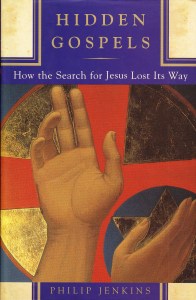
A certain, amorphous indignation comes over those of us trained in history when we encounter abuses of the same. In my case, some thought me conservative when I argued in my first book that Asherah as Yahweh’s wife wasn’t nearly the slam dunk some scholars were making it out to be. Don’t get me wrong, I wanted to see Yahweh as happily married as the next deity, but it was a matter of the evidence being weak and not thoughtfully examined. That is to say, I sympathize—maybe even empathize—with Philip Jenkins. His book, Hidden Gospels: How the Search for Jesus Lost Its Way, is an historical dressing down of many in the New Testament scholarly community who’ve perhaps let a bit of historical rigor slip in order to understand the world of early Christianity.

You see, once upon a time, scholars took the Gospels as, well, the gospel truth. Contradictions were simply harmonized or glossed over. When newer ancient material began to be discovered, however, adjustments had to be made. Perhaps the “orthodox” story of Christian origins wasn’t the only option available. In the twentieth century some spectacular manuscript finds were made, including the “library” of Nag Hammadi—largely Gnostic—and the Dead Sea Scrolls. New understandings of early Christianity were possible when these texts were considered. Some scholars engineered sweeping theories about revolutionary ideas concerning Jesus and his buds. Jenkins laments the lack of historical precision that many of these reconstructions demonstrate, and he comes across as somewhat annoyed.

Sensationalism, as we all know, sells publications and gets presidents elected. We all like a good story. In the case of Jesus, this means that the reconstructions of scholars often challenge traditional views, and popular publications love it. Jenkins finds it distasteful. Although this book is well written, as all of Jenkins’ material tends to be, it probably doesn’t do his arguments any favor to have retained the tired trope of heresy. Heresy means nothing without a supernatural bias, something that historians must avoid. Heresy, after all, assumes that one and only one version is correct (orthodox) and the four Gospels demonstrate that such a simple dichotomy is more difficult to sustain than it might appear to be. Yes, the Gnostic texts may not be as early as the traditional Gospels, but the ideas may have been circulating from near the beginning. We know surprisingly little about Jesus, so it’s not unexpected that rumors would’ve flown, even in antiquity. A solid source of information on some of the early “other gospels,” Jenkins’ book serves as a useful reminder that history is almost never as simple as it seems it should be.