Protest Reading

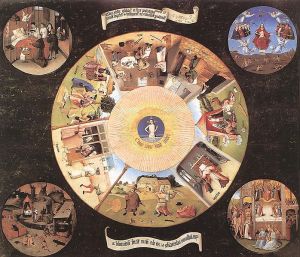
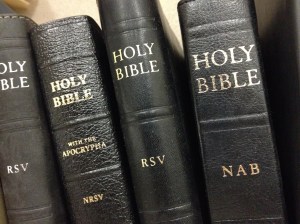
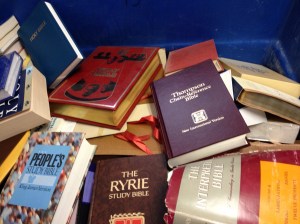
In these days of bold ignorance, reading in public is an act of resistance. A world that follows the uninformed to perdition requires those who stand as witnesses. Those who read. As a cabinet of the wealthiest people in the country is being assembled we need to remind each other that wisdom and wealth aren’t the same thing. Not even close. We read to improve our minds and we find, in such reading, that wealth increases happiness only to a point. Excess wealth leads to misery, but like the addicted, those who have it just can’t stop. Stop, I say, and pick up a book. To help with this my wife sent along the Banned Book Advent calendar. That’s not to say we can read a book a day, but I believe the world would be a better place if we could. Especially if those books were banned.

You see, banned books cause us to think. That’s the payoff. I’ve read many, many banned books. Some of them I didn’t like very much, but that’s not the point. Liking what you read may lubricate the process, but it is the reading itself that stretches the mind. Makes use of mental muscles we didn’t know that we had. Those who ban books want prejudiced minds to prevail. Think about it: prejudice comes from the combination of the prefix for “already” and the root for “judging.” The prejudiced have already decided. Reading challenges. It has from the earliest days of myths on clay down to the era of ordered electrons on a flat screen. Reading makes you question. The thought police prefer mindless acquiescence. Want to show your true colors? Pull out a book and read.

IMG_0899

The season of Advent is one of anticipation. We all know what’s behind door 25, but the journey is the point. That journey is better when it’s literate. When I travel my carryon always has books. More than I can read on the trip, just in case. Books are banned because we fear knowledge. Once exposed to an idea we must deal with it. Far simpler to lock it away in some sealed room and continue to do things like it’s still the 1450s. Before Twitter started revolutions, books did. When we put down our books we are opening an invitation to ignorance. Last month showed what happens when that invitation is given. I won’t make it through a book a day this season, but I flip out my reading material whatever chance I get. And I believe a better future will result.


The Wicked Man

I confess, it was a moment of weakness. Or I could say that it was dedication to research. In either case, I subjected myself to watching the remake of the 1973 classic, The Wicker Man. The reviews that I’ve read over the past decade since its release had warned me not to subject myself to it. Not only did I, but I had my wife gamely watch it with me. If you plan to watch the flick but haven’t, I’ll first of all beg you to save your time and secondly warn you of spoiler alerts. So here goes.

By Source, Fair use, Link

By Source, Fair use, Link

In a movie that may be either pro-feminist or misogynistic, depending on which way you look at it, this version of The Wicker Man takes place in the United States. We’ve got all kinds of New Religious Movements in this country, so that much is believable. The film has a group of women who mute, deafen, and enslave their males moving from Salem, Massachusetts, across the country to Puget Sound where they can find an island to be left alone with their rituals. Superfluously adding an “s” to the original’s Summerisle, they come up with the sloppy-sounding Summersisle where they can raise bees. They worship the great mother-goddess, which is cool enough, but their religion appears to be cobbled together in a way that suggests those responsible for the movie didn’t do their homework. Although Sister Summersisle (five “s”es—count ‘em!) claims this to be a Celtic religion there are merely the weakest echoes of such.

To make matters worse, Edward Malus goes around beating up women when they get in his way. Yes, he is the unwitting victim—we’ve seen the original and know how this plays out—but it makes the viewer uncomfortable watching this unsympathetic protagonist punching, kicking, and even bicycle-jacking with a gun, the women of the island. A man comes ashore and the first thing he does is try to take over. Were there evidence of a deeper plot here it might suggest that this was intentionally written into it. As it turns out, however, as we enter a fearful era of the rich white man’s revenge, such scenes only suggest that Mr. Malus had it coming. Perhaps the movie is prophetic after all.

I really don’t recommend spending your time on the remake of what has become a horror classic. If you’ve seen the excellent original, you already know how it ends. And despite his brusque manner Neil Howie didn’t shout invectives at women or punch them in the face. In short, he took his fate in what might be a way that is also prophetic.


Fear of the Artificial

As someone who dedicated four years—particularly long winter nights—to the cause of high school robotics, I found myself knowing quite a bit before I walked into the room. Now let me post a disclaimer here: I’m no techie. I’ve studied the humanities throughout my education and although I’ve been able to engineer a bookshelf or two, and even the occasional project with moving parts, the technical eludes me. I claim absolutely no expertise in it. So where was I going that robotics came to mind? A lecture on Artificial Intelligence. AI. You see, I’ve been a bit concerned about it for some time because I’ve seen what robots can do. A friend recently showed me some episodes of Battle Bots on YouTube (the relative who started this blog for me was doing quite well in the competition last season), and from my own experience watching hours of FIRST robotics competitions, I know enough to be afraid.

What could possibly go wrong? (DARPA photo)

What could possibly go wrong? (DARPA photo)

The lecturer assured us that we had nothing—or next to nothing—to fear. Artificial Intelligence, he assured us, is a misnomer. Machines have no will. No mind. There’s nothing they want. They do as they’re told. You write a program and feed it to your bot and your mechanical friend can do only what it’s told to do. This sounds uncomfortably like slavery to me and although I know I’m projecting, I have to wonder if robots think the same way about it too. No, the lecturer assured us, they do only the tasks assigned. They don’t think at all. Then he said something that made me shiver. That wasn’t his intent. He said something like, “We don’t even know what consciousness is, so how can we replicate it?” That was meant to be reassuring.

I took this idea and flipped it over in my head. Rotated it. Ran it through my own programming. If we don’t know what consciousness is, how can we be sure we haven’t accidentally created it? Herein lies the heart of fear. Scientists have been trying for decades to define, to explain empirically, what consciousness is. We simply don’t know. We all recognize it when we see it in other humans. We’re finally starting to recognize it in animals (long overdue). How do we know that it isn’t a function of complexity? And when does something become complex enough to qualify? I don’t know about you, but videos of swarm robots send me hiding under the bed. Not that it will do me much good. They’ll know where I’m hiding. Maybe I could use some intelligence right now. Even something artificial might help to stop me from shivering.


Mark of the Beast

namingantichristI grew up believing in “the Antichrist.” As I came to realize that much of the New Testament pointed to contemporary problems (for them) with the Roman Empire and that what appeared to be predictions were actually safe ways to discuss forbidden topics, I began to worry less. It was about the past, not the future. Recent political events have ratcheted up my anxiety level again—maybe there is such an evil after all. Robert Fuller’s Naming the Antichrist: The History of an American Obsession is an important book in this regard. Although end-time worries have diminished among some now that we’re safely into a new millennium, for the true believer none of that matters. The Antichrist is a great motivator. I hadn’t realized until reading this book just how much of contemporary culture has grown from this fabricated fear.

Let’s get this straight from the beginning. In the Bible there is no figure known as “the Antichrist.” The generalized word antichrist is used only twice and in neither instance is the book in question Revelation. Early Christians speculated that the beast of Revelation might be “the Antichrist” but that identification wasn’t solidified until the beginnings of the Fundamentalist movement in the late 1800s. By the time Fundamentalism was a fully developed system, by about the 1920s, believing in the Antichrist and trying to identify him had become a cottage industry. I grew up in the shadow of Hal Lindsey and the pressing concern that “the Antichrist” was alive in the world today. Face it, The Omen loses something if he isn’t. This strange, non-biblical belief has come to define a large number of true believers.

Fuller’s book is important for the insight he brings into why some “Christians” are avowed enemies of peace, toleration, and the improvement of human conditions. Those who believe their tribe is the only correct one hold the double standard of ethical treatment of those inside and scorn and hatred of those without. This view believes that the world is to be condemned, natural resources used up, wars started, and civil rights suppressed, in the name of Christ. Perhaps you may begin to see why a chill ran down my spine as I was reading this book. We need to try to understand this perverted way of looking at the world in order to understand the forces that would rather see a dictatorial billionaire run the country than an eminently qualified woman. Reason’s got nothing to do with it. It’s all about conviction. Failure to understand that is perhaps the surest way to bring about the end of the world. We ignore religious thought to our own peril.


True to Nature

A friend recently sent me an article on Jack London from smithsonian.com. As the article by Kenneth Brandt makes clear, London is an author for our times. Someone who might truly be called a populist, London, like many of us born in the working class, had an epiphany. Perhaps his came earlier than many, but at the age of 18, while working laboring jobs, he noted that he “was scared into thinking.” He decided, before the idea of sending all kids to college had caught on, that he should acquire an education. In the words quoted by Brandt, he wanted to become a “brain merchant.” Certainly London’s works need no introduction from a guy like me. Robust and masculine, his stories are those of man pitted against a nature that is often out to crush, freeze, or starve him. Today we need to loosen up those pronouns a bit. Women, who’ve arguably had it tougher than men for all of biological history, have had to struggle for survival too. In the current political climate we all need to remind those who substitute testosterone for brains that we all share human rights.

455px-jack_london_young

The Religious Right, or “alt-right” as they seem to prefer these days, wasn’t always a fetus farm. It has been historically documented that it was Francis Schaeffer, erstwhile hippie and free thinker, who when he got abortion stuck in his craw, decided that men had to protect the unborn from women. He seemed to have forgotten whose gonads planted that seed in the first place. Prior to Schaeffer Christian saints tried to avoid sex all together. Among the original “abstinence only” crowd, some of the more zealous put their money where their testicles were and castrated themselves. Ah, men were real men in those days. Today masculinity means ganging up on women and grabbing them by the Call of the Wild, apparently.

Like London, I think we all need to be scared into thinking. We’ve let a wildly distorted view of humanity—one-sided and with dangling evidence of gender loyalty—to steal the White House from the woman who thoroughly won it from the vox populi. Where is Buck when we need him? London knew, as evolution repeatedly teaches, in Brandt’s words, “abusive alpha males never win out in the end.” I say that “swing states” should look carefully at that hanging chad. In the meantime, while the fat cats bicker and argue over the best way to suppress females to make themselves look bigger, I think we should all read again about what happens when Spitz meets Buck. If you haven’t read The Call of the Wild before, it’s time to do so now.


Hollow Bible

Sleepy_Hollow_-_Title_Card

The proofs for my article on the Bible in Sleepy Hollow are now here. It will be appearing shortly in the Journal of Religion and Popular Culture. For those who know my previous academic work—hi, both of you!—this represents a departure from the familiar for me. Some years back, floundering for a teaching position like a fish that’d flipped out of the acadarium, I talked to a colleague who confirmed what I’d long suspected: study of the biblical text is dying. Face it, nobody cares about J, E, D, and P, or even Q, anymore. We’ve made our point. The Bible is a composite document with many sources that people can still tuck under their arms on the way to the polls. It’s so easy to forget that this text is the basis for so many lives and eternal plans. While we scholars have been arguing with one another, culture has moved on. That’s why I looked at the Bible in “Sleepy Hollow.”

If the Bible isn’t relevant, why bother studying it? If the main character—dare we call him protagonist?—of the New Testament says to turn the other cheek and his “followers” advocate for gun ownership it’s time to ask what went wrong. Scholars know the Bible, but do we know the Bible? Long ago meaning slipped away from academics. Consider science. We can question global warming because the science has become a topic of conversation among specialists that the rest of us can’t hope to understand. Instead of trusting that they know what they’re talking about, we politicize it. Scientific research, even in major universities, is funded by interested third parties. You know, some scholars don’t think there really was even an E after all.

The Bible no longer means what the specialists say it does. I may have spent years of my life and thousands of dollars to speak as an expert, but I soon learned nobody was listening. Meanwhile, culture marches on, somehow supposing if two Corinthians walk into a bar the rich man in his tower makes the best sense, according to the Good Book. Indeed, if you want to find out what the Bible says, all you need to do is head up the Hudson Valley for a season. Or listen to those who hand out tracts and purchase firearms. What could possibly go wrong there? My article will be out in a few weeks. If you’re one of the two who read it keep in mind that there’s more to it than meets the eye.


Holiday Season

Now that the holiday season is upon us, I stop to think about what holidays really do. “Keep Christ in Christmas” signs have popped up like winter dandelions as Trump signs consider to litter the landscape. Thanksgiving, however, gave me the opportunity to forget about all of this for a while. The culture of signs. Signs telling us we must bow down and worship. The holidays signal a season when it is okay to hibernate and forget that more powerful forces out there may wish you harm. Part of the trouble is that those who are coming sometimes can’t see beyond their own interests. Perhaps what I do for a living conflicts with the job I’m paid to do. Conscience dictates that one or the other must go. But conscience is such an old fashioned idea.

img_3092

The holidays start with Thanksgiving, but it is now the Monday after. Those in liturgical traditions of Christianity will note that we are in Advent, a season of anticipation. I do wonder what we’re anticipating. Perhaps it’s because Thanksgiving came and went in a blur of travel weariness this year. The few days when commuting wasn’t an issue were the opportunity to stay still for a while and not look at news feeds and reflect on all we’re thankful for. I started hearing Christmas carols in stores shortly after Halloween. We’re entering the season of money in a country in love with lucre. Take a close look and see what lies in that manger.

Most years the stretch of dark months of November through January are accompanied by a sense of peace. Human beings loving each other and getting along. I guess I’ve been away from the news for a few days. I know there was a Black Friday last week. I also know that money has a strange way of funneling upward, a kind of osmosis of Mammon. On my quiet strolls I wonder what we, as a country, truly value. On the highway stuck in traffic with thousands of others returning home, I try to think that in these metal shells are living, breathing, loving human beings. Many of them only trying to get ahead. We’re all in a rush since there’s so much to do before we allow ourselves another holiday. Wouldn’t life be better with more days for reflection? I’d rather not politicize the holiday. Keeping Christ in Christmas seems to be asking for one not to forget the offering plate. I’m wondering about those sleeping in the street not far from Trump Tower. I’m wondering what ever became of conscience.


Bibliotherapy

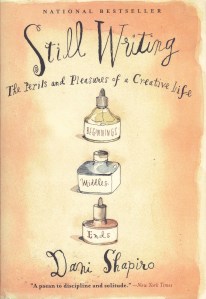
This may sound strange, considering the source, but I fear I don’t read enough. An article by Sarah Begley in a recent issue of Time, reinforces what we’ve known all along—reading is incredibly good for you. Even fiction. Especially fiction. For the most part, as I’m commuting, I read non-fiction. There’s nothing wrong with this, of course, but it doesn’t always help with literacy issues that might call for a bibliotherapist. You see, literacy builds a kind of psychological strength that helps with real-world issues. Part of it is because many books go through a rigorous process of approval. Still, it’s important to realize that this kind of reading may not be the popular fiction that can be found in grocery stores and airports—although even that is fine—but the level of writing that really helps is somewhat mysteriously labeled “literary fiction.” The kind of book an author writes, rewrites, and rewrites. Deep thought and care go into such books, and they can be a help to their readers. Reading isn’t just fundamental, it is transformative.

img_2947

I remember my school years well. Kids are amazing in their level of energy. They crave activity and experience. Getting them to read can be difficult. You need to sit still. And concentrate. Concentration isn’t easy. You have to train a child to read, and, at least where I grew up, that was a struggle. The fact that it’s possible to graduate from high school and be functionally illiterate is one of the signs that learning to enjoy reading doesn’t always take hold. I knew guys in middle school who would rather do just about anything other than read. I often wondered what anyone could do to make them realize what they were missing. I read books and stories that took my breath away. There was something incredible going on between the covers—but how to convince others?

Recently a colleague pointed out to me that those of us in publishing are, statistically speaking, a very small number of people. We work in an industry that serves a small number of people. We are an odd lot. We read books, and some of us write books, and we do so for a small sector of society. Signs are hopeful that interest in reading is growing. Leading by example may help. At any one time I have at least one, generally two or more, fiction books going at the same time. On the bus I read through non-fiction at a faster rate. Maybe the mix is actually right. Fiction reading takes more time. It could be because I’m getting more out of it than I realize. I just wish I had more time to do it. More time for reading health. I may need to see a bibliotherapist.


Radio Nowhere

Those of us who somehow managed to be educated without the use of computers, at least nothing more advanced than a TI-30 calculator, fumble our way through the world-wide web. I’ve got this blog, a Twitter and a Facebook account, and I’m on Google + and Medium, and I really don’t know how any of these things work. One of my motivations for starting this blog was to continue the tradition of speaking to audiences that I used to have in my lectures while I taught. I was told that such a format was known as a podcast and I found a host site where I could leave my recordings for free. I could then make a link and bring them onto the podcast page of this blog. How any of that works, I have no idea.

img_2855

Recently a few would-be listeners have asked what has happened to the podcasts. Since I don’t really know where they were in the first place, I’m not sure how to send a map to them now. One of my readers, however, has kindly set up a new webpage where all 23 podcasts are available. You can find it by clicking on this link. My thanks to Ahmed Fasih for setting this up. The podcasts cover various aspects of ancient religion. Even now, every great once in a while, a world-recognized name in academia will ask me about some of these topics. When you’re an academic you have the opportunity to spend vast amounts of time focusing on a single subject. The only subject you have that privilege with outside academia is money. I do hope my friends in the academy realize just how lucky they are.

In any case, the podcasts are back. Maybe now that they’re not invisible any more, and since in coming days it may be important to remember when things were better, I may find time to add to them. Blogs—at least those that are regularly read—are locations for discussion. I’m always glad to answer questions that are posted here. During the work week my time is constrained, so you might need to wait for a weekend, but I will respond. I know religion is passé. I know people have better things to do with their time. I also know that for the vast majority of humankind religion remains a vital and integral part of their lives. Exploring it seems to make sense to me. For those who’d rather listen than read, the podcasts are once more available.


Found in Translation

embassytownTraduttore, traditore—“translators are traitors”—is an Italian saying invested with a great deal of truth. Anyone who’s worked with the proliferation of languages in the world knows the truth of the adage. What is said in one language can’t be stated precisely in another language with all the depth and texture of the original. China Miéville’s Embassytown is a sprawling novel that addresses the question of how cultures evolved on widely separated world can ever understand one another. I can’t possibly go into a detailed summary of the story—it took me about 30 pages to begin to understand what was going on—but the book drew me in nevertheless and left me happy to have expanded my conceptual world.

The reason that I’m bringing this novel up in a forum where religion lurks in the background is that Miéville explicitly brings religion into his story. It may be impossible to explain precisely how he does this without the detailed summary that I’ve already begged off giving, but it is nevertheless noteworthy that in any sufficiently complex world religion emerges. We tend to think that religion is something that evolved from the slime and now that we’ve bathed in the light of pure reason it will eventually be washed into the gutter of discarded concepts. History demonstrates repeatedly that such is not the case. Religion is resilient and, dare I say it, inevitable. Human beings—perhaps also other conscious beings—know that there is something outside ourselves. That’s the foot in the door for higher beings or forces or worlds. In a word, religions.

Fiction writers frequently appeal to religions for verisimilitude. Are imaginary worlds believable without religions? It’s a long stretch. Star Wars has characters calling belief in the force a religion. Star Trek, in any number of episodes, dealt with gods. Anathem was based on the monastic ideal. Science fiction has trouble when it leaves religion completely out of the picture. A non-deistic universe is nearly incomprehensible to the human mind. Even great scientists and other rationalists occasionally lapse into thoughts about luck, fate, or fortune. Embassytown doesn’t focus on religion throughout, of course. It may be a minor subplot. But translating an alien world with a language that can’t be understood into a fiction of English is facilitated by putting a religion into the general mix. This is a smart and complex world, but when you read it you’ll find it believable because a religion naturally emerges. And that, I say, is realism.


Abundance

img_2996

A few weeks before Leonard Cohen died I saw a story on how his song “Hallelujah” had been done to death. Covered and recovered, it seemed to be on every cover artist’s playlist. It is a haunting song, however, and the notion of a cold and broken hallelujah feels somehow appropriate this Thanksgiving. Don’t get me wrong—I am thankful for more things than I can name or would care to share with complete strangers on the internet. In fact, when I literally tried to find a job in Canada in anticipation of a horrible November surprise, one of my immediate regrets was that I’d no longer have American Thanksgiving to celebrate. Thanksgiving, to me, has been images of a cozy indoors with special food while the chill takes over outside. Two days in a row off of work. Sleeping until I’m not tired any more rather than waking according to schedule, no matter how troubling the night might have been. In short, feeling safe and secure in a world growing colder.

Since the first week of November the iciness has been growing more intense. I know it’s the circles I go around in—and perhaps they are small enough to call them semi-circles—but I have seen more sad and depressed and scared faces in the past weeks than I have seen in my previous half-century on this planet. It’s Thanksgiving Day, and even vegetarians look forward to something special by way of fancy nourishment. But it feels like a cold and broken hallelujah to me. Entrepreneurs have already been reminding us that tomorrow is Black Friday. We should get our game-faces on and our credit cards out and head to our favorite retail establishments. Pack up our troubles in the old plastic bag and spend, spend, spend.

Thanksgiving, of course, was an originally generic religious holiday. It’s hard to give thanks without someone to, well, thank. You could be Muslim, Jewish, Christian, or even one of those who thanks dharma, karma, or chance. Just be glad that we’re here right now and even though the wind is gusting and there’s perhaps a bit of snow in the air, we have an indoors where nobody hostile is looking for means to exploit us any further than we wish to be exploited. That our planet, for the time being, still supports human life. And that by any measure other than the Electoral College we all really want progress and fair treatment for all. I am thankful and mindful of those who had to sacrifice to allow us the privilege of being here today. It’s Thanksgiving, and I’m thankful.


United or Untied?

Beliefs can be most problematic things. I’ve spent the better part of the last five days in one of the reddest of “Red States.” People in Texas were unfailingly friendly and kind. They seem genuinely interested in helping me although I’m pretty stereotypically a “blue stater” (the beard, the tweed, the glasses—there’s no mistaking it). They help me when I’m lost. They look out for my well-being. But I’ve been conditioned to think poorly of my neighbors. My father was a high school-educated working man from South Carolina. I grew up poor in Pennsylvania. This man taking my check ticket is amiable and solicitous. He doesn’t ask me what I believe.

Sometimes the Founding Fathers got it wrong. The Electoral College has created Red and Blue States. God created people. I want to think that those who are from elsewhere are different. Predatory. Out to get me. In reality what matters is that you and I are beside each other right now, and we’re perfectly happy to be so. We are people. I don’t know what you believe. You don’t know what I believe. It really doesn’t matter unless you believe you should harm me or I should harm you. (I don’t.) This isn’t normalizing the devastating administration constructed brick-and-mortar on hate. There are legitimate foes to face. Me? I’m on the side of the people. All the people. Female people. “Foreign” people. People who love those who are biologically similar or different or anywhere in-between. I can’t believe that our government has tried to drive such a deep wedge between us. From Camelot to Asphodel in one lifetime.

img_3087

Our deeply divided country is in need of healers, regardless of belief. From everything I’ve heard there is no health in the incoming administration. Business has long been the enemy of people—long before Adam Smith formulated its name those who have, without intervention, take advantage of those who have not. Its no coincidence that those wounded in service of their country are given purple hearts. Not red hearts. Not blue hearts. I’m here among people who wish me well, and who, although they’ve disagreed about politics in the past, have never allowed an election stereotype them so badly. We need to end the Electoral College and its unholy progeny of red and blue and swing states. Let people be people who unite against the real enemy—the one that’s trying to tear us apart. That’s something I truly believe no matter how problematic it might be.


History and Its Discontents

img_3081

I’m standing in the lobby of the Menger Hotel. Before history becomes too falsified to recognize, I want to soak up the fact that Theodore Roosevelt organized his Rough Riders in this very hotel, and that O Henry stayed here. There were other notables too: Ulysses S. Grant and Robert E. Lee among them. Southern and Northern supporters, Republicans and Democrats, writers and fighters. Once our country was big enough for everyone. I have a feeling that narrative history will be rewritten. I don’t think they make them like Teddy Roosevelt any more. A rich man who actually did care for the poor. There was a day when such things could be said without a wink and a nod. Before “In God We Trust” was inscribed on paper money, confusing forever deity and dollar. I breathe deeply. History weighs heavily upon me here.

Those of us who study ancient religions can’t help looking backwards. There is a consolation in it. Before progress also becomes a myth, I can stand here and gaze back into days when those who were presidents actually read. Theodore Roosevelt wrote books. He believed that the rich had serious social obligations. He had no words of complaint when his nephew Franklin Delano decided to join the Democratic party to become the president who saw this nation through the Great Depression. Today we stand on the cusp of an even greater depression. Or the Great Oppression. At least the incoming administration won’t need to stay in drafty old hotels. They’ll just built tasteless modern ones and say that they’ve always been there. Post-truth is the only truth now.

“The Gift of the Magi” tells the story of a doomed trade. A couple each sacrifices something they value to give the other a gift that they cannot use due to that very sacrifice. It’s kind of like electing a president out of spite. Like cutting off your hair when your Christmas present will be expensive brushes. Like believing that having money equates to intelligence. I hope there’s still something of Teddy Roosevelt left in this hotel. A sense of greatness that didn’t need a red cap to make itself appear as a lover of people. Roosevelt didn’t flinch from insults. He delivered a campaign speech after having been shot by a would-be assassin, bullet still lodged in his chest. He wasn’t a perfect man, but he believed sincerely in the obligations of the wealthy. I want to inhale that history before all of this becomes just another piece of fiction for an administration that doesn’t believe reading to be fundamental any more.


Foundation Myths

Foundation myths are some of my favorite myths. If you’ve got to believe in something, it may as well be something fun, right? Usually before I travel to a place I do some research on it. For some reason November of this year has proven to be under a kind of shadow and I wasn’t thinking clearly in the run-up to this year’s AAR/SBL meeting in San Antonio. I’d traveled here once before, and when I raise that occasion with anyone the automatic response, like so many automatic sprinklers, is “that was the year it rained.” This may be the year of the flood, but at least the skies have been dry. I decided to make up for my lack of knowledge by taking in the markers along the River Walk. There’s quite a lot about saints and the founding of this city. I learned that it was named for Saint Anthony of Padua. The site of the first mass, in 1691 (just a year before hell broke loose in Salem) is marked with a granite slab along the green river with its endless supply of ducks.

We’re fond of naming cities after saints. San Francisco, Saint Louis, Saint Paul, San Diego, Saint Petersburg. Perhaps we’ll soon be adding Leningrad to that list. I suppose we like to compare our communities to our better angels. We’re all trying to be good, after all, aren’t we? With all these saints looking over us these ought to be very kind cities indeed. We have yet to name a major city after Jesus, but that doesn’t stop the saintly communities from trying to cash in on the big name.

img_3051

Conversion has become a somewhat problematic concept. In current doublespeak we would all be better off if we were the same. If what I’m hearing is correct that means Caucasian, male, pseudo-Protestant, and rich. Well, we don’t want too many to be rich—it’s hard to feel special if too many join the country club. Our saints are those that know how to shuffle the money and make it all look above board. Meanwhile we can sell our Jesus tee-shirts and have those admittedly Catholic saints stand guard over our walls and bless our rifles and condos. It’s pleasant to live in the new promised land. Too bad the good Lord made some kind of error the first time around, but to forgive is divine, after all. I think we can afford to be magnanimous when we’ve got the saints on our side. Myths are so much fun to believe.


Post Post-Truth

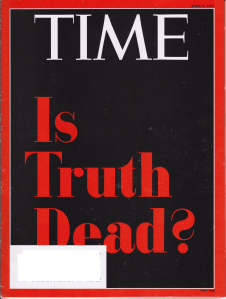
One of the benefits of working with words is that you get to participate in reality. George Orwell famously wrote that if people didn’t have the words to express concepts the government didn’t like, those concepts would cease to exist. At least as long as they allow us to have the internet, concepts may survive. Oxford Dictionaries’ word of the year reflects just this. The word is “post-truth.” Post-truth is a word of hard currency in the political marketplace. It essentially means that objective facts no longer outweigh emotion and personal belief in establishing reality. Think “global warming isn’t happening because it cuts into my bottom line.” Think “humans didn’t evolve from a common ancestor apes because an outdated book doesn’t say they did.” Think “Donald Trump won the election.” Truth is no longer truth without “post” in front of it. Believe what you will. No, I mean that. I choose to believe Trump was not elected. Post-truth cuts both ways.

In a world where reaction has replaced dialogue and where you win arguments by revealing your NRA card, truth is merely the first casualty. Already mainstream media, who told us the post-truth that Trump, according to the polls, couldn’t win, are now telling us it’s all politics as normal. This will be a simple transition of power. Pay no attention to the man behind the curtain. There is no wizard in Oz. Politicians lie. Only those born without a brain stem don’t realize that objective fact. We can be sure that even George Washington lied from time to time. There was no cherry tree-gate. Unless you choose to believe there was, then I guess it has to be okay. Your truth’s as good as mine.

img_3044

Over the past several years some prominent scientists have been saying philosophy is but misguided navel-gazing. It tells us nothing of reality. Truth, however, is a philosophical concept. Post is something to which you tie people before a firing squad. Truth has, until recent days, been considered that upon which all reasonable people could agree. The earth is not flat. We are flying around the sun so fast that it makes me earth-sick. We were able to put people on the moon. All of these are now post-truths. Along with the fact that every vote counts. In this slurry of fear, hatred, and distrust, who has time to worry about objective facts? Lexicographers do. And I praise them for giving us the most relevant word since Moses stumbled down the mountain with a tablet that read, “Thou shalt not bear false witness.”