Taking Time

Good writing is hard work. One of the mixed blessings of the internet is that it makes publication so easy. Get yourself a blog and nobody has to approve anything! Ideas come tripping across your fingers onto some electronic substrate and, viola! You’re an author! The problem is that being an author’s not the same as being a good author. Writing well (and I make no such claim for myself—after all this is just a blog) is hard work. A piece has to be written, and then read again and again. I’m reminded of the story of a convicted murder whose name I’m forgotten (call it a defense mechanism). This was early last century. The murderer was caught, initially after having been found wandering, disheveled, in public. As a respectable man (he was a doctor, I think) part of his defense was that he’d never have left his house without being presentable. He would have on a collar and hat. People would see him, and he had to convince them of his presentability every single time he walked out that door. (This isn’t an affliction that I share, by the way.) Writing for publication is like that—you need to take care to look respectable every single time.

I can’t speculate about how other writers do their thing, but for me the main requirement for this is time. Any piece that I want anyone else to see, has to be written. Read. Edited. Re-read. And probably edited again. All before the public sees it. This is just for the informal stuff. I’m currently writing a book (which is pretty much a constant state with me). The draft was finished months ago. I started thinking about a publisher. Then I read it again. I couldn’t believe I’d ever thought it was ready for a publisher. Several rewrites followed. I’m in the midst of another one at the moment. I think of it like my ill-used rock tumbler. You want shiny rocks, you’ve got to send them through with finer and finer grit. If you do it right, they’ll come out looking like they’re wet, and they’ll stay looking that way. Polished writing takes time.

Some things can’t be hurried. As a middle-schooler I had a summer job with the school district. One of my assigned tasks was painting bus shanties. Many of these were, as you’d expect, way out in the middle of nowhere. I’d be dropped off with a couple other teens and we’d paint the shelter inside and out. One day I got tired of the constant, boring, and repetitive task of filling a paint pan with white paint, carrying it into the shelter, using it up, and then doing it all over again several times. I decided to pour the paint directly on the plywood floor of the shelter. All I’d have to do would be to roll it out and who’d be the wiser? I only did it once. Little did I consider that the best painting, like the best writing, is a thin layer over the substrate. You need to go over it more than once, leaving time between layers. More importantly, I didn’t realize that you can’t gauge how much paint you need this quick way. The best thing is to run out and refill. Then you can pour the remainder from the pan back into the can. The floor took hours and hours to dry. Not only that, but the top surface dried first, so when I stepped in, I pulled up a thick layer of paint off on the bottom of my shoe. Tom Sawyer I was not. I had to redo it. What I learned that day, though, was a lesson about writing. Take your time. But you don’t have to take my word for it. I just write a blog.

Comet Tales

Göbekli Tepe, apart from being impossible to pronounce correctly, is a site of embarrassment to historians. First of all, this archaeological site in Turkey is too old. Abandoned around 9000 BCE—some 5000 years before the Sumerians show up with their writing—Göbekli Tepe had already gone through several phases of elaborate building and willful destruction. A large “temple” has been unearthed there with elaborately carved plinths that suggest a mythology at which we can only guess. Conventional wisdom states that the state came first, then organized religion. Göbekli Tepe suggest that it was the other way around—religion came first. We have no writing to go by here, however, just towering monoliths that make us scratch our heads in wonder. We are the apes.

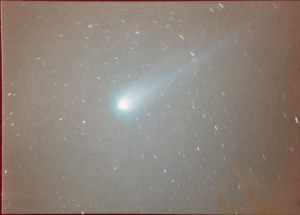
Hyakutake, 1996. My first comet.

A friend pointed me to an article in New Scientist that suggests one of the Göbekli Tepe “carvings show comet hit Earth and triggered mini ice age.” That’s a lot of ice. And eisegesis. Part of the problem here is that old scientists tend to sweep anomalous evidence off the table. It’s an admitted part of the empirical method. If a single anomaly stands against a host of conventionally expected results, the anomaly goes into the bin as an outlier. Göbekli Tepe, as real as it is, is an anomaly. Reputable books on it written in English by archaeologists and historians do not exist. Embarrassed turning away and staring at shoes ensues. The site is just too old, too sophisticated, and too far outside convention to be dealt with rationally. You can read a lot into an isolated carving, especially when accurate information is lacking.

To give you some perspective: the great pyramids of Egypt date from the Old Kingdom of Egypt, after 3000 BCE (remember, we’re counting backwards here). Stonehenge’s main phase (the famous blue stones) was a couple of centuries later than the Great Pyramid of Khufu (Cheops). Göbekli Tepe had closed up shop some 6000 years prior. By comparison, more time had passed between Göbekli Tepe and the Great Pyramid than between the Great Pyramid and us. We, with the internet in our pockets and humans walking on the moon, preparing to go to Mars, are only less than 5000 years from jolly old Khufu. Göbekli Tepe, with its inscrutable carvings, shouldn’t be there. And yet it is. Standard procedure suggests it be ignored. So far, conventional historians have done just that. And in my opinion that’s worse than an ice age brought on by comets written on a stone that nobody can read.


Who Cares?

With all the petitions going around I’m getting a bit dizzy. I won’t go to the doctor though, since I think Trump may be a pre-existing condition. In any case, seeing all these petitions gives me an idea for one of my own. I suggest a petition that says members of congress should not have a health plan. Now wait, hear me out—I’m not vindictive, just practical. Apart from the fact that some of them have been kept alive and active well past their sell-by date, these are people who are supposed to represent us, right? How can they represent what they don’t understand? For a few years after being sent down from Nashotah House I had no medical insurance. Cobra was rightly named because it was more fatal than a bite of its namesake snake. If I had anything go wrong, well, dying was always an option. How many of our “representatives” understand that? When’s the last time they had to stick their fingers between the seats on a public bus to look for change? It’s far easier to pull it out of your constituents’ pockets.

Like everything out of the White House since January, this hasn’t been thought through. Let’s see if I’ve got this right: the rich want tax breaks so they take away the healthcare of the poor people who work in their factories. The poor people die. They can be replaced with cheap labor from south of the border, but we need to build a wall to keep them out. And all of this is going to cost quite a bit so we have to tax the poor people to pay for it. Wait, the poor people are dead. Look, guys, you’re not rich unless you have someone to compare yourself against. I’ve never been to the country club but I bet it’s pretty hard to putt if your green looks like my front lawn.

Hm, death may be a pre-existing condition…

If the government wants to lead, it needs to consist of people like us. That’s why I say we should petition the members of congress to forego their own health care. The day after the House vote I had an email from my Republican representative. He said, “Don’t blame me, I didn’t vote for it.” Well, we live in a day of government-sponsored prejudice. All Republicans are alike. Enjoy it while you can, 45 sycophants. Midterm elections are coming up and I’m going to send a petition to the newly elected Democratic majority. If I’m feeling faint in the meantime I’ll just put my head between my legs. That’s what our elected officials are doing.


Wall-E of Separation

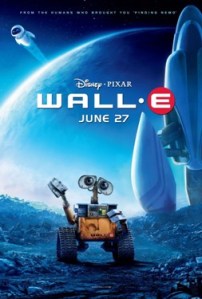
io9 is a progressive website. Its futuristic stories delight and entertain. When a friend sent me a story on io9 titled “New Fan Theory Asks the Obvious Question: Is Wall-E Satan?” I had to read. Then wonder. People know so little about the Bible. The idea is simple: in Wall-E the people live in an undisturbed paradise until Satan (in the form of EVE’s plant) tempts them to leave paradise and return to an earth they’d forgotten existed. Okay, so the Genesis parallels are blindingly obvious (Peter Gabriel was even formerly a member of a band named with the title of that very book). What’s wrong is that there’s no Satan in the Bible’s first book. I give Katharine Trendacosta credit—she discounts the connection of fat, immobile future humans and paradise. The idea that the snake of Genesis is Satan, however, is about as biblical as original sin.

Genesis never calls the snake Satan. It doesn’t mention original sin. In fact, many (Christians, especially) don’t realize the event isn’t called “the fall” in the Hebrew Bible at all. The gaining of knowledge by the first human beings is painful yes, but can be a good thing. Some Jewish interpretations of Genesis 3 suggest precisely that. The story goes that Eve and Adam were living, stupidly, in the garden. The snake points out that the fruit will make them wise—and it does. They do not immediately die as God said they would. Instead they lose a blissful ignorance and have to grow up. The serpent is never said to be the Devil until the very last book of the Christian revisionist scripture, Revelation. Sometimes a snake is just a snake. That’s the way it is in the book of Genesis.

Christian interpretation, however, took over the story of humanity’s awakening and made it into the fall into sin and evil. Things have been so bad ever since than that we have to elect Trump to start a war that’ll end it all. That’s Christian revisionism writ large. Read Genesis again. Slowly. The snake is not said to be Satan. “The fall” isn’t sinful. In fact, the word “sin” doesn’t occur until the story of Cain and Abel in the next chapter. So, is EVE inspired by Satan to end the paradise of the Axiom, unaware of its true origins? Only in a revisionist history of the Bible. The idea existed long before io9, and, according to Genesis, it was wrong even then.


Good Newsists

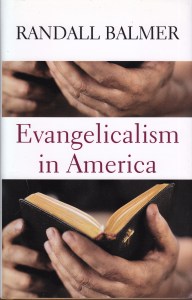
In the interest of avoiding conflict thereof, I cannot yet give a review of Randall Balmer’s Evangelicalism in America. Since I’m writing a review of it for Reading Religion, I’ll use it as a springboard into a topic that should concern all who believe in religious freedom. One of the resounding themes of Balmer’s treatment is that Evangelicalism, after it wedded to the Religious Right, lost its soul. Those are my words, not his, but the sentiment’s about right. For anyone who wasn’t politically aware in the 1980s, it may seem a surprise that religion didn’t enter into politics before that decade. With the exception of the fear of the Catholic in the case of John F. Kennedy, religion wasn’t used as a political wedge until the presidency of Jimmy Carter. The Religious Right, unhappy with the born again Southern Baptist in the White House, moved to solidify the Evangelical bloc.

Evangelicals had been an underground movement for half a century. Many had no idea what being “born again” meant when Carter first claimed the sobriquet. Balmer points out that it was the threat of the withdrawal of tax-exempt status to discriminating Christian schools that led to political action. Bob Jones University, fearful of racial intermarriage, didn’t admit African American students. Leaders of the Religious Right saw the loss of tax-exempt status as a move against their sacred segregated culture and a push that required a shove. Coopting the abortion issue (historically Evangelicals had supported women’s rights, including the right to abortion in many cases), they nailed together a platform for political activism which put women “back in their place,” kept racial “purity,” and romanced a total aberration in Christianity—the “prosperity gospel.” All of this is well documented. And well hidden.

Looking at Evangelical politics today, abortion—the control of women—has become THE issue. It’s hard to believe, as Balmer amply illustrates, that Evangelicalism used to be allied with the Social Gospel. It was a religious view with a conscience and it supported issues that are now polarized as “liberal” and leftist. This shift came about gradually, but not accidentally. There were political players—Balmer names names—who had one goal in mind, and that goal wasn’t Jesus or what he’d do. It was the sweet prize of political power. Evangelicals, you see, are born followers. A leader with a strong voice can lead them just about anywhere. Many Evangelicals today would deny their more liberal history, but it is right there for anyone who’s willing to learn something about who they once were.


Weather Vain

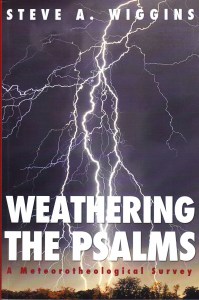
The other day I was awakened by a severe thunderstorm. It’s been quite a while since that’s happened. Unlike when we lived in the Midwest, thunderstorms in New Jersey tend to be widely scattered and somewhat uncommon. (It’s all a matter of perspective, I know.) My basis of comparison is how often I notice such storms. I’ve never been able to sleep through one. Thankfully this one came at around 4:30 a.m., past when I’m usually awake on a weekend. I’d forgotten the raw power of just how loud and bright such a storm can be. Danger seems all around. The feeling is primal and urgent. As I got out of bed and walked into the dark kitchen, windows filled with electric blue followed by and tremendous blast, I thought once again of Weathering the Psalms and the story behind it.

By the way, when I speak to young scholars about publishing I tell them this isn’t the way to go about finding a topic. That having been said, my book was born in the Midwest. Life at Nashotah House revolves around required chapel twice daily. Weather does not stop it. In fact, holding the daily office by candlelight because a storm had knocked out the power was not uncommon. Morning and evening prayer—indeed, all of the canonical offices—are built around the recitation of the Psalms. Reading the Psalter in slow, stately tones while thunder raged outside, rattling the ill-fitting stained-glass windows, left an indelible impression. It was only natural in such circumstances to notice how often the Psalms mention the weather. Thus a book was born.

I’m currently at work on a new book. I can’t say the topic just yet because someone might be able to beat me to it. (Knowing the way I come up with book ideas, however, I doubt it.) Sitting in my darkened living room, in my writing chair with the fury just outside, I was strangely inspired by the storm. Then it was over. Silence followed by birds singing, just like in Beethoven’s sixth symphony. The thunderstorm is one of nature’s psalms. As at Nashotah House, in the Midwest we had perhaps too many of that particular kind of psalm. Nevertheless, in the silence that followed I was left strongly in touch with my muse. These are the states that lead to poetry and song. Every great once in a while they might even lead to a book idea. As I tell students, just don’t expect that anyone else will get it.


United States of Ego

We all know the type. The guy who brags that he can do something complex without all the study and “hard work” (scare quotes theirs) necessary beforehand. When he starts strutting his stuff, and realizes that it is much harder than he thought, he has to find a way of backing down without losing face. We all know somebody like that. Now we all know somebody like that by dint of his being in the White House. Politics, like most complex things, isn’t as easy as it looks. When you’re president of the United States, backing down quietly’s not an easy thing to do. Why not start a nuclear war instead? Better dead than read, as the saying goes.

Thing is, braggarts may convince others that they don’t know what they’re talking about, but they’ll never convince themselves. The truly sad thing is we’ve never lived in a country where it was possible to buy your way to the White House before, based purely on ego. Don’t get me wrong—I know that every president has to be an egoist to some degree. What the previous 44 have had, however, is considerable knowledge of politics. Even the dumbest of them read. They knew this wouldn’t be some simple task that you could simply wing, like a business deal. You have to do homework. A lot of it. And it’s not easy. Even the relatively simple life of a professor of religious studies requires years of training. Hours and hours and hours of reading and thinking. Believe it or not, it’s hard work.

Now we have a chief executive tweeting that it’s hard to be president. Everyone, it seems, except 45, knew that. That’s why most people would never bother to run for the office. Our civilization utterly depends on experts. That surgeon that works on your heart, you swear, had better be an expert. Those guys who build the missiles we lob onto whomever we feel like, had better be experts. And even if your steak comes out of the restaurant kitchen poorly prepared, you send it back for expert treatment. And yet, we’ve elected the least qualified candidate who’s ever run for the office in over two centuries of history. His expertise: pleasing himself. Greed is a poor substitute for leadership. Even now that it’s crystal clear we live in a headless state, his supporters cheer him on. Let’s hear it for the poor uber-wealthy. Those guys need all the help they can get.


Blood Brothers

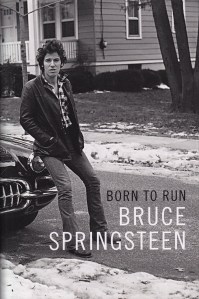
Every once in a while I take a chance and write about music. I don’t do this too often since it’s a very personal thing, and as open as I may be on this blog, I’m not as accessible as I seem. We all need a place to retreat in this world, and Bruce Springsteen’s music is one of those places for me. Late last year, just after it was published, Springsteen’s Born to Run—his philosophical and revealing memoir—sold briskly for several weeks. Since it made its way into my stocking I’d been intending to read it since then. And putting it off. There’s something disillusioning about finding out your heroes are only human. The best among mine are heroes precisely for that reason. Gods need not apply. Overcoming my fear, I dove in.

Two things stood out in this autobiographical account: religious imagery looms large, and depression mingles liberally with it. I recall reading an early review where the writer expressed surprise that the Boss suffers from depression. I responded (perhaps out loud), “have you ever listened to his songs?” I became a Bruce fan because he sang about working class people. Bruce and I share that background. He knows that your roots never let you go. Indeed, roots are what keep you grounded. Many of my academic colleagues, I learned, were simply carrying on the family business—and a privileged business it is. Those of us who had to overcome poverty to get in the door were never really welcome in the ivory tower. You can’t help where you’re born, but you can sure be punished for it. Bruce understands that.

I’ve never been to one of his concerts. I don’t even like to listen to his music when someone else is in the room. There’s something deeply personal about communing with someone you feel understands you. Of course I’ve never met Bruce Springsteen. I probably never will. He won’t know the kind of influence he’s had on my life and I feel that I’m risking an awful saying so here on this blog. There aren’t too many heroes in my life. I’m not inclined to idolize people. In this memoir, however, Bruce won’t let himself become an idol. He’s not perfect and he takes pains to make sure that you know that. We were, nevertheless, raised in situations not dissimilar from each other. Unlike Bruce, I have no musical gifts. No, I’ll never likely meet him—and if I did I wouldn’t want it to be with other people around. Some things are just too personal that way.


Trusting Truth

How do we know what’s true? For many the answer is what your experience reveals. If that experience involves being raised as a Bible-believer, that complicates things. A friend recently sent me a New York Times piece entitled “The Evangelical Roots of Our Post-Truth Society,” by Molly Worthen. For those of us raised in Fundamentalist conditions, this isn’t news. Then again, those raised Fundamentalist assume that everyone knows the truth but others have blatantly decided to reject it. It’s a strange idea, inerrancy. It’s clearly a form of idolatry and its roots can be traced if anyone wishes to take the time to do it. Inerrancy is the belief that the Bible is correct, tout court. It’s right about everything. If it contains one error, so the thinking goes, it topples like a house of cards. (Cards are sinful by the way, so get your hands off that deck!) If that’s your starting point, then the rest of the facts have to fall into place.

As much as I wish I could say that this simplistic outlook may be corrected by education, that’s not always the case. Many children of inerrantists are raised to question what they learn in school. Worse, many are home schooled so that they never have to be exposed to the sinful machinations of others until they try to enter the job market and are utterly perplexed by the fact that they don’t even speak a common language with the rest of society. Key code words don’t mean the same things outside that safe, withdrawn community where everyone knows the Bible and understands that to know it is to love it. Science doesn’t love the Bible, they’re taught. So science is wrong. It’s quite simple really. You already have all the information you need in one book. If science disagrees, then, well, you already have all the information you need.

There’s an internal logic to all of this, and dismissing the heartfelt beliefs of Fundamentalists only gets their backs up. It’s not about logic, but the emotion of belief. Some neuroscientists have been suggesting that we reason not only by logic but also with emotion. That complicates things, for sure, but it also explains a lot. For example, in a world where religion drives nearly all the major issues facing society, logic would dictate that universities would build up religion departments to try to understand this very real danger. Instead we find the exact opposite. Withdrawing into your own little world occurs on both ends of the spectrum. Dr. Worthen is to be applauded for bringing this out into the light. If society wants to benefit from this knowledge, it will need to stop and think about what it really means to be human. Fundamentalists, for all their foibles, illustrate that nicely.


Independent Bookstore Day

Many modern mini-holidays are centered around things you might buy. I don’t mind that so much in the case of Independent Bookstore Day—of which I wish you a happy one. Quite by accident I found myself in an independent bookstore just last night, not aware I was prematurely celebrating. If anything might save us from the muddle we’re in, it’s books. We live in a society with plentiful distractions, many of them shallow. Books take some effort. They demand your time. They make you take some quiet space to think. Books came along with, and perhaps were the source of, civilization. Today we’re harried and hurried and frantic with an electric source of information and entertainment that never turns off. And we’re seeing the results of that playing out on an international scale. How different it would be if we’d grab a book instead!

The strange thing is that those inclined to action often suppose reading to be an utterly passive activity. The basis for human progress, however, has often been what someone has read. Surprisingly, books can be the source of progress. When we see reactionary elections taking place around the world, leaders who don’t read emerge as the hailed champions of regress. We’re living through that right now. Books can be dangerous. Think about it—you’re being given access, however briefly, to someone else’s mind. The combined power of minds is an impressive thing. If what I’m reading is anything to go by, the hive mind is a source of incredible strength. You want action? Put multiple minds together. There’s a reason that civilization has gone hand-in-hand with literacy.

In the wake of Borders going under, independent bookstores have started to make a comeback. Those of us who work in the publishing industry have to keep an eye on those numbers. A visit to a bookstore is all about discovery. Quite often I’ve walked in with a list in hand. When I exit my list has grown rather than shrunk, and the purchase I’ve made was likely not on the list to begin with. Independent Bookstore Day gives us a chance to think about how very much we do not know. Unlike those who claim power and brag that they don’t read, admitting that we have more to learn is the way toward progress. I may not be the most active man in the world, but I do recommend action in the form of getting to a bookstore. If we each do our part, we can’t help but to make the world a better place.


Dog Daze

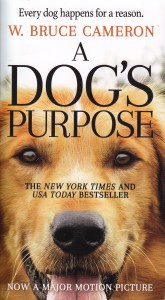
I read quite a bit about animals. One reason is that when you’re counting all the species on the planet we’re pretty clearly among the animal part. Having grown up with many pets, the dogs particularly stand out. We tended to have only one dog at a time and they were so full of personality that it obviously wasn’t a matter of projecting to understand that one was more or less optimistic or joyful than another. Some could be mean while others were loving. There was quite a bit of buzz about W. Bruce Cameron’s A Dog’s Purpose back in January. For Modern Mrs. Darcy’s 2017 Reading Challenge the book fit one of the categories for me, and so I found myself reading about animals again. The thing about buzz is that I listen with only half an ear. I didn’t know much about the book except that it was a novel narrated from a dog’s point of view.

A couple of things struck me as I got into the story. One was that the protagonist ended up still believing that humans were more important than dogs. I suppose there’s some kind of evidence for that, from a dog’s viewpoint, but it doesn’t seem very strong to me. After all, we’ve bred wolves into pugs and cockapoos with an intentionality that even Mr. Darwin would’ve recognized as unnatural selection. Left to their own wolves would’ve adapted, but they’re pack animals and while dogs may think us the alphas, they’re each an important part of the group. They are giving, but that’s the nature of being in a pack. It’s also something that elected officials in Washington could stand to learn. When there aren’t rifles and traps, pack animals prosper.

The second thing that stood out about A Dog’s Purpose was reincarnation. The idea scares me. Life’s been a long challenge this time around and, unlike Nietzsche I’m not sure I could face it this exact way again. In any case, reincarnation only works if there are souls to pull it off. Cameron posits that for Toby to become a fully developed Buddy four cycles of reincarnation are needed. Like a good Platonist, our protagonist recalls the important lessons from each previous life and is able to develop into a more fulfilled dog each time around. The karma here is good. Cameron does seem to “get it” from a human-projected dog’s point of view. It can be fun, and it can be sad. The important lesson, for me, is that animals are who we are and to be a successful pack we need to look out for the good of each other.


The Labyrinth of Copyright

Here’s another post originating from my daily work as an editor. (As an editor you tend to assume nobody’s really interested in what you do all day, but I’ve been told this isn’t so.) What is copyright? And do I have it? First of all, a caveat: I’m not a lawyer. Copyright is complex and, to answer my second question first, yes, you do have it! So what is copyright? Essentially it’s the protection of intellectual property. As long as that property remains in your head, it’s yours alone. Once it’s expressed in writing, art of any kind, music, or even as a chart, it is automatically covered by copyright. If you want to use something someone else wrote, or produced, in your book, you need permission. Small quotes are generally considered fair use, but don’t push that doctrine too far! Fair use is listed as just that, a doctrine.

What many authors don’t realize is that your book contract is an exchange—you’re selling your copyright to the publisher for their services (they publish your book, promote it, register the copyright (it already has copyright, but registering helps to protect it legally), and handle the financial aspects of selling your book). You can’t publish your own work again without permission of the publisher. Sometimes I’ve had people ask me to use my artwork (from my own published articles) in their work. I don’t mind, of course, but I don’t own the copyright! If I published my work, the publisher has taken that copyright and I remain simply the author. If I want to publish my own published work somewhere else, I have to ask permission. Copyright, however, doesn’t last forever.

The only safe date before which material can be used without fear of infringement is 1922. Works published before then are in the public domain. Right now new works (such as this blog) are covered by copyright for the life of the author plus 70 more years. After that, unless the law changes, you don’t need permission to reuse these idiosyncratic musings. Not that that’s ever been an issue. I’m not a litigious person, but I do like to be cited. (Who doesn’t?) In any case, if you’re working on an academic piece, and you want to reuse somebody’s drawing, or an extended piece of writing, or even a tiny bit of a poem, you must have permission to do so. That’s what copyright does for you. The “fair use doctrine,” like most doctrines, doesn’t hold up well in court. If in doubt, just ask. Before you do, though, you might want to consult a copyright lawyer, just in case.

All opinions my own.


Occam’s Beard

Skeptics can be so much fun. We really do need them, otherwise we’d likely still be living with notions of medical science being attributed to four humors, none of which were that funny. Still, sometimes it gets tiresome to read endless references that take Occam out of context. You see, one of the foundations, if not the very keystone, of modern scientific method is that of parsimony, aka Occam’s razor. The idea is simplicity itself. If there are multiple possible explanations for a phenomenon, then the simplest is most likely correct. But only if it supports your biases. The reason I raise this question is the materialistic dismissal of “consciousness” as merely a by-product of having a brain. The reasoning goes like this—nothing exists that can’t be measured by science. Since that which isn’t material can’t be measured, the most parsimonious explanation is that it doesn’t exist. QED.

This way of looking at the world has become so common that those of us who question it are given a condescending smile and a paternalistic pat on the head. But my thinking about this goes back to Occam himself. William of Occam (or Ockham) was a late medieval churchman and thinker. As a scholar he possessed a sharp mind. As a friar he also possessed a soul. There was no disconnect in those days. His observations of the natural world led him to the reasonable conclusion that if a simpler solution sufficed, a more complicated one need not be posited. So far, so good. This is not, however, to suggest that more complex things may not be going on. Quantum physics, for example, suggests that things aren’t quite so easy to explain. And what about poor Occam’s soul? This very component that made William William has been dismissed as mere illusion. Did it therefore not exist?

Is it more parsimonious to suggest that “mind” (or soul, or consciousness, whichever you prefer) is mere illusion, electro-chemical signals flitting between highly specialized cells just happen to give off a fiction of consciousness, or would the simpler answer be, as Occam himself believed, we have souls? We have no way to measure such things, but to claim they don’t exist is to rob a great thinker of his very mind. Any of us who experience consciousness know that it’s no illusion. We feel the pains and joys of this same body day after day and, if we’re honest, we believe that we’ll continue even after this fleshy substrate wears out. There’s a profound logic here. Science doesn’t know how mind affects matter—how I can decide to type and my fingers move. The most parsimonious answer, they claim, is that it only seems to be so. A far more honest answer would be that mind is real. And I’m sure Occam himself would agree, even if he preferred to call it a soul.


Frankly Frankenstein

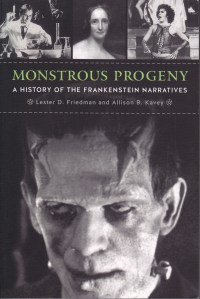
As a novel, like its monster, Frankenstein trespasses all kinds of boundaries. Is it science fiction or horror? Is it Gothic or presciently modern? Is it feminist or conventional? One thing about it is certain: it has been immensely influential. Lester D. Friedman and Allison B. Kavey have created for the world a truly wondrous treatment of this meme. Monstrous Progeny: A History of the Frankenstein Narratives is perhaps the most engaging monster book I’ve ever read (and there have been many). One of the main reasons for this is that Friedman and Kavey are keenly aware that binaries don’t necessarily exclude their opposites. Frankenstein is about both science and religion, and it treats both profoundly. Considering that Mary Shelley was only 21 when the novel was published bespeaks a rare genius in blurring boundaries and making those on each side think.

Monstrous Progeny considers multiple issues associated with Frankenstein. Should science be approached alone, or should peer review be involved at every stage? Is religion eschewed by this woman so strongly influenced by atheism, or is it the very crux of the matter? And what about the incredible and continuing afterlife of Shelley’s story? Friedman and Kavey survey not only the novel but several movies associated with, or based on ideas from, the book. Modern science, if we’re to be honest, also owes much to the fictional musings of a 19-year-old girl on a dark and stormy night. The tale of the tale is nearly as fantastic as its progeny. Challenged to write a ghost story, Shelley produced an undying Zeitgeist feature instead. Monstrous Progeny delves deeply into this unexpectedly profound idea, showing how it grips the heart of many contemporary nightmares.

Genres can be deceiving. Shelley wrote her tale as a “ghost story.” It received literary acclaim, becoming one of the best selling books in England in the nineteenth century. Only when Universal found success with Dracula in 1931 and followed it up with Frankenstein the same year did film critics want something to call movies like this. The term “horror film” was invented. There is certainly horror in Frankenstein, but there’s much more to it than that. The relationship between religion and science, and the very real ethical issue of making something because we can, are never far from the reader’s mind. Giving life to the creature only underscores the conflicts and contradictions of life in a world where to be gods risks destroying any possibility of heaven. Monstrous Progeny is a thought-provoking book that will, in its own way, brings our present fears to life.


Science Marches On

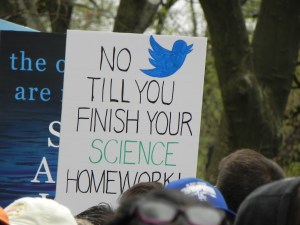
A few thoughts about the March for Science in Manhattan over the weekend seem to be in order. To get to the rally in time, from our little corner of New Jersey, we found ourselves on an early train. We arrived at 62nd Street and Central Park West to discover the march was beginning just outside of one of Trump’s unimpressive towers. The area for marchers was clearly marked off by barricades, but a woman walking her dogs, a resident of Trump’s tower, wandered in among the crowd. Like most Trump followers, she seemed clueless that there was an obvious way around the obstacles and had to be helped by the police. Seems to be a theme with 45—police are everywhere watching his assets. Meanwhile the hotel doormen from next door were asking for “Resist” paraphernalia and reminiscing about their shock when the boy next door received the nomination. The mood was jovial despite the spitting rain.

The speeches at the rally were mostly given by children ten and younger. The future teaching the past. As might be expected, the signs were clever, and some took considerable thought to figure out. A few, it seems, felt religion was to blame. Well, they’re probably right about that. One gets the sense that science and religion are like cats and dogs, and nobody has to guess which one’s identified with the cats. Still, the majority of the signs pointed out the benefits of science. Even scholars of religion use the scientific method, believe it or not. Like science, religion (as revealed by science) may be good for people. Who brings religion to a science rally?

I’ve always been a fan of science. Throughout school I learned a lot and did well in physics and chemistry, biology not so much (dissection was never my thing). I still read science and incorporate it into my thinking. Balance, however, suggests perhaps religion also be treated as not evil in and of itself. After all, it is evolved behavior. As the march progressed down Broadway, we passed a church that had a prominent banner reading “Prayer really does work,” or something along those lines. I’d seen enough clever signs already that morning to notice this contrarian voice. Then I wondered, why can’t science and religion seem to get along? Both can (but need not) make exclusive truth claims. What’s wrong with admitting that we just don’t know? Belief is involved in either case. No doubt science is important. I’ve always supported its study and always will. Is it, however, too much to believe that maybe religion can also enlighten, if understood for what it is—a human way of coping with an uncertain world? As science marches on, hopefully it will help us comprehend even the unmeasurable.