Gods Will Be Gods

“And it came to pass, when men began to multiply on the face of the earth, and daughters were born unto them, That the sons of God saw the daughters of men that they were fair; and they took them wives of all which they chose.” Genesis 6 begins with one of the most unusual stories in the entire Bible. And that’s saying something! The sons of God mating with the daughters of men? A couple verses on we hear about giants roaming the earth in those days, presumably the children of this divine-human miscegenation. What is this stuff straight from pagan mythology doing in the pages of Holy Writ? Over the centuries, translators have tried to tidy up the boldly direct language of the King James here, making the sons of God into angels or some lesser beings. It is too hard to accept that sacred scripture admits of polytheism.

Monotheism, it is clear, came to the Israelites somewhat late in their history. The Bible is full of bold clues that other gods exist, and, worse yet, they are sometimes as powerful as Yahweh. In the light of later theological development, translators often bow to popular pressure and clean up the Bible’s language a bit. Fact is, Israelites, like most ancients, lived in a world populated with mythical creatures. Gods galore, monsters, demons, angels, witches, giants—they all haunt the pages of the western world’s sacred book. But that’s not what we expect the Good Book to say. The Hebrew text here is unequivocal, these are the “sons of God” we are talking about. Either that, or worse, “the sons of the gods.” More and more deities.

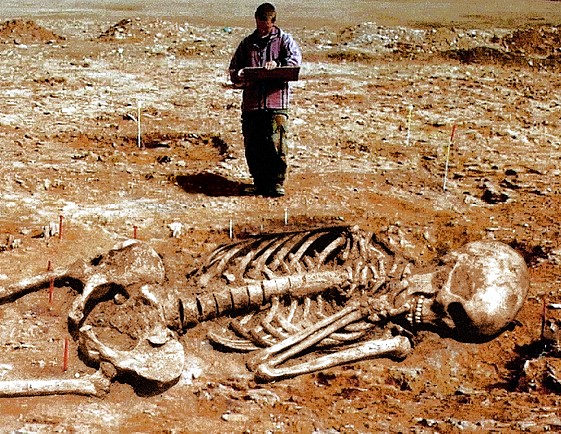
We can’t be sure why the ancient believed in monsters and giants, but it seems likely that such creatures had explanatory value for their world. Lacking science—paleontology was millennia in the future—they had to explain the huge bones found in the earth. We do know that dinosaur bones had been discovered in the Mediterranean basin in antiquity. These big bones often look human to a non-specialist. Heads are frequently missing. It has been suggested that these give rise to our biblical giants. Yet another response has been the recent trend of fundamentalists with Photoshop skills to post photos of archaeologists actually discovering giants on the Internet. Some of these doctored images are very impressive. It is an effort to save the Bible from the truth. A Bible that requires saving, however, should give even the most fervent believer pause for thought. Isn’t it just easier to suggest the sons of God were typical guys and that little has changed since the world was young?
Dark Light

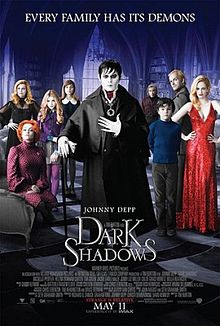
It took a few weeks and five states, but I finally got to see Dark Shadows. Although I’d seen the trailers, there was quite a bit over which I remained in the dark. After all, the television series ran daily for several years and the story of Barnabas Collins was never really resolved, to the best of my knowledge. Trying to fit all of that into a couple hours of cost-intensive Hollywood showmanship would be a tall order. I have come to trust the Burton-Depp collaboration, however, and I had read some time ago that Johnny Depp had wanted to be Barnabas Collins when he was growing up. It is difficult nevertheless to resurrect a vampire after some three-and-a-half decades of slumber. Speaking with some friends after the movie I discovered that I was not the only child discouraged from watching Dark Shadows after school as a child. But watch I did.

Barnabas Collins became a monster as the result of a curse. The series—which I remember principally as a series of impressions and images—and the movie make that clear. The man who has lost control of his own fate is a reluctant monster. An aristocrat who lives by draining the blood of the common folk. Despite the humor and carnality of the movie, social commentary is there. Sometimes buried in an iron coffin, and sometimes in a vintage VW bus from the early ‘70’s. It may not appear full blown on the big screen but it pulses through the veins nevertheless. Barnabas Collins is a reluctant and conflicted vampire, but he does kill others to survive.

Why would a kid raised in a religious setting be so drawn to a creature of evil? Perhaps it was because Barnabas was the ultimate penitent. He had to victimize others, but he always regretted doing so. Like any living (or undead) creature, his nature compels him to survive. He is sad about his lot in the world, but is helpless to change it. Like many children of the monster generation I was nourished by a long series of movies featuring impossible creatures, including vampires. The earliest vampire I knew, however, was Barnabas Collins. Although Bram Stoker had set the type nearly a century earlier, my measure of the vampire was the reluctant denizen of Collinwood. Although I read my Bible dutifully, and never missed church, I still found the plight of this lonely monster compelling. The movie may not live up to the standard of all Dark Shadows aficionados, but if it brings a subtlety of moral ambiguity to a generation of absurdly self-assured modern-day fundamentalist children, the curse of Barnabas Collins may really be a blessing in disguise.


Blazing Forest

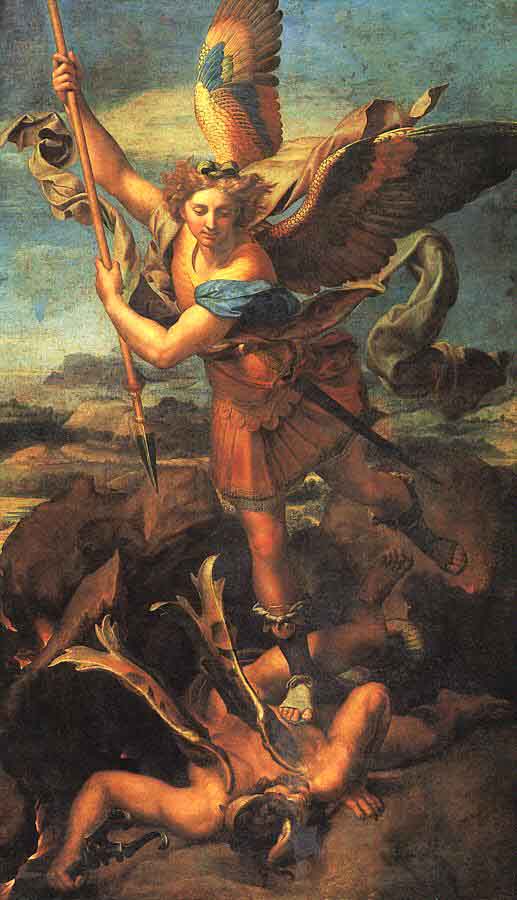
Back in 1996 an angel was on the big screen. In a manner of speaking. Michael, starring John Travolta as the archangel Michael, may not have been an instant classic but it did have a memorable line or two. The image of a smoking angel had been contrived by Van Halen over a decade earlier, but the idea of the prince of the army of Yahweh being a guy just like the rest of us was strangely refreshing. No Park Avenue deity this. When the reporters first meet Michael and wonder if he’s the real thing, one suggests tugging on his wings to see if they’re real. Michael responds by asking if he should pull the reporter’s privates to see if they’re really attached. His companion comments, “An angel that says ‘pecker.’” While the very idea of “bad words” is an unusual one, it is well-nigh a universal. In just about every culture there are words or phrases that just aren’t uttered in polite company. Those who can’t control their mouths, suggests the book of James, can’t control their lives. So it is with a kind of perverse wonder that I read about the bullying bravado that issues from the lips of New Jersey’s governor.

Don’t get me wrong. I never fault anyone for speaking like they were taught. I was raised in a blue collar family and at times the talk could get pretty blue as well. I would, however, point out that you’ll not find a student I taught over my two decades in the classroom that every heard me cuss in class. It is a matter of standards. Emotions, those great clawing monsters inside us, rage to escape. The building blocks of society—restraint and control, and dare we even wish? subtlety and refinement—are signs of civilization. Some of us were taught to leave name-calling on the playground. I am profoundly saddened when politicians believe they are the best America has to offer when in reality they reveal themselves coarse, vulgar bullies. Enter Chris Christie.

In a public venue on Wednesday New Jersey’s governor called the chief budget officer for the Office of Legislative Services, “idiot,” “jerk,” and “numbnuts.” Here’s where we see Tea Party values incarnate. Belittling others, especially in a public forum, reveals a nature that should make all civilized civilians hang their heads in a surfeit of collective shame. America has come to this? Admiring bullies and slashing and burning services for those who need a little communal support? And he has been posturing for a vice presidential nomination. And angels will be smoking cigarettes in the wings. A President/Vice-President who says “numbnuts?” America deserves far better than this. Where is Michael when we need him?

Take that, you #!@&$!


Scary Monstrances

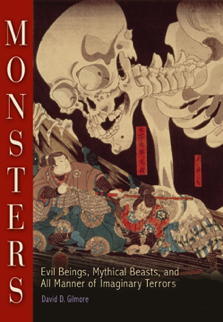
I can’t help myself. I’ve always found monsters fascinating. Now that I’m mostly grown up and am expected to have a modicum of respectability, I try to read academic books on monsters so that I can legitimate what would otherwise be puerile juvenility. David D. Gilmore’s Monsters: Evil Beings, Mythical Beasts, and All Manner of Imaginary Terrors was my latest foray into the forest. As I have come to expect, just pages into the book the first reference to religion emerged. This connection between monsters and religion is not Gilmore’s central theme, but it does recur at several points in the book. I especially enjoyed his discussion of Spain’s Pentecostal dragon. The Tarasque, named after its host town, is a medieval dragon that is still feted to this day in some locations. Considered to be symbolic of the sins of humankind, it accompanies either the holy day of Pentecost or of Corpus Christi. This connection between the church and monsters took me back to my first experience of Corpus Christi.

Raised as solid a protester as a Protestant can be, I had a difficult transition to some aspects of Anglicanism. The ceremonial was great, but some of the popish blandishments I could never quite accept. When a member of Boston’s famed Church of the Advent, the rector asked me to be a torch bearer on Corpus Christi. This involved processing outdoors onto Beacon Hill in full drag (or cassock and surplice, as I’m sure the parsimonious will correct me) to accompany the holy sacrament, carried as it turns out, in a monstrance. The idea that looking at a piece of wafer-thin bread on public display could somehow mediate a divine blessing, I never understood. It felt as much a fairy tale as the dragons of Spain. Monster or monstrance?

Gilmore concludes that monsters are people’s projections of their deepest unresolved issues. He may be right. One of his observations, however, struck me. He suggests monsters predate even gods in the human imagination. I tend to think they entered that gray space at the same time. Our minds have always told us that there were creatures out there to fear. Some of them, we hope, are good. Others are clearly evil. Monsters are difficult to explain in a world created by a benevolent deity. It is perhaps no mistake that Zoroastrians conceived of Angra Mainyu as monstrous. Divinity and diabolism could be fused into one being. There is a profound lesson here, for those able to read. Monsters are among the earliest projections of human imagination. And they remain forever with us.

Angra Mainyu; god or monster?


Children Shall Lead Them

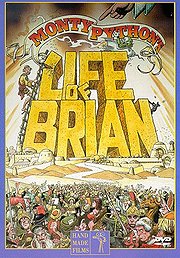
One of the perks of moving to New Jersey was landing in a town with strong support for the arts. Every time I attend a middle or high school concert, I consider how the old image of painful evenings of parents patiently pretending to enjoy the music has ended. The kids in this town could be professionals. If I close my eyes, I forget they’re all under nineteen. Last night at a school concert one of the pieces was “Always Look on the Bright Side of Life,” Eric Idle’s chestnut from the Life of Brian (now featured, I hear tell, in Spamalot). I first saw the Life of Brian with some trepidation while in seminary—I had been sounded warned that it was a profane movie, making fun of Jesus. Considering that all the actual references to Jesus in the movie are quite positive, I eventually realized what all the fuss was about. The movie doesn’t make fun of Jesus, it does, however, show the laughable nature of those who follow a religion blindly. This, I gather, was the real root of the problem.

Next to this fun piece, the concert also included several pieces taken from originally sacred contexts such as Mozart’s Dies Irae and settings of Veni, Sancte Spiritus and Ave Maria. Spirituals, likewise, are a perennial favorite. Performed along next to these pieces of religious origin were also decidely secular pieces such as “Scarborough Fair” and the Beatles’ “Hello, Goodbye.” In concert the sacred and profane blend beautifully. Perhaps there is a paradigm hidden in plain sight here. Religions need not be defensive and unbelievers need not attack them. The world is surely big enough for differences of opinion.

Music has a power that sometimes frightens me. I don’t often address it in my blog because of how much it affects me. Theorists often note that music is part of nearly every religion ever invented—we know that something special is going on when we hear it. And music has the ability to move large groups of people simultaneously. I’ve not attended many professional concerts (the last one was Alice Cooper in Atlantic City back in 2008), but no matter how secular the artist the experience is profoundly spiritual. I’m not sure I can adequately define what that means, but when it is felt there is no mistaking it. So maybe that’s why school concerts have such power. It seems that schools that support the arts also tend to have excellent academic records as well. The truth is hidden in plain sight.


After Before the Dawn

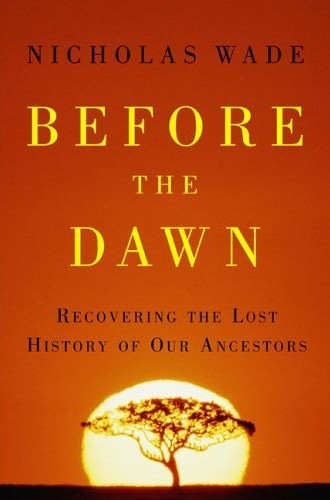
Apropos of reading Nicholas Wade’s Before the Dawn, as a sometime scholar of religion a number of points struck me. According to both material artifacts and DNA, several changes took place among human beings some 50,000 years ago. Having just read P. W. Singer’s Wired for War as well, the early coalescence of war and religion in human history was unavoidable. Wade ties the emergence of both with the development of language. It is only when we can speak that we can begin to express our theological speculations and, as history continues to teach us, despise those who disagree with us. It becomes clear quite early in the tome that Wade has an interest in explaining religion. Like many science writers he struggles with the issue of why religion persists, despite the explanatory value of science. We know how multiple aspects of our world work, yet we still defer to a divine that no one has ever seen or registered in any empirically verifiable way.

Not only does this tendency stretch back to our distant, distant relatives. The Natufians, about whom I generally lectured my students (itself ancient history), are marked as well by the dual achievements of religion and war. Wade is one of the few scholars I’ve discovered who concurs with my assessment that religion was among the earliest of human behaviors. In my mind, it is tied to consciousness and its evolution. Once we begin to realize that we are not in control of our destiny, we start to seek explanations from above, and hope that God loves us. Otherwise the picture isn’t so pretty. Indeed, Wade suggests that religion evolved as a socially cohesive force. Tying the concept to ethics and trust, he suggests early people had to learn to get along with strangers and religion cemented that bond.

I’m not a scientist, so I cannot assess whether this explains religion or not. It does seem clear, however, that if Wade is right religion itself has evolved into a more aggressive beast. Sure, religions still serve to bind people together—but only so far. As populations separated, their various religions evolved and led them to distrust one another. Instead of bonding humans together, religion began to put them into competition for the truth. Here, Wade’s analysis is sadly true—religion and war evolve together. Our small planet is yet too big for everyone to get along, to know and trust the stranger. Religion had helped us at the critical stage when we needed social bonding, and now it has naturally evolved into the opposite—a socially divisive force of orthodoxy and heresy. If Wade is correct, we all need religion to take on its most ancient role and bring people together instead of giving us excuses for war.

Waiting for the dawn


Avengers and Gods

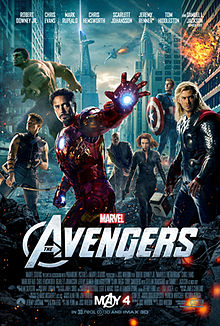
The Marvel Comics Universe is a complex blend of juvenile and adult themes. At the suggestion of one of my readers (thanks, Erika!) and the urging of my family, we went to see The Avengers this weekend. Having grown up in my own complex circumstances (first of all, fundamentalist—therefore not prone to too much secular material, and secondly, of humble means—therefore not prone to too much material material), I was aware of only some of the group. I’d read Hulk, Iron Man, and Thor comics, and I knew who Captain America was, but I never realized they’d teamed up, along with Black Widow and Hawkeye, to form the Avengers. I guess I just missed that part. The amazing integration of gods, performance-enhanced humans, and technocrats, makes for a fascinating consideration of the boundaries of good and evil.

This became clear when Captain America first encounters Thor in the film and is told he is a god. His response, straight from Tea Party rhetoric, is “There’s only one God, ma’am, and he doesn’t dress like that.” Clearly a man from the early twentieth century would have expectations of Yahweh’s dress code. It would be a white robe, no doubt, but as the gods Thor and Loki duke it out, Yahweh is nowhere to be seen. The movie also toys with the concept of immortality. Dr. Banner, under the guise of the Hulk, is unkillable. In a poignant moment he admits having attempted suicide, but his alter-ego proved indestructible. The cheer of the audience was palpable when Loki tells the green guy, “I’m a god and I won’t be bullied by—” only to be divinely thrashed by the Hulk who responds with the word, “Demigod.”

Over the past several years I’ve noticed that hero movies have begun to declare Gotterdammerung, the twilight of the gods. No longer are supernatural beings the ones who rule humanity. Heroes are now in charge of their own destinies. And yet, that old time religion is still present. As Tony Stark is about to attack one of the wickedly cool flying leviathans he asks Jarvis “Are you familiar with the story of Jonah?” I wondered just how many in the theater got the reference—how many, like Captain America at the comment of flying monkeys, got the joke? When the movie was over, and I was convinced I wouldn’t have to go to work on Monday (I was sure my building was one of those destroyed in the mayhem), I pondered the resolution. The gods took their dispute to Asgard, out of the realm of humans. This was, after all, a dispute between deities. And humans, as so often happens in such scenarios, were simply caught in the middle.


Enoch’s Dilemma

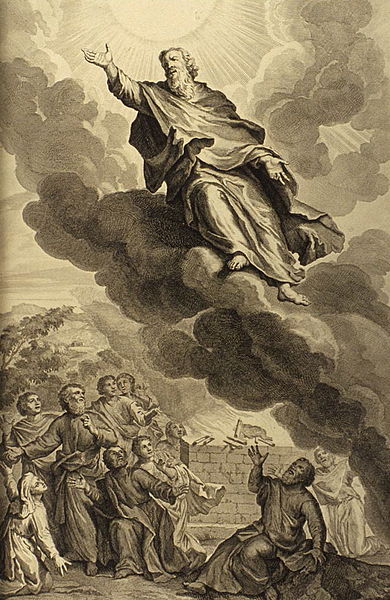
“And all the days of Enoch were three hundred sixty and five years: And Enoch walked with God: and he was not; for God took him.” These two verses from Genesis 5 convey just about all we know of Enoch. That, and he was the father of the oldest man ever, Methuselah. With this intriguing introduction, however, the religious mind insists on a backstory. Over the centuries of antiquity, books grew about this mysterious character as he became the prototype of the person who never died. The Bible doesn’t state that Enoch didn’t die. Nor does it state that he did. Plenty of wiggle room for the mythic imagination. In what appears to be an unrelated story, the Chronicle of Higher Education this past week reported on technology that builds on the strange but natural idea of phantom limbs.

When a person loses a limb, sometimes they report still feeling it. Their brains grew in a body that possessed the limb, and once it is gone the brain still has memory of it. The term used for this is a phantom limb. Knowing that mind does control matter to some extent, robotics experts have figured out ways to wire a robotic limb to the brain of a paralyzed person that responds to brain signals sent to the phantom limb. As much like science fiction as it sounds, this is already happening. The robotic limb responds just like a biological limb. This technology is just developing, of course, and is very expensive. It also implies that cyborgs, once the fodder of futuristic fiction, are becoming reality. Some theorists, such as Raymond Kurzweil, suggest that the brain itself can be converted to electronic signal and transferred into mechanical storage. Once that is achieved, we will have Enoch without any God to take him.

The world that we’ve been engineering bears a strange resemblance to the world of the Bible. For the people of ancient Israel death was the final word, and with rare exception (the only unquestioned case of the undying man was Elijah) people simply accepted the inevitable with no concept of an afterlife. Contact with the Zoroastrians convinced some Jews of the possibility of life beyond death and the quest for immortality was on. It has been a desideratum of human aspirations ever since. We invented machines to help us do what nature has not equipped us to attain. Finer and finer lines have been drawn between the biological and the mechanical. While it make look like immortality to some, to others it seems that we have been kidnapped—taken, if you will—by technology. What really happened to Enoch? The Bible doesn’t say, but it seems that we are getting very close to finding out on our own.


Convergent Evolution

Back when my opinion mattered—in higher education, you must realize, a scholar’s outlook only matters when s/he has a teaching post, no matter how abysmal the school. Once that post is gone you just become another guy with an opinion—I was invited to a conference. This is quite an honor for someone consigned to the bargain basement of academia, and for my paper I read from a burgeoning book that died a sudden death along with my academic career. In that stillborn tome I argued that many aspects of ancient mythology—including some in the Bible—made better sense in the light of science. I suggested that some of the infelicities in ancient texts might be the signs of continuing evolution of the human brain. Ancient people were able to believe what we find troubling. By the end of the conference many respectable scholars were looking askance at me when I stepped into the room. Honestly. I heard the word “Wiggins” uttered as if it were an archaic curse. Shortly after that I found myself working out of some guy’s basement for a salary fit for a knave.

Imagine my delight, then, at finding a reputable scholar who argued that the human brain indeed continues to evolve. In fact, it has speeded up the pace as new challenges have emerged. Before the Dawn: Recovering the Lost History of Our Ancestors by Nicholas Wade was recommended to me by my brother-in-law. As I was updating myself this week on how we became human, I was surprised to see Wade suggesting what I had suggested in my paper—the patterns of human behavior (we both have an interest in religion, it seems) are tied to the evolutionary state of our brains. Sitting on a bus next to many other drones commuting like ants to New York City, I felt strangely vindicated. I had an idea scorned by my colleagues that is being suggested by science. Not that everyone will accept Wade’s conclusions. Many scholars of ancient religions will never even read them. When I explained my thesis to a colleague after losing my academic status, he said, “I don’t give much credibility to science.”

Convergence is the phenomenon of two species evolving an adaptation independently. Often it is difficult for people to believe that a trait shared by two populations is simply nature’s way of trial and error that happened to work twice, in different situations. Nicholas Wade and I experienced convergence on this point. He, of course, is a famous writer and I am nobody. Nevertheless, my unpublished idea was presented at a conference the year his book must have been in production. We had both been reading about evolution and wondering what its effect on religion might have been. I will comment more on Wade’s specific ideas about religion in the book in another post. He, of course, went on to write The Faith Instinct, which was widely acclaimed. At that time I was struggling to find work and it seemed that natural selection hadn’t selected me at all. I am glad, however, that my idea made it into print, even if it was evolved by someone else who is far more fit for survival.


Free Tea

I first became aware of The Town Hall, I have to admit, through the Christopher Guest mockumentary A Mighty Wind. In the movie, three aging folk groups are brought together for a concert in Town Hall to honor the memory of one of their early promoters. When I began to walk past Town Hall on my way to work, I grew curious about its history. This curiosity was piqued by the scriptural quotation engraved on the façade: “Ye shall know the truth and the truth shall set you free.” New York City is an architect’s smorgasbord and I am often intrigued by the little gems I spy here and there. I discovered that The Town Hall was originally a political venue built by The League for Political Education, an organization sorely needed now. Built because of the need for a public space to discuss the Nineteenth Amendment (which the League supported), Town Hall was originally a venue to keep the public informed.

The Nineteenth Amendment—which the Tea Party seems to have overlooked, along with much of what we recognize as democracy—was drafted by Susan B. Anthony and Elizabeth Cady Stanton. It took congress only four decades to ratify it. Women were finally given the right to vote. Stanton was noted for her suffrage activities, including the production of The Woman’s Bible. The idea that an entire half of the human race should share the rights of the other half seems to have required a building erected to educate the public. Of course, there were moments when even The Town Hall couldn’t bear the words spoken on stage, as when Margaret Sanger was arrested for speaking about contraception there in 1921. I suspect there were Tea Partiers in the audience.

The same stage also provided a venue for Edna St. Vincent Millay to have her poetry reading breakthrough. Richard Strauss and Sergei Rachmaninoff performed there, as did any number of other greats. Truth may take many forms. Certainly human equality is as basic a truth as can be found. Art and poetry are equally as parsimonious, in the formal sense of the word. These things that we value are the very aspects of culture that the Tea Party would like to curtail. Thankfully there have been believers in the truth in the past who have been willing to construct monuments to sanity. And I can’t help but think that there would be even more of them if we still had a League for Political Education to help promote the truth. Without it, as it says in stone, we can never be truly free.


Whose Call?

I think about religion quite a bit. Well, it’s actually a big part of my job. I also spend quite a bit of time sorting out where religion is represented in the spectrum of human learning, specifically in higher education. One can’t help but notice a profound disconnect between reasoned thought on religion and the often brainless way that it is played out in public forums. Often this ineptitude comes through the mental fumbling of politicians, but just as often the culprits are well-heeled preachers who learned their trade at the hand of like-minded individuals who castigate the usual methods of examining evidence. Even as recently as this week I saw disparaging remarks made in a Chronicle of Higher Education article about seminary education—something I understand a little too well. For all their faults, most seminaries try to teach students to interpret their faith intelligently.

Perhaps it is too fine a line to be etched in the sand, but the study of religion and the promotion of religion are entirely different entities. Our society desperately needs more of the former. I quite often lament the short-sighted lack of education about religion in higher education. Given the frequently destructive nature of religious teaching, it would behoove us to understand it a bit better. In my research on the state of education about religion in the United States, it has become clear that many—perhaps most—high-powered institutions of higher education do not offer the opportunity to study religion. Many secular schools, seeming to fear religious cooties, simply avoid the subject like Yersinia pestis. There is nothing particularly alarming about that. Until one starts to count the number of accredited institutions that teach indoctrination as education.

A simple survey of institutions of higher education in the United States will reveal hundreds of doctrinally based colleges that generally teach uncritical attitudes towards religion. Students graduate from such schools with bona fide parchments that claim them to be proficient in the subject. Meanwhile, at the local state university, no one can study religion because it is considered a subject unworthy of academic research. Maybe it’s just me, but I have trouble reconciling this lack of interest with what I see in a society where Tea Parties are steeping and sabers are rattling in the name of religion. Same sex unions are being shouted down. Women are paid lower wages for the same work as men. The ground is being fracked beneath our feet. The impetus for these destructive behaviors takes is fueled by religion, and they only scratch the surface. I would humbly suggest that if we want to see the state of the union clearly it is best done with eyes open rather than hiding behind an amendment and pretending religion is not there.


Stormy Weather

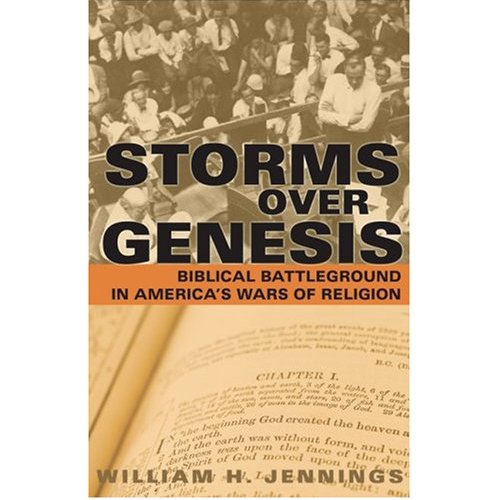
The privileging of one literature over others is problematic. Of course, the entire industry of biblical studies is built around such preferential treatment. And so is a large share of Christianity. I’ve just finished reading William H. Jennings’ Storms over Genesis: Biblical Battleground in America’s Wars of Religion. For someone who has taught Genesis before there wasn’t too much new material in here, but it strikes me as a very good primer for those who wonder about why the issues of gender inequality, global warming, and evolution remain firmly entrenched in evangelical minds, and therefore, our society. Just the first three chapters of Genesis, as Jennings points out, have led to the much of the irrational, at times inane, arguments that just won’t go away. Tea Party kinds of issues.

At the base of it all is the concept that Genesis somehow represents the way the world is supposed to be (rather than the way it actually is). As if seconding my choice of bus reading, The Economist recently published an article on Glen Rose, Texas. I’ve known about Glen Rose since I was a child. There, in a bizarre twist on the Flintstones, locals claim human and dinosaur footprints intermingle in a nearby creek bed. As the article points out, some locals see this as evidence of young earth creationism—seems Fred and Wilma missed the ark along with Dino. For decades paleontologists have tried to explain that the “human” tracks are actually dinosaur tracks as well. Given their size and stride, if they were human Adam must’ve been a giant. Despite the science, the myth persists. Even the article in The Economist doesn’t give the scientific answer.

It would be difficult to find a book more influential than Genesis. It would also be difficult to find one that is less scientific. Anyone who has studied ancient societies knows that they delighted in telling outlandish stories to explain the origin of the world. After all, there were no eyewitnesses. No channel 11 helicopters hovering overhead to bring you the story live. It all comes from mistaking a good story for a good book. In an era when evidence of evolution literally abounds, we still have nearly half the population of this technological nation trying to make room for the Valley of the Gwangi. Jennings may not hold the answers to all the problems Genesis raises, but if people would read Storms over Genesis, we might be able to afford a little more energy to solving global warming rather than running from dinosaurs in Texas.


Fighting God

Quoting Orson Scott Card, P. W. Singer notes in Wired for War that two of humanity’s “primary occupations” are war and religion. These two aspects of life are simultaneously very distant while abutting each other. While analysts cite many causes of war, there is no agreement concerning why we seem to be constantly belligerent. As a species we are keenly aware of small differences, perhaps like ants, and use those minor points to excuse the exercise of violence. Yet we are also a profoundly religious species as well, believing in supernatural powers that sometimes deliver us from, sometimes into, war. The Bible, just by way of example, contains many accounts of war. Often they are undertaken at the behest of deity. Religion and war coexist a little too comfortably.

Although Singer’s purpose in this book is to analyze the impact of robotic technology on the practice of war, he also finds indications about the origins of war itself. In today’s affluent world, dominated by technology, we should expect that armed conflict would be on the decline. Instead, it would be difficult to find any historic era when unfair distribution of basic goods has been more pronounced. As Singer notes, social disruption today tends to begin in cities, places where those in squalor daily see the opulence of their neighbors’ lifestyles. Our culture awards the aggressive—those with bigger houses, bigger cars, bigger payrolls. To these we defer. At the same time, the vast majority have difficulty finding enough to survive, let alone thrive. Still, we offer tax breaks to those who don’t need them and remind the poorest of their social obligations. This is often done in the name of religion. God is the ultimate capitalist.

The sum result, it seems, is not to lessen human hopes for religious deliverance. The belief in fairness, biologists inform us, is deeply embedded in primate evolution. We believe in fairness, and when it is elusive we thrust it toward the heavens, trusting in divine justice. Millions have died awaiting that justice that isn’t forthcoming. Again, another quote from one of Singer’s sources, “Amid galaxies of shining technologies there is a struggle to redefine human meaning… Half the world is looking for God anew, and the other half is behaving as though no god exists” in the words of Ralph Peters. Although the reference here is to technology, it could just as easily be to money or war. It appears as though we have an actual trinity of casus belli that are inseparable: technology, money, and God.

Some of our earliest technology


Robo-Stop

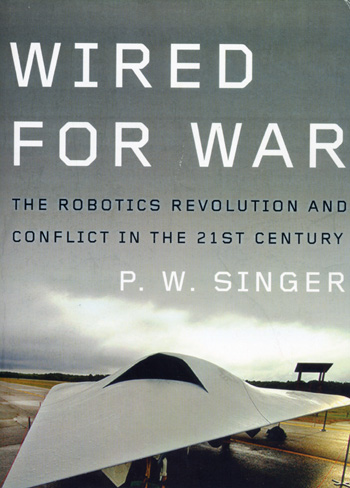
I have just read the most disturbing book yet. And for me, that is saying something. The facets of fear that P. W. Singer’s Wired for War manages to cut are sharp and dangerous. That he was able to write the book with a good dose of quirky humor only ameliorated the troubles a minor bit. The subtitle of the book is The Robotics Revolution and Conflict in the 21st Century. I was drawn into robotics by the FIRST Robotics competitions in which my daughter’s school competes. Not an engineer or programmer, I merely sit on the sidelines and cheer along those who understand mechanics, hydraulics, and electronics. Quite often I get the sense that since science works so well there is little room left for serious consideration of the humanities. Particularly religion. By the end of Singer’s book, however, my choices in life were reaffirmed. I would rather spend the limited days left to the human race celebrating our humanity. For, it seems, our days may be numbered indeed.

Considering that Wired for War was published three years ago, the technology must surely now be even more advanced than it was when the book went to press. That such technology as Singer describes exists is not in itself too much cause for worry, but the fact that such technology rests in military hands is decidedly disturbing. One of the few resources able to tap into the tremendous budget of the United States with impunity, the military services have been able to commission robots that are even now deployed in our various conflicts. A strong ethical question run through Singer’s account: we are racing ahead with lethal technology and artificial intelligence—and no one is really driving this machine. Shouldn’t someone be?

One of the more sobering aspects of Singer’s account is how humans are increasingly left “out of the loop” when it comes to lethal decisions being made by robots. Their logic is flawless, as is their aim. Their understanding, however, is purely mythical. As I read this gripping account, several issues spiraled out to be considered on their own. I arrived home disheartened and concerned for a future that seems to be inevitably in the hands of those I fear most: those with excess capital. Military robots do not possess empathy or compassion, just physics and trigonometry. And they already exist. When those powerful enough to wage war discuss the rules, their decisions are tellingly called “the doctrine of war.” Doctrine, whether military or religious, is always a sure sign of danger to come. And the robots aren’t coming. They’re already here.


Living with Art

A day spent among art can be more spiritual than a month of Sundays. Few become rich by being artists—in fact the opposite is society’s expectation. The masterpieces artists leave behind then become among the most valuable of all human creations when their often tragic lives end and it is recognized that no more genius is forthcoming. As a lifelong dabbler in the arts, I know that nothing like a perturbed state of mind serves to bring about the pieces I like best. Seeing the art of others, however, is a deeply satisfying experience. In a pre-Mother’s Day celebration, we met friends yesterday to revisit Grounds for Sculpture in Hamilton, New Jersey. We’ve grown accustomed to gray skies this spring, so the fact that it was sunny and warm came almost as a divine sign that this was a day to spend outdoors among the artwork of both humans and nature.

As rational as we strive to be, emotion remains our main motive force. Psychologists and neuroscientists, approaching the human mind rationally, inevitably conclude that emotion and reason are hopelessly entangled in the psyche. Not only does this explain the persistent draw of art, but also of religion as well. If possible, pull back and try to listen to someone, anyone, describe their religion in rational terms. How quickly it breaks down! And yet, reactions against a purely scientific—and doubtlessly empirically correct—explanation of the origin and development of life on earth lead to very hostile reactions. For many such explanations are not emotionally satisfying. We need a little more magic in our imaginative diet. Art allows us to indulge without embarrassment in our need for emotional expression. In the art galleries I’ve seen, whether Edinburgh, London, Paris, New York, Milwaukee, Corning, or Hamilton, there have always been hundreds of others seeking something there as well.

What we are seeking can’t be purchased with money, and it can’t be grasped by greedy hands. It can only be held in receptive and hungry internal places—the space pre-scientific individuals called the soul. And there it will remain. The first time I saw the Mona Lisa and the statue of winged Nike will never leave me. Yesterday, wandering the acres of art called Grounds for Sculpture, once again artistic expression claimed another willing victim. In our money-fevered world where “real life” is squandered chasing material goods to outstrip everyone else, art, the spiritual quest, lies quietly awaiting the weekend. The time people value most. And those who spend that time among art will be the most blessed of all.