Holy Matrimony

BBC Two is currently airing a series entitled The Bible’s Buried Secrets, unfortunately not yet viewable in the United States. The episode “Did God Have a Wife?” is presented by my colleague Francesca Stavrakopoulou, who did, no doubt, an admirable job. So once again Asherah finds herself in the news. The issue of monotheism is intricately tied up with how gods related to one another in the ancient conceptual world of Israel and its neighbors. Since the gods were modeled on humans, their behaviors could be embarrassingly human as well. Myths of actual divine marriages are rare, and extra-consortial affairs seem to have been pretty common. This aspect survives in the classical Greek world where Zeus’ many trysts are among his most notable deeds.

In a society like ancient Israel where marriage was a regular expectation of all young people who survived to marriageable age, an obvious mystery attends a single god. If Yahweh is male – and the Hebrew Bible seems not to dispute this point – would he not require a spouse as well? The well known Kuntillet Ajrud and Khirbet el-Qom inscriptions appear to suggest that Yahweh had a wife, and if he had the Religious Right should only rejoice since that would seal their definition of marriage forever in this literalist nation. And yet, the Bible remains decidedly mute on this point. In the end, it is interpreted that male is superior to female, again, pleasing certain religio-political factions.
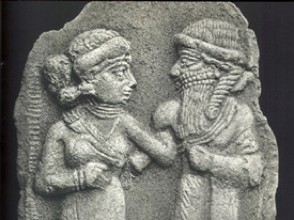
Marriage in a human institution. It is a practice concerning which the Bible is strangely taciturn. In ancient times marriages (unless among the gods) were secular, not sacred ceremonies. Among a human population in danger of dying out through attrition, marriage ensured prolific reproduction. According to Christianity, even God had a kid. In a world that has changed in ways that biblical writers could never have imagined, marriage as a source for an increasing population is more problematic than it is essential. It seems that the jealously guarded definition of marriage is really just another green-eyed monster lurking in the Neo-Con closet. Maybe once Yahweh’s marriage certificate surfaces the issue of what marriage is really about will be discussed rationally.


Crossing Italy

“Poor men wanna be rich, rich men wanna be king, and a king ain’t satisfied ‘til he rules everything” – sage words of a young Bruce Springsteen. Of course, “man” may well apply to institutions as well as individuals. According to a recent story in the New Jersey Star-Ledger, the European high court has ruled that it is appropriate for public schools in Italy to decorate their classrooms with crucifixes. While this may not seem unusual for the heavily Roman Catholic nation, indeed, the homeland of the church itself; nevertheless it reveals much of the nature of religion. Religions, like Springsteen’s human characters, want to take charge of everything. Partial rule just isn’t good enough in a business that deals with absolutes.

Not every citizen in Italy is Roman Catholic. Some are not even Christian. State sponsored schools bearing the insignia of the church’s glory days send a message that can be heard from the highways to the backstreets: Christianity rules! If we wheel the world around a few degrees further we will find similar rhetoric in nations like Iran, only the specific brand of religion has changed. The message is distressingly familiar: Islam rules! There was a time when the church could likely be called the only true superpower in Europe. We remember that time now as the Dark Ages.

As campaigns for next year’s elections in the United States are pumping up, we are hearing quite a bit about candidates’ religious convictions. That which used to be a private affair has become an emblem emblazoned on a flamboyant flag declaring “Gott und Ich” to the world. Worse, the religions are being used to score votes. Once in office, that religion will return to its flaccid state and politics will be business as usual. The populace, however, has trouble seeing through this. Religion is injected with such emotional freight that leaving it out of elections – or classrooms – is like abandoning a helpless infant. As they nail their crucifixes to the walls of public schools in Italy, I’ll be over here with Bruce surveying these badlands.


Frippery or Faith?

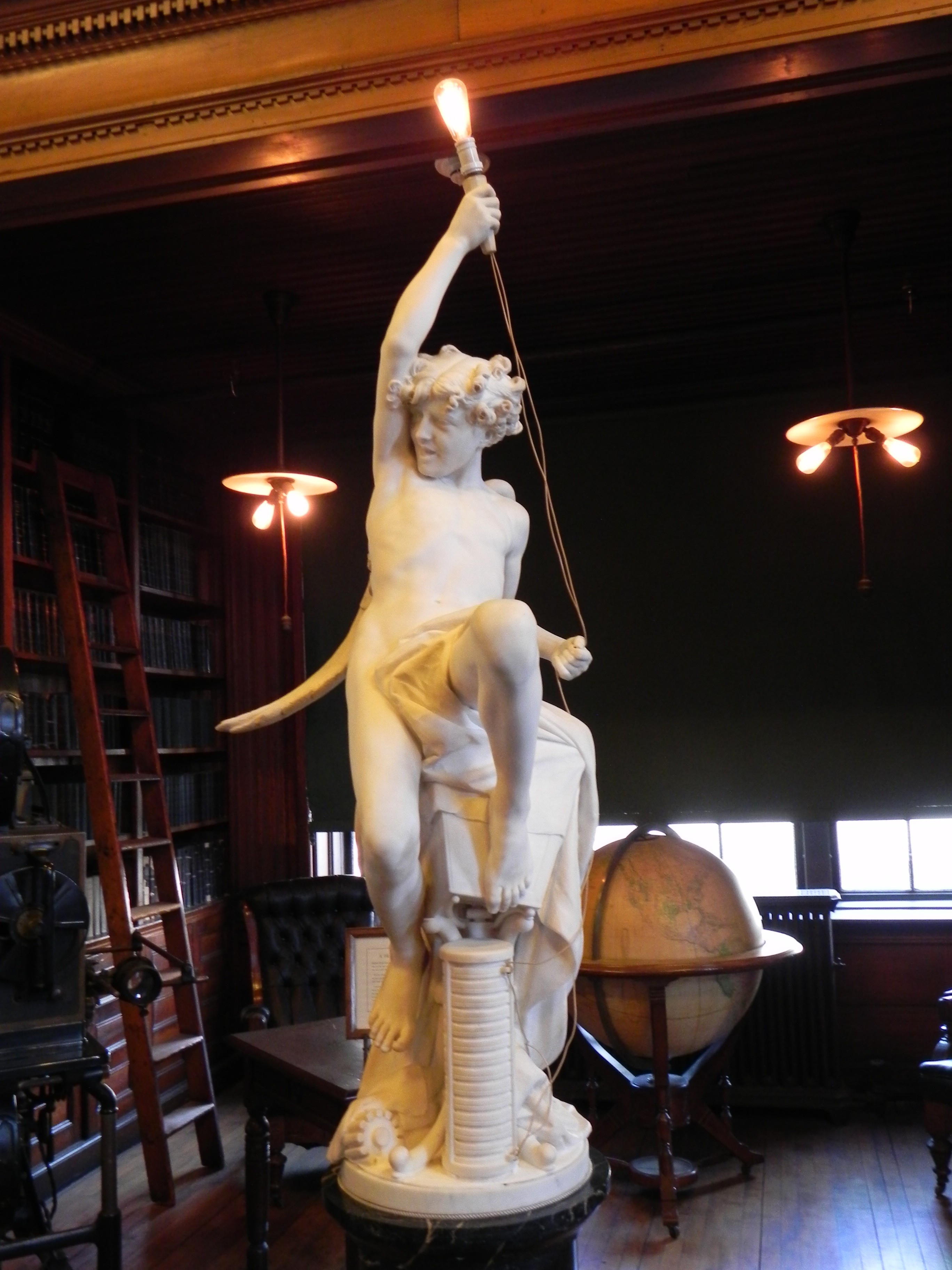
A lesson quickly learned in New Jersey is that the state has housed its fair share of geniuses and that inspiration takes many different forms. From Albert Einstein to Thomas Edison, these thinkers have changed the complexion of not only the state and country, but also of the entire world. While on a visit to Edison’s final factory and laboratory in West Orange yesterday, his devotion to thinking could not be overlooked. With little formal education, Thomas Edison taught himself what was necessary to become one of the most prolific inventors in the history of the world. The key to what he believed to be purpose of human existence is, sadly, under fire from politicians who’d rather keep the populace in the dark while they (the politicians) make the important decisions. “The man who doesn’t make up his mind to cultivate the habit of thinking misses the greatest pleasure in life.” So Edison said. Bully governors would rather turn out the lights.

As politics and conservative Christianity become even more intimate – if that is even possible – those who do not share their views are considered dangerous outsiders. As a religion specialist, it is difficult to gauge how sincerely such politicians take their religion. As their lifestyles clearly indicate, what they practice is as far from what they preach as the east is far from the west. Manipulating sincere, if misguided, believers into marks that will propel them into seats of power, they talk the talk. “Faith, as well intentioned as it may be, must be built on facts, not fiction – faith in fiction is a damnable false hope.” So said Edison.

If we measure the religion of the Religious Right in terms of action, it clear that their principles have far less to do with what Jesus said and did than with securing personal gain. Women are placed in subordinate positions; the poor, minorities, those who work to keep the economy afloat while the wealthy suck in more than they could possibly use, these people become targets rather than neighbors. Roman emperors knew the society was dissatisfied and provided bread and circuses. The Religious Right is perfectly capable of learning the more insidious lessons of history. If they had been around in Edison’s lifetime, no doubt they would have tried to turn off the lights so that we’d all remain in the dark. In such a situation it might be wise to leave the final words to Edison: “Religion is all bunk.”

Let there be light!


Inspired Lunacy

The moon is too easily ignored. Perhaps we fill our nights with too many other diversions that we easily overlook the millions of tons of rock high over our heads. When I introduce students to the importance of the moon in ancient religions they often seem surprised by the fact. The moon? It gives no heat, it is constantly changing, and sometimes it disappears altogether. Rather wimpy god to worship, don’t you think? Tonight the moon is back in the public eye because it is in perigee, its closest approach to earth in 18 years. In the facile language of the media, it is an “extreme super moon” (sounds like something you could buy at Wal-Mart). As with most ancient Near Eastern religions, modern perceptions, often vaguely scientific, do not encompass the enormity of phenomena before we became masters of the night.

The moon races Venus to perigee

In some ancient Near Eastern religions the moon was superior to the sun. We know that the moon’s light is reflected from the sun – something that did not fit their cosmology. Instead, in those regions often brutalized by a hot sun, the moon appeared kinder, gentler. It’s light helps to make many nights less intense and it never burns you. Since it is easier to stare directly at the moon, it makes an effective timepiece as well. Its changes are periodic and predictable. For a world without electricity, where nights were only infrequently shortened with oil lamps, and where daylight savings time would have made no sense, the moon ruled.

Actually, the moon played a role in developing the concept of the Trinity. Three great luminaries regularly appear in our skies: the sun, moon, and Venus. These days when most people have difficulty locating Venus, and generally no interest to do so, it goes without recognition that it is the third brightest natural object in the sky. In fact, Venus is bright enough regularly to stimulate UFO reports. A celestial triad thus ruled the skies of antiquity, and in many of those cultures the moon was the greatest of the three. So give the moon a few minutes of your time tonight as it gets closer to the earth than it will be again for many, many years. Perhaps it may give us a bit of understanding on the origins of some of our religious ideas that persist to this day.


Dream Quest

H. P. Lovecraft was a writer who remained unappreciated during his life but who has become a very influential literary figure after his death. So it is with artists. Known mostly for his short stories, one of the novellas he wrote, “The Dream-Quest of Unknown Kadath,” carries immense religious implications. Those familiar with Lovecraft’s fictional world know of the god Cthulhu and the “Other Gods” that he places in outer space. In “Dream-Quest” Lovecraft states that these Other Gods, “are good gods to shun.” While mere fiction, the concept of divinity has become pliable in the hands of its human author. Mortals are those who describe gods, those who decide what their deities will be like. The dream of the titular quest involves the earth gods having been removed from their shining city to leave the dark and dangerous other gods in charge.

While some would dismiss Lovecraft as overly inventive, his view of the earth being clouded by the crawling chaos Nyarlathotep strangely matches what we see playing out in the headlines. Those who are supposed to protect the masses, their leaders – elected or otherwise – have shown themselves to be interested in personal gain above all sense of duty. Throughout the world, and increasingly clearly in the United States, the working poor are seen as simple commodities easily manipulated and programmed to support those who would exploit them. Crawling chaos has landed.

Lovecraft’s “Dream-Quest” has a host of unlikely heroes, among them the cats of Ulthar. These cats maintain a true divinity appropriate for the descendents of Bastet. Feline divinity represents hope to Randolph Carter, Lovecraft’s protagonist. They also represent the tendency of the earth gods only to appear when most sorely needed, otherwise simply to set their own agenda. Where are the cats of Ulthar now? The problem with gods is they don’t always show up when you need them. Many dismiss Lovecraft as just another overly imaginative writer of cheap fiction, but to those will to listen carefully he was an author that could hear a very faint pulse. Even if that pulse was coming from under the floorboards to haunt a reality where the earth gods had gone away.

A little writer shall lead them


Third Mile Island

Sitting in the shadow of the cooling towers of Three Mile Island along the banks of the Susquehanna River the night before a friend’s wedding is one of the college memories that remains vividly in my mind. The accident had occurred some six years earlier, but seeing those ominous blinking red lights, no doubt to warn low-flying aircraft of the massive towers, left me with an irrational sense of danger. It will be a sad day when we have nothing left to fear. The next year, the Chernobyl disaster took place. This tragedy has results that are still playing out among the millions exposed to the radiation. Perhaps these events explain why Alan Parson Project’s Ammonia Avenue remains among my favorite albums.

While having my oil changed yesterday, the waiting room television was fixated on the story of the Fukushima Daiichi meltdown, settling it comfortably between Three Mile Island and Chernobyl. With anxiety about the year 2012 running amok, many people are looking for signs. Perhaps the most unfortunate meme the Bible has introduced to the world is the Apocalypse. In origin apocalyptic concepts emerged from the Zoroastrian idea that a dualistic change in ages was coming. Believing this world to be under the baleful influence of Angra Mainyu, a day was eventually going to arrive where all this would be turned around and Ahura Mazda would set things right. Christianity borrowed the idea, shrouded it in secrecy, and began an unhealthy interest in the end of all things.

Fukushima Daiichi may feel like the end of the world, but it is not. In fact, all that we know of our planet shows its great resilience. The late Stephen Jay Gould, in his popular book Bully for Brontosaurus, opined that the earth is not as fragile as is often supposed. He notes in the prologue, “Our planet is not fragile at its own time scale, and we, pitiful latecomers in the last microsecond of our planetary year, are stewards of nothing in the long run.” Not that we should not attempt to protect our environment – we do that to preserve ourselves and other species – but if we should fail, earth will carry on. Our globe is expected to support life for another 500 million years. Instead of following false positives, we might be better off reminding ourselves that Gaia still has a few tricks up her metaphorical sleeves.

One way or another


Zounds

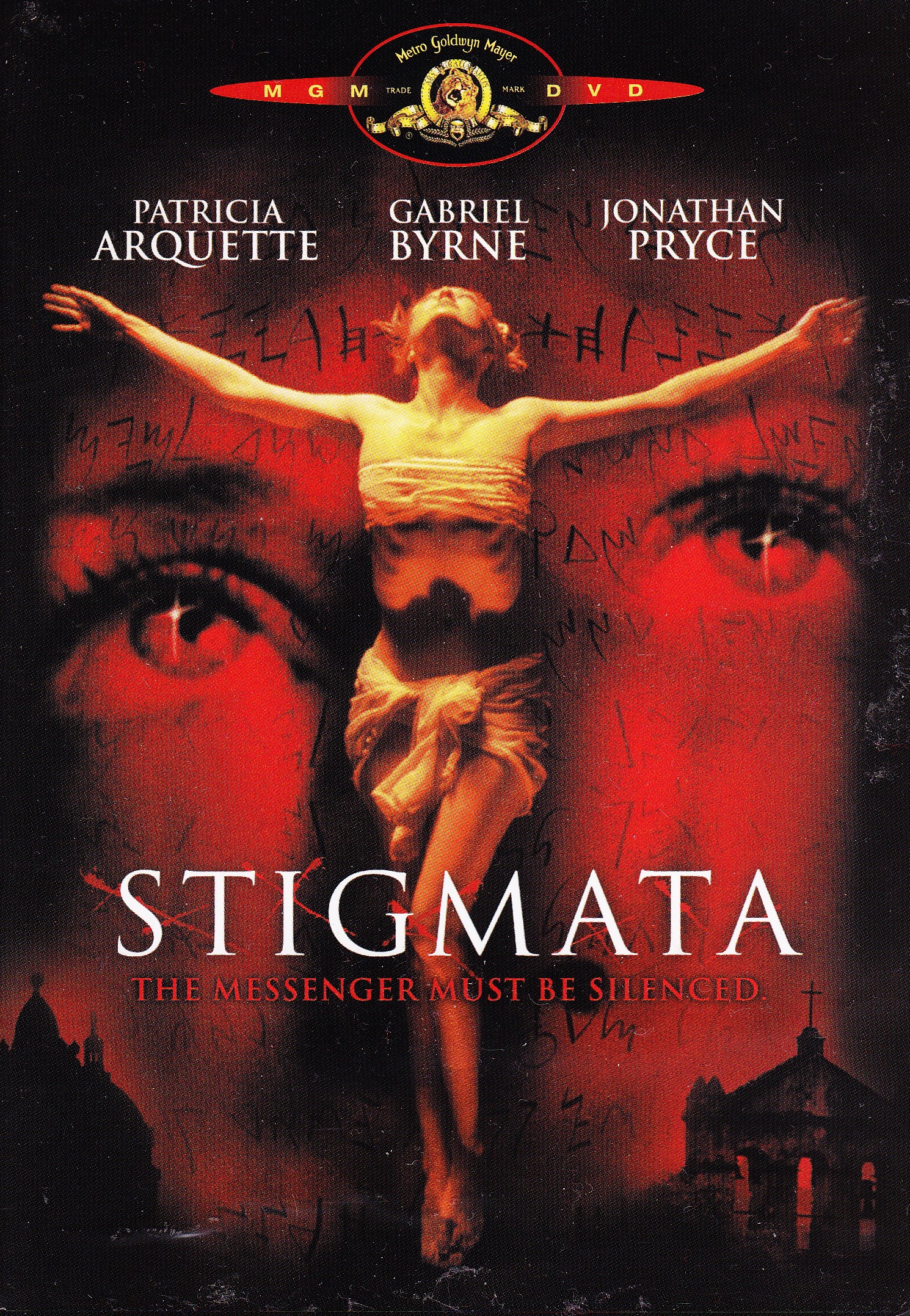
Back in my first exposure to state university life in Wisconsin, I frequently received eager guidance from students on religion in the media. After having taught in a seminary where interest in the world beyond ecclesiastical walls was rare, this exposure to wider interpretation was welcome. One of the movies suggested to me by helpful undergraduates was the then fairly contemporary Stigmata. My interest in horror films was burgeoning again after my nightmarish experience at Nashotah House, so I watched the movie with renewed appreciation for the abuses presented on the part of the established church. I rewatched Stigmata this past weekend and a number of features stood out as apposite for this blog.

As always in movies, liberties are taken with reality. Stigmata presents the Gospel of Thomas as a serious threat to Catholicism. Of course, even the Gospel of Judas made a public splash back in my Oshkosh days, but the great Titanic of the church remained steadily afloat. The contents of the Bible are secure and non-negotiable for the vast majority of Christianity. There is no more room within its black leather binding for further revelations. The movie also presents a woman – an atheist, no less – as being the vehicle for a truth she can’t understand. In the masculine citadel of the Catholic Church she must be silenced, in an overly dramatic way, of course. The message seems to be that religion is unwilling to learn from secular women, even if they bear the truth.

The critics were not kind to the movie, but I found it a strangely religious film. The premise behind it advocates the reality of Christianity, only the Jesus of history is occluded behind a great mask of human tradition. Enamored of power, the church decides what will be revealed to the masses since control is more important than truth. A woman cannot correct the false belief of men, since a masculine god has given manly instructions to a male institution. Underneath it all, however, is a virgin Mary weeping real human blood as half of humanity is simply disregarded by the half that retains its abusive strength. Perhaps the commentary was a little too close to home, even for the (mostly male) critics.


The Ides of March

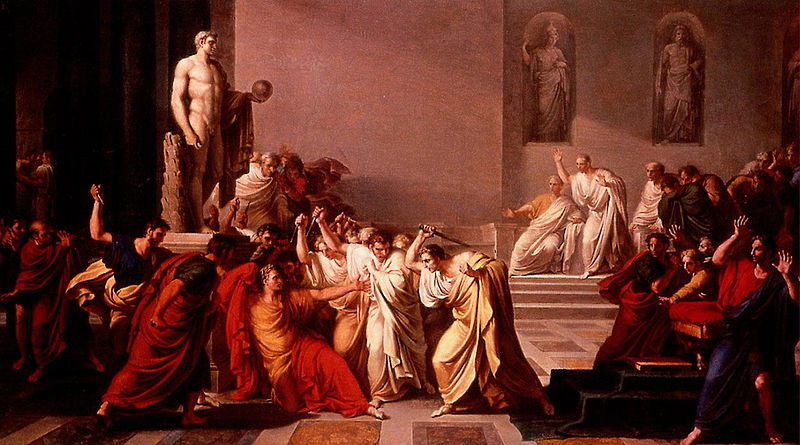
In the days of ancient Rome, politicians as well as plebeians feared the interference of the gods. Auspicious days were ignored, even by emperors, at their own peril. In my Mythology class the concept of hubris frequently emerges. Generally thought to be excessive pride, hubris can take many forms. Whenever a mere mortal strives for godhood, however innocently, it must be punished. Julius Caesar, declaring himself emperor, had to face the wrath of the gods. The ides of March kept in check the ambitions of the powerful. In a world where the political become too powerful, the very phases of the moon step in to restore balance.

The ides seem to have their origin in the date of the full moon. The month of March, named after the god Mars, featured a military parade on the ides. Then, as now, political power is simply the form of government backed by the military. The history of human unrest, especially notable since the American and French revolutions when the common people shouted, “Enough!”, is where might is shown not to equal right. Pontiffs and presidents, enamored of firepower and its blandishments, appear like Caesar before their populaces, confident in their wealth and military backing.

The concept of hubris might once again be meaningful to a culture under siege. As pundits and politicians make bids for places of abusive power, confident that there is no one above them, ethics are reformed in their own images. Have they not become their own gods? We the people bow to their vision of what should be. How many political leaders retire to uncertain futures because their own pensions have been slashed and healthcare diminished? Those who care for them in their dotage are the very children whose educational funds they’ve slashed. Hubris? It behooves all of us to beware the ides of March. Most, like Caesar, will ignore the warning and don the purple. Those who read, however, will not anger the gods.

Et tu, Brutus?


Jane Who?

“Conventionality is not morality. Self-righteousness is not religion. To attack the first is not to assail the last.” So states Charlotte Brontë in the preface to the second edition of Jane Eyre. I am inclined to believe that the lines were widely ignored by clergy and politicians, for public leaders in nineteenth century Britain were not likely to take the advice of a young lady who only had one real credit to her name. Politicians and clergy of twenty-first century America can hardly be expected to have read Jane Eyre, for how would this woman know the harsh realities of how to assert one’s own will on the masses? In the stewing tea pot of the Religious Right, conventionality is morality. Self-righteousness is religion. George Santayana might well have saved his cramped fingers from writing, “Those who cannot remember the past are condemned to repeat it.”

As politicians oil their moving parts in preparation for next year’s great race, they know that many constituents will gladly accept conventionality as morality without asking about the origins of such practices. Schoolyard bullies who seek their own aspirations praise the great darkness that has settled over New Jersey where education is simply a commodity with which to bargain. Jane Eyre? Who’s she? If she’s a constituent, I’d better spin this slashing of education funds to her liking. Without an educated public, it is much easier to bolster one’s personal authority.

For years educators have been watching in dismay as other developed nations soar past American expertise in science, math, and even geography. Our response: let’s cut education funding. Conventionality is morality. Education teaches children to think for themselves. Is it not better to show them that self-righteousness is religion? We can put other religions on trial (thank you, Mr. King), while conveniently forgetting our founders were largely religious dissenters. To know that, however, you have to read a little history. We are far too busy plotting how to shortchange our future in order to feather further already overly plush nests.


Sex and Violence in Ancient Pompeii

The earthquakes and tsunami that have devastated northern Japan have me thinking about natural disasters. Currently in New York City there is a display of artifacts from Pompeii, an exhibit I have not yet had a chance to visit. The parallelism of the two tragedies, however, has not escaped me. Pompeii’s destruction by Mount Vesuvius in 79 of the Common Era and its subsequent rediscovery and excavation are the stuff of legend. An unsuspecting city in the shadow of a sleepy volcano, at the pinnicle of its civilization, suddenly snuffed out. Forgotten for centuries, and eventually rediscovered. But rediscovery led to embarrassing revelations.

How will you be remembered?

Some of the first artifacts recovered from Pompeii were the erotic frescos that adorned many of the buried structures. Further, such images as super-sized phalli and other cultic implements of questionable morality led to reburial of some of the material because of more recent sensibilities. We judge ancient and extinct societies on the basis of modern predispositions on decency and propriety without considering that it is our view that is the innovation. Even a cursory read through the Holy Bible will reveal many stories where sexuality plays a prominent role. This suggests that biblical writers, like most people of antiquity, were less shy of sexuality than their post-Victorian heirs.

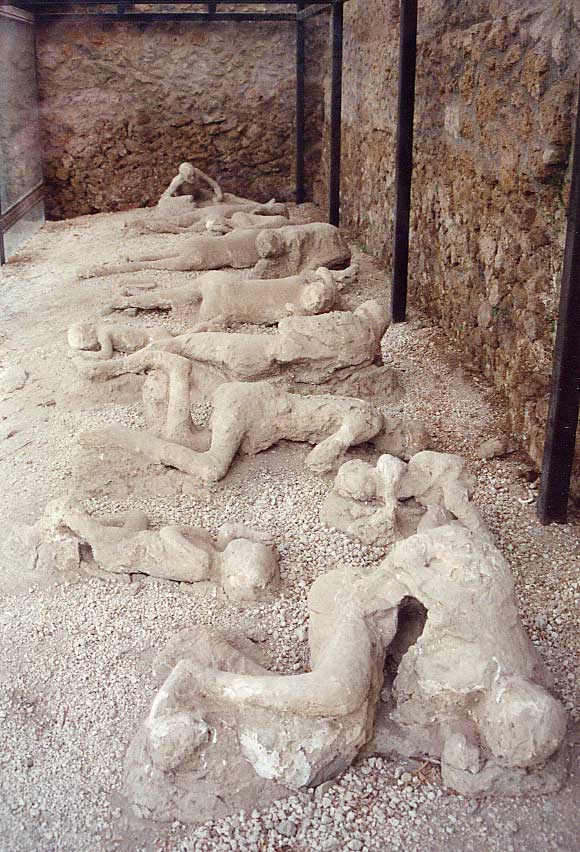
Natural disasters have a way of stopping time. Not just in the sense of speeding up the rotation of the earth by another 1.6 microseconds either. Surveying the wreckage of what we believed was a stable status quo, priorities are suddenly shifted. Compassion, rescue, and survival outweigh the petty differences of just the night before. Disasters are snapshots of the human condition. As the hot ash settled on Pompeii, lovers clasped in their final moments, never imagining that some two millennia further on that more modern, civilized tourists would be embarrassed by so human a response. Disasters are harsh teachers, but we may learn in the face of an unfeeling nature that we are all humans after all.


Ring of Fire

It looks so peaceful from above

The great tragedy unfolding in Japan has many Internet pundits wondering if this is a sign of the 2012 apocalypse. In reality it is simply a great human tragedy, a reminder that we are creatures who’ve evolved in a dangerous, often inhospitable universe. Natural disasters may have been one of the stimuli for the development of religion in the first place. Now we can look to seismology and tectonic plates to find out “why” hundreds had to die in Japan, but the human psyche demands a metaphysical reason. Some Christian websites are quick to point out that only a very small percentage of Japanese are Christian. Born with the sin of not being American, well, Shinto happens.

Like last year’s Chilean earthquake, this current disaster has once again shifted the earth on its rotation axis, according to the U.S. Geological Survey. GPS markers on the coast of Japan indicate that the large island has shifted over two meters because of the quake. The world was not made for us, however. We evolved on a planet, peopled it with gods, and decided that they created this place for us. In reality, we survive on the basis of our adaptations to this planet. Any planet dynamic enough to support life will be volatile enough to demand life from its inhabitants.

This is not as fatalistic as it sounds. Religions reflect the impotence humans feel in the presence of raw nature. We’ve shed many physical defenses for the advantages of large brains that require us to piece together a sensible view of an event that has no inherent meaning. The fact is that we are not in control. Once we eliminated the smaller-scale threats of exposure and the dangers of predation, we left ourselves open to macro-scale disasters that no human is large enough to impact. And we know, deep in our psyches, that this is simply part of the price we pay for being human. 2012 will come and go with its own share of natural disasters, but right now we should focus on helping those who’ve experienced their own current apocalypse.


Anubis Rising

As if reality weren’t haunting enough, I’ve been continuing my quest to find the scariest fiction book written. I’ve borrowed suggestions from others, but it seems that the fear factor is a decidedly personal thing. Nevertheless, the suggestions are often enlightening as well as provocative. I recently finished Dan Simmons’s A Winter Haunting. Simmons’s work had previously been unexplored by me, so this was a foray into the unknown. Of course, I read horror with an eye toward the sacred and I’m seldom disappointed. In A Winter Haunting the sacred appears in the form of Egyptian religion. Simmons makes very effective use of hellhounds, tracing them back to Anubis.

Now Anubis lays me down to sleep

The religion of ancient Egypt had a morbid preoccupation with death – or maybe it was just a healthy recognition that it is inevitably coming. Many of their gods eventually ended up patronizing the dead in some way. Andjety, Ptah, Min, Osiris, Isis, Nephthys, Maat, and Thoth, as well as Anubis, regularly appear in the cult of the dead. And, of course, pyramids represented the stairway to heaven long before Page and Plant. Death and its psychological angst have been crucial to the development of religion from the beginning. The Egyptians honed it to a fine art.

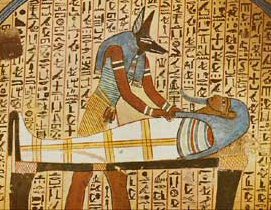
Anubis was likely associated with the dead because of the scavenging of wild canines at shallow graves. Magic, a phenomenon anthropologists have difficulty distinguishing from religion, dictates that the source of the problem should be appropriated as its cure. To protect the dead, the scavenger of the dead transformed into Anubis. Simmons did his homework, for this transformation is well represented in A Winter Haunting. Without knowing this particular plot device, I had been reading about Egyptian funerary cult independently of the novel and this coincidence proved entertaining as well as informative. I won’t be sleeping with the lights on, though. The search continues.


Thy King Dumb Come

Is it legal to be Muslim? It is against the law to be religious? What about an extremist? The Peter King Trials, under the auspices of the almighty House Homeland Security Committee, are attempting to put radical Islamists on trial. My question is: when was the last time they cleaned their own backyard? Religions make extreme claims. As long ago as Yahweh thundering from Mount Sinai, adherents to monotheistic religions have claimed that their interpretation of God demands many unsavory actions – genocide, infanticide, war-time rape – all permissible in the Holy Bible. When terrorists draw their inspiration from the Quran, however, it crosses that invisible line in the sand. During the deepest chill of the Cold War nobody thought to bring Russian Orthodox Christians to trial. After all, they are cut from the same monotheistic cloth.

The damage done by Christian extremists is less visible, or at least more forgivable, in American eyes. Innocent mistakes, people doing what they thought that God demanded. It could happen to anybody. As long as they are Christian. As we daily watch the infectious creeping of Fundamentalism and its subtle (or overt) violence against those who are different, in a great move of theatrical diversion, King and his minions try to focus blame on “pagans.” Right belief, the afterbirth of monotheism, has taken on a life of its own. It can brook no rivals. If it is Christian right belief it can support the sale of fellow human beings, the dehumanization of prisoners of war, the starvation of the young. They are, after all, not Christian. Not like us.

In the words of the King, “Too many of the leaders of the Muslim community… are not cooperative and are not willing to speak out and condemn this radicalization that’s going on.” Physician, heal thyself. Radicalization in the name of Christianity is acceptable, even laudable. It is just part of the frontier, pioneering spirit of this great nation. Other religions, however, need not apply for freedom. After all, what do they think this is – a democracy?

Just following the king of kings


If You Ash Me

It was a familiar British voice on the BBC that first introduced me to the concept of Dismal Days. As a very frugal couple newly married and living abroad for the first time, my wife and I had little entertainment other than the radio. Doctoral candidates didn’t have time for television, and besides, in Britain you had to pay for a television license in addition to the electricity it would cost to watch it. We didn’t even use our pathetic wall heater in winter. When the BBC 4 announcer mentioned that it was a medieval dismal day, my wife and I exchanged bemused glances. The concept has become part of our mental warehouses. Today is not a medieval dismal day in that sense, but Ash Wednesday brings a dreariness all its own. As a young Fundamentalist I didn’t know about this particular day, but when I attached myself to the local Methodist congregation I learned a history lesson.

Methodists descended directly from Anglicans (Church of England). And as I learned in my ill-fated Nashotah House days, some Anglicans believe they never really separated from Rome. Ash Wednesday has now become a widely recognized day of mourning and repentance (as if all days weren’t such) and for many years I submitted to the ashes. It was always with wonder, however, since Jesus purportedly said not to show any outward signs when you are lamenting. I wondered where the tradition began. The earliest references to Ash Wednesday date from the papacy of Gregory the Great, in the eighth century of the Common Era. It is just like the Middle Ages to add drear to an already dark and cheerless season. Lent was originally intended for reflection, but in the macabre mind of the Dark Ages it became an excuse for utter misery.

Dismal Days are actually far older. In origin we again have the Romans to thank, although they blamed the Egyptians. In Roman society two days each month were deemed infortuitous to begin important ventures. In fact, the word “dismal” derives from the Latin for “evil days.” The idea that certain days are especially gloomy is a hangover from superstition that many rational people have now completely disregarded. Many of those rational people, however, will be spotted today with ashes on their otherwise hygienically cleansed foreheads.

Why not buy in bulk?