Neo-Cons and Mockingbirds

Among my high school catch-up reading is one of my favorite novels, required in my own youth, Harper Lee’s To Kill a Mockingbird. While a certain distress accompanies the fact that I read this book over thirty years ago, as I reintroduce myself to the welcoming characters of Scout, Jem, and Dill, I lament that there is so much to read that we can’t simply linger on the great works of literature we’ve loved before. Reading the novel as an adult there is much, I am certain, that I missed the first time around, not knowing what to expect as I approached the story with no preconceived notions.

One of the constant stresses I lay on my students is how the Bible utterly suffuses American society. We are bombarded by Bible, whether we know it or not. It was with appreciation, therefore, that I saw the exchange between Scout Finch and Miss Maudie in chapter five. Miss Maudie, complaining that “foot-washing Baptists” take the Bible a little too literally, declares, “but sometimes the Bible in the hand of one man is worse than a whiskey bottle in the hand of – oh, of your father.” (The incongruous image of Atticus Finch drinking whiskey is not lost on his young daughter.) This statement summarizes much that is true in today’s society as is evident in Max Blumenthal’s Republican Gomorrah. Many Americans create an idolized image of the Bible that is used to gain control over others. When such individuals gain political power everyone else is at risk.

In the backlash to having a moderate man elected to the presidency, the news is full of biblically constricted complainers who fear the impotence of the Bible. Their fears are unfounded. Our society has been constructed on foundation blocks of biblical literalism and although the superstructure is unaware of it, the Bible continues to root many Americans firmly to their planet. The “founding fathers” were not Christians, but many of their country-folk, Puritans and others fleeing the formalized religions of Europe, were. The aggregate of their descendants has been tapped successfully by neo-con politicians to win elections and referenda around the nation. There is no end in sight. If only the wisdom of Miss Maudie were taken a little more seriously, we might have a chance to move beyond the illusion of a pristine yesteryear that never was.

Killing me biblically
The End of the World as We Know It

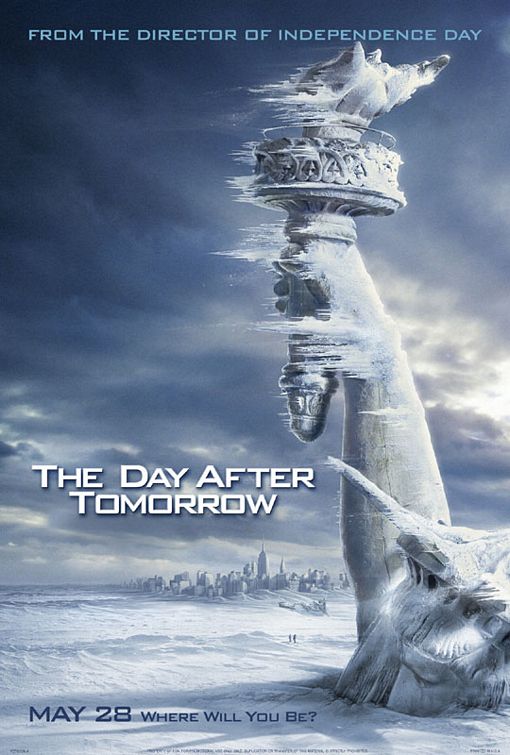
Well, that may be a bit dramatic, but my whole family is scratching its collective head over the news that our time on this planet has been foreshortened by the Chilean earthquake. Yes, scientists from NASA announced yesterday that Saturday’s 8.8 magnitude earthquake actually shook the earth three inches off its axis and has led to a loss of 1.26 milliseconds of time. Even for the gods this seems to be playing against the rules!

I wonder what the Fundamentalists are thinking about it? I do know that some extremely conservative types mess with time when trying to explain how the 4.5 billion-year-old world could have been manufactured in just 6 days — they call it the “day-age theory.” Or that the globe stopped spinning for 24 hours to give Joshua and his invaders more time to kill the Canaanites. I’ve even had students tell me that this latter case was scientifically proven. Time, however, ticks on despite our concerns with it.

It was my daughter who suggested the title for this post. After she said it, however, she noted, “Well, actually the world as we know it ended with the earthquake.” The world as we knew it. Radical changes have taken place with stunning rapidity on this old globe we call home, and some days the whole world changes. In 1815 the eruption of Mount Tambora led to the “year without a summer.” Wayward space rocks sometimes wipe out over 90 percent of all species on the planet. We live in a constantly changing environment. And it is my hunch that when that final disaster comes, those who’ve spent all their energy climbing the money mountain in the company of financial wizards, bank presidents, insurance profiteers, and oil company gods will come running to those who’ve spent their lives learning about religion seeking comfort in the face of the inevitable. We know we live in a temporary world; the wise spend their time contemplating the implications of that fact.

A little more to the left...


WWJWF?

On the way to work yesterday, my wife spotted an old billboard ad that read, “My birthday wish: Protect life from conception until natural death. Jesus.” Now, I realize that this is a belated birthday response (or perhaps premature – scholars of the Christian Scriptures tell me Jesus was likely born in April), but I felt compelled to exegete this wish. In the biblical world, which, by definition, includes Jesus, there was no such thing as conception as we know it. Ancient folk did not know about sperm and ova, and so “conception” was simply the act of carrying a child. When it began they did not know. The Bible is pretty clear that breath indicates life, so life begins at the moment of the first breath. Everyone in the first century knew that.

As a good Jewish believer, Jesus also knew that the Bible dictates scores of reasons that life would not end naturally. Many acts considered normal and healthy today were singled out in the Torah as offenses against the almighty, and many were worthy of the death penalty. If natural death is the divine will, well, father and son ought to have a heart-to-heart talk. I will go on the record as opposed to capital punishment. Heck, I’ll go on the record as a pacifist and a vegetarian too. I do so, however, fully aware that the Bible has a different view.

My concern with billboards like this is that they co-opt a figure who cannot correct the human errors of misreading emotion for righteousness. Anyone with money can make up a birthday wish for Jesus and, with a willing vendor, splay it out for all passing motorists to see. I respect the sanctity of life, but I don’t force my wishes into Jesus’ mouth. We have the Bible, we have brains. For those who want to know what Jesus really wished for, it is a simple a matter as reading a book.


Trojan Gods

Every great once in a while Hollywood produces a major motion picture that demands the attention of scholars. Well, at least those of us who like to stay current about the way our subject is being displayed to the wider public. When Troy was released in 2004, I was still firmly engaged in teaching biblical studies and the Trojan War, although located somewhere at the fringes of the Ancient Near East, was not a particular concern. Now that I’m also teaching a mythology course that covers the Iliad, I figured I’d better watch the movie. For research purposes only, of course. Although I hadn’t seen the film before, I knew of the critics’ complaints that the gods, conspicuous in Homer, had been left out. I was expecting to be disappointed, but I found the movie to be more intelligent and subtle than I supposed it might be. The absence of the gods, distressing as it may be to purists, gave the movie an angst that is generally reserved for more cerebral subjects.

The question of where the gods might be in all the slaughter and destruction of war reminded me of a book that had profound influence on me several years ago. Richard Elliott Friedman’s The Disappearance of God: A Divine Mystery (Little, Brown, 1995) traces the gradual withdrawal of God from the scene in the course of the writing of the Hebrew Bible. The god who appears so active in the early chapters of Genesis distances himself further and further until the latest writings, according to Friedman’s dating, show few traces of the divine at all. God subtly, quietly, goes away.

Portrayed as defying the power of the gods in the film, Achilles desecrates the temple of Apollo and seals his fate. Nevertheless, although he is shot by an archer, the death of the hero seems more like an arbitrary act than the design of divine majesty. The Greeks, after all, did win the war. Atheism, however, did not exist in any real terms in the twelfth century before the Common Era. Then again, Achilles probably did not exist in any real terms either. Although Troy will never be among my list of most profound films, its commentary on the quiet skies of ancient Ilium serves as a useful metaphor, even for today.


Childhood Never Ends

Yesterday’s 8.8 earthquake in Chile has people asking once again what has angered the almighty. Guilt, unassuaged by human suffering, accompanies natural disasters around the world. This perspective is nothing new, but rather an inherited burden from our cultural forebears who believed gods to be perpetually vindictive or indifferent to people, and who would strike out without warning. One of Poseidon’s favored titles in Homer is “earth-shaker.” When something as stable as the very planet rocks, the gods must be angry.

Psychologists have long delved into the all-too-human reaction of guilt to momentous occasions. Guilt is also generally recognized as a universal human emotion, occasionally supposed to be in evidence among the great apes. Perhaps our primate progenitors were born with an innate sense of having wronged the powers that be, for like children we still cry out for deliverance from blizzards, hurricanes, wild fires, volcanoes and earthquakes. No matter how much we grow up, we never outgrow our sense of having angered that great parent in the sky.

Science has revealed to us a natural world with physical causes. We know that massive plates of the earth’s crust rub past each other as they float on a hellish, viscous ocean of molten rock. We know that incredible stresses and pressures find release in the freeing jolts of earthquakes. This we know, but we find the concept more frightening that we are the victims of nature than the fantasy that we are victims of God. Better to put a human face, albeit an angry one, on natural disasters since we may at least beg for mercy.

There is no divine “why” to such disasters. Even the Bible affirms that things just happen sometimes with no divine intentionality. As this artificial world we constructed shivers from natural forces we are led by natural feelings to irrational conclusions that empower us. We are children looking for an absent parent. And Poseidon, it seems, evaporated long ago.

Never trust a god with a fork!


Holi Holidays

I am the first to admit that I know far too little about Indian religions. As I teach Ancient Near Eastern religions every year, it becomes clear that much of our own modern, western religious tradition owes a debt of gratitude to the ancient traditions of the Far East. Zoroastrianism, substantially connected to early Indic religions, had an immense impact on the major monotheistic faiths that grew out of the ancient Near East.

So it was that I was pleased to see a story in the local paper about the upcoming Hindu festival of Holi. I know little about this festival other than it includes a celebration of color. Having grown up a little too attached to television, a device that was black-and-white in those days, I have retained my fascination with color and the emotion and power it conveys. When color television came to our home, it was an epiphany. Reading about human cognitive development it is impossible to ignore the impact color has on Homo sapiens and their outlook on the world. A master film-maker may convey depth and feeling in the absence of color, but once color is added, the story becomes vibrant. I took my family to a New Shanghai Circus performance at the local community college last night. As stunning as the acrobatics were, the vivid colors definitely enhanced the experience.

While at Nashotah House I found myself being consulted on color. The classrooms were being painted, and as Academic Dean I was asked what the color scheme should be. I consulted a friend who works in architecture, and she gave me a book about the “feel” of colors. My advice was overruled, but a new sensitivity to color had been awakened. Strangely, later that year a local public school brought me in as a consultant on classroom color. My engagement with color is purely subjective, but I know if I see a certain shade of blue I can be literally transfixed by fascination. My minimal exposure to Holi has opened a new window on religion for me. Color. It is an aspect of life to be celebrated.

Courtesy Louisiana State University


Abuse of Power

In many ways the naiveté of youth still clings to me. I was reared to respect authority and to trust those whom society placed in power over me. As skeptical experience wears away at this ancient veneer, I have become more retrospective of the whole enterprise of the social experiment. Perhaps I shouldn’t have read The Call of the Wild after all.

A few months back I wrote a post supporting a student at Butler University, Jess Zimmerman, who was being sued by the university for perceived slights against the administration on his anonymous blog. That post has forged a connection between Jess and myself, although I’ve never met him. That connection is one of justice and fairness, traits that should, above all, be upheld by institutions of higher learning. In an email last night, Jess updated me on his situation. The lawsuit has been dropped (my thanks to all of you who signed the electronic petition through this blog), but the recriminations continue. The details are available on Jess’ blog, but the short version is that in order to have a fair trial the university had placed him under a $100,000 bond. I am saddened, but not surprised, by this abuse of power.

Over the past several months I have wearily retrod this familiar path. I too have been the victim of institutional power in an episode that haunts me to this day. In slow motion I watch and rewatch men “in authority” dismantling the hopes and aspirations of a neophyte academic who was left wondering, like a dog, why he was being beaten so. There is no action to take. There is no club to wield. The only thing required is to be aware of the situation. Although I shouldn’t have done it, I did read Jack London’s Call of the Wild. And it is my hope that young students unfairly targeted, like Jess, have the resilience of Buck and will remember their pasts when they come to lead their companions in forging a better world.


The Gospel According to Caulfield

When one is asked to cite her or his favorite theologian, J. D. Salinger isn’t likely to be in the running. He might not even make the top ten. My personal introduction to Salinger, however, took place in a theological context. While in a Cambridge (Massachusetts) bookshop with a grad school buddy, I pointed out Mircea Eliade’s classic The Sacred and the Profane, insisting that my friend read it. Never to be outdone, Dave pointed at Salinger’s Franny and Zooey and said if I bought and read it he would do the same with Eliade. The Catcher in the Rye had not been part of my high school curriculum, so I was curious what all the fuss was about. I took him up on his dare. I’m not sure Dave ever read Eliade, but I read Salinger. My first impression was, “I don’t get it.”

Now my daughter’s school does require The Catcher in the Rye, and I’ve always tried (not always successfully) to keep up with her required reading. It gives us something to talk about – I’ve read several great books I’d otherwise have missed by this exercise. So I picked up the Catcher and plowed through. Salinger, I’m sure, requires no introduction. What is noteworthy, however, is that Holden Caulfield, while avowing himself an atheist, does make subtle but pointed comments about religion. (One of the occupational hazards of being a religionist is a constantly humming radar looking for any god-talk that might otherwise blend into the haze.) Holden, in chapter 14, points out the idiotic behavior of the disciples while Jesus was alive. He admits to thinking Jesus is okay, but his favorite character is the demon-possessed man who lives among the tombs. “I like him ten times as much as the Disciples, that poor bastard,” he says.

Who is as honest as Holden?

There is true religion in this statement. The “lunatic” running about in the tombs, rejected by society and even as far from God as you can get (demon possessed), is an image of humanity. Living a life of desperate alienation, the man in the tombs appeals to angst-ridden teenagers and displaced adults alike. He is likeable because he is like us. Holden scores bonus points on that observation!

With Salinger’s recent death, a renewed interest has sprung up about his novels – books that have changed the literary landscape. I read Catcher with more inherent appreciation than I did Franny and Zooey, but I’ve grown up a little since then. As an adult I can better appreciate the honest appraisals of Holden Caulfield.


Burning Crosses and Aftershocks

In a small blurb I would have missed had my wife not pointed it out, today’s paper carried a brief follow-up on the religious implications of the Haiti earthquake. The story (caption) ran: “A Christian mob circles a burning stack of items to be used for a Haitian voodoo ceremony for earthquake victims while singing church hymns in the Ti Ayiti neighborhood in Cité Soleil. The voodooists were run out of the central pavilion under a hail of rocks, and all the ceremonial items they left behind were destroyed and burned.”

My mind, at seeing burning religious symbols in the picture, turned to the infamous burning crosses used by equally intolerant “believers” in the last century in this country. Perhaps the motivation for burning the symbols is different, but the message is the same – a very narrow band of the wide continuum that is Christianity has decided that another variety of human being must be brought under control or destroyed. I don’t seem to recall reading in the Gospels, or even Paul for that matter, that throwing stones at believers in other faiths was a recommended activity. The voodou service, according to the blurb, was intended to help earthquake victims. Instead, the Christian faction forcibly drove them out and violated their religious symbols. Could they not have been spending helping victims instead?

I am not the sort to throw the first stone, knowing my own faults all too well, but the rampant supersessionism of an entitlement generation Christianity is showing its ugly side in such an instance as this. If religions are not here to improve the lives of others, then what is their purpose? To placate mythical gods to ensure one’s own blessed future, no matter who has to be hurt along the way? It seems to me that less time burning religious symbols and more time helping the needy is a platform worthy of any honest religion.


Archaeology in the Service of Politics

People are political creatures. Unfortunately. Politics, as most honest observers of society admit, serve the interest of the ruling party over the good of the whole. This is a nearly universal human flaw; a glance at any newspaper will demonstrate its prevalence. Those who practice politics can hardly be blamed for using the system they’ve inherited, but the system leads to many instances of unfortunate posturing and suffering. Clearly seen in Middle Eastern current events, it is nonetheless no less so in the “western world.” Often in both political arenas the Bible is invoked.

An article in this morning’s New Jersey Star-Ledger bears the headline “Archaeologist links ancient wall to Bible and King Solomon.” The story goes on to describe how excavations in Jerusalem outside the Temple Mount have unearthed a stone wall that might have been part of the legendary temple of Solomon. Of course, putting biblical names to mute structures amounts to voicing ownership claims. Solomon is not a historically attested individual yet – the only source referencing him is the Bible – and claims to have found his temple are premature. As the story states, “Palestinian archaeologists have criticized their Israeli counterparts’ rush to link finds to the Bible.” Amen. So they have; the structure itself is used as a form of dominance. Eilat Mazar, the archaeologist named in the article, is quoted as having said that this wall, “testifies to a ruling presence.”

The Haram es-Sharif, or Temple Mount, is one of the most hotly contested pieces of real estate on the planet. Embedded within these claims are acclamations of ownership. This brief post does not offer the space to unfold the complex issues in any substantial way, but it is an opportunity to note how archaeology is often used to establish tenuous holds on a past that is too foggy to penetrate. Like the classic dystopias of the twentieth century, politically oriented individuals use the evidence to write their own versions of the past. Pasting the name of an uncertain Solomon on a building that the Bible states was built by Phoenicians is an ironic historical twist indeed.

Gnu Jerusalem from WikiCommons


Patriarchal Goddesses

My fascination with goddesses began when I decided to research Asherah. Having grown up in a monotheistic milieu, goddesses were strangely, but not surprisingly, irrelevant. I had, of course, read about them in mythology classes, but they seemed less defined than the gods who had strong, striking characteristics. Now that I’m revisiting many classical goddesses in the course of preparing my class on Mythology, I’m discovering a renewed appreciation for the feminine divine and its contribution to the ancient world.

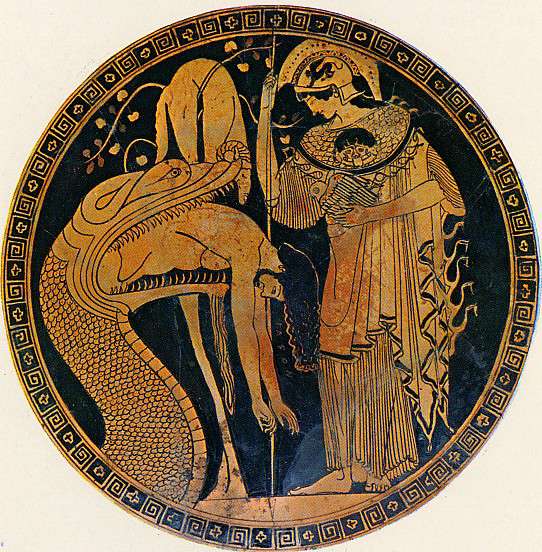
Athena saves a hero

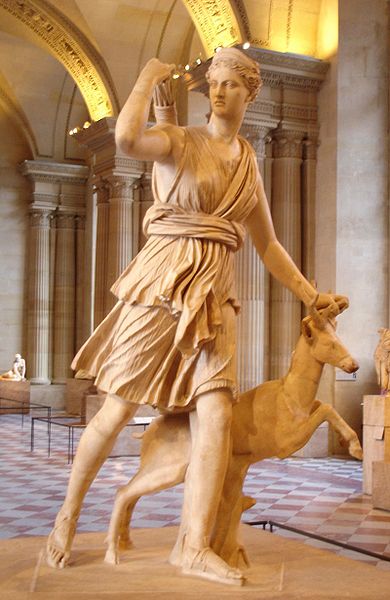
Athena and Artemis have been on my mind for the past several weeks. Among the Olympian deities they are among the strongest female figures (Aphrodite, of course, provides her own feminine form of power, and Hera, although mighty, remains largely in the background). Perhaps what creates such a striking form for Athena and Artemis is that they blend the traditional masculine and feminine roles in a way that the ancient Greeks were prescient to devise – they both possess weaponry and strength that frequently brings mortal men to their demise. They don’t wile with “feminine charms” like Aphrodite; instead they meet men on their own tuft – hunting and warfare, bravery and muscle. They are virgins, not needing male approval. Together they form the basis of many ancient aspects of divine nobility.

Artemis and her man-dog

Today, however, when we think of Olympians Zeus and Poseidon come to mind almost immediately as the two major figures. No one disputes the unstoppable power of Zeus’ thunderbolt or Poseidon’s earthquake. The goddesses, however, display their power on the human level. They may set the fortunes of armies going to war or individuals out for personal glory or fame. They touch the characters on a more human level. They also have their counterparts, unfortunately often eclipsed, in the world of the ancient Near East. Astarte is still poorly understood, and Anat, although more fully fleshed out at Ugarit, largely remains an enigma. The importance of Athena and Artemis thus stands out in sharper relief for having survived the overly acquisitive masculine ego to remind people everywhere that goddesses also will have their due. Given enough time, perhaps even the gods will understand.


Eine Kleine Neanderthal-Musik

I suffer a limited form of amusia. No, it’s not a fear of amusement, but rather lack of musical ability. I appreciate music very deeply, but I simply can’t make it. I’ve tried lessons and teachers end up turning away in exasperation. The embarrassing part about all this is that music is an integral part of religion – almost all forms of religion have their musical repertoire, and musicologists have demonstrated that the early human impulse to make music has a religious basis. I can only sit in the audience.

That's me on the left

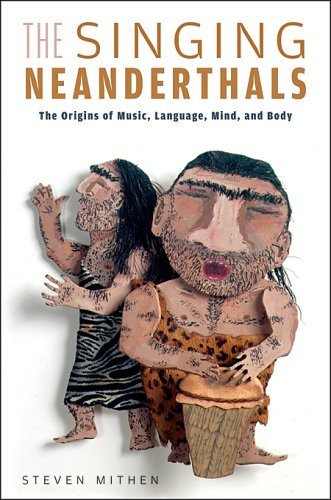
I’m finally getting around to reading Steven Mithen’s The Singing Neanderthals: The Origins of Music, Language, Mind, and Body. A few years back I gave an academic paper suggesting that musical development could be an analog to religious development on a neurological level in the Bronze Age. Since I’m not a neuroscientist I have to rely on others to do the experimental side of the equation. Mithen serves this function nicely. When I read about music and the brain, which I do frequently, I am surprised that more scholars of religion haven’t picked up on this connection. Since music is frequently “background noise” today, many people casually assume that it is insubstantial, a whim. I look at it (listen to it) from a different angle. I seldom listen to background music – if music is playing, I pay attention to it, and something in my unprofessional brain says Mithen is often right on target.

Of course, religion and music is not the main thrust of The Singing Neanderthals, but rather the idea that music was formative for human cognition. Perhaps music even developed before speech. For me this is an important piece of a much larger puzzle: whence did religion arise? Like all inquiries that delve too deeply into the past, the answer is lost among ambiguous artifacts and ancient dust. And yet, those who know more about this than I do seem to be pointing in the direction that both religion and music have their origins in the pre-Homo sapiens stage of our evolution. I’m not surprised. I only wish I could play along.


Saint John, Elton, That Is

“I think Jesus was a compassionate, super-intelligent gay man who understood human problems. On the cross, he forgave the people who crucified him. Jesus wanted us to be loving and forgiving. I don’t know what makes people so cruel. Try being a gay woman in the Middle East — you’re as good as dead.” According to Parade.com, this was Elton John’s take on Christianity. I find the comments endearing in a naïve sort of way. They further demonstrate how people construct their gods in their own images. Compassionate? No question. Super-intelligent? Well, maybe. He certainly was creative, witty, and above average in intellectual celerity. Gay? Not likely. Not for doctrinal reasons, but simply for cultural ones. “Gay” as a lifestyle simply did not exist in the first century. The Bible maintains a steely silence on any aspect of Jesus’ sexual life, so we can never know. Perhaps it’s a case of “don’t ask, don’t tell”? Understood human problems? Bingo! Yahtzee! That is, I believe, what Jesus was all about. In my humble opinion, Elton hit that one dead on.

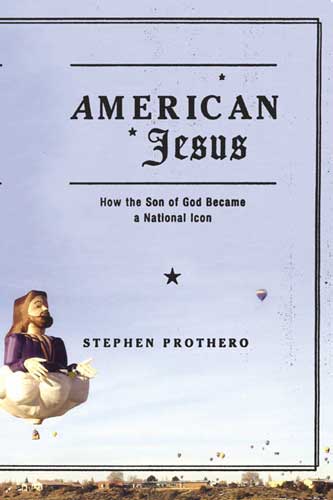
The crafting of Jesus into our own form is a major aspect of Stephen Prothero’s American Jesus. A fascinating romp through a bizarre collection of made-over Jesuses, Prothero’s book should be required reading for anyone interested in civil religion or Thucydides. Even a religion prof from my alma mater, however, didn’t fully convince me that anybody really understands who Jesus was. Such is the way with all truly great individuals.

Unlike some commentators who are clearly upset by Elton John’s summation of Christianity’s founder, I am a bit more circumspect about it. No one has cornered the market on Jesus. As hard as various Christianities have tried, Jesus still emerges in divergent forms to diverse individuals and populations. From Superstar to “super-intelligent gay man,” there is no doubt that Jesus left an eternal imprint on the human population of this planet and that those who believe in him will always portray him in their own image.


Klaatu Barada Nikto

I grew up with robots. Of course they were on the television screen and I was far away in rural-ish western Pennsylvania. They were exotic creatures built by guys much more intelligent than I could ever hope to be, and they were powerful, completely rational, and scary. Now I find myself involved with the FIRST Robotics team in my daughter’s high school where kids a third my age are building a robot. It is a humbling experience.

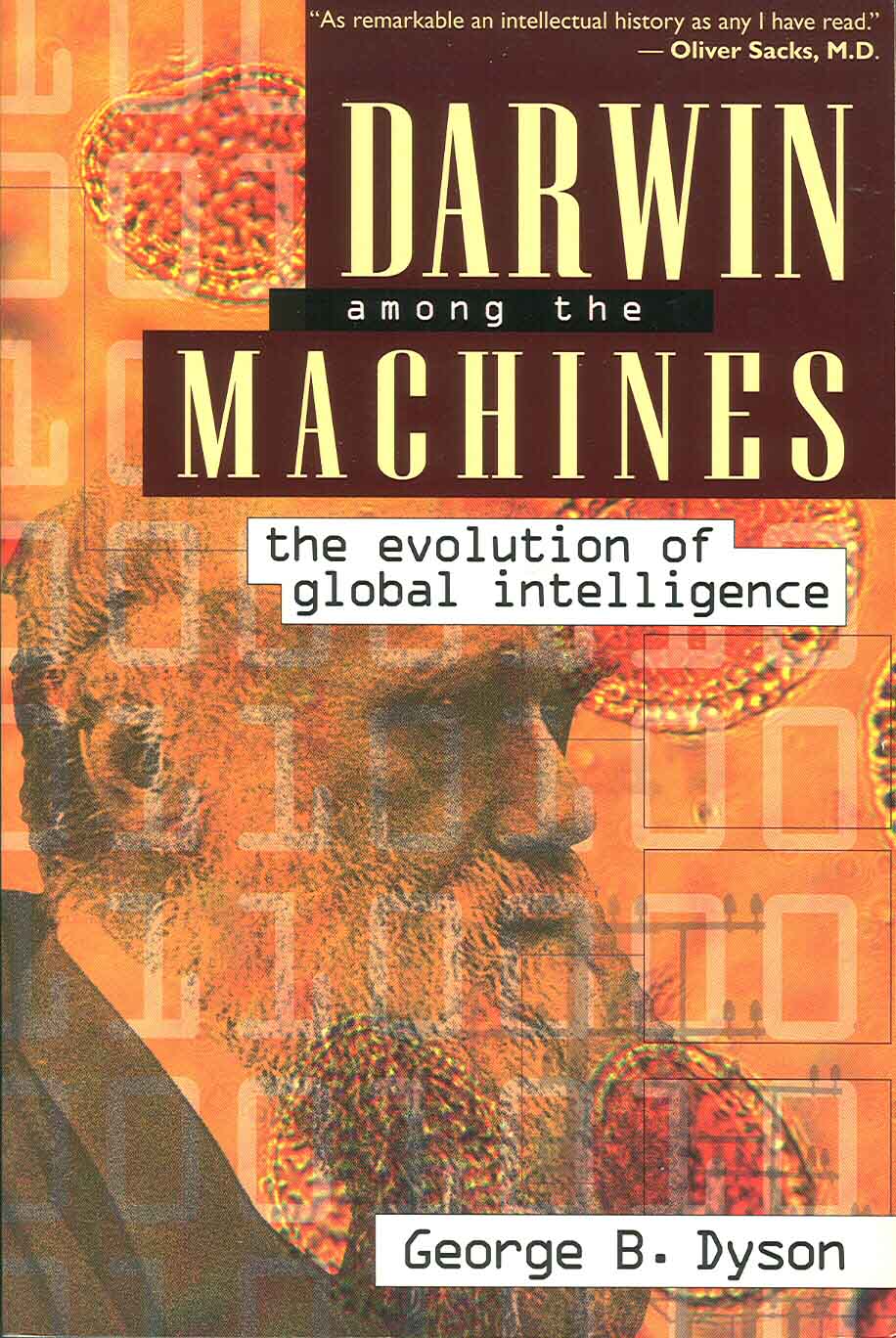
The more I ponder my small support role in the construction of a robotic creature, the more my thoughts turn to George Dyson’s masterful science writing in one of my favorite books — Darwin Among the Machines: the Evolution of Global Intelligence. I would not have known of this brilliant book had I not met George and a group of his friends several years back while they were discussing some of the ideas raised in his work. The main one that captured my attention was the premise that when we build machines we may be constructing an unrecognized form of consciousness. The greatest minds in neuroscience today cannot agree on what consciousness really is or how far it extends beyond this “three-pound universe” in our heads. Although most would decline to comment on the overtly religious term “soul,” we still know that any difference between consciousness, mind, psyche, and soul is very slim indeed.

Read this book!

Our lifestyle is made possible by robots. We drive cars largely constructed by them, use their chips to communicate over vast distances, and even take a stroll on the surface of Mars with them. My question from Monday’s post may have been whimsical, but it was serious. Where is it that the essence of a creature resides? Does it require carbon-based biology, or do we, unwittingly, create a race of slaves just like the gods of old?


Everything’s Better at Harvard (Except Religion)

My wife pointed me to an important article in Newsweek on the plight of religious studies at Harvard. Now, I have to admit to a couple of bunches of sour grapes right up front. I was accepted at Harvard but elected not to go. Only after I had completed my doctorate at Edinburgh University after a lifetime of the study of religion and found that no jobs were available did I realize my mistake. I met colleagues who had jobs while attending academic conferences. All of those well settled in respectable positions had graduated from Harvard. A similar phenomenon exists in Great Britain. Those who actually find satisfactory positions hold doctorates from Oxford. Problem is, neither Harvard nor Oxford corner the market on good education (oh, the heresy!). People, however, are simplistically impressed by lineage.

In any case, this article by Lisa Miller points out the high drama of academic discord at the Shangri-La of American institutions. The famous linguist, Steven Pinker, who personally believes religion to be a severely faulty means of seeking enlightenment, has worked to prevent a required course in religion at the famed secular university on the grounds that faith and reason do not share the same status. Miller goes on to express how small colleges and state universities are picking up on the slack. My limited experience at Rutgers bears out her observations. In this large, rambling, decidedly secular school, my classes in the religion department are always full and I have to turn students away. Yet the university refuses to allow for a full-time hire. Secular America is deep in a state of denial. Because many academics reject religion personally, they simply can’t see how vital it is to understand it. I personally believe no one should be allowed to hold public office without having completed a course in Bible and its political abuse.

Meanwhile, Harvard still holds back. Its reticence will not prevent misinformed people from using their religion as a means of power and destruction. Pretending that since religion is not personally important it is not important at all has deadly consequences. To me it seems obvious that it is not the school you attend that is important, but what you learn while you are there.