Books and Editing

My life has been about books. It was only as I became what is now known as a tween that the passion took hold, but since that time I’ve been addicted to them. As some readers know, I have a Goodreads account. Each year I try to take out a Goodreads challenge on how many books to read. That recently got me thinking; as an editor you read lots of embryonic books, but they don’t count. Being an editor’s a funny job. Not ha-ha funny, but the other kind. When I was having trouble breaking back into higher education, I ran across a quote that went something like this: What’s an editor? A writer who actually has a job. (Rimshot.) I have a tendency to take things literally, so I thought I’d discover lots of writers among professionals in the publishing world. I haven’t.

It could be that other writers keep it well hidden. I publish my fiction under a pseudonym and it may be that the other editors I know live hidden lives too. Somehow I doubt it. They check their email at midnight and all day long on weekends. One thing I know about writers is that we need time to write. If your workday is already eight hours and your commute is three-plus hours more, you won’t be checking work emails on weekends if you want to get any writing done at all. But what about the reading? Does it count when you read books that aren’t even born yet?

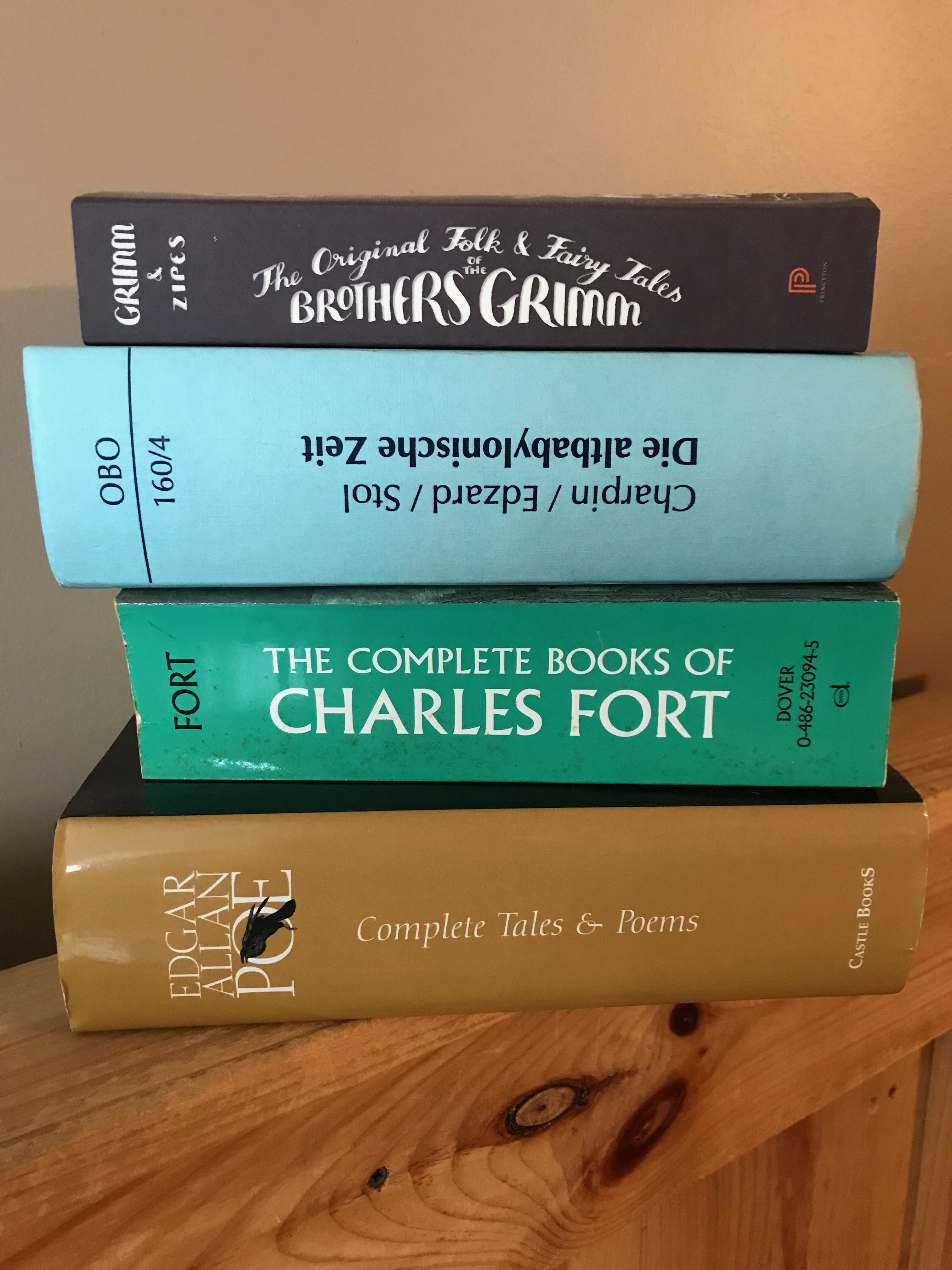
On Goodreads I enter my books by the ISBN. The International Standard Book Number (for which you have to pay, I’ve learned) is a tool used so that booksellers can keep track of titles with a unique identifier. The system is fairly recent (at least according to some of the books I read), and not all books have one. For those of us who read ancient documents, those can’t count either. Ilimilku didn’t think to stamp 13-digits on the bottom of his clay tablets. There’s no way to trace just how much s person reads in an actual year. I measure myself by my books. I get a profound sense of fulfillment when I finish one. That’s why I so often post about them on this blog. Books mean something. Call it a bad habit if you will. We’re outgrowing our apartment because I find it hard to part with books. There are those who spend their lives building arsenals. Then there are those who spend theirs building libraries. I know which I prefer.


Investment Advice

One of the more obvious transitions to adulthood involves Christmas becoming less of a holiday for receiving gifts. As we get older we learn that very few things in life are actually free, and that gifts often have some kinds of obligations involved. My favorite gifts have always been books and movies. Each comes with a required investment of time. That doesn’t mean I’m not grateful, or that I don’t want these things—quite the opposite! It simply means that time is required to enjoy them. Or benefit from them. In the workaday world, time is the rarest gift of all. The gifts I received fell mostly into these genres, so I’ll be sharing a number of these books and movies with you over the next few months.

A knowing relative gave me a refrigerator magnet. Our fridge is covered in these, mostly from places we’ve visited. We do have one of the more colorful iceboxes around. This magnet is red and reads “Make America Read Again.” If anything can combat the evil spewing from our nation’s capital, reading can. Those who’ve decided that rhetoric from documented lying lips is more Christian than compassion for the poor need to learn to read again. The election of Trump has ushered in an era of attempted murder of the truth. The tactic of calling any news you don’t like “fake news” so that your own distorted version of reality rules is among the most dangerous in the toolbox of autocracy. Sacrificing truth on the altar of expediency seems like a very strange means of promoting the evangelical message, at least in my opinion. If people would read, they’d know when they were being lied to.

Reading forces you to confront the mind of another. This exercise is unique among human beings, as far as we know. It’s a kind of telepathy, involving the considered contents of another person’s thoughts coming directly to you. Lying is a possibility, of course. Even liars write books. The more widely you read, however, the greater likelihood of discovering the truth. Reading requires investment. It takes time and mental energy. Other activities must be laid aside. The potential benefits, however, are beyond measure. If we could make America read again, the results would be the greatest gift anyone could hope to find under any tree. It’s time to begin reading through the books that made their way to me this holiday season. This is a gift whose costs I gladly accept. It’s an investment in the future. Even Christmas trees require daily watering.


Might As Well Read

During my recent travels I had a layover at Sea-Tac Airport. Since I don’t get out much, I always find a walk through the airport a way of measuring what other people find important. At least in a circumscribed way. When you’re traveling you’re limited in your options. Most airlines have addressed passenger ennui by offering devices with electronic entertainment. Instead of an in-flight movie, you’ll have choices of what you want to do, courtesy of the endless magic of in-flight wifi. So the thinking goes. Airports, it would stand to reason, will offer plenty of travel-size diversions. The kinds of things you’re allowed to take onto a plane but which won’t or can’t be used to harm others. A sign at Sea-Tac reads “Books. Food. And yes, beer. Just ahead.” An interesting choice of offerings.

I was strangely heartened by the pride of place given to books. Yes, people still find the book on a plane satisfying. Stories have a way of drawing us in. Making us forget that we’re in a cramped space filled with strangers and recirculated, pressurized air. Books have the ability to take us far away. It’s a magic that movies can’t always achieve. Books leave more to the imagination. I recently rediscovered this on a solo trip across the Atlantic. I used the opportunity to read a novel cover-to-cover. The impact was incredible. For those six hours I was on the ground, following the adventures of young people caught up in the liminal zone of adventure and love. It was a powerful experience.

On my daily commute I tend to read non-fiction. Perhaps it’s the result of earning a doctorate, or perhaps it’s the stigma of enjoyable reading being “fluff.” The great majority of books I read this way teach me a lot. I read about many different subjects, and have recently learned to make commuting time a type of research exercise. But then, a cross-country plane ride is different. While an evening commute from New York City can stretch to three hours or more, that’s fairly rare. Instead, air time is unbroken time. I look forward to it with the prospect of a good novel. Airports are one place where hoi polloi don’t mind hanging out in a bookstore. Yes, the fare will be mostly bestsellers, but anything that gets people to read is a good thing. And, of course, if that doesn’t work for you there’s always beer. Just ahead.


Sea Around Us

Re-reading books is something I do somewhat too infrequently. One of the obvious reasons is that I won’t possibly finish everything I want to read in my lifetime as it is, and once something’s in the vault I tend to move on. I keep books, however, because I frequently go back to them to refresh my memory. Wholesale re-reading takes commitment. I just finished re-reading Rachel Carson’s The Sea Around Us. It’s difficult to describe the impact this book had on me when I first read it, years ago. Even though modern editions state that it retains its authority (broadly it does) I couldn’t help but be struck by a number of things this time through. Carson thought of herself as a writer. In her day that meant adhering to the conventions of language, which was, I admit, embarrassingly masculine. The assumptions of the 1940s and ‘50s against which Carson struggled set the very frame for the discussion. I recall being told in school, by female English teachers, that the only proper pronoun to use when the subject was of indeterminate gender was the masculine. I raised my eyebrows, but being good at following rules, I didn’t raise my hand.

Not that this takes away from the poetry and mastery of The Sea Around Us. It is a wonderful book. It also made many people stop and think about the ocean for the first time. Really think. And that’s a second observation about my re-reading. Hearing the recitation of how, historically—or prehistorically—the oceans covered much of North America. Thinking about how my hometown, far, far inland would’ve been underwater for eons really made me ponder. We’ve built our coastal cities rapidly, and with typical human short-sightedness. Even without our generous input, global warming has been ongoing for centuries. Sea-levels have been rising. Our desire for wealth, settling as close as possible to the water to facilitate trade, didn’t take into account what would happen in the perhaps foreseeable future. Even now when the warning is loud and clear the businessmen of the White House are in full denial.

There’s a kind of strange justice to this. You see, one of the other features of The Sea Around Us, and one of the most compelling aspects of the book, is Carson’s narrative of how we came from the sea and our desire is to return to the sea. Our blood evolved from ocean water. We rely constantly and in significant ways on the oceans. They, for example, are the powerhouses and condensation points for almost all of our weather. They separate us and bring us together. The very origin of life itself basks in pelagic profundity. Indeed, the ocean supplies the very concept of “profound.” The deeps. Although it had a beginning, it seems the world ocean will outlive our tribal little race. Damaged and poisoned by our greed, in eons it will recover. And those beings that survive will find their own wisdom beneath the waves.


Independent Bookstore Day

Many modern mini-holidays are centered around things you might buy. I don’t mind that so much in the case of Independent Bookstore Day—of which I wish you a happy one. Quite by accident I found myself in an independent bookstore just last night, not aware I was prematurely celebrating. If anything might save us from the muddle we’re in, it’s books. We live in a society with plentiful distractions, many of them shallow. Books take some effort. They demand your time. They make you take some quiet space to think. Books came along with, and perhaps were the source of, civilization. Today we’re harried and hurried and frantic with an electric source of information and entertainment that never turns off. And we’re seeing the results of that playing out on an international scale. How different it would be if we’d grab a book instead!

The strange thing is that those inclined to action often suppose reading to be an utterly passive activity. The basis for human progress, however, has often been what someone has read. Surprisingly, books can be the source of progress. When we see reactionary elections taking place around the world, leaders who don’t read emerge as the hailed champions of regress. We’re living through that right now. Books can be dangerous. Think about it—you’re being given access, however briefly, to someone else’s mind. The combined power of minds is an impressive thing. If what I’m reading is anything to go by, the hive mind is a source of incredible strength. You want action? Put multiple minds together. There’s a reason that civilization has gone hand-in-hand with literacy.

In the wake of Borders going under, independent bookstores have started to make a comeback. Those of us who work in the publishing industry have to keep an eye on those numbers. A visit to a bookstore is all about discovery. Quite often I’ve walked in with a list in hand. When I exit my list has grown rather than shrunk, and the purchase I’ve made was likely not on the list to begin with. Independent Bookstore Day gives us a chance to think about how very much we do not know. Unlike those who claim power and brag that they don’t read, admitting that we have more to learn is the way toward progress. I may not be the most active man in the world, but I do recommend action in the form of getting to a bookstore. If we each do our part, we can’t help but to make the world a better place.


Non-Lending Library

One of the hidden benefits of the coming societal collapse is the chance for the resurgence of print books. Since I’ve spent most of my life surrounding myself with volumes thick and thin, dense and light, I’ll have plenty to read between bouts of skulking out for food like a feral cat and clawing off those who follow me home, thinking that it’s edible stuff I’m stockpiling. Won’t they be surprised to learn it’s only books! My wife sent me an Atlas Obscura story the other day about book curses. The description of the life of a medieval scribe sounded oddly compelling to me—hunched all day over a writing desk, copying books by hand. Not having to worry about catching the bus before sunrise or being too tired to answer your personal email in the evening. The point of the piece, however, was the book curses.

I’ve been an avid reader since moving to a small town where the main occupation of kids my age was recreational drug use. I was one of the very few who didn’t inhale. Reading became my escape from the loneliness I felt. And I used to lend books to people who’d ask me. I quickly learned that others didn’t share the same care for books that I had. Lent books seldom made their way back to me. We were poor and there were no bookstores nearby and Amazon wasn’t even a meme in Jeff Bezos’ eye yet. Replacing books wasn’t easy. Once I lent out a book I’d already read (but you couldn’t tell it, I’d been so careful). The borrower actually did return it, but the spine was all creased and cracked so that you couldn’t even read the title anymore. I soon began to regard books like those medieval monks who put curses on them so nobody would steal them. I stopped lending them out.

The thing I’m banking on is that books will retain their barter value when society implodes. Of all possible universes only in that one will I be considered wealthy. Those who visit our little apartment inevitably comment on the number of books. What they don’t realize is that there’s a strategy involved here. Like those medieval monks, I have a suspicion that knowledge—including facts that don’t have alternatives—will one day in our dystopian future be valued above all the tweets and lies Washington seems to suggest we follow blindly. And blindness will make a great curse, now that I think about it, to protect these books from being stolen. Or “anathema-maranatha,” as my medieval mentors used to say. Or as Sarah Laskow ends her piece, “May whoever steals or alienates this book, or mutilates it, be cut off from the body of the church and held as a thing accursed.” Maybe this isn’t so strange for a guy whose first academic appointment was at a school that reminds many of The Name of the Rose. (Which was the last book I lent out, for the record.)


2016 in Books

As is my custom on this last post of the year I’ll be revisiting the books that made an especial difference to me in 2016. I record most books I finish on Goodreads, and I welcome friends in that venue. I draw on their recollection for what I’ve read and all of the books I mention here have individual posts on this blog. Use the search function. It’s free!

screen-shot-2016-12-30-at-4-50-39-am

The first important book was Scott W. Gustafson’s At the Altar of Wall Street. If you missed this one, it is well worth your time. Economics has become a religion. If you doubt that, look at 11/9 and tell me so. Philip Gulley’s The Quaker Way was also an early read that’s worth revisiting. November has made many of these books more important than they seemed at the time. Whitley Strieber and Jeffrey Kripal’s The Super Natural will expand the minds of those who allow for unconventional possibilities. And Marc Bekoff’s Minding Animals will remind us we’re not alone on this planet. The Soul of an Octopus by Sy Montgomery was a book I really couldn’t put down, and a nice complement to Bekoff. Marcelo Gleiser touched a chord with The Simple Beauty of the Unexpected, a book worthy of anyone who wants to consider how science and humanity might cooperate for everyone’s benefit. While not really a reading-through book, Tristan Gooley’s The Lost Art of Reading Nature’s Signs is important and worthy of attention.

In the realm of monsters, Elizabeth Baer’s The Golem Redux was a fantastic introduction to a Jewish legend that I revisited in three more books over the year. Several other monster books followed, but especially memorable were Carol Clover’s Men, Women, and Chainsaws, and Maya Barzilai’s Golem—please be patient with me regarding this one. I haven’t written a post on it yet, since an official review has yet to be published. Alexandra Petri’s A Field Guide to Awkward Silences won her an instant fan. I’ll read anything she writes. I didn’t give Alice Miller’s The Drama of the Gifted Child the attention it deserves. It’s kind of a personal thing. Kyle Arnold’s The Divine Madness of Philip K. Dick was utterly fascinating, looking at another person Miller would have found intriguing. Also on the topic of writers, Melville’s Bibles by Ilana Pardes spoke deeply to me.

For fiction, highly recommended are Amy Tomson’s The Color of Distance, Peter Rock’s My Abandonment, Emily St. John Mandel’s Station Eleven, Toni Morrison’s, The Bluest Eye, Pete Hamill’s Snow in August, and Jennifer McMahon’s The Winter People. Less profound, but thoroughly enjoyable were Jonathan L. Howard’s Carter and Lovecraft, and Jasper Fforde’s The Woman Who Died a Lot (reading anything by Jasper Fforde is time well spent). My childhood favorite, Lester del Rey’s Day of the Giants retains its magic.

According to Goodreads, I finished 106 this year. Along the way I finished the 2016 Modern Mrs. Darcy reading challenge. Many of the books were excellent, and this shortlist represents those that idiosyncratically stick out in my mind. Please participate in a show of hope for the future: make 2017 a year of reading.


Colorful Leaves

Weekends, it seems, are incomplete without being among books. You might think that someone who works in publishing might want to get away from books in the off hours, but quite the contrary. I love a good walk in the woods in autumn. Especially if it’s followed by a trip to the local independent bookstore. It just feels right being among books. I realize that I’m in the minority by expressing such an opinion, and that the book buying (and book publishing industry) is (are) small compared to other forms of passing one’s time, but they are significant beyond their size. My wife and I have scoped out the various indie book sellers all around. When we have to take the car in for service, we drop it off, have lunch at a diner, and stroll down to the bookshop. It’s a pleasant way to spend an afternoon.

img_2984

Here’s the sign on our Clinton indie. In case you can’t make it out, the legend says “This is a book shop. Cross-roads of civilization. Refuge of all the arts. Against the ravages of time. Armoury of fearless truth. Against whispering rumour. Incessant trumpet of trade. From this place words may fly abroad not to perish as digital waves but fixed in time. Not corrupted by the hurrying hand but verified in truth. Friend, you stand on sacred ground. This is a book shop.” I especially appreciate the sentiment of sacred ground. Indeed, sanctuaries of all sorts often house books. As libraries experience funding difficulties, civilizations are in the throes of collapse. Just to have books around me makes me feel secure.

Some months ago we had to have a refrigerator replaced. Our apartment has a strange, offset back door that makes getting anything of size in or out difficult. The front door is a fairly straight shot, but just beyond the entryway I had set up a bookshelf after we moved in. The appliance guys came in, jaws literally dropping. “I’ve never seen so many books in one place,” one of them said. They then complained and told me they couldn’t get the old fridge out as the landlord had said they’d be able too. “Your books are in the way,” they complained with accusatory tones. I had to unload the books from two shelves and move them while they watched. I, the lover of books, was duly chastened. I’m afraid my love affair with reading has only become more passionate since that day. The books are back on their shelves and they’ve been joined by more friends. What is a weekend without books but a wasted opportunity?


Paper or Plastic?

Perhaps the most frequent topic on this blog is books. I don’t discuss every book I read, but most end up here. I can’t help but be pleased then, that recent polls show the number of people reading books is rising. Not only that, but that paper is back. We all appreciate new things. In fact, our economy would grind to a dead stop if it weren’t for new things that keep us buying. Ebooks were a new thing. Sometimes they’re even convenient things. If you’re going on a trip and you tend to travel with lots of books, like I do (who knows what mood you’ll be in when you get there? You’ve got to be prepared!) then an ebook reader can save stress on your back and luggage capacity. But I still prefer to zip open my bag and see four or five books smiling up at me. Visitors (rare, but not completely fictional) sometimes ask why I keep them all. I must restrain myself from retorting “why do you keep all your children?”

img_2945

Books—print books—represent so many things. Yes, they often contain knowledge. But they also contain memories. The contain emotions too. I remember that book that I saw in the library window at the University of Wisconsin Oshkosh book sale display. I was only at Oshkosh one year, but I recall seeing the book that my advisor had recommended a decade and a half earlier. I was so excited I called the librarian to ask if it could be put on hold. He allowed as it couldn’t but if I were to pay in advance perhaps another book could be substituted in the display. I remember having my worldview torn open by books—that January that I read three books that changed my outlook on life almost completely over Christmas break. How can I bear to let any of them go?

I suspect ebooks were a fad. They are still useful and they still sell. But is there any feeling like taking a book, closing the back cover, setting it on your lap, and thinking about what you’ve just seen? I know nothing like it. Of the many books I’ve written, only two have been published. In some sense, those two are the only two I’ve done. I keep trying with the others, but meanwhile out there in a few select libraries people can find bricks of paper with my name on the outside. It wouldn’t been the same if the publishers had said, “it will only be an ebook.” I know that it shouldn’t make a difference if its paper or plastic, but it does. It makes all the difference in the world. No matter if it means having to build more bookshelves. They make excellent insulation.


Used Knowledge

One of the unadulterated pleasures of life—or maybe adulterated is the better adjective—is the used book sale. The year I missed the Hunterdon County Friends of the Library sale felt like a year without a summer. There are other book sales around, but this one’s my favorite. Books are my heroin. You see, I became an academic because it was too difficult to make a living as a writer. Besides, I never formally studied writing and what are you without credentials? Just a poser making some claim of talent. Like most academics I learned to write in staid, measured prose, never exaggerating or showing any emotion. Research for that kind of writing requires a university library since who can afford those kinds of books and you need a JSTOR account to keep on top of all the journals. You read and read on the same topic for months at a time until you have something new to say. Thus knowledge, they tell us, progresses by baby-steps, into a safe and conservative future.

Nietzsche, meet Evangelicals

Nietzsche, meet Evangelicals

The reading that I do is of a different species. I’ve had academics ask me “why don’t you do research on the bus?” Have you ever tried to do research on a bus? Some stranger sleeping next to you with his/her body relaxing and melting into your side of the seat, their arm falling off their rotund belly onto you before being retracted to start the cycle all over again? And staid, measured prose before the sun comes up hardly makes the trip any faster. Of course editing pays much, much less than the professorate. So I buy cheap books. Nothing like a buck a book to bring out the reasonable side of any economically minded obscure private intellectual. You never know what you’ll find at a book sale. Some of my best reading experiences on public transit have been at the behest of orphaned books others turned out into the streets. Books I would never have read otherwise. Books that I feel would understand me.

The once and future academic in my brain tries to reconcile this with what I paid thousands and thousands of dollars to learn how to do (research). Isn’t this in some way pushing knowledge forward? After all, maybe a dozen people will read this post and that’s kind of like publishing, isn’t it? Don’t mind me, I’m just book drunk. It’s the used books talking. While my academic friends prepare themselves for a summer off, some going to vacation houses they justly deserve, I’ll be filling my commute with adulterated books. And hopefully by the time I reach the bottom of this stack another sale will come along so that I don’t have to go through withdrawal. Methadone for books hasn’t been invented yet, and besides, I take no substitutes.


Durable Goods

CharingCrossThose who love books share a soul. A weekend never feels complete to me without at least an hour spent in a bookstore. On one such weekend a clerk in our local indie recommended Helene Hanff’s 84, Charing Cross Road. The recommendation was actually for my wife, but knowing me, she said I’d like it. What’s not to like about a set of revealing letters between a struggling, New York-based writer and a London used bookstore clerk? Books tell the story of a person’s life. If I’m invited to someone’s house, I look at their books. I would expect the same if they ever came to see me. Kind of like dogs sniffing each other out. Books reveal the inner person. They also give me ideas of more things to read.

I can’t help but think we’ve lost something intangible in the world of ordering books online. Don’t get me wrong, I appreciate Amazon maybe more than is proper, but how many treasures have I found simply by browsing? The days are well past when a single person could claim to have read every book (and really, who would want to?) so there’s always something undiscovered lurking at the bookstore. And these days used bookstores have the most character. In Milwaukee I used to frequent a used bookstore that could have passed the building inspectors’ visit only by bribery. I spent happy hours there. You see, books are durable goods that can outlast their owners. Can anyone really ever own a book?

84, Charing Cross Road was an unexpected delight. A quick web search reveals that Marks & Co. Is no longer with us. It is now a McDonald’s. Helene Hanff is gone too. And she thought she was born a century too late! Yet here we are in the twenty-first century and books are still with us, despite our losses. They have something of eternity to teach us. The ebook has not yet managed to kill off print. Our local used bookstore closed some years back. I confess to visiting a Barnes and Noble in a state of desperation. There a guy, older than me, was talking to a clerk. I couldn’t help but overhear when they mentioned the used bookstore, now long gone. Even the clerk sighed that they were the only show left in town. Although they were strangers I knew that we somehow share a soul. So it is with those who love books.


But Loses (His) Soul

Although a couple steps from the real thing, a book review can be an art form of its own.  A short piece in a recent Wired magazine focused on an ironic bestseller that I keep seeing on the standard lists: The Life-Changing Magic of Tidying Up, by Marie Kondo.  Apart from something we’ve probably all heard from our moms, I wonder why so many people buy a book telling them to get rid of things.  Clive Thompson notes in his review (“Clutter Clash: How Tidying up Can Hamper Creativity”) that one of Kondo’s pieces of advice is that books should be on the list of things to discard.  Disagreeing in principle with this assessment, it is an even larger argument that I would like to challenge: “studies” apparently show (I’m not sure which studies) that clutter can be “soul crushing.”  Given that we have no empirical way to assess souls, I’m uncertain how to measure the number of angels crushed under my stacks of books.  Who has the right to assign clutter to the ranks of venial sins—or mortal, for that matter?
 
The book’s subtitle, The Japanese Art of Decluttering and Organizing, may provide some vague spirituality to the topic, and I agree that entropy can get the upper hand from time to time, but soul-crushing?  Some of us keep books and papers precisely because of their value in lifting the non-verifiable soul.  In fact, I was just reading (ahem) about how religions (the traditional home of wisdom about souls) revolve around their books.  Perhaps we should leave at least a showy Bible for the coffee table to display along with our copy of Feng Shui for Dummies.  My soul feels lighter already!

IMG_2727
 
When did advice for improving our souls shift from those who spend their ruminative lives asking the weighty questions to those who suggest picking up after yourself might just work as well as a life of self-denial and putting others first?  And why would you buy a book that recommends you don’t keep books?  My existential crisis deepens, and I haven’t even read it.  I can’t shake the feeling that  I spent thousands of dollars over multiple years getting an education in what turned out to be merely housekeeping.  I marvel at the clutter-free environment as much as the next person.  That’s one of the reasons I love art museums so much.  Yes, my soul does get a boost there.  If I go to the gift shop on the way out, however, I’ll likely want a book to help recapture those sublime moments.  Then I will go home, where my clutter awaits, and will truly feel peace in a place where books abide in profusion.


Rumors of Books

An off-the-cuff remark by Sandeep Mathrani, some CEO of something or other, had the publishing world buzzing a couple weeks back. The rumor began that Amazon.com was about to open hundreds of brick-and-mortar bookstores. After the opening of a store in Seattle, the idea—neither confirmed nor denied by Amazon—has made the book industry reassess its future yet again. Stock in Barnes and Noble immediately fell, but soon recovered. As someone whose entire life has revolved around books, I was glad to read the story. I have no idea of the business implications—I just don’t think that way—but the fact that book news was deemed newsworthy at all was heartening. Of course, it would be even better news if this signaled a growing interest in books.

DSCN5025

The book industry has been a steady one, despite worries and shifts of format, but it has never been as robust in America as it has been even in the small nation of Iceland. There are too many distractions for people to dedicate the quiet hours required to open a book and learn from it. When I sit on the bus and the driver has forgotten to turn on the overhead reading lights, almost nobody complains. Although I see some Kindles in the dark, it is often social media or movies that the person next to me is viewing. A longish bus ride, it seems to me, is the place for a book. Portable knowledge. Do we ever stop to consider the wonder of this anymore? All it takes is a rumor and the industry quivers.

Books, like monsters, are one of those topics that has an inherent connection to religion. No matter how secular a writing may be today, books have close ties to religion, and they always have. The great secrets of religious explorers and inventors are kept between the covers for any awaiting enlightenment. We have become a more secular people, but the religion of secularism is intellectual. The basis for such thinking comes in book form. For me, there’s always a sense of accomplishment with finishing a book. A gold star on the sticker chart. And I worry about books following the thylacine into extinction. And if the thylacine is something you don’t recognize, I have a book that I could recommend.


Books of 2015

Screen Shot 2015-12-28 at 3.38.16 PM

It’s the end of 2015 and looking at my records on Goodreads it looks like I read 100 books this year. That tends to be my goal mark, but after twelve months of reading I like to think back over which were the books that have made the biggest impact on me over the year. Joe Bageant’s Deer Hunting with Jesus remains on the most important list. It is joined by Andrew Newberg’s How God Changes Your Brain, Spencer Wells’ Pandora’s Seed, Alice Dreger’s Galileo’s Middle Finger, and Paul Levy’s Dispelling Wetiko. Bageant, Dreger, and Levy especially address some of the root causes of social ills and even make suggestions about how to address them. Newberg offers advice on how to improve brain functioning and Wells taps into the ever-important issue of care for our planet. I read some good academic titles as well: Diana Walsh Pasulka’s Heaven Can Wait, Darren J. N. Middleton’s Rastifari and the Arts, and Ronald Hutton’s The Triumph of the Moon.

Screen Shot 2015-12-28 at 3.37.33 PM

Being a religionist, books with supernatural themes are always of interest. Among these I found intriguing Michael Murphy’s The Future of the Body, David J. Hufford’s The Terror that Comes in the Night, Ardy Sixkiller Clarke’s Encounters with Star People, and Jeannie Banks Thomas’s Putting the Supernatural in Its Place. It seems important to have reasonable people address unconventional issues. These are related to books on monsters, noteworthy among which were: M. Jess Peacock’s Such a Dark Thing, Kim Paffenroth’s Gospel of the Living Dead, Brenda S. Gardenour Walter’s Our Old Monsters, and Lisa Morton’s Ghosts. Long ago I realized that I no longer needed to justify including monsters or the supernatural categorically with religion. They share too many roots to be separated out artificially.

Screen Shot 2015-12-28 at 3.36.54 PM

Finally, it was also a year of novels. Pride of place here goes to Robert Repino’s debut, Mort(e). I am compelled to mention Margaret Atwood’s MaddAddam, John Green’s Paper Towns, Shirley Jackson’s We Have Always Lived in the Castle, and Valerie Martin’s The Ghost of the Mary Celeste. Although I’m not much of a fantasy reader, Tod Davies’ The Lizard Princess has stayed with me since reading it. For any of these books you’ll find an individual blog post from this year. That’s not to say that other books I read weren’t good. Nearly every book I post on Goodreads has a write-up here. I tend to like most books I read, although I’m occasionally disappointed when a book does’t reach its full potential. 2015 was a rich year of reading and I’m looking forward to a very literate 2016.

Screen Shot 2015-12-28 at 3.35.38 PM


Book Deaf?

It’s Tuesday morning and I have been listening to authors pitching their books for three solid days now. Truth be told, I am a bit jealous. I’ve got a few more books in me yet, but research time simply does not exist in the world of capitalism and its discontents. Not that I envy being on the author’s side of the table—I remember how it felt to pitch Weathering the Psalms to several editors and to receive an icy “no” in response. I think now I begin to understand. Yesterday one of my appointments asked if I was “book deaf” yet. It was a term I’d never heard, but I immediately knew what he meant. Editors hear pitch after pitch. I pull out my phone and look at my calendar and see a new project every half-hour throughout the day, but no, I’m not book deaf. In fact, I have to constrain myself to keep my credit card firmly inside my wallet. Being surrounded by books is like being in a jungle teeming with deadly animals.

IMG_2614

From the exhibitor’s booth, Tuesday is a day of relief and worry. Most of the papers are over at AAR/SBL, and most of the participants have already left. As at any conference, fair, or exhibit, we are strictly forbidden from taking down the booth before closing time. We stand about, straining our ears to hear that first transgressive ripping of strapping tape from its roll, indicating that someone in another booth is being naughty. We’re tired, weary even, but not book deaf. Never book deaf.

IMG_2615

In my unguarded moments I sometimes think that maybe some day I’ll have a book here that others will clamber to find. Maybe someone like me will prowl to a pre-selected booth with a specific title firmly in mind, and that title will bear my name. I suppose it could happen, although it isn’t likely at this point. I hear each pitch and more. I hear the dreams and deep desires of every author. We want to be heard. We want others to think us respectable, honorable even. There are publishers out there who will publish anything. They will accept books to fill catalogues and websites and you’ll never hear from them again. Still, you’ll find some interesting things if you wander by their table. And if someone sees that you’re an editor while you’re browsing you’ll never turn a deaf ear. This is what religion scholars live for. Books are our reality.

IMG_2617