Exercising Exorcism

About the last people, ironically, that you’ll find researching demons are religion scholars. That’s perhaps a slight exaggeration, but there’s an embarrassment to the topic that serious academics just can’t shake. Nobody wants to be thought truly believing in that stuff. Michael W. Cuneo, who teaches sociology and anthropology at Fordham University, isn’t afraid to look. His American Exorcism: Expelling Demons in the Land of Plenty is a user-friendly, often witty look at what is an amazing phenomenon. Exorcism had pretty much gone extinct by the middle of the twentieth century. Then The Exorcist happened. Cuneo makes no bones about it—Hollywood wrote the script on what was to become a somewhat bustling business through the end of the millennium and beyond. And it wasn’t limited to Catholics. Protestants, mainly of Evangelical stripe, cottoned onto Deliverance ministry and joined the fray against the demonic.

American Exorcism reflects Cuneo’s personal account of attending exorcisms. As he puts it at the end, no fireworks occurred. In fact, he’s skeptical that demons exist and he strongly suspects exorcisms work in the same way that a placebo does. He’s well aware that the majority of people he met and talked with in the making of this book disagree on that point. Cuneo himself attended at least fifty exorcisms, both Catholic and Protestant, and shysters among the exorcists were rare. Most were sincere, devoted people who are helping others in distress for no fees, no glory, and no promotion. They see a need, believe they know the diabolical cause, and take the devil by the horns (metaphorically speaking).

There is a solid mistrust between academics with their studied skepticism and exorcists with their eyewitness accounts that defy belief. Cuneo suggests that even what they think they see may not really be happening in the real world. My question, coming down to the end of the fascinating book, revolves around what exactly this real world is. There can be no doubt that present day concepts of exorcism are largely based on “the movie.” Cuneo seems just a bit reluctant to say what I also declared in my forthcoming book—pop culture, the movies, dictate reality for many people. At least in the realm of religion. Sacred institutions have lost their authority to make ex cathedra pronouncements about what is real and what is not. Few bother to, or can, delve into the tedious work of reading academic studies on the subject. It’s far easier to let the unseen presences behind the camera take over. Isn’t that what possession is about, after all?
The Art of Commuting

You can tell when the holiday season settles on the city. The commute home takes longer because developers simply can’t ignore a highway and the potential it has for shipping in the lucre. Highway 22 is built up in several spots—it’s kind of like a 20-mile long roadside mall between where the bus enters it and my exit. Holiday shoppers right after work clog this artery faster than fried eggs for breakfast every day. We crawl, penitent, wanting only to reach home. You get to know the regulars on the bus. You may not know their names, but their faces and personalities become clear enough. The man sitting across the row from me was someone I couldn’t recall having seen before. Lots of people, of course, go into New York occasionally. A stranger on the bus isn’t exactly rare.

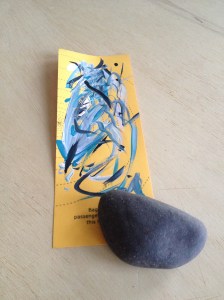
Near my stop I slip into the empty seat next to the aisle to get ready to disembark. He looks over at me and asks if he can give me a bookmark he’s made. Worse than talking to strangers is taking candy from one. He encourages me by telling me he does it to promote his work, since he writes haikus and does paintings. I accept one and learn of the website unfoldingmind.com. He then asks what I’ve been reading. If you read my posts in order, you can see my last book was The Exorcism of Anneliese Michel. There’s a reason I don’t tell my fellow passengers about my literary choices. I say it is a book about an exorcism and he takes it in stride, asking if it was an actual case.

I had my own unfolding moment then. Not only was it the case that I could mention exorcism in casual conversation, but a man considerably younger than me knew what it was. Stop and think about that: prior to the movie and novel, The Exorcist, very few modern people even knew about the rite. Strangers on a bus, both artists in their own way, I like to think, knew what this was. I look at my bookmark, some original art with a haiku on it, and think of the many interesting people that make this bus their temporary domicile. Occasionally, amid the snoring phone-movie watchers, is another passenger using the long ride home to open his or her mind. The bookmark is now amid the artifacts of my personal museum. And my words, hardly poetry, are a tribute to those who practice the arts that make us human.


Getting Exorcize

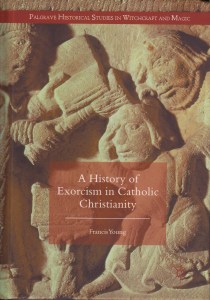
Supply and demand may seem to be an odd framework to apply to religion, but it obviously exists within the polity of churches, synagogues, and mosques. What the people want does influence what’s on offer. Watching movies about demonic possession isn’t something that comes naturally to me. Demons are scary, and it doesn’t help that, historically speaking, they’ve never really been properly defined. Francis Young has provided a service to the curious with his book A History of Exorcism in Catholic Christianity. The book is just what it says, an examination of how Catholics have formally dealt with demons, or more properly, demoniacs, over the centuries. Young notes the protean nature of demons at the beginning—they meet cultural expectations of their time rather than obeying theological niceties. What to do about them?

Long relegated to the realm of epilepsy and mental illness, possession has gone through several periods of ascendency and decline. Indeed, in the nineteenth century it looked as though exorcism, in Catholicism, might have been on the endangered species list. Science was calling the reality of the spiritual world into question and nobody likes to be thought naive. With few exceptions, the move toward eliminating the role of the exorcist was gaining steam. Then in the twentieth century the demand for exorcism revived. As Young notes, a large part of the increasing interest arose from the novel and subsequent movie, The Exorcist. Possession was something so little talked about for so many years that it proved a rich ground for a new kind of monster that was eminently believable. The church, after all, never said there weren’t demons. Since that time, interest has been waxing once again.

Part of the reason would seem to be that humans are meaning-seeking creatures. When our main sources of authority in that realm are eroded, we start looking elsewhere to find succor. Ironically, outside Catholicism the mainstay of exorcism has been among various evangelical Protestant groups. They may not have an ancient ritual to use, but what they lack in experience they make up for in enthusiasm. Their demons are culled from a literal reading of the Bible. And interest among Catholics, in this strange supply and demand rubric, has meant that more exorcists are being trained and made available. The world that Young leads his readers through is one in which strange things reside. He makes no judgment about demons or their reality. He does, however, provide a very thorough history of what the Catholic Church has done about them, when the demand exceeds supply.


Night of the Museum

I admit to being a relative stranger to contemporary commercial television. We don’t have “triple play” at home, and since the internet provides more information and entertainment than one person can possibly handle in a lifetime, why pay extra? On a visit home, however, where internet does not yet exist, I fell to the default of watching TV. Scrolling through the cable channels available in this small town, I start to understand why we don’t pay extra for this at home. Much on offer appeals to the lowest common denominator, and although some educational programs exist, they have to put somebody in danger in some remote location in order to draw the viewers in. Then I stumbled on Mysteries at the Museum.

For those of us hopelessly enamored of the past, museums are an irresistible draw. I joined the program already in progress. It was talking about Stroudsburg, Pennsylvania, through which we’d driven to get here. A resort town in the Poconos, I always think of Stroudsburg as a traffic bottleneck, particularly on a holiday weekend. Instead the story was telling of a haunted jail in which a prisoner had to be exorcised after it was found that he could make it rain inside his cell. Then the name of the Warrens was mentioned. The Bible used in the exorcism is from their occult museum (thus the tie to the title of the program). Ed and Lorraine Warren, as my regular readers know, get mentioned here every once in a while. Real life ghost hunters, they kept a museum of the occult in their Connecticut home. I’d missed the part of the program where they revealed the provenance of the artifact. Now things started to make sense. After the commercial break, however, the story shifted to a historic pair of hiking boots.

Image credit: Creative Commons Share Alike 2.0 Generic license. Photo by Doug Kerr, Wikimedia Commons.

What was so striking about this brief segment of the show was not the implied credulousness of the investigation, but rather the certainty with which those interviewed declared this was a water demon case. Okay, so I’d just finished a seven-hour drive and I may not have been at my sharpest, but where did such certainty come from? Who were these experts telling us what had happened? I’ve read enough of the Warrens’ accounts to get a sense of how they worked, but not even the name of the priest was presented, let alone that of the demon. What we had, then, in this 15-minute segment, was a Bible and an anecdote of rain falling in a Stroudsburg jail. As I switched off the program to go to bed, I knew that I’d find the missing information on the internet. Even without triple play.


December Demons

Conversations with friends, inevitably, turn to the fiasco this country faces with Donald Trump. My response, apart from attempting a measure of optimism and combativeness, often involves escapism. Regular readers know that I watch horror movies. They may not know that I watch such films to help me cope with the very real fears of living in what has all the signs of being an out-of-control autocracy. With this in mind, I’ve been reading about horror films to try to understand myself a bit more. Perhaps a roundabout way to psychological insight, but it is cheaper than seeing a therapist. Over the weekend I again watched The Exorcist. A classic of the horror genre, it is rare in having been nominated for Best Picture at the Academy Awards and having received mainstream critical acclaim. What made it particularly interesting at this particular viewing is the fact that demons are such poorly understood monsters.

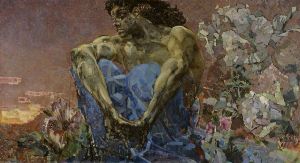
Mikhail Vrubel's demon, Wikimedia Commons

Mikhail Vrubel’s demon, Wikimedia Commons

One of the reasons for this is that no single entity known as “demon” fits all the ancient ideas about such spiritual beings. The earliest demons we know about, from ancient Mesopotamia, aren’t necessarily evil. They seem to be in control of natural forces that harm people, but that isn’t always intentional. From the human perspective this is bad, but from the point of view of the divine world, it’s neutral. Sumerians and those of the Babylonian and Assyrian empires did not believe in Hell. There was no Satan and therefore “fallen angels” intent on harming people weren’t part of their worldview. The Greeks, who gave us the word, referred to as “daimons” nature spirits that were generally benign. In the biblical world, influenced by Zoroastrianism, a dualistic understanding of the universe emerged and eventually demons came to be understood as angels that followed the Devil in revolt against God.

Complicating the picture, possession, in world religions, is not always a negative thing. In some cases it is a way of having a deity inhabit one’s body—something of a blessing. In the New Testament demons may have been an explanation for epilepsy. They were, however, understood in that day as possessing spirits of evil intent, in league with Satan. Thoroughly evil, they could evoke paranormal phenomena and could completely control a person unless expelled. In modern media, where reality television dictates the terms, demons are responsible for some hauntings. They are disembodied entities “that were never human” and they are always malevolent. One of the reasons they are so scary is that no one really knows what they are. And in cases where one has no idea what to expect, fear is a natural result.


Getting Exorcise

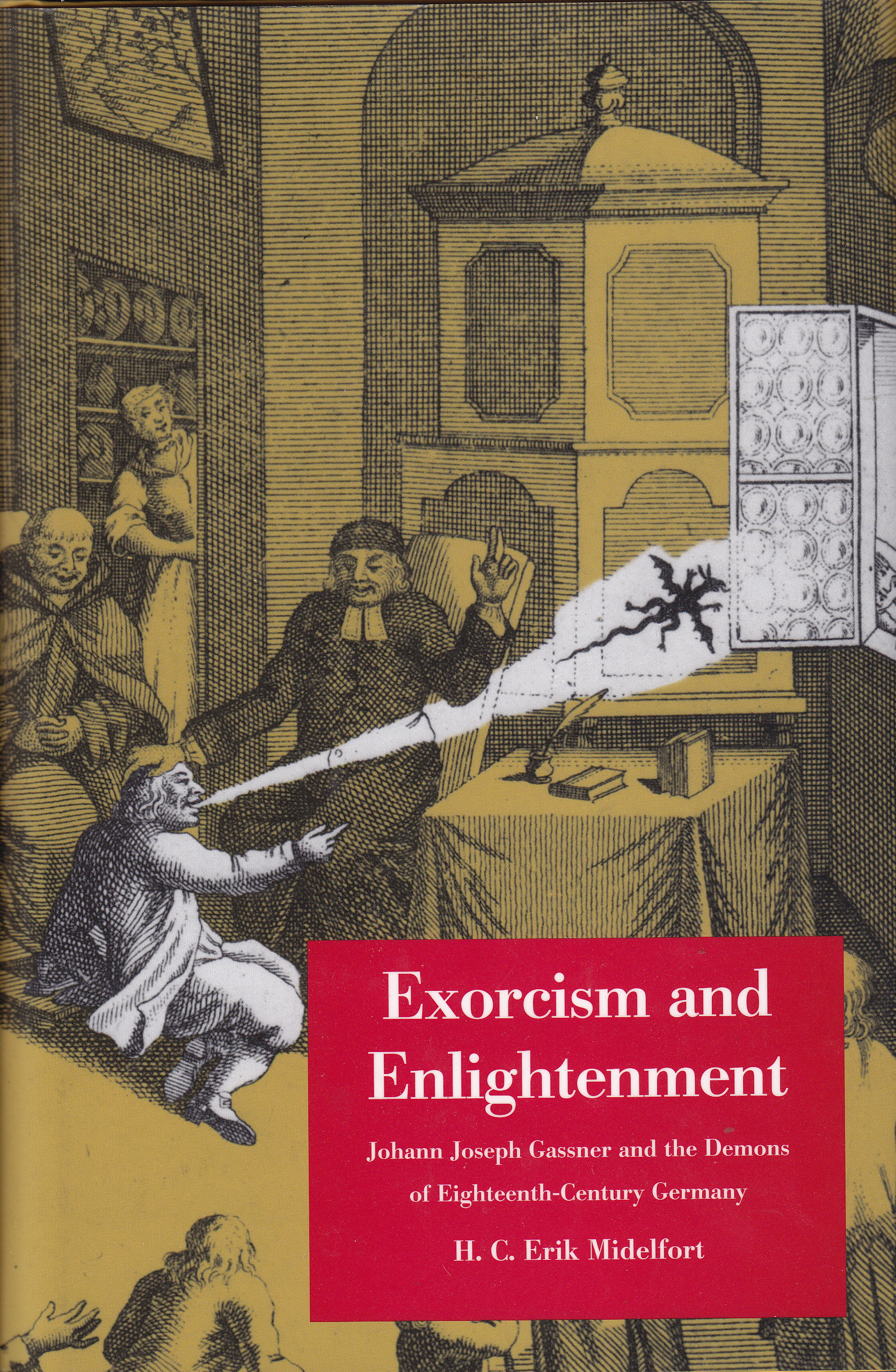
ExorcismTo be honest, I can’t recall having heard of Johann Joseph Gassner before. Given his role in the European witch-hunting culture, however, I must have read his name a time or two. As with most names out of context, it was quickly forgotten. H. C. Erik Midelfort, therefore, is to be congratulated with bringing out not only Gassner’s name, but his remarkable career. Exorcism and Enlightenment: Johann Joseph Gassner and the Demons of Eighteenth-Century Germany, like so many other books, came to my attention in a bookstore. Books on demons have a strange kind of draw to someone interested in both religion and monsters, and since it was on an overstock shelf, I found it impossible to let it lie. This proved to be a wise decision.

Midelfort proves himself one of the rare academics who doesn’t talk down to his readership, yet makes what could be a complex topic understandable. Complex is about the only word to describe what would become Germany in the Eighteenth Century. The remnants of the Holy Roman Empire left a divided region with prince-bishops—clerics with political control outside their own dioceses—vying for all kinds of authority. Although the Enlightenment was well underway, the region was embroiled in the controversy of a priest by the name of Gassner. Gassner was a healer, but also an exorcist. Believing that many torments suffered by the populace were demon-spawned, he used highly public and, to some, incredible exorcisms before healing those in need. His success was unquestioned, but the church, struggling between Catholicism and Lutheranism, as well as struggling to find a place in the Enlightenment world, found Gassner a bit of an embarrassment. What do you do with demons in a world where science says they don’t exist?

One of the most notable takeaways from Midelfort’s book, for me, is that the Enlightenment did not suddenly change the world. Even fully aware of empirical experimentation and the use of reason, the scholarly world did not utterly acquiesce to a subdued materialism. It still hasn’t. As the case of Gassner demonstrates, our comfortable, physically predictable world holds some surprises for us yet. At least for Gassner, believing demons don’t exist doesn’t stop them from tormenting people. As he cured his thousands, skeptics gathered (including his contemporary Franz Mesmer) to explain away what was happening. Even today, as Midelfort points out, we can’t explain the placebo effect. There’s no question, however, that it works. As does, if the media is to be believed, the occasional exorcism in the twenty-first century.


Holy Hostage

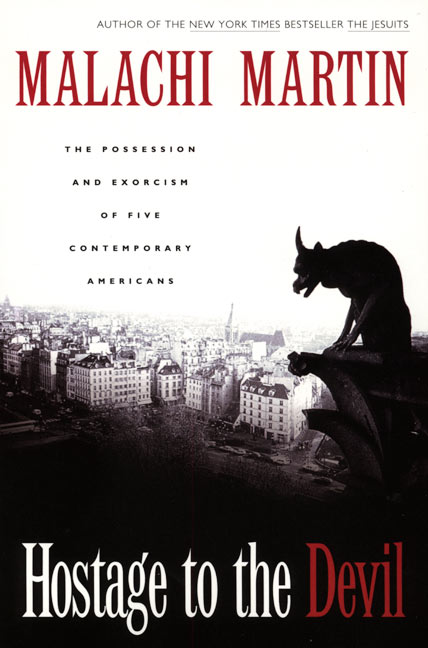
HostagetotheDevilA chance glimpse at a textbook shelf in a university bookstore made me aware of Malachi Martin’s Hostage to the Devil, although it is several years old. I was intrigued that a major, secular, state university would offer a course requiring a book about demonic possession. I’m not completely naive about college students, but this seemed just a tad extreme. Nothing is more dangerous than a book dangling in such a context, like the Necronomicon of Abdul Alhazred. The world of the demonic is freighted with arcane rules and a decided Catholic superiority. Even to the rational it can be insanely frightening. As I read Martin’s account, I frequently found myself puzzling over the unseen world he so meticulously describes—after all even the Bible has little to say about it. And Martin is a great lover of verbosity, detailing more than the reader needs to know about the five exorcisms he elaborates. If you want to know what a dying priest looks like, in great detail, you’ve come to the right place.

Perhaps the most jarring aspect of reading such a book is how such obviously intelligent people can come to such diametrically opposed worldviews while looking at the same evidence. Here was Malachi Martin, convinced that demons lurk about the world in great numbers. There is Richard Dawkins, convinced that we are nothing but particles and proteins walking around. Manhattan—the haunt of countless demons, or the febrile accident of firing synapses that means ultimately nothing? Although much of what Martin describes could probably be mental illness, one has the distinct impression Dawkins has never attended an exorcism. Both write with great authority and even greater conviction.

Hostage to the Devil is not an easy book to read. Martin’s style is smooth, like a novelist, but the length of his book keeps demons on your mind for a protracted period. Rationality can be worn down by attrition, and even the non-believer can be made to wonder. Would priests and their chosen attendants lie? Do the possessed really levitate, and contort, and cause objects to fly around the room in defiance of the physics so highly valued by atheists? For over 450 pages Martin will keep you wondering. You’ll also find out what an exorcist ate for his boyhood breakfast back in Ireland decades before facing the Prince of Darkness. Hostage to the Devil is a deeply disturbing book where the monsters we’ve all learned to shove deeply into the closet come springing back out. And the only effective help in the known world is the Catholic priest who happens to be an exorcist. And who can argue with that?