Fearful Faithful

It’s sitting on the table next to my chair and I’m afraid of it.  It all started during the Easton Book Festival.  I feel sorry for those people who have to stand on the street corner and pass things out for a job.  In Manhattan I used to see them being completely ignored by swarms of people passing by.  They’re only doing their job.  I made a habit of accepting their chits, and even if they didn’t mean anything to me, I felt that the person handing them out might have experienced a small measure of satisfaction that someone accepted what they were offering, and had said “thank you.”  In Easton back in October, my wife and I were heading to one of the venues to hear an author talk and a guy was passing out paper, and I accepted one as a matter of habit.
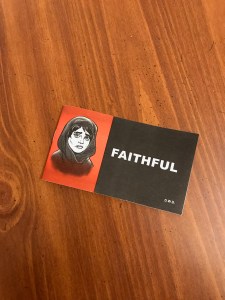
It was a Chick tract.  If you’ve been reading this blog a while you’ll have run across the concept before.  Jack T. Chick was a cartooning evangelist.  He drew hundreds of tracts and comic books that formed a steady diet for me, growing up.  Although they looked like cartoons, these intolerant, Fundamentalist tracts were quite often very scary.  Especially to the young.  More than once I’d spiral into a childhood depression after reading one.  Although it seemed simple—say the prayer at the end and you’d be saved—how could you be so sure?  The disturbing contents stayed with me long after the sixteen pages were done.  Now, as an adult, I was being offered a road back to a childhood I fervently wished to avoid.

I stuck the tract in my pocket and forgot about it.  When I got home I emptied my pockets and found it again.  Curious, I was tempted to read it.  I know, however, that doing so will only drag me back to a memory of younger days when a kind of terror permeated my days.  And nights.  My theology, which was formed of a mosaic of these tracts (what child really listens to sermons?), was a scary one indeed.  It was populated by demons, Catholics, and servants of the Antichrist.  Anyone who wasn’t straight and pretty waspish was a threat to my eternal salvation.  Is that somewhere I want to go again?  The tract sits, unread, on my table.  It reminds me of the abuses to which religion might be put.  And I’m thinking I might start refusing free handouts on the street once again.


Seasonal Music

Music is deeply, deeply personal.  That’s why I don’t write much about it.  There are pieces, I swear, if someone walked in to shoot me when I was listening to them I wouldn’t even notice.  This effect is amplified in autumn.  I don’t listen to music all the time.  In fact, I rarely do.  The reason is, counterintuitively, I fear that music may cease being meaningful to me.  Good things have a way of running out.  The music I like is only very slowly supplemented.  So as the clouds encroached this month, I put on some tunes and I began thinking of appropriate songs of the season.  I’ve heard attempts of more recent artists to sound spooky, but their lyrics don’t match the mood I’m seeking—remember, it’s deeply personal.  So what is autumnal music?

Despite being a fundamentalist, I was raised on rock-n-roll.  My favorite artist growing up was Alice Cooper; in fact, to this day Alice is the only secular rock artist I’ve seen in concert.  Two tracks on Welcome to My Nightmare are among those eerie autumn songs: “Years Ago,” and “Steven.”  This album was profoundly sunk in my psyche before I discovered others.  While not scary in the same way, “Brilliant Disguise” from Bruce Springsteen’s Tunnel of Love hits a similar chord.  The melancholy of autumn must be appeased and this song begs to bring it on.  Many of Leonard Cohen’s songs are like the angst of this season bottled up for a restorative tincture, but I was quite a bit older when I discovered Nick Cave.

The Boatman’s Call with its willowy sound and occasionally explicit lyrics, walks that line between a deep-seated spirituality and fear.  There are others, of course, some even fairly recent.  Imagine Dragons’ “Demons” from Night Vision certainly qualifies, as do the first two tracks on Muse’s The Resistance.  But this is my list, and I fear to reveal too much.  Someone who knows your music knows very much about you.  I hear some people discuss music as if it’s a throw-away commodity.  For others of us it has become part of our souls and we’re reluctant to reveal too much.  New members of this autumn music club are added only very slowly, and I reacquaint myself with the long-term members not frequently enough to rob me of their impact.  So it was as the clouds thickened and the cold wind began to blow as the leaves were beginning to turn that I put on my personal songs of the season.  And there was transcendence, but it was, as transcendence tends to be, deeply personal.


Glossophobia

For a guy so full of phobias that there’s no elbow room at Hotel Fear in my head, people are sometimes curious as to why I don’t suffer one of the most common sources of terror: speaking in front of crowds.  Glossophobia is extremely normal.  I suspect it’s one of evolutions tricks for keeping metaphorical cooks out of the allegorical kitchen.  If we’re all talking at once, who can be heard?  The internet will prove to be some kind of experiment in that regard, I expect.  Thing is, I’m not what most public speakers appear to be: confident.  I’m not.  Beneath the surface all kinds of phobias are vying for the next private room to become available.  Over the weekend I had a public speaking engagement, and that made me consider this again—why doesn’t it bother me?

Although the answer to “why” questions will always remain provisional, I have an idea.  It’s kind of creepy, but true.  In my fundamentalist upbringing, I was taught that my life was being taped.  You see, it goes like this: since the book of Hebrews says “And as it is appointed unto men once to die, but after this the judgment,” some Fundies like Jack Chick illustrated this as an outdoor cinema in Heaven.  Or rather, in the clouds just outside Heaven.  Here you’d be summoned, buck naked, as soon as you died.  Other nude souls would gather round the big screen and your entire life would be projected for all to see.  Since everyone’s dead there are apparently no time constraints.  As a kid I realized that I was being watched.  All the time.  Now, I’m not conscious of this constantly, but I did translate it to public appearances.  We’re all, it seems, actors.

With a lifetime of performing experience, by the time I was a teen I wasn’t afraid of public speaking.  Introspection was a big part of my psyche, and when I had a speaking engagement, I knew that I had to be conscious of what I did and said, because people would be watching me.  I learned to play the part.  I did take a college course in public speaking, and even a preaching course offered by the Western Pennsylvania Conference of the United Methodist Church, but both of these were long after I’d begun taking public speaking roles.  I make mistakes, of course, and early on I learned to laugh at them before the audience did.  We were all being taped, after all, and there’s no outtake reel before the pearly gates.  Strange, but true.  If you’re afraid to speak in public just remember—you’re being watched, all the time.


Identified or Not

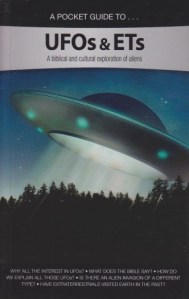
Okay, so this will require some explanation.  It came about like this: I was in a used bookstore.  (This in itself requires no explanation, of course.)  I noticed a slim book, cover out, called A Pocket Guide to UFO’s and ETs: A biblical and cultural exploration of aliens.  Biblical?  I picked it up only to discover it was from Answers in Genesis.  Please note: I do not buy books or paraphernalia of Fundamentalist groups unless I can get it used.  I don’t want to support this particular weirdness in any way.  Well, the money for this used book was going to support a used bookstore and not a religious aberration, so I figured it would be good to see what the Fundies have to say about a topic that seems to have started to engage public interest again.

The book begins by helpfully pointing out that if there’s life on other planets the Bible doesn’t mention it.  And since the only way it could’ve got there is by evolution—for surely the Almighty would’ve said something about it in his book, if he’d invented it—the whole idea is a non-starter.  Evolution, as everyone knows, is a satanic idea meant primarily to challenge the Bible and secondarily explain the diversity of life forms on earth.  And since earth is the only planet the Bible recognizes, it is the only one with life.  So, UFOs, it stands to reason don’t exist.  Well, that’s not quite fair.  They do exist but most can be explained away and those that can’t may well be demonic.  Since there can be no aliens, and since some sightings can’t be otherwise explained, then demons—which the Bible does mention—must be responsible.  They (demons) can also explain why other world religions exist.

There’s plenty in here to offend just about everyone apart from the Answers in Genesis crowd.  The screed spends quite a bit of time knocking down ancient astronaut ideas, and taking Erich von Däniken to task.  Science is useful in explaining how pyramids were built, but not in how the rock used to build them was formed (it takes far too long to make limestone the old fashioned way; God simply used a variety of different rock types to make the one inhabited planet more interesting geologically).  And those UFO religions?  Inspired by demons, no doubt.  In fact, even reading a little book like this could lead you to become interested in the subject, so be careful!  In fact, the safest thing of all (and I’ve only got your well-being in mind) is to leave it on the shelf.


Fear of Religions

There’s a narrative of fear in Christianity that seems to have been absent at the beginning.  This is evident when driving the highways of America where you’ll see billboards (which are meant for selling things) advertising the truth of a kind of biblical Fundamentalism.  On my recent trip across Pennsylvania this fear stood out in some rather obvious ways.  And it doesn’t reflect the Christianity reflected in the Good Book.  Stop and think about it: although the persecution of early believers was probably never as widespread as the usual narrative says it was, the writings we have describe facing persecution with joy.  Believing that they would be delivered, the oppressed welcomed the opportunity to prove their faith.  The Chick tracts I read as a child, however, focused intently on how scary the future persecution would be.  Fear, not joy, was the motivation for belief.

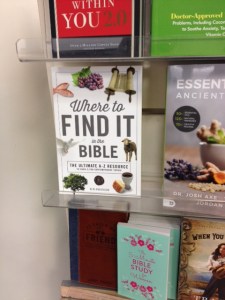
As we stopped in a turnpike rest area, we noticed a kiosk of Christian books amid snacks both salty and sweet.  The only other reading material available had to do with tourist attractions and finding directions.  It was, upon retrospect, odd.  Pondering this I recalled the narrative I heard repeatedly in my youth—a time was coming when it would be illegal to be Christian.  There would be persecution and the only proper response was a faith borne of fear.  This was not a religion of love thy neighbor.  No, this was a religion of armed survival based not on turning the other cheek, but on asserting itself with a show of firepower.  This kind of weaponized evangelicalism has taken over the narrative of Christianity.  Paul of Tarsus, knowing he would likely be executed, wrote of his joy from prison.  In the land of plenty we tremble.

The more cynical side of my experience suggests that politicians—who have learned that fear gets them elected—found in this form of Christianity a convenient set of sheep without a shepherd.  There’s fear in these billboards.  Fear that another religion may take over.  Or that secularism may make cherished beliefs illegal.  This isn’t cause for celebration, as the sermon on the mount proclaims it should be, but rather a call to arms.  In this country we have more than enough.  Among those left out, however, this fear grows just as rapidly as among those who fear they may lose the abundance they have.  They try to convert the weary traveler whose eye is drawn to the billboard.  And even those who stop for a drink of cold water which, the Bible suggests, should be freely given.


Different Kind of Salvation

It’s encouraging and disheartening all at the same time.  And seldom has the evil of money been so obvious.  Last night I attended an environmental panel discussion at a local church.  It was encouraging to see so many people out on a rainy, chilly night in Bethlehem, a city famous for its might steel mill.  Everyone there knew the problem and agreed that something had to be done.  As the speakers gave their presentations it became clear just how corrupt politicians are.  Corruption is bipartisan, of course.  In the name of “economic growth” we allow the fracking rape of our state despite the known and proven environmental hazards.  Despite the fact that Pennsylvania has a green amendment in its state constitution.  Money, as Cyndi reminds us, changes everything.

Shortly after even Mitch McConnell admitted climate change is real, at the state level climate deniers are running things.  It brought to mind the frightening and omnipresent teachings of my Fundamentalist youth: the sooner we can destroy this planet the sooner we’ll make Jesus come again.  Convinced of the absolute certainty of that second coming, there is almost a mandate to ruin, pillage, and plunder natural resources because the Good Book ensures us that, upon a white horse the savior will come in the nick of time.  Politicians, elected officials believe this.  They also believe in mammon.  If you’re gonna go down, you might as well do it in style.  Like John Jacob Astor on the Titanic.  It’s the way of the aristocrat.  Rising seas drown rich and poor alike.

It was a miserable night to be out.  The weather has been freakishly off for some time now, and all the science—real science, that is—predicts it’s only going to get worse.  How the government became the enemy of the planet that gave it birth would be a fascinating story if only it were fiction.  The truth is we’ve elected people that can be bought.  And bought easily.  Laws are passed that violate the constitution of this commonwealth and meetings are held behind closed doors.  Local activists are very active while most of us struggle to keep ourselves employed, heads, as it were, above water.  We need to pause now and again to consider what a wonder this planet is.  We must learn that the only power money has is that which we freely give it.  Rain was pouring down.  Brontide was actual thunder as the state legislature drew up chairs for the last supper.


Evolving Intelligence

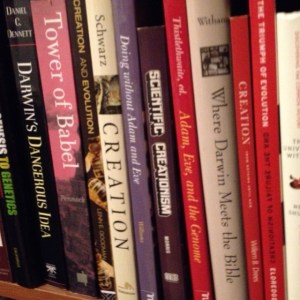
In the process of unpacking books, it became clear that evolution has been a large part of my life.  More sophisticated colleagues might wonder why anyone would be concerned about an issue that biblical scholars long ago dismissed as passé.  Genesis 1–11 is a set of myths, many of which have clear parallels in the world of ancient West Asia.  Why even bother asking whether creationism has any merit?  I pondered this as I unpacked the many books on Genesis I’d bought and read while teaching.  Why this intense interest in this particular story?  It goes back, no doubt, to the same roots that stop me in my tracks whenever I see a fossil.  The reason I pause to think whenever I see a dinosaur represented in a museum or movie.  When a “caveman” suggests a rather lowbrow version of Adam and Eve.  When I read about the Big Bang.

The fact is evolution was the first solid evidence that the Bible isn’t literally true.  That time comes in every intelligent life (at least among those raised reading the Good Book).  You realize, with a horrific shock, that what you’d been told all along was a back-filled fabrication that was meant to save the reputation of book written before the advent of science.  The Bible, as the study of said book clearly reveals, is not what the Fundamentalists say it is.  Although all of modern scientific medicine is based on the fact of evolution, many who benefit from said medicine deny the very truth behind it.  Evolution, since 1859, has been the ditch in which Fundies are willing to die.  For this reason, perhaps, I took a very early interest in Genesis.

Back in my teaching days it was my intention to write a book on this.  I’d read quite a lot on both Genesis and evolution.  I read science voraciously.  I taught courses on it.  I’d carefully preserved childhood books declaring the evils of evolution.  To this day Genesis can stop me cold and I will begin to think over the implications.  When we teach children that the Bible is a scientific record, we’re doing a disservice to both religion and society.  This false thinking can take a lifetime to overcome, and even then doubts will remain.  Such is the power of magical thinking.  I keep my books on Genesis, although the classroom is rare to me these days.  I do it because it is part of my life.  And I wonder if it is something I’ll ever be able to outgrow.


Fossilized Ideas

In our current political climate, perspective helps quite a bit.  Indeed, one of the shortcomings of our conscious species is our inability to think much beyond the present.  In either direction.  Because of the biblical basis of western civilization, a significant portion of otherwise intelligent people believe that the world was created 6000 years ago.  I grew up believing that myself, before I learned more about the Bible and its context.  I also grew up collecting fossils.  Somehow I had no problem knowing that the fossils were from times far before human beings walked the earth, but also that the earth wasn’t nearly as old as it had to be for that to have happened.  Faith often involves contradictions and remains self-convinced nevertheless.

While out walking yesterday I came across a fossil leaf.  Unbeknownst to our movers last summer, I have boxes of fossils that I’ve picked up in various places that I’ve lived.  I find it hard to leave them in situ because of the fascinating sense of contradictions that still grabs me when I see one.  There was an impression of a leaf from millions of years ago right at my feet.  It was in a rock deeply embedded in the ground and that had to be left in place.  Never having found a floral fossil before this was somewhat of a disappointment.  Still it left an impression on me.  Perhaps when dinosaurs roamed Pennsylvania—or perhaps before—this leaf had fallen and been buried to last for eons.  How the world has changed since then!

After that encounter, I considered the brown leaves scattered from the recently departed fall.  Some lay on the muddy path, but few or none of them would meet the precise conditions required to form a fossil.  If one did, however, it would be here after humanity has either grown up and evolved into something nobler or has destroyed itself in a fit of pique or hatred.  We know we’re better than the political games played by those who use the system for their own gain.  The impressions we leave are far less benign than this ossified leaf at my feet.  The Fundamentalist of the dispensationalist species sees world history divided into very brief ages.  God, they opine, created the entire earth to last less than 10,000 years.  All this effort, suffering, and hope exists to be wiped out before an actual fossil has time to form.  It’s a perspective as fascinating as it is dangerous.


You’re History

A story from Inside Higher Ed discusses a study of history majors and their rapid decline.  This occurs during a sudden onset of “job related” majors and the graph accompanying the article shows how STEM has taken over higher education.  These are the fields with actual occupations awaiting them at the end of the degree, while disciplines such as history and religion (also very near the bottom) have less clear career paths.  Indeed, when I’ve been in the job market I find that a religion degree is less than useless, no matter what the department recruiters tell you.  If you’re not bound for the clergy you undertake the study at your own peril.  History, I expect, suffers from a similar dynamic, but the peril in this case is to all of civilization.

We’ve seen over the past two years how a stunning lack of knowledge of history sets a nation on the path to chaos.  Businessmen with no classical education don’t make good national leaders.  Knowing where we’ve been, as Santayana so eloquently stated, is the only thing that keeps us from repeating past failures.  History is our only safeguard in this respect.  Over the Thanksgiving break I spent a little time delving into family history.  Since I don’t come from illustrious lineage, I felt the frustration of finding out what happened to obscure people from the last couple of centuries.  Lack of history on a personal level.  On a professional level, my doctorate is really in the history of religions (ancient religions) and I’ve become keenly aware of just how little history there is to the very popular modern Fundamentalist movement.

Maybe I said that wrong.  They do have a history, but the belief system that is touted as ancient is really quite modern.  Anti-modern, in fact.  When historical knowledge is lacking, however, people can make all kinds of claims based on nothing more than wishful thinking.  History keeps us honest.  Or it used to.  When we’ve outlived the need for history we’ve started down a path unlit by any embers of past human foibles.  We’ve been living in a culture in love with technology but not so much with critical reflection of where such innovations might take us.  Doctors are beginning to complain that they spend more time on their computers than with their patients.  The time freed up by the internet has been taken up by the internet.  And when all of this comes to its natural culmination, we would be well served by historians to make a record of what went wrong.  If we could find any.


Mythic Truth

“Myth embodies the nearest approach to absolute truth that can be stated in words.”  I recently came across this quote from Ananda K. Coomaraswamy.  Coomaraswamy was a philosopher and metapmhysist from Ceylon, and like many eastern thinkers had a more holistic view of the world than western rationalism.  We’re taught from a young age that myth is something false, not true.  This colloquial use of the word is so common that those of us who’ve specialized in myth slip into it during everyday conversation.  Words, however, have uses rather than meanings.  Coomaraswamy was engaging this reality in the quote above.  Words can take us only so far in exploring reality when we have to break into either formulas or poetry.  Although they are under-appreciated poets are the purveyors of truth.

Having studied ancient mythology in some detail, it became clear to me as a student that these tales weren’t meant to be taken literally.  Instead, they were known to be true.  It takes a supple mind to parse being true from “really happened,” as we are taught in the western world that on what “really happened” is true.  In other words, historicism is our myth.  Meaning may not inhere in words, but when we use words to explore it we run up against lexical limits.  Is it any wonder that lovers resort to poetry?  On those occasions when I’ve been brave enough to venture to write some, I walk away feeling as if I’ve been the receiver of some cosmic radio signal.  We have been taught to trust the reality of what our senses perceive.  Myth, and poetry, remind us that there’s much more.

The Fundamentalist myth is that the Bible is literally true.  If they’d stop and think about it, they’d realize the mockery such thinking makes of Holy Writ.  The Good Book doesn’t look at itself that way.  In fact, it doesn’t even look at itself as a book—an idea that developed in later times.  The time and the cultures that produced the Bible were cool with myth.  They may not have called it that but the signs are unmistakable.  Ananda Coomaraswamy knew whereof he wrote.  The closest to absolute truth we can come takes us to the end of declarative, factual writing.  Scientists writing about the Big Bang devolve into complex mathematical formulas to explain what mere words can.  Myth is much more eloquent, even if we as a society, dismiss it along with other non-factual truth.


Knowing How To Know

Some questions are deceptively simple.  For example: how do you know?  The fancy philosophical word for this is “epistemology,” although that often takes it a step further to ask how do you know you know.  Given that many powerful individuals are motivated by a Fundamentalist faith the question of how we know is more important than it might seem.  Back in the days when faith commitments meant thinking such things through, theologians in the western world came up with three bases of knowledge: scripture, tradition, and reason.  Anglicans, especially, favored this “three-legged stool.”  If you removed any one of the three, the stool became unstable, topsy-turvy.  The analogy worked well.  It assumed that all three factors would be weighed against each other.

Image credit: Blackash at en.wikipedia

As time went on two developments occurred—the wider belief in science, and the work of John Wesley, a priest in the Church of England and founder of the Methodists.  Science argued that reason alone led to knowledge, whereas Wesley’s thought suggested a fourth leg for the stool—experience.  This latter configuration eventually became known as the Wesleyan quadrilateral, sometimes one leg was bigger (usually Scripture), but the other three could not be dismissed.  Science, however, rested on a one-legged stool, reason alone.  Fundamentalism, which is a fairly new form of religion, chooses Scripture as its one leg for a wobbly stool.  It may sometimes claim “tradition,” but since it only dates to the nineteenth century its tradition can’t hold a candle to that of, say, Roman Catholicism.

Amid all the drama we see developing in the halls of government where, increasingly, the power to declare truth resides, it’s important to understand how we know.  For a large and growing segment of society Scripture has been removed as a leg of the stool.  For others it is the only leg.  Having attended a United Methodist seminary, I admit the Wesleyan quadrilateral made great sense as soon as I heard of it.  At the time I didn’t think of this, but if you remove Scripture, the stool still has three legs, and could stand for even a secular person.  Scientists, if they examine their own precepts closely, could see that their stool has those three legs: tradition, reason, and experience.  The largest, of course, is reason.  Still, science builds on the work of earlier thinkers (tradition) and the observation of results (experience).   Knowing how we know the truth has become a question that theologians would’ve never anticipated.  The self-assured assertions of a self-convinced egoist don’t have a single leg to sit on.


Chris 73 / Wikimedia Commons


Headline News

Some headlines just can’t be resisted.  George Knapp: Christian Fundamentalists in the Pentagon Shut Down Government Paranormal and UFO Probes Due to Demon Fears” is one such headline.  It appears on the blog of Jason Colavito, a name I recognized from the book The Cult of Alien Gods: H. P. Lovecraft and Extraterrestrial Pop Culture that I read several years back.  Skeptical of many strange claims made, Colavito criticizes journalist George Knapp for some sloppy reporting.  If you go all the way down the rabbit hole, you will end up in some very weird places indeed!  What caught my attention here, however, is the connection between demons and UFOs.  More than that, the claim that government funding was deep-sixed for fear of the Devil.  (Has anyone else noticed that it’s October?)

This isn’t the first time I’ve read about this.  Having grown up Fundamentalist, I often heard talk of the Devil’s wiles.  One of the things he had his demons do, I was told, was fly around in UFOs to deceive people into thinking demons were aliens.  If this sounds far-fetched to you, remember that God made dinosaur bones to plant in the ground to test people’s faith in Genesis 1.  That’s just the kind of universe we live in.  Better get used to it.  The real problem, and one with which Colavito concurs, is that high ranking military officers (and other government officials) believe the Fundamentalist screed.  This is a matter of documented truth—much of our government policy is dictated by the evangelical agenda.  Stranger than fiction.

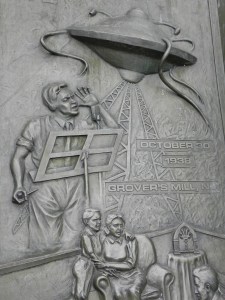
In 1952 there was a UFO flap in Washington DC.  No matter how you choose to explain it, this is an incident on the public record, and the Air Force responded with its famous temperature inversion explanation.  At the same time, some Fundamentalists were thinking that demons had improved on the bat-wings they’d been using for millennia.  They now zipped around in silvery discs with the same object as they’ve always had—to dis the Almighty.  As entertaining as such a story may be, it becomes scary when it might indeed be the motivation for government action.  I don’t know about you, but when I look at just how much of my meager paycheck goes to the powers that be, I want to know that rational people are spending it wisely.  Wait.  Well, I thought some of them were rational until a couple of years ago, about this time.  In any case, we do get some entertainment value for our cash, which is some comfort I suppose.  Keep watching the swamp!


Binaries

Inside, outside, upside-down.  The more life moves toward binary code—what isn’t computerized these days?—the more scholars are moving away from simple binaries.  Just when I thought I was getting used to this sacred/profane divide, academics are scrapping it for more nuanced paradigms not based on any assumptions of presumed deities and their projected wishes.  Nothing as simple as “either/or” could justify all these salaries for stuff you can just look up on the internet, after all.  Still, binaries are a very human way of looking at the world.  Light and dark doesn’t mean there aren’t all the shades in between.  And the very basic difference between inside and outside may be far more helpful than it might appear.

Being inside a religious tradition—really being inside—creates a pattern of thinking that frames all of one’s experience of life.  While reading about the Book of Mormon recently this became clear to me.  Looking at it from the outside is something those on the inside have great trouble doing.  The same is true of various Eastern Orthodox Christian traditions, or Evangelicalism.  Those living on the inside of tightly constrained ways of thinking—believing—can’t see what it looks like from the outside.  I suspect that not all religions traditions fall into such ways of thinking; there are shades here.  “Mainstream” Christianities, for example, tend to blend at the edges and those inside might have an idea of how those on the outside view them.  Lutherans know the jokes about their outlooks and can even tell them.  Methodists and Presbyterians too.  They tend to conform a bit to expectations and  tend not to be extremist about things.  Being mainstream will do that to you.

It is unusual for a person to change religious traditions.  Those who do can see their former tradition from the outside—whether mainstream of not—with a kind of objectivity that frightens true believers.  Most religions have some tenets that look a bit unbelievable when viewed from outside.  Once seen from that perspective, however, there’s no unseeing it.  I grew up Fundamentalist.  After some time in the mainstream Methodist tradition I could see Fundamentalism from the outside.  When I eventually joined the Episcopal Church I had been viewing it from the outside my entire life up to that point.  Looking at faith traditions inside out offers perspectives otherwise not to be had.  Nobody wants to believe the wrong religion.  Perhaps that’s why it’s so difficult to look at your own from the outside.  You have to be willing to accept shades of gray, even if looking at it in a binary way.


Galilean Blues

Call me nostalgic, but growing up Fundie, “Capernaum” tripped easily off my lips.  In fact, it was a word I heard very frequently at church, always pronounced “kap-er-NEE-um” (please pardon my amateur phonetics).  Even though no one I knew had ever been to Israel, we all knew it was in Galilee and that it figured large in the early life of Jesus of Nazareth (although we assumed he was surnamed “Christ”).  When I attended seminary I was surprised to hear the geonym pronounced “ka-per-NUM.”  It sounded so sophisticated—aristocratic, even.  Still, everyone at Boston University School of Theology knew what, and roughly where, it was.  It was a household name, no matter how you pronounced it.

Spellcheck disagrees.  It doesn’t recognize one of the most famous places in the New Testament.  Now, I’m aware that my view of things is idiosyncratic.  This blog should be proof of that.  Those who grow up from Fundamentalism often know this experience—something that everyone knew when you were young and informed is arcane knowledge to the rest of the world where Kardashians and Sedarises are household names.  The Bible, irrelevant at best, is a foreign country.  Then the religious right comes to power and everyone’s confused.  They don’t speak the same language as the rest of the world.  They say kap-er-NEE-um.  Others scratch their heads and glance at their knee caps.

When I visited ancient Capernaum it required some imagination to reconstruct what it had been, back in the day.  Since the ruins were relatively recent—only a millennium or two—some of the buildings were still above ground, including the famous synagogue.  Even among the unchurched archaeologists, everyone knew the connection of the city to Jesus of Nazareth.  That doesn’t mean, however, that the programmers responsible for spellcheck recognize the name.  Kardashian doesn’t get a red underline on my word processor.  Even in the first century, however, Galilee was a backwater (with real water!).  Important people came from big cities and had family connections.

Some things don’t change much over the millennia.  The famous often find their spotlight because of connections.  If the deity decided to incarnate today, s/he’d know to get a website put together first.  And it would help to have some product endorsements.  Even salvation at a click isn’t enough to draw most people in.  Of course, the matter of name—excuse me, “brand”—is important.  More than anything, you want something people can pronounce.  And just to be safe, anchor it to either New York or the city named The Angels.


Personifying Evil

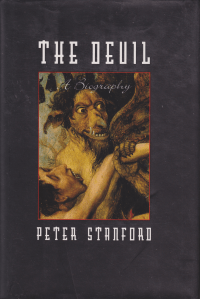
Biographies seldom cover millennia. Even if one were to try to uncover all the scant facts on old Methuselah at 969 years, it would still fall short of four digits. So Peter Stanford’s The Devil: A Biography takes the long view. Even with that lengthy perspective, there’s little that might be known about the prince of darkness. Even with a role in the Good Book his appearances are few and details are lacking. What Stanford does, of course, is outline, more or less, the history of Satan. This is no easy task since few ancient sources focus on trying to provide explanations for exactly who this might be.

As with most books by non-academics (and I don’t mean to sound snobbish here) there are some overstatements. Some of the details aren’t so finely parsed. It’s the big picture the author’s after and he does quite well when it comes to the modern era. Not only is there enormously more material from which to choose, there is also a great deal of literature and even headlines available to harvest. All writers that I’ve encountered on the subject make the point of demonstrating that news of what’s happening in the modern world suggests either the Devil exists or that something (or things) is doing a great job parodying such a character. When seeing evil in the highest reaches of the government it’s not so hard to believe.

The thing about the Devil is that he almost died out. In the nineteenth century when the explanatory value of science was firmly kicking in, and industrialization was making our live both easier and harder, the dark lord went underground. Humans seemed capable of making and claiming their own evil, and even the professionals—the clergy and formal religionists—had admitted Satan was most likely a metaphor gone wild. The birth of Fundamentalism, a movement that became prominent only in the 1920s, necessarily resurrected the Devil. The Bible does mention Lucifer, so he had to be real. Since that day he’s learned a lot. Protean to the extreme, he bears many guises. No longer beholden to a demonic tail, cloven hooves, or a pointy beard, he most often appears clean shaven and wearing expensive business suits. Borrowing a phrase from the Good Book, it’s by his fruits that we know him. Stanford’s biography shows its age a little, but when you’re covering a couple thousand years of speculation, being outdated is only a venial sin.