Talking to Vampires

Perhaps it’s the unremitting dissatisfaction of Louis, but I had trouble getting into the novel Interview with the Vampire.  I put it down for over a year before picking it back up and finishing it.  I wasn’t inclined to see the movie, but it’s the season for vampires, and since it was a commercial and critical success, I gave in.  Although I still found the story depressing, the movie works fairly well.  The A-list of handsome actors gave me pause, but they seem to have taken to their roles pretty readily.   In case you’re unfamiliar, Louis is turned into a vampire in the eighteenth century in Louisiana by Lestat.  Lestat is a French vampire and, for many years, the only other one that Louis knows.  To convince Louis to stay with him, Lestat saves one of Louis’ victims, a young girl named Claudia, turning her into a vampire.  After thirty years as a child, she too becomes dissatisfied and “kills” Lestat.
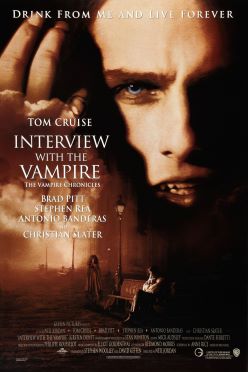
Free from Lestat’s influence, in Paris Louis and Claudia find Armand, who has a theater full of vampires.  Claudia is killed by exposure to sunlight, for killing Lestat, but Louis is rescued by Armand.  Still dissatisfied, Louis returns to New Orleans where he finds Lestat alive, and by the end of the eponymous interview, quite well.

The movie sets its own rules for what harms a vampire.  Crucifixes don’t bother them, nor does garlic deter them.  Staking them doesn’t work.  They can be dismembered, burned to death, and exposed to sunlight, however.  Vampires have a flexible mythology.  Even though they can move much faster than a human, they don’t always use this skill when fighting one with another.  As I think over this, the movies that have multiple vampires often do similar things; fights between immortals hold their own contradictions, it seems.

With the screenplay written by the author of the novel, it’s no surprise that the film doesn’t appear to deviate in any major way from Anne Rice’s printed story.  Of course, it’s been a few years since I’ve read it.  Apart from the difficulties in consistency mentioned above, the film is well made.  Sympathy for Louis grows readily enough, even though his disappointment at his vampire state remains intact.  Visually it scratches an itch for a (mostly) period vampire piece.  The child vampire—the most striking element in the novel—remains compelling in the movie.  The time is compressed somewhat from the original story.  Given time I may warm up to the series.  I’ve never explored The Vampire Chronicles further, but perhaps I shall.

Joban Vampires

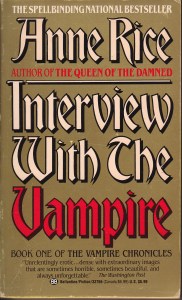
Interview VampireThe first vampire novel I ever read, I remember correctly, was one of the Dark Shadows series written by Marilyn Ross. I don’t recall which one, since I had to buy my books from Goodwill or some such vender utilized by the poor. Now, I’m really a squeamish guy and the sight of blood bothers me. Barnabas Collins, however, was a compelling character—deeply conflicted and a reluctant vampire. The combination of his sadness and the setting in coastal Maine kept me looking for Dark Shadows books every time we went shopping. It surprised me, given all that, that I had such difficulty getting into Anne Rice’s Interview with the Vampire. I started reading it years ago (it was also a second-hand copy, and, interestingly, the color scheme of the cover nearly matched Dark Shadows novels) and some eighty pages in put it down only to forget about it. Starting from the beginning a few weeks ago, I gave it another try. Although Louis is a conflicted vampire, the pace is languid and it was almost as if the self-pity was overdone. I was determined this time, however, to see it through.

One of the recurring themes of the book, and I presume the Vampire Chronicles series, is that vampires are not evil because of the Devil. In fact, there is nothing Satanic about them. Blame tends to fall on God for their state. The more I thought about it, the more the theodicy of the vampire began to resemble that of Job. Like Job, death for a vampire takes a long time. There is much suffering along the way. Louis can love, in a measure, and can loath himself. He never really understands what it is to be a vampire. The other undead he meets help to define him, but he can’t get too close. His life is a kind of Hell without Satan.

Rice’s vampires don’t fear crucifixes or shun churches. In fact, Louis takes a priest as one of his victims, sacramentally near an altar in a church. Religious imagery and discussion abound in the book. It truly is a vampire theodicy. Perhaps, for its day, it was the next step in vampire evolution. Bram Stoker, while the most famous contributor to the modern vampire myth, didn’t corner the market on defining the undead. When Louis meets vampires of the old world, they are mindless, plodding killing machines that even other vampires avoid. Rice’s vampires feel, think, and yes, theologize. I feel strangely satisfied now that I’ve finally finished the Interview. It was a vampire at my bedside for so long that it feels like an accomplishment to have finally laid it to rest.