
Perhaps it’s the unremitting dissatisfaction of Louis, but I had trouble getting into the novel Interview with the Vampire. I put it down for over a year before picking it back up and finishing it. I wasn’t inclined to see the movie, but it’s the season for vampires, and since it was a commercial and critical success, I gave in. Although I still found the story depressing, the movie works fairly well. The A-list of handsome actors gave me pause, but they seem to have taken to their roles pretty readily. In case you’re unfamiliar, Louis is turned into a vampire in the eighteenth century in Louisiana by Lestat. Lestat is a French vampire and, for many years, the only other one that Louis knows. To convince Louis to stay with him, Lestat saves one of Louis’ victims, a young girl named Claudia, turning her into a vampire. After thirty years as a child, she too becomes dissatisfied and “kills” Lestat.
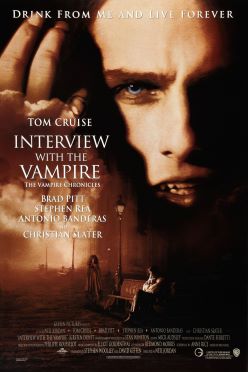
Free from Lestat’s influence, in Paris Louis and Claudia find Armand, who has a theater full of vampires. Claudia is killed by exposure to sunlight, for killing Lestat, but Louis is rescued by Armand. Still dissatisfied, Louis returns to New Orleans where he finds Lestat alive, and by the end of the eponymous interview, quite well.
The movie sets its own rules for what harms a vampire. Crucifixes don’t bother them, nor does garlic deter them. Staking them doesn’t work. They can be dismembered, burned to death, and exposed to sunlight, however. Vampires have a flexible mythology. Even though they can move much faster than a human, they don’t always use this skill when fighting one with another. As I think over this, the movies that have multiple vampires often do similar things; fights between immortals hold their own contradictions, it seems.
With the screenplay written by the author of the novel, it’s no surprise that the film doesn’t appear to deviate in any major way from Anne Rice’s printed story. Of course, it’s been a few years since I’ve read it. Apart from the difficulties in consistency mentioned above, the film is well made. Sympathy for Louis grows readily enough, even though his disappointment at his vampire state remains intact. Visually it scratches an itch for a (mostly) period vampire piece. The child vampire—the most striking element in the novel—remains compelling in the movie. The time is compressed somewhat from the original story. Given time I may warm up to the series. I’ve never explored The Vampire Chronicles further, but perhaps I shall.

