It’s a Series

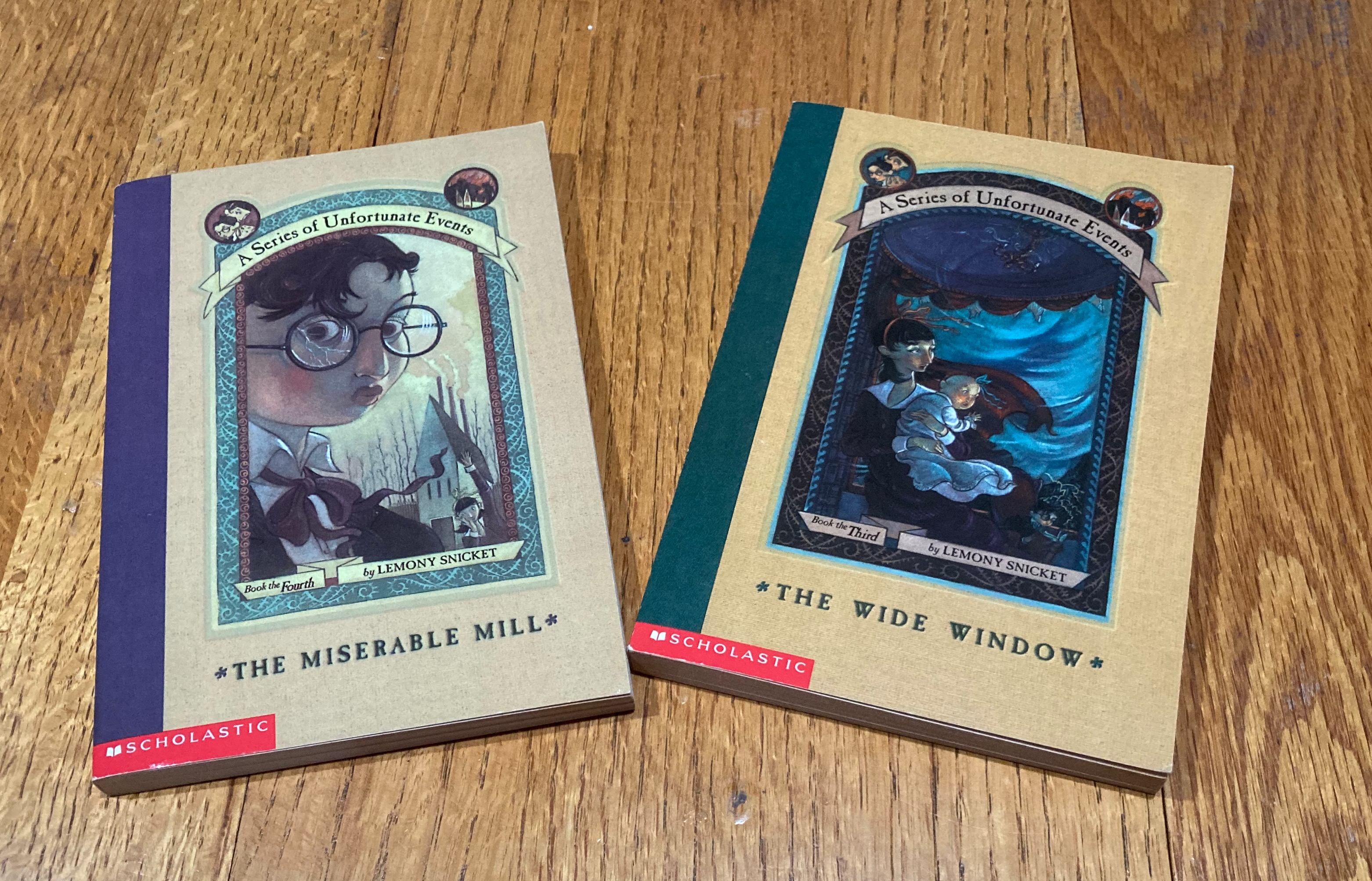
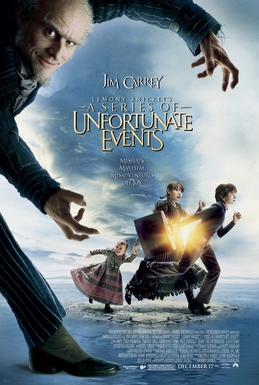
The transition between Lemony Snicket’s The Wide Window and The Miserable Mill, volumes three and four, respectively, of A Series of Unfortunate Events, is the gulf between what was portrayed in the 2004 movie and what wasn’t.  The books do show their age a bit in that some of the villains might be considered offensive these days, but the writing is clever and even educational.  Dealing with two of them together is, like the film, an attempt to forge a transition.  The Wide Window, which is both compressed and elaborated in the movie, doesn’t resolve itself as portrayed on the screen.  Of course Count Olaf is at large again and the Baudelaire orphans are left homeless once more.  In the movie Jim Carrey’s Captain Sham is perhaps his best character with his attempts at a cross between a sea captain and a Newfoundland landlubber.  The book raises the ethical issue of what laws it’s permissible to break to save your life, which is missing in the film.

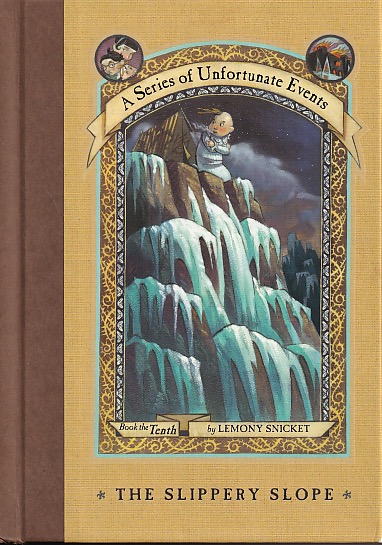
The Miserable Mill, book four, reflects how dark these tales can be without the movie to lighten the mood a bit.  Maybe not quite enough to categorize them as horror, but enough to make them somewhat scary.  Here the orphans have reached the end of their family connections and are passed off to the owner of a lumber mill who puts them to work right away.  Of course, Count Olaf is lurking nearby and is working with an ophthalmologist who specializes in hypnosis.  It is actually a frightening thought to be hypnotized against your will.  The orphans learn to appreciate how difficult their siblings’ specializations are and, of course, make it through together.

Hypnosis is something I’ve never experienced.  I went to a show once where the stage performer attempted to hypnotize the audience.  I was fervently religious at the time, and it didn’t work on me.  I’d read that religious people are difficult to hypnotize (that is, those who haven’t been hypnotized already).  Since that time I’ve been curious if I might be hypnotized as an adult, and, if so, what it would be like.  As a mental state, hypnosis is still poorly understood.  It is used in literature, not uncommonly in horror.  I will, of course, continue working my way through A Series of Unfortunate Events because once you get started it’s difficult to stop.  It is obvious, however, that I’ve watched the film enough to have a sense of what transpired through The Wide Window.  Now, with and after The Miserable Mill, I have little recollection of what might be ahead.


Lemony Reptiles

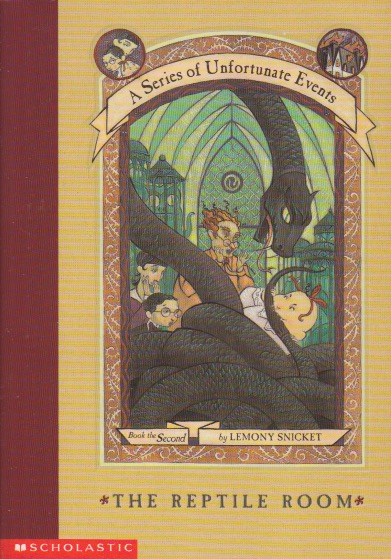
Having embarked on A Series of Unfortunate Events again, and having just finished The Reptile Room again, I might reflect on Lemony Snicket’s contribution to dark academia.  I mentioned to a friend recently that some dark academia aficionados consider the series to fall into that genre.  Having had the books read to her at a young age, she asked “Why?”  That got me thinking again about this wide, wonderful, amorphous category of books.  In my personal calculus, dark academia involves education—and this may be book learning undertaken independently—something going seriously wrong, and, in the best of it, a gothic atmosphere.  While A Series of Unfortunate Events is generally quite funny and fun to read, it clearly has the main elements I seek in classifying dark academia.  The Baudelaire orphans are pursued relentlessly by Count Olaf in a setting which, although difficult to place time wise, has Victorian aesthetics.

Of course, The Reptile Room is the second book utilized by the movie A Series of Unfortunate Events to get it up to feature length.  Reading it again revealed just how distorted my memory of the story had become by the movie.  The resolution of the scam by Stephano in the film is merely a distraction by the children to come to the real reveal in the book.  I’m not one to diss the movie.  It is quite gothic and it has many quotable moments, but it isn’t the same as the books.  I still remember when we first learned about these books from a niece, very young at the time, who enthused about them.  We were just a little cautious about reading scary stories to our daughter because one Roald Dahl book we read really was too gruesome for a child of tender years.  We immediately loved this series, however.

A quarter century or so is plenty of time to forget details.  Rereading these books also reminds me how influential they were on some of my own writing, although I read them as what passes for an adult at the time.  (I was old enough to be, and indeed was, a father.)  It occurs to me, as it likely did back then, just how clueless adults are.  Some of the descriptions of Count Olaf in this book could easily be substituted for a particular denizen of the Oval Office these days.  And, I suspect, children are able to see through those who constantly make up excuses to cover their own incompetence.  I’m looking forward to The Wide Window.


Bad Start

I’m not too proud to admit to reading books for young readers.  On a recent family night we watched the 2004 film, A Series of Unfortunate Events (not for the first time), and I realized that my memory of the books by Lemony Snicket was hazy.  Since we bought and read all the books for my daughter, I pulled The Bad Beginning from the shelf and read it in a couple of hours.  Although it was published over a quarter century ago, it is still fresh and it stands as one of those books (and series) that defied convention and presented stories that were potentially disturbing for children.  I have to admit that another of my motivations in re-reading this was the suggestion that perhaps on another family night we might start watching the Netflix adaptation, which, as I understand it, is better than the theatrical movie.

The movie, of course faced a dilemma.  There are thirteen books in the series—too many to comfortably fit into one film.  Each individual book, however, is too slim to fill out a feature-length presentation.  The decision was made to blend the first three books together, beginning and ending the show with the events from The Bad Beginning.  If you’re not familiar with the series, even if you don’t have children, the books are an entertaining read.  Snicket, who was later revealed to be Daniel Handler, is quite a clever author and there were a couple of points that had me, well, snickering out loud.  In any case, I’m given to understand that the Netflix series tackles this conundrum of too much/little material by being, ahem, a series.

A brief summary of The Bad Beginning may help if you’re still undecided about reading it as an adult.  The three Baudelaire children, Violet, Klaus, and Sunny, are orphaned in a fire.  Adopted by their scheming uncle, Count Olaf, they are immediately put in peril as he tries various ways to get at their parents’ fortune.  Since Olaf is a thespian, he devises a plot to hold a wedding between himself and fourteen-year-old Violet in disguise as a play.  The plot is foiled, of course, by the children.  The book ends by letting the reader know that the orphans are still in danger because Olaf has escaped and remains at large.  That would take quite a lot of padding to get a feature-length film out of it.  It works quite well as a brief book for young readers.  I was impressed at both the set-up and execution when I first read this many years ago.  And I liked it again the second time through.


Golem Events

Public domain, via Wikimedia Commons

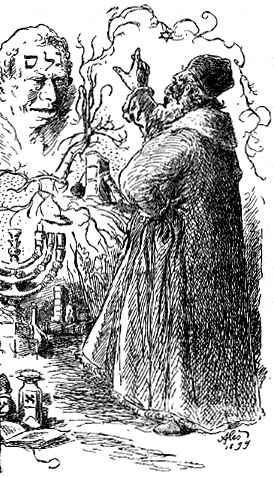
It doesn’t have a title yet.  At least not one that’s announced.  Still, when a friend pointed out this article that Daniel Handler, better known as Lemony Snicket, is writing a horror film about a golem, I sat up straight in my chair.  Since I don’t tend to dwell on children’s topics here, it may not be obvious that I was a real fan of A Series of Unfortunate Events, by Lemony Snicket, back when they came out.  Alerted to this series by a cousin who was my daughter’s age, we made this bed-time reading for a few years.  Handler, in the early days, did a pretty good job of keeping his identity secret.  He’s written some adult fiction, and those of us who write know that readers want more of the same thing from a writer—if you want to survive you do what they ask.

I’m a very eclectic reader—that may be one reason I don’t have many followers on this blog.  People like the same thing time and again.  (I’ve always been suspicious of genres.  One of the reasons, I suspect, that my students found my lectures interesting is that I drew from my eclectic reading, but that’s ancient history now.)  In any case, A Series of Unfortunate Events was formative in my own writing.  The movie remains one of the most gothic available, but it pales next to the novels.  Yes, they’re written for young readers, but they’re also very well written for young readers.  I discovered Snicket, or Handler, was Jewish when he wrote The Latke Who Couldn’t Stop Screaming.  And now he’s turned his attention to one of my favorite monsters.  The golem has been part of horror from the earliest days of the genre (that word!).

Paul Wegener and Henrik Galeen’s The Golem, part of a trilogy, came out in 1915.  Before the Universal monsters.  Even before Nosferatu.  The legend of the golem—which may have inspired Frankenstein—has a long history.  While not biblical, the golem does go back many centuries.  Unfortunately these early horror films are lost, or mostly lost.  The Golem and the Dancing Girl, from 1917, is a lost comedy horror.  The third film, The Golem, How He Came into the World, from 1920, survives and is sometimes called “The Golem.”  I wrote earlier about the excellent 2018 film The Golem by Doron and Yoav Paz, sensitive to Jewish issues in the seventeenth century.  This sub-genre of golem movies may be starting to come into its own.  It remains to be seen what Handler will do with it, but if his previous work is anything to go by, we may be in for a real treat.


Universal Books

I’m reading an overwritten book right now.  In fact, I just finished an overwritten book.  Such works, I suppose, are the results of being taught how to write.  It’s not that people can’t be taught to compose, but for various reasons some authors, either through the privilege of having high-powered publishers, or their own conviction that they don’t require correction, overwrite.  I suppose overwriting is, like beauty, in the eye of the beholder.  Several years back I recall a critic stating Lemony Snicket’s A Series of Unfortunate Events was overwritten.  I thought it was fun.  Yes, deliberately exaggerated, but nevertheless well-composed.  Those books were enjoyable to read because, I think, they refused to take themselves seriously.  Writers can be temperamental people.

As an editor something I need to repeat—for academics are consummate overwriters—is to keep your intended readership in mind.  No book is written for everyone.  In fact, many people can’t make it through books like the Bible because they’re hard to read.  Religious books often are.  There’s no such thing as a universal book, but some believers in some religions make the claim for their sacred texts.  Like many curious people I find it rewarding to read the scriptures of other traditions.  It’s not always easy—in fact, it seldom is.  It’s frequently disorienting and I look for an edition with an introduction.  The reason is when it comes to books, even sacred ones, it’s not one size fits all.  Many religious conflicts in the world could be resolved if we’d just realize this.

Someone who reads a lot is bound to be disappointed from time to time.  We turn to books either looking for a certain mood or specific pieces of information.  Authors often take things in their own directions.  Our minds don’t all work in the same way.  That’s why, in my opinion, reading is so important.  I prefer “long form” writing—I always have.  Sometimes an idea can be well expressed in an article, but taking the time to develop ideas requires a nuance not all publishers appreciate.  (Yes, I realize that by expressing this sentiment in a brief essay like this I leave myself open to deconstruction—one of the overwritten books I just read was written by a deconstructionist.)  Still, I have trouble abandoning books that take ideas in a way I wouldn’t go.  Usually when I start reading, I’m committed to finish.  Some would say that’s foolish.  I take it as a learning opportunity.


Ode to Zibaldone

Scribbling. All it takes is a margin of an agenda paper or the back of an envelope. I don’t remember when I started doing it—I’ve been writing my own blend of fiction, facts, and philosophy since I was in elementary school—but I would find a relatively clean piece of paper, fold it up, and put it in my pocket. I’ve carried a pen around with me for decades. Why? You never know when an idea might strike. There’s nothing like the discovery of a new idea. Lifelong learning is like that. So it was when I was reading Lemony Snicket’s Series of Unfortunate Events to my daughter that I learned about commonplace books. A commonplace book is a notebook where you jot all kinds of things down and you know where they are, unlike that piece of paper in my pocket that long ago started to rip apart at the folds, the ink becoming illegible as the paper grew softer and more pliable. A commonplace book seemed like a great idea.

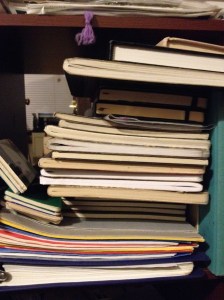
This all came back to me when a friend send me a story on zibaldones. I’d never read the word before. A zibaldone, according to the story by Cara Giaimo on Atlas Obscura, is an Italian commonplace book. They used to be part of every thinking person’s accoutrements. A blank book where you could write down anything of importance. Giaimo suggests that the internet has taken the place of the zibaldone—blogs, Facebook, Twitter, Pinterest—we’re spoiled for choice where to put our thoughts. I still carry a commonplace book, however. Too many, in fact. Next to my writing chair rests a stack of notebooks. There’s one for each non-fiction book I’ve written, whether published or not. There are several filled with fiction. Some with poetry. My most recent zibaldones are Moleskines, which I purchased—as many as I could afford—when Borders sadly went out of business. Ideas. They just keep coming.

Some of my notebooks.

Some of my notebooks.

Perhaps the greatest benefit of the zibaldone is that, if one survives, an historian gets a glimpse at what someone who was not famous saw. Observations about the world scribbled down. The most proficient of scribblers organized their commonplace books in advance. As for me, I still scribble things on scraps of paper. I carry a notebook and pen at all times, but sometimes an idea is so slippery I don’t have time to pull a formal zibaldone from my pocket. I tape scrapes of paper into my notebooks. Right next to new words I’ve learned. Somewhere among today’s scribbles you’ll find the word zibaldone along with the hope that some day some of this might be significant.