Bad Start

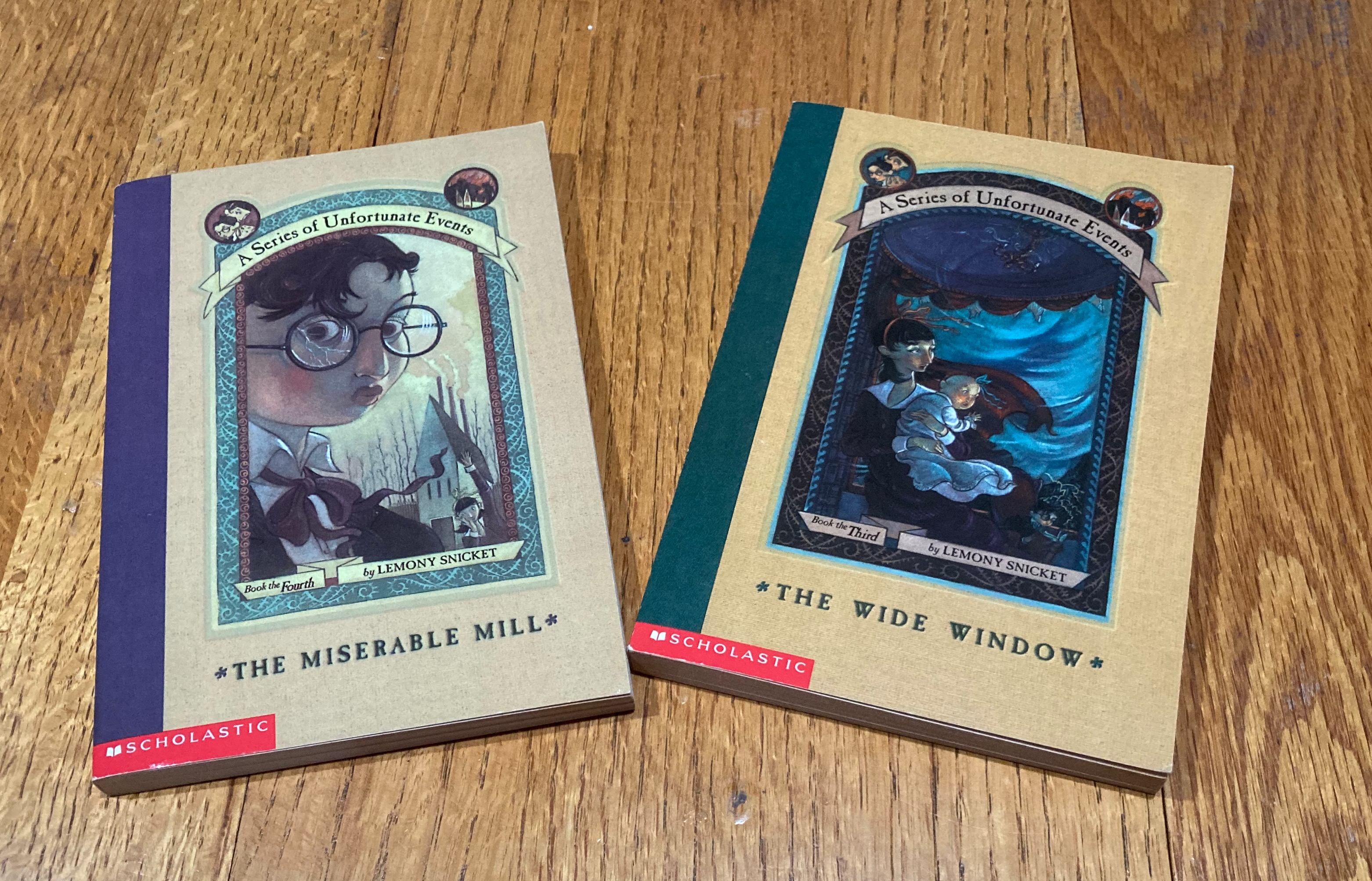
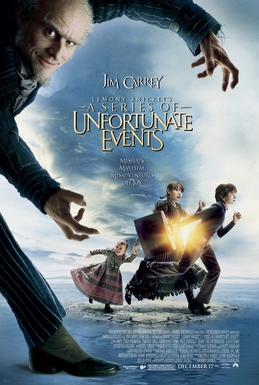
I’m not too proud to admit to reading books for young readers.  On a recent family night we watched the 2004 film, A Series of Unfortunate Events (not for the first time), and I realized that my memory of the books by Lemony Snicket was hazy.  Since we bought and read all the books for my daughter, I pulled The Bad Beginning from the shelf and read it in a couple of hours.  Although it was published over a quarter century ago, it is still fresh and it stands as one of those books (and series) that defied convention and presented stories that were potentially disturbing for children.  I have to admit that another of my motivations in re-reading this was the suggestion that perhaps on another family night we might start watching the Netflix adaptation, which, as I understand it, is better than the theatrical movie.

The movie, of course faced a dilemma.  There are thirteen books in the series—too many to comfortably fit into one film.  Each individual book, however, is too slim to fill out a feature-length presentation.  The decision was made to blend the first three books together, beginning and ending the show with the events from The Bad Beginning.  If you’re not familiar with the series, even if you don’t have children, the books are an entertaining read.  Snicket, who was later revealed to be Daniel Handler, is quite a clever author and there were a couple of points that had me, well, snickering out loud.  In any case, I’m given to understand that the Netflix series tackles this conundrum of too much/little material by being, ahem, a series.

A brief summary of The Bad Beginning may help if you’re still undecided about reading it as an adult.  The three Baudelaire children, Violet, Klaus, and Sunny, are orphaned in a fire.  Adopted by their scheming uncle, Count Olaf, they are immediately put in peril as he tries various ways to get at their parents’ fortune.  Since Olaf is a thespian, he devises a plot to hold a wedding between himself and fourteen-year-old Violet in disguise as a play.  The plot is foiled, of course, by the children.  The book ends by letting the reader know that the orphans are still in danger because Olaf has escaped and remains at large.  That would take quite a lot of padding to get a feature-length film out of it.  It works quite well as a brief book for young readers.  I was impressed at both the set-up and execution when I first read this many years ago.  And I liked it again the second time through.


Gothic South

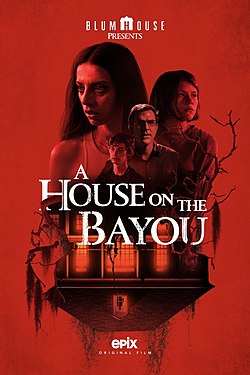
Southern gothic has a certain appeal even to northerners.  Casting about for a weekend movie included in one of our streaming services, A House on the Bayou suggested itself.  I hadn’t heard of it before, but it bore the Blumhouse brand, so I gave it a try.  In this age of digital production, it is the equivalent of a “straight to video” release.  The story is a bit confusing but the atmosphere is creepy and most of the acting is good.  Spoilers may arise from this point on.  John is having an affair with a younger woman and Jessica has found out.  She insists that if John wants to save their marriage he has to agree to a vacation with her and their daughter Anna.  Down on the bayou.  Once they get there both Jessica and John’s passive aggression towards each other is on show.

A couple of locals, eighteen-year-old Isaac and his Grandpappy, stop over.  It’s pretty obvious from the beginning that there’s something off about the pair.  Isaac clearly has supernatural powers and soon begins to threaten the family.  It turns out that John, knowing Jessica would insist on coming to this house, had pre-hired Isaac and Grandpappy to kill Jessica and make it look like a robbery.  Thing is, Isaac and Grandpappy have moral fibre.  They lock John in a hidden room with a demonic coyote that eats him.  And they burn his lover to death.  Jessica and Anna, who still love John, want to save him and after Jessica kills Grandpappy and Isaac, goes to the police.  It turns out that there is no house on the bayou and they all know about Isaac and Grandpappy, who are still alive, because they’re beings who kill evil-doers.

While not a great movie, this is one that’s heavily invested in religion and horror.  Morality is defined, according to Isaac and Grandpappy, by the Bible.  There is some confusion in the plot, however, when Grandpappy denies Isaac is his grandson and the locals seem to say he is.  Isaac implies that he’s the son of the Devil.  Grandpappy says Isaac never ages, but he tells John he’s 21 and has been in the Army (he tells Anna he’s 18).  Although he protects morality, Isaac attempts to abduct Anna to “marry” her, although she’s only 14.  There’s a good attempt to integrate religion into this horror, but as often happens, the religion is inconsistent with what it claims to be.  I’m not sure how many viewers pay attention to such things, but some of us do write books about it.  Overall, it is passable southern gothic for a rainy afternoon.


Made to Order

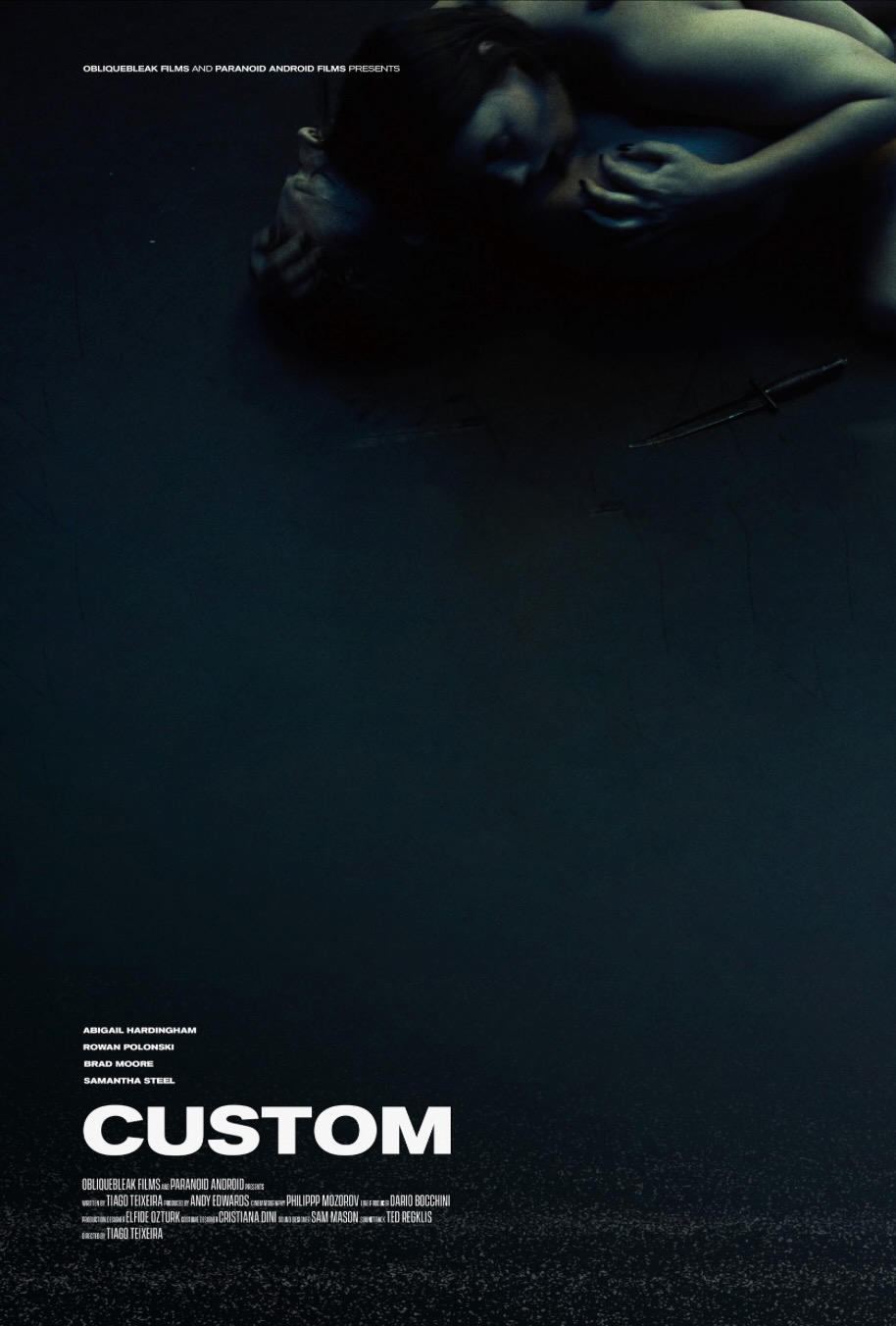
Like those who’ve commented on IMDb, I watched Tiago Teixeira’s Custom because of its brief 77-minute showtime and its horror label.  An artsy film, it feels kind of unfinished.  It’s clearly a movie about demons, but it doesn’t give enough to really figure it out.  Jasper and Harriet are young artists who are having a difficult go of making a living (something we all recognize as true).  They decide to try making custom erotic films for the internet and this brings them to the attention of a mysterious benefactor who pays them 10,000 pounds for each film made to his specs.  They have to shoot on VHS, and once the film begins rolling, and a strange chanting starts, they fall into a trance and don’t recall what they did.  They’re instructed never to watch the tapes, but when they do what they find disturbs them.  Jasper tries to find out something about the purpose of the films (they’re not posted anywhere) only to discover that they are somehow laced with the Key of Solomon.  In case you haven’t read Holy Horror, the Key of Solomon is a grimoire for summoning demons.

At one point, the friend who brings them this gig asks Jasper what his idea of Hell is.  Jasper says being stuck, not able to move forward.  Towards the end of this short movie, Jasper is shown being stabbed by Harriet, something he experienced at the beginning of the film (without showing who’d stabbed him).  The implication is clearly that he’s stuck in a loop.  He’s reliving being attacked—maybe fatally wounded—by his girlfriend.  At one point their patron asks him if he knows who Harriet’s sleeping with when she’s not home.  It seems, between the demons and the nightmare scenario, that Jasper is in Hell.

This strange, little film engages religion and horror.  At one point, the friend who brings Jasper this job, says that the saints were the original perverts.  He mentions some mutilations in the lives of a few saints, including St. Lucy of Syracuse, who is often shown carrying her own gouged-out eyes.  This brought to mind The Nun II, a film released some six months earlier, that also involves the same eyeless saint.  There’s no doubt that the stories of the saints are good fodder for horror.  It seems that one of the reasons such stories were told was to evoke just that feeling.  So Custom is a film that engages religion and horror.  The connection with demons isn’t made clear, but they’re obviously part of the story of one artist’s personal Hell.


Sluggish

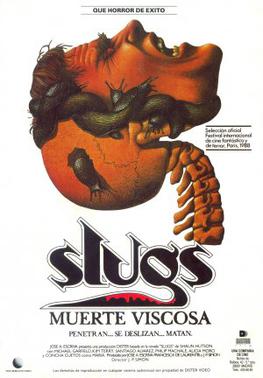
If you enter into it with the spirit of the thing, Slugs is actually better than you might expect.  You have to expect that it’s going to be hokey and outlandish, with bad acting.  With all of that in the assumed category, it’s a passable horror film.  I was surprised to learn, in the opening credits, that it was based on a novel.  That makes me almost curious enough to read it.  Set in a small town in upstate New York (Ashton), the movie is about carnivorous slugs.  There’s an incipient humor about the idea and although no planned laugh-out loud moments permeate this film, there are plenty of incredulous snort opportunities.  The local health inspector is the first to cotton onto the fact that the slugs are attacking, but even he doesn’t believe his own wife at times when she points out their unusual behavior.

There’s a lot of running about and trying to get officials to do something about it, but who takes slugs seriously?  Meanwhile the gastropods eat the town drunk, a gardener, a young couple making out when the parents are gone, and are responsible for the death of a local developer.  That leads to the gore required by the tale.  Finally the health inspector teams up with the local sewage inspectors and a high school science teacher who figures out a way to blow up the slugs.  In some respects the movie resembles Evolution at this point—using a pumping truck to spray the invaders with a chemical solution that saves the day.  The best friend of the protagonist does get eaten by the slugs while trying to save the town, but otherwise there’s a happy ending.

This is a bad movie but it’s better than many “so bad it’s good” features.  Some competent work is done with special effects and the story itself is laughable (I don’t know about the original story).  I have a weakness for innocuous creatures turning dangerous—it’s one of the more interesting applications of existential horror in a world full of different types of animals, plants, and fungi.  (And occasionally even minerals can attack, cue The Monolith Monsters.)  As a kid these were the kinds of movies, in addition to the usual vampires, werewolves, and mummies, that helped me cope with an uncertain world.  There are those who find Slugs profoundly bad, but I’m not among them.  Is it great?  Not by any stretch.  Is it worth watching for free when you have a spare moment?  Certainly.  If you get into the spirit of the thing.


Remembering Downtown

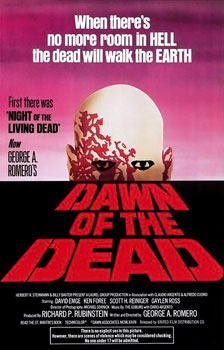
Monroeville Mall.  Even those who’ve never been to Pittsburgh may recognize it as the site of George Romero’s Dawn of the Dead.  I have to confess that, although living in Pittsburgh for a little while I never got there myself.  It has nevertheless been a pilgrimage site for fans of the movie, but, according to the New York Times, the mall has been purchased by Walmart.  Their plans?  Tear it down.  No empathy.  No sense of decorum.  Just cheap prices and sub-par goods.  I recently had to go to a Walmart.  It had literally been perhaps a decade since I entered one.  I dislike their business practices and they have ruined many a small town downtown area as well as many a mall.  In fact, the one I’d be in prior to this recent trip was the store located in Seneca, Pennsylvania.

Across from that giant Walmart stands the husk of the once trendy Cranberry Mall.  Not far away is the struggling downtown of Oil City.  My aging mother lived in Seneca—had once worked in the mall—but getting down the hill into Oil City was more difficult than nipping over to the super Walmart for groceries or other necessities.  Prices were cheap and she wasn’t flush with cash.    The same applied to many of her neighbors.  Walmart exploits such situations, becoming the only show in town.  Mom and pop stores can’t compete with their prices.  Malls, although many affluent specimens still exist, have struggled in working-class areas.  They served for more than shopping, however.  They were meeting places.  They too contributed to the troubles downtown.

Monroeville Mall never went upscale enough to survive.  Ironically, it was the message that shopping had become a source of meaning that was critiqued by Romero’s movie.  It’s that same corporate greed for more and more market share that will be the eventual death-knell of capitalism.  Any system founded on greed is the same thing as “might makes right.”  We’re seeing that in the politics of our own day.  The paradox of this ouroboros will become clear eventually, if our species survives long enough to observe.  We become attached to places.  While not all movie props can be preserved, we’re compelled toward pilgrimage, and Pittsburgh is the home of the modern zombie.  A message that may not always come through in Dawn of the Dead is that all of us are being made into zombies.  Not by some satellite picking up something in space and then returning to earth, but by good old capitalism.


Horror for Folk

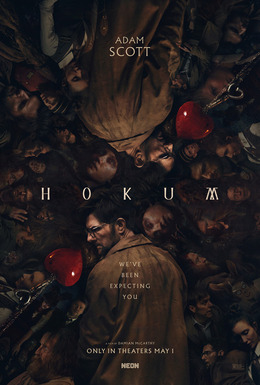
I’ve been following a few auteurs these days, and I discovered  Damian McCarthy somewhat accidentally.  Wanting to watch a movie and relying on the two streaming services I can choose from, I watched and enjoyed Oddity.  A bit of Celtic folk horror, its story is disturbing rather than the kind of thing that destroys you psychologically.  A friend then told me that he’d directed only one other movie, Caveat, which I also watched.  Hokum is the third and most recent of the folk horror trilogy and is a movie I’m glad to have seen.  It follows an acerbic American writer, Ohm Bauman, who goes to Ireland to scatter his parents’ ashes at a place they enjoyed.  He arrives at Halloween and finds the hotel owner frightening two young boys with stories of the Cailleach, a witch associated with the coming of winter.

Bauman treats everyone poorly except Fiona, the one woman on the staff.  He hangs himself after disposing of the ashes but is rescued by Fiona and the single bellhop.  After he’s released from the hospital, Bauman finds the hotel closing for the season and Fiona missing.  He suspects she’s in the forbidden honeymoon suite and Mal, the front desk clerk, reluctantly allows him to explore it.  Bauman finds Fiona’s body and learns that Mal murdered her because he got her pregnant.  I’m leaving out a lot, but the movie’s worth watching.  The witch, in the film’s scariest scene, circles Bauman as he hides in the curtained four-poster bed while trapped in the honeymoon suite.  Mal realizes that his only option is to kill Bauman and the two end up in the hotel basement where Mal is caught by the witch.  Bauman, we learn, was playing with a gun as a boy and accidentally shot and killed his mother, thus his guilt and depression.

A little research after watching Hokum revealed some of the subtlety of the film.  The Cailleach, who drags away the murderous Mal, is associated with winter.  In Celtic timekeeping, Halloween is the onset of winter and the murder that leads to Mal’s demise took place on Halloween.  It’s even shown with a carved turnip jack-o-lantern.  Holiday horror, anyone?  Another aspect that comes out is that the witch’s minions strip off body parts as the unwary are dragged away.  The owner frightens the boys at the start by implying the witch will take their private parts.  Mal is guilty of murdering Fiona because he impregnated her.  Subtle, but effective.  There’s more to the film than I can summarize in the brief space here, but it is another example of sophisticated folk horror from Damian McCarthy.  He is an auteur worth following.


Shy Incubus

Shelby Oaks is one of those horror films that benefits from more explanation than the camera gives.  Or maybe I just missed some things.  Yet another religion and horror movie that utilizes demons, which are legion these days—paging Nightmares with the Bible—it goes like this: Riley, along with three friends, is a YouTuber.  (I sincerely think my life would’ve been different if that were a career option when I was in high school.)  They run a channel under the name Paranormal Paranoids.  While investigating the Ohio ghost town of Shelby Oaks, they disappear.  Many think it’s a publicity stunt, but the three friends are found murdered and Riley is still missing.  Her sister Mia can’t rest not knowing the fate of her sister.  She’s interviewed by other YouTubers, but after a man (Wilson Miles)  shoots himself in the head at her front door, she becomes an investigator herself.  Her husband is less enthused by the idea.  There will be spoilers below.

Throughout, it becomes clear that Mia and Riley were close and that Riley, and once Mia, saw a demon looking through her second-floor bedroom window at night when she was a child.  The demon, Tarion, it turns out, is an incubus.  The man who killed himself was Riley’s kidnapper/rapist.  It turns out that Tarion, unlike the usual incubus, doesn’t perform the sex himself.  Mia finds Riley alive, but her child is dedicated to Tarion—a step removed from Rosemary, whom the Devil himself raped—and Riley tries to kill the boy.  Mia accidentally knocks Riley through a window where hellhounds consume her.  Tarion had planned, since childhood, that Mia would watch his progeny that Riley would bear.

There are some creepy things here.  The use of Wilson Miles’ initials to form the sigil for Tarion brings Blair Witch elements to she story.  The use of the sisters’ initials to show their connection was a nice touch.  And the found footage aspects are done pretty well—the camera doesn’t move excessively, making viewers ill.  Overall, however, the movie has trouble hanging together.  This is a demon without a Bible, a shy incubus who sends others to do his work.  Ideas aren’t fully developed, leading viewers to wonder a number of things—why didn’t Mia wash the blood off herself until after watching the video Wilson had in his hands?  Why did Wilson kill himself in the first place?  This isn’t a bad horror film, but the religion in it could be further developed.  The two naturally go together.


Smile for a Second

I’d read that Smile 2 was better than the first Smile.  But there was a gap of about a year between seeing the sequel and I might’ve forgotten some details about how this was supposed to work.  The “smile” entity possesses someone when they see the previously possessed person die by suicide.  Okay, we’re back where we started.  The movie makes a fairly heavy use of hallucinations, so it’s difficult to know how far to “rewind” to get back to what “really” happened.  So let’s start at the beginning.  Skye Riley is a pop artist who’s trying to stage a comeback tour after a bad stint with drug abuse that led to the death of her boyfriend in a car crash.  Since Skye was in the car, she sustained several injuries but she’s healed up and ready to perform again.

The problem is that she’s still in pain.  A high school friend, who unfortunately is possessed by the smile entity, deals in drugs so she tries to get some Vicodin from him.  She witnesses his death by suicide and becomes infected.  From that point on the hallucinations start.  We learn that the possessing entity drives the victim, or host, insane within a week.  Skye meets a nurse who offers to help her by stopping her heart, thus killing the entity, and then reviving her at the last moment.  She naturally thinks him insane.  Meanwhile the hallucinations continue and the viewer doesn’t know what is “real” and what is not.  After reconciling with her best friend, and killing her mother, Skye decides she has to take the nurse’s offer.  She’s tricked by hallucinations into not having the procedure done and (somewhat predictably) dies by suicide in front of a huge audience, thereby infecting them all.

The film was praised for its acting, and no doubt, it is good.  The premise is scary enough, but somehow it just didn’t convince me.  Perhaps it was a little too slick.  A little too self aware of the previous film.  The explanation for the entity is that it’s some kind of demon or spirit, but when the movie ends up showing its “true form” it doesn’t seem as scary as all that.  Maybe because it’s smiling.  I’m glad that the critics found it good.  Horror does deserve more positive press than it tends to get.  The creepy smile is effective, but the movie itself, while introducing religion, in the form of a demon, felt like more of the same.


Spliced

Predictably, I watched Splice again after reading the novelization by Claire Donner.  It is, as I indicated in my post on the book, a sad story.  During this rewatch, a few things stood out.  First and foremost, how many times you must rewatch a film to pull off writing the novel.  Either that, or hit the pause button constantly.  When I was writing Holy Horror I did both of those things quite a lot.  A detail you want to catch, and you have to see what’s on the screen.  I’d pause a scene and put my face right next to the screen, seeing individual pixels.  You have to know your stuff.  Another factor is that actors really do have influence on your understanding of character motivation.  An ambiguous look for the camera comes away pregnant with meaning in the novelization.

The emotional life of the characters is really filled in, in print.  The movie felt like it was going too fast.  That’s a finger on the pulse of reading a book versus watching a movie.  For a writer a movie deal can be a real boon but often you read about how they dislike the results.  That’s really no surprise.  A book takes time to read and you reflect as you go.  Movies hit you with constantly shifting images.  Both can be powerful media, but in different ways.  Another thing I noticed (I hadn’t seen the movie for thirteen years before reading the book) is that the mental image I’d formed of the characters was quite different from what the actors looked like.  

In the introduction to the novelization, screenwriter and director Vincenzo Natali notes that he likes how Donner explores Dren’s inner life.  Dren, in case you’ve not read or watched, is the hybrid.  Indeed, that is an element largely missing from the movie.  Some critics suggested that it should’ve explored that more.  For many of us, emotion is a major motivating factor of life.  We are frequently driven by our feelings, and, despite what AI says, they are integral in our thought process.  What was going through the mind of a creature, part human, with no parents?  I know that having grown up not really knowing my father left deep impressions, voids, in my life.  The novelization explores these kinds of things for all the main principals.  In my opinion, reading the book enhances watching the movie.  Of course, I’ve always been on the book side of the equation to begin with.  


Folk Exorcism

The consensus seems to be that The Old Ways is pretty good.  This folk horror, demonic possession film didn’t impress me too much, however.  The premise is good: there is a ruin in Mexico that explorers leave having been possessed.  They don’t know it.  At the same time, it seems that the possession of Cristina, the protagonist, came from her mother.   And she also visited the ruin.  Most of the movie takes place in a room where a bruja and her adult son attempt to exorcise Cristina while her cousin Miranda watches.  Things are a bit more complicated than that, however.  Cristina has returned to her hometown with the intention of dying via a heroin overdose.  Apparently the demon was luring her there to finish her soul.  In any case, it felt quite confusing to me.  

The story actually begins with Cristina finding herself held captive by a bruja named Luz.  She insists that Cristina can’t go until the demon has been destroyed.  Cristina feels fine, though, and doesn’t believe there is a demon.  Meanwhile she’s able to smuggle in her heroin and uses it at night.  But she also starts seeing what seem to be demonic entities.  She escapes but finds that she can’t cross a line of salt.  She’s forced to admit that she does have a demon and submits to a painful “old way” extraction.  Luz performs the ritual—nothing like Exorcist style—and even performs surgery on Cristina with her bare hands.  In the end, the exorcism leads to Luz’s death.  Cristina prepares to go back to Los Angeles, but then discovers the demon has taken possession of her cousin Miranda.

Becoming a bruja herself Cristina performs the ritual on her cousin.  The results are less dramatic but lead to a confrontation with a particularly nasty demon.  The cousins together are able to destroy it.  Meanwhile, Cristina’s boss has come looking for her and he too went to the ruin and has been possessed.  Cristina prepares to do another ritual, the old way.  There seems to be too much going on here and much of it is unfamiliar and therefore difficult to understand.  It is a good example of religion and horror cooperating and the use of folk methods for handling a demon felt fresh.  The eeriness of the situation is perhaps more uncanny than scary, but the biggest problem for me was that the origin of the possession kept shifting.  There is a character (a little boy) who’s not really explained, but who isn’t a good sign.  This isn’t a bad movie, but it made The Exorcist feel like old school.


Big Feet

It’s a strangely affecting film.  Among certain groups, Sasquatch Sunset was discussed long before it was released.  I knew it was categorized as a comedy, and that it featured a Bigfoot family, otherwise I knew nothing about it.  When it finally came to a streaming service, with commercials, I convinced my wife to watch it one weekend evening.  I was surprised how deeply it invaded my dreams.  It was still stuck in my head when I awoke the next morning.  Now, movies will sometimes do that to you, but it’s difficult to say why this one does so.  First of all, there’s no dialogue at all.  No “humans” are shown in the film.  The Sasquatch—parents, a child, and an another adult male—communicate by grunts and howls, but you soon begin to feel for them.

The plot, such as there is, is simple.  The movie follows the group through a year, during which two of them die.  The remaining Bigfoot bury them.  They are perplexed by the human intervention in the wilderness.  They have no permanent residence, but are nomadic.  They come across as road and it frightens them.  Then they find a tent.  And logged areas.  A leg-trap.  Finally they don’t know what to make of a Sasquatch statue that they find outside the Bigfoot Museum in Willow Creek, California.  The whole movie engenders a sense of loss.  Loss of the wilderness, and loss of connection with the natural world.  And, of course, there are many comic moments.  We see ourselves in Sasquatch, and since they are played by human actors, that’s only natural.  They play the parts midway between ape and human, which is oddly disturbing.  All of this acted without words somehow forces concentration, and stays in your head.

Bigfoot has become less of a taboo subject in my lifetime.  Sasquatch outdoor statuary has become common.  The cryptid adorns whimsical tchotchkes and even Christmas tree ornaments.  Although they aren’t recognized by mainstream science, some prominent scientists have cast their vote with the “may exist” camp.  Reports of sightings continue to grow as the ridicule factor declines.  It’s a topic, however, still best handled with some humor.  The 1987 Harry and the Hendersons, which wasn’t as good as Sasquatch Sunset, was also a comedy.  Stephen Spielberg was an executive producer of Harry but kept his name out of the credits, even though he directed UFO movies.  Ari Aster is one of the executive producers of Sasquatch Sunset.  The topic’s becoming more mainstream, and this is  one of those movies, I warn you, that may get stuck in your head.


Things Seen

I disagree with the critics on this one.  Things Heard & Seen is a remarkable horror film.  That’s not to say it’s without its flaws, but it is quite engrossing for the right kind of viewer.  It has elements of dark academia, as well as ghosts and a respectful treatment of Swedenborg.  And it takes place in the Hudson Valley (the headless horseman is even mentioned once).  The Bible appears both visually and is quoted.  In short, it encapsulates many of my personal interests.  And it’s not badly made.  There will be spoilers here, but it’s difficult to discuss religion and horror without them.  George Claire married Catherine because he got her pregnant.  He has, however, finished his doctorate and been offered a post at Saginaw College, in the Hudson Valley.  It quickly becomes clear that George is an entitled, self-centered liar (sounds familiar).

As the story unfolds, both Catherine and their daughter Franny see ghosts.  George dismisses them but even at the college the head of his department is a Swedenborgian and tells him not to dismiss the spiritual world.  George’s true character starts showing through.  He cheats on his wife.  He forged his letter of support from his Columbia doctoral advisor because his work was substandard.  When a fellow faculty member finds out, he runs her off the road, putting her into a coma.  He drowns his department head while boating on the Hudson because he also learned the truth.  He even claims to have painted pictures done by his brother.  In other words, he’s a real piece of work.  The ghosts aren’t able to save his wife when he murders her, but his colleague comes out of her coma and spills the beans.

In the end, George sails away into a Thomas Cole painting where a Swendenborgian ending overtakes him.  The use of Swedenborg adds an etherial element to the film, figuring thoughtfulness to what otherwise might be just another story about an unhinged academic.  The department head’s advice about seeing death in a Swedenborgian way was also strangely affecting.  In other words, this is thoughtful horror.  And once again it demonstrates that religion can be crucial to understanding what we really fear.  I suppose some critics dislike the unambiguous use of ghosts and the supernatural breaking into “reality,” but that seems to be precisely the point.  I only learned of this movie because Netflix recommended it, but they hit on several major themes in my work over the past several years.  I would watch this one again.


Missed Movie

It has been years since I read H. P. Lovecraft’s “The Dunwich Horror.”  I’d never seen this original movie made from it, often cited as being a reasonable adaptation of a Lovecraft story to film.  The visuals are sometimes impressive, but it is a slow moving, plodding movie.  It does, as far as I can recall, follow Lovecraft in general terms.  This is one of those movies that would’ve fit into Holy Horror for two basic reasons: it begins with a quote from the Bible and it has its own alternative sacred book, the Necronomicon.  In one scene the latter is explicitly compared to the Good Book.  Since religion didn’t enter horror in any kind of direct way until about 1968, this movie is an early example of how the two interact.  It came before The Exorcist.

The point is made at several junctures that the religion of the Whateleys is the antithesis of Christianity.  Indeed, the point of all Wilbur Whateley’s shenanigans is to raise the old gods.  Lovecraft, famously an atheist, used gods to set up his cosmic horror.  He’s also notoriously difficult to capture in movie form.  While Roger Corman was the executive producer he was not the director, and that may answer for the pacing.  Daniel Haller, the director, had worked with Corman before on some of his Poe Cycle films and had directed Die, Monster, Die, also a Lovecraft adaptation.  Lovecraft wasn’t a terribly cinematic writer.  His stories contain ideas that feel like they might fit on film, but executing them well is difficult.

For this movie, the house used for the Whateley residence is fitting.  It helps create a sense of dread.  The basic idea of the flick is that Wilbur needs a virginal victim to help summon the old gods.  He lures Nancy Wagner to his house where she falls under the influence of drugged tea.  There’s an intriguing glass sculpture that is never fully explained.  As Nancy begins to lose her will, her friends come to find her, and one of them is killed by Wilbur’s inhuman twin that had also killed their mother during birth.  Once released, this monstrous progeny begins killing locals (the locals hate the Whateleys) and is poised to take Nancy until a guest lecturer at Miskatonic University bests Wilbur in spells recited from the Necronomicon, saving the girl and dooming the last Whateley.  The family line ends.  Until it is rather heavy-handedly shown that Nancy is pregnant by Wilbur, so the unwholesome Whateley genealogy continues.  The visuals aren’t bad, but the story is lacking.  Still, it’s part of the canon, so I needed to see it and it used religion to intrigue me.


Coming for You

Skimming through the freebies on a streaming service I came to Serpent’s Lair.  Having written a book about demons, I try to keep an eye out for possession movies I might’ve missed and that may add something new to the discussion.  This one turned out to borrow quite a lot from other films, most noticeably, The Omen.  Tom Bennett and his wife Alex buy a unit in a house that could’ve stepped from Rosemary’s Baby.  I kept wondering what the unnamed city was where they worked.  It turns out that the entire film was shot in Romania, so that’s why identifiable landmarks were missing.  In any case, their unit had been inhabited by a college professor who’d been dabbling in the dark arts.  Some of his stuff was left behind.  By the way, there is a lot of religious imagery in this film—maybe not directly Bible (so not Holy Sequel material), but plenty of religion.

Their kindly next door neighbor is a doctor who smokes a lot for his profession.  The couple adopts a stray cat in the courtyard.  The cat turns out to be a kind of conduit for a succubus.  Naturally, the cat takes a dislike to Alex, finally causing her to fall down the stairs and end up in the hospital.  When she’s out of the house the former resident’s sister comes to close his estate.  I don’t think I’m spoiling anything if I say she is the succubus.  While Alex is away, she coaxes the faithful Tom into a torrid affair.  Tom really loves Alex and is reluctant, but succubi can be very persuasive.  Meanwhile more cats move into the building.  When an archaeological colleague of the former tenant arrives, he notes that said tenant had no sister.  Research indicates Tom is dealing with a Bast succubus.  Of course, the colleague is killed.  Spoiler alert:

It turns out the the doctor next door is Satan himself.  The only way to get rid of a succubus is to set it on fire.  Alex has already left Tom, so the next time the demon shows up, he lights her up.  Satan, next door, sees the whole thing and laughs.  Roll credits.  While a low budget film for its time (1995), it isn’t a cheap movie.  Serpent’s Lair at least tries.  The story is a touch weak because much of this has been done before.  It takes advantage of something that had been discovered a couple of decades earlier—religion is a great setting and source for horror.  Even if the explanation doesn’t really satisfy.


Check for

If after Sleepaway Camp you’re still willing to go into the woods, beware of Ticks.  Actually, for a direct to video movie, Ticks isn’t bad.  It has some production values and a story that, although very far fetched, keeps you watching.  It all begins with a group of inner-city kids going on a wilderness enrichment project.  They don’t know that some cash croppers growing marijuana have been using steroids to enhance the growth of the plants nearby the cabin.  The steroids leak onto some ticks who grow supersized and are out for blood.  The kids and their chaperones know none of this as they try to get into nature and away from their unhealthy urban lives with its crime and entitled situations.  The local sleazy drug lord, however, doesn’t like them too near his operation, and keeps an eye on them.  One of the drug growers is the first to be attacked.

The mutated ticks start out about the size of a hand.  They first attack the dog of  one of the kids, draining it of blood and killing it.  Then they go for people.  Although there’s nothing really new here, other than using ticks as the monsters, it’s a somewhat fast-paced film that satisfies the monster itch.  Only one of the kids actually dies, although several are bitten.  In keeping with the tropes of many American films, though, the one Black kid is the sole victim.  This could’ve been thought through a bit more carefully.  The only other deaths are, however, three white men—all of them associated with the drug growing operation.  A bit of humor keeps things from getting too heavy, but the fact is that ticks can be scary and it turns out that making them bigger, as tenacious as they are, can work to make them scarier.

If you’ve ever been bitten by a tick (only once, that I know of, in my case) you know they can be frightening in that they carry diseases.  In the movie, instead of Lyme their bite is, or can be, hallucinogenic.  This isn’t applied evenly, however, sometimes the bites do this, and that is used to build some tension and to resolve some issues.  In the end, though, it turns out like many of the young-people-in-a-cabin-in-the-woods movies.  I won’t tell you how it ends since you may decide to see it, if you’ve cheap like me, and have been hankering for another excuse not to spend a week in the woods.  You’re generally fine if you do rent a cabin, but it is always best to check for ticks.