
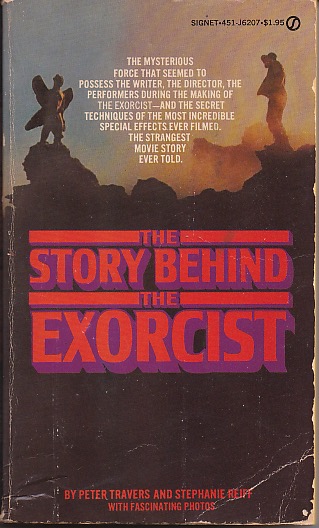
The prediction was that it would be forgotten in five years after it lost the Oscar for best picture to The Sting. The Exorcist, however, is a movie that continues to spawn new books and analyses. I read The Story Behind The Exorcist because I wanted a contemporary account with its seventies impressions. I didn’t see the movie when it opened; I was younger than Regan at the time. I certainly heard about it, though. Throughout my childhood it was whispered of as the scariest movie ever. Peter Travers is a well known movie critic; the book was written before he joined Rolling Stone. Stephanie Reiff is a little more difficult to pin down. She wrote two other books, both about the occult, published in 1977. Travers would’ve been in his early twenties when the book was published. It shows in the at times punchy style.
The Exorcist was a phenomenon. My awareness of it was second-hand for many years but I did hear about the long lines to get in to see it. A whopping box-office success, it was the first horror film to be nominated for a best picture Oscar. Horror films still tend to be shunned by the Academy, despite their frequent financial success. In any case, when I discuss horror movies with those born in, say, the eighties or later, The Exorcist rarely comes up as among the scariest films. It is, however, largely responsible for the way that demonic possession is understood. No possession movie since hasn’t owed a debt of gratitude toward it. The Exorcist often lands on lists of the greatest movies ever made. It’s interesting to read the dismissive period reviews of the critics reproduced in the book. The film is over fifty years old and still discussed.
While I don’t spend much time on social media, the other day a friend posted a picture of himself reading a book about The Exorcist. I’ve read at least five on the film specifically. Interestingly, William Friedkin, the director, never reached these heights again. William Peter Blatty, author of the novel as well as screenwriter and producer, never replicated the success. Not only was the movie a runaway hit, it represented the true coming of age of the horror genre. It attempted things never before seen. And it influenced religion itself in ways nobody dreamed mere celluloid could. I’m still reading books on it. This particular one doesn’t have the greatest depth, but it captures the feel of the times. Adding The Roman Ritual as an appendix, however, may have been playing into the Devil’s hand.

