Spliced

Predictably, I watched Splice again after reading the novelization by Claire Donner.  It is, as I indicated in my post on the book, a sad story.  During this rewatch, a few things stood out.  First and foremost, how many times you must rewatch a film to pull off writing the novel.  Either that, or hit the pause button constantly.  When I was writing Holy Horror I did both of those things quite a lot.  A detail you want to catch, and you have to see what’s on the screen.  I’d pause a scene and put my face right next to the screen, seeing individual pixels.  You have to know your stuff.  Another factor is that actors really do have influence on your understanding of character motivation.  An ambiguous look for the camera comes away pregnant with meaning in the novelization.
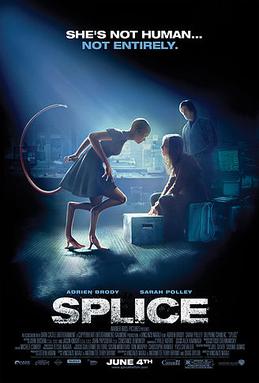
The emotional life of the characters is really filled in, in print.  The movie felt like it was going too fast.  That’s a finger on the pulse of reading a book versus watching a movie.  For a writer a movie deal can be a real boon but often you read about how they dislike the results.  That’s really no surprise.  A book takes time to read and you reflect as you go.  Movies hit you with constantly shifting images.  Both can be powerful media, but in different ways.  Another thing I noticed (I hadn’t seen the movie for thirteen years before reading the book) is that the mental image I’d formed of the characters was quite different from what the actors looked like.  

In the introduction to the novelization, screenwriter and director Vincenzo Natali notes that he likes how Donner explores Dren’s inner life.  Dren, in case you’ve not read or watched, is the hybrid.  Indeed, that is an element largely missing from the movie.  Some critics suggested that it should’ve explored that more.  For many of us, emotion is a major motivating factor of life.  We are frequently driven by our feelings, and, despite what AI says, they are integral in our thought process.  What was going through the mind of a creature, part human, with no parents?  I know that having grown up not really knowing my father left deep impressions, voids, in my life.  The novelization explores these kinds of things for all the main principals.  In my opinion, reading the book enhances watching the movie.  Of course, I’ve always been on the book side of the equation to begin with.  

Novelization

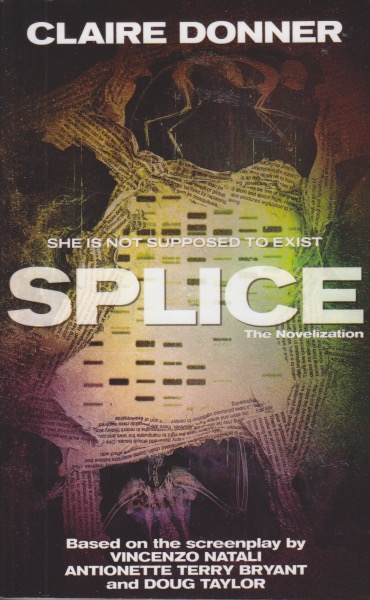
I watched the sci-fi horror film Splice a few years ago.  Long enough that I don’t recall many details.  When Claire Donner, a friend of mine from Miskatonic Institute of Horror Studies, told me she’d written a novelization of Splice, I knew I had to read it.  If you’ve seen the movie then you know the story.  If you haven’t, you can read it in her book.  I don’t often read novelizations—I read the one for Tim Burton’s Sleepy Hollow, and as a young person read the original three Star Wars novelizations.  Such books really only apply to movies not already based on a novel, of course.  They give the reader a path into the inner lives of the characters.  Naturally, now I have to watch Splice again to see it through Donner’s lens.  The basic idea, if you want some encouragement, is that a couple of scientists add some human DNA into a gene-spliced animal being lab grown for enzymes to fight disease.

In the rawest sense, this is the story of Frankenstein for a more technological crowd.  Like Frankenstein, it is a sad story.  And like said sad story, it involves reproduction without two human parents.  The real builder this time, however, is Elsa and Donner gives considerable development to her motivations and thought process.  (I’m very curious to know if I can see that in the movie or not.)  Clive, her partner, isn’t aware of the source of the human DNA.  The spliced creature grows into the passably human Dren, who finds herself asking the questions Frankenstein’s creature asked about his own existence.  Like said creature, Dren has to be hidden away, and controlled.  At the same time, she is evolutionarily superior to her maker.  There’s a lot to see here, folks!

Having written a fair bit of fiction in my time, I do wonder what it might be like to do a novelization.  I suspect most of us, if a movie is well made, decide on the motivations of characters but how often do we delve into their inner lives?  I’m not sure that I do that most of the time.  When I write fiction I do it all the time.  I want to know my characters and why they are the way they are.  Sometimes they remain mysteries to me, but that doesn’t prevent me from trying.  This novelization is deftly done, and approved by the screenwriter/director.  And the deep motivations make the scenario plausible.  If you haven’t seen Splice you might enjoy doing so.  And then read the novel.  Or the other way around.