Making Monks

Now that I’m an antique, antique stores have a special draw.  They’re kind of like museums with free admission where you can buy the artifacts.  There’s a particularly large one in Allentown that I’ve visited a few times.  It’s the kind of place that, if you want something you see, you buy it right away because it’s not likely to be there next time you go back.  Back in March I saw a pair of bookends that caught my attention.  They were carved in the shape of monks reading books.  The reason I was fascinated by them is that I had bought my wife a very similar figurine (too small to be a bookend) when I first started teaching at Nashotah House.  We didn’t have much money, but I thought it was a whimsical reminder of where I was when I had to be away all week so that we could keep our academic couple dreams alive.
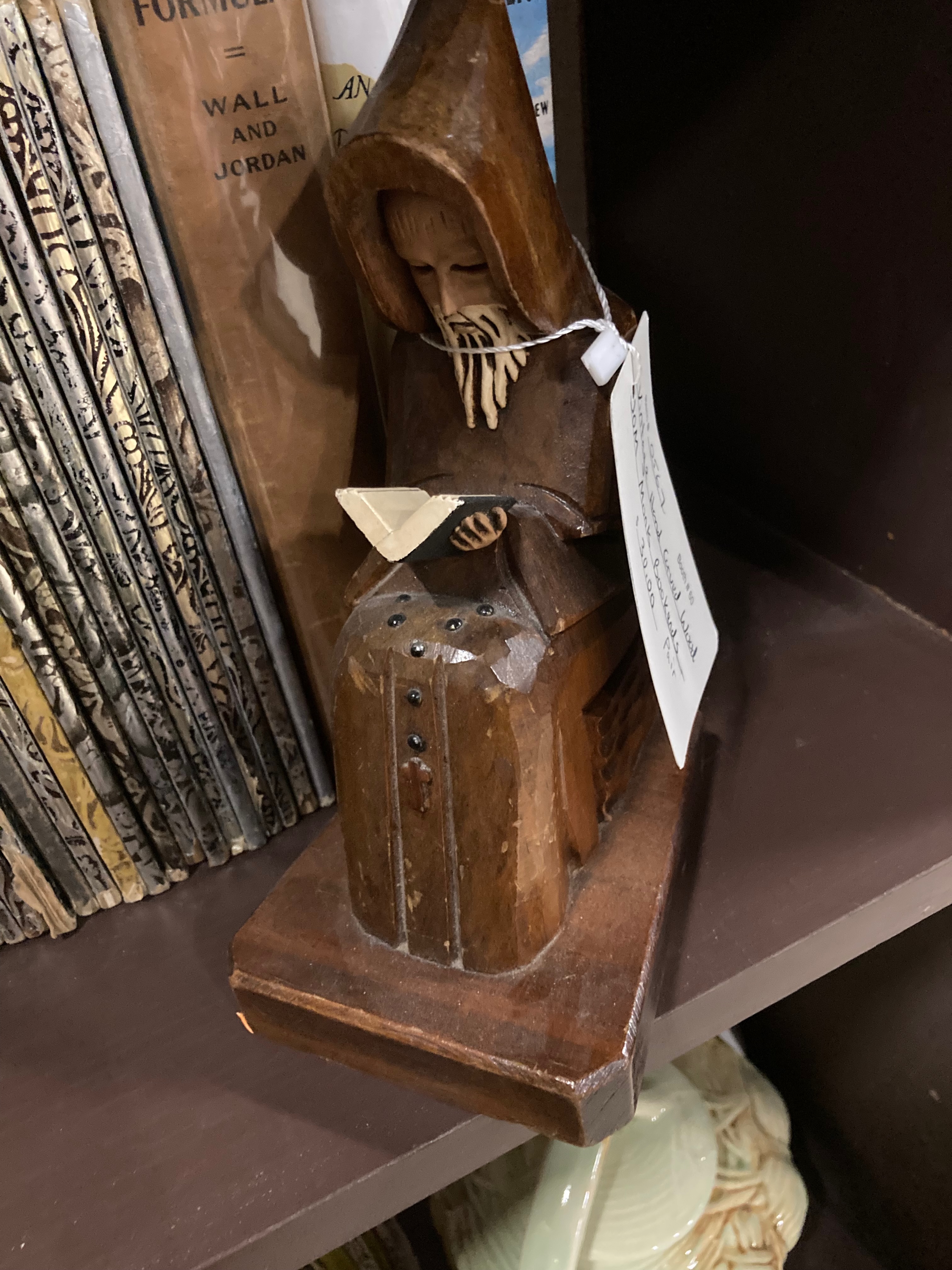
By the time I got back to the antique store the “bookends” were long gone.  What I was really curious about was whether there could be a connection with the Nashotah House curio I purchased nearly 35 years before.  There’s probably something I’m missing.  Was there a Platonic original somewhere?  When I failed to find them at the antique store, I did an online search and discovered a very similar one on Etsy, listed as being made in the 1970s.  I bought the one we have in 1992.  It was clearly handmade; the Nashotah House bookstore had a few of them on display at the time.  They no longer carried them after the inventory sold out.  I’d supposed they were made by a local Nashotah House person—which may be true—but where did they get the idea?

A bit more time on Etsy revealed another exemplar, this one listed as from the 1940s, specifically from Mexico.  One of the Etsy sellers is listed as being in Florida.  I bought mine in Wisconsin.  I found a pair in an antique store in Pennsylvania.  What is the missing link here?  This is the kind of rabbit hole academics are liable to tumble down.  Since I’m a dark academic, it strikes me as a research topic for someone without tenure worries to consider.  Or perhaps a detective who was raised Catholic.  All the five examples (two on Etsy, two in the antique store, and one from Nashotah House) follow the same plan and are stained and painted similarly.  This antique is curious about the origin story of those other antiques.


Pondering Origins

I’m not a numbers guy.  I never had any interest in statistics, and I tremble when I see my accountant’s number pop up on my phone at tax time.  But exponential sequences have an inherent fascination.  Think about your ancestry (I recently wrote about genealogy and that got me pondering).  You have two parents.  And they each had two parents.  By the time you get back to ten generations (eight greats before grandparents) you have 1,024 ancestors of roughly the same generation.  That’s a lot of people just to make one individual.  Think of all the circumstances that might’ve led to any two of them having been kept apart—then where would you be?  Of course the numbers double each generation which is where my reasoning capacity shuts down.

At some point, doesn’t it seem, that there wouldn’t be enough people available to make you?  I know that’s not true—you’re reading this and that proves this false—but it does make each individual life a thing of wonder.  Or even at the level of your own parents.  If you have siblings you know how different even biologically similar people can be.  And there are many others who could’ve been conceived instead of you or me.  The chances are astronomical that we’re here at all.  I often wonder if such circumstances are why our minds seek religious answers.  People are meaning-seeking creatures.  And against such long odds, it seems that maybe we’re a miracle after all.  Naturally, a driving force behind it all suggests itself.

Photo credit: NASA

Science has been a real boon for the billions of us alive today.  There’s no doubt that dispassionate, rational thought can lead to amazing outcomes.  At the same time, the doubt creeps in that this is the only explanation.  It occurs to me when watching the birds in the spring.  How do they know their own species and with whom to mate?  Is all of this driven by that notorious fudge factor we call “instinct”?  I have no answer to what the source of that will to keep life going is.  Biology tends to be among the slipperiest of sciences.  Life is difficult to define when we don’t even know everything that’s out there in our infinite but expanding universe.  The numbers are just too massive.  All I know is that by the time you get back to twenty generations (eighteen greats) it took over a million people to make just one of us.  And that’s by the numbers.