
Now that I’m an antique, antique stores have a special draw. They’re kind of like museums with free admission where you can buy the artifacts. There’s a particularly large one in Allentown that I’ve visited a few times. It’s the kind of place that, if you want something you see, you buy it right away because it’s not likely to be there next time you go back. Back in March I saw a pair of bookends that caught my attention. They were carved in the shape of monks reading books. The reason I was fascinated by them is that I had bought my wife a very similar figurine (too small to be a bookend) when I first started teaching at Nashotah House. We didn’t have much money, but I thought it was a whimsical reminder of where I was when I had to be away all week so that we could keep our academic couple dreams alive.
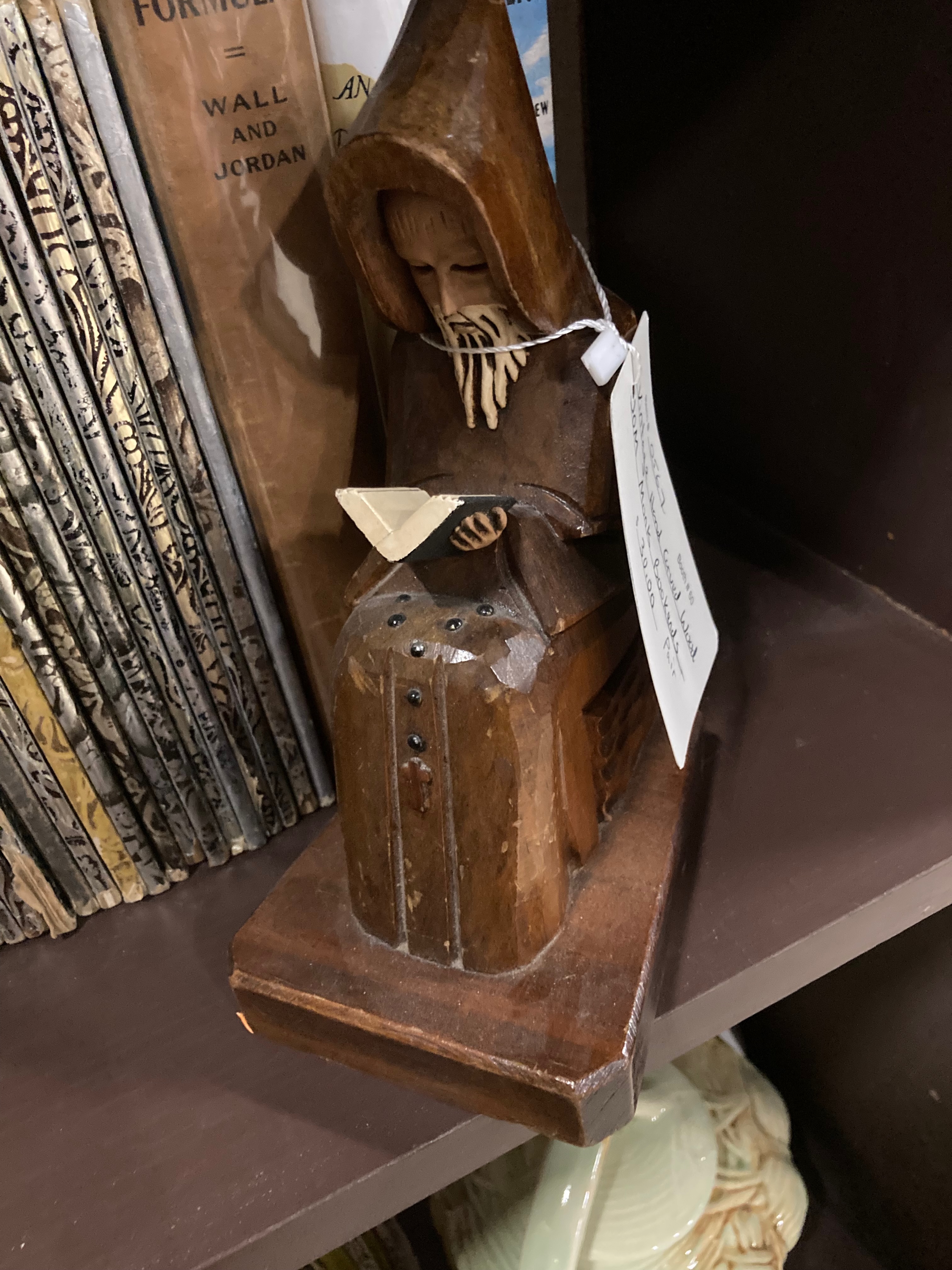
By the time I got back to the antique store the “bookends” were long gone. What I was really curious about was whether there could be a connection with the Nashotah House curio I purchased nearly 35 years before. There’s probably something I’m missing. Was there a Platonic original somewhere? When I failed to find them at the antique store, I did an online search and discovered a very similar one on Etsy, listed as being made in the 1970s. I bought the one we have in 1992. It was clearly handmade; the Nashotah House bookstore had a few of them on display at the time. They no longer carried them after the inventory sold out. I’d supposed they were made by a local Nashotah House person—which may be true—but where did they get the idea?
A bit more time on Etsy revealed another exemplar, this one listed as from the 1940s, specifically from Mexico. One of the Etsy sellers is listed as being in Florida. I bought mine in Wisconsin. I found a pair in an antique store in Pennsylvania. What is the missing link here? This is the kind of rabbit hole academics are liable to tumble down. Since I’m a dark academic, it strikes me as a research topic for someone without tenure worries to consider. Or perhaps a detective who was raised Catholic. All the five examples (two on Etsy, two in the antique store, and one from Nashotah House) follow the same plan and are stained and painted similarly. This antique is curious about the origin story of those other antiques.

