
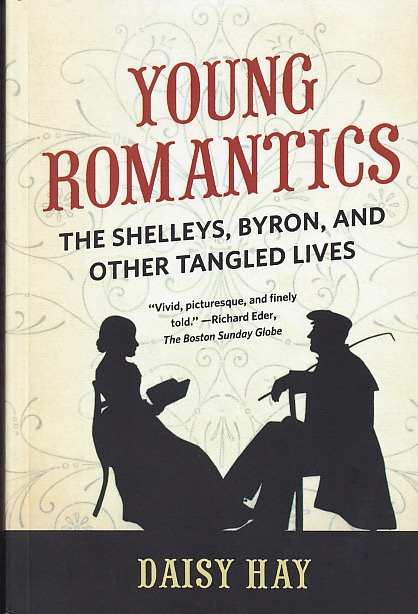
One of the more recent fascinations for me has been the fateful meeting of Lord Byron and Percy Bysshe Shelley, Mary Godwin, Claire Clairmont, and John William Polidori that took place in the summer of 1816. That gathering famously led Mary, later Mary Shelley, to write Frankenstein and Polidori to compose “The Vampyre,” based on an idea of Byron. Daisy Hay casts her net a bit further in Young Romantics: The Shelleys, Byron, and Other Tangled Lives. Particularly, Hay considers the often unsung role of Leigh Hunt, a young journal publisher, who brought together a coterie of creatives that included Byron and Shelley (although those two met later), but also John Keats and a host of others. Romanticism pervades this group with Keats, Shelley, and Byron all dying young. (And Polidori as well, but he’s not really much in Hay’s narrative.) These three poets threw a very long shadow. As recently when I was in school, we still learned about them.
In my reading over the past many months Leigh Hunt’s name had naturally come up, but I never considered looking more into him. He never achieved the fame of his circle, and he fell out of favor by writing an account of Byron that was unkind to the poet, even as his posthumous star was in the ascent. This account makes for fascinating reading. Shelley and Hunt shared the scandal of marrying and having the sisters of their wives live with them. Victorians would, of course, assume something improper was happening. Byron, it was well known, had many affairs, including one with his half-sister. People love gossip and even though Hunt’s sister-in-law, Beth Kent, made a name for herself publishing books on plants, both she and Claire—the other women—have largely been ignored. Claire outlived everyone in the circle apart from the late interloper Edward Trelawny, who cast himself as a fast friend of Shelley and Byron.
Hay does an excellent job of pulling all of this together. The lives are indeed tangled. Of course, relationships in general are quite tangled. This book begins with Hunt and pretty much ends with him. Hay provides some previously unpublished notes from Claire and has to bring the story to a close with Trelawny. Historically he was the last survivor. He was also known in his lifetime for making up incredible stories about himself. I’ve read his account of Shelley and Byron’s deaths. That book, with its dark academia vibes, may have been the first I read on this fascination. It’s been with me, however, at least since 1987. And it will likely continue.

