
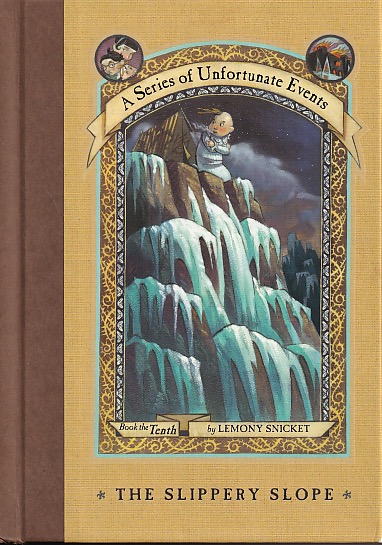
The world is quiet here. The Baudelaire orphans have been reunited by the end of The Slippery Slope, but Quigley Quagmire gets separated from them at the denouement. As a friend of mine once said regarding movies, it’s difficult to watch people who long to be—and belong—together being separated. Indeed, it is one of the saddest of plot points. Count Olaf and his band of villains kidnap Sunny while, they think, sending Violet and Klaus hurtling to their deaths. The orphans were on their way to the V.F.D. headquarters in the Valley of Four Draughts. They eventually arrive to discover that the schismatic group of V.F.D. has already burned it down. And we get a strong inkling that Volunteer Fire Department is what stands behind the mysterious initials. Reading this again as an adult also reminds me that this is where we caught up with the series since we began buying the hardcovers for my daughter as they came out.
This segment of the Series of Unfortunate Events once again has the orphans wondering if they’re becoming as bad as the villains. They decide that instead of fighting fire with fire they need to work to make the world a quieter, more peaceful place. And two of Count Olaf’s associates, the women with white faces, leave his troupe. A pair of criminals that have even Olaf nervous show up in this episode as well. Lemony Snicket’s humor remains intact, despite the darkness of the tale. There are laugh-out-loud parts in the last two chapters. And some memorable quotes/ideas: “Count Olaf, like any good businessman, has committed a wide variety of crimes.” The idea that somebody well-read is potentially trustworthy is repeated throughout the story. I mentioned a biblical connection (of course I did!) for The Carnivorous Carnival, but here there’s an explicit one as Snicket categorizes Adam and Eve’s decision to put on clothes “to leave the snake-infested garden” as an impulse passion. After drying my tears, the cleverness of all this sank in. Typically the impulse passion in Eden is precisely because the primordial couple is unclothed. There’s much to chew over in these books ostensibly for children. The message of what distinguishes good from evil wasn’t lost on me.
I recently discussed with my daughter how some authors are able to bridge from children’s, or young adult, novels into those for adults. There’s kind of an invisible line there. Adult life can be serious business, and it often is. There are some great funny novels as well for the adult crowd. And sometimes they can even be disguised as books for young readers.

