Thunderers

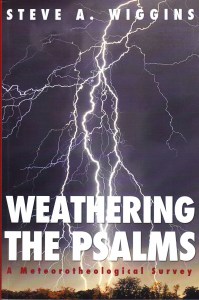
“Storms are the embodiment of Mother Nature’s flair for the dramatic, and the words that we use to write about them are infused with that drama,”—the words aren’t mine, but they express something I often acknowledge.  The quote comes from a Verbomania post about the word “brontide”—a noun for things that sound like distant thunder.  Weather-related words are indeed part of the religious vocabulary as well.  I wasn’t quite daring enough to suggest it in Weathering the Psalms, but it seems that thunder may be behind most basic religious beliefs.  Well, that and bad luck.  Think about it—most cultures have a very powerful storm-deity.  That power is expressed in thunder.  Even in the twenty-first century a sudden clap can made the sophisticated duck and cover.  

We don’t know as much about ancient Mesopotamian culture as we’d like to, but it’s pretty clear that storm deities commanded major of respect.  Eventually in the city-state of Ugarit, in what is now northern Syria, a god named Hadad (aka “thunderer”) became the patron of the city and was known mainly by his title “lord” (Baal).  There may have been more than one lord, but the one in charge of day-to-day affairs was the one who controlled storms.  We’ve entered another rainy season around here (something you tend to notice when the roof leaks), and my thoughts often turn to how very much the weather controls us.  Interestingly, thunder hasn’t been much in the picture.  We’ve lived in our house coming up on a year and I have been awoken by thunder (something that still scares me as much as when I was a kid) only once.  Thunder is the approach of gods.

There’s drama about the weather.  In fact, fiction writers have long known that one of the most effective ways to suggest the mood of a story is the meteorological method.  Weather sets the scene.  The sound of distant thunder has a naturally ominous, almost predatory quality.  The growling, low and loud bursts from the sky sound so like human expressions of rage that it is only natural that they should be interpreted this way.  Since the sky is (or used to be) out of the reach of humans, the sounds from above were from the realm of the divine.  When gods approach the mood is threatening.  We dare not meet them.  That mythology has long informed our perceptions of meteorological phenomenon, acknowledged or not.  Brontide is an underused word that brings the drama of both nature and the divine together.  It could be a psalm word.


Symbolic Delays

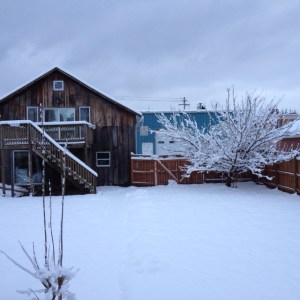
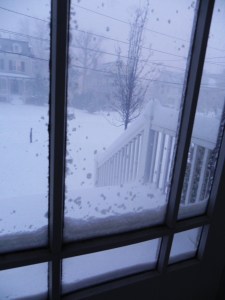
Weather affects more than the Psalms, of course.  With all the hype of the latest winter storm things were closed or delayed before any accumulation even started.  Now I’ll admit up front that I’m a fan of snow days; we dutifully trudge to our desk jobs as if we’re doing something vital when many of us are really just trying to make money for the man.  A snow day’s a little unplanned levity in our lives when staying off the roads seems like a good idea.  It’s one of life’s guilty pleasures.  Of course, the dreaded delayed opening brings its own set of issues.  You can’t sleep in unless it’s announced the night before, and once you’re up your mind heads to work anyway.  Working remotely, alas, means you have no excuse, no matter what the weather.

Snow is a great symbol.  I don’t mean its whiteness and purity—there are plenty of white things that aren’t pure.  No, I mean it’s a great symbol in its ability to control people.  We don’t like rain, although we understand its necessity.  Snow, however, fills us with a childlike wonder.  Anticipation.  Unlike a winter rain, it can be fun to play in.  It covers everything.  The suggestion of a blanket ironically makes us feel warm, even as the temperature dips below freezing.  But for me the most potent symbol is light.  I awake early, even on snow days.  As I make my way downstairs in the dark, it’s immediately evident when snow covers everything because the sky is lighter than it should be this time of day.  Whatever light’s trapped below the clouds reflects off the snow creating a luminosity that’s almost otherworldly in its calm.  It doesn’t last too long for the sun is rising earlier, at least it is until our pointless time change, but for a few hours we’re in the midst of an unnatural light.

Darkness is far too prevalent.  We know that someday even our mighty sun will use up all its fuel.  We crave the light for it’s limited.  Days are noticeably longer now than they were at the start of December.  Those few moments of serenity before the sun comes up, when the snow produces what seems like its own light, are among the most tranquil of life.  Before the plows begin scraping metal against asphalt, hoping for a snow day while wrapped in a fleece throw, face clouding the chilly window before it.  Yes, it’s a powerful symbol.  Even if the internet means work awaits just as usual.  


Tempestuous Wind

There was quite a windstorm that blew through here yesterday.  It reminded me rather forcefully of Weathering the Psalms.  Firstly, it blew loudly enough to wake me up a few times in the night.  When I finally climbed out of bed, listening to the blustery concussions beating the house, I remembered that the first chapter of Weathering was about the willful wind.  That’s not just a poetic phrase—according to the Psalter, the wind does the will of God.  Like much of the weather, it’s weaponized by the Bible.  Seeing what the wind can do, the reasons for this should be obvious.  Hurricanes are tremendous windstorms (although unknown in the land of the Bible), but they are also known for their tremendous rain.  Tornadoes, however, are pure wind and are among the most destructive forces on the planet.  (Before people came along, anyway.)  Wind commands respect.  We’re a very long way from taming it.

When thinking of meteorology, it’s easy to forget wind.  Rain and snow are pretty obvious.  Even desert heat is impossible to ignore.  The wind, invisible and powerful, is perhaps the most godlike of weather’s many features.  To the ancient way of thought, it was also inexplicable.  We understand the earth’s rotation and temperature differentials between water and land and the uneven heating between the surface of the ground and air aloft.  The ancients understood it more to be a pure act of God.  The wind certainly can seem spiteful.  It’s not difficult to attribute agency to it.  Such things go through my mind when the howling is loud enough to wake me.

Invisibility suggests power.  It wasn’t so much the “monotheism” of Israel that made it distinctive as it was the inability to see its deity.  That lack of visual confirmation not only necessitates a kind of faith, but it also veils a threat.  We humans tend to be visually focused.  We fear the dark.  Foggy, misty settings can give a story an atmosphere of foreboding.  Placing the divine out of site only enhances supernatural powers.  So it is with the wind.  As is to be expected, the windstorm has mostly blown itself out by now—moving on to another location until the temperature differentials even out and its howl becomes more of a whimper.  It will have done its work, however, for even as it passed through it brought to mind the proper respect for that which cannot be seen.  


The Late Vortex

So there was this polar vortex recently, here in the States, that led to a meteorological frenzy.  It was worse than the apocalypse itself since it was so bone-chillingly cold outside.  I had contacts from around the world asking if we were okay.  It used to be called “winter.”  Now, I’m not big on human suffering.  I hate to see anyone cold, hungry, or lonely.  These are things for which theodicy itself will some day have to stand trial.  But it does seem that we’ve caved in to media hype about the weather.  Yes, the cold is not to be trifled with.  It can kill.  Winter, however, comes around every year in the temperate zones, and using our evolved brains can help us survive things like winter’s chill.  Heck, our species has survived ice ages before.  They just had no internet to tell them that.

One morning at Nashotah House we were scheduled to attend a lenten mediation in Milwaukee.  A real winter storm was upon us—whether it was a polar vortex or not I do not know—and the temperature plummeted.  The Dean at the time was undeterred.  He’d hired a van to take us to Milwaukee.  I awoke to the news that the air temperature, not the wind chill, was 42 below zero.  For those of you who read centigrade, it crosses paths with Fahrenheit at 40 below.  The weather forecasters warned that mere minutes outside could be fatal.  Our Dean was no respecter of weather.  We piled into a rented van whose windows frosted over as soon as they were cleared and we made our way to experience lent.

My point is, winter can get cold.  A polar vortex by any other name would be so chilly.  What makes the difference between a cold day and an apocalypse?  The media.  Now that we’re constantly online we know when the chill settles in.  The hype makes it more marketable.  Advertisers pay, but they want hits.  By the end of the winter we’ve survived many apocalypses.  I always did find it ironic when some celibate priest would snort, hitch his pants, and say he was a real man (it actually happens!), but living through winter is something we ought to be used to by now.  On the way home from Milwaukee, we said evening prayer in the van so that we wouldn’t have to go outside to trudge to chapel in the midst of what may have been a polar vortex.  Even real men feel the cold, I guess.


Mastering the Elements

First time home ownership is best left to younger people.  And perhaps younger houses.  The constant onslaught of things falling apart, or falling off (it has been an extreme weather year) has soured me on the idea.  You get set in your ways, you see.  The move from apartment to house didn’t come with a raise that would cover all the repairs invisible to a home inspector’s eye.  Although our house has stood for over 120 years, the last owners let lots of things go with a lick and a promise and we, the naive middle-aged first-time buyers in a seller’s market, bit.  I thought there would be repairs to make, but not all at once.  The royalties from books like Holy Horror don’t make even a small dent in the contractor’s fees.  We should maybe have bought a house in Jericho instead.  One right on the city wall.

The shake-down voyage of a ship reveals the problems, so the theory goes.  It stands to reason that people have to go through a shake-down year as well.  I’ve got the roofer on speed-dial, and I keep a wary eye on a garage that has more love than actual care poured into it.  All I want to do is read and write (which I could do just fine as a renter, thank you) in a place dry and not too cold.  The weather, however, has been unforgiving.  Rain and more rain.  There’s something primal about all this—an element of having to struggle against nature in order to survive.  In the modern world we’ve taken for granted our ability to keep the beasts and weather at bay.  Storm systems like the one that has just blown through serve to remind our species that there are things that will forever remain beyond our control.

The lament is the most numerous genre of psalm

Something like this was going through my mind as I wrote Weathering the Psalms.  (We didn’t own our house at Nashotah House, though.  Whose house?  Nashotah’s house.)  Living in the Midwest gave me a new appreciation for the weather.  Some of the storms we witnessed were nothing short of theophanic.  Global warming has a way of bringing the weather front and center.  Elements of this element, however, are within our control.  We understand at least the human-driven elements of global warming.  We deny they exist to scrape together a few more pennies at the end of the day.  Meanwhile those who buy houses need to do their homework.  If need a roofer too, I’ve got one on speed-dial.


Shut up or Shut down?

So the government’s shut down over a presidential temper tantrum.  Like most people, I suspect, I haven’t really noticed.  Except for two things.  When I drove up to Ithaca over the holidays, some of the highway rest stops were closed.  It seems our government wants to share the misery of not being able to relieve itself.  Secondly, the NOAA weather forecasts are no longer updated as frequently as they should be.  I’m no expert on the weather—I did write a book on meteorotheology, which took quite a bit of research on weather in ancient times, but I know that doesn’t qualify.  Still, I rely on weather forecasts to get daily business done.  In particular, we were expecting a winter storm around here that had been predicted, by NOAA, to arrive around 11 p.m.

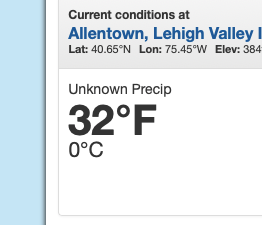
Okay, I thought, people will be off the roads by then, and crews will be out to treat the icy conditions by morning.  Seven hours early, around 4 p.m., I noticed a rain, sleet, snow mix falling.  The ice particles looked quite a lot like salt crystals, but I was pretty sure that the government doesn’t have that kind of pull.  In any case, when weather catches me unawares, I turn to NOAA since our government is apparently God’s own chosen one, figuring that the Almighty might know a thing or two about what goes on upstairs.  The current conditions, NOAA said, were “unknown precipitation.”  Apparently the government isn’t even allowed to look out the window during a shut-down.  Maybe it was salt after all.

So, among those of the “God of the gaps” crowd, the weather is perhaps the last refuge of a dying theology.  Their cheery refrain of “science can’t explain” has grown somewhat foreshortened these last few decades, but when unknown precipitation is falling outside all bets are off.  Come to think of it, Weathering the Psalms could’ve been titled Unknown Precipitation, but it’s a little late for that now.  A creature long of habit, I awoke just after 3 a.m.  Hastily dressing against the chill of the nighttime thermostat setting, I wandered to the window, wondering whether there would be a snow day.  It’s dark this time of night, as I well know, but in the streetlights’ glow it seemed as if no weather event had happened at all.  It’s just like our shut-down government to get such basic things wrong.  As long as I’m up, I might as well get to work on my current book on horror.  It’s only fitting.


Flight Home

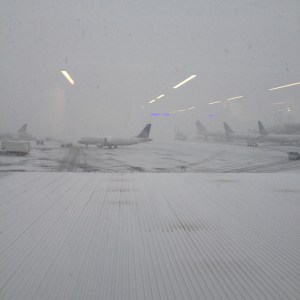
Although I was not looking forward to the long, late flight home scheduled for tonight, I can’t help but think there was something almost prophetic in the weather that prevented my trip.  I awoke in Newark only to confirm with many other stranded passengers that this was not a lot of snow.  I’ve had to commute into New York when much higher amounts were in the forecast.  Many of us, meteorologists included, were asking why this storm was so devastating to travel.  Part of the answer comes down to belief.  Nobody believed we could have this kind of nor’easter in November.  Even now nobody seems to want to discuss the elephant in the igloo.  Global warming, we’ve known for decades, will make erratic weather patterns.  We need to think about weather differently than we have before.

One of the motivations behind writing Weathering the Psalms was that for all of our technology, we still don’t understand, or appreciate, the weather.  Driven by dollars in great collectives, businesses are reluctant to allow employees a “day off,” even when many of them have work laptops at home.  We believe in money, supposing the weather to be only a minor nuisance.  Having bought a house, though, has revealed something to me.  Home and hearth are all about staying safe from the weather.  (Well, and in keeping out wild animals too, but we’ll just drive them extinct.)  A house is a place to keep the water and wind out.  We want to keep dry and to prevent the wind from chasing away our body heat.  Homes are our places to keep the weather outside because we instinctively fear it.  Reverence it.  Weather may well be the origins of at least some religious thought.

Ancient peoples and modern religious fundamentalists believe(d) in gods literally in the sky.  They looked up when wanting to understand matters beyond their control.  Yes, predators attacked, but you could fight back.  Against the sky there’s no recourse.   Weather can kill, and can do so in many ways.  Building shelter helps, but we’ve all seen enough hurricane footage to know that even our structures are subject to the wind.  Computer models were suggesting that this storm might have been pulling back for a real roundhouse punch but our conservative views on the weather (such things don’t happen in November, right, Edmund Fitzgerald?) prevail.  The official stance of our current government is this is all a myth anyway.  It’s only when myths interfere with money that we start to pay attention.


Last Call

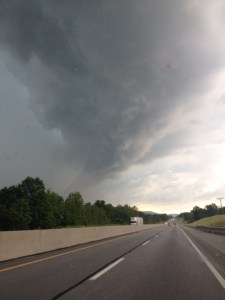
The alarm that wakes you in the middle of the night.  There’s something primal, something visceral about that.  We humans, at least since our ancestors climbed down from the trees, have felt vulnerable at night.  If our sleep is constantly interrupted we don’t think clearly.  We build secure houses. Lock our windows and doors at night.  Say our prayers before we go to sleep.  Last night I discovered that the homeowner has even greater concerns than the humble renter.  While 11:30 may not be the middle of the night for some, for early risers it is.  And there’s nothing to strike terror into the heart of a homeowner like a tornado warning.  Especially here—our realtor laconically told us that they never have tornadoes in eastern Pennsylvania.  The weather warning system disagreed with him last night.

Getting up as early as I do, first light is hours away.  Hours before I might check for damage with the light of old Sol.  My wife had to work, no less, at a venue some distance away and we both had to rise early and wonder what the damage might be.  We knew, of course, that the pointless ritual of changing our clocks would occur tonight, but that does alleviate concerns about whether the roof was still on the house or not.  You can’t take anything for granted, not even the continuity of time.  Thus my thoughts returned to Weathering the Psalms.

Severe weather led to that book.  If I were to rewrite it now it would come out quite differently, of course.  No one would write the same book the same way after a decade and a half.  Still, there may have been some things I got right in it.  The weather is a cause of awe and fear.  The sound of the wind roaring last night was impressively terrifying, even in a technological world.  Especially in a technological world that relies on an unwavering power grid and constant connectivity.  In the midst of a wakeful night, alone with thoughts too haunting for the day, the weather has a power with which we’re foolish to trifle.  Global warming is a myth if it gets in the way of profits.  Then darkness falls and we realize just how very small we are.  In the light of dawn, the damage was not too bad.  A frightened car meeping its mewling alert.  And a strange justification that perhaps my book contained some truth after all.


Keypad of Heaven

There are those who celebrate technology, and those who mourn it.  I fall somewhere in the middle.  One of the selling points for our house was keyless entry.  The great thing about it is you never have to worry about forgetting your keys.  The bad thing is that batteries don’t like cold weather.  The former owners of our house seem to have had it even less together than we do,  They had no instructions or emergency keys for these electronic locks.  So it would happen on a cold, blustery weekend morning we would find ourselves locked out of our most expensive possession.  Now, you have to understand that this “well-maintained” house—so claimed by the not-inexpensive inspector—has turned into a money pit.  The list of derelict pieces and appliances grows weekly and we haven’t even paid off the roof yet.  Emergency locksmiths, I now know, earn their keep.

As I stood on the porch in the gusting wind, waiting in a thin jacket (we were not out for a long trip) for someone I would pay handsomely to break into my house, I considered technology.  If you can afford to keep up with it, it must be great.  If, say, electronic keypads were solar, wired to panels on the roof so that the batteries never died, that would be fantastic.  Even a key would be an advance on a day like this.  So once our teeth stopped chattering and we added yet another creditor to our growing list, I thought how that very morning my computer told me it needed a systems upgrade.  “Didn’t you just have one?” I asked, almost out loud.  I know what it is to be a servant.  My thoughts wandered, as they frequently do, to The Matrix.  When the machines take over, their problem is battery power.  Since we scorched the sky, they began using us as wet cells.  

Later in the day, for cheap entertainment, we went to a local parade.  Among the many vehicles on display were old cars and tractors.  Tractors that even I might have a chance of understanding because they were merely open engines on a frame with seats and large wheels.  This was technology that fed people rather than preventing them from entering their houses.  I couldn’t help but notice that they started with keys.  There’s a reason that the key has always been a potent symbol.  Its simple technology leads to hidden wonders.  And on a cold morning those hidden wonders might well include your own house.

“Now, put these where you won’t lose them!”


Animal Rains

We may have been to the moon—if not personally, collectively—but we still don’t control the weather down here.  It’s probably not news that the eastern part of the country has been getting a lot of rain lately.  One of the factors that led me to write Weathering the Psalms was the overwhelming tendency for humans to attribute weather to the divine.  It used to be that we couldn’t reach the sky, so placing deities there seemed a safe bet.  Now that we’ve shot through the thin membrane of atmosphere that swaddles our planet, we’ve discovered beyond a cold, dark space liberally sprinkled with stars and planets but mostly full of dark matter.  The deity we thought lived beyond the sky somehow wasn’t anywhere our probes flew and recorded.

Still, down here on the surface, we live with the realities of weather and still think of it in terms of punishment and pleasure.  When we don’t get enough rain, God is destroying us with drought.  Too much rain, and the Almighty is washing us away with flood.  The true variable in all of this is, obviously, human perception.  Sure, animals experience the weather too, and they sometimes look to be as disgusted as humans when it snows too early or too late, or when the rain just won’t stop.  I have to wonder if somewhere in their animals brains there’s the seed of an idea that the bird, or squirrel, or woodchuck in the sky is angry at them for some unspecified faunal sin.

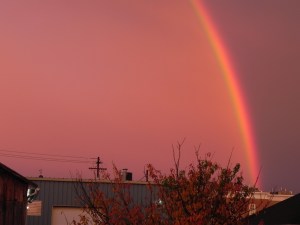
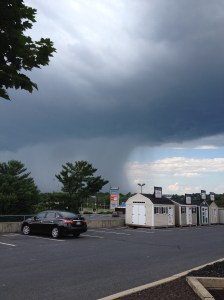
While heading to the store yesterday, after weather reports assured us the rain was finally over for the day, the skies told a different story.  The vistas around here are never what they were in the midwest—or what they are in Big Sky country—but the approaching storm was pretty obvious.  An opaque drapery of precipitation was coming our way and although a rainbow would cheekily show up afterward, knowing that we’d been caught away from home with our windows open felt like punishment for something.  Perhaps the hubris of buying a house when all I really require is a corner in which to write.  Somewhere in my reptilian brain I translated a natural event into a supernatural one.  When we got home to discover the storm had gone north of us, it felt like redemption.  I spied the birds sheltering in shadows from the sun’s heat.  Were they thinking it was some kind of divine avian displeasure, and hoping for some rain to cool things off for a bit?  If so, was our religion correct, or was theirs?


Prelude to Chaos

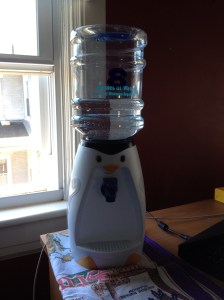
Liquids are the enemy.  Don’t let the cuteness of this little guy fool you—there’s collusion here.  For as well as creating life, and being necessary to sustain it, water destroys.  Creator, annihilator.  We moved during a time when neither of us had vacation and we told the over-tired movers that it was okay to put our boxes in the garage.  We planned to move them soon, but, you know, work.  Then the rains came.  Not just sprinkles, but downpours.  The garage isn’t water-tight.  Boxes were soaked.  Many books were damaged.  This wasn’t a flood that can be claimed on insurance, it was simply rain pooling where people usually park their (normally waterproof) cars.  In their place sat our books.

We both worked the day after the rains.  When we discovered the damage the next evening, it looked manageable.  I had to work the next day, of course, and a few breaks sufficed to get the many, many boxes of damaged books out into the sun.  It was carnage.  We don’t have much in the way of material goods; we spend a bit of money on books, however.  Now they’ve become the victims laid out on this altar of home ownership which, at the time, seemed like a good idea.  We needed a house for our books.  We needed time to move them from the garage to the house.  Yes, old friend Morpheus, “Time is always against us.”  

Job sat upon his ash-heap and pondered why he’d paid the movers so much only to have his moved goods destroyed.  And in a manner in which insurance assessors are trained to point to the fine print.  Those who store their goods in the garage reap the wrath of liquid.  You see, when water reaches cardboard, or paper, the wood pulp sucks it up.  Carefully dried, the paper remembers the compelling nature of water.  Too little, and you die.  Too much, and you die.  No wonder the ancients thought that water was a deity.  It claims all—tries to get in through your roof.  Lays insouciantly on your basement floor.  And the garage—yes, who thought of the garage when the immediate concern was to shut the windows to keep Leviathan out of the house?  I spent weeks carefully packing those books against shipping damage.  Used up my vacation days doing so.  Chaos has claimed them.  I would weep, but that would be collusion with the enemy, even if nobody sees.


Melting Psalmists

With weather like this, I could use a Psalm or two.  Of course, in my mind, weather and Psalms are closely connected.  Here in the mid-Atlantic states, we’ve been experiencing a heat wave.  Unlike many parts of the west, such heat here in the east is accompanied by very moist air, meaning that cooling down is only possible in a large body of water or air conditioned interiors.  We have neither readily available at our place, so we try our best to keep cool and compose psalms, mostly imprecatory, I fear, about the weather.  Although it was thunderstorms that stirred my interest to write Weathering the Psalms, I included a chapter about temperature, for the Psalter sings of hot and cold as well as lightning and thunder.

The world of ancient Israel was quite different from that of North America.  There are mainly two seasons in the Levant—dry and rainy.  The dry season isn’t always as hot as we tend to imagine it, although the day I visited Masada the air temperature was about 120 degrees.  Enough to make a dip in the Dead Sea look inviting.  The Bible often views high heat as a form of divine punishment.  Although we human beings have expanded to fill just about every ecosystem our planet has to offer, we thrive in central California conditions.  Not all of us can live there, however.  And it’s a good thing that global warming’s a myth since it’s awfully hard to function when it is over 90 degrees for days in a row.  WWDD?  What would David draft?  Perhaps, “I’m melting”?

The interesting thing about the global warming myth is how real it feels.  I suppose the solution is to use more fossil fuels to help keep cool.  Fans, arctic air conditioning, lingering languidly at the open freezer door.  I stand here sweating, wondering what the Almighty could possibly find wrong with a country that is now great again.  One that takes children from their mothers yet insists birth control is evil.  One that loudly and punishingly insists guns should be in every home.  One where the elected head of government is involved in over 3,500 lawsuits, yet gets to appoint justices in the Supreme Court.  David got caught, if not in flagrante delicto, at least within a couple months of adultery with Bathsheba.  Instead of paying her off, he had her husband murdered.  But then—and here’s the key difference—he humbled himself and repented.  The sweet Psalmist of Israel might yet have something to teach us yet about weather and the Psalter.  Until the United States becomes the chosen nation again, I think a cold shower will have to do.


Rains and Bows

It’s raining and I’m here for an outdoor event. Here, in this case, is Ithaca, New York. The event is the parade that’s an integral part of the Ithaca Festival. As people have been laying out their chairs and blankets along the route since morning, it’s a fair guess that if we don’t stake out our few feet of available public space we’ll miss the parade. And yes, it will rain on my parade. The problem is waiting in the rain. With one hand holding an umbrella and water getting in anyway like a leaky roof, there’s only so much you can do. Reading a book—my default activity—is out of the question. I know very few people here and since I’m acting as a placeholder, there’s nobody to talk to. Tom Petty was right after all.

The parade itself turned out to be a celebration of diversity. Ithaca is what America could be. The various liberal organizations, eager to educate, marched by to cheers and bonhomie. There’s nobody judging here. This became clear in a particularly striking juxtaposition (for which I have no photos, because it was raining) in the parade lineup. A group of Mad Max-themed metal rockers went by in a gnarly truck decorated with torches protruding from fake human skulls. Dressed in future period costumes from the movie diegesis, they produced the guttural, primal roar that is an accusation against current society. Then, like Mel Gibson shifting to The Passion of the Christ, the group immediately behind was a Bible Baptist Church. Add water and mix.

For this I’d sat in the rain for a couple of hours. Forced to relax, I watched the water on the fabric over my head as beads crawled together, joined one another, and scurried, animal-like, from the umbrella to the ground. The drops may look uniform from a distance, but they’re diverse. They come in different sizes, and perhaps because of the distorting character of the nylon, they took different shapes. Placed together in one location, it was natural, it seemed, for them to come together for a common goal, which was the ground. There was a parable playing out here right over my head. While it didn’t seem to be the case at the time, it clearly was a lesson to be shared. Had it been sunny, I would’ve been reading a book. Sometimes it takes sitting in the rain to learn something that should be obvious no matter what the weather.


Odd One Out

The older I get, the more I realize I’m the one that’s weird. Go ahead and say it, “You’re just now figuring this out?!” This epiphany came to me on a stiff breeze. To understand you have to get the idea of commuting on New Jersey Transit. Although twice in one week my route was blessed with a brand new bus, the general operating procedure is to use the oldest, least reliable buses on my route. It is one of the longest routes the company runs into New York City, which means that it is one of the most expensive. You’d think they’d use their best buses, but then you’d be thinking like me. Breakdowns aren’t as frequent as they had been for a while, but other discomforts are fairly common. Just this past week, for instance the heat was stuck on high. Add about 50 bodies to an enclosed, overheated space, and well, let your imagination go.

Now interstate buses aren’t like the school species. The windows don’t open. There are, however, two escape hatches in the ceiling. When I got on board I noticed immediately that it was a sauna bus. The last time this happened (and yes, this wasn’t a unique situation in my experience) passengers opened the escape hatches to create a breeze. Problem was, it was winter this time. The day was struggling to reach 40 degrees outside. As we hit the highway the wind was blowing full against those in my row and I learned what wind chill really can be. There wasn’t much traffic, so the bus was tooling along at about 65. I could feel my left eye beginning to freeze up. My book pages were flapping wildly in my blue-tipped fingers. The personal nor’easter cut right through my winter coat. In my row we were lined up like eskimos, all bundled up. There were no free seats to which we might move. I couldn’t reach the hatch to close it. Nobody said anything.

Here’s where the weirdness comes in. As I child I was raised being taught that true believers think of others first. Other people may not see it, but I consciously try very hard in subtle ways to make sure others get what they need before me. I’m learning not everyone necessarily thinks that way. If I had a degree in fluid dynamics I might be able to describe airflow on a speeding bus. Instead, let me put it this way: the guy who opened the hatch was sitting in the row in front of it, out of harm’s way. The icy blast didn’t hit him, but it did everyone behind him. Passengers tend to think of themselves first. I’m sure I do, too. Just trying to get home after a trying day of work is, well, trying. It’s just that some folks try not to do things that cause others pneumonia, no matter how warm they feel. But then, I’m the odd one, I know.


Sky Mercies

While in a used bookstore recently, I was going over the science titles. I like to read accessible science since I often find it approaches religious ideas in secular terms. Once in a while even the terms of these disparate disciplines coalesce. I spied a volume on the top shelf titled The Mercy of the Sky. The spine showed a purplish cloud-bank, and the very concept set me wondering. We’d just been through a bomb cyclone the day before with wind bellowing through our apartment. Many trees were down and power was out for several people I’d overheard talking that day. I stared at the spine, thinking perhaps this would be a good follow-up to Weathering the Psalms, but as I already had books in my hands, and since I’m not the tallest guy around, it seemed beyond my reach. Of course, after I left I thought more about it.

The previous day’s nor’easter had revived that sense of a storm as divine anger. Strong winds, my wife commented, are generally disturbing. They make it difficult to sleep. It’s hard to feel secure when the heavens are anything but merciful. Although the wind is easily forgotten, it’s among the most easily anthropomorphized of natural phenomena. And it’s ubiquitous. Everything on the surface of the earth is subject to it. Indeed, the atmosphere is larger than the planet itself. Is it any wonder that God has always been conceptualized as in the sky? The quality of the mercy of the sky, we might say, is strained.

Danger comes from the earth below us, the world around us, and the realm above. Like our ancient ancestors staring wonderingly into the sky, it is the last of these that’s most to be feared. The wind can’t been seen, but it can be felt. It cuts us with icy chills, drenches us with dismal rain, even flings us violently about when its anger compresses it into a tight whirl. We can’t control it. Unlike other predators it requires neither sleep to refresh nor light to see. Its rage is blind and it takes no human goodness or evil into account. After a great windstorm, the calm indeed feels like a mercy. Elijah on Mount Sinai stood before a mighty wind, tearing the land apart. It was the still, small voice, however, that captures his imagination. There’s a calm before the storm, but it is the stillness in its wake that most feels like the mercy of the sky.