
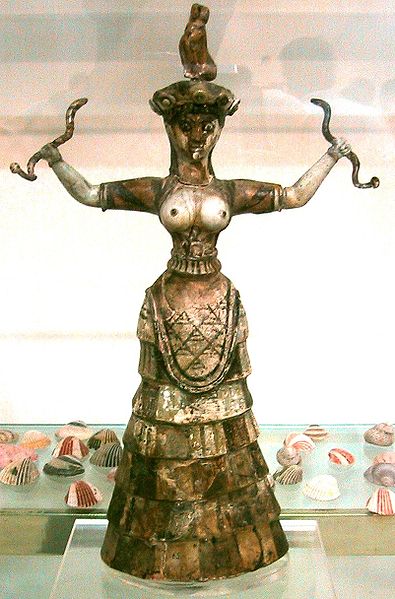
In the course of preparing to teach a course on Classical Mythology, I have been reading up on the Minoan culture of ancient Crete. This fascinating civilization is obviously related to many others in the Ancient Near East, but it has such a distinctive ethos that it always gives me pause. The Minoans had a religion that was apparently dominated by a great mother-goddess. Decades ago astute archaeologists and historians demonstrated that the amorphous “mother goddess” of antiquity was a modern construct rather than an ancient reality, but the evidence still stands that at least the Minoans revered the sacred feminine.
The work of Marija Gimbutas had overstated the case for a matriarchal society in antiquity, but she had touched on a truth sometimes obscured by the patriarchal world of yesteryear — some cultures did venerate the divine mother. Among the cruel ironies of history the name of this goddess has been lost, but images of a secure island with its chthonian female divinities remain. Among the artifacts discovered among the various Philistine sites in the Levant was an inscription, apparently dedicated to Asherah. Asherah is a thoroughly Semitic deity, first appearing in Mesopotamian contexts further to the east. The Philistines, however, likely settled their region after migrating from Crete a few centuries after the collapse of the Minoan culture. Could they have brought with them a remembrance of the divine mother?
I am not convinced by arguments that suggest a polymorphous “mother goddess” reigned in antiquity, as much as I might wish it had been so. What a different world might have emerged if monotheism had been based on a divine mother! Minoan culture appears to have been strong but relatively peaceful. In one of the androcentric twists of history “Cretan” and “Philistine” have come into modern usage as derogatory slurs against good taste and refinement. History demonstrates, however, that apart from foreign biases those hailing from ancient Crete may have developed the superior civilization of antiquity.


4 thoughts on “Our Mother Who Aren’t in Heaven”