
Religion is all about emotion. Those who approach religions rationally soon have to face the fact that believers approach the subject with a less-than-rational motivation. Religion fulfills basic psychological needs – we can explain our world without divine forces, but for many this cold and clinical approach lacks vitality and meaning. Belief in the divine is emotionally satisfying, and as long as humans experience emotion, God’s job is safe.
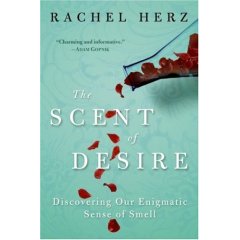
Aware of this emotional component, I was intrigued when I heard about Rachel Herz’s book, The Scent of Desire: Discovering Our Enigmatic Sense of Smell. It is schoolyard wisdom that smells are closely associated with memory; everyone I’ve asked about this has had the experience of a firm memory being mediated by an unexpected aroma. What Herz has discovered, however, is that our sense of smell evokes memory just about as well as other sensory cues. The vital difference is that our sense of smell is vital for emotional development. The fragrance-induced memory is more fraught with emotion, therefore it may seem more intense that memories brought on by old photos or songs. In fact, those who lose their sense of smell often report living with emotional flatness. Laboratory animals with their olfactory organs removed show no motivation in their pathetic lives.
Considering the emotional component of religion and the fact that our olfactory perceptions are closely linked with our limbic systems, I wonder how religious satisfaction smells. Surely emotion is more complex than what our noses detect, but if emotional systems are shut down without a sense of smell, it stands to reason that religion must be related, at least in some form, to smell. The presence of the divine is often described as “inspiration” or inhaling. In Hebrew and other Semitic languages the world for “spirit” is also “breath.” Although Herz doesn’t discuss this aspect of scentology in her book, it would be an avenue to investigate for those with an interest in the origin of religion and the aroma of the divine.
 Steve A. Wiggins
9 thoughts on “Aroma of the Divine”