
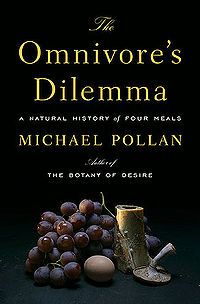
 Michael Pollan’s The Omnivore’s Dilemma has been on my “to read” pile for some time. I finally finished with it this week. As a vegetarian, I really didn’t need convincing that raising other beings with feelings and some intelligence for the purpose of eating them involves dilemmas. Pollan is not a vegetarian and makes the best case I’ve ever read for justifying his position. Still, I personally can’t face being the reason animals must die for my own gain. I know this is a stance fraught with difficulties. I’ve often mused that if I could get by without even eating plants, I would. I just hate to inconvenience anyone, or anything, else. But that’s not what I want to discuss. Pollan spends the first part of his book discussing corn, or maize. I hadn’t realized what a versatile crop it is, nor how prolific. The difficulty is that it is so good at what it does that it is bankrupting the farming industry. Government subsidies make corn growing the only way that big farmers can get ahead while nearly driving them broke at the same time. (It takes Pollan chapters to explain this, so I’ll need to refer you to the source on this one.) His conclusion: the free market simply does not work for food production.
I’ve long believed that the problems with our economy come from a decidedly “one size fits all” mentality. The free market rewards those who climb over others without that gnawing sense of guilt that prevents me from eating meat. Once you have lots, you only want more. No one ends up satisfied. Okay, so we’ll let Wall Street play its game. Higher education is in crisis because, like farming, the free market model simply does not apply. Guys like me (and plenty of gals too) do not spend years of our lives earning doctorates under the delusion that we’ll get rich. Many of us are idealists who just won’t grow up. All we want is to contribute to the collective knowledge of the human race and make a reasonable living doing it. Then the free market comes and whispers into university presidents’ ears that they should be making six or seven figure salaries. They should have limitless expense accounts. Universities should be all about “branding” with corporate style logos and money-sieves called sports teams. Somewhere along the way they forgot that they need teachers too. Some very prominent universities in the United States now have 70 percent of their classes taught by adjuncts. The system is simply not working.
One of the strangest anomalies out of all of this is that Christianity, the religion started by a guy who said the rich could not enter heaven unless they gave everything away, has crawled into bed with the free market. Enthusiastically. For many people to vote with conscience is to vote for an inherently unfair system that must, by its very design, consume all others. Survival of the fattest. I’m no economist, but I am certain that many other industries have gone the way of the T-rex because they simply didn’t fit the model of unbridled gain. Education is one, and the asteroid is already about to hit. What bothers me the most is that agriculture is another. Pollan ended up scaring me more than any horror flick. Our farming industry, right here in the best fed country on earth, is very, very frail. As long as we’re converting everything to the greed-based system, we should make money edible. After the asteroid strikes, during that long, dim winter, it will be the only thing left on the planet in abundance.
 Steve A. Wiggins
4 thoughts on “Eat, Love, Eat”