
Stereotypes are so easy to fall into. Having been “typecast” myself, early in my career as a “seminary professor” and a “conservative”—neither of which matched my mental outlook at all—I eventually had to abandon higher education as a career option. Why did I take a job that didn’t fit? If you’re asking that question, obviously you missed the 1990s. It was a brutal time to be looking for a job; there was this recession… wait a minute. What decade was I writing about again? In any case, many people will always remember me in the various roles I’ve played as I sought to actualize my ideal career. It is always interesting to see how others break out of their expected roles into new venues. Penn Jillette of Penn & Teller has established a reputation for speaking his mind. To those with limited experience, such as myself, he is stereotyped as a “magician,” more specifically, a “bad boy magician” who gives away the secrets of the guild. To find out that he is a writer was a kind of epiphany.
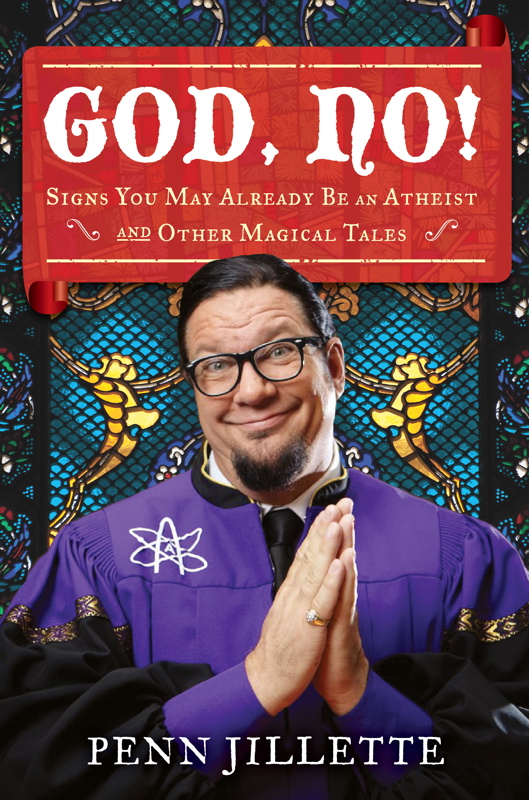 I read his new memoir/confession, God, No! this past week. I’ve always been cognizant of the strangeness of a world where someone may speak authoritatively on the basis of star status, but Americans love their performers. I’ve enjoyed the Penn & Teller acts I’ve seen on television, and after reading Penn’s book, I think I would like him in person. I can’t agree with him much of the time, but his honesty and good moral sense are very winning. I seriously cannot remember the last time I read a book that made me snort out loud with laughter or try to sink even lower on public transit so the polite person sitting next to me would not be able to see all the profanity on the pages before me. The book itself very loosely follows the Ten Commandments, which, surprisingly, the author largely agrees with in principle. The essays are all over the place, but the libertarian spirit is difficult not to admire. His appreciation of rational explanations for the world is admirable.
Probably the most difficult point of agreement for me, however, is his definition of an atheist as anyone who do not know if God exists. He does have a chapter lambasting agnostics, but as a stickler (as much as anyone in religious studies can be a stickler about anything) for definitions, it is useful to distinguish atheism and agnosticism. Saying one does not know is not the same as declaring one is certain. Since the existence of God can be neither proven nor disproven, those who say God does not exist believe that assertion. Those who say God exists also believe their assertion. Objective knowledge, in our current state, is not possible. I had to agree, in the final chapter, that faith causes most of the problems we find associated with religion, but I’m afraid faith is a huge part of the human condition. God, No! is not for everyone. Those who read it will, nevertheless, find an author as convinced as any evangelist that he’s right. And if they are honest, they will have to admit to having laughed along the way.
 Steve A. Wiggins
2 thoughts on “Who’s to Say?”