
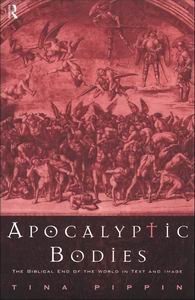
We are all products of our upbringing. Our early assumptions, although sometimes challenged and overcome, are generally with us for life. So it was that my progression of education led me to a small, conservative college to major in religion. Compared to what I learned at Grove City, the historical criticism firmly in place at Boston University sounded downright sinful. Nevertheless, it made sense, so I followed reason. At Edinburgh we were way beyond historical criticism in that wonderful, European way. Somehow in the midst of all the excitement, I missed Post-Modernism. “Po-Mo” has, like most recent movements, been quickly added to the pile of the passé, but I find it refreshing. I just finished reading Tina Pippin’s Apocalyptic Bodies (Routledge, 1999). This may have been one of the first truly Post-Modern biblical critiques I have read, and it was fascinating. Pippin is taking on especially the book of Revelation. If more people had read her book there would have been less panic back around May 21.
I find feminine readings of the Bible enlightening. As a member of the gender largely responsible for a book filled with sex and violence, it is often difficult to see how the other half of the human race might read that same text. Having grown up with a literal understanding of Revelation, I never questioned whether it was a good or a bad thing. The end of the world must be God’s will, therefore, by definition, good. One of the beauties of a Post-Modern interpretation is that everything is thrown open to question. Pippin does just that. Noting the ennui associated with eternity, she asks a question that always lurked in my mind—isn’t too much of anything eventually a problem? Eternity itself becomes problematic. Where do we go from here?
Perhaps the most striking comment Pippin makes is in the context of her chapter on the monsters of the apocalypse, “Apocalyptic Horror.” She compares Revelation to horror movies and demonstrates how all the elements are there in the Bible. She notes, “There are many monsters in the Apocalypse, but the real bad ass monster sits on the heavenly throne.” Pippin explains that God, in Revelation, joys in killing off humankind. As many of us have come to learn, people are generally good; at least most people have done nothing to deserve the heinous punishments gleefully doled out in Revelation. That, of course, raises the sticky question of ethics as applied to the divine. Here the book of Job comes to mind where our hapless hero declares that even though he is innocent, God still can count him guilty. It is the human situation. And Job was a good guy. Pippin’s little book challenged many of the assumptions with which I’d grown. Anyone who can read such a book and not worry about being a good parent is more Po-Mo than me.
 Steve A. Wiggins
Pingback: November Biblical Studies Carnival: The Undead Edition « The Musings of Thomas Verenna